Undone and Dusted: The Long Art of Christopher Williams

โ€œGlory be to God for dappled things,โ€ Gerard Manley Hopkins famously exclaimedโ€”in a poem, no less, that was first published some three decades after his death. The delayed recognition he received makes us now think of Hopkins as a modern poet rather than a Victorian one. Brought to light in the darkest of days, his words spoke to an inglorious post-World War world so different from the perfectly imperfect one he knew that he could hardly have anticipated it. And yet, anticipate us he didโ€”and “[a]ll things counter, original, spare, strange.” Secure in his belief in the One “whose beauty is past change,” Hopkins could revel in all that is “fickle, freckled (who knows how?),” in a life that is protean, fleeting and undoneโ€”the ever unfinished and often dirty business of living reconciled to our longing for perfection, permanence, and the eternal.

ย 

โ€œGlory,โ€ I wanted to shout, for dusty things, for art so long that no one in a single lifespan can ever be done with itโ€”and for a chance to dust off works neglected and ignored to bring them to life anew. Not because they are perfect, not because they are classic or timelessโ€”but because, in all their sketchiness, patchiness and almost-but-not-quiteness, they remind usโ€”and glorifyโ€”the long and short of life: the clouds on the horizon, the waves hitting the rocks, the light of the ever setting sun on ancient mountains.

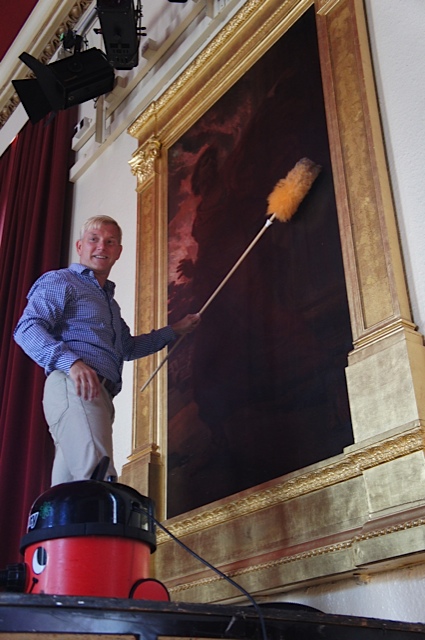
I was too busy tackling the dust (and keeping my mouth shut not to take it in) to wax philosophical and shout thenโ€”but I do think and feel it now when I look at some of the smaller canvases of Christopher Williams (1873-1934), a once well known artist, and native of Wales, whose forgotten and, in many cases, never before exhibited works I had a small part in putting back on public display here at the National Library of Wales in Aberystwyth.

Far more than Williamsโ€™s monumental paintings of momentous historical, mythological, and biblical themes, which belong to an age fast fading in his day, what is glorious to me are his studies of sea, sky, and rockโ€”of the mutable majesty, the perennial transience of nature that he sought to encapsulate while working against time: the dying light of day, the waves against unwavering cliffs, the clash of the evanescent with the apparently everlasting.ย 

A few years ago, when I knew little of Wales and less of Williams, I visited one of the spots along the coast he had painted and compared what I saw to what he had depicted. The rocks were the same all right, but the sea and the sky looked nothing like the painting. Had he painted what he wanted to see, wanted us to see, or remembered seeing? Years later, when I returned to the same scene, the sea was turquoise, the sky ceruleanโ€”it was as Williams had pictured it. Only then did I appreciate the long hours he must have spent studying the light and the colors it creates. What was before him was fleetingโ€”what is before us is unfinishedโ€”but what his quick brush transported one hundred years into his future is the product of a study far from cursory. Perhaps it takes a knowledge of the presence of something past change to see past the unchanging and glory in the changeable.

And there they are now, on view for a short while (until 22 September 2012), these past glimpses of change, these small studies alongside his finishedโ€”staid, staged and statelyโ€”compositions I helped to ready for the big show. Not that the project is done and dusted, as, together with my partner, Robert Meyrick, the curator of the present retrospective, I shall be co-authoring a book on the artist’s life and work . . .
Stiff Competition: A Hairspray to Defy the West End Elements

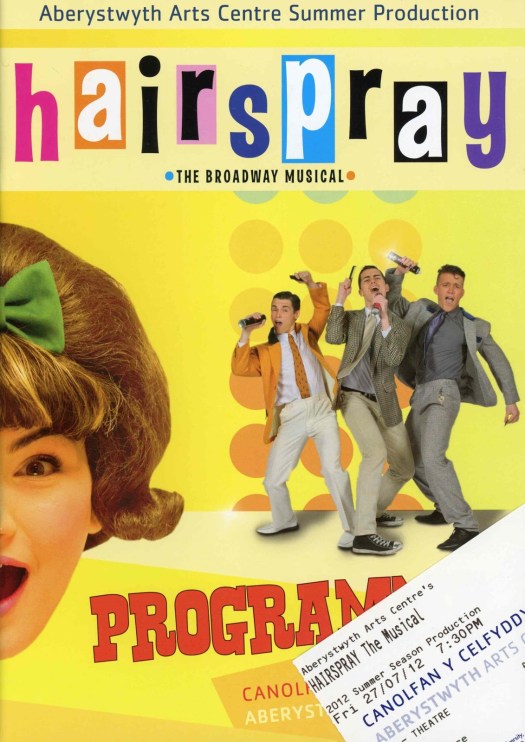
Funny thing about prejudice: if you let it take hold, it can deprive you and those around you of a real good time.ย  That, in a shiny Aqua Net shell, is the message of Hairspray, the musical.ย  And, boy, did I deprive myself . . . until now.ย  Sure, others around me still had that good time, but when Hairspray hit Broadway back in 2002, I was as set as an untamed cowlick. ย I would have none of it. My Aqua Net days were long behind me by then, and I was not going to splash out on a rehash of a late-1980s cult comedy about early 1960s culture-clashing teenagers, told in songs that a Porter and Gershwin kind of guy like me is not inclined to hum while wearing a shower cap. Well, Kiss my Kate! Last Friday, I finally woke up and smelled the coiffing.ย  “Good morning, Baltimore!” Andโ€”oh, never mind โ€œbeautifulโ€โ€”what a colorful morning it is.

Funny thing, too, that I only had to travel about half a mile to learn that musical lesson; no subway ride down to 42nd Street, no walk through Londonโ€™s West End via Leicester Square (and TKTS).  Just up the hill, to Aberystwyth Arts Centre, where each summer a musical is staged that, as a tourist attraction, is far more reliable than our windswept seaside.  Over the years, I have seen eight of those summer seasons come and go, from Oliver! to Chess.  Boasting a cast whose list of combined Broadway and West End credits is way longer than I am in the tooth, this yearโ€™s production tops them all.

Its readily translatable story of teenage rebellion aside, Hairspray may not be the easiest piece of Americana to transplant to Wales.  Never mind references to Allen Funt, Jackie Gleason, and the Gabors, names not likely to ring for todayโ€™s young, British audiences the bells I and Tracy Turnblad can hear.  The Director’s Note in the program about Rosa Parks, whose image flashes on a big screen during one of the numbers, fills in some of the blanks.  This, after all, is American history, no matter how much John Waters it down.

Then again, it may not be the easiest thing, either, to translate the Civil Rights Movement into a musical riot without becoming as crude or politically incorrect as John Waters used to be.  But, whatever your own sense of otherness and experience of xenophobia might beโ€”and โ€œI Know Where Iโ€™ve Beenโ€โ€”Hairspray gives you enough of a whiff of those ill winds to make you investigate whence they blow.  โ€œRun and Tell Thatโ€: if any production can communicate a shakeup without making anger the primary colour of the emotional rainbow, Unholy Waters! this can can.

You might expectโ€”and forgive, tooโ€”any glitches or leftover curlers on opening night; but there were none here: upon pulling the lid, this Hairspraywas as solid as a freshly lacquered beehive.  Andrew Agnew is marvelous as Edna Turnblad, a part I identified so much with the fabulous Divine that I couldnโ€™t face watching John Travolta in a latex mask.  Agnew makes you forget bothโ€”and he plays Edna in such an understated way that her big number โ€œ(Youโ€™re) Timeless to Meโ€ makes you understand what, to someone of my certain age, is the warm heart of this show.  Itโ€™s a heart whose Beat youโ€™d canโ€™t stop without making Hairspray lose its maximum hold.

Edna might have missed every boat except the one she pours the gravy from; but she is not too old to kissโ€”and kickโ€”the past goodbye and say โ€œWelcome to the 60โ€™s.โ€  This transition requires more than a new do or a swift costume change; and Agnew achieves it by centering Edna in the 1950s, a woman who loves Lucy though she might not like Ikeโ€”and who not only loves Tracy from the remove of a generational gap but gets her, too.

Tracy, of course, is her daughterโ€”the embodiment of that new ageโ€”and Jenny Oโ€™Leary inhabits the role with the confidence and youthful energy for which it calls.  Tracy may not quite grasp just how seismic the event is in which she plays her part, an eventโ€”this much she knowsโ€”far bigger than “Negro Night” on the Corny Collins Show; but she approaches integration with the I-donโ€™t-get-it naivety that has many of todayโ€™s youngsters baffled at their parentโ€™s definition of marriage as a strictly segregated affair.

Hairspray leaves no doubt as to who โ€œThe Nicest Kids in Townโ€ are; โ€œniceโ€ simply ainโ€™t.  It is self-serving conventionality, a meanness of spirit that lingers under the neat surface like something you fight with lice shampoo.  How else to approach โ€œMiss Baltimore Crabs,โ€ Velma Von Tussle, a nasty piece of work done justice by Lori Haley Foxโ€”and done in by the sheer force of Motormouth Maybelle, a woman who, like Edna, has seen better days, but whose better days were lived in times much worse.  

Marion Campbell, who plays Maybelle, comes on stage late to belt out her showstopper of a numberโ€”and her presence hits you like, say, Mahalia Jacksonโ€™s in Imitation of Life: a voice to be reckoned with, especially in a fight for equality.

Though the actress playing Tracy Turnblad receives top billing, it would be wrong to call the rest of the cast โ€œsupporting.โ€  Hairspray demands a great many good voices as it gives most of its characters the chance and challenge to shine, and everyone in this cast is living up to that challenge: Arun Blair Mangat as Seaweed, Samantha Giffard a Penny Pingleton, Morgan Crowley as Wilbur Turnblad, Hugo Harold-Harrison as Corny Collins . . .

The list is longer than thatโ€”but I’d be bald by the time I were done honor roll calling.  Besides, if I’m counting anything it’s the days until my next trip to the salon for another hit of Hairspray. Yes, funny thing about prejudice: once confronted, it can yield such eye-opening, ear-popping surprises.

So, toodle-oo to stiff upper lip! Stiff up yer quiff instead.

Face Value?

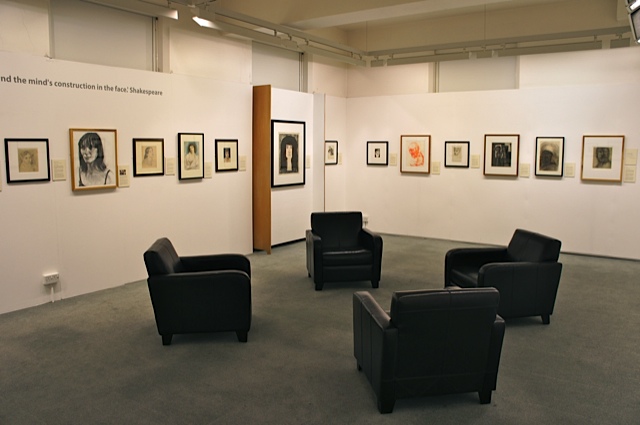
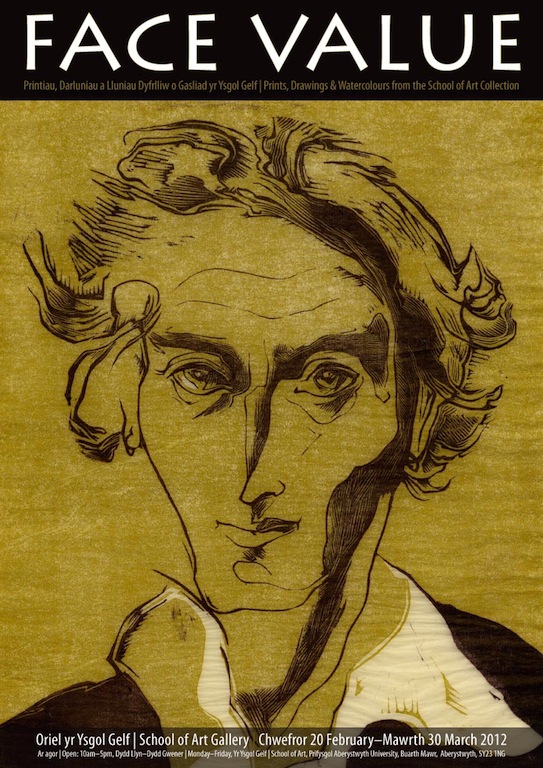
Time to mingle with the visitors, to watch them stand back, take in the artworkโ€”and read those captions. During the past few months, I have been involved in putting together an art exhibition at the local university. It all started last October. I was given the opportunity to teach an undergraduate course in writing informative and interpretive texts for museums: labels, text panels, promotional material. The class was designed as a workshop. So, rather than just theorizing about such matters as readability and legibility or analyzing prose styles and target audiences, my students and I were faced with the challenge of curating a show.

That show, Face Value, is on display and open to the public until 30 March 2012 at the School of Art, Aberystwyth. ย  It features works on paper (watercolors, etchings, drawings) by artists as diverse as cover girl Gertrude Hermes, Edward Burne-Jones, Fernand Lรฉger, Dante Gabriel Rossetti, Simeon Solomon, William Strang, Stuart Pearson Wright, and Keith Vaughan. ย Here is the introductory panel greeting guests at the private view tonight:

โ€˜It is only at the first encounter that a face makes its full impression on us,โ€™ the philosopher Arthur Schopenhauer once remarked. Face Value encourages such chance encounters.  Many of these works on paper from the School of Art collection are presented here for the first time.  Most have never been shown side by side.

This themed exhibition explores various acts of reading: our interpretation of facial features, our attempts to work out the relationships between appearances and mental or emotional states, between character and physical characteristics, as well as between artist, sitter and ourselves.

In 1868, Charles Darwin conducted an experiment to demonstrate that humans have a universal set of facial expressions. An anatomist stimulated a subjectโ€™s facial muscles with electrodes to elicit expressions of anxiety, sadness, and joy. He then took a series of photographs with which Darwin presented guests at a dinner party, inviting them to guess the subjectโ€™s emotional state. Are our responses predictable? Are faces quite this easy to read?

Face Value is itself the product of an experiment. It was conceived in a classroom, in workshops designed to debate or refute the value of interpretive texts written for museums. Do we look at and judge a self-portrait of a named artist as we do an anonymous, faceless study of a head? Does knowledge about artist or sitter influence our appreciation? What is the curatorโ€™s role in aiding or informing our โ€˜encounterโ€™ with works of art?

โ€˜Who sees the human face correctly,โ€™ Picasso asked, โ€˜the photographer, the mirror, or the painter?โ€™ Our various guides to interpretation are meant to suggest that there is no โ€˜correctโ€™ reading and that works of art cannot be taken at face value.

At face value, this is just another art exhibition; but many of the texts on the wall would not read or sound the way they do had I not learned from listening to and reading about radio how to keep sentences simple, short and clear.  It is a lesson I am still learning … and worth learning it is.  Especially for curators.

โ€œ. . . reduced, blended, modernisedโ€: The Wireless Reconstitution of Printed Matter

Nearly two centuries ago, young Rebecca Sharp marked her entrance into the world by hurling a book out of a coach window. That book, reluctantly gifted to her by the proprietress of Miss Pinkertonโ€™s academy for young ladies, was Johnsonโ€™s dictionary, a volume for which Ms. Sharp had little use, given that she was rarely at a loss for words. By the time her story became known, in 1847, words in print had become a rather less precious commodity, especially after the British stamp tax was abolished in 1835, which, in turn, made the emergence of the penny press possible. Publications were becoming more frequentโ€”and decidedly more frivolous.

Gone were the days when a teenager like Mary Jones, whose story I encountered on a trip to the Welsh town of Bala last weekend, walked twenty-five miles, barefooted, for the privilege of owning a Bible. Sure, I enjoy the occasional daytrip to Hay-on-Wye, the renowned โ€œTown of Booksโ€ near the English border where, earlier this month, I snatched up a copy of the BBCโ€™s 1952 Year Book (pictured). Still, ever since the time of the great Victorian novelists, the reading public has been walking no further than the local lending library or wherever periodicals were sold to catch up on the latest fictions and follow the exploits of heroines like Becky Sharp in monthly installments.

In Victorian times, the demand for stories was so great that poorly paid writers were expected to churn them out with ever greater rapidity, which left those associated with the literary trade to ponder new ways of meeting the supply. In Gissingโ€™s New Grub Street (1891), a young woman assisting her scholarly papa is startled by an

advertisement in the newspaper, headed โ€œLiterary Machineโ€; had it then been invented at last, some automaton to [. . .] turn out books and articles? Alas! The machine was only one for holding volumes conveniently, that the work of literary manufacture might be physically lightened. But surely before long some Edison would make the true automaton; the problem must be comparatively such a simple one. Only to throw in a given number of old books, and have them reduced, blended, modernised into a single one for todayโ€™s consumption.

Barbara Cartland notwithstanding, such a โ€œtrue automatonโ€ has not yet hit the market; but the recycling of old stories for a modern audience had already become a veritable industry by the beginning of the second quarter of the 20th century, during which โ€œgolden ageโ€ the wireless served as both home theater and ersatz library for the entertainment and distraction craving multitudes.

A medium ofโ€”and only potentially forโ€”modernity, radio has always culled much of its material from the past, โ€œReturn with us nowโ€ being one of the phrases most associated with aural storytelling. It is a phenomenon that led me to write my doctoral study Etherized Victorians, in which I relate the demise of American radio dramatics to the failure to establish or encourage its own, autochthonous, that is, strictly aural life form.

Sure, the works of Victorian authors are in the public domain; as such, they are cheap, plentiful, and, which is convenient as well, fairly innocuous. And yet, for reasons other than economics, they strike us as radiogenic. Like the train whistle of the horse-drawn carriage, they seem to be the very stuff of radioโ€”a medium that was quaint and antiquated from the onset, when television was announced as being โ€œjust around the corner.โ€

Perhaps, the followers of Becky Sharp should not toss out their books yet; as American radio playwright Robert Lewis Shayon pointed out, the business of adaptation is fraught with โ€œartistic problems and dangers.โ€ He argued that he โ€œwould rather be briefed on a novelโ€™s outline, told something about its untransferable qualities, and have one scene accurately and fully done than be given a fast, ragged, frustrating whirl down plot-skeleton alley.โ€

It was precisely for this circumscribed path, though, that American handbooks like James Whippleโ€™s How to Write for Radio (1938) or Josephina Niggliโ€™s Pointers on Radio Writing (1946) prepared prospective adapters, reminding them that, for the sake of action, they needed to โ€œretain just sufficient characters and situations to present the skeleton plotโ€ and that they could not โ€œafford to waste even thirty seconds on beautiful descriptive passages.โ€

As I pointed out in Etherized, broadcast writers were advised to โ€œfree [themselves] first from the enchantment of the authorโ€™s styleโ€ and to โ€œoutline the action from memory.โ€ Illustrating the technique, Niggli reduced Jane Eyreโ€”one of the most frequently radio-readied narrativesโ€”to a number of plot points, โ€œbald statementsโ€ designed to โ€œeliminate the non-essential.โ€ Only the dialogue of the original text was to be restored whenever possible, although here, too, paraphrases were generally required to clarify action or to shorten scenes. Indeed, as Waldo Abbotโ€™s Handbook of Broadcasting (1941) recommended, dialogue had to be โ€œinvented to take care of essential description.โ€

To this day, radio dramatics in Britain, where non-visual broadcasting has remained a viable means of telling stories, the BBC relies on 19th-century classics to fill much of its schedule. The detective stories of Conan Doyle aside, BBC Radio 7 has just presented adaptations of Thackerayโ€™s Vanity Fair (1847-48), featuring the aforementioned Ms. Sharp, and currently reruns Trollope’s Barchester Chronicles (1855-67). The skeletons are rather more complete, though, as both novels were radio-dramatized in twenty installments, and, in the case of Trollopeโ€™s six-novel series, in hour-long parts.

BBC Radio 4, meanwhile, has recently aired serializations of Trollope’s Orley Farm (1862), Wilkie Collinsโ€™s Armadale (1866) and Mary Elizabeth Braddonโ€™s Lady Audleyโ€™s Secret (1862). Next week, it is presenting both Charlotte Brontรซโ€™s Villette and Elizabeth Gaskellโ€™s Ruth (both 1853), the former in ten fifteen minute chapters, the latter in three hour-long parts.

Radio playwright True Boardman once complained that adaptations for the aural medium bear as close a relation to the original as โ€œpowdered milk does to the stuff that comes out of cows.โ€ They are culture reconstituted. โ€œ[R]educed, blended, [and] modernisedโ€œ, they donโ€™t get a chance to curdle . . .

Note: Etherised Victorians was itself ‘reduced and blended,’ and published as Immaterial Culture in 2013.


Related writings (on Victorian literature, culture and their recycling)
โ€œHattie Tatty Coram Girl: A Casting Note on the BBCโ€™s Little Dorritโ€
โ€œValentine Vox Pop; or, Revisiting the Un-Classicsโ€
“Curtains Up and ‘Down the Wires'”
Eyrebrushing: The BBC’s Dull New Copy of Charlotte Brontรซ’s Bold Portrait”

"I started Earlyโ€”Took my Dog . . ."

“. . . and visited the Sea.” I have not read the poetic works of Emily Dickinson in many a post-collegiate moon; yet, as wayward as my memory may be, I never forgot those glorious opening lines. You might say that is has long been an ambition of mine to utter them, to experience for myself the magic they evoke; but, until recently, I have failed on three accounts to follow Emily in her excursion. That is, I had no dog to take along; nor did I never live close enough to the sea to approach it on foot, at least not with the certain ease that might induce me to undertake such a venture.
Now that there is Montague in my life and Cardigan Bay practically at our doorsteps, the only thing that prevents me from having such a Dickinsonian moment is a habitual antemeridian tardiness. If โ€œAllโ€™s right with the worldโ€ when โ€œMorningโ€™s at seven,โ€ as Robert Browning famously put it, then I might as well roll over and let it bask in its easterly lit serenity. It is for the early birds to confirm of refute such a Browning version of bliss.

Besides, as Victorian storyteller Cuthbert Bede once remarked, it is โ€œwell worth going to Aberystwith [. . .] if only to see the sun set.โ€ So, Iโ€™m starting late instead and take my dog for evening visits to the sea. No โ€œMermaidsโ€ have yet come out of the โ€œbasementโ€ to greet me; nor any of those bottlenose dolphins that are on just about every brochure or poster designed to boost the townโ€™s tourist industry. They are out there, to be sure; but unlike Ms. Dickinson, Iโ€™m not taking the plunge to get up close and let my โ€œShoes [ . . .] overflow with Pearlโ€ until the rising tide โ€œma[kes] as He would eat me up.โ€

Not with Montague in tow. Dogs are not allowed on the beach this time of year. It is a sound policy, too, given that Montague frequently manages to confound me by squatting down more than once, especially when I am only equipped with a single repository with which to dispose of the issue. Is it any wonder that Iโ€™d much rather start late, preferably under cover of night?

On this sunless Tuesday morning, though, I started just early enough to keep Montagueโ€™s appointment with the veterinarian. No walk along the promenade for the old chap, to whom the change of schedule was no cause for suspicion. Now, I donโ€™t know what possessed me to agree to his being anesthetized to have his teeth cleaned, other than Montagueโ€™s stubborn refusal to permit us to brush them. I trust that, once he has forgiven me for this betrayal of his trust, that we have many more late starts to meet and mate with the sea . . .

โ€œ. . . from a civilized land called Walesโ€: A Puzzlement Involving The King and I

I rose before the sun, and ran on deck to catch an early glimpse of the strange land we were nearing; and as I peered eagerly, not through mist and haze, but straight into the clear, bright, many-tinted ether, there came the first faint, tremulous blush of dawn, behind her rosy veil [ . . .]. A vision of comfort and gladness, that tropical March morning, genial as a July dawn in my own less ardent clime; but the memory of two round, tender arms, and two little dimpled hands, that so lately had made themselves loving fetters round my neck, in the vain hope of holding mamma fast, blinded my outlook; and as, with a nervous tremor and a rude jerk, we came to anchor there, so with a shock and a tremor I came to my hard realities.

With those words, capturing her first impression and anticipation of a โ€œstrange landโ€ as, on 15 March 1862, it came into partial viewโ€”the โ€œoutlookโ€ being โ€œblindedโ€โ€”aboard the steamer Chow Phya, Anna Harriette Leonowens commenced The English Governess at the Siamese Court (1870), the โ€œRecollections of Six Years in the Royal Palace at Bangkok.โ€ The account of her experience was to be followed up by a sensational sequel, Romance of the Harem (1872), both of which volumes became the source for a bestselling novel, Margaret Landonโ€™s Anna and the King of Siam (1944), several film and television adaptations, as well as the enduringly crowd-pleasing musical The King and I.

Conceived for musical comedy star Gertrude Lawrence, the titular โ€œIโ€ is currently impersonated by Shona Lindsay, who, until the end of August 2009, stars in the handsomely designed Aberystwyth Arts Centre Summer Musical Production of the Rodgers and Hammersteinโ€™s classic.

The title of the musical personalizes the story, at once suggesting authenticity and acknowledging bias. Just as it was meant to signal the true star of the original productionโ€”until Yul Brynner stole the showโ€”it seems to fix the perspective, assuming that we, the audience, see Siam and read its ruler through Annaโ€™s eyes. And yet, what makes The King and I something truly wonderfulโ€”and rather more complex than a one-sided missionaryโ€™s taleโ€”is that we get to know and understand not only the Western governess, but the proud โ€œLord and Masterโ€ and his daring slave Tuptim.

Instead of accepting Anna as model or guide, we can all become the โ€œIโ€ in this story of identity, otherness and oppression. Tuptimโ€™s experience, in particular, resonates with anyone who, like myself, has ever been compelled, metaphorically speaking, to โ€œkiss in a shadow,โ€ to love without enjoying equality or protection under the law. Tuptimโ€™s readily translatable story, which has been rejected as fictive and insensitive, is emotionally rather than culturally true.

โ€œTruth is often stranger than fiction,โ€ Leonowens remarked in her preface to Romance of the Harem, insisting on the veracity of her account. Truth is, truth is no stranger to fiction. All history is narrative and, as such, fictionโ€”that is, it is made up, however authentic the fabric, and woven into logical and intelligible patterns. Whoever determines or imposes such patternsโ€”the historian, the novelist, the reporterโ€”is responsible for selecting, evaluating, and shaping a story that, in turn, is capable of shaping us.

Tuptimโ€™s adaptation of Uncle Tomโ€™s Cabin, which strikes us at first strange and laughableโ€”then uncanny and eerily interchangeableโ€”in its inauthentic, allegorical retelling of a fiction that not only made but changed history, is an explanation of and validation for Rodgers and Hammersteinโ€™s sentimental formula. Through the estrangement from the historically and culturally familiar, strange characters become familiar to us, just Leonowens may have been aided rather than mislead by an โ€œoutlookโ€ that was โ€œblindedโ€ by the intimate knowledge of a childโ€™s love.

Strange it was, then, to have historicity or nationality thrust upon me as Anna exclaims, in her undelivered speech to the King, that she hails โ€œfrom a civilized land called Wales.โ€ It was a claim made by Leonowens herself and propagated in accounts like Mrs. Leonowens by John MacNaughton (1915); yet, according to Susan Brownโ€™s โ€œAlternatives to the Missionary Position: Anna Leonowens as Victorian Travel Writerโ€ (1995), โ€œno evidence supportsโ€ the assertion that Leonowens was raised or educated in Wales.

Still, there was an audible if politely subdued cheer in the Aberystwyth Arts Centre auditorium as Anna revealed her fictive origins to us. Granted, I may be more suspicious of nationalism than I am of globalization; but to define Leonowensโ€™s experience with and derive a sense of identity from a singleโ€”and rather ironic reference to homeโ€”seems strangely out of place, considering that the play encourages us to examine ourselves in the reflection or refraction of another culture, however counterfeit or vague. Beside, unlike last yearโ€™s miscast Eliza (in the Arts Centreโ€™s production of My Fair Lady), Anna, as interpreted by Ms. Lindsay, has no trace of a Welsh accent.

As readers and theatergoers, we have been โ€œgetting to know you,โ€ Anna Leonowens, for nearly one and a half centuries now; but the various (auto)biographical accounts are so inconclusive and diverging that it seems futile to insist on โ€œgetting to know all about you,โ€ no matter now much the quest for verifiable truths might be our โ€œcup of tea.โ€ What is a โ€œpuzzlementโ€ to the historians is also the key to the musical, mythical kingdom, an understood realm in which understanding lies beyond the finite boundaries of the factual.


Related writings
“By [David], she’s got it”; or, To Be Fair About the Lady
Delayed Exposure: A Man, a Monument, and a Musical

Related recordings
โ€œMeet Gertrude Lawrence,โ€ Biography in Sound (23 January 1955)
Hear It Now (25 May 1951), which includes recorded auditions for the role of Prince Chulalongkorn in The King and I

โ€œAlone Togetherโ€: A Portrait of the Artist as an Artistโ€™s Spouse

โ€œSo, here he is. My father. In a churchyard in the furthest tip of Llลทn. Eighty years old. Wild hair blowing in the wind. Overcoat that could belong to a tramp. Face like something hewn out of stone, staring into the distance.โ€ The man observing is Gwydion, the middle-aged son of R. S. Thomas (1913-2000)โ€”โ€œPoet. Priest. Birdwatcher. Scourge of the English. The Ogre of Wales.โ€ With this terse description opens Neil McKayโ€™s โ€œAlone Together,โ€ a radio play first aired last Sunday on BBC Radio 3 (and available online until 28 March).

The voice of the Nobel Prize nominated poet (as portrayed by Jonathan Pryce) is heard reading lines from his works, the words that are, to us, a stand-in for the man. None of them escape the commentary of his estranged son: โ€œYes, you could tell yourself this is him, the real R. S. Thomas,โ€ the observer, filial yet unloving, remarks. โ€œBut youโ€™d be entirely wrong.โ€ As his fatherโ€™s old voice keeps on reciting, he adds: โ€œOh, heโ€™d be happy enough for you to fall for it . . . and to fall for the version he tells of his own life.โ€

What compels the son to revise this โ€œversionโ€ of a life is the life of another, a figure that, to his mind, is concealed or mispresented in the autobiography of the father. The figure is Elsi, the Welsh poetโ€™s English wife (1909-1991), whose fifty-year-relationship with R. S. was compressed by him in these lines:

She was young;
I kissed with my eyes
closed and opened
them on her wrinkles.

Speaking of their first encounter, R. S. introduces Elsi as โ€œa girl who was lodging fairly close by,โ€ the kind of icy understatement with which Thomas, writing about himself in the third person, kept his distance from his readers, just as the people he knew and wrote about were turned into abstracts on a page. โ€œHe doesnโ€™t even give her a name,โ€ the son comments, โ€œand thatโ€™s where it starts to unravel.โ€

The churchyard in which we are introduced to the father is Elsiโ€™s burial place; it is Gwydionโ€™s ambition and quest to bring her to life for us, to let us see her in something other than the austere words of an introverted, discontented, and tormented manโ€”an Anglican rector who sought isolation in the remote west of “the real Wales,” who, advocating Welsh independence and separation from England, was consumed by what the Welsh call “Hiraeth”: a longing for home. In how far did this longing, this radical yet futile attempt at forging an identity alien to him, prevent R. S. from making a home for the two, the three, of them?

Searing, severe, yet profoundly moving, โ€œAlone Togetherโ€ is a compelling play at biography; listening to it, I was reminded of the above self-portrait of Elsi, who, as an artist, was known as Mildred Eldridge, respected and sought-after long before R. S. published a line of poetry. Until now, whenever I looked at it, hanging there on a wall of our home, I have never considered it as an autobiographical act.

Both their approaches to rendering the self seem indirect, his being the third person singular, hers a reflection. Eldridge does not assume the center of the frame; nor does she give us a close-up of the face in the looking-glass; and yet, her self-portrait, tentative as it may be, allows us a glimpse at her perception. The distant self in her husbandโ€™s performance, by comparison, seems a construct, the artifice of an entire controlled performance. Unlike her husband, Eldridge appears before us the first person singular, letting us see her as only she sees herself: a mirror image.

In how far are written or spoken words a path toโ€”or a vessel forโ€”the essence of the one writing or speaking? Is anyone knowable through the vocables that are a locum for self and experience? Cautioned not to take a fatherโ€™s word for whatever โ€œitโ€ amounts to verity, can we now trust the estranged son in his voice-over, his over-writing of the words he claims to be false or misleading?

โ€œAlone Togetherโ€ suggests that, for all his accomplishments as a writer, R. S. Thomasโ€”who yearned to be Welsh but could not speak it, who, as Elsi puts it, โ€œadopted the vowels of an Oxford Donโ€ to hide the shame of being, as he puts it, an โ€œignorant Taff from Cardiffโ€โ€”envied the ease with which his accomplished artist wife communicated in a language beyond words, expressed herself freely on a blank canvas . . . and felt at home there.

"Everybody talks too much": Dylan Thomas and the Long-Lost "Art of Conversation"

“To begin at the beginning.” Thus opens what is undoubtedly the most famous of all plays written for radio: Under Milk Wood, by Welsh poet Dylan Thomas. BBC radio first produced the play in January 1954, with fellow Welshman Richard Burton in the role of the narrator. It had been previously performed in New York, shortly before Thomas’s death in November 1953 (which is the subject of a new book, Fatal Neglect by David N. Thomas, whose previous biography was the source for the motion picture The Edge of Love. Thomas’s poetry is still widely read today; but little is known generally about his other works for the wireless, about which there is generally little talk these days.

Thomasโ€™s most popular story, โ€œA Childโ€™s Christmas in Walesโ€ (published posthumously in 1955) was originally written for radio, as may be deduced from the attention Thomasโ€™s pays to descriptions of sounds and voices, from the โ€œmost unducklike sound, a mewing moo that an ambitious cat might make who wished to be a cowโ€ to that โ€œsmall, dry voice, like the voice of someone who has not spoken for a long time,โ€ a โ€œsmall, dry, eggshell voice from the other side of the door: a small dry voice through the keyhole.โ€

Indeed, as I learned from Douglas Cleverdonโ€™s introduction to the Folio edition of Under Milk Wood, Thomas had been on the air, whether as poet, critic, or actor, since 1939. Among his broadcast features is โ€œReturn Journeyโ€ (1947), a precursor to โ€œMad Townโ€ (as Under Milk Wood was initially titled); it has been published in the anthology Wales on the Wireless (1988). Earlier this year, another play for voices by Dylan Thomas has been discovered and is now being given its first production on the air. Titled “The Art of Conversation,” it is available online until 9 December.

The title is somewhat misleading, since the play is really about shutting up. It is a Second World War propaganda piece, commissioned as part of a โ€œLoose Lips Sink Shipsโ€ campaign, the sort of cautionary talk on the virtue of silence exemplified in the US by mystery writer Mignon Eberhartโ€™s โ€œThe Enemy Is Listeningโ€ (Cavalcade of America, 7 June 1943). In it, a sinister voice (Everett Sloaneโ€™s) replies to remark that no โ€œreal American intends to give information to the enemy,โ€ that

sometimes, sometimes someone forgets. ย A word overheard and repeated. A small fact passed on to someone else may mean little to you. ย It may mean nothing to the person to whom you repeat it. ย But the third or the fourth person or the tenth or the twentieth may be your enemy. Your enemy.

Thomasโ€™s โ€œThe Art of Conversationโ€ is a rather more subtle performance. It permits us to indulge in the excesses of talk by Britainโ€™s most celebrated conversationalists, only to remind us that there are times whenโ€”and subjects about whichโ€”the word should be โ€œmum.โ€ “I donโ€™t think youโ€™ll find Mr. Hitler with a little notebook under our table, do you?” one careless talker quips; but, just to be on the safe side, the idle talk that ensures is being censored.

Like Eberhart, Thomas weaves a web of compromising voices; yet he dispenses with melodrama and, indeed, as is typical of his compositions, with plot altogether. Instead, he opts for an informal lecture (replete with audience) punctuated by โ€œthe lantern slides of soundโ€: a multitude of voices, some distinct, others choric. All are preliminaries and subject to shushing:

Hundreds of odds and ends of hundreds of hearsays and rumours may, and can, be brought together into such a pattern that a whole Allied enterprise is thwarted or destroyed. A wagging tongue may sink a ship; a stray word over a mild-and-bitter may help to murder children.

However chatty and playful, โ€œThe Art of Conversationโ€ eventually gets down to business and brings its message across; at least, it might have done, had it not disappeared for decadesโ€”apparently before it was ever broadcast. According to the current issue of the Radio Times, there is no evidence that the play was intended for radio; but you need only to listen to know that it could have hardly been written with any other medium in mind.

Alison Hindell’s belated production slightly condenses the original script (available here in its entirety), but otherwise takes few liberties with Thomas’s prose and directions; a 1920s “nigger” is turned into “negro,” a concession to our politically corrected sensibilities. Few US radio dramatists were treated with such respect.

The single exception is the rather pointless addition of an opening line that is not part of Thomasโ€™s “Art,” but the famous introduction to Under Milk Wood, quoted above. No doubt, the presenters intended to draw the famous poet into his forgotten โ€œConversation,โ€ so as to validate this lesser performance; but, instead of indulging in such self-conscious reverberations, they should have left themselves out of it, especially since there is enough of Thomas in it to make the lecture worth our while.

If only a discovery like this could get us talking again about radio . . .

"By [David], she’s got it"; or, To Be Fair About the Lady

Having spent a week traveling through Wales and the north of Englandโ€”up a castle, down a gold mine, and over to Port Sunlight, where Lux has its originsโ€”I finally got to sit down again to take in an old-fashioned show. That show was My Fair Lady, a production of which opened last night at the Aberystwyth Arts Centre, where each summer a musical is put on for the amusement of the locals and the visitors to the seaside town a few miles east of which I now reside. These productions, the aforementioned Oliver!, Fiddler on the Roof, and West Side Story among them, tend to be quite ambitious in their choice of Broadway and West End fare, titles likely to raise expectations higher than any theatrical curtain falling on them, whether to the relief or regret of the assembled crowds. The present Lady is no exception.

According to lore shared by Michael Kantor and Laurence Maslon in Broadway: The American Musical, even Oscar Hammerstein gave up on the idea of showtuning Shawโ€™s Pygmalion, advising fellow songwriter and radio alumnus Alan Jay Lerner against it. โ€œJust You Wait,โ€ the librettist thought and, to the delight of millions, he and his partner, Frederick Loewe, got on with the show that not only opened on Broadway in 1956 but refused to close for several seasons, proving an enduring popular and critical success.

Now, I did not expect a performer equal to Julie Andrews or Audrey Hepburn when I took my seat and glanced at the program. Indeed, I was never fond of the former or of the film version starring the latter. I had read in the local paper that two leading ladies were taking turns during the month-long run and that the showโ€™s director, Michael Bogdanov, was yet to determine which one of them would perform on opening night. The Lady in question was Elin Llwyd, a graduate of the Royal Welsh College of Music and Drama. Sure, a Welsh lead for a part requiring a Cockney accent transformed into an English that would both please and fool high society as being the genuine article. Iโ€™m a far more โ€œOrdinary Manโ€ than Professor Higgins professes to be; but, having lived among the Welsh for some time now, I can tell a Cymru tongue from an English one when it is stuck out at me from a reverberating stage.

โ€œThe English have no respect for their language,โ€ the Irish playwright (heard here introducing himself) deplored in his Preface to Pygmalion. Neither have theatrical directors, it seems; or, rather, they do not appear to have much respect for the ear by which they mean to drag audiences into the realm of make-believe. Mind you, the production is being coy about the filiations of Eliza, casting fellow Welshman Ieuan Rhys as her father and throwing in a few self-conscious references about the culture and language. Still, no matter how ably supported and otherwise capable, the slate-hewn Galatea taking center stage faces the well-nigh impossible task of faking not one accent, but two; and, as her acting became more energetic and engaging during the second act, Welsh got the better of the flower girl from the slums of Lisson Grove, London, whom a conceited gentleman scholar wagers to unveil as one of his kind by chiseling at her accent. โ€œBy George, sheโ€™s got itโ€? By David, she couldnโ€™t get rid of it!

“Ah-ah-ah-ow-ow-ow-oo!” A few years ago, I was incapable of discerning what now spoke so clearly against the effort to suspend my disbelief. I have spent most of my adult life being cast as a foreigner based on the sound of my utterings. Often, I was made to feel like an imposter, earmarked as one supposedly pretending to be American or English while invariably exposed by a slip of my wayward Teutonic tongue. Given my accentual trials, I am drawn to stories like Eliza Doolittleโ€™s . . . or Elin Llwydโ€™s.

Patois may be less restricting and defining these days; but, for a play like Pygmalion or its tuneful remake to ring true, phonetic distinctions should not be leveled along with the social discriminations they beget. In this case, equal opportunity spells a missed one. Besides, it just ainโ€™t fair to the memory of the vernacularly challenged ladies and lads whose speech was not equal to their ear.

As Their Own Words: The "Colorless Green Ideas" of Sleep Furiously

How strange, I thought, sitting in the darkened auditorium of our local art house movie theater. Here I am, watching a film capturing the world around meโ€”my immediate environs, the people who are now, in terms of proximity, though not, generally, of propinquity, my neighbors. Looking on once again brought home just how removed I am from the lives and experiences of the people shown on the screen, insisting instead on reliving my recent trip to New York, city and state.

That one of them is a friend, and that the filmโ€™s director is her son, only added to the sensation of not being truly part of the networks of people among whom I now happen to reside, that I seem to be less part of the land than our terrier, Montague, leaping in the fields.

The film was Gideon Koppelโ€™s Sleep Furiously (2007), one of the official selections screening at this yearโ€™s Edinburgh Film Festival. You might call it a documentary; but it really is more precisely a document, meaning that no documentarian vision is imposed on what we are being shown. While the images of rural life in Wales are reminiscent of Humphrey Jenningsโ€™s aforementioned Silent Village, Sleep Furiously does not extract a message from what it examines, other than articulating an apparent respect for the life depicted. It captures what some argue to be endangered; it preserves what some fear to be fading. Beyond that, however, the film does not so much as construct a syntactic unit from the words it permits us to overhear.

The seeming randomness of Sleep Furiously (whose title is derived from Noam Chomsky’s famous grammatical yet nonsensical sentence) invites us to study each moment, each figure in the landscape as so many nouns and verbs. It is an encyclopedia of a place, not a social commentary.

The camera is mostly static. It is the people, the landscape and the living things in it that are in motion; and it is this movement within the frame that compels us to keep watching: a library van creeping up and down narrow countryside lanes, people busy at their dayโ€™s work, farm animals giving birth, raindrops gliding along a washing line. We are encouraged to look at snapshots, rather than judge or ponder the judgment of a curator who, by comparing and setting aside, is out to assign a definite space to each artifact with the intention of fixing a meaning beyond that each shot may either have intrinsically or hold for us, the individual spectators. Instead, the people we meet speak for themselves without posing or being imposed upon.

Freed from the burden of being representative types, mere manifestations of a directorโ€™s position of manifesto, the individuals we meet come alive; and however insignificant they might be to the world at large, their words and image become memorable. It is the lens and the microphone that communicate and let communicate, that extend the hidden community in which they dwell.

For once, I got to see the life in the cottages and farms all around me, disconnected as I remain from most of them and they from me. And, next time I see our friend, Pippi Koppel, I can tell her: hey, I never knew that about youโ€”that you put a dead owl into your freezer and mailed it off to a taxidermist; that you renewed your library copy of Glorious Cakes; that you introduce children to the art of pottery; or that you place stones upon your husbandโ€™s grave . . .

I sensed that, beneath the syntax those who look on or judge without bothering to look construct out of our lives, we are all word made flesh. Most of us aspire to being nouns, to being somebodies, while others are adjectives, enriching or changing the lives of those on whom they depend for their own meaning.

The lucky ones are verbs: those who make, who mean, who matter without being mere complements of someone elseโ€™s sentence. Unless we are prepared to remain a question answerable to othersโ€”Happy? Misfit? Either … or?โ€”we had better work at being and creating. Try! Continue! Change! That, not simply syntactically speaking, is imperative!