Joan Blondell in Dachau

I am no historian. At least not in a traditional facts-and-figures sense. Early in life, I became doubtful of efforts to account for the present by recounting the past of a place or a people. Growing up – and growing up queer – in Germany during the 1970s and 80s, I was not encouraged to find myself in such accounts.  After all, how could I have developed a sense of being part of a national history? The present did not make me feel representative even of my own generation, while the then still recent past was presented to me as the past of a different country. A different people, even. A people whose history was not only done but dusted to the point of decontamination.

Visiting Dachau, June 2015

That many of those people – those old or former Nazis – were all around me and that the beliefs they held did not get discarded like some tarnished badge was apparently too dangerous a fact to instill. Pupils would have turned against their teachers.  Children would have come to distrust their parents. They might even have joined the left-wing activists who were terrorizing Germans for reasons about which we, endangered innocents and latent dangers both, were kept in the dark.

As I have shared here before – though never yet managed adequately to convey – I left Germany in early adulthood because I felt uneasy about my relationship with a country I could not bring myself to embrace as mine. It’s been a quarter of a century since I moved away, first to the US and then to Wales.  For over two decades, I could not even conceive of paying the dreaded fatherland a visit. 

Eventually, or rather suddenly, that changed. In recent years, I have found myself accepting offers to teach German language, history and visual culture, assignments that made me feel like a fraud for being second-hand when imparting knowledge about my birthplace.  I realized that I needed to confront the realities from which I had been anxious to dissociate myself.

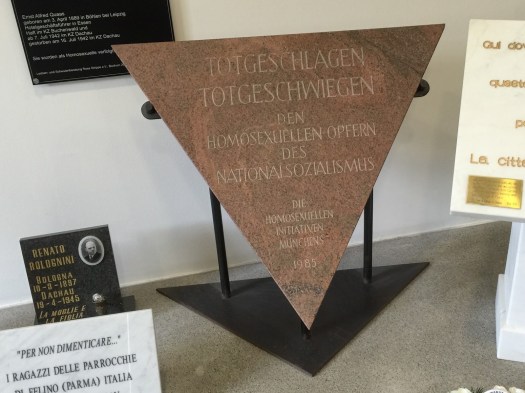
Beaten to death, silenced to death”:
A memorial to the homosexuals killed during
the Nazi regime, made in the year I came out.

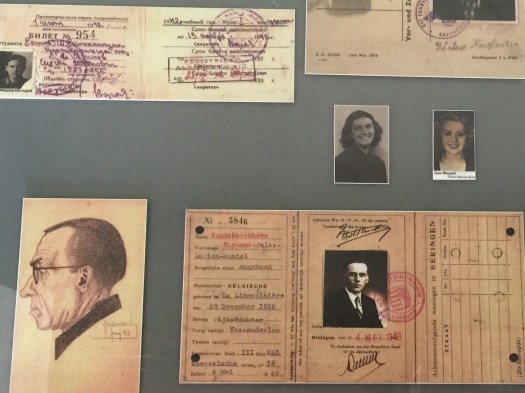
This summer, I visited the Dachau concentration camp for the first time.  There, in the face of monumental horrors, I was drawn to one of the smallest and seemingly most inconsequential object on display: a cigarette card featuring the likeness of 1930s Hollywood actress Joan Blondell.

Dates and figures are no match for such a fragile piece of ephemera. To be sure, the macabre absurdity of finding a mass-manufactured collectible—purchased, no less, at the expense of its collector’s health—preserved at a site that was dedicated to the physical torture of real people and the eradication of individuality could hardly escape me.

But it was not this calculated bathos alone that worked on me.  It was the thought that I, too, would have collected such a card back then, as indeed I do now. Investing such a throwaway object with meaning beyond its value as a temporary keepsake, I can imagine myself holding on to it as a remnant of a world under threat.

Lives taken, identities recovered at Dachau.
Unexpectedly, a picture of Joan Blondell

Looking at that photograph of Joan Blondell at Dachau, it was not difficult for me to conceive that, had I been born some forty years earlier, I might have been sent there, or to any one of the camps where queers like me were held, tortured and killed.  That minor relic, left behind in the oppressive vastness of the Dachau memorial site, speaks to me of the need to take history personal and of the importance of discarding any notion of triviality. For me, it drives history where it needs to hit: home—home, not as a retreat from the world but as a sense of being inextricably enmeshed in it.

Joan Blondell, meanwhile, played her part fighting escapism by starring in “Chicago, Germany,” an early 1940s radio play by Arch Oboler that invited US Americans to imagine what it would be like if the Nazis were to win the war.

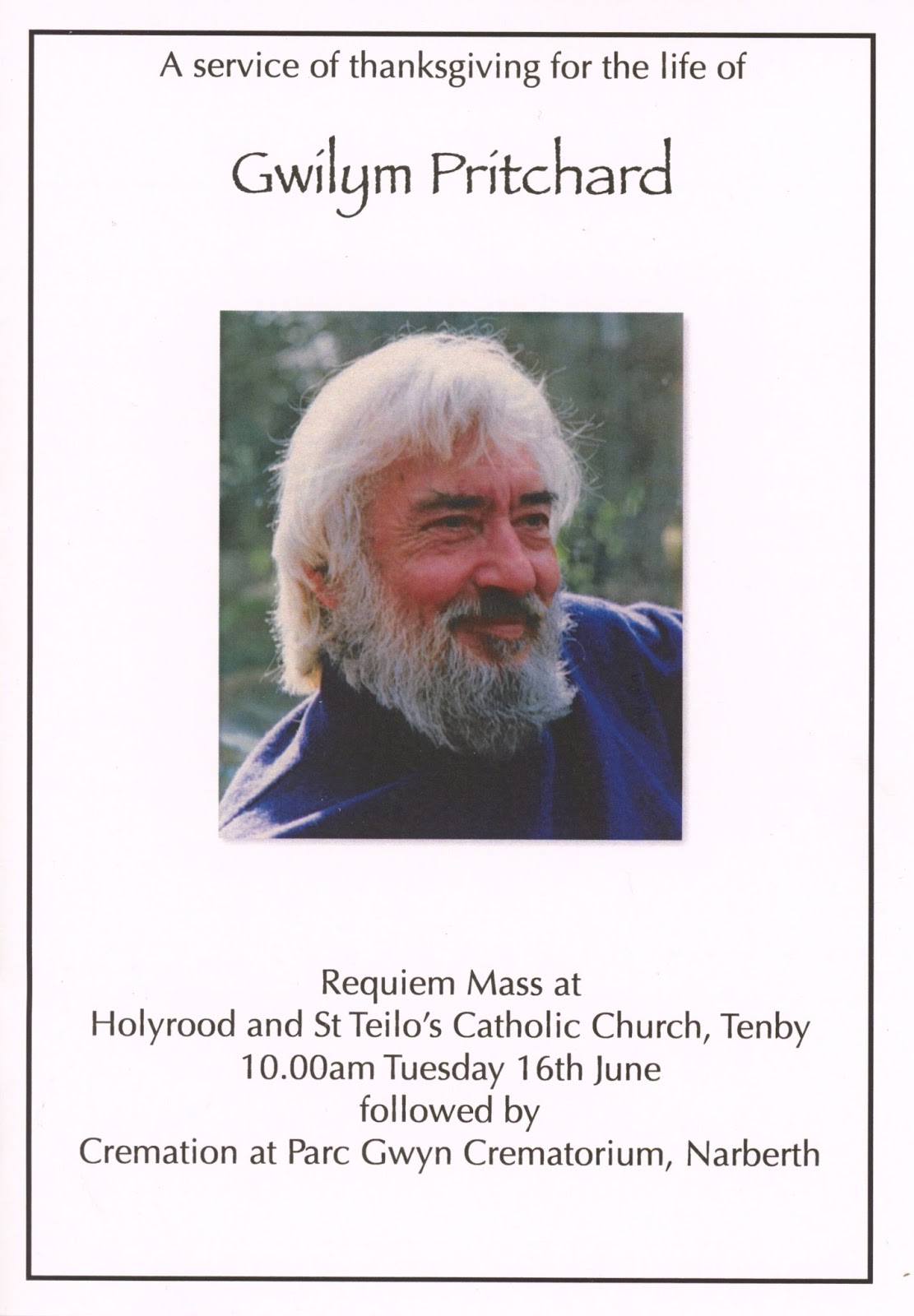
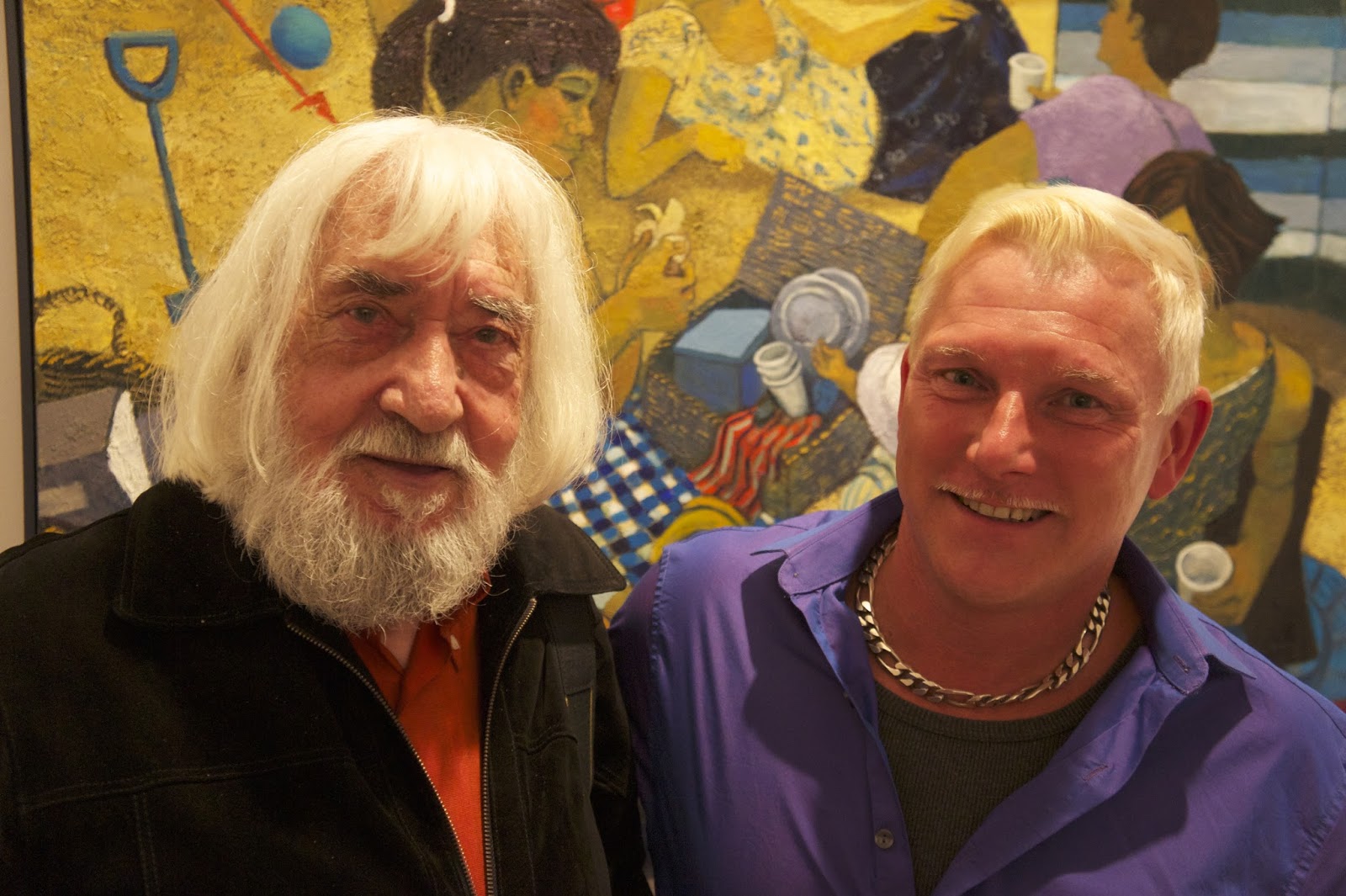
"Cofion, G": Remembering Gwilym Pri[t]chard

“I haven’t kept any diaries as such, apart from the odd word or two in my sketch books.  I have never felt the need to write anything and I really cannot see the point why anyone would be interested in what I would have to say.”  This is what the painter Gwilym Prichard wrote to me in reply to some questions I had while I was working on a monograph on his life and art.  Knowing Gwilym, I also knew that, though he was a man of his word, one word might have to suffice even when I, as a would-be biographer, was hoping for a thousand.


Gwilym talked – and continues to talk – to us through his art; he also talked to his art and had, he told me, private conversations with the works as they came into being on the canvas.  He didn’t think much of critics or the need for interpretation.  He believed that an artist’s work should speak for itself.  Terse as his words to me might sound, they were uttered in humility rather than indignation.  “I am grateful,” he added in parenthesis, “that I have had some success with my painting – I really have very little confidence but what I produce or show is stuff that I have painted with love and sincerity.  I hope that this comes through.”  That love – and the success it brought – was easily documented, mostly through Gwilym’s paintings.

 
Above Rhostryfan (1982), the painting I chose for my 
obituary of Gwilym in the Guardian

“Any more questions?” Gwilym continued his notes, which, much to my surprise, amounted to over thirty handwritten pages.  Clearly, he did not mean to cut me off, and wished me and my partner, Robert Meyrick, “all the best with the writing” with which he had entrusted us.  He answered every question, right down to the matter of the “t,” the letter he dropped from his surname in midlife whenever he signed his art.

 
That “writing,” A Lifetime’s Gazing, was a very special assignment for me.  Through Bob, I met Gwilym and his artist wife, Claudia Williams not long after I had moved to Wales in November 2004.  Back then, I felt distanced from Wales and the Welsh; I found it difficult to find myself or to find any purpose for myself here.  In fact, I still struggle with that.  I did not know then that I would end up working on Gwilym’s monograph.  Though it began years later, the project offered me an opportunity to write about the culture that I, a German with a New York education, could never presume to call my own.
 

I could relate to Gwilym in his difficulties of expressing himself fully – I mean truthfully and meaningfully – in English, Welsh being his first language, the language of his childhood.  Welsh spoke to him differently.  “I am a Welsh painter because I am Welsh,” he wrote, refusing to make an issue of what he felt to be at the core of his being … something understood.


Gwilym described himself as “emotional,” and English was perhaps too much the language of adulthood or reason, too abstract for an artist who treasured the concrete – the rock, the sea, and the soil.  The concrete had weight and depth for him, a weight and depth he did not have to measure because he felt it as an immeasurably rich presence, a constant in a life full of change and challenge.

How fortunate Gwilym was to have developed such a language; and how lucky we are to be hearing him with our own eyes whenever we look at the works that chart his journey …

Teaching by Numbers That Don’t Add Up; or, Not in the Mood to Celebrate an Anniversary

On the eve of the tenth anniversary of broadcastellan, I look back at what this blog once was and what it has been reduced to over the years.  The neglect is due in part to the fact that I struggled to engage an audience or generate interest in my study on radio, which, under the title Immaterial Culture, was eventually published as an academic book in 2013.  I think a copy of it still lies in some corner of the Theatre and Television department of Aberystwyth University, the institution that is my current employer.  It attests to the lack of imagination, ingenuity and respect of said institution that my offer to deliver a lecture on the subject has never come to fruition.  But that is only one of my grievances.

Why there is so little going on here at broadcastellan has mainly to do with my being too busy to devote time to what is essentially a hobbyhorse I can no longer ride at leisure.  My life has changed considerably since that first tentative entry in May 2005; in terms of my academic career, it has not changed for the better.

As a zero hour contract employee at Aberystwyth University, I work virtually daily for little or no pay.  No pay, you ask? How can that be? Well, I spent months creating two courses in art history that I delivered at a university in China in October 2014 and March 2015.  I received no compensation for this preparation; the work was simply not time-tabled, nor thought of as deserving of pay.  There is no shortage of examples; so I consider the most recent one.  Today, I was denied pay for work that was expected of me.

Showing my support for the university, I agreed to teach a course that apparently no full-time member of staff would touch.  For this dubious privilege I was to be remunerated on an hourly basis.  On that iffy foundation, I was to prepare a series of lectures and seminars.  No, let me revise that: I received no money for the preparation.  If the hourly lecture rate is meant to reflect preparation, the rate is below minimum wage.  

I am accustomed to this practice, having worked under such conditions for years.  In this case, there was quite a bit of research, the subject being The Language of German Politics.  I have not lived in Germany in about a quarter of a century and have not voted since before the wall came down (which is just about the time I left).  I was told that the instructor who had taught the course previously did not leave behind any notes on which to draw.  If it was a part-time instructor, I can sympathise.

Why leave behind your intellectual property, even though such rights are violated routinely at institutions of higher learning that take everything from you and take credit for anything you do (such as publishing a book or staging an exhibition that happens despite one’s work for the university, not as a result of it).  Anyway, I enjoy a challenge; a member of staff recently referred to my sense of enjoyment as masochism.

Agony it certainly turned out to be, at times.  I did not receive a contract for signing until three weeks into teaching, at which point it was impossible to withdraw.  There is no mention of pay for grading assignments in the contract, and there were to be 63 individual written papers and 21 final exams to grade.

On average, I spent over 40 minutes reading and marking each essay or translation submitted, sometimes considerably longer.  For each piece of writing up to 1000 words I was permitted to claim the staggering amount of £2.53.  This meant that I worked below the minimum wage, and in many cases quite significantly so.

This is so demonstrably unreasonable that I expressed my incredulity to the Human Resource department of Aberystwyth University.  After all, the task of evaluating the effectiveness of a translation is not simply a matter of right or wrong. As someone who has studied translation theories, I regard translation as an interpretative act that is – or should be – to some degree open to debate.  It is a debate I could hardly afford to have with my students, at least not at the rate of £2.53 per 1000-word manuscript.

I was familiar with these appalling pay rates from other teaching assignments at Aberystwyth University and have tolerated them heretofore without comment.  Though assessing a translation is not equivalent to reading a manuscript mainly for its content, the pay rate is the same.

This by-the-numbers approach to remuneration – and education – is detrimental to the quality of teaching that an institution like Aberystwyth University can deliver when it is relying on part-time staff.  I tried not to short-change students by providing fewer comments, as records will bear out.  I read each submission literally word for word in order to assess responsibly and provide detailed and constructive criticism on matters such as word choice and sentence structure.  This, I believe, is as it should be, and I expect neither praise nor gratitude for my conscientiousness.

As a zero contract hour employee at another department of the same university I routinely meet with students for tutorials.  It is an important aspect my teaching.  Anyone’s teaching.  Due to the decision of the European Languages department to pay me only for the hours I spent conducting lectures and seminars, I was unable hold individual meetings with my students there.  This contributed to student dissatisfaction, instances of which were brought to my attention just as I was about to depart for China.

Yes, I had another teaching commitment, on behalf of Aberystwyth University, while three of my courses were going on here in Wales.  I took off for Beijing with a sense of failure in the face of adversity; and, despite the module coordinator’s assurance that she had ‘heard a lot of praise for [my] teaching,’ the message left me disheartened.  Had I been permitted to conduct tutorials, I would have been able not only to address student concerns but also considerably to bridge the gap created by my China assignment.

It had been suggested to me to mark more leniently to ease tension.  However, I reject the notion that the lowering of standards should be considered as a measure to assure or boost student satisfaction.  Instead, I followed the departmental marking guidelines from which my standards were derived.

Being unable to meet with students resulted in spending more time assessing performances so as clearly to explain how each mark was derived.   This effectively lowered my pay for each assignment.  As I told the head of department, I do not think it fair to our students to provide fewer comments as a result of staff members’ time constraints.

Not being able to hold tutorials, I was also forced to spend more time responding to student inquires via email.  This time is not remunerated, either.  That I had to spend time in class detailing marking criteria, for instance, also limited the time allotted to delivering the material (almost all of which I created myself, as no lecture notes or presentations were available from previous years on which to model my own performance).

The department’s decision to cut corners further by denying me payment for a meeting with – and requested by – the module coordinator to finalise work that requires double marking is, apart from being unjust and insulting to me, a shortsighted decision that impacts negatively on the marking and compromises its fairness.  I had assumed it to be a matter of course that I should be paid for such time; I stated in an email to the module coordinator that I would bill the department at the ‘meeting’ rate, upon which the meeting was called off.  I have informed the department that I am unwilling to conduct a discussion about marks via email, thus without pay.

I told the department that I would not accept any further employment under the same conditions.  To do so would mean to accept Aberystwyth University’s exploitative practices.  The contract is phrased in a way that only underscores its inadequacies.  There is mention of time and a half pay and double pay, for instance.  Such a contract can never be honoured when the work in question is teaching.  I routinely work weekends and late into the night.  There is no mention anywhere of remuneration for any time spent designing or preparing for courses or responding to student email.

There is also no mention of marking.  As a long-time zero hour contract employee I might be expected to be familiar and perhaps even reconciled to such terms; but teaching languages is, as I said, vastly different from teaching other subject matter, as language comes – or should come – under closer scrutiny than in other disciplines.  Responsible teaching of languages will therefore almost inevitably result in a pay below the minimum wage for part-time staff.

All the while, my dedication to teaching has made it difficult for me to pursue my career as a writer, from which I derive as yet no income.  For a year’s worth of teaching, I get paid under £10,000.

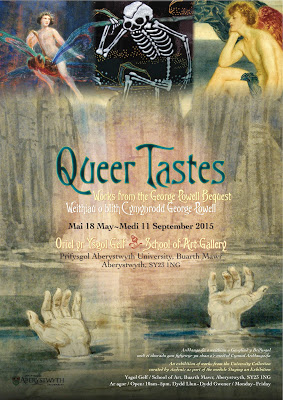
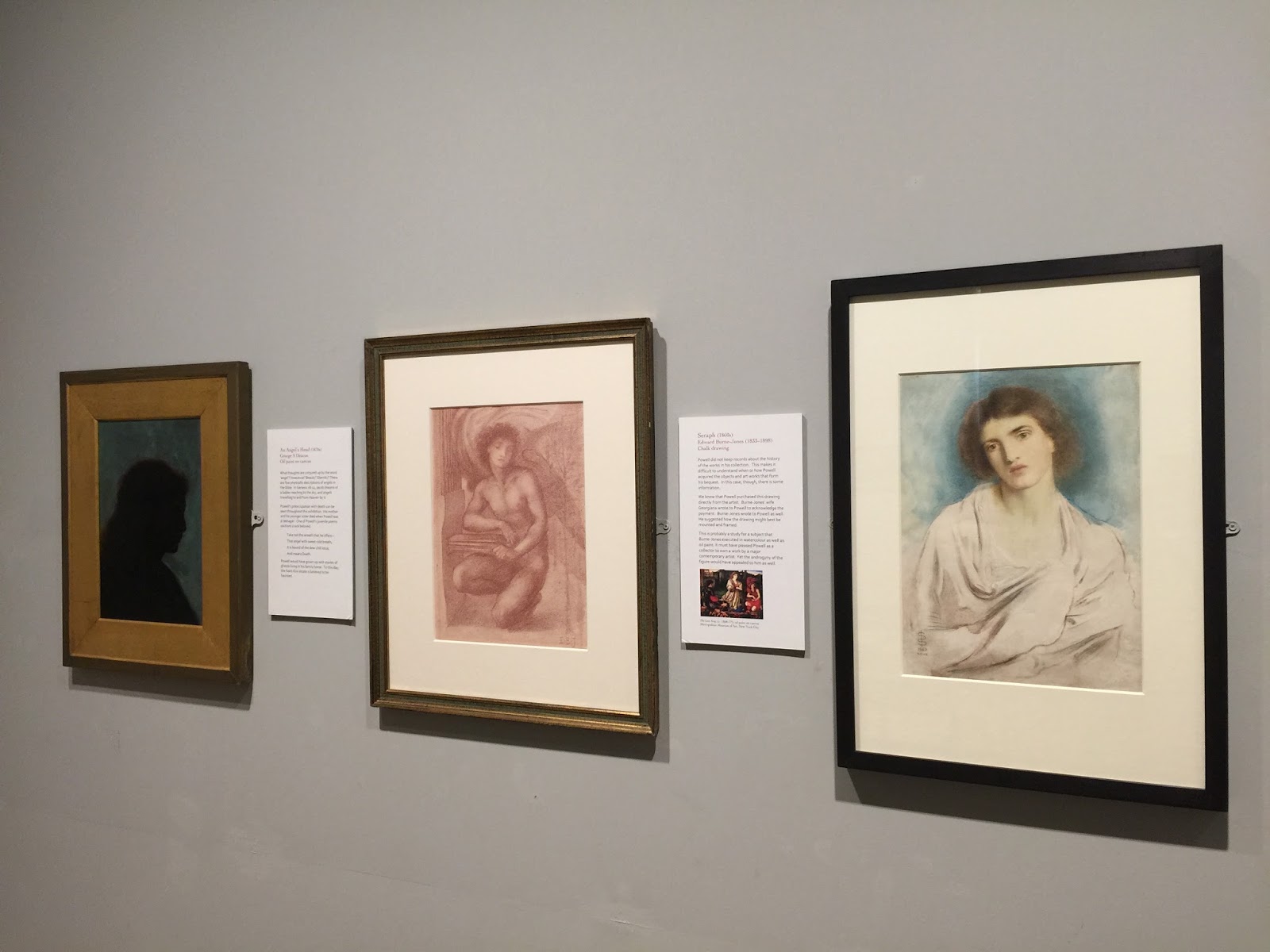
Queer Tastes: Works from the George Powell Bequest

George Powell
Poster design by Neil Holland

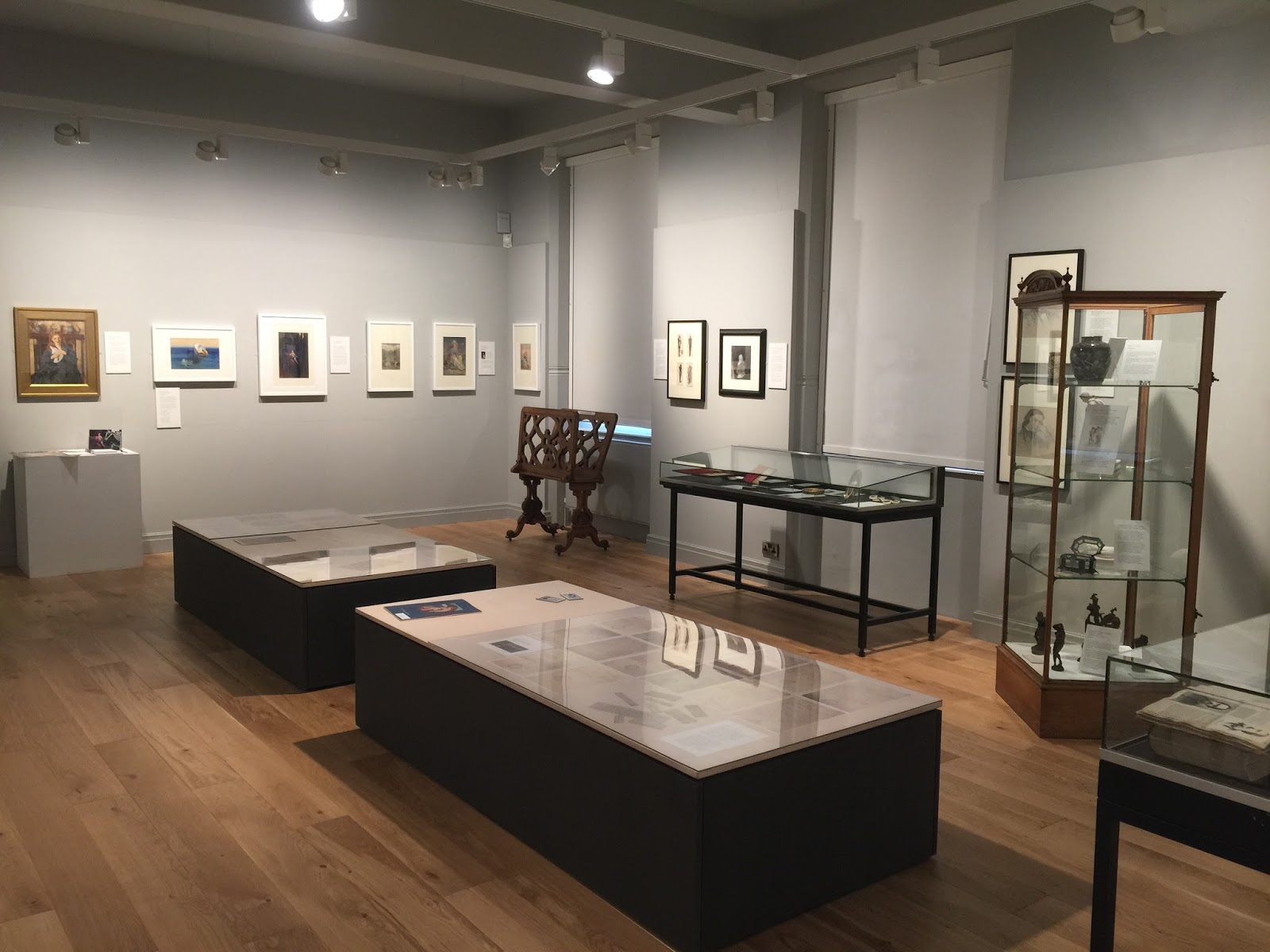
Queer Tastes is an exhibition I curated with students of my undergraduate module Staging an Exhibition at the School of Art, Aberystwyth University. Each year, the module culminates in a student-curated show on a given theme.


This year’s exhibition, which is open to the public from 18 May to 11 September, explores the identity of the Welsh-English dilettante George Ernest John Powell (1842 – 1882) through the collection that he bequeathed to Aberystwyth University. The objects were selected by students of the School of Art, which holds part of Powell’s bequest.  

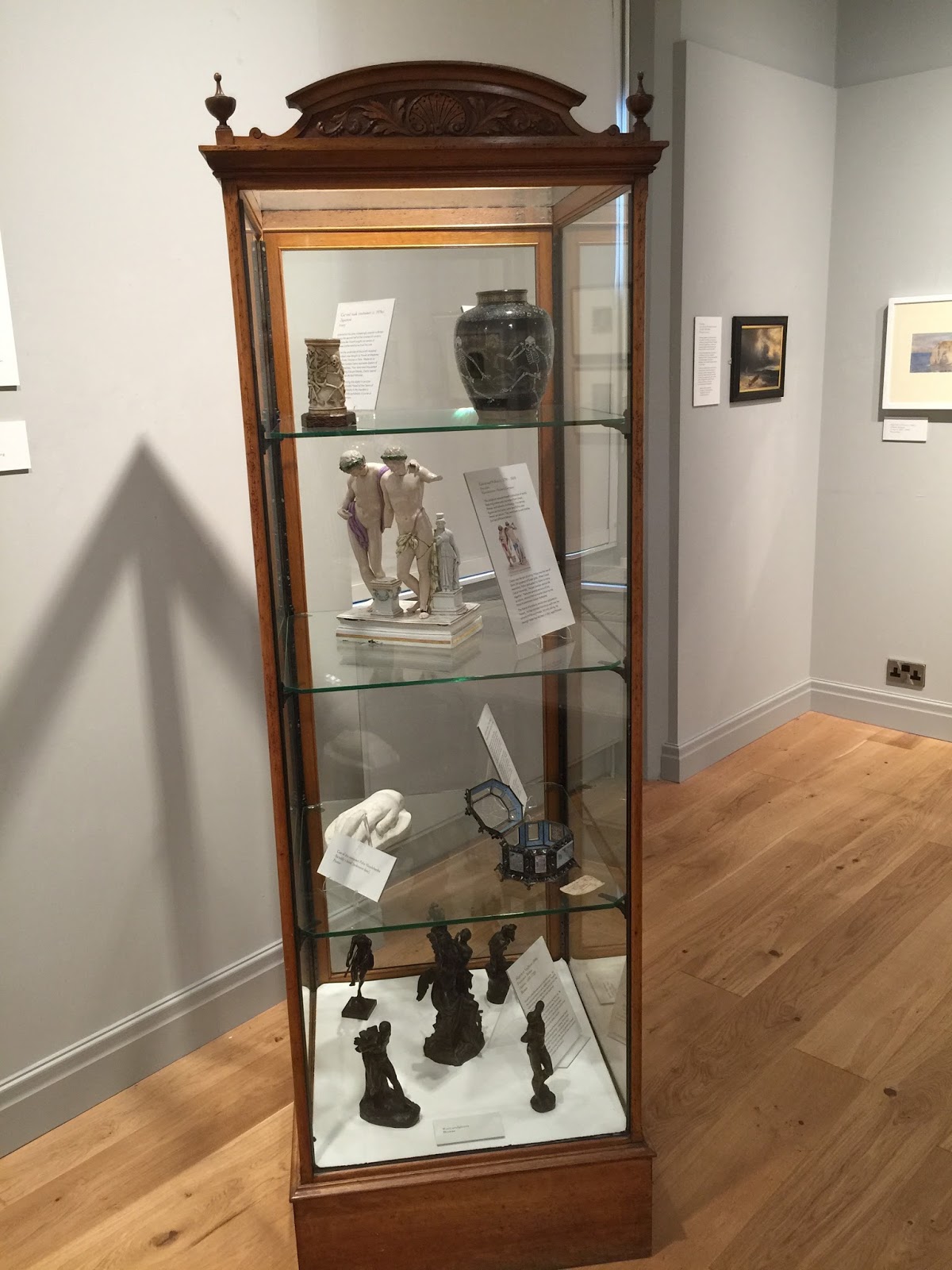
The exhibition includes works by Simeon Solomon, Rebecca Solomon, Edward Burne-Jones, Richard Westall and Hubert von Herkomer as well as artefacts and curios ranging from a plaster cast of Felix Mendelssohn-Bartholdy’s hand and a glass casket that allegedly once contained a splinter from Robert Schumann’s coffin.

The Powell family owned the Nant-Eos estate a few miles inland from Aberystwyth. Educated at Eton and Oxford, George Powell spent little time at Nant-Eos, which he would inherit in 1878. It was an unhappy place for him. His parents were estranged. His mother and younger sister died when Powell was a teenager.


Powell was a dreamer, much to his father’s disappointment. Instead of going hunting, the boy wrote poems about death, loss and betrayed love. Eager to get away, Powell travelled to Europe, Russia, North Africa and Iceland. In the company of the poet Algernon Charles Swinburne, Powell spent summers on the Normandy coast. There, he entertained writers and artists in a cottage he named after a bisexually promiscuous character in de Sade’s Philosophy in the Bedroom.

Powell has been called ‘eccentric’, ‘sinister’ and ‘sad’. He has also been labelled ‘homosexual’, a term not used in his day. ‘Queer’ suggests something – or someone – strange or at odds with our views. It asks that we trace our responses to otherness in ourselves.

A man of the world, Powell wanted to be remembered back in Wales as a patron and benefactor. He offered parts of his collection to Aberystwyth Town Council, on provision that a public gallery be created for their display. When the deal fell through, Powell gave the objects you see here to the University of his ‘dear but benighted town’.

Making our possessions public is in a way a ‘coming out’. It invites others to wonder about our past. It also means saying ‘I matter’. Collections like Powell’s encourage us to question how a person’s worth is determined.
Curators: Danielle Harrison, Kayla McInnes, Alice Morshead, Jenny Skemp, Valerija Zudro, with support from Harry Heuser (text and concept) and Neil Holland (staging and design).
Powell’s life and collection are the subject of my essay “‘Please don’t whip me this time’: The Passions of George Powell of Nant-Eos” in the forthcoming anthology Queer Wales (University of Wales Press).


Stanley Anderson: An Abiding Standard

This is a speech I prepared for the private view of “Stanley Anderson: An Abiding Standard” at the Royal Academy of Arts in London on 24 February 2015. Mindful of the assembled party ready to mingle and enjoy the evening, I decided to cut my talk short. Here it is in its entirety.

Stanley Anderson’s move from London to Oxfordshire coincides with – and made happen – a body of work for which he is now best known: a series of thirty or so prints on the subject of traditional farming methods and rural trades. They are on view in the Council Room.

Anderson’s move to the countryside was not a retreat. Despite their nostalgic appeal, his works are not escapist. Like his London scenes, they engage with the here and now. His here and now.

Anderson’s prints do not glorify England’s past or gloss over what he perceived to be its problems. It took me a while to appreciate that. As someone interested in the 1930s and 1940s and the impact the Second World War had on civilian life, I was disappointed not to find any overt references to the conflict, any depictions of the homefront, or images of disabled soldiers. After all, Anderson himself lost his London studio during the Blitz.

But they are there, those references. Or at least, Anderson’s commentaries on the human condition are there.

It is telling that so many of the men whose activities – or inactivities – he portrays are old. Anderson himself was in his 50s and 60s when he created these line engravings. The young had gone to war or else were working in the factories. It was war that turned men into machines and that, like other crises before it, had thrown the fragility – or the speciousness – of modern civilization into relief.

Anderson said that, when he moved to the country, his ‘mind and feelings became clearer, more definite in their reactions.’ In the countryside, alive to the seasons, he ‘seemed immersed in a sense of stability’ that was ‘not static. He called it ‘a sort of ordered growth’. Ordered growth in the face of chaos. And what he set out to do in his prints was to remind others of what they were in danger of losing or forgetting: the traditions that, he feared, would die with the men – the friends, neighbours and fellow craftsmen – whose work he commemorated in his prints.

Anderson did not want to be called an “artist.” He did not consider self-expression to be the highest achievement or chief aim of visual culture. He saw himself as a craftsman in the medieval tradition.

He aligned himself with anyone who derived his living – and his satisfaction – from the work produced with his or her own hands, just as Anderson did (with the support of his wife Lilian, a trained nurse).

Trade was not a dirty word for Anderson; nor did he mind getting his hands dirty. He not only related to his working men subjects – menial labourers and skilled craftsmen alike –he befriended these men, at a time when England turned its back on their traditions and forced the hand of many who were pushed into assembly line work or else were made to operate the machinery of war.

Moving to the countryside was not a getting away from mankind but a getting closer to his fellow man. Anderson called fellowship the ‘only currency’ that truly mattered. The ‘pleasure and interest’ of others in his work was what he deemed ‘ample repayment for all [his] labours.’

The hours he spent creating these prints were a time of contemplation; he abhorred speed and distrusted work produced quickly and, he believed, thoughtlessly. His works are spiritual, and the Zeitgeist they capture is that of an age in which spirituality was fast disappearing.

Anderson did not work or live fast. As [co-curator Robert [Meyrick] said, he spent seven years as an apprentice in his father’s engraving workshop, an experience on which he would draw and which he would not regret. His career is a continuum that anyone banking on instant fame might find hard to comprehend. His aim was to live by an abiding standard and his career was the reward of biding his time.

‘My life has been a quiet, studious one,’ the sixty-year-old Stanley Anderson told an American friend who wanted to write a biographical essay on him. There had been ‘no exciting experiences immorally, no amazing lights and shades, no boisterous contretemps; just a steady, sustained effort to express clearly and as well as my ability will allow, that note, in the main, I feel so deeply in life and nature – the plaintive note […].’

‘I often wonder, Anderson added, ‘if this is the reason I crave the friendship of sympathetic folk; why I feel that the arts are a social, or sociable act; why I abhor the bigotry, the insufficiency of self, and fear the exclusiveness of ‘success.’

Before we continue enjoying the ‘sociable act’ of this private view, I would like to express my gratitude to the man to whom everyone seeing this exhibition is indebted: to Stanley Anderson himself.

Anderson reminded me, again and again, how rewarding – how necessary – it is to keep at it, to keep looking, beyond the first glance in the search for novelty or the reassuring instance of recognition.

“In all matters of execution his work is highly disciplined,” a 1932 review in the London Times declared “and, if he seldom thrills you, he never lets you down.” If by thrill we mean the quickening pulse in response to the flashy and sensational, then the reviewer was certainly right. But there are thrills in Anderson’s work that are the rewards of anyone who keeps looking: discoveries of social commentaries – cultural references and sly observations – in which Anderson’s prints are rich.

We have not provided object labels for each of the 90 or so works on display here because we want to encourage you to look for yourselves without being told what to see. Anderson will tell you much about his attitudes toward modernity – and toward modernism – in these prints. These are not works that are open to a myriad of individual interpretations. His intentions become clear, his message, which often appears in fine print – in signs, fictional newspaper headlines and literary allusions – is consistent. His prints are essays on modern life and traditional labour, for the appreciation of which every line counts. So, stay a while …. and keep on looking.

“Stanley Anderson: An Abiding Standard” is on at the Royal Academy of Arts, London, from 25 February to 24 May 2015.

Nuns Ablazing: Sister Act at Aberystwyth Arts Centre

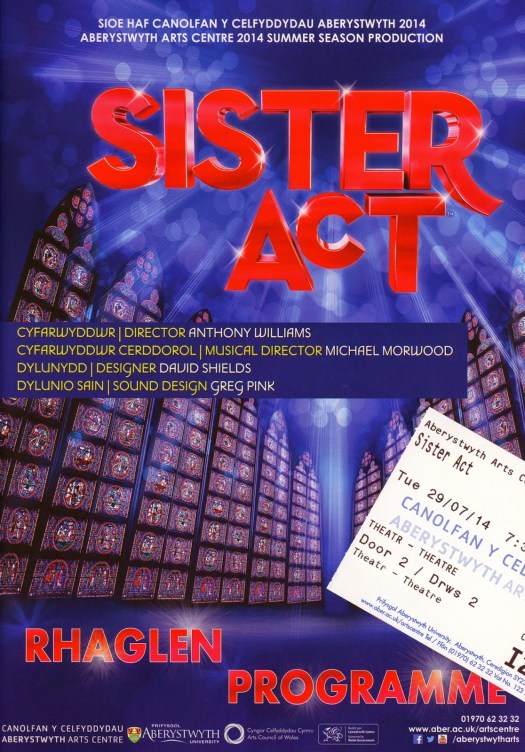
“Farrah Fawcett as thou art in heaven!” This is a good time to dust off your “F. M. boots” and shake your groove thing right on down to our local Arts Centre here in Aberystwyth. You know, F as in Funky and M as in, well, Mary, Mother of Grace.  Or, FM as in radio, tuned to the station that gives you Diana, Donna and … Deloris.  Deloris Van Cartier, honey, the diva that dreamed of a wearing white fur and ended up in a nun’s habit.  Yes, it’s Sister Act, the musical. The one about the convent where the mother’s Superior and the sisters Supreme.

In this production, Mother Superior is played by Lori Haley Fox, whom I previously saw perform here in Chess and Hairspray.  There is a bit of Velma Von Tussle in Mother Superior—but her Sister Act character has some depth, which comes across in Fox’s rendition of “Here Within These Walls.” You don’t just get to hiss and laugh at her, but get to understand her struggle to restore the order that wasn’t meant to be a reformed one. It’s a fight against the trivialization and exploitation of her beliefs.  To be sure, it’s a tall order to deliver such conviction in a play so invested in that very trivialization. But if there are false notes in this musical, they are not coming out of Fox’s mouth.  Nor out of Jenny Fitzpatrick’s, for that matter, who is great in the wear-your-Jackal-and-hide part of Deloris “Sister Mary Clarence” Van Cartier, a diamonds craving tramp with the proverbial heart of gold.  Or a golden larynx, anyway. And Fitzpatrick sure got that, and soul besides. Make that Philly soul.  After all, the scene is set in Philadelphia, the town to which the bastard of Disco can trace some of its heritage.

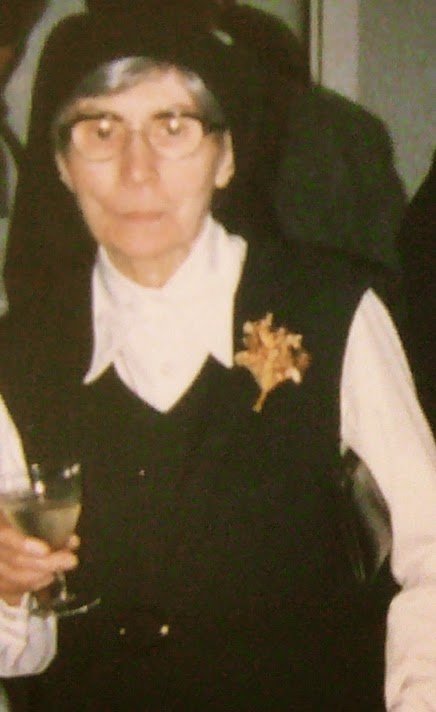
My great aunt was a nun, so I fancy myself an authority

[Image caption: My great aunt was a nun, so I fancy myself an authority.]

I’ve been attending the Aberystwyth Arts Centre productions ever since I arrived in this town after fifteen years of life in Manhattan.  I had a bad attitude in my suitcase and thought that nothing could match Broadway, that this was just the sticks.  Well, shows like Chicago and Hairspray proved me wrong.  Actually, the very first show I saw here, Oliver!, did that.  And it was great to see Mr. Bumble again, right there in that convent.  Gary Davis, I mean, who plays Monsignor O’Hara. Indeed, there were a number of familiar faces in the cast, among them David Barrett and Robert O’Malley.

Brother, it must be tough for any man to assert himself in a place where all those rapping and von Trapping sisters are doing it pretty much for themselves (and the Almighty); but Robert Grose as Curtis Jackson and Aaron Lee Lambert as Eddie Souther are giving it their best shot—and I’m using the metaphor advisedly.  Grose is at his smarmiest best singing “When I Find My Baby,” a creepy number worthy of Sweeney Todd and likely to give you the heebie-Bee Gees.

Meanwhile, in “I Could Be That Guy,” Lambert makes a transition that rivals the costume change endured by Deloris – albeit from plain to fabulous, so that the twain can meet somewhere in between—and he doesn’t get a phone booth or even a Hong Kong Phooey filing cabinet to do it in. So, props to him! Then again, why call props when Velcro and virtuosity will do? 

There are echoes of Kiss Me, Kate in the trio of thugs—The Three Degrees of separation from the baboon—who are making apes of themselves for our amusement in “Lady in the Long Black Dress.” Never mind Earth and Fire; these guys are pretty much all Wind. That said, Andrew Gallo as Joey has more moves in his eyebrows than most wannabe Travoltas have in their polyester-clad hips. George Ray as TJ does four-eyed cute as well as Rick “Suddenly Seymour” Moranis ever did. And Ricardo Castro is just bueno as Pablo in a Brüno kind of way. 

Meanwhile, for those who prefer their eye candy unwrapped, there are a couple of highly distracting boy dancers, competing though they were, temporarily, with an audience member in front of me who insisted on noisily unpacking her own treats. Sure, Toffifee is retro, but a flask is more discreet. 

Dancing boys and their legs apart, this is still a play in which the sisters have the upper hand; and glorious Jodie Jacobs as Sister Mary Robert and fierce Andrea Miller as Sister Mary Lazarus prove that “It’s Good to Be a Nun.” So what if Sister Act’s pastiche.  Why reinvent the Disco Ball? I, for one, am glad to be having the sisters “Here Within These Walls” of Aberystwyth Arts Centre to “Spread the Love.”  I’ll be back for another audience with them—and that adorable Pope—just as soon as I get the platforms redone on the F. M. boots I wore out tapping along. “Fabulous[,] Baby”!

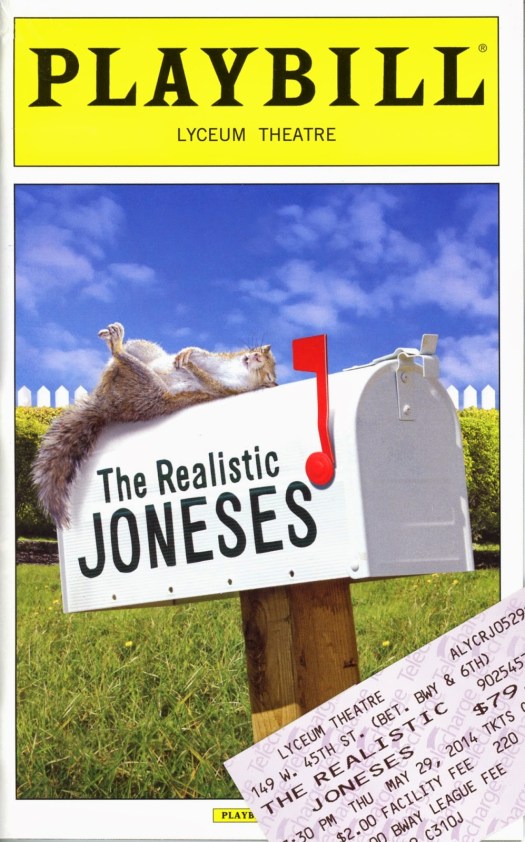
If only the Squirrel: A Word on Plays on Words as Plays like The Realistic Joneses

I don’t get it.  No, I take that back.  I didn’t get anything from it.  No, that’s not it, either.  I didn’t really like it is more like it, really.  Will Eno’s The Realistic Joneses, I mean.  It’s one of those plays that are nothing more than wordplay.  The Joneses aren’t really Realistic.  That much I got, and not much else. 

The characters are just worders, if that’s the word for it.  If it were a word.  They are not word made flesh.  I’m not sure whether they are mouthpieces because I’m not sure what they were meant to mouth, other than that we are mostly words to one another.  Words that are no reliable access to thought or feeling, that are no substitute for flesh, for sensations and experiences. 

A playwright who says as much as that – or as little – has got a real challenge.  But that may be too charitable a word for a playwright’s “I’ve got nothing, really.”

The Realistic Joneses, to me, is a bad play.  Even the wordplay isn’t that good.  It is of a sitcom caliber, and the characters are a bunch of near flatlining oneliners.  I mean, ‘Ice cream is a dish best served cold’? Seriously, is that bit of lame rhetoric – a cliché made obvious as a commonplace – a substitute for a plot twist? I didn’t feel the play was a moving comment on the increasingly disembodied state of twenty-first century humanity, much less a sensitive portrait of toxic malaise. I didn’t feel.  That’s just it.

The Realistic Joneses is a play on the hollowness of words, and I don’t feel that that is a valid point to make in a play.  Not any more.  Not even for the middle-aged with a nostalgic yearning for some old-fashioned post-modern self-reflexivity.  Well, post-modernism isn’t what it used to be because it just isn’t anymore.  Or oughtn’t to be.  The tongue has to come out of the cheek eventually, and it has to learn to speak again and say something other than, say, “What’s there to say?” Not just some piffle passing for the absurd.  To me, surrealism isn’t anything goes nothing, at least not in the theater.

I walked out of the Lyceum Theatre thinking that I had just spent what amounts to a buck a minute on a rotten piece of ephemera – like that dead squirrel Tracy Letts picks up and throws into a trash bag, or the spoilt food Michael C. Hall takes out of the refrigerator – with little else but these few words of mine to show for it. If only that food had been served hot. 

If only the squirrel had lived.  If only.  Or maybe not.

One Tough Act One to Follow

Theater ought to make for good theater.  Noises OffA Chorus of Disapproval.  Stuff like that.  Sometimes, though, it doesn’t.  And it doesn’t because it doesn’t quite become stuff.  And when it ain’t stuff, it fails to matter.  The Lincoln Center production of Act One drives that home.  And what a slow drive it is.  You just sit there, or I did, thinking: when will it stop? Incredulous, I kept checking my watch to see whether time had stood still and I was stuck in the mind of a playwright who hadn’t quite stopped revising, who hadn’t quite figured out just where to go and how to end.  And the end, when it came at last, couldn’t have been less of one.  You could have spelled it out in six letters.  THE END.  It’d be quicker that way. But that doesn’t make an ending feel like any conclusion to draw from.
 
Granted, the question of how and where to finish is always a tough one when it comes to autobiography, a life unfolding and not wrapped up retrospectively. If only Moss Hart had done the adapting of his 1959 autobiography, the play might have had, if not necessarily a structure but at least an urgency, a currency that this nostalgic exercise in pointlessness woefully lacks.  Instead, we end up with an adaptation that, in its second act, is mostly about the act of adapting.
 

That’s just the problem with the second half of James Lapine’s reworking of Hart’s book.  It tells – rather than compellingly dramatizes – the story of how Hart and Kaufman collaborated on Once in a Lifetime (1930).  Watching two guys sitting around drafting a play isn’t nearly as riveting as experiencing that play or the evolution of it.  And, to me, at least, it didn’t help matters that, several years ago, I saw a lifeless National Theatre production of Once in a Lifetime, starring David Suchet.  What should have been sheer madcap felt drowsily close to one nightcap too many.

 
“The theatre is not so much a profession as a disease, and my first look at Broadway was the beginning of a lifelong infection,” Hart wrote.  It’s a line from Act One, the book, that makes it into Act One, the play, and it makes you aware how little blood there is in the latter.  It is altogether too glossy to make us believe in the curative potency of make-believe, felt by someone brought up in “unrelieved poverty,” as Hart put it.  Such urgency could turn theater-crazy Aunt Kate, charmingly though she is played by Andrea Martin, into someone akin to Blanche DuBois.


If the play, in this production, at least, isn’t quite a cure for drama dependency, that may be because it isn’t sufficiently catching to be an antidote to theater madness.  It has a cuteness about it that is merely subcutaneous.  It doesn’t prick you, or hook you, or infuse you with the passion of which it can only speak in borrowed words.

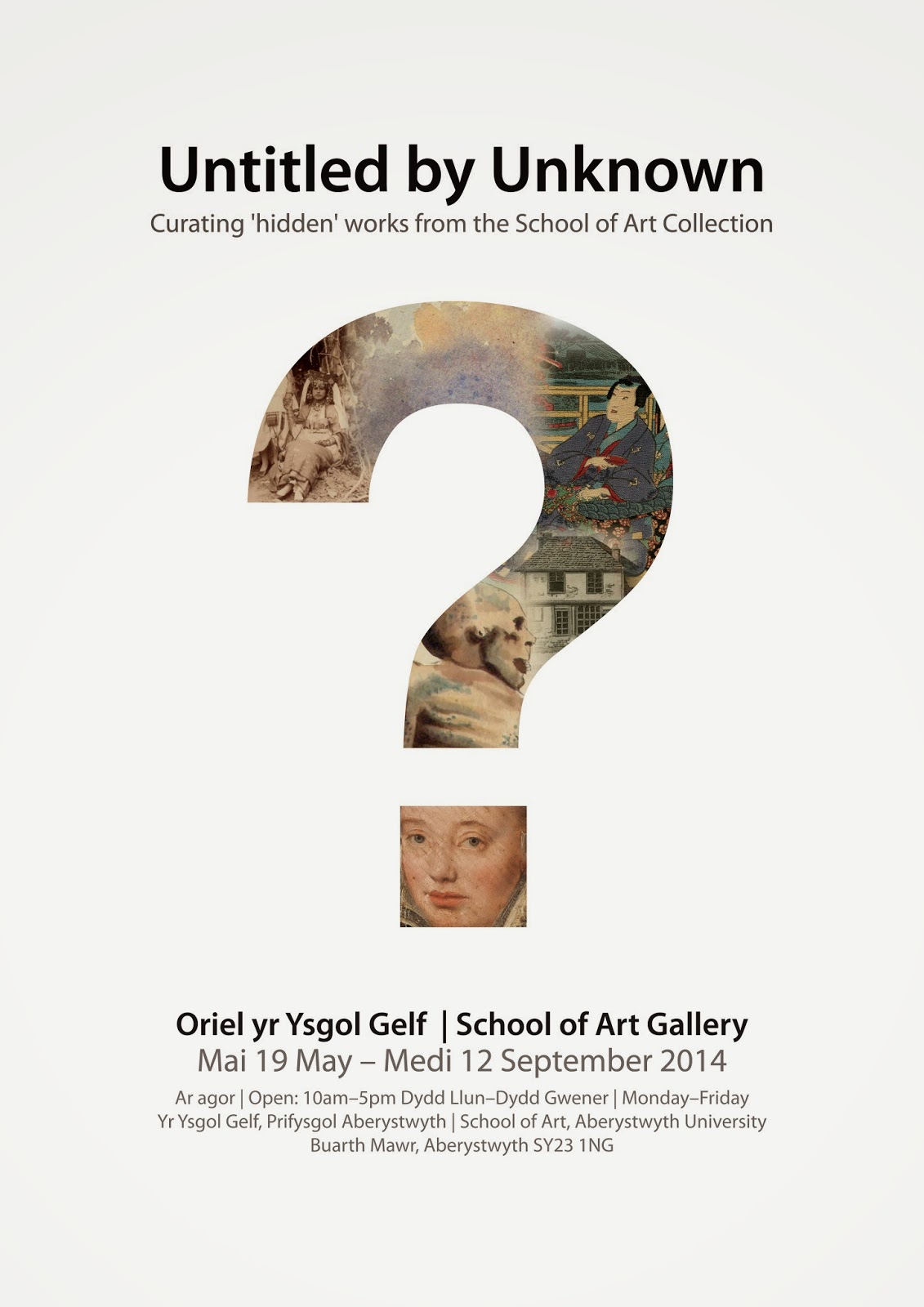
"Untitled by Unknown"

Every spring, the students of my “Staging an Exhibition” class are doing just what the title suggests: they curate a show at Aberystwyth University’s School of Art galleries. And every summer, I have to come up with another idea for another spring. This year’s exhibition, on show now until 12 September, poses a particular challenge. As stated on introductory panel, most of the works on displayed “have no official title. The identity of their creators remains unconfirmed.” This opens the debate as to their value and relevance: “Do their uncertain origins mean that these objects are unworthy of our time and attention?”

Untitled by Unknown: Curating ‘Hidden’ works from the School of Art Collection investigates the effects of doubt and mystery on our estimation of visual culture. The thirteen curators not only researched the objects but also needed to think of ways to interpret in the absence of verifiable facts.

Viewers are “encouraged to reflect on the ‘hidden’ lives” of the objects chosen by students: they include photographs, watercolours, prints and miniature paintings. Each work is identified only by the number by which it is filed and can be accessed in the School of Art collection’s online database.

The idea was to let visitors of our exhibition in on the curatorial task, to suggest that while a “lack of facts can be an obstacle,” it “can also be an opportunity for personal engagement.” Visitors may well question our interpretations and uncover alternative stories. Perhaps, they know more than we do about some of the mystery objects in our collection.

Untitled art works by unknown or anonymous artists often have no chance of being displayed—at least not until their mysteries are solved. Still, public museum and galleries have a responsibility of sharing the works in their collection.

Untitled by Unknown is not intended to show astounding works from exceptional artists. It is here to open a debate about what should be on display and how it may be shared.

My thanks to the students involved in making the show – and my class – possible: Jessie Davis, Karolina Hyży, Justyna Jurzyk, Kate Largan, Charlotte Raftery, Laura Roll, Elizabeth Salmon, Melissa Sarson, Belinda Smith, Julia Steiner, Stephanie Troye, Veera Vienola, and Eleri Wood.

Our thanks also to curator Neil Holland for all his help and expertise.

Immaterial Me

My study Immaterial Culture: Literature, Drama and the American Radio Play, 1929-1954 has just been published. So, as well as explaining the subject matter of the book and the objectives of its writer, I decided to devote a few journal entries to the story behind its production, to its birth and life in relation to my own journey.  There is also the small matter of its afterlife, a matter to which no parent, proud or otherwise, can be entirely indifferent.

Along with my other recent publications and current projects, of which I have said nothing in this journal, Immaterial Culture has long kept me from materializing here.  No doubt, I could have made more effective use of broadcastellan as a promotional vehicle.  And yet, writing, like listening to radio plays, is a solitary experience; at least it is so for me.

Like the performers behind the microphone, writers are generally removed from the audience for whom their performance is presumably intended, an audience that often seems so abstract as to be no more than a construct.  The writer, script reader and listener may be sitting in a crowded room, and that crowd may well matter; but what matters more is the immateriality of the words once they are read or spoken.  Words that create images or match stored ones.  Words that evoke and awake feelings, stimulate thought.  Words that, uttered though they are to the multitude, begin to matter personally and take on a multitude of new lives.

That Immaterial Culture is a profoundly personal book will not be readily apparent to anyone reading it.  After all, I have refrained from using the first person singular to refer to myself as the reader or interpreter of the plays I discuss.  I thought I’d leave the privilege to say “I” to that “obedient servant” of the Mercury Theatre, the orotund Orson Welles.  Instead, I decided to disappear and let the play scripts and productions I audition take center stage, a prominent position they are often denied.

Talking about old radio plays as if they have no presence, as if they are chiefly of interest to the (broadcast) historian, only makes matters worse. Immaterial Culture, then, is an invitation to listen along, an invitation to talk about American radio plays of the past as one still discusses the material culture of books, motion pictures, theater, and television programs …