
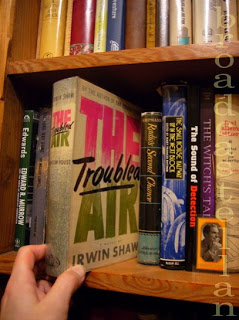
 This being the birthday of novelist Irwin Shaw (1913-1984), I dusted off my copy of The Troubled Air (1951) to pay tribute to a radio writer who successfully channelled his anger and frustration by feeding it to the press, a rival medium that was only too pleased to get the dirt on broadcasting. Like his previously mentioned short story “Main Currents of American Thought,” published in 1939, The Troubled Air is a blistering commentary on the business to which Shaw was introduced by radio writer-producer Himan Brown, for whom he penned the aural comic strip The Gumps. For details on the novelist’s experience in radio, I refer you to Michael Shnayerson’s insightful 1989 biography; here, I am drawing on a few passages of The Troubled Air to document a hack-turned-published author’s urge to let off steam at a time (the McCarthy era) when the old radio mill seemed on the verge of blowing up.
Clement Archer, a former history teacher with hopes of becoming a playwright, enters radio after being persuaded by one of his students that a “ two-headed Zulu could do it. As long as you can type fast enough, you have nothing to worry about.” Archer has his doubts:
“My natural prose style,” he [tells his student], “is something of a cross between Macaulay and the editorial page of the New York Times, and my idea of how people should behave in fiction comes mostly from James Joyce and Proust. And I never had Bright’s disease and I never tried to seduce a twenty-year-old immigrant, and I actually believe that the innocent always suffer and the evil always prosper in real life. So I can’t say I feel boyishly confident about my equipment on a Monday morning when I sit down and know I have to write five fifteen-minute heart-breaking episodes before Friday. I have a lovely idea for next week. Little Catherine (the name of the program was Young Catherine Jorgenson, Visitor from Abroad) is going to California and she’s going to get caught in an earthquake and be arrested for looting when she goes into a burning building to rescue an old miser in a wheelchair. Ought to be good for ten programs, what with the arrest, the examination by the police, the meeting with the cynical newspaper reporter who is reformed by her, and the trial.
In fact, life in radio’s fiction factory turns out to be “murderously hard work.” After years of it, Archer gets a break at last when he becomes the producer-director of University Town, a series of anthology drama under the sponsorship of a drug company. When his actors and musicians are accused of Communist affiliations by Blueprint, a “belligerent” and “mysteriously” financed magazine “dedicated to exposing radical activities in the radio and movie industries,” the advertising agency in charge of the program gives Archer two weeks to find out from the five people involved—a Jewish immigrant composer, an aging actress, a gorgeous ingénue, a black comedian, as well as Archer’s best friend and former student—whether the accusations are false.
When asked by Archer why drastic measures such as the firing of his composer were deemed necessary, the agency representatives responds by arguing that radio
is not at the moment in a strong position. In fact, it is not putting it too vigorously to say that the medium is fighting for its life. A new form of entertainment, television, is gaining enormous momentum, capturing our clients and our audience; the economic situation of the country is uncertain and advertisers are retrenching everywhere—the old days when we could do anything and get away with every—are gone, perhaps forever.
Being supportive of his creative team, Archer is denounced as a Red sympathizer, even though the communists denounce him equally. His phone is tapped, his career is finished, his marriage in turmoil and a friendship exposed as a fraud.
Shaw was hardly alone in denouncing the industry in which he had worked; but, unlike former gag writer Herman Wouk (from whose satire Aurora Dawn I quoted here), he could not bring himself to make light of the experience.
 As much as I have enjoyed our
  As usual, I am slow to catch up. A few years ago, the BBC relinquished the rights to televising the Oscars; and since we are not subscribing to the premium channel that does air them, I am relying on the old wireless to transport me to the events. So, here I am listening to …
  As much as I dislike mathematics and however arithmetically challenged I am without a calculator, I very much enjoy compiling lists and studying figures such as box office statistics. I am less interested in watching contemporary film than in finding out how many others have. It gives me an idea of what is popular without having to subject myself to yet another sequel of an indifferently constructed CGI clones. My kind of picture is, on average, at least half a century old. Today, I considered the list of films I have screened of late and rated them, on a scale from one to ten, at the Internet Movie Database. It is not an easy task, this kind of opining by the numbers, as I
  Not that I am entirely visual-minded on this my day of reckoning. Once again, I am cataloguing my library of books on broadcasting, a collection that has grown considerably since last I attempted to inventory it. While I am at it, I am scanning some of the covers, so aptly referred to as dust jackets and put them on display where they are more likely to tickle someone’s fancy rather than irritate throat and eye. Pictured are first editions of Francis Chase’s Sound and Fury: An Informal History of Broadcasting (1942), Charles Siepmann’s Radio’s Second Chance (1946), and fred allen’s letters, edited by Joe McCarthy (1965).
 There is “no glory in radio,” Allen remarked in a letter to Abe Burrows (


 This seems to me just the day to hear about Messrs. Polk and Harding, to listen to the words of Franklin Pierce and Chester Alan Arthur. During the late 1940s and early ‘50s, they were all brought back to life via that great spiritual medium, the wireless. For little less than half an hour at a time, they wafted right into the American home, which, a decade earlier, had been accustomed to so-called Fireside chats from an above determined to come across as being among.
 In the house I now call home, I am surrounded by a great many works of art, from oils and etchings to ceramics and stained glass. When I moved in the walls were already crowded with images; and I felt strangely if understandably disconnected from them and my new surroundings. For this simple reason, our Welsh cottage soon came alight each evening in the ersatz glow of moving images imported from the Hollywood of the 1930s, ‘40s, and ‘50s (a few exceptions notwithstanding). These pictures are projected onto a blind behind which unfolds the celebrated beauty of the Welsh landscape which, on a cloudless night, is more silver than the screen. For weeks after moving here from New York City (back in November 2004), a move worthy of a Daphne du Maurier thriller, were it not for my genial partner, I was unable to draw the blinds without bursting into tears, no matter how serene the scenery (our living room view being
  The smattering of rousing captions that accompany the images sure smacks of desperation. How do you sell a forgettable thriller as a must-see? You resort to words and phrases like “kill” and “cold blood, “evil” and “insane,” “murder” and “monstrous secret” to align the indifferent material you are pushing with the neo-gothic literature known to sell. In radio dramatics, no words were more prominent than “murder” and “death.” “Love” doesn’t sell half as well as death. “Sex” might, but radio was too cautions to go where most minds—and the species at large—are on a regular basis. To this date, US entertainment is more tolerant of mutilation than titillation, owing chiefly if indirectly to the violence that is religion.
 Harry Heuser