"This . . . is London": Florence Foster Jenkins, Again

Well, it doesn’t always take “practice, practice, practice” to get to Carnegie Hall. Sometimes, delusions of grandeur—and a few thousand gawkers in search of the proverbial train wreck—will do. If you are among those who still marvel at the American public’s decision to include Kevin Covais among this year’s American Idol finalists, consider the career of a tone-deaf diva who brought the William Hung-factor to classical music: Florence Foster Jenkins, a coloratura-blind soprano so astonishingly awful that audiences are still pricking up their ears in disbelief some sixty years after her silencing. Call it “Schadenfreude schöner Götterfunken.”
When last I was in New York City, I went to see Souvenir, a “fantasia on the life of Florence Foster Jenkins” starring Judy Kaye (and reviewed it here). A few weeks later, I was surprised to discover that another not-so-musical portrait of the miss-most-notes notable was on display in London, where it can be taken in at the Duchess Theatre until the end of April. Of course, I had to see and hear for myself how La-la-la Jenkins was being treated overseas, so far from the famed hall she brought down in the fall of 1944, within weeks of her exit at age 76.

As conceived by Peter Quilter, patched-together from what little he could find about the performer in print, Glorious is the sort of guilty theatrical pleasure few people permit themselves these days, given the exorbitant ticket prices that make the legitimate stage a recycle bin for acknowledged classics and crowd-pleasing musicals. Glorious doesn’t quite live up to its title. It is unambitious, trivial, and decidedly silly. Maureen Lipman, whom I had previously seen opposite Sir Ian McKellen in a rather chintzy reproduction of the pantomime Aladdin, delivers the broad jokes and broader slapstick with pitch-perfection. Only too rarely, when addressing us as Jenkins’s audience, does she become as captivating or “glorious” as the original herself must have been to 1940s concert-goers.

Unlike Souvenir‘s Judy Kaye, Lipman does not go far beyond shtick, not being required or encouraged to do so by Quilter’s cartoonish script, which at times seems little more than an assortment of rather ho-hum puns, few of which you would get away with even in intoxicated company.

Unlike Ms. Kaye—who was just and judiciously supported by a pianist-narrator based on Jenkins’s own accompanist, Cosme McMoon—Lipman is being surrounded by a host of sitcom characters: an irascible Hispanic maid, a womanising admirer, a ditzy confidante, and a society lady appalled at her caterwauling. The situations derived from these fictional foes and associates are far less inspired than the close-up of Jenkins at her self-delusional best.

And, unlike Ms. Kaye, Lipman is unable to end on the moving high note both Quilter and Stephen Temperley (the writer of Souvenir) chose for their flourish. Both playwrights attempt to bring home Ms. Jenkins’s blissful ignorance of her tone-deafness by letting us hear the dulcet tones the performers assumes to be producing. Musical star Judy Kaye gets an opportunity to sing “Ave Maria,” while Lipman merely lip-synchs to a recording. The audiences of Souvenir are offered a glimpse, at least, of the diva’s doubts and fears, while those seeing Glorious will encounter a consummate mis-performer sheltered by a stupefying lack of self-awareness.

“[I]t was certainly rather wonderful living in the head of this unique woman,” Quilter remarks in his notes on the play. Unfortunately, we get to enter neither his mind nor hers. Instead, we are being treated to two hours of Will and Disgrace.

"This . . . is London": Approaching Edward R. Murrow

I have returned from my latest London trip; my stimulated mind is filled with assorted impressions that I now ready for recollection in relative tranquility. Rather than pouring out those impressions like the content of an overstuffed suitcase, I shall meet the challenge of assembling them into a sequence of composite portraits, portraits not so much of myself but of the experience of gathering ideas and collecting thoughts. You might call this manipulation of the everyday a form of “method living”: a mental aligning and creative channelling of life’s vast, fleeting, and potentially overwhelming influences into something resembling a design of my own making.

There is to me nothing more thrilling than the tracing of a pattern in the patched-up fabric of the everyday. Granted, I often impose such a design by snipping off too many of the loose ends and by choosing that to which I expose myself with rather too thorough discrimination, by excluding the ill-fitting piece or neglecting the odd thread. Yet the satisfaction of finding sameness where others might only detect difference is not necessarily the program of a narrow mind. I try to do as much stitching together as I do selecting or cutting away. Atropos, Clotho, and Lachesis—I intend to do the handiwork of all three fates.

One of the threads I chose to follow during my wanderings through the maze that—compared to the comforting simplicity of New York City’s map—is sprawling London was the career of American journalist Edward R. Murrow. In his late 1930s broadcasts from London, Murrow had encouraged Americans to connect with world affairs by bringing the hardship of those under Fascist attack home to radio listeners who, in the confines of their living rooms, might have imagined themselves immune to such devastating influences. Later, he exposed fascism of another kind in his commentaries on misguided patriotism and undemocratic perversions of unity.

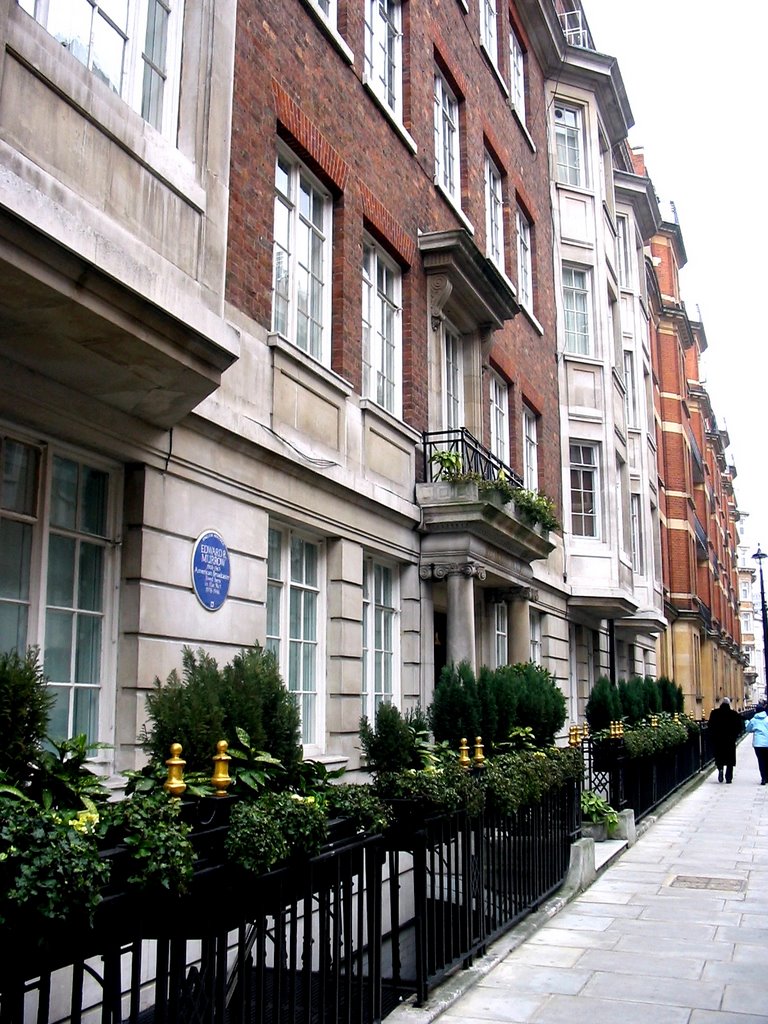
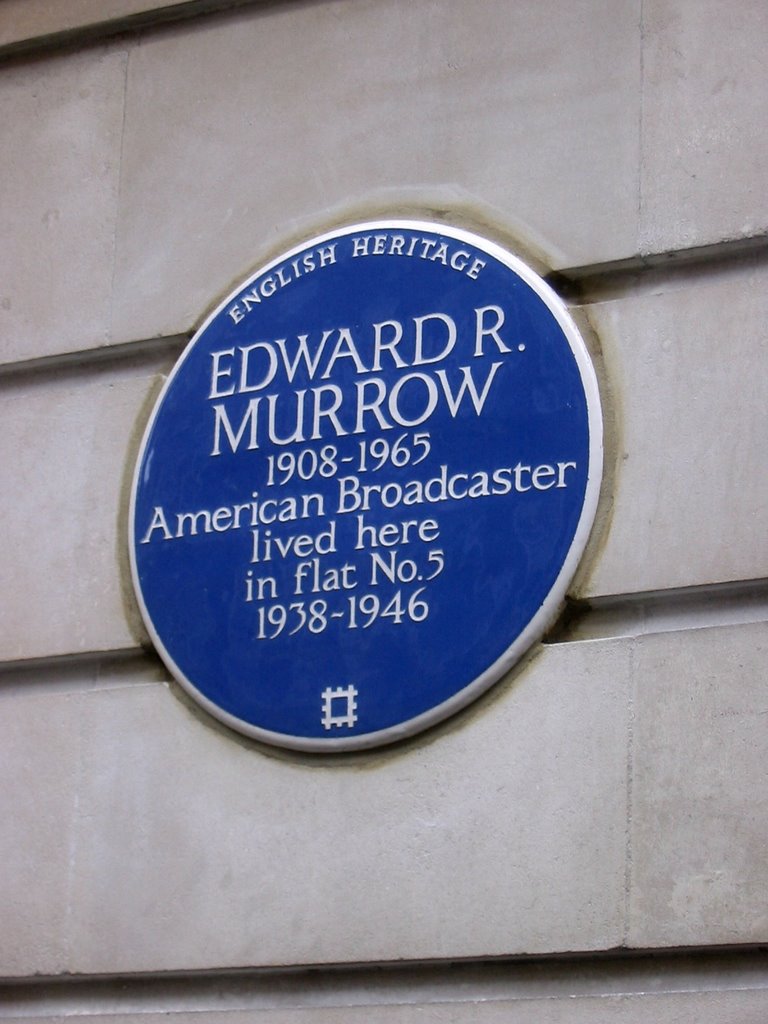
After a brisk two-hour walk from South Kensington, across Hyde Park, I arrived at Murrow’s former residence in Marylebone, not far from the British Telecom tower. I took a few photographs and walked on. I experienced no great stirring of emotions, let alone a spiritual connection. Yet the site itself, along with the act of finding, approaching and appropriating it pictorially became part of a design, enforced by the screening of Good Night, and Good Luck. my mate and I attended a day later. It had not been altogether planned that way; indeed, I was surprised to find the film to be still in such wide circulation.

The quietly impressive motion picture and my altogether unremarkable photographs do not so much amount to a biographical composite sketch of Murrow, a man who shaped history by recording it. Rather than capturing his past they suggest his presence—or our need for it.

Much of what Murray reflected upon in his broadcasts—even in reminiscences such as this one from 3 December 1944—is anything but dated, if only you permit yourself to look beyond the names of places and persons and weave his expressions of hope and fear into the fabric of our current wars and crises:

You remember those mean streets in London where so many died; the men stretching canvas over holes in roofs and walls, trying to patch things up before the winter comes, anything to keep out the rain and cold.  At the airfield you remember that it was just here you watched Mr. Chamberlain descend from his plane when he came back from Munich, waving his written agreement with Hitler and talking about peace in our time.  That was such a long time ago. And you wonder when there will be peace again and what it will be like. . . .

You recall all the talk of a better world, a new social order, a revolution by consent, that marked the desperate days, and you realize that talk of equality of opportunity, of equality of sacrifice, of a peace based on something other than force, comes more readily to the lips when disaster threatens.  There isn’t so much of it now [. . .]. 

Europe for a long time will be concerned with the urgent problems of day-to-day existence. The fundamental economic and social conflicts will not have been settled by this war. [. . .] 

For years after this war Europe will be in torment and [ . . . ] you wonder what part America will play in it all.  In battle and in production we have been magnificent.  We have delivered the planes, tanks, guns and ships and the men to fight with them.  The evidence of our strength can be found all around the world.  We’re not as tired as the others.  Our industrial plant is undamaged.  Our homes have not been blasted.  We enjoy security and relative comfort and our responsibility is frightening, for Europe will look to us—not for charity, advice or admonition, but for an example.  Democracy hasn’t been very fashionable over there in recent years and there are many who doubt that it can survive the strains and stresses of peace. . . .

Is democracy still “fashionable” anywhere? Is it the gear of choice or an imposed uniform that ceases to be fashion by resembling fascism? Has the current war on terror (or the terror of war) done much to preserve it? Are we still talking about a “peace based on something other than force”? The patterns we discover when engaging with the so-called past are often disturbing rather than reassuring. And yet, to ignore them, to refuse recalling them into our everyday, might be more disturbing still—a wilful refusal to connect that, far worse than passivity, is a violent act of tearing apart the fabric along with its flawed design.

“This . . . is London”: Departures for, of, and at the Theater

Well, I’m afraid this journal entry is going to be all over the place—like my luggage, as I am preparing for tomorrow’s trip to London. I would have enjoyed sharing one of my “What Those Who Remembered Forgot” obituary footnotes to commemorate the radio career of Oscar and Tony winner Maureen Stapleton (1925-2006); but I could not find any recordings of her performances heard on Best Plays, a US drama anthology that premiered on 8 June 1952 with a production of Winterset. Nor have I come across Stapleton’s guest appearances on radio’s Quiz Kids program. So, after some searching, I had to give up on the tribute and continued to plan my theatrical entertainments for the days ahead.

I have yet to see a truly great stage production in London, most of the plays I attended during my previous visits having been less than scintillating. Let’s see, there were the lackluster revivals of The Philadelphia Story and Once in a Lifetime, starring Kevin Spacey and David Suchet, respectively. While colorful and quirky, Matthew Bourne’s adaptation of Edward Scissorhands (discussed here) was choreographically far less impressive than his Swan Lake.

Rather more to my liking was the staging of Agatha Christie’s And Then There Were None, which, as discussed here, offered few surprises (being faithful to the novel), but a genuinely creepy finale.

Then again, I’ve always been fond of unabashed melodrama, even though, at today’s prices, theatrical thrillers are a decidedly rare and guilty pleasure. Gone are the days when everyday people flocked to the theater for some choric hissing of villains in plays with titles like The Worst Woman in London or The Ugliest Woman on Earth. I’d settle for a production of William Archer’s The Green Goddess, but doubt whether our politically correct climate—in which even a cast member of South Park balks after discovering his scientologically reconstituted conscience—still allows for the blossoming of such vulgar delights, now relegated to that slowly deteriorating hot house of popular culture, the movie theater.

Imagine a scene like this—as described by Charles Dickens—at one of today’s West End temples of drama:

We were a motley assemblage of people [. . .] . Besides prowlers and idlers, we were mechanics, dock-labourers, costermongers, petty tradesmen, small clerks, milliners, stay-makers, shoe-binders, slop-workers, poor workers in a hundred highways and byways. Many of us—on the whole, the majority—were not at all clean, and not at all choice in our lives of conversation. But we had all come together in a place where our convenience was well consulted, and where we were well looked after, to enjoy an evening’s entertainment in common. [. . .]
Between the pieces [a pantomime and a melodrama], we almost all of us went out and refreshed [. . .]. The sandwich—as substantial as was consistent with portability, and as cheap as possible—we hailed as one of our greatest institutions. It forced its way among us at all stages of the entertainment, and we were always delighted to see it; its adaptability to the varying moods of our nature was surprising; we could never weep so comfortably as when our tears fell on our sandwich; we could never laugh so heartily as when we choked with sandwich; Virtue never looked so beautiful or Vice so deformed as when we paused, sandwich in hand, to consider what would come of that resolution of Wickedness in boots, to sever Innocence in flowered chintz from Honest Industry in striped stockings. When the curtain fell for the night, we still fell back upon sandwich, to help us through the rain and mire, and home to bed.

Perhaps I could have done without those assorted noises and scents after all; but I sure enjoy an evening of unpretentious theater. Unfortunately, both Jerry Herman’s silent-screen musical Mack and Mabel and Noel Coward’s Hay Fever, starring Judy Dench, won’t open until April.

Instead of such revivals, I might be singing the Resurrection Blues. There is Robert Altman’s production of Arthur Miller’s play of that title, of course; but I have never been particularly fond of Miller, mostly due to his denunciations of radio, the medium that not only sustained him during the lean 1940s, but that influenced the mind-as-stage explorations attempted in plays like Death of a Salesman and After the Fall. I’d much rather see Altman’s latest movie, A Prairie Home Companion, Garrison Keillor’s own adaptation of his popular radio series.

I’ve still got my eye on Glorious!, that other play about the odd career of vocally challenged Florence Foster Jenkins, one version of which, titled Souvenir, I enjoyed when last I was in New York City. Well, we shall see what tickets I can manage to snatch up at the half-price booth. Next week, at any rate, I hope to share some souvenirs from what I trust will amount to a glorious time in the metropolis.

"This . . . is London": Getting Ready to Take in the Sounds Again

Broadcasting House, London

Well, it has been a rather gloomy weekend, a few hours of which were spent finding a publishing house and home for Etherized, my doctoral study on old-time radio. I have been slow to send out proposals but am aware that I cannot rest on my laurels until they begin to smell. The fresh air being too damp, cold, and swiftly circulated, I sought shelter by the fire and found pleasant company in an unflappable adventuress by the name of Eve Peabody. Surely you’ve met Eve Peabody, the blues singer whose voice, by her own admission, is strictly of the “bathtub” variety? You know, the gal who once crashed a ritzy social gathering with a pawn ticket for an invitation. Yes, that Eve Peabody—the gold-lamé garbed, Bronx Local-hardened heroine of Mitchell Leisen’s deucedly clever screwball comedy Midnight (1939).

There’s much to be learned from an urbane charmer like Eve (as portrayed with pitch-perfection by Ms. Claudette Colbert). Lessons in picking yourself up, dusting yourself off, and starting all over again, I mean. Having escaped a Monte Carlo disaster—a failed system that left her practically penniless at the roulette table, with the exception of that one French coin with a hole in it—Eve takes a gamble by hopping on a train to not so gay Paris.

Alighting none too delightedly with damp and dreary prospects before her, she inquires with sarcasm, rather than incredulity: “So this, as they say, is Paris?” Not altogether reassured by the conductor, she wryly remarks: “Well, from here it looks an awful lot like a rainy night in Kokomo, Indiana.” I might find myself saying something not unlike this when I step out of the train in London this Wednesday. The forecast is not promising; but, like Eve, I am determined to make the most of my stay.

Perhaps, my idea of a good time differs from that of most visitors, but, aside from the shops and a West End show or two, Edward R. Murrow’s house in Hallam Street is right up there on my list of must-see attractions. As I reported a few weeks ago, a blue plaque has been placed on the façade of Weymouth House earlier this year, commemorating the contributions of its former resident, Murrow, to bringing the terrors of the London blitz home to American radio listeners, many of whom may have otherwise been indifferent or downright hostile to the British, quite willing even to let my Nazi ancestors have their way with them.

“This . . . is London,” of course, was Murrow’s famous introduction to his blitz broadcasts. His reports made a distant fight for survival seem real and urgent—unlike that picturesque firework display that stood in for the air raids in the recent Judy Dench-starrer Mrs. Henderson Presents. After all, radio can produce terrors far more immediate than video or photography, provided you have mind, heart, and guts enough to translate dreadful sounds into horrible images.

Walking through London again, I might do what I used to do when I first came to New York City, which is, besides taking in the sights, to take in the sounds as well. When the broadcastellan journal was still in its infancy, rather than its present adolescence, I contemplated the soundscape of Britain. For, surely, London has one of the most distinct sonic designs of any Western metropolis, the chiming of Big Ben being its most memorable earmark. So, as an exercise in getting in tune with said town, I will tune in again to “A Portrait of London” (20 July 1956), a CBS Radio Workshop tour conducted by Winston Churchill’s daughter Sarah, who took American listeners right into the bell tower of Big Ben.

“So this, as they say, is London, huh?” I might find myself saying on Wednesday as I step out onto the platform at Euston Station: but, hearing the inimitable sounds of the big city, I am unlikely to add “Well, to me it sounds an awful lot like a rainy night in the Welsh hills.”

White House Warnings, the Iran "Challenge," and the Art of Recycling Words for the Atomic Age

Only yesterday I was leafing through my dusty copy of Rogues’ Gallery: The Great Criminals of Modern Fiction. Granted, the story of pickpocket Thubway Tham (discussed in my previous journal entry) was anything but “great,” the dubious gentlemen among whom he appears in this anthology, figures like Raffles or Arsene Lupin, being far worthier of the appellation. Putting the book aside and glancing at today’s headlines, I got to thinking about those real-life acts of roguery and their perpetrators, thieves and tricksters fit for a place in that proverbial gallery.

Without being facetious, I think that most of us are eager to put certain politicians right up there with confidence men, embezzlers, and racketeers. Unlike fictional smugglers, highwayman, or cardsharpers, however, our misleading leaders rarely inspire cloak-and-dagger romances, at least not while they are still in office. Their potential to do harm to a far greater number of people than any pirate of old renders them too treacherous to be enchanting, and too powerful to be defused by mere ridicule. That we might have contributed to their ascent—either by having been taken in by their words or by having stood aside while others made what we’ve come to suspect as the “wrong” choice—only drives home that the joke, if ever it was one, is decidedly on us.

In the United States, the people’s trust in their political leaders may be reaching a new low these days, giving way to an indiscriminate, haphazard scepticism that could potentially be more hazardous than the actions that triggered it. So, hearing the latest White House warning about the Iranian nuclear program, I wonder who among us, the citizens or allies of the US, is willing to accept or heed it. Is it a danger real or imaginary, pre-existing or newly conceived in the act of pronouncing it true? What’s more, is not even a manufactured threat a concrete one nonetheless, whether as propagandist tool or diplomatic blunder?

Thinking this, I was reminded again of “Air Raid,” a verse play for radio by Archibald MacLeish, a big name in American poetry and pamphleteering. “Air Raid” is a didactic drama about an unheeded warning. Now, as I remarked when I commemorated the anniversary of the its premiere, the play was originally an appeal designed to caution US citizens against isolationism. Confronting the public with an enactment of a deadly attack on civilians, MacLeish went so far as to suggest that those who lose their lives to wartime terror are responsible for the consequences of their inaction.

However questionable his achievement, the anti-fascist cause that motivated its author was a noble one. “Air Raid” suggests that the greatest threat facing a people is not posed by foreign aggressors or domestic demagogues, but by an attitude of indifference to or ignorance of the political affairs makes the public vulnerable to acts of suppression and obliteration. Yet, like all propagandistic speech—and the melodramatic vehicles in which it hits its target audience—these words of caution were readily coopted.

On this day, 10 March, in 1956, nearly two decades after its first broadcast, “Air Raid” was restaged by the CBS Radio Workshop. The same words poured once more from the speakers—but their context had changed entirely. Now the play had the stamp of the Eisenhower years pressed upon it, the gullibility of the public being relied upon rather than challenged with the announcer’s insistence that “Mr. MacLeish’s prophesy” had become “grim reality” in an age of “guided missiles” capable of “nuclear destruction.”

“Learn what you can do to increase your chances of survival,” the program’s announcer implored listeners at the close of the broadcast: “Contact your Civil Defense Office.” As American families retreated into their picket-fenced homes—or into dreams of such—they were left with the impression that the world outside the United States was evil and that their leaders had solely their safety, rather than profits, in mind. It was thus that the lucrative armament of the cold-war years was being justified. MacLeish’s warning had become “grim reality,” all right—so much so that the public was not to appreciate his original message.

So, given that we have mostly familiar words of warning to go by once more, how can we determined the honesty or falsehood of those who utter them? Does the present truth lie in the perceived deceptions of the past? And how far should we remain willing to listen with the generosity of an open mind—instead of hiding behind the reflecting shield of satire—to keep an essentially sound and worthy political system such as democracy from falling apart?

Thneaking Up on "Thubway Tham"

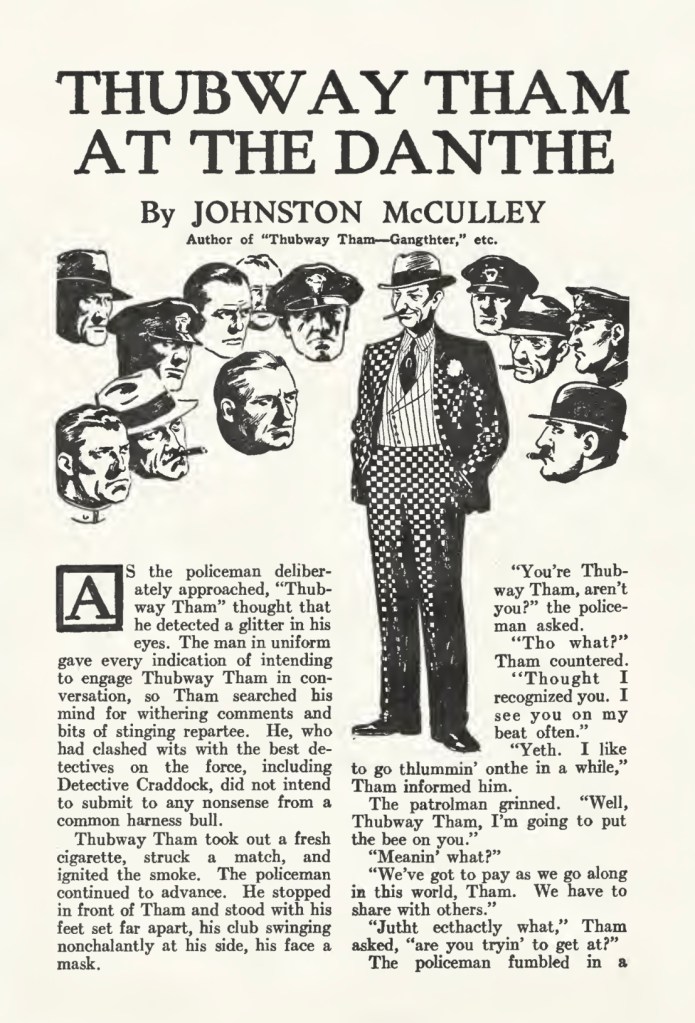
Thubway Tham, as he appeared in Detective Story magazine, 25 Jan. 1934

The other day I called detective Ellery Queen to the rescue when I found myself in need of some pop-cultural assistance while dealing with a certain case of bigotry in the blogosphere. Searching for a visual aid to prop up my improbable prose, I dug up my copy of Ellery Queen’s Rogues’ Gallery, a 1945 anthology of crime fiction containing radio scripts by Dannay/Lee and John Dickson Carr.

It occurred to me that, aside from those two scripts, I hadn’t read any of the other pieces in said volume. So, leafing through, I happened upon a story about a small-time crook with a big-time speech impediment, a lisp so thick that it earned him the nickname “Thubway Tham.”

Now, Tham never hit it big in radio or the talkies (with that voice, he had about as much of a chance to make it there as silent-screen siren Dolores Costello). That said, he was a rather popular pulp hero in his day, which is reason enough for me to make his acquaintance.

Thubway Tham was the brainchild of Johnston McCulley, creator of the recently if not altogether successfully resuscitated Zorro. According to McCulley (as retold by Mssrs. Ellery Queen), Tham first sprang into action during his author’s visit to New York City in 1919. Observing the crowds being “spewed out of the subway,” McCulley realized that those Big Apple commuters were a veritable herd of cash cows for a clever pickpocket.

In need of a saleable story, McCulley came up with “Subway Sam”; but, somewhat intoxicated at the time, the writer found that his mouth would not cooperate in pronouncing the name and settled for “Thubway Tham” instead.

An artful little dodger who forever thumbed his nose at the luckless Detective Craddock, his arch-enemy, Tham kept appearing and disappearing in story after story (some 182 by 1945, according to his prolific father); yet the times were changing, and what might have been amusing in the prosperous 1920s or reassuring in the lean 1930s was no longer appropriate during the war years, when paper was too precious for the spreading of questionable romances of self-serving criminals and the glorification of devious individualism.

Even less-than upright characters, such as the Saint, were being recruited for the war effort. And unless Tham was satisfied to go underground for the duration, disappearing from public view along with other misfits like honorable, but propagandistically irredeemable Mr. Moto, he was expected to take his hand out of other people’s pockets long enough to lend it to Uncle Sam.

Here is how McCulley’s aging lawbreaker, anno 1944, saw his dilemma:

Thubway Tham found his favorite bench unoccupied, and sat upon it.  He was thinking of the war.  Many of his younger friends had enlisted or been drafted.  Familiar faces were missing.  Even certain of the gentry habitually under the eyes of the police had accepted honest toil in shipyards and factories turning out munitions and war supplies.

Tham was sad.  A few days before he had tried to enlist and get into a uniform.  But there were several things wrong with him physically, the army surgeons found.  Tham had started the physical examination feeling rather fit, but by the time they got through with him he was wondering which hospital l would be the best when he unexpectedly collapsed on the street.

He was contemplating now seeking work in some defense plant.  But, frankly, that did not appeal to him.  Tham was a creature of habit, and a part of that habit was to ignore manual labor.  Moreover, work in a war plant would keep him away from his beloved subway.

So, McCulley confronted poor Tham with “the lowest of the low,” with con artists whose prey were “hicks from the sticks,” the “real men” about to fight for their country. Tham could continue stealing, but, punishing those more selfish than he and redistributing his loot, morphed into some simulated Saint, a decidedly less daring and debonair Robin Hood of Modern Crimes.

However valuable such sentimental propaganda might have been, the wartime heroics of turnabout Tham, as recorded in “Thubway Tham, Thivilian,” made for a rather dull and disingenuous Oliver! twist.

What might Thubway Tham be doing these days? Is he still trying his shaky hand at subway robbery? Or has he turned to that superhighway in the sky, where latter-day tricksters, unhampered by physical defects, find ample opportunity to keep their fingers busy and their pockets full?

Don’t let me catch you again, Tham.  Disguised as a conscientious “thivilian,” you pretty much wore out your welcome.

Up to My Eyes in Dog-eared Books

This is one of those rare, lugubrious days of landscape-swallowing fogginess on which you might as well retreat, brandy in hand, into the confines of your small but reassuringly familiar study. My thought being as opaque as the wintry sky, my mind as obnubilated as the mist-shrouded hills, I have put aside all semi-intellectual or quasi-artistic endeavors for the moment. Instead, I busy myself cataloguing the books in my radio drama library, another four dusty volumes of forgotten plays having arrived by mail yesterday. During my years of researching so-called old-time radio in New York City, I had access to several excellent public and academic libraries, however deficient my own.

While a vast number of recordings have been preserved, there are some plays you can only find on paper, among them rare pieces by noted American authors like Sherwood Anderson, who died on this day, 8 March, in 1941. Writing my dissertation, I was determined not to discuss at length any play I had never set my ears upon. The page seemed to be a poor substitute for a performance. Who, I ask you, would claim to know a movie having only read the screenplay? I thought. And yet, once your eye is becoming accustomed to the language of radio, you can almost hear the plays as they might have been produced.

Distrustful of my less than reliable memory, I used to photocopy much of what I read and carefully filed away each text for ready reference. After I had earned my doctorate and decided, propelled by romance, to move to the United Kingdom, I took those thousands of sheets out of their assigned ring binders, boxed them up, and posted them, along with most of my belongings, to be shipped overseas.

Upon my arrival in Blighty, I was not only confronted with stacks of paper (relieved to find them there), but with the problem of making a new and orderly home for them. Little did I know when I decided to be economic by dumping the old binders that the paper sizes in the UK differ from those in the US, that British sheet protectors are too narrow for American paper, and that such incompatibilities would spell many a tedious hour punching holes or cropping paper. Eventually, I resigned in frustration from such labors and resolved to ditch some of the copies in exchange for the originals, however obscure.

Tossing another photocopied script into the bin this morning, I noticed that the play thus preserved was broadcast on the first anniversary of Anderson’s death on this day in 1941. The piece in question is “The Test” by radio dramatist Joseph Ruscoll, and I have not yet come across a recording of it.

Produced by the Columbia Workshop, it concerns adolescent lovers Janet and Joseph who, thirty years after parting, are nothing but joyful memories and pangs of regret to one another. They separated as the result of a dare—the eponymous “test”—that was to prove Joseph’s love for Janet: would he give up his harmonica for their harmonious union? No, he would not stoop to accepting the challenge—and the two were twained no more. Through the miracle of the pre-cellular phone wireless, a radio commentator interviewing both brings about a reunion of sorts. After all, radio was, as Gerald Nachman put it, “yesterday’s internet”:

Narrator: And you never spoke to him again, Janet?

Janet.  Never.  (Sorrowfully)

Narrator: Or you to her, Mr. Pike? 

Joseph: I had my pride.  (Lowly)

Narrator (sighs): And that was thirty years ago?

Janet (flaring up): Pride! If he had really loved me, he wouldn’t have had any pride!

Joseph (flaring up in turn): And if she really loved me, she—what about her foolish pride?

Janet (indignantly): Foolish?

Joseph (crying out): Foolish! Foolish!

Janet: What do you think, Mr. Narrator?

Narrator (sadly): I think you were both very, very foolish.

Perhaps, we’d better put our keyboard to some special use tonight by searching for old friends or else put it aside altogether, seeking instead the company of neglected loved ones rather than dwelling in the sheltering obscurity of our inconsequentiality or sweltering in the ersatz heat of emboldening internet anonymity. I write for myself and strangers—but I live for a hug and a smile.

On This Day in 1943: Gracie Allen Decides to Replace Jack Benny with "Thirty Minutes of Refinement"

Last night, I finally got to see the so-called highlights of the Academy Awards, an assortment of leftovers that UK channel Sky One tosses to those subscribers who refuse to have juicy bits of trivia over-nighted for a premium. While mercifully abridged, the ceremony was chopped off at all the wrong spots, with more attention being paid to red carpet parading than to the presentation proper, let alone the politics behind the trophy distribution.

I had been looking forward to a few choice moments described by television critic Brent McKee in his online journal, but never got to judge for myself what exactly was the matter with Lauren Bacall, whom I had already presumed dead a few weeks ago. The commercials-riddled presentation made gossip-fest Entertainment Tonight look like an uncompromising piece of investigative journalism. Being accosted by the inane and utterly superfluous commentary provided by a couple of British MC stand-ins, I hardly even got as much as a glimpse of Jon Stewart, whose hosting of the high-profile, low-rated affair received rather mixed reviews.

Just how difficult it is to find a suitable master (or mistress) of ceremonies was played up in this year’s introductory Oscar sketches, in which former presentational misfires like Whoopi Goldberg and David Letterman refused to front once more what amounted to a chorus of disapproval.

What is required of an Academy Awards host is not simply a modicum of charm and wit, as well as a stature that bears a vague semblance to Hollywood star power, but also a persona firm enough not to crack when faced with the shocks and punctures it is likely to sustain during a never entirely predictable live broadcast. Censors and advertisers balk at volatile comics (an energetic personality Robin Williams once used to personify), as much as a large percentage of the statistical presence known as the general public might enjoy their ad-libbing antics.

True, the exposure of certain parts of the human anatomy aside, American broadcasters are no longer quite as squeamish as they once were in their furtive approach to the lexicon of the commoners (even though rap lyrics can still be awarded a prize without being deemed fit to air in their original form). Still, notwithstanding the fact that everyday language seems to have just about shrivelled to the utterance of monosyllabics, the broadcasters’ dictionary of permissible phrases sure used to be much smaller a few decades ago.

On this day, 7 March, in 1960, for instance, Jack Paar returned to host the Tonight Show after an absence of one month, during which he protested NBC’s rejection of a tame bit of toilet humor (some quip about a “water closet”). Today, of course, it is chiefly political correctness that concerns those who suck up the open air of which they are merely lessees while sucking up to the advertisers and corporate entities that condition it.

Sometimes I wonder whether the host is as overrated a figure as the actor who portrays the spectacle that is a James Bond movie. How irreplaceable are the ostensible headliners of any show, even if their names are as closely associated with it as, say, Jack Benny’s was with the Jack Benny Program? Benny learned the hard way on this day in 1943. The perennial 39-year old—who would later give a young Paar his break when discovering the newcomer while entertaining the troops)—was forced to sit out his own broadcast due to a cold, only a funeral having kept him away during the previous season.

Asked to substitute for him were fellow radio comedians George Burns and Gracie Allen. Yet while George was perfectly willing to pinch-hit for bedridden Benny, his batty wife simply refused to go on the air to take care of the impending vacuum.

Gracie had decided to become an intellectual, and filling in for the lead of an old comedy act just would no longer do. She was scheduled instead to give a piano concert, undaunted by her apparent lack of keyboards-tested talent. None of George’s coaxing would convince her to change her absent mind; besides, she already owned the expensive articles of clothing that George promised to bestow upon her in the event of her much-needed cooperation.

Eventually, Gracie condescended to do the show after all, having discovered a kindred soul in sensitive Dennis Day. Sure, he liked Little Women; but he liked books even better. And when he demonstrated his love for poetry by reciting Rudyard Kipling’s “If” in a pitch that screamed “cultured”—no ifs and buts about it—Gracie could not but seize Benny’s temporarily vacant timeslot, determined to present her “Thirty Minutes of Refinement.”

Now “refinement” was a concept to which violinist Benny himself aspired, but which those in charge of shaping popular radio entertainment mainly derided for profit as some harebrained, longhair attempts at bothering the blissfully ignorant with unnecessary uplift.

An Eye for an Ear: An Oscar "Triumph" for Radio Drama

Well, you’d expect me to go on about it, wouldn’t you? About the Academy Award for the documentary short “A Note of Triumph: The Golden Age of Norman Corwin,” I mean. Now, I haven’t actually seen the ceremony, shown live in the UK on one of those premium channels that test your willingness to pay yet a little extra for something that used to be free; on the night prior to the Oscars, I enjoyed instead “An Audience with Norman Corwin” (a recording of which is available on the BBC homepage until 10 March). The program features clips of several of the plays I wrote about in my study, including “We Hold These Truth,” “The Odyssey of Runyon Jones,” and experts from the World War II propaganda series An American in England.

To borrow the title of one of Corwin’s own commemorative pieces celebrating the triumph of the medium, “Seems Radio Is Here to Stay” after all. It is a rare occasion indeed when the visual arts are called upon to serve as a promotional vehicle for the theater of the mind, a theater that stood on shaky ground on the soil of American culture. Too often, old-time radio drama was reduced to the billboarding of motion pictures, to sly efforts of teasing home audiences out of their seats and into the theaters or the arms of the retailers.

So unless you choose to align yourself with the three unsympathetic passers-by who answered my poll question by stating that they simply “don’t care,” this Oscar win is an occasion for cheer and cautious optimism. I say “cautious” because I also don’t hold with those who argue my statement about the sorry state of and wanting respect for radio drama in the USA to be somewhat exaggerated, let alone patently false.

I assume those aficionados of the wireless are too much among their kind to notice how little the public knows about writers like Corwin, how little evidence there is of their works on the shelves of our stores and libraries. Even Corwin added a tentative “Seems” to his title. Not that he had doubts about its potential excellence, having so often provided evidence of it himself.

What’s so great about keeping one’s eyes closed? Is it an irresponsible drowning out of reality, or a hapless fishing in the shrinking pool of our imaginings? Or is radio just a plaything for those who missed the boat when it comes to modern technology? While I would not recommend it for viewers of American Idol, who’d realize that much of what we think we appreciate in sound is augmented by visuals, a time-out for our over-worked oculars may be a stimulating and downright exciting if perhaps disorienting workout for one of our often underestimated senses.

As Corwin put it in his salute to those already tuning in,

. . . it is good to take a nip of fancy every now and then,
A swig or two of wonderment
To jag the mind.
It’s good to send your thoughts excursioning
Beyond the paved and well-worn alleys of your life
If only as a form of exercise
Especially in wanton days like these.

The “days,” of course, are always “like these,” which makes this a time as good as any to go take that excursion on the airwaves. And should you decide to go sailing, surfing, or simply dipping your toes into that vast sea, come back again, if only long enough to tell me about your adventures. In the meantime, I am going to embark upon my own experiments in radio dramatics, the issue of which, if seaworthy, I might be sharing with you before long.

A Case for Ellery Who?: Detecting Prejudice and Paranoia in the Blogosphere

Well, only a few short hours ago I was writing about the constitutional freedoms that US citizens enjoy and the appeal American writers like Pulitzer Prize winner Marc Connelly made to 1940s radio listeners of the The Free Company (and “The Mole on Lincoln’s Cheek” in particular) to cherish and defend such liberties. I suppose that includes the freedom to sever one’s connections to anyone we realize to be incompatible or determine to be objectionable, regardless of any interests or passions we might otherwise share. Now, I don’t wish to make a Brokeback Mountain out of a molehill; but I have to confess that I am rather dismayed at the length one of my former readers went to in order to disassociate himself from my ramblings, sentiments he previously appreciated and endorsed. Allow me to expound.

I am always eager to read about and hear from others who, like me, are interested in early-to-mid 20th-century American popular culture; they need not be like me in other respects or feel themselves to be other, like me. Now that I am outside the academy and live somewhat remotely, I am thrilled to communicate with those who are drawn to the neglected yet fertile fields of silent movies, pre-code Hollywood, and old-time radio.

As may have become clear to the few who visit this site with some regularity, I am neither nostalgic nor flippant (or camp) in my approach to such marginalized topics. Nor am I an historian. The chief reason for keeping this journal is to share what I think matters to a few, regardless of how immaterial it may be to the many. Just who are these few, I sometimes wonder. And sometimes I get an answer that is disheartening if not, upon reflection, entirely uncommon.

Yesterday, I decided to add another online journal to my short list of links (see right). On said blog, I had left a comment about the sorry state of many old-time radio recordings, a remark that was kindly and publicly acknowledged, and received one in return regarding the career of actress Lurene Tuttle.

Pleased to have come across another old-time radiophile (I dislike lazy acronyms and refuse to stoop to letter combinations like OTR), I sent a message to the Tuttle expert, inviting him to be linked on my page. The response so startled me that I decided to drop today’s feature—much to my regret of disappointing an admirer of screen legend Kay Francis —and write instead about this sad case of blogophobia, the fear of being linked to and associated with someone as repulsive as myself.

I assure you, this is not a case of a bruised ego. I always assumed the most repellent aspect of broadcastellan to be its syntax and diction, its subject being merely inconsequential to most. It turns out, however, that the invitation was rejected as a direct response to . . . my blogroll.

According to the e-missive sent to me, one of the sites listed on the right is so offensive that said Tuttle-tale decided not only to refuse the link, but to erase the two comments I had left on his blog, even if doing so meant having to delete the posts to which they were attached—one of which journal entries having welcomed my “intelligent” remarks (about Vic and Sade) and greeting me as the first reader to leave a response. However obliging, I won’t go so far as to delete my essay about Ms. Tuttle in order to assist in this erasure, an obliterating not only of the former association but of the prejudice behind its severance.

What has this to do with Ellery Queen, apart from the double entendre intended? Well, even during the McCarthy era, in which small-mindedness reached its peak in the US, programs like The Adventures of Ellery Queen encouraged listeners to be open and embracing of those whose constitutionally protected beliefs, creeds, and pursuits of happiness differed from their own. Here, for instance, is the message attached to “One Diamond,” first heard on the Ellery Queen program on 6 May 1948:

This is Ellery Queen, saying goodnight ’till next week, and enlisting all Americans every night and every day in the fight against bad citizenship, bigotry, and discrimination—the crimes which are weakening America.

Should you find this message offensive and the people I chose to include in my blogroll abhorrent, I ask you—kindly but resolutely—to turn away and divest yourself of any associations with broadcastellan you might have sought or tolerated until now.