
 I guess I am still too wrapped up in US culture to have given British cinema its due. So, last weekend, while on a DVD shopping spree in Manchester, I made an attempt to rectify this cultural lopsidedness. Among my purchases was a copy of David Lean’s Blithe Spirit. Or is it more appropriate to call it Noel Coward’s Blithe Spirit, even after a noted director has . . . transubstantiated it? Generally, stage plays are treated like the brainchildren of their authors, while motion pictures are attributed to their directors. How many classic films could you trace back to their screenwriter parentage without resorting to the Internet Movie Database?
Anyway, it is an irksome inconsistency I grappled with when I needed to decide how to present and define radio plays for my dissertation (the aforementioned “Etherized Victorians”). Far from being a dead issue, the question arose anew when I followed up my screening of Blithe Spirit (1945) by taking in two radio disincarnations of Coward’s 1941 play.
The first one, soundstaged for Everything for the Boys on 16 May 1944, preceded the world premier of Lean’s feature by a year. Its adaptor was none other than Arch Oboler, probably the biggest name—and not the smallest ego—in US radio drama. Whether daring Americans to turn their Lights Out! or to put on a pair of 3D glasses, Oboler was hardly a subtle craftsman; he certainly was ill-suited to deliver the wit of Noel Coward.
Not surprisingly, Oboler’s rewrite of Blithe Spirit is a humorless affair, a tepid romance rather than a wicked romp. Presented to a live studio audience, the reconstituted comedy elicited only one laugh and a few mild chuckles; nor did it deserve more. The soundman was permitted to break a few dishes—flung by the two ghostly wives of the “hag-ridden” protagonist—but the damage was done largely by eraser, as hardly any of the play’s celebrated witticisms survived the adaptor’s indiscriminate airbrushing.
The challenge seems a formidable one when the play to be radio-readied involves ghosts visible and invisible, audible and inaudible, as well as the flesh and fancy of a decidedly material psychic. A filter microphone and a few hints from The Shadow will not suffice when wit is what is wanting.
Aside from a clipped and colorless script, the casting of Madame Arcati—the robust medium with a penchant for sandwiches, physical exercise, and dry Martinis—made matters worse: fluttery and frazzled, she lost much of her comic weight when portrayed by Edna Best. The Theatre Guild on the Air, at least, had access to the original New York cast. It also had the benefit of thirty-five extra minutes, and a script that retained much of the sparkle of Coward’s virtual sex comedy.
On 23 February 1947, nearly two years after Oboler’s inept dabbling in Coward’s froth, the Theater Guild revived Blithe Spirit with considerably greater success. It also broke a few dishes too many (to the audible delight of the studio audience to whom following the job of the soundmen had all the relish of an inside joke); but it kept both the spirit-flesh dynamics and civility-vulgarity dialectics relatively intact.
Sure, Mildred Natwick as Madame Arcati fudges a few good lines, and the attempt to explain the fact that Elvira, the irreverent revenant, is visible only to the tormented male and not to his second wife is almost as clumsy as my prose here. Still, having missed the recent London revival of the play , this was a more than tolerable substitute.
However much it tickled me to watch the redoubtable Margaret Rutherford (captured above in an ethereal fade) as she throws herself into the role of Madame Arcati, the Theater Guild adaptation brought the wit of Coward’s lines home to me like no coating of Technicolor ever could.
 Without being aware of it at first, I continued my engagement with the movies of 1939—Hollywood’s greatest year—last night, as I followed up a previously mentioned screening of Drums Along the Mohawk by projecting Howard Hawks’s Only Angels Have Wings onto my small big screen. Well, I must agree with cinema critic Ted Sennett, who held that the two leads were unfortunate miscasts. The suave Cary Grant (as flying ace Geoff Carter) does indeed cut a “faintly ludicrous figure, and Jean Arthur [as Bonnie Lee] is nobody’s idea of a showgirl.”
 As I realized anew last night, watching John Ford’s splendid Technicolor epic Drums Along the Mohawk, you don’t need historical footnotes or extensive background information to appreciate old-fashioned melodrama, even if such fictions claim to be based on verifiable facts. As an informed viewer, you’d probably be distracted and irked by careless inaccuracies or wilful distortions, interacting with the film intellectually rather than permitting yourself to become emotionally engaged—unless, of course, you are happily equipped with a remarkable ability to suspend disbelief. Surely I would never stoop to advocating ignorance, but such alleged bliss is no hindrance to the melodramatic experience. How different is the response to humor, especially when a bit of arcane trivia is called upon to serve as the centerpiece of a punch line.
 The day recalled in my

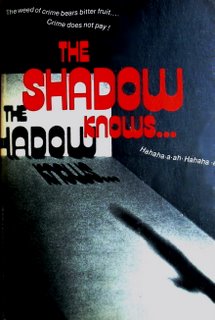 I remember the first time I heard the menacing voice of The Shadow—and it was not over the radio. I was a college student in New York City and was cleaning the Upper East Side apartment of a fading southern belle. Well, I needed the cash and she was too much of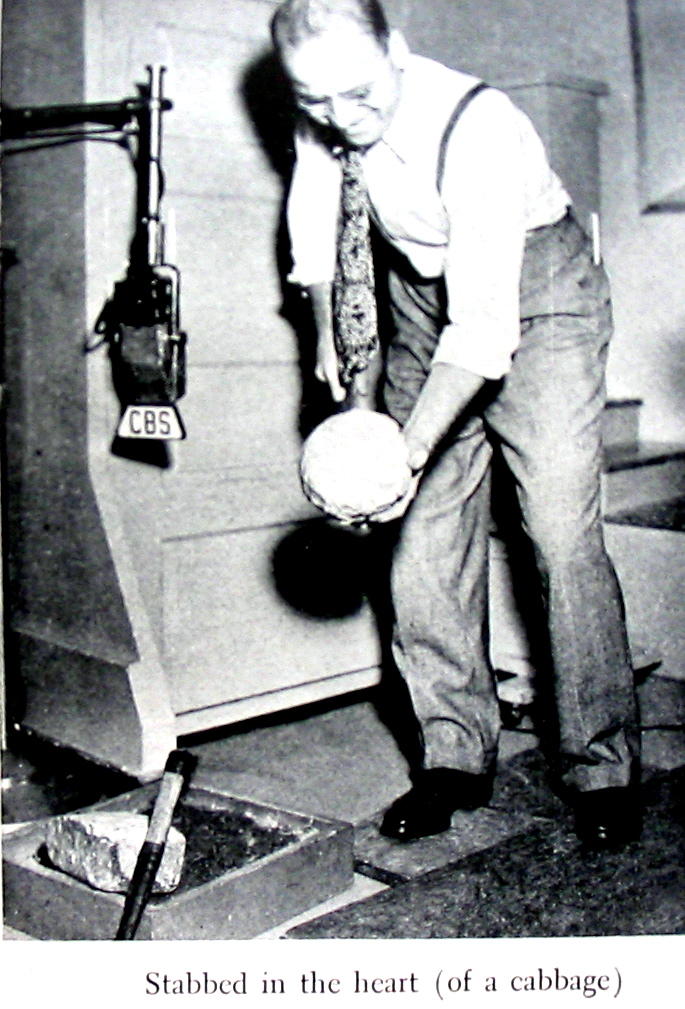
 Harry Heuser