Lost Issue: US Television, Elsewhere

A really old issue of Radio Times

Yesterday, at the local supermarket, a line on the cover of Radio Times caught my eye: “The new Desperate Housewives is here!” Since Housewives was the last—come to think of it, the only—dramatic series I had been following since moving here to Britain from the US, I was sufficiently intrigued to do a double-take. Yes, that’s what it said. Then I scratched my head in momentary puzzlement: A new season already, I thought, how could that be? As it turns out (and I tend to read carelessly at times) the line referred to the series Lost, which is being touted, somewhat misleadingly, as the newest US ratings champ in search of a British audience.

Lost, indeed! That show had its US premiere in September 2004. What took Channel 4 so long to land it? This might have meant smooth sailing in the days of Gilligan’s Island; but in an age of online piracy and file sharing, when motion pictures are tossed into the market in near-global simultaneity to counter ticket sales erosion, eleven months at sea seems a dangerously prolonged journey. It’s already been regurgitated on the web and neatly logged for me over at TV.com. So, why hop aboard now?

I grew up with second-hand culture. A TV-crazed kid in my native Germany, I very rarely watched any locally produced programs. Cartoons aside, my earliest memories include watching Hoppla Lucy (Here’s Lucy), Familie Feuerstein (The Flintstones), Lieber Onkel Bill (Family Affair) Die Bezaubernde Jeannie (I Dream of Jeannie), Raumschiff Enterprise (Star Trek), and, somewhat later, Drei Jungen und drei Mädchen (The Brady Bunch). All shows were dubbed, of course, but the production values—the home of the Bradys alone—told me that these shows had not been thrown together in my backyard. Although the Bradys were notoriously unfashionable, I took these hand-me-downs gladly.

That didn’t change much during the shoulder-pads decade, when Alexis Carrington Colby Dexter vamped herself to the top of the ratings in Denver Clan (as Dynasty was known in Germany). What did change was that I began to realize I was looking at preserved goods not quite as fresh as they were advertised to me (no, I’m not talking Joan Collins here). The tabloids were already giving away plot developments and cast changes for the months to come and what was left for me to do was to speculate just how the convoluted storylines would end up where I knew they would eventually go.

Melodrama thrives on foreshadowing and you-know-it’s-coming signposting; but these inside scoops were no markers woven into the fabric of the plot. It was almost like watching Psycho after reading Truffaut’s seminal Hitchcock interview—it was impossible for me really to see it for the first time. The experience was second-hand and I was almost forced to be distant and analytic in my reading, rather than engrossed. The feeling that I was untouched by something millions elsewhere had reveled in began to irk me.

Watching US television in the US, I experienced a sense of sharing, of participating in broadcasting events as they were unfolded to the public, even though the fictions I followed were no longer televised live. Now, I once again get the impression that I’m being dealt seconds. Pouting, I decided that, next week, when Lost comes along I’m not going to stand on the pier to watch this inaugural-seasoned vessel dock or sink.

So, when I got home from the market, I put aside the Radio Times, picked up a DVD, and settled down to watch The Shanghai Cobra from my Charlie Chan collection. Old hat and third rate, to be sure, but at least it wasn’t peddled to me as dernier cri.

The Caterpillar and the Butterfly: Fantasy Metamorphosed, from Corwin’s “Curley” to Burton’s “Charlie”

When I dipped my toe into the cool Irish Sea yesterday afternoon, I thought to myself “How detached I am from the enveloping present, how remote from the surrounding world.” Sure, I dip into the currents of culture now and again, but little of what is current seems to have any grip on me. I just shake my mind like that wet toe and retreat. Not that the beach was any more comforting for being terra firma. I was chilled by a feeling of rootlessness, intensified, no doubt, by my relatively recent transplantation to the west of Britain. And yet, here I am, nowhere and anywhere, tending to my journal. Well, according to Technorati, there is one born every second.

Not permitting myself to become wistful, I slipped into the darkness of a movie theater to take on the latter-day mongrel that is Charlie and the Chocolate Factory.  What a reassuring experience it turned out to be. Once again, I know where I am—and why I am there and loving it. The “there,” of course, is nothing but the sanctuary of my confirmed biases.

Tim Burton’s re-adaptation of Roald Dahl’s 1964 story is a mongrel indeed. It is a cautionary tale for children playing itself out as a computer game. Curb your greed, your arrogance, and your precociousness, it tells children, or you will suffer the fate of obnoxious brats like Augustus, Violet, Veruca and Mike. Obey your elders, even a deranged manchild like Willy Wonka, and your humility will be amply rewarded. The eponymous kid is too much of a goody-two-shoes to make a compelling hero (and, given the lesson learned by Wonka himself, retaining the title of the 1971 adaptation would have made more sense).

The trouble with Charlie is not its muddled message about innocence and purity, however; it is that, in its now treacly, now quirky delivery, in its very conception, there is too much of Augustus Gloop and Mike Teavee to render it sincere.  Charlie is a self-conscious if diverting botch. It is eye candy with a cavity built in; it is at once a celebration and a negation of fantasy. Does not Dahl’s description of Augustus Gloop sound like a critique of Hollywood blockbusters, of the spirit of Disneyfication? Listen:

How long could we allow this beast

To gorge and guzzle, feed and feast

On everything he wanted to?

Great Scott! It simply wouldn’t do!

However long this pig might live,

We’re positive he’d never give

Even the smallest bit of fun

Or happiness to anyone.

So what we do in cases such

As this, we use the gentle touch,

And carefully we take the brat

And turn him into something that

Will give great pleasure to us all . . .

It is telling that Burton’s movie very nearly drowns out these words in its lavish production numbers. In time it will metamorphose into DVDs and computer games, into the videodorous playthings of Mike Teavee. Conveying the warning about being a guy like Burton’s movie once again drowns the message by dreamcoating it in Technicolor:

The most important thing we’ve learned,


So far as children are concerned,


Is never, NEVER, NEVER let


Them near your television set—


Or better still, just don’t install


The idiotic thing at all.

In almost every house we’ve been,


We’ve watched them gaping at the screen.


They loll and slop and lounge about,


And stare until their eyes pop out.


(Last week in someone’s place we saw


A dozen eyeballs on the floor.)


They sit and stare and stare and sit


Until they’re hypnotised by it,


Until they’re absolutely drunk


With all the shocking ghastly junk. . . .


IT ROTS THE SENSES IN THE HEAD!


IT KILLS IMAGINATION DEAD!


IT CLOGS AND CLUTTERS UP THE MIND!


IT MAKES A CHILD SO DULL AND BLIND


HE CAN NO LONGER UNDERSTAND


A FANTASY, A FAIRYLAND!


HIS BRAIN BECOMES AS SOFT AS CHEESE!


HIS POWERS OF THINKING RUST AND FREEZE!


HE CANNOT THINK–HE ONLY SEES!

And what else, other than reading, “used the darling ones to do?” in the days “[b]efore this monster was invented?” Well (you may have guessed it, coming from me), they listened to the radio, that forgotten generator and amplifier of fantasy. Long before colorful butterflies like Charlie and the Chocolate Factory dazzled kids with a flutter of images, there was “My Client Curley,” Norman Corwin’s madcap adventures of a boy, Stinky, and his dancing caterpillar.

Stinky has to learn what Charlie seems to know and Burton doesn’t quite remember: money talks so loudly at times, it threatens to mute happiness and muffle the imagination. Unlike Burton, who clutters his film with pointless references to popular culture (Busby Berkeley, Psycho, the Beatles), Corwin offers a poignant mass media satire, of a world of commerce, sensationalism, and mediocracy.

Throughout it all, the dancing caterpillar comes vividly alive without uttering nary a syllable. There he is, in all his terpsichorean splendor. I’m there, too, knowing why I love old-time radio. Not because it is past, but precisely because it is present whenever I put my mind to it. So, to appropriate Dahl’s words for a plea for the theater of the mind, “please, oh please, we beg, we pray, / Go throw your TV set away, / And in its place you can install /A lovely [radio] on the wall.” Well, okay, keep the TV—but do give Corwin’s “My Client Curley” a try.

In Bed With Orson; or, How I Got the Wandering Ear

Elsa Maxwell, Claudette Colbert and Orson Welles

What I didn’t get to tell in Etherized Victorians, my doctoral dissertation, is how I love to cuddle up with a good voice. Aside from being rather too intimate an aspect of my passion for old-time radio to be shared in an academic paper, the sensuality and sway of the human voice, regardless of the words it conveys—seemed to be decidedly beyond the boundaries of my vocabulary.

I am hardly one to shy away from lexical experimentation; but I felt that I could not approach the subject—the mystique—of the vocal with the clarity and precision I aim for in all my linguistic playfulness. How, for example, could I describe the lush, seductive performances of Ann Sothern (as Maisie) and Natalie Masters (as Candy Matson), the sinister melancholy and paroxysmal fury of Peter Lorre (on Mystery in the Air, for instance), or the tender, tattered quavering of Gertrude Berg (matriarch of The Goldbergs) as I listen to them burble, groan, hiss and whimper, as I hear them snarling at or whispering to me?

How could I intellectualize the suave and mannered cadences of Vincent Price as the Saint or the hammy bluster of Orson Welles as Harry Lime? Some passions are not to be explained, to be argued out of existence. They are to be reveled in, secretly, in the shelter of darkness.

There are many such pleasures to be had listening to recordings of US radio broadcasts of the 1930s, ‘40s and ‘50s, a period during which voices were trained for and attuned to the special demands of the microphone. For me, they can be found and felt when encountering a friendly and well-groomed speaking voice of an announcer like Harry Bartell; a distinguished, eloquent recital like Ronald Colman’s (as in his D-Day reading of Edna St. Vincent Millay’s “Poem and Prayer for an Invading Army”); a tough, noirish delivery like Joseph Cotton’s (on Suspense); an unsentimental everymanliness like Joe Julian’s (on Corwin’s An American in England); a glamorous, sultry purring like Marlene Dietrich’s (as the peripatetic adventuress of Time for Love), Ilona Massey’s (as a spy-catching baroness in Top Secret) or Tallulah Bankhead’s (in her memorable role as hostess of the Big Show); a warm, avuncular drone like Nigel Bruce’s (as Sherlock Holmes sidekick and narrator Doctor Watson), a smart and charming lilt like Claudette Colbert’s (frequently heard on the Lux Radio Theater; above, in bed with Welles and etiquette maven Elsa Maxwell) or a queer pomposity like Monty Woolley’s (in his role as the Magnificent Montague).

Quite often, these voices had to convey lines better left unspoken, words unworthy of the actor’s talent. Yet through the magic of timbre and intonation, gifted performers could imbue almost any line with feeling, subtlety, or sly innuendo. And I’m not even talking about the suggestive reading Mae West lent to her characterization of Eve that got her banned from the airwaves. Last night I went to bed with Dane Clark. I didn’t quite get through his performance of John Andrews in a NBC University Theater production of John Dos Passos’s “Three Soldiers,” but his voice still lingers in my mind’s ear this morning.

Ever since I got my first radio, as a child, I have gone in search of voices, soothing, thrilling, enticing. I was eavesdropping on a hidden realm the passage to which was the canal of an eager ear pressed close against the speaker. It was my keyhole to the world about which I knew yet little, a world to which I did not yet belong. It was a levitating grown-up table, an off-limits chamber made of air and furnished by my imagination. Today, these disembodied voices come to me mainly by invitation. Whom, I wonder, am I going to take upstairs with me tonight?

The Eyes Have It: A Case of Overruled Aurality

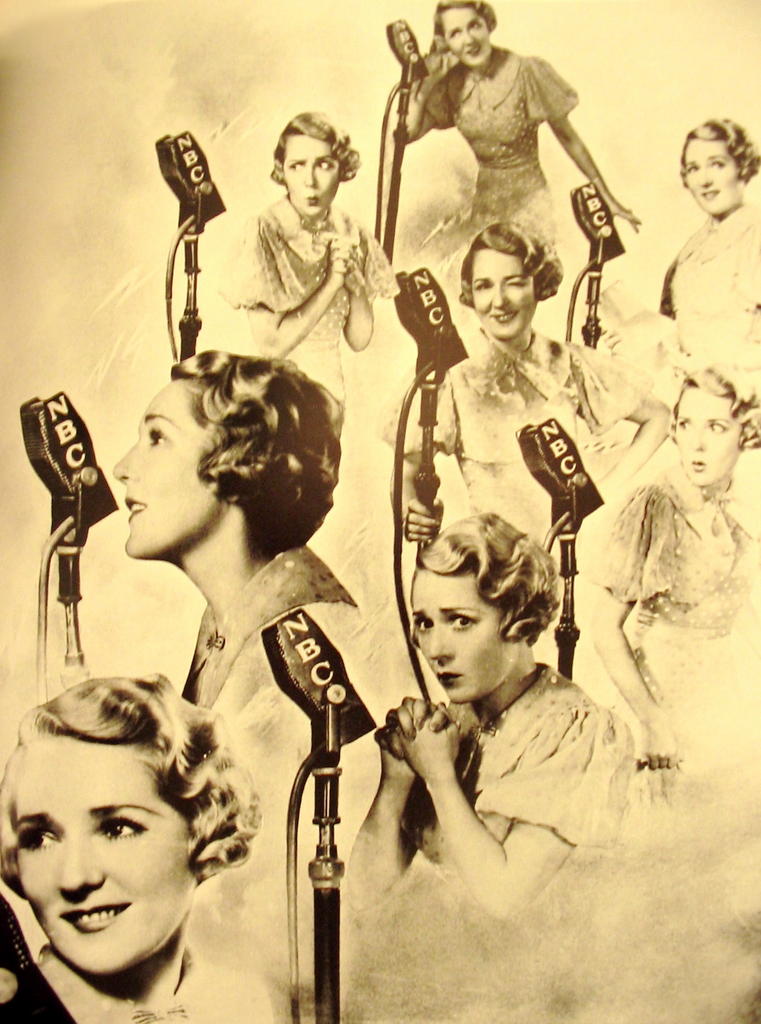
Mary Pickford, from silent screen to radio

Eye or ear—which sense organ do you value more? Which one would you more willingly relinquish? Do we rate or trust our perceptions according to a hierarchy of the senses? I frequently ask myself these questions as I lie there listening in the dark, as I set out to get lost in an imaginary landscape only to switch on the light once more in order to return to what is real and to focus my mind’s eye on the screen of my computer. Ours is such a visually conceived, mapped, and organized world—a world demanding and indeed dependent on “ocular proof”—that I gather most of us would rather part with our hearing than with our sight.

Our lexicon provides clear signs of how we “see” ourselves and “look” at our world; it makes plain, “at a glance,” that we have more “regard” for the icon than for the echo. We say “I hear you” when, in commiseration, we find a mirror image of our thoughts in the words of another; we say “I see what you mean” to signal that we have gained understanding, to show that we have gleaned “insight” from such communications. The ear merely confirms what the eye alone can truly demonstrate; and the ability to see clearly is of such significance to us that we tend to believe that a picture is worth more than a thousand words. Were the radio listeners of the pre-TV era—audiences in the true sense of the word—more likely to give up their eyes and to lend an ear?

To be sure, in the 1930s and ’40s, radio listening was America’s favorite pastime; according to one survey, more Americans were willing to forgo moviegoing and reading than go without their radios. The ways in which Hollywood attempted to catch up with or cash in on radio—after a decade of distrust, rivalry, and neglect—seem to attest to radio’s formerly central role in American culture.

The other night I was watching Look Who’s Laughing, a 1941 trifle starring a number of well-known radio players including ventriloquist Edgar Bergen, his puppet Charlie McCarthy, Jim and Marion Jordan (of Fibber McGee and Molly fame), Harold Peary (the Great Gildersleeve), as well as radio announcer Harlow Wilcox. Although carelessly tossed together, this production proved to be RKO’s most profitable production that year.

Radio personalities sure could sell a picture. And yet, rather than showing how powerful broadcasting was at the time, films like these suggest instead how dependent on visuals American audiences truly were. Not satisfied to imagine, they wanted images of the voices on the air. They bought radio magazines, flocked to studio broadcasts, and paid money to find on the big screen what the radio promised to deliver free of charge. Radio only delivered promises. It teased listeners with messages like “if you could only see us now” or “come and get it,” titillations ideally suited to commerce: to have means to behold.

Movies turned radio performers into stars or prevented former vaudevillians like Edgar Bergen from becoming invisible. Many movie stars (like Mary Pickford, above) stepped up to the microphone and were paid handsomely to address or perform for the masses. Radio—live entertainment for the living room—kept many an actor alive during the Depression; but it was screen and press exposure that assured a larger-than-life star status. Hollywood’s supplementality, its ability to augment or substitute reality, to make us see and believe, tells us much about the tyranny of vision. Now excuse me while I close my eyes . . .

Anodyne Thrills, Abject Thraldom: Broadcasting “fear itself”

“The only thing we have to fear is fear itself,” US president Franklin Delano Roosevelt insisted in his 1933 inaugural speech. These days, as bombs are going off again in London (and, for that matter, in many other places east and west) and as people are being victimized both by terrorism and the measures taken to control it, this famous aphorism seems particularly poignant. What is to be feared, certainly, is the abject thraldom of fear, the suspicion it breeds, and the potential it has to quell the spirit of humanity, to diminish our ability to act within reason and with understanding. As is the case with all epigrams, however, FDR’s becomes shorter on wisdom the longer it is pondered.

What might this be, “fear itself”? Is fear not always a reaction, whether reasonable or not? As a response to stimuli or surroundings, it is neither to be feared in “itself” nor as part of our being. The avoidance of conditions potentially harmful to us is an instinct it would hardly behoove us to conquer in our efforts to become more civilized, less primal. I lived in New York City when the World Trade Center towers crumbled in a cloud of asbestos-filled dust. What impressed me most during the immediate aftermath was that those living in fear and trembling were reminded of their mortality, encouraged to examine their everyday lives in order to find ways of making themselves useful to others. Even heroes were publicly shedding tears.

While often admired, warriors who prefer fight over flight are often less civilized than the worriers who respond to threats by trying to avoid them or void them with circumspection. In any case, fear is hardly the “only thing” to be dreaded, no matter how dire the situation. Recklessness and heedless indifference of dangerous consequences beget more horrors than caution, awe, or diffidence. What is to be feared most, perhaps, is fearmongering—the deliberate provocation of fear, the manufacturing of fear for profit or political gain. The media are open, the masses vulnerable to such designs. Yet when the fears are real and not sensed keenly enough, imagined terror may assist in making true horrors apparent.

The 7 December 1941 broadcast of Inner Sanctum Mysteries‘s “Island of Death” suggests just slow the radio industry was to react to the terror that had finally hit home. The show, however inappropriate, had to go on, for the sake of the sponsors. The titular island is not, of course, Hawaii; but it is doubtful that either this “strange and terrible tale” of black magic or the sponsor’s product, “Carter’s Little Liver Pills” (the “best friend to your sunny disposition”) could do much to get people’s minds off the topic of the day or alleviate the anxieties the news—or lack thereof—must have produced.

The government could not afford radio drama to remain escapist. Within a few weeks after the attack on Pearl Harbor, fear became a weapon aimed at mobilizing the homefront. In Arch Oboler’s “Chicago, Germany,” for instance, listeners were confronted with the dystopia of an America annexed and governed by the Nazis. With nightmarish fantasies like these, the Treasury hoped to raise millions for defense.

It is too simplistic to argue that audiences then were more gullible or less sophisticated than today’s consumers of popular culture. Certainly, the 1940s, when millions of civilians perished or faced irreparable losses as the result of global warfare, were not “innocent” times, as those pining for nostalgia might opine. They were times of uncertainty like any “now” any time, times of suffering, hardship, and frustration—times during which those tired of threats or numbed by pain needed to be reminded that a present free from fear might bring about a future without freedom, that to stop fearing might well mean to stop living.

The weekly blood-and-thunder anthologies were deemed particularly suitable to the awakening of real terror through imaginary thrills. Underlying the tension of such melodramas, wrapped up neatly within less than 30 minutes, were the anxieties of war, which were often driven home with a final curtain call appeal. Even shortly before the end of the war in Europe, when those listening to the tales of The Mysterious Traveler were invited to rejoice as ”Death Comes for Adolf Hitler” (24 March 1945), a mere month prematurely, they were cautioned that the dangers of Nazism were still very much alive. So, rather than being purely escapist, the terror of the airwaves provided anodyne thrills to impede abject thraldom.

Today, the uses of fear are well understood by the terrorists, that new breed of indiscriminals holding the world hostage; but the weapon that once was the thriller is too rarely being honed to prepare us for them.

In Pursuit of Echoes; or, the Vagaries of Coveting Nothing

What attracted me to live broadcasting to begin with is its transient nature. Radio plays are being played out in time rather than space. They pass through your mind, where they might well linger; but the sounds proper are gone as soon as they are heard. After World War II, when producers of radio plays in the US increasingly resorted to transcriptions, that is recorded sound canned for later broadcast, listening in lost much of its intimacy and immediacy.

The actors were no longer performing live and radio was no longer the immediate medium that brought absent listeners into the presence, the not-here-but-now of the speaker. The age of the rerun had begun; performers were becoming less engaging, less careful in their readings, and recording and editing technology presented those in charge with more opportunities to control and censor what was being uttered.

In the years between VJ-Day and the Korean war, commercial radio was more clamorous and importuning than ever. It had lost its lure, however, its hold on the American imagination. As in the myth of Echo, the living voice was tamed, became petrified, repetitive, and ultimately inconsequential. It was stillborn, already past before being presented. Recordings took the live—the life—out of radio.

Today’s technology has made it easier than ever to capture sound, to retrieve and release it, encouraging us to become ever less attentive, ever more in need of external memory, of megabytes, databases, and hard drives. Yet, as I was reminded last week, sound waves resist being shored; however preserved, they remain fleeting, that is, being fleeting, refuse to remain.

As a result of some carelessness on my part I damaged my computer and lost my entire library of recorded plays; some 7250 of them, gone. For months I was in pursuit of thin air and, with one shock to void a thousand voices, ended up with nothing. Storing radio ephemera, cataloguing plays neatly and listening to them with proper knowledge of their precise broadcast date, of their place in time, has been an obsession of mine for years.

When I began to write about the time art of radio dramatics I realized, time and again, just how much of what is preserved and available online is incorrectly or inadequately logged. It had been my aim to serve aural art by preserving it; but, having been thwarted in my efforts, the paradox of live recordings makes itself keenly felt. I was in pursuit of Echo, but now feel more like Narcissus staring into the mirror of his own folly. If only I could remember, re-member the missing pieces now almost beyond recall. . . .

Well, almost. The machine might have given up the ghost, but the aftermath isn’t the last act of Hamlet; “the rest” will not have to be “silence.” The pursuit continues, and I am forever catching up with the elusive echoes of sound’s past.

“War of the Worlds”: A Report from the Sensorial Battlefield

We know that in the early years of the twentieth century this world was being watched closely by intelligences greater than man’s and yet as mortal as his own.  We know now that as human beings busied themselves about their various concerns they were scrutinized and studied, perhaps almost as narrowly as a man with a microscope might scrutinize the transient creatures that swarm and multiply in a drop of water.  With infinite complacence people went to and fro over the earth about there little affairs, serene in the assurance of their dominion over this small spinning fragment of solar driftwood which by chance or design man has inherited out of the dark mystery of Time and Space.  Yet across an immense ethereal gulf, minds that are to our minds as ours to the beasts in the jungle, intellects vast, cool and unsympathetic, regarded this earth with envious eyes and slowly and surely drew their plans against us.  In the thirty-eighth year of the twentieth century came the great disillusionment. . . .

This 1950s paperback from my collection includes the script of the 1938 “War of the Worlds” broadcast.

With these ominous lines, read by Renaissance ham Orson Welles, opened what is now the best-remembered and most widely discussed of all US radio plays—Howard Koch’s adaptation of H. G. Wells’s “War of the Worlds” (30 October 1938).  Apart from this introduction, a slightly tweaked passage of Wells’s original narrative, the infamous Mercury Theater production took great liberties with its source.  It was an infidelity that proved most felicitous; for rarely has any story been transferred from one medium to another with greater ingenuity and with such sensational results.

Steven Spielberg’s cinematic update, which I experienced yesterday, pays homage to both Wells and Welles by quoting these words, by delivering them in a sonorous, Wellesian voice (Morgan Freeman’s), and by employing them as a literary bookend for an episodic melodrama that unfold as a series of more or less stupendous set pieces.  Freeman’s voice-over narration notwithstanding, Spielberg’s conventional sci-fi thriller—some kind of intergalactic Jurassic Park—has none of the qualities that made the radio play such an engaging and provocative experiment in adaptation.

Like all filmic reworkings, Spielberg’s spectacle struggles with and falters under the pressure of making terror visible, of equating the evocative with manifest dread.  The opening montage sums up the war to be fought by zooming in on the sources of threat and salvation, cosmos and microcosm.  Neither infinite outer space nor infinitesimal innerspace remains hidden from view.

The camera soon assumes the role of the terrorizing invader alluded to in Wells’s introductory remarks, as the menaced protagonists are being “watched closely,” “scrutinized and studied, perhaps almost as narrowly as a man with a microscope might scrutinize the transient creatures that swarm and multiply in a drop of water.”  As in our daily lives, captured by infiltrating webcams and ubiquitous close-circuit security equipment, vigilance and violence coincide; the act of surveillance has become the art of assailants.  And still, the demand for ocular proof has to be satisfied at all costs.

Throughout the movie, the hero’s daughter is cautioned not to look as camera and special effects expose the audience to the horrors of alien warfare and the consequences of human frailty.  In one scene, she is being blindfolded by her father in an attempt to shelter her from the murder he feels compelled to commit.  For one brief moment, the audience is spared a graphic scene.  As the crime is being perpetrated behind closed doors, a close-up of the girl’s face reveals that her mind’s eye creates an image no less terrifying than the atrocities she had witnessed before.  The father, like most western adults, has become too dependent on visuals to recall the power of suggestion and the thrills produced by the insinuating ear.  The movie thus manages to disclose his failings—and our sensorial loss—but cannot combat the empire of the eye to which it is beholden.

However futile, the radio artists of the 1930s and ‘40s were among the last dramatists to wage war against the dominion of the visual world.  Howard Koch’s adaptation proved to be one of the last victorious battles, dealing such a blow as to put censors on guard against the forgotten force of non-visual stimulation.  Then, “in the thirty-eighth year of the twentieth century came the great disillusionment. . . .”

Related writings

“Thousands Panic When Nelson Eddy Begins to Sing”
“‘War of the Worlds’: The Election Edition”

Listening Away; or, Sound and Soli[ci]tude

Well, I missed Live 8 this weekend; or it went right past me, rather. These days, I seem to be catching up with the world instead of living in it. Visual reminders of the present are all around me; but they flicker in a sphere of some remove, while the sounds of the past, close up and intimate, continue to envelop and move me. The world of today often appears to be a realm apart, not an actuality that envelops me. Even if it calls out to me, I can rarely be reached for comment.

Does Kate Smith still ring a bell?

So, the spectacle of Live 8 has passed me by. Of course, mass-mediated fund-raising efforts and public appeals are nothing new; they certainly precede television. There was Kate Smith, for instance, who raised millions for defense on US radio during the war loan drives of the 1940s. US programs like the Treasury Star Parade produced plays and staged musical numbers expressly for that purpose.

Not long after VJ Day, public service announcements encouraged listeners to assist financially in the rebuilding of Europe, to give to civilians who, not too long ago, were to be thought of, if at all, as adversaries and extensions of enemy forces.

War and peace propaganda aside, radio audiences were often urged to contribute to their communities and be socially responsible; they were reminded that careful listening meant responding and interacting, even though the actions to be taken were dictated to them.

Undoubtedly, Live 8 is creating the greatest gathering of individuals being sold on a latter-day Borrioboola Gha—a distant, indistinct mass of people unified in hunger and deserving of charity, provided the image of “Africa,” its local needs and multiple identities can be commodified, packaged and transmitted globally as a relatable tune.

I can recall the Band Aid efforts of 1985. Excited as I was by the idea of becoming part of a transnational musical bloc party, I never thought much about the cause behind it nor made any contribution other than showing up for it at an open-air concert in Cologne, Germany.

Today, making a spontaneous, one-time donation is as easy as pressing a button on your mobile phone; but can the incongruous, televised images of musical entertainers and starving children assist in making complex geopolitical situations, post-colonial legacies and neo-Imperialism more transparent, or even in making millions elsewhere matter at home?

Can an image truly say more than a thousand bytes of sound? Presumably, the fleeting utterances airwaved on live radio appeal to the emotion more than print or visual media, which encourage closer scrutiny and permit re-examination—the remove of reason.  Radio, it has been argued by Marshall McLuhan and his followers, is a fascist medium. It is the fabled tribal drum, a sonic leveler—enchanting, reverberating and hammering home.

Indeed, the aural medium strikes me as a more immediate, more readily suggestive propagandistic tool than other mass media. Sure, television or computer screens, too, can reach the multitude-as-individuals with whatever messages they are employed to convey; but the eye, opening up a world, also keeps it at a distance. We look on, stare or gawk at something other than and outside of ourselves; even our own image, once televised or screened, becomes strange to us.

Unlike the eye, my ear brings the world home, making even the infinite seem intimate. Whatever “eager droppings” spill over the “porches of my ear” melt into me, become me. I take sound in, am taken in, and, thus taken, am carried away—by force and by choice—from the image empire of today. I am listening, away.

[Last revised 25 January 2025]

A Soundscape of Britain?

Princess Diana Memorial Fountain,
Hyde Park, London

A few days ago I went to the Tate Gallery in London to see A Picture of Britain. This exhibition of paintings, coinciding with a BBC television series, did not exactly get rave reviews. Critics complained that the real Britain was, for the most part, left out of the picture. The works on display mainly feature idyllic representations of what Britain could be or ought to be, according to followers of the Picturesque or romantically inclined artists. In short, plenty of nature, little naturalism. I wonder how A Soundscape of Britain would turn out, if ever there were such a showcase devoted to national noise. What would be the representative sounds of Britain?

In the US, during radio’s so-called golden age, the Columbia Workshop and the later CBS Radio Workshop offered listeners aural snapshots and panoramas of New York, London, and Paris. “A Portrait of London,” for instance, which aired over CBS on 20 July 1956, took listeners to Big Ben, the city zoo, and Buckingham Palace, with Sarah Churchill (daughter of the former Prime Minister) serving as tour guide.

A few weeks earlier (7 July 1956), the Workshop had taken tuners-in to Paris, while “The Sounds of a Nation” (18 November 1956) sonically evoked the history of the United States. Some twenty years earlier, the Columbia Workshop had presented a “Broadway Evening” (25 July 1936), a noisy report from the bustling Big Apple. Other such programs include “Crosstown Manhattan” (8 December 1938) and Norman Corwin’s “New York: A Tapestry for Radio” (14 May 1944).

While more concerned with the spoken word than with the creation of collages in sound, Corwin conducted frequent experiments in bringing faraway places home to the radio audience with travelogue series like An American in England (1942) and Passport for Adams (1943), as well as the ambitious documentary One World Flight (1947), which consisted of interviews and recorded sounds from actual locations in Italy, India, and Australia.

Corwin’s travelogues did not simply revel in sound qua spectacle; they were propagandistic or didactic in nature, designed to glean messages from or impose meaning on bits and bites of sound. As Alexander Pope once put it, the “sound must seem an echo to the sense.” How, then, could one make sense of Britain through sound? What, besides the tolling of Big Ben, or the water gurgling in the Diana, Princess of Wales Memorial Fountain (pictured above), or the chirping of robins, or the roaring North Sea, or raindrops falling on hedgerows, might be A Soundscape of Britain?

Many years ago, visiting New York City for the first time, I walked through the streets of Manhattan to capture the sounds of the sirens, the pedestrians on the pavement, the honking of cars and the hollering of cabbies during rush hour. It gave me immense pleasure listening to these recordings back in the misery that was my home across the Atlantic. I could drown out the silence and loneliness in ways that a few pictures in my photo album could not accomplish. I have always loved wrapping myself in sound’s cape, escaping in sound . . .

Charlie’s Chance; or, How Not to Blog

Blog like hothouse flower: Must blossom for anyone. That is how the incomparable Charlie Chan might have expressed my present dilemma. I am not at all pleased with the previous entry into this journal. Rather than sharing what I love, I exhausted myself, and, no doubt, the good will of others in a tiresome, impersonal rant. I had wanted to make that in which I delight relevant to those unfamiliar or reluctant to catch on to it by availing myself of a prominent, topical hook; but instead of writing about the wit of satirist Fred Allen, my favorite US radio writer-comedian of the 1940s, I ended up going on about the latest foray into UK television by Jerry Springer, whom I despise.

It is quite easy to write a diary (if you have learned how to be honest with yourself and have come to terms with the level of intimacy you can handle when writing about your innermost thoughts); but once they are being made public, those private thoughts are expected to matter to others. They must have a purpose other than self-indulgent expression.

What I am still struggling to reconcile in this journal is the public and the private, being at once intimate and out there. That is, I have not yet assumed a persona I can trust at the microphone as I broadcast these thoughts from home. Those who seek fame or monetary gain are generally quite sure of themselves and their chosen medium. I, who have nothing to lose but face am less self-assured. Only of this I am certain: I want to write what I know best and love most. Do I care whether anyone else shares whatever views I express? Would I like any of those anyones to let me know? Sure I would. Still, the telling must come first.

“Little things tell story,” as Chan reassuringly put it. I am very fond of the man, whom I first encountered on German television when I was in my early teens. Back then, I felt envious of his No. 1 son (and all his numerous offspring). I did not have a close relationship with my father; so, the sleuthing, world-travelled “Oriental” with the gentle touch and a houseful of kids became a guardian to fantasize about.

Today, in this politically corrected and lawsuit-controlled climate, Chan doesn’t have much of a chance as hero and model. role model or heroic figure (a talked-about Lucy Lui project notwithstanding). In his prime, he was loved even by the Chinese, although no fellow countryman portrayed him on the screen. His wisdom, delivered in what is known as Chanograms, blossomed for anyone.

Yes, Charlie Chan was once again on my mind this week when I came across and purchased the Chantology DVD set (pictured)—which is what makes my reference to him topical and relevant to me. Whether it matters to anyone else—whether anyone cares to know or share—is another matter, a mystery as yet unsolved.

I think I now know how not to blog. I am just not sure yet how . . .