The Pink Standard: Legally Blonde at Aberystwyth Arts Centre

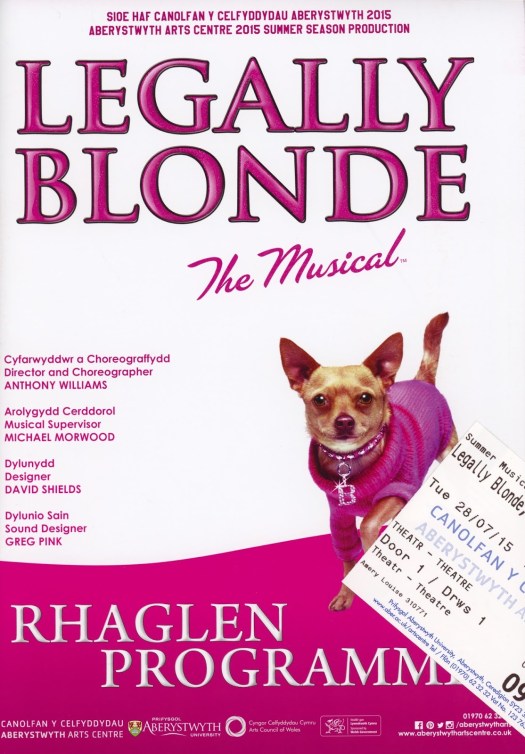
Okay, I am blond, gay and European. So it isnโ€™t all that difficult for me to relate to this yearโ€™s summer season offering at the Arts Centre here in Aberystwyth. โ€œPositiveโ€ and โ€œOmigod You Guys,โ€ itโ€™s Legally Blonde: The Musical. Ever since I relocated, for love and legal reasons, to this little Welsh town โ€“ from an island, no less, that has Broadway running through it โ€“ I have not missed a single one of these seasonal spectaculars. After all, they are often the only indication that summer actually takes place here. And since that very first show โ€“ which was Oliver! back in 2005 โ€“ I have been coming back to the scene it would be a crime to miss.

Iโ€™ve also seen the summer season grow up over the years, and the characters along with it, from a criminally mistreated but dutifully hoofing and oh-so-adorable Victorian orphan to a stylish, twenty-first-century Harvard Law graduate who seems to be fighting a lost cause but ends up winning her first case and her true love besides.ย 

Inย Legally Blonde, justice is served as in Dickensian days, except that what you deserve is no longer dished out as a helping of destiny. I wonโ€™t say that either way is โ€œSo Much Betterโ€ than the other โ€“ for entertainment purposes, at least โ€“ but it sure is about time to have, at the heart of it all, three persevering females who donโ€™t have to suffer Nancyโ€™s fate so that the Olivers of this world can enjoy the twist of their own.

Legally Blondeย does its part to โ€œBendโ€ if not quite โ€œSnapโ€ the long string of boy-meets-girl plots of theatrical yesteryear; at the same time, it cheekily pays tribute to the ancient laws of Western drama, right down to its cheerleading Greek Chorus. The conventions are not discarded here but effectively โ€œWhipped Into Shape.โ€ And what it all shapes up to be is an updated fairytale of boy meets girl in which girl ditches boy since boy doesnโ€™t meet the standards girl learns to set for herself.

The lads, meanwhile, perform parts traditionally forced upon the ladies: they are the chosen or discarded partners of the women taking charge. Unless they are objectionable representatives of their sex, like the opportunistic Warner Huntington III (convincingly played by Barnaby Hughes), the men ofย Legally Blondeย are mainly paraded as sex objects, flesh or fantasy. ย Exhibit A: stuff-strutting Kyle (inhabited by a delivering Wade Lewin). ย Exhibit B: gaydar-testing Nikos (gleefully typecast Ricardo Castro, returning to Aberystwyth after last yearโ€™s turn as Pabloย in the divineย Sister Act). ย Come to think of it, even the two dogs in the show are male โ€“ and how well behaved these pets are in the hands, or handbags, of the women who keep them.

Not that it looks at first like the women have a clue or a fighting chance. I mean, how can a gal be oblivious for so long to the connubially desirable qualities of gentle, reliable if fashion-unconscious Emmett Forrest (played by David Barrett, who was unmissable as Mr. Cellophane in the Aberystwyth production ofย Chicago)? That Elle Woods ultimately finds her way and gets to sings about it is the so not gender-blind justice ofย Legally Blonde.

And that we side with the spoiled, seemingly besotted sorority sister is to a considerable degree owing to Rebecca Stenhouseโ€™s ability to make Elle mature in front of our eyes, from bouncily naรฏve and misguided to fiercely determined yet morally upright. And, as her character gets to prove, a valedictorian is not just Malibu Kenโ€™s girlfriend in a different outfit.ย Legally Blondeย demonstrates beyond the shadow of a doubt that you can be pretty and โ€œSeriousโ€ in pink, even though I, personally, have failed on both accounts.

Depending on Elleโ€™s success in getting her act together is the life and career of Brooke Wyndham (energetically played by endorphin-level raising Helena Petrovna), a celebrity on trial whose fitness empire is endangered by a dirty secret of a potential alibi. And if you are a cynic out for a hanging, just wait and see what Brooke (and Petrovna) can do with a piece of rope.

As it turns out, Brooke does not have to make a case for orange being the new pink, which of course was the old black. Ultimately, not wardrobe but a serious case of TTP saves the day, for which the production hairdresser can take some credit. Follicles play nearly as big a part inย Legally Blondeย as inย Hairspray, to name another property Aberystwyth Arts Centre has laid its skilled hands on in recent years. And if that production had a showstopper in โ€œbig, blonde and beautifulโ€ Motormouth Maybelle,ย Legally Blondeย has down-but-not-out stylist Paulette Bonafonte, a role Kiara Jay makes her own with warmth, knowing and extensions in her voice that reach from here to “Ireland.”

Legally Blondeย is not without its share of injustices. It takes a seasoned professional like Peter Karrie to accept a plea bargain of a part that allows him to be the villain of the piece but denies him the moment his Phantom-adoring followers may have been hoping for. It was Karrie I saw in that memorableย Oliver!ย production, and he is back here as Professor Callahan, a suave shark with a nose for โ€œBlood in the Water.โ€ Like Fagin, he is a law unto himself; but unlike Fagan, the professor is ill served by a book that bars him from tunefully โ€œReviewing the Situation” once he gets his just deserts. Not that you won’t be gasping at the scene that constitutes his downfall.

Now, had I a Manhattan-sized โ€œChip on My Shoulder,โ€ I could object that, if โ€œWhat You Wantโ€ to produce is a musical, you might consider putting a few instruments back into the pit. I mean, with sets as swanky as Acapulco, why should the singing be practically a cappella? The overture out of the way, any such objections are largely overruled, given the plain evidence that these troupers hardly depend on orchestral crutches. “Break a leg” to all of them โ€“ dancing, skipping and rollerskating โ€“ for keeping the pace brisk and makingย Legally Blondeย such an infectiously high-spirited show.

This was the first season I attended as a legally married blond, gay European โ€“ and I think it is no overstatement to say that, for all their heterosexual pairings, shows likeย Legally Blondeย have helped to take on patriarchal bullies, to rethink masculinity and what means to โ€œTake It Like a Man.โ€ Itโ€™s not the American flag alone that is prominently on display here. Whatever your angle, I can bear witness to the fact that, by any standard โ€“ gold, platinum blonde, or otherwise โ€“ the Aberystwyth Summer Season is in the pink.
Nuns Ablazing: Sister Act at Aberystwyth Arts Centre

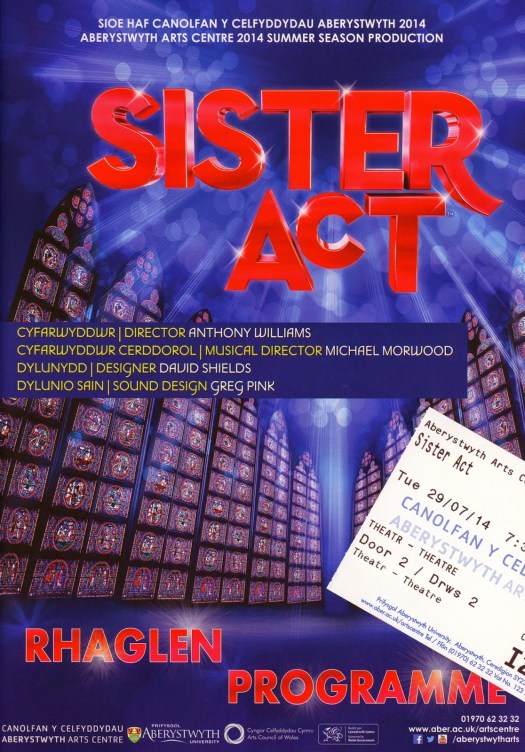
โ€œFarrah Fawcett as thou art in heaven!โ€ This is a good time to dust off your โ€œF. M. bootsโ€ and shake your groove thing right on down to our local Arts Centre here in Aberystwyth. You know, F as in Funky and M as in, well, Mary, Mother of Grace.  Or, FM as in radio, tuned to the station that gives you Diana, Donna and โ€ฆ Deloris.  Deloris Van Cartier, honey, the diva that dreamed of a wearing white fur and ended up in a nunโ€™s habit.  Yes, itโ€™s Sister Act, the musical. The one about the convent where the motherโ€™s Superior and the sisters Supreme.

In this production, Mother Superior is played by Lori Haley Fox, whom I previously saw perform here in Chess and Hairspray.  There is a bit of Velma Von Tussle in Mother Superiorโ€”but her Sister Act character has some depth, which comes across in Foxโ€™s rendition of โ€œHere Within These Walls.โ€ You donโ€™t just get to hiss and laugh at her, but get to understand her struggle to restore the order that wasnโ€™t meant to be a reformed one. Itโ€™s a fight against the trivialization and exploitation of her beliefs.  To be sure, itโ€™s a tall order to deliver such conviction in a play so invested in that very trivialization. But if there are false notes in this musical, they are not coming out of Foxโ€™s mouth.  Nor out of Jenny Fitzpatrickโ€™s, for that matter, who is great in the wear-your-Jackal-and-hide part of Deloris โ€œSister Mary Clarenceโ€ Van Cartier, a diamonds craving tramp with the proverbial heart of gold.  Or a golden larynx, anyway. And Fitzpatrick sure got that, and soul besides. Make that Philly soul.  After all, the scene is set in Philadelphia, the town to which the bastard of Disco can trace some of its heritage.

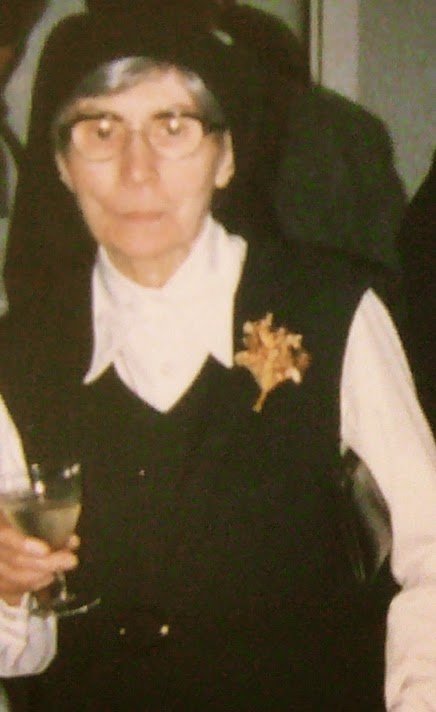
My great aunt was a nun, so I fancy myself an authority

[Image caption: My great aunt was a nun, so I fancy myself an authority.]

Iโ€™ve been attending the Aberystwyth Arts Centre productions ever since I arrived in this town after fifteen years of life in Manhattan.  I had a bad attitude in my suitcase and thought that nothing could match Broadway, that this was just the sticks.  Well, shows like Chicago and Hairspray proved me wrong.  Actually, the very first show I saw here, Oliver!, did that.  And it was great to see Mr. Bumble again, right there in that convent.  Gary Davis, I mean, who plays Monsignor Oโ€™Hara. Indeed, there were a number of familiar faces in the cast, among them David Barrett and Robert Oโ€™Malley.

Brother, it must be tough for any man to assert himself in a place where all those rapping and von Trapping sisters are doing it pretty much for themselves (and the Almighty); but Robert Grose as Curtis Jackson and Aaron Lee Lambert as Eddie Souther are giving it their best shotโ€”and Iโ€™m using the metaphor advisedly.ย ย Grose is at his smarmiest best singing โ€œWhen I Find My Baby,โ€ a creepy number worthy of Sweeney Todd and likely to give you the heebie-Bee Gees.

Meanwhile, in โ€œI Could Be That Guy,โ€ Lambert makes a transition that rivals the costume change endured by Deloris โ€“ albeit from plain to fabulous, so that the twain can meet somewhere in betweenโ€”and he doesnโ€™t get a phone booth or even a Hong Kong Phooey filing cabinet to do it in. So, props to him! Then again, why call props when Velcro and virtuosity will do?ย 

There are echoes ofย Kiss Me, Kateย in the trio of thugsโ€”The Three Degrees of separation from the baboonโ€”who are making apes of themselves for our amusement in โ€œLady in the Long Black Dress.โ€ Never mind Earth and Fire; these guys are pretty much all Wind. That said, Andrew Gallo as Joey has more moves in his eyebrows than most wannabe Travoltas have in their polyester-clad hips. George Ray as TJ does four-eyed cute as well as Rick “Suddenly Seymour” Moranis ever did. And Ricardo Castro is just bueno as Pablo in a Brรผno kind of way.ย 

Meanwhile, for those who prefer their eye candy unwrapped, there are a couple of highly distracting boy dancers, competing though they were, temporarily, with an audience member in front of me who insisted on noisily unpacking her own treats. Sure, Toffifee is retro, but a flask is more discreet.ย 

Dancing boys and their legs apart, this is still a play in which the sisters have the upper hand; and glorious Jodie Jacobs as Sister Mary Robert and fierce Andrea Miller as Sister Mary Lazarus prove that โ€œItโ€™s Good to Be a Nun.โ€ So what if Sister Act’s pastiche.  Why reinvent the Disco Ball? I, for one, am glad to be having the sisters โ€œHere Within These Wallsโ€ of Aberystwyth Arts Centre to โ€œSpread the Love.โ€  Iโ€™ll be back for another audience with themโ€”and that adorable Popeโ€”just as soon as I get the platforms redone on the F. M. boots I wore out tapping along. โ€œFabulous[,] Babyโ€!

Future [S]ense? The Lost Found Objects of David Garner

Look! There are objects, people, and situations that compel me to do just that.  It takes some effort, though, to make me look longer than a moment, that blink of an eye Germans call โ€œAugenblick.โ€  It is an effort and commitment that I have to bring myself to make, and whatever or whoever it is that commands me to look must warrant my sustained attention, must conquer my resistance, must provoke, charm, or seduce me to engage me in an exchange

โ€œLook!โ€ is a command that rarely fails; but, apart from performances that define the intended or desired duration of that look, few sites dictate, implore or recommend just how long I am to keep looking.  Do I circle once around this sculpture? Do I give that landscape the once-over, the twice-over or the over-and-over? How long do I need to look until I see something that rewards me for not looking away sooner?

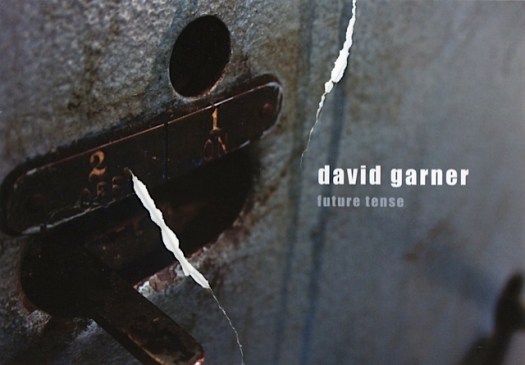
Not every instance of looking turns into a spell of lingering, loitering and longing for more; and nothing is more effective in making me avert my gaze than being told what to look out for and how to see things.  This is the reaction I had looking at David Garnerโ€™s exhibition Future Tense, currently on display at the Aberystwyth Arts Centre.

Garner uses found objects to make more or lessโ€”and mostly lessโ€”compelling statements about a grab bag of social and political issues: production and consumption, education, unemployment, and postcolonialism.  His work hinges on a pairing of visual and verbal puns (such as โ€œWooly Learning/Dysgu Gwlanog,โ€ a school blackboard with felted wool surface and wool text) or clichรฉs (like โ€œBeware when the gloves are off,โ€ a row of ten Porcelain glove moulds mounted on an oak panel and suggesting a fascist salute); most of these pairings are too obvious in their single-minded double-meaning to startle, let alone enliven a discourse.  

Often, as in โ€œSheep in Sheepโ€™s Clothingโ€โ€”a taxidermied sheep wearing a coat knitted from its own fleeceโ€”the found object is stripped of its mysteries, its woollinessโ€”its indeterminacies and ambiguitiesโ€”spun instead into a readily solvable and as such instantly dissolvable puzzle.

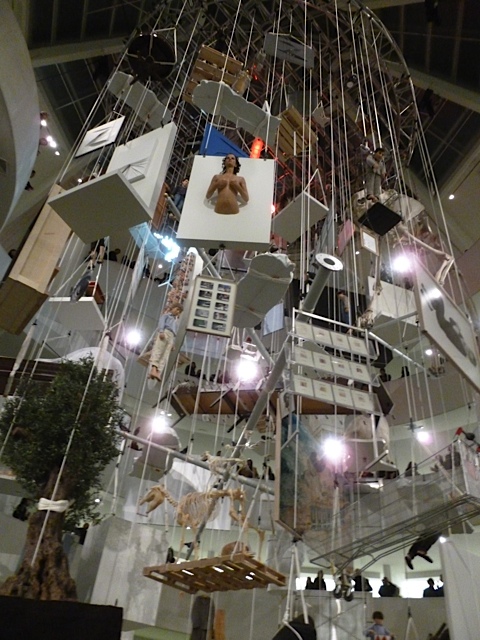
Unlike Duchampโ€™s perennially stimulatingย Fountain, Garnerโ€™s found objects are given a final resting place in a self-contained junkyard of a performance that rewards only those who are content to discover an artistโ€™s meaning and who, unlike me, accept that meaning as final; such hermetic hermeneutics leave no room to respond other than โ€œGot it.ย  Next!โ€ย There is none of the wonder, the aweโ€”the sheer thrill of lookingโ€”that I experienced staring at Maurizio Cattelanโ€™sย All at the Guggenheim Museum earlier this year.

The only truly gripping sight in Garnerโ€™s Future Tense is not a sight at all but a sound: the sound of a large clock loudly ticking away.  I resisted looking at the caption and let that sound transport, envelop, and alarm me; listening, I was, for once, unaware of the time I had wasted looking here but reminded instead of the potentialities of art to move us to the point that we cannot but invest it with our life experience, our anxieties and desiresโ€”a potential that is largely unfulfilled by Future Tense, a configuration of readymades whose presence is so much circumscribed by the artist’s foregone conclusions that they have little chance of a future in our imaginings . . .

Stiff Competition: A Hairspray to Defy the West End Elements

Funny thing about prejudice: if you let it take hold, it can deprive you and those around you of a real good time.ย  That, in a shiny Aqua Net shell, is the message of Hairspray, the musical.ย  And, boy, did I deprive myself . . . until now.ย  Sure, others around me still had that good time, but when Hairspray hit Broadway back in 2002, I was as set as an untamed cowlick. ย I would have none of it. My Aqua Net days were long behind me by then, and I was not going to splash out on a rehash of a late-1980s cult comedy about early 1960s culture-clashing teenagers, told in songs that a Porter and Gershwin kind of guy like me is not inclined to hum while wearing a shower cap. Well, Kiss my Kate! Last Friday, I finally woke up and smelled the coiffing.ย  “Good morning, Baltimore!” Andโ€”oh, never mind โ€œbeautifulโ€โ€”what a colorful morning it is.

Funny thing, too, that I only had to travel about half a mile to learn that musical lesson; no subway ride down to 42nd Street, no walk through Londonโ€™s West End via Leicester Square (and TKTS).  Just up the hill, to Aberystwyth Arts Centre, where each summer a musical is staged that, as a tourist attraction, is far more reliable than our windswept seaside.  Over the years, I have seen eight of those summer seasons come and go, from Oliver! to Chess.  Boasting a cast whose list of combined Broadway and West End credits is way longer than I am in the tooth, this yearโ€™s production tops them all.

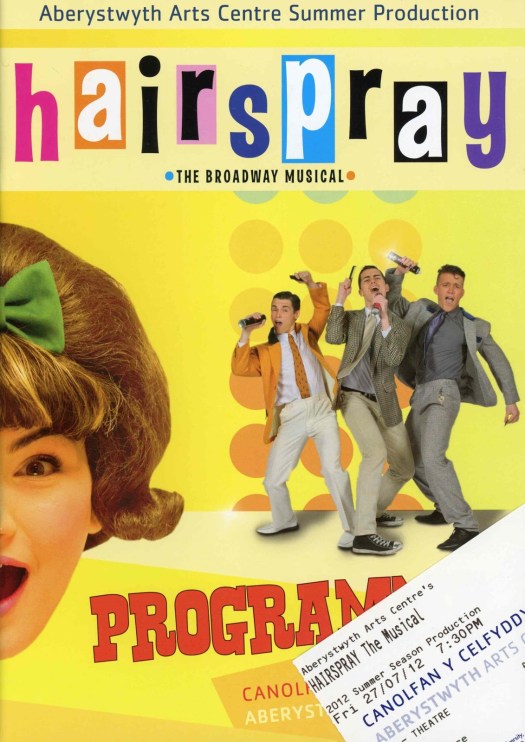
Its readily translatable story of teenage rebellion aside, Hairspray may not be the easiest piece of Americana to transplant to Wales.  Never mind references to Allen Funt, Jackie Gleason, and the Gabors, names not likely to ring for todayโ€™s young, British audiences the bells I and Tracy Turnblad can hear.  The Director’s Note in the program about Rosa Parks, whose image flashes on a big screen during one of the numbers, fills in some of the blanks.  This, after all, is American history, no matter how much John Waters it down.

Then again, it may not be the easiest thing, either, to translate the Civil Rights Movement into a musical riot without becoming as crude or politically incorrect as John Waters used to be.  But, whatever your own sense of otherness and experience of xenophobia might beโ€”and โ€œI Know Where Iโ€™ve Beenโ€โ€”Hairspray gives you enough of a whiff of those ill winds to make you investigate whence they blow.  โ€œRun and Tell Thatโ€: if any production can communicate a shakeup without making anger the primary colour of the emotional rainbow, Unholy Waters! this can can.

You might expectโ€”and forgive, tooโ€”any glitches or leftover curlers on opening night; but there were none here: upon pulling the lid, this Hairspraywas as solid as a freshly lacquered beehive.  Andrew Agnew is marvelous as Edna Turnblad, a part I identified so much with the fabulous Divine that I couldnโ€™t face watching John Travolta in a latex mask.  Agnew makes you forget bothโ€”and he plays Edna in such an understated way that her big number โ€œ(Youโ€™re) Timeless to Meโ€ makes you understand what, to someone of my certain age, is the warm heart of this show.  Itโ€™s a heart whose Beat youโ€™d canโ€™t stop without making Hairspray lose its maximum hold.

Edna might have missed every boat except the one she pours the gravy from; but she is not too old to kissโ€”and kickโ€”the past goodbye and say โ€œWelcome to the 60โ€™s.โ€  This transition requires more than a new do or a swift costume change; and Agnew achieves it by centering Edna in the 1950s, a woman who loves Lucy though she might not like Ikeโ€”and who not only loves Tracy from the remove of a generational gap but gets her, too.

Tracy, of course, is her daughterโ€”the embodiment of that new ageโ€”and Jenny Oโ€™Leary inhabits the role with the confidence and youthful energy for which it calls.  Tracy may not quite grasp just how seismic the event is in which she plays her part, an eventโ€”this much she knowsโ€”far bigger than “Negro Night” on the Corny Collins Show; but she approaches integration with the I-donโ€™t-get-it naivety that has many of todayโ€™s youngsters baffled at their parentโ€™s definition of marriage as a strictly segregated affair.

Hairspray leaves no doubt as to who โ€œThe Nicest Kids in Townโ€ are; โ€œniceโ€ simply ainโ€™t.  It is self-serving conventionality, a meanness of spirit that lingers under the neat surface like something you fight with lice shampoo.  How else to approach โ€œMiss Baltimore Crabs,โ€ Velma Von Tussle, a nasty piece of work done justice by Lori Haley Foxโ€”and done in by the sheer force of Motormouth Maybelle, a woman who, like Edna, has seen better days, but whose better days were lived in times much worse.  

Marion Campbell, who plays Maybelle, comes on stage late to belt out her showstopper of a numberโ€”and her presence hits you like, say, Mahalia Jacksonโ€™s in Imitation of Life: a voice to be reckoned with, especially in a fight for equality.

Though the actress playing Tracy Turnblad receives top billing, it would be wrong to call the rest of the cast โ€œsupporting.โ€  Hairspray demands a great many good voices as it gives most of its characters the chance and challenge to shine, and everyone in this cast is living up to that challenge: Arun Blair Mangat as Seaweed, Samantha Giffard a Penny Pingleton, Morgan Crowley as Wilbur Turnblad, Hugo Harold-Harrison as Corny Collins . . .

The list is longer than thatโ€”but I’d be bald by the time I were done honor roll calling.  Besides, if I’m counting anything it’s the days until my next trip to the salon for another hit of Hairspray. Yes, funny thing about prejudice: once confronted, it can yield such eye-opening, ear-popping surprises.

So, toodle-oo to stiff upper lip! Stiff up yer quiff instead.

Letters of a [Class] Betrayed: Opera Without Soap

I am not inclined to manual labor. If I lift a finger, it is likely to come down on what isnโ€™t grammatically up to scratch or else to add a few scrapes to my scalp as I take some rambling bull by the inkhorn. There has been a little more of that going on latelyโ€”teaching and editingโ€”and, my furrowed pate notwithstanding, I am heartily glad of it. Yet as much as I relish being back in the game after suffering the indignity of being benched for the betterโ€”or, rather, worseโ€”part of the past five seasons, the academy has never felt like a home court to me. It is as if, carved into the trunk of my family tree however rotten, puny and lacking in shelter it might be, are memos more emphatic than the certificates of achievement now gathering dust in the drawer I am so little inclined to tidy. Instead of considering myself invited as I enter places of culture and learning, I still feel at times as if I were crashing a party.

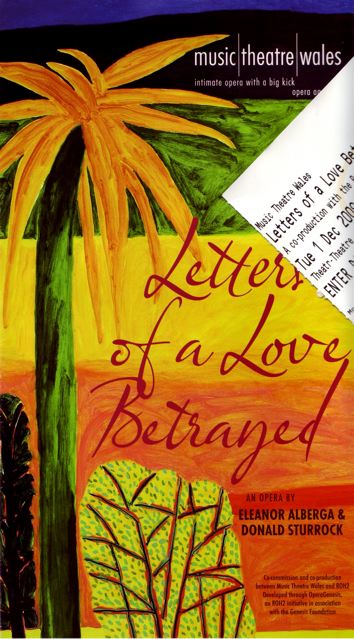
Program and ticket stub for Letters of a Love Betrayed

You see, I was born into that endangered social stratum known as the working class. It is an origin of which I am mindful, though neither proud nor ashamed. At least, I am not ashamed of it now. I used to be as thrilled about it as Ann Blythโ€™s character in Mildred Pierce, even though my parents bore a closer resemblance to Lana Turner in Imitation of Lifeโ€”that is, too busy to notice that living up to their aspirations left their offspring in the dust they raised as they tried to shake the dirt clinging to their roots. At any rate, stuck in that cloud of dust was I, an asthmatic kid who couldnโ€™t afford to hold his breath at the off chance of parental attention.

Not to suffocate under the rubble of post-Second World War Germany, my parents had to put their noses far closer to the proverbial grindstone than I ever did. Their generation, aided by American interests, pulled off the Wirtschaftswunder or โ€œeconomic miracle,โ€ a sleight-of-hands-on approach to the lasting trauma caused by total war and final solution, the coming to terms with which would have required equipment far more difficult to handle than shovel and broom.

I am not so disingenuous as to pass off my staying put as a form of sit-down strike, of giving the clean-and-cover-up efforts of my parentsโ€™ generation the spotless finger; but apart from the months I ill served my country working as a hospital orderly or the hours I spent cleaning apartments in New York City to help finance my college education, I remained sedentary for much of my life.

So far, itโ€™s been a life spent lost in thoughts, ensconced in writing, and plunked down for performances that artists work on studiously for our delight and instructionโ€”the kind of delight my father found it difficult to accept as serious work and the instruction he thought less of than the empirical knowledge that, along with calluses, is the badge and perquisite of the experience-hardened laborer.

I suppose it is easier for the workerโ€”not to be equated here with the impecuniousโ€”to aspire to material possessions instead of culture and learning, since exposing yourself to something that poses a challenge rather than promising instant gratification requires still more work on the part of those who have little time and less energy to spare.

Now, my comparatively indolent existence permits me to spare that time; yet, as if my conscience and buttocks alike had been shaped by Protestant work ethics, I often feel rather uncomfortable. Iโ€™m not one to pooh-pooh the benefits of resting on oneโ€™s Popo (as dainty Germans call the posterior); but, there is nothing like wriggling in my seat in hopes of improving my mind to convince me that the callusesโ€”and Iโ€”belong elsewhere.

I had that impression sitting through Letters of a Love Betrayed, a new opera by Eleanor Alberga (libretto by Donald Sturrock). Reading about it, I was intrigued by the promised fusion of Latin rhythms and a neo-Gothic romance based on a story by Isabel Allende, but felt let down by a score that to my untrained ear sounded forbidding, unmelodious, and, worse still, forgettable. Perhaps, the perceived cacophony was the result of a clanging together of too many stereotypes. Whatever melo- Letters possesses is all in the drama; derivative and contrived, it is creakier than a chair that has been squirmed out of too often.

I didnโ€™t get it. I didnโ€™t like it. I felt like a tired, vitamin deprived miner lured into a soup kitchen of the arts, the drama being a concession to what is assumed to be his tastes as he is being fed a presumably healthy diet with a none too musical spoon.

As I sat down again to express my thoughts on the matter of whatโ€™s the matter with me, I kept wondering whether what I was responding to so angrily was utter musical rubbish, dreck worse than the grime to which I chose not to expose myself, or whether my inability to open my mind was dictated to me by my past, a past unfolding in letters of a class betrayed.

โ€œI’ve Got a Little Listโ€ (and the Hot Mikado Isnโ€™t on It)

At the risk of sounding like a loser at a Vegas spelling bee, I am a serious eye roller. Like a roulette wheel on an off night, each circulation marks the extent of my displeasure. The other night, I was really taking my peepers for a spin. Judging from such ocular proof, you might have thought that more than eyeballs were about to roll. Indeed, it seemed as if I were going to face the Lord High Executioner himself. Instead, we were merely going to a production of The Hot Mikado. I just couldnโ€™t warm to the idea of going camp on a classic that seems least in need of burlesqueโ€”or Berlesques, for that matter. Not that this stopped middle-aged troupers like Jack Benny, Bob Hope, and Groucho Marx to play โ€œThree Little Maidsโ€ (as part of a war relief benefit broadcast); but, at least, those tuning in were spared the visuals.

If I was less than enthusiastic, it was mainly on account of Charleyโ€™s Aunt. That dubious Victor/Victorian dowager had way too many nephewsโ€”and โ€œthey’d none of them be missed, they’d none of them be missed.โ€ Cross-dressing has long been on the none too little list of circus and sideshow acts that are more of a source of irritation than of hilarity. One strategically placed banana peel does more for me than two oranges nestling in a bed of chest hair. Itโ€™s a fruitโ€™s prerogative.

The origins of my aversion date back to the time when I began to realize that what I needed to get off my chest one day was something other than the fur I was not destined to grow in profusion. I was about twelve. Still without a costume on the morning of the annual school carnival, I let my older sister, who was as resourceful as she was bossy, talk me into wearing one of the skirts she had long discarded in favor of rather too tight-fitting jeans. Being dressed in my sisterโ€™s clothes was awkward for me, considering that I was fairly confused about my gender to begin with, certain only about the one to which I was drawn. More than a skirt was about to come out of the closet, and I was not equipped to deal with it.

Responding to my calculatedly nonchalant remark that the costume was some kind of last-minute ersatz, our smug, self-loving English teacher, Herr Julius, told the assembled class that, during carnival, folks tended to reveal what they secretly longed to be, which, apparently, went well beyond the common desire not to be humiliated. No wonder Herr Julius did not bother to don a mask other than the one with which he confronted us all the scholastic year round.

Matters were complicated further by my wayward anatomy. Letโ€™s just say that it didnโ€™t require oranges to make a fairly convincing girl out of me; I was equipped with fleshy protuberances that earned me the sobriquet โ€œbattle of the sexes.โ€ I wondered whether I was destined to shroud myself in one pretense in order to drop another. That, in a pair of coconut shells, is why cross-dressers and any such La Cage faux dollies were never to become my bag. And Iโ€™ve got a lot of baggage.

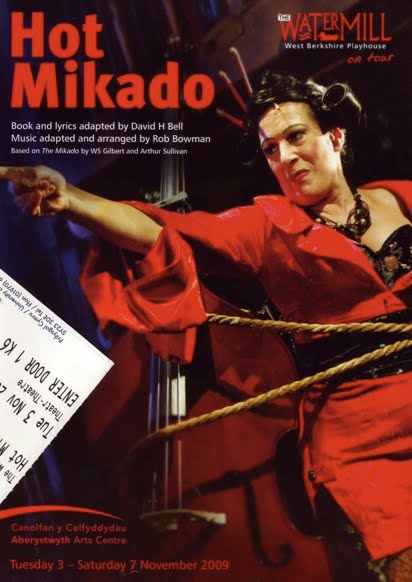
What has that to do with The Hot Mikado, the show I was so reluctant to clap my eyes on? As it turns out, not very much. I had been mistaken about the gender of the performer playing Katisha, the character on the poster (pictured above) that was advertising the Watermill production I caught at Aberystwyth Arts Centre.

Far from being some newfangled cabaret act, The Hot Mikado is seventy years old this year. Appropriating presumably WASPish entertainment for a younger and less exclusive audience, it was first performed in 1939 with an all-black, extravagantly decked out cast headed by the legendary Bill โ€œBojanglesโ€ Robinson in the title role. The currently touring Watermill productionโ€”which is soon to conclude in Girona, Spainโ€”updates the carnivalesque spectacle in retro-1980s colors, with Manga and movie inspired costumes, as well as assorted references to Susan Boyle and British politics. The music is still jazz-infused Gilbert and Sullivan.

Set โ€œsomewhere in Japanโ€ and produced at a time when Mr. Moto was forced to take an extended Vacation, the anachronistic Hot Mikado was all jitterbug without being bugged down by pre-war jitters. It is outlandish rather than freakish, amalgamated rather than discordant, qualities reassuring to anyone who has ever felt mixed up or unable to mix. A few bum notes aside, the production was hardly an occasion for any prolonged orbiting of orbs. The joyous spectacle of it kept even my mindโ€™s eye from rolling, from running over the bones, funny or otherwise, that tend to tumble out of this Fibber McGeean closet of mine . . .

Related recordings
Greek war relief special (8 February 1941), featuring Frank Morgan, Bob Hope, Jack Benny and Groucho Marx singing songs from The Mikado
โ€œHollywood Mikadoโ€, starring Fred Allen (11 May 1947)
Chicago Theater production of โ€œThe Mikadoโ€ (22 October 1949)
The Railroad Hour production of โ€œThe Mikadoโ€ (5 December 1949

โ€œ. . . from a civilized land called Walesโ€: A Puzzlement Involving The King and I

I rose before the sun, and ran on deck to catch an early glimpse of the strange land we were nearing; and as I peered eagerly, not through mist and haze, but straight into the clear, bright, many-tinted ether, there came the first faint, tremulous blush of dawn, behind her rosy veil [ . . .]. A vision of comfort and gladness, that tropical March morning, genial as a July dawn in my own less ardent clime; but the memory of two round, tender arms, and two little dimpled hands, that so lately had made themselves loving fetters round my neck, in the vain hope of holding mamma fast, blinded my outlook; and as, with a nervous tremor and a rude jerk, we came to anchor there, so with a shock and a tremor I came to my hard realities.

With those words, capturing her first impression and anticipation of a โ€œstrange landโ€ as, on 15 March 1862, it came into partial viewโ€”the โ€œoutlookโ€ being โ€œblindedโ€โ€”aboard the steamer Chow Phya, Anna Harriette Leonowens commenced The English Governess at the Siamese Court (1870), the โ€œRecollections of Six Years in the Royal Palace at Bangkok.โ€ The account of her experience was to be followed up by a sensational sequel, Romance of the Harem (1872), both of which volumes became the source for a bestselling novel, Margaret Landonโ€™s Anna and the King of Siam (1944), several film and television adaptations, as well as the enduringly crowd-pleasing musical The King and I.

Conceived for musical comedy star Gertrude Lawrence, the titular โ€œIโ€ is currently impersonated by Shona Lindsay, who, until the end of August 2009, stars in the handsomely designed Aberystwyth Arts Centre Summer Musical Production of the Rodgers and Hammersteinโ€™s classic.

The title of the musical personalizes the story, at once suggesting authenticity and acknowledging bias. Just as it was meant to signal the true star of the original productionโ€”until Yul Brynner stole the showโ€”it seems to fix the perspective, assuming that we, the audience, see Siam and read its ruler through Annaโ€™s eyes. And yet, what makes The King and I something truly wonderfulโ€”and rather more complex than a one-sided missionaryโ€™s taleโ€”is that we get to know and understand not only the Western governess, but the proud โ€œLord and Masterโ€ and his daring slave Tuptim.

Instead of accepting Anna as model or guide, we can all become the โ€œIโ€ in this story of identity, otherness and oppression. Tuptimโ€™s experience, in particular, resonates with anyone who, like myself, has ever been compelled, metaphorically speaking, to โ€œkiss in a shadow,โ€ to love without enjoying equality or protection under the law. Tuptimโ€™s readily translatable story, which has been rejected as fictive and insensitive, is emotionally rather than culturally true.

โ€œTruth is often stranger than fiction,โ€ Leonowens remarked in her preface to Romance of the Harem, insisting on the veracity of her account. Truth is, truth is no stranger to fiction. All history is narrative and, as such, fictionโ€”that is, it is made up, however authentic the fabric, and woven into logical and intelligible patterns. Whoever determines or imposes such patternsโ€”the historian, the novelist, the reporterโ€”is responsible for selecting, evaluating, and shaping a story that, in turn, is capable of shaping us.

Tuptimโ€™s adaptation of Uncle Tomโ€™s Cabin, which strikes us at first strange and laughableโ€”then uncanny and eerily interchangeableโ€”in its inauthentic, allegorical retelling of a fiction that not only made but changed history, is an explanation of and validation for Rodgers and Hammersteinโ€™s sentimental formula. Through the estrangement from the historically and culturally familiar, strange characters become familiar to us, just Leonowens may have been aided rather than mislead by an โ€œoutlookโ€ that was โ€œblindedโ€ by the intimate knowledge of a childโ€™s love.

Strange it was, then, to have historicity or nationality thrust upon me as Anna exclaims, in her undelivered speech to the King, that she hails โ€œfrom a civilized land called Wales.โ€ It was a claim made by Leonowens herself and propagated in accounts like Mrs. Leonowens by John MacNaughton (1915); yet, according to Susan Brownโ€™s โ€œAlternatives to the Missionary Position: Anna Leonowens as Victorian Travel Writerโ€ (1995), โ€œno evidence supportsโ€ the assertion that Leonowens was raised or educated in Wales.

Still, there was an audible if politely subdued cheer in the Aberystwyth Arts Centre auditorium as Anna revealed her fictive origins to us. Granted, I may be more suspicious of nationalism than I am of globalization; but to define Leonowensโ€™s experience with and derive a sense of identity from a singleโ€”and rather ironic reference to homeโ€”seems strangely out of place, considering that the play encourages us to examine ourselves in the reflection or refraction of another culture, however counterfeit or vague. Beside, unlike last yearโ€™s miscast Eliza (in the Arts Centreโ€™s production of My Fair Lady), Anna, as interpreted by Ms. Lindsay, has no trace of a Welsh accent.

As readers and theatergoers, we have been โ€œgetting to know you,โ€ Anna Leonowens, for nearly one and a half centuries now; but the various (auto)biographical accounts are so inconclusive and diverging that it seems futile to insist on โ€œgetting to know all about you,โ€ no matter now much the quest for verifiable truths might be our โ€œcup of tea.โ€ What is a โ€œpuzzlementโ€ to the historians is also the key to the musical, mythical kingdom, an understood realm in which understanding lies beyond the finite boundaries of the factual.


Related writings
“By [David], she’s got it”; or, To Be Fair About the Lady
Delayed Exposure: A Man, a Monument, and a Musical

Related recordings
โ€œMeet Gertrude Lawrence,โ€ Biography in Sound (23 January 1955)
Hear It Now (25 May 1951), which includes recorded auditions for the role of Prince Chulalongkorn in The King and I

"By [David], she’s got it"; or, To Be Fair About the Lady

Having spent a week traveling through Wales and the north of Englandโ€”up a castle, down a gold mine, and over to Port Sunlight, where Lux has its originsโ€”I finally got to sit down again to take in an old-fashioned show. That show was My Fair Lady, a production of which opened last night at the Aberystwyth Arts Centre, where each summer a musical is put on for the amusement of the locals and the visitors to the seaside town a few miles east of which I now reside. These productions, the aforementioned Oliver!, Fiddler on the Roof, and West Side Story among them, tend to be quite ambitious in their choice of Broadway and West End fare, titles likely to raise expectations higher than any theatrical curtain falling on them, whether to the relief or regret of the assembled crowds. The present Lady is no exception.
According to lore shared by Michael Kantor and Laurence Maslon in Broadway: The American Musical, even Oscar Hammerstein gave up on the idea of showtuning Shawโ€™s Pygmalion, advising fellow songwriter and radio alumnus Alan Jay Lerner against it. โ€œJust You Wait,โ€ the librettist thought and, to the delight of millions, he and his partner, Frederick Loewe, got on with the show that not only opened on Broadway in 1956 but refused to close for several seasons, proving an enduring popular and critical success.

Now, I did not expect a performer equal to Julie Andrews or Audrey Hepburn when I took my seat and glanced at the program. Indeed, I was never fond of the former or of the film version starring the latter. I had read in the local paper that two leading ladies were taking turns during the month-long run and that the showโ€™s director, Michael Bogdanov, was yet to determine which one of them would perform on opening night. The Lady in question was Elin Llwyd, a graduate of the Royal Welsh College of Music and Drama. Sure, a Welsh lead for a part requiring a Cockney accent transformed into an English that would both please and fool high society as being the genuine article. Iโ€™m a far more โ€œOrdinary Manโ€ than Professor Higgins professes to be; but, having lived among the Welsh for some time now, I can tell a Cymru tongue from an English one when it is stuck out at me from a reverberating stage.

โ€œThe English have no respect for their language,โ€ the Irish playwright (heard here introducing himself) deplored in his Preface to Pygmalion. Neither have theatrical directors, it seems; or, rather, they do not appear to have much respect for the ear by which they mean to drag audiences into the realm of make-believe. Mind you, the production is being coy about the filiations of Eliza, casting fellow Welshman Ieuan Rhys as her father and throwing in a few self-conscious references about the culture and language. Still, no matter how ably supported and otherwise capable, the slate-hewn Galatea taking center stage faces the well-nigh impossible task of faking not one accent, but two; and, as her acting became more energetic and engaging during the second act, Welsh got the better of the flower girl from the slums of Lisson Grove, London, whom a conceited gentleman scholar wagers to unveil as one of his kind by chiseling at her accent. โ€œBy George, sheโ€™s got itโ€? By David, she couldnโ€™t get rid of it!

“Ah-ah-ah-ow-ow-ow-oo!” A few years ago, I was incapable of discerning what now spoke so clearly against the effort to suspend my disbelief. I have spent most of my adult life being cast as a foreigner based on the sound of my utterings. Often, I was made to feel like an imposter, earmarked as one supposedly pretending to be American or English while invariably exposed by a slip of my wayward Teutonic tongue. Given my accentual trials, I am drawn to stories like Eliza Doolittleโ€™s . . . or Elin Llwydโ€™s.

Patois may be less restricting and defining these days; but, for a play like Pygmalion or its tuneful remake to ring true, phonetic distinctions should not be leveled along with the social discriminations they beget. In this case, equal opportunity spells a missed one. Besides, it just ainโ€™t fair to the memory of the vernacularly challenged ladies and lads whose speech was not equal to their ear.

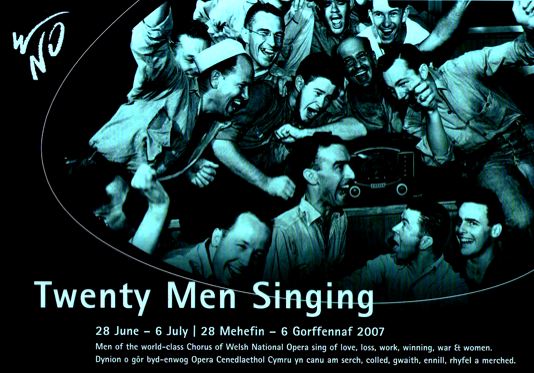
Twenty Men Singingโ€”But Why?

There they stood last night, singing a cappella, performing songs from Schubert to South Pacific, from the 13th-century Middle-English “Sumer Is Icumen In” to Alfred Schnittke’s “Adam Sat Weeping at the Gates of Paradise,” which premiered in 1988. Twenty they were; men of the Welsh National Opera, touring Wales with their aptly titled program Twenty Men Singing. Some of their sonic offerings were tonic, many (and for my taste rather too many) of them somber, reverent, and brooding.

Why were they singing? To amuse themselves, to entertain others, to earn a few quid or to enjoy the applause of an appreciative crowd? Why sing in unison when what you want is to stand out? If, indeed, that is what you want.

According to the program notes, those Twenty Men Singing explore just that: why men raise their voice together in song, whether to celebrate life, to protest or lament. In song, a hoped for unity is being realised in sonic unison. A chorus of disapproval is formed in resistance to voices and actions that may threaten community. Leoลก Janรกฤek’s “Sedmdesรกt tisรญc” (1909), for instance (as translated by John Binias), many-voices the pressures inflicted on the national identity of a Czech bordertown by neighboring but less than neighborly Germans and Poles:

70,000 graves they dig for us
Outside Tesin
Beg for help from heaven
Herded like cattle
Like cattle we gaze about
Our own slaughter [ . . .].ย 

Let our voices thunder out: [. . .].
Before we are finished [. . .].

This Saturday, performers around the world are singing to bring awareness to what may well be the greatest threat to humanity, regardless how much religion and nationalism, how much faith and terror (and the terror of faith) are being exploited by those who make a fortune keeping us at war with one another.

On this day of Live Earth, festivities that coincide with the anniversary of the London suicide bombings of 2005, we are asked to consider the terra we share, not the terror that divides us, to let “our voices thunder out” before we are “finished.” I cannot think of a better reason for joining a chorus.

Fidelity Be Hanged; or, How Do You Solve a Problem Like Moll Flanders?

Now thereโ€™s a dame with a pastโ€”so much of one that it is difficult to imagine a future for her. Moll Flanders, I mean. The question of her past, path, and purpose was raised anew last night by Keiron Selfโ€™s stage adaptation of Daniel Defoeโ€™s 1722 narrative (now touring Wales as a co-production of Mappa Mundi, Theatr Mwldan, and Creu Cymru). Adultery, bigamy, incest, theft. What could possibly be next? Hold on! Theft? That’s already somewhat of an anticlimax, isnโ€™t it? How about a happy ending?

In his anticipation of censure, Defoe insisted that โ€œ[n]one can, without being guilty of manifest Injustice, cast any Reproach upon [Moll Flanders], or upon our Design in publishing it.โ€ Positioning himself within the tradition of storytelling for moral uplift, he continued his defense by stating that the โ€œAdvocates for the Stage have in all Ages made this the great Argument to persuade People that their Plays are useful, and that they ought to be allowโ€™d in the most civilizโ€™d, and the most religious Governmentโ€; that they are โ€œapplied to virtuous Purposes, and that by the most lively Representations, they fail not to recommend Virtue and generous Principles, and to discourage all sorts of Vice and Corruption of Manners [. . .].โ€

โ€œTo give the History of a wicked Life repented of,โ€ Defoe remarked, โ€œnecessarily requires that the wicked Part should be made as wicked as the real History of it will bear, to illustrate and give a Beauty to the Penitent part, which is certainly the best and brightest, if related with equal Spirit and Life.โ€ Is Moll being made a spectacle and example of for the sole purpose of our edification? Or is penitence thrust upon her to justify the sensational come hither that draws us in?

Mollโ€™s moral lapses are cumulative; but instead of suffocating her under piled-up offenses, Defoe determined to put her to the test by having her locked up at last. He threatens Moll with execution to play out what he promised his audience all along: a final act of repentance and virtue rewarded. About whether she is deserving of forgiveness, Defoeโ€™s portrait does not leave much doubt; but is someone like Moll still capable of atonement after a life of debauchery?

Mappa Mundiโ€™s stage adaptation departs from Defoeโ€™s “blueprint” (as Self calls his literary source) by avoiding the contemplation of Mollโ€™s life after crime, let alone her afterlife. She does not get to reap the rewards either of her none-too-good deeds or her subsequent atonement. Whereas Defoe has her telling us of establishing a future for herself and a loving husband in penal-colonial Virginia, Self’s Moll wanders in ever seedier circles and dies where her flashback-dramatized life story began: Newgate prison, in whose confines the play is set.

โ€œHow do you reconcile the happy ending of Moll Flanders after such a life of sin and wickedness?” novelist Katherine Anne Porter was asked in a literary panel discussion broadcast on CBS radio in the early 1940s, a time when a dramatization of Defoe’s story was not to be thought of. “How do you reconcile that happy ending with the morality he is preaching in the book?โ€ To which Porter replied: โ€œShe repented, donโ€™t you see? That her past weighs more heavily on than against Moll becomes even more difficult to “see” once the criminality of her acts is called into question.

According to Self’s revision of Defoe’s story, Moll is wronged by the society that criminalized her existence. This Newgate Calendar Girl has done no harm not already inflicted upon her: meeting the challenge of securing a husband, trying to make a living, and holding on to her livelihood in old age (that is, turning to thievery when her body is robbed of its attractions). In such a social reading of her life, there is no point inโ€”no need forโ€”penitence. The penitentiary takes its place.

In the stage bill for the Mappa Mundi production, Self expressed his hope of having given Moll a โ€œvoiceโ€ of which Defoe might approve. Instead, he makes us question the veracity of her words by suggesting her insanity (in a psychedelic finale) and then shuts her up by condemning her to be hanged, however loudly he condemns those who hang her. After all, there is no spectacle in quiet remorse.