“I pulled and she shook”: A Décor to Try One’s Decorum

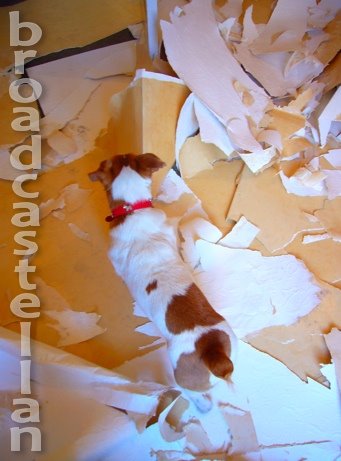
My dog, Montague, demonstrating his wallpaper training in response to my stripping

All right, so I’m sounding like an aging burlesque queen about to toss her tassels and turn in the G-string that is a turn-on no longer—but, by Gypsy, I am tired of stripping. Wallpaper, I mean. This old Mazeppa has nothing but a scraper for a gimmick, and the only hand she ever got for all her grinding is a mighty sore one. I just could not live with it, though, that dreadful pattern—having it stare me down in defiance, berate me for letting myself be defeated by all the work that needs doing in the old house we plan on inhabiting before long. The idea (not mine, mind) was to paint over it—but I scratched that faster than I could scrape. It might peep out from behind the paint, that ghastly design. It might start to creep up on me if I don’t get at it first—just like in that most famous of all interior decorating nightmares, Charlotte Perkins Gilman’s “Yellow Wallpaper” (1892). To date, Gilman’s feminist tale of terror is the most convincing argument for taking it all off.

To the tormented soul telling the story, the paper she finds in her room—the room in which she is meant to rest—becomes a “constant irritant.” Within a few short weeks of studying it, for want of the intellectual activity denied to her, she is driven to the distraction once classified as hysteria:

The color is hideous enough, and unreliable enough, and infuriating enough, but the pattern is torturing. 

You think you have mastered it, but just as you get well underway in following, it turns a back-somersault and there you are. It slaps you in the face, knocks you down, and tramples upon you. It is like a bad dream.

Unlike the blank, “dead” paper on which she writes in secret, the wallpaper is teeming with life, just below the surface. It is the surface of conventions that Gilman tears down with a vengeance:

This bed will not move!

I tried to lift and push it until I was lame, and then I got so angry I bit off a little piece at one corner—but it hurt my teeth.

Then I peeled off all the paper I could reach standing on the floor. It sticks horribly and the pattern just enjoys it! All those strangled heads and bulbous eyes and waddling fungus growths just shriek with derision!

When Gilman’s story was adapted for US radio, listeners to CBS’s Suspense program may have felt rather differently about this schizophrenic battle when, in a broadcast that aired on 29 July 1948, it was enacted by Agnes Moorehead, who, in tackling the part, had to struggle as well with our memories of the neurotic and disagreeable Mrs. Elbert Stevenson, her most famous Suspense role. “Sorry, Wrong Paper,” I kept thinking as I witnessed the disintegration. And yet, as the hard and cutting echoes of Mrs. Stevenson suggest, paper can beat both rock and scissors—a thought that filled me with renewed terror.

“It dwells in my mind so!” Gilman’s character remarks, tellingly, about the dreaded wall covering. The dwelling has overmastered the dweller, like a wild animal resisting domestication, a beast beyond paper training. The prospect of being dominated or possessed in this way by a questionable décor is a scenario horrifying enough for me to put penknife to paper . . . and keep stripping.

“Jumping Niagara Falls”; or, She’s Pushy, for a Corpse

Among the fifty-eight movies I added to our video library while shopping in New York City is the 1948 film adaptation of Lucille Fletcher’s radio play Sorry, Wrong Number. Fletcher penned the adaptation as well, despite her previous remarks about the merits of her original script. “I wrote ‘Sorry, Wrong Number,’” she was quoted in a 1948 anthology of Plays from Radio, “because I wanted to write a show that was ‘pure medium,’ something that could be performed only on the air.” And yet, “Sorry” has been reworked for stage and television and turned into both film and novel. If the original play is “pure medium,” Anatole Litvak’s melodrama is a Sorry adulteration. Just how much of a narrative muddle it is becomes clear when the screenplay was returned to the airwaves as a presentation by the Lux Radio Theater on 9 January 1950.

The thrill of the original lies in what Matthew Solomon refers to as its “narrative isochrony,” that is, the congruence of elapsed airtime and the clock ticking away the last minutes in the life of the central character. Instead, Sorry is marred by too many flashbacks and too much background story for what is essentially our witnessing of the inevitable death of someone we cannot wait to shut up.

Fletcher invites us to rethink Mrs. Stevenson’s role of a victim and permits us to enjoy tuning in to the well-scheduled execution of a perfect monster. In her screenplay, however, the playwright attempted to elicit feelings for a woman we’d much rather strangle, to make us waver between sympathy and condemnation. Mrs. Stevenson now has a first name and presumably a heart, however weak.

Alfred Hitchcock might have agreed with this revision, considering that the audience experiences suspense more keenly if the character is sympathetic. Fletcher also adds a moment of doubt as to Mrs. Stevenson’s fate by suggesting that her executioner might also become her rescuer.

At the same time, though, the film, unlike the radio play, compromises its point of view, letting the camera glide through Mrs. Stevenson’s room and giving us eyes to see the world beyond instead of keeping us close to the invalid who is being given a pair of wobbly legs just strong enough to make us wonder about her condition and chances of survival. Film insists on showing, even if the most compelling sight is the emotional state as written in the face of a person reduced to being all ears.

At any rate, Mrs. Stevenson died, eventually and unsurprisingly. Or did she? While on our trip upstate, recalled in the current entries into this journal, I was reminded of “Jumping Niagara Falls,” the unlikely sequel to Fletcher’s rather conclusive thriller. In it, Mrs. Stevenson is out for revenge—from the grave as her husband Elbert goes off to the Falls with a woman young enough to be his granddaughter. What’s left of Mrs. Stevenson is nothing more than what we get when we first encounter her—a voice, which insists on making itself heard on the telephone, the radio, and (or perhaps solely in) the mind of the man who masterminded her murder.

That voice, in the 1999 sequel (by Brian Smith and George Zarr) is Claire Bloom’s. To me, though, as to anyone loving radio, the voice of Mrs. Stevenson belongs to none other than the aforementioned “First Lady of Suspense.” Equipped with Moorehead’s larynx, Fletcher’s celebrated harridan might have us all over in a barrel.

". . . it’s been a good day": A Cake for Mr. B

Yes, it’s been a good day. Yes, sir, a good day. Started out that way. When I woke up, the warm, friendly smell of breakfast was drifting upstairs, and the blossoms of my cherry tree were tapping against the windows. Mmm. Lying there, I felt seventeen. Until Marilly’s voice bolted upstairs . . .

Mayor, aren’t you ever coming down to breakfast? It’s gonna be stone cold!

. . . and my years were upon me again as Marilly’s voice called me back.

Thus opens a wistful episode of The Mayor of the Town, broadcast on this day, 28 April, in 1943. The sentimental comedy starred the aforementioned Lionel Barrymore in the title role and Agnes Moorehead as his daydream-terminating housekeeper Marilly. Moorehead’s voice (last remarked upon here) sure could shatter illusions. None tuning in could have mistaken Barrymore for a teenager, though. While the microphone withheld much that a camera could not hide, Barrymore sounded as if the road of his life had seen better days and that, along the way, loads of dust and rubble had gotten lodged in the traveler’s voice box. The actor’s vocal chords not only bespoke the age we insist on calling true but also befitted the part of a man with plenty to look back on through the rear view mirror of his mind.

During the course of his “good day,” the Mayor encounters many a youngster—an inquisitive boy, a lovelorn adolescent, a young husband, and a father-to-be—whose doubts and cares recall to him the challenges faced by his former self. A whole life is condensed into the span of a few hours, further compressed to fit the time slot allotted for a single broadcast.

Yes, it’s been a good day. I kept seeing myself over and over in those kids. But what man doesn’t see himself in every real boy? And then, at noon, I performed a wedding, and I saw myself again. Young and in love and full of ideals . . .

Leaving his housekeeper well out of earshot in the company of her suitors (among them, another Lionel, the gravel-voiced Stander), the Mayor drifts in and out of reflections on youth and age as the goes about his daily business in Springdale. “My, how things do repeat themselves,” he muses, as he recalls bidding farewell to his love to go into battle, just like those thousands of young men and women who where then going out into the theaters of war.

“Too much nostalgia isn’t good for anyone,” the Mayor checks himself as he, a widower now, is reminded of his wedding anniversary. “I could stand a little vinegar to mix with all that honey.” Yet just as his character tells his housekeeper to “get out the sulphur and molasses,” the cast and crew of the show break into “Happy Birthday.” A cake was being brought in, the announcer explained to those listening at home. Yes, all along, while the Mayor reminisced, the actor who brought him to life with his well-worn voice was celebrating an anniversary of his own.

“Mr. Barrymore” Moorehead addresses the star of the program,

we of the cast of The Mayor of the Town want to give you our best wishes on your sixty-fifth birthday. We’re especially pleased your birthday falls exactly on our broadcasting day, for we’d like all our listening audience to join in our celebration. Springdale and its people are very real to us, and very near to our hearts. But nearer to us is the one who represents it all: our dear friend, Mr. Barrymore. So, Mr. B., we offer you our thanks for the many pleasant hours we’ve had with you and wish you many happy returns of the day.

Then paying his respects to Mr. B is the year’s Academy Award winning “Best Actor” and president of the Screen Actor’s Guild—the aforementioned James Cagney—who reminds us that this was not only the anniversary of Barrymore’s birth, but also the “fiftieth anniversary” of his

first appearance on any stage; because, friends, fifty years ago today, one of the most loved actors of stage, screen, and radio made his debut in Kansas City appearing in The Rivals, with his grandmother, the great actress Mrs. John Drew.

After such sentiment and cheer, the broadcast—itself as old as Lionel Barrymore was then—concludes with the “sulphur and molasses” supplied by the makers of Rinso, sponsors of the program, whose spokesman was called upon to bring home the realities a gentle comedy like The Mayor of the Town could only gloss over. The announcer reminded listeners that it had not been such a “good day” elsewhere, that many a celebration had to be scaled down or postponed for the duration (“save waste kitchen fats”—”yes, those homely meat drippings make explosives”), and that many a youth, such as the “American flyers executed by Japs” that day—would never get a chance to wax nostalgic . . .

Open a New Door . . .

Well, this is St. Nicholas Day. Traditionally, it is the day on which children in Germany (among whom I once numbered) put their hands in their boots to find out whether Saint Nick, passing by overnight, left anything within. Preferably candy, and, given the repository, preferably wrapped. Now, it has been several decades since last I observed the custom. These days, as an every so slightly overweight atheist with somewhat of a passion for boots, I would be more pleased to find my footwear polished.

There are still a few holiday customs I like to observe. I shall miss the annual display of tinsel, since we won’t be home long enough to enjoy the spectacle. So, Ms. Colbert, generally to be found up a tree around this time, is going to dangle elsewhere this season.

At least I won’t have to do without the miniature thrills of opening those little doors (or Türchen). This year, my Advent calendar (which I used to make but never get for myself) arrived just in time for the first of those twenty-four minute inspections, a welcome series of opening acts at a time when you are supposed to be closing the door on a rapidly expiring year. How surprised and delighted I was to be receiving a calendar featuring old Krtek, the mole that dug up childhood memories a few months ago on my trip to Prague. How fortunate I am to have a best friend (and fellow web journalist) who remembers . . .

Since this is also the 107th birthday of the aforementioned Agnes Moorehead (1900-1974), radio’s First Lady of Suspense (heard on this day, 6 December, as the “Useful Information Lady” in Orson Welles’s Hello Americans), it is an opportune time to return to my journal and my favorite subject . . . so-called old-time radio drama. The last few days have been rather busy and none too inspired. I did not get to pick a Dickens novel, which I enjoy reading around this time. Nor did I manage to follow this season’s twenty-part radio adaptation of Dombey and Son. The serial is still being broadcast and you may catch up with this week’s chapters at the BBC broadcast archive.

Until my departure for New York City next Friday, I am going to listen to a few recordings of seasonal broadcasts from the 1930s, ’40s, or early 50s (as I have done before). Now, Ms. Moorehead would have made a wonderful Scrooge. Never mind that, as The Mayor of the Town‘s Dickensian housekeeper Marilly, she was still heard humming “O Tannenbaum” well past New Year’s (21 January 1948, to be exact); but, unlike so many actors before and after, foremost among them her costar, the actor pictured in the previous entry into this journal (and heard here doing his celebrated impersonation of Dickens’s old grouch, however incongruously, on the same program [24 December 1942]), the former Margot Lane to Welles’s Shadow was never cast in the role. And Susan Lucci was? As Krtek might say, “Bah, hummock!”

Up to Scratch; or, Giving the Voice the Finger

I guess we have all been exposed to them, no matter how quickly our fingers move to stop our ears. Sounds that drive us up the wall and get us to scream, shiver, and wince. For some, it is the screeching of a piece of chalk on a blackboard (perhaps already one of the “endangered” sounds aforementioned; for others it might be a creaking door swinging on rusty hinges. Fiddlesticks (however annoying they might be), that’s nothing compared to the noise Agnes Moorehead has to endure in the Suspense thriller “The Thirteenth Sound,” first broadcast on this day, 13 February, in 1947.

It is a battle of sounds, mind, considering that Moorehead had one of the most grating voices in the business, which is just what makes “The Thirteenth Sound” (written by writer-actor team Cathy and Elliot Lewis) such a frightfully clever—and cleverly frightful—vehicle for the “First Lady of Suspense (previously mentioned here).

Crime dramas can be divided into head-scratchers and nail-biters; the former being the whodunit, the latter the kind of thriller I shall call the will-they-won’t-they, in which a character, hero or villain, is placed in a shaky situation or shown to be in an unstable frame of mind. Will they get out of it, or won’t they. This is stuff in which Suspense, which started out as a series of detective mysteries written by the aforementioned John Dickson Carr, came to specialize after the success of “Sorry, Wrong Number,” also starring Ms. Moorehead (and featured in one of my podcasts. Improving on both the head-scratcher and the nail-biter, “The Thirteenth Sound” might justly be called a nail-scratcher.

It gets under our skin with a goose bumps inducing sound, a sound that could be the undoing of the play’s central character, slyly named Mrs. Skinner. She—and this is no mystery since we’re in on the act—has bumped off her husband, who doesn’t get a word in, but whose loud snoring and “nervous habit of grinding his teeth in his sleep,” the good woman claims, used to keep her up at night. Upon doing him in, she sleeps soundly for the first time in years.

And yet, in the effort of keeping a guilty secret, Mrs. Skinner’s nerves may not be up to scratch, old or otherwise. However strident, her voice may have met its match in the finger of suspicion pointing from beyond the grave. Like Poe’s “Tell-Tale Heart” before it, “The Thirteenth Sound” presses a stethoscope on a guilty conscience. It is the microphone that makes a public hearing out of the ordeal.

Orson and the Count: The Man Cast as The Shadow as the Man Who Cast None

The afternoon couldn’t be any less gloomy. The sky is of a deep blue, the air is fresh, and—until the health hazard that is Tony Blair gets his death wish to turn the West of Britain into a nuclear powerhouse (as if the radioactive Irish Sea weren’t enough of a warning against atomic energy)—a plain and reliable sign that nature, or what remains of it, is still providing an atmosphere in which even those among the ostensibly superior animals may thrive who are least protective of its balance.
Long gone are the days when peril could be apprehended with the naked eye, the days before pesticides made our apples look appealing and generals fought wars with missiles to keep their hands clean. Those were the days when shields and fortresses were things of iron and stone, rather than metaphors for our lack of security. The Middle Ages, in short.

Yet even during those presumably darker days, the invisible was more terrifying than any clear sign of danger, which is how superstitions, sanctioned or otherwise, could capture and enthrall our imagination. The untraceable was always ominous, and clarity suspicious. After all, even if threats eventually manifest themselves, the absence of any such ocular proof of safety or danger is valid only for the moment of looking; it is no insurance against impending peril or against the human failings of sight and oversights.

Every technological means of capturing danger and thereby defusing it gives rise to invisible counterterrors, to elusive weaponry, to secrecy and stealth. No artistic medium was more suited to tapping into those fears of the unseen than radio, the mass medium that, back in 1938, was capable of causing widespread terror by virtue of sound alone.

The man largely responsible for this terror attack—known as “The War of the Worlds”—was an ambitious 23-year-old whose voice was familiar to millions of American as that belonging to Lamont Cranston and his alter ego, The Shadow (introduced here). On this day, 11 July, in 1938, the theatrical Wunderkind took on another, rather more grand and prestigious radio project by mounting his Mercury Theater on the air.

Lurking underneath the cloak of artistic pretensions was the melodramatic excess that had made The Shadow such a radio triumph—the ghastly and lurid that generated chills more pleasant than any news from Europe, darkening in the shadow of fascism. The opening attraction of the now legendary Mercury Theater on the Air was an adaptation of Bram Stoker’s Dracula, which, during those days, was not yet the academically respectable narrative it today, despite Welles’s insistence that it could be found in “every representative library of classic English narratives.”

The Mercury‘s “Dracula” (recently podcast, with an excellent introduction by Jim Widner) is unabashed blood and thunder. And, despite its toning down of the novel’s overt sexuality and its counterbalancing installation of an intellectual woman like Mina Harker (played by Shadow sidekick Agnes Moorehead), this adaptation for radio is more in keeping with the original novel than any filmic adaptation. Tearing down the house with neo-Gothic hooey, Welles and fellow adaptor John Houseman retain some of the structure of Stoker’s novel, a story assembled from various manuscripts, gathered by those who join forces to make sure that Dracula is out for the count.

Like the novel, the radio adaptation emphasizes the use of modern technology (train and typewriter, telegram and phonograph) as weapons against an ancient curse, a past insisting on making its presence felt. It is a past so present that, ultimately, it can only be conquered by forces as old as itself: the solidarity of individuals rising against a despotic power and the reassuring solidity of a piece of wood driven through a heart of darkness.

The Mercury‘s “Dracula,” like its subsequent production of “The War of the Worlds” (discussed here), may be read as a comment on fascisms: the rallying of western democracy against the threat of a blood-sucking dictator to the east of them. It is a comforting romance, this triumph of unity—and of radio as a unifying force. Yet, as those under the influence of that instrument of are often unaware, the prominent figures casting shadows in our midst—more ingratiating and integrated than the lonesome Count—can be much more difficult to hold accountable, discount or counter.

Another “Wrong Number,” a False Start for Marilyn, and the Right Answer at Last

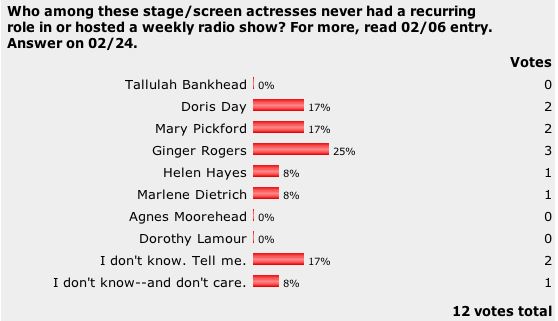
For the past three weeks I have been commemorating the dames, gals, and ladies of the airwaves; but now, the correct answer to the question posed in first broadcastellan quiz can finally be revealed. Thanks to all those who guessed or knew or couldn’t care less—and told me so. Tallulah Bankhead, Doris Day, Mary Pickford, Helen Hayes, Marlene Dietrich, Agnes Moorehead, and Dorothy Lamour—they were all radio regulars at some point in their careers, whereas others, including Ginger Rogers, the lady in question (as guessed by three readers), limited their air time to occasional guest appearances on dramatic programs like the Lux Radio Theatre. And others still, Marilyn Monroe among them, started out in commercials.

On this day, 24 February, in 1947, more than five years before she became a major star, a noticeably nervous Monroe, having waited months for her first movie role while already under contract at Fox, was pushed before the microphone to appear in a commercial break for the Lux production of “Kitty.” Within the few seconds allotted for her radio debut, Monroe was faced with the task of initiating her career (by mentioning her first Technicolor screen test), plugging Betty Grable’s The Shocking Miss Pilgrim (whose costume she got to wear during the test shoot), and peddling Lux “flakes” (which ostensibly kept those costumes fresh and colourful). However alluring her timbre, Monroe fumbled. She could not even get the name of the announcer straight; her voice was rarely broadcast thereafter, even as her film roles remained scarce and undistinguished.

A pleasant voice, while an asset, was not a radio requisite. As I mentioned previously, Louella Parsons did quite well without one, notwithstanding her consternation when being told she had to do without the larynx of Ms. Rogers, who allegedly insisted on getting paid to be interviewed. The giggles and high-pitched screechings of comedy actresses aside, the most celebrated woman’s voice on American radio was the less than pleasing one emanating from Agnes Moorehead. Her virago vocals, by which Joseph Cotton’s character in Since You Went Away claims to have been haunted across the Atlantic, was ideally suited to the role of irate Mrs. Stevenson in that most famous of original old-time radio plays, Lucille Fletcher’s “Sorry, Wrong Number.”

On this day in 1944, Moorehead, shown left during a performance of “Sorry,” once again starred in the role she had originated on the radio thriller anthology Suspense in May 1943. The part was subsequently translated for motion picture audiences and television viewers (by Barbara Stanwyck, Mildred Natwick, Ida Lupino, and Shelley Winters); but, however bitter Moorehead might have been losing the role to Stanwyck on the big screen, no actress would snatch the original from the “First Lady of Suspense.”

It was not until long after Moorehead’s death that Claire Bloom (recently seen on UK television in the last of the second season of Marple), made an attempt at superseding the “First Lady,” not only by recreating the role for radio in 1999, but by starring in a sequel of sorts.

While she had nothing to do with that sequel, radio dramatist Lucille Fletcher was responsible for the 1948 film adaptation. Her involvement did not, however, assure the aesthetic success of the latter, which, for all its high melodrama, has little of the tension generated by the original play. With its numerous flashbacks, the film destroys the intensity of a drama unfolding in real time. Like Allan Ullman’s novelization of Fletcher’s screenplay, it fails to approximate, let alone recreate, the excitement of eavesdropping on someone in mortal danger, someone whose life, like the live broadcast during which it plays out—runs on a decidedly tight schedule beyond our control and influence.

“I wanted to write a show that was ‘pure medium,'” Fletcher remarked about “Sorry, Wrong Number.” She succeeded so well that any adaptation would amount to nothing short of mediocre impurity.

On This Day in 1937: The Shadow Gets a Voice-over

I remember the first time I heard the menacing voice of The Shadow—and it was not over the radio. I was a college student in New York City and was cleaning the Upper East Side apartment of a fading southern belle. Well, I needed the cash and she was too much of a spoiled socialite to do more around her place than pet her Shih Tzu and point out the offending dust particles. She told me about some prank phone calls she had been receiving from a rather peculiar and not-so-secret admirer in her neighborhood. I think she had filed a restraining order, but that did not stop this cookie character from entering her sphere telephonically. The eerie message he left on her answering machine, which she did not hesitate to play back for me, was as ominous as a line from David Lynch’s Twin Peaks. It was not ‘Fire walk with me,’ though, but “Who knows what evil lurks in the hearts of men?” followed by a declarative but less than clarifying ‘The Shadow knows!’ Sinister laughter concluded this bizarre tele-communication. Let’s just say I was glad to put down the feather duster that afternoon and make off with my meagre earnings.

Several months later I came across those very words once more—and I could not get out to escape them, as I was already home.  I had just discovered the thrills of old-time radio and now realized that the unnerving telephone message etched in my mind was nothing but an imitation—albeit a brilliant one—of the most memorable signature in American radio drama. Yes, those lines sure tolled a bell, even though the knell was delivered in a different voice and accompanied by the somber and to me as yet unfamiliar strain of Saint-Saens’s Le Rouet d’Omphale.

The alter ego of Lamont Cranston—’wealthy young man about town’ who used his mysterious ‘power to cloud men’s minds’ to aid the forces of law and order—The Shadow was a man of many voices. Since he always had to have the last laugh, his strained vocal chords seemed to require a number of replacements.  On this day, 26 September, in 1937, when The Shadow returned to the airwaves after a thirty-month-long hiatus, Cranston received another one of those vocal makeovers, this time courtesy of Orson Welles.

Welles has gotten rather too much credit for his portrayal of The Shadow; after all, he was neither the first actor to play the role nor the one who stuck with it the longest. He spoke condescendingly of the popular program—an attitude common among actors and writers who used radio as a career springboard or a temporary cash cow—and asserted that he read his part without rehearsals (an unlikely story, given the fastidiousness of the sponsors and Welles’s youthful inexperience). To be sure, Welles’s first disappearing act as The Shadow—in an episode titled “Death House Rescue”—was neither a dramatic nor a thespian marvel.

In a story about Cranston’s efforts to save the life of an alleged cop killer on death row, Welles comes across as pompous and disdainful; since he always sounded like none other than Orson Welles, overgrown ‘boy wonder,’ it is difficult to determine whether he was sneering in character or at his character—a ham hampered by an attitude of I’m-way-above-such-baloney.  Agnes Moorehead, who played opposite Welles, managed a less self-conscious performance as Cranston’s companion, the “lovely Margot Lane,” whatever trifle of a line she was being tossed. Unlike Welles, Moorehead inhabited her role rather than interrogating it, which made her a most valuable and much admired player in commercial radio drama.

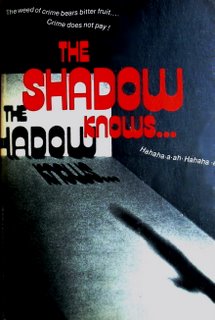
Still, his pretensions notwithstanding, Welles’s subsequent fame served The Shadow quite well. It encouraged scholars to dig up transcriptions of the long-running series and contributed to their preservation, although surveys of Welles’s distinguished theatrical and cinematic repertoire generally devote little more than a few footnotes to these broadcast performances. Some scripts from the final months of the series (not preserved on tape) even resurfaced in print—as a 1970s high school textbook (pictured above).

As may have become apparent, I could never quite warm to Welles or wring chills from his impersonation of The Shadow. Then again, I always thought of The Shadow as the voice of a creep on the answering machine of a dislocated Scarlett O’Hara gone twilight. What an introduction!