
White House Warnings, the Iran "Challenge," and the Art of Recycling Words for the Atomic Age

Only yesterday I was leafing through my dusty copy of Rogues’ Gallery: The Great Criminals of Modern Fiction. Granted, the story of pickpocket Thubway Tham (discussed in my previous journal entry) was anything but “great,” the dubious gentlemen among whom he appears in this anthology, figures like Raffles or Arsene Lupin, being far worthier of the appellation. Putting the book aside and glancing at today’s headlines, I got to thinking about those real-life acts of roguery and their perpetrators, thieves and tricksters fit for a place in that proverbial gallery.

Without being facetious, I think that most of us are eager to put certain politicians right up there with confidence men, embezzlers, and racketeers. Unlike fictional smugglers, highwayman, or cardsharpers, however, our misleading leaders rarely inspire cloak-and-dagger romances, at least not while they are still in office. Their potential to do harm to a far greater number of people than any pirate of old renders them too treacherous to be enchanting, and too powerful to be defused by mere ridicule. That we might have contributed to their ascent—either by having been taken in by their words or by having stood aside while others made what we’ve come to suspect as the “wrong” choice—only drives home that the joke, if ever it was one, is decidedly on us.

In the United States, the people’s trust in their political leaders may be reaching a new low these days, giving way to an indiscriminate, haphazard scepticism that could potentially be more hazardous than the actions that triggered it. So, hearing the latest White House warning about the Iranian nuclear program, I wonder who among us, the citizens or allies of the US, is willing to accept or heed it. Is it a danger real or imaginary, pre-existing or newly conceived in the act of pronouncing it true? What’s more, is not even a manufactured threat a concrete one nonetheless, whether as propagandist tool or diplomatic blunder?

Thinking this, I was reminded again of “Air Raid,” a verse play for radio by Archibald MacLeish, a big name in American poetry and pamphleteering. “Air Raid” is a didactic drama about an unheeded warning. Now, as I remarked when I commemorated the anniversary of the its premiere, the play was originally an appeal designed to caution US citizens against isolationism. Confronting the public with an enactment of a deadly attack on civilians, MacLeish went so far as to suggest that those who lose their lives to wartime terror are responsible for the consequences of their inaction.

However questionable his achievement, the anti-fascist cause that motivated its author was a noble one. “Air Raid” suggests that the greatest threat facing a people is not posed by foreign aggressors or domestic demagogues, but by an attitude of indifference to or ignorance of the political affairs makes the public vulnerable to acts of suppression and obliteration. Yet, like all propagandistic speech—and the melodramatic vehicles in which it hits its target audience—these words of caution were readily coopted.

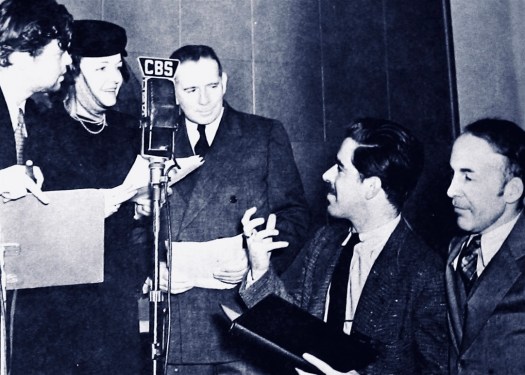
On this day, 10 March, in 1956, nearly two decades after its first broadcast, “Air Raid” was restaged by the CBS Radio Workshop. The same words poured once more from the speakers—but their context had changed entirely. Now the play had the stamp of the Eisenhower years pressed upon it, the gullibility of the public being relied upon rather than challenged with the announcer’s insistence that “Mr. MacLeish’s prophesy” had become “grim reality” in an age of “guided missiles” capable of “nuclear destruction.”

“Learn what you can do to increase your chances of survival,” the program’s announcer implored listeners at the close of the broadcast: “Contact your Civil Defense Office.” As American families retreated into their picket-fenced homes—or into dreams of such—they were left with the impression that the world outside the United States was evil and that their leaders had solely their safety, rather than profits, in mind. It was thus that the lucrative armament of the cold-war years was being justified. MacLeish’s warning had become “grim reality,” all right—so much so that the public was not to appreciate his original message.

So, given that we have mostly familiar words of warning to go by once more, how can we determined the honesty or falsehood of those who utter them? Does the present truth lie in the perceived deceptions of the past? And how far should we remain willing to listen with the generosity of an open mind—instead of hiding behind the reflecting shield of satire—to keep an essentially sound and worthy political system such as democracy from falling apart?

On This Day in 1938: Broadcast “Air Raid” Assaults Like Sontag’s 9/11 Tirade

Sunlight and shadows across my
copy of MacLeish’s Air Raid

Well, only yesterday I wrote about the potentialities of broadcasting and blogging as means and modes of connecting with the world. Today I am going to mark the anniversary of an execrable “disconnect” by relating it to a disturbing episode in my life, a moment of outrage in a period of confusion and despair. Ready?

On this day, 27 October, in 1938, the Columbia Workshop laid an intellectual egg of such poor taste that I sometimes felt the only proper way of connecting to it would be to hurl it right back at its author, the American poet-pamphleteer Archibald MacLeish. The play produced by and broadcast over the US radio network CBS was “Air Raid,” an exercise in propagandist verse. Like “The War of the Worlds”, which aired a few days later over the same network, “Air Raid” entered the anti-fascist debate and commented on the political tensions then mounting in Europe by exploiting and fueling the anxieties of an American public divided between battle cries and isolationism. The nation’s enemies, such plays told in the abstract language to which pre-war radio playwrights were bound to adhere, were not quite so distant as to render their attacks futile.

In “Air Raid,” MacLeish went so far as to hold civilians whose lives were threatened or lost in fascist offensives responsible for their inaction. As in the previously discussed “Fall of the City,” the audience is taken to the scene of terror, listening in as carefree women, heedless of the warnings they receive, ar e going about their daily affairs until blown to bits by machine guns fired from above. The announcer, observing the raid from a secure post, reports and comments on the execution:

There’s the signal: the dip: they’ll
Dive: they’re ready to dive:
They’re steady: they’re heading down:
They’re dead on the town: they’re nosing:
They’re easing over: they’re over:
There they go: there they—

His coverage of the event is cut short by the stammering guns and the shrieking of women and ends in a boy’s calling of my name: “Harry! Harry! Harry!” I did not require such a prompt to feel personally offended.

MacLeish intellectualizing of terror and patronizing of the terrorized is the kind of disastrous argument that reminded me of Susan Sontag’s words shortly after the attacks on the World Trade Center. In an article published in the New Yorker, Sontag lamented the “disconnect” between the “monstrous dose of reality” that was 9/11 and the “self-righteous drivel and outright deceptions being peddled by public figures and TV commentators.”

Sontag opined that the “voices licensed to follow the event seem to have joined together in a campaign to infantilize the public,” a public lacking in “historical awareness” and subjected instead to the “psychotherapy” of “confidence-building and grief management.” Arguing the insistence on America’s strength to be not “entirely consoling,” Sontag concluded: “Who doubts that America is strong? But that’s not all America has to be.”

In retrospect, I find these words unremarkable; they have been uttered many times since. Living through the terror of those days in New York City, however, I was infuriated by such ill-timed chastising from afar (Sontag lived in Paris at the time). I sat down and cried and wrote a lengthy response to let out my anger, shared with the German friend who brought Sontag’s commentary to my attention:

Sie mag aus der Ferne spotten; sähe, fühlte, spürte sie die Stadt würde sie den New Yorkern kaum “Dummheit” vorwerfen.  Wenn ich ihr aus der Ferne auch weder Feigheit noch Dummheit unterstellen will, so muss ich doch feststellen, dass Abstand auch eine Freiheit von Anstand bedeuten kann.  Sontag schrieb einmal ein erfolgreiches, vielzitiertes, und feines Buch mit dem Titel Against Interpretation.  Sie täte gut daran, sich gegen ihre eigenen ‘Interpretationen’ zu sträuben.

In essence, I argued that Sontag should heed the words that formed the title of her book Against Interpretation, that she should have reserved her distant and distancing intellectualizing and her attacks on the supposedly infantile public and the media that pampered it for a period in which a bewildered public was more likely to stomach further humiliation and to respond with a kindness and dignity lacking in Sontag’s words to the unwise.

Attacking both the medium it employs and the masses it engages (that is, attempting to appeal to the latter by questioning the former), MacLeish’s “Air Raid,” like Sontag’s tirade, is a prime example of how not to connect.

“A symmetry of unborn generations”: A Guernica for Radio

One of the many attractions of Madrid I will make sure not to miss is Picasso’s Guernica (1937), the most famous 20th-century painting in the Reina Sofía collection. A report from the commonplace-turned-combat zone, Guernica is a piece of anti-totalitarian propaganda commemorating the world’s first civilians-targeting air attack: the 26 April 1937 raid on the busy market town of Gernika-Lumo, masterminded by General Franco and carried out by the Condor Legion of Nazi Germany.

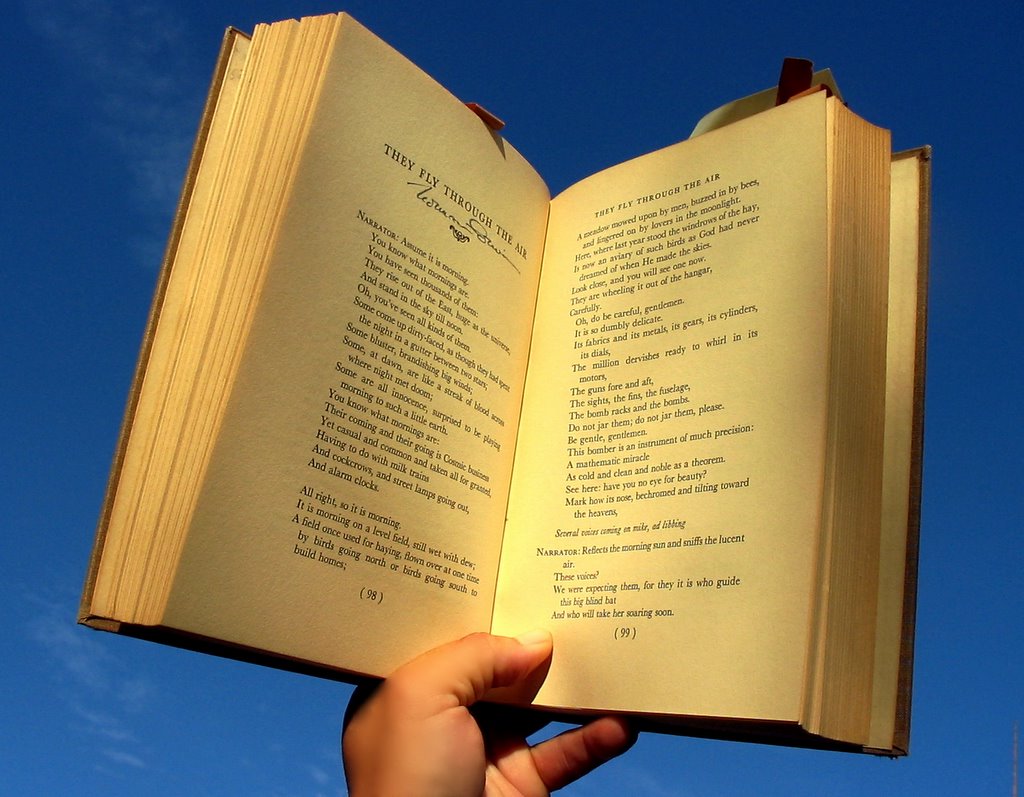
Holding up to the sky my copy of Corwin’s play “They Fly Through the Air,” signed by its author

For a long time, the painting was kept out of Spain and was mostly on display at the MoMA in New York City, where, during the Vietnam War, it became a site for vigils held by members of the peace movement, one of whom went so far as to deface it with red spray paint. It was Picasso’s wish that Guernica be returned to his homeland only after the reestablishment of democratic rule. A swiftly executed and brutally manipulative commentary on modern warfare, it invites comparisons to the three best-known American verse plays for radio, Archibald MacLeish’s “Air Raid,” Edna St. Vincent Millay’s “Murder of Lidice,” and Norman Corwin’s “They Fly Through the Air with the Greatest of Ease.”

MacLeish’s “Air Raid,” in contrast to Picasso’s painting, overtly implicates the civilian population, including his radio listeners, castigating them for their supposed ignorance and inertia. As in “The Fall of the City,” MacLeish attacks those falling rather than sentimentalizing their plight. His are bold performances, but his cruel warning turns listeners eager for news into silent partners of war who are asked to “stand by” as they tune in while women and children, refusing to heed warnings of an impending blitz, are being attacked and annihilated:

You who fish the fathoms of the night
With poles on roof-tops and long loops of wire
Those of you who driving from some visit
Finger the button on the dashboard dial
Until the metal trembles like a medium in a trance
And tells you what is happening in France
Or China or in Spain or some such country
You have one thought tonight and only one:
Will there be war? Has war come?
Is Europe burning from the Tiber to the Somme?
You think you hear the sudden double thudding of the drum
You don’t though . . .

Not now . . .

But what your ears will hear with in the hour
No one living in this world would try to tell you.
We take you there to wait it for yourselves.
Stand by: we’ll try to take you through. . . .

Millay’s “Murder of Lidice” recalls the innocent lives of those slain by Richard Heydrich, Deputy Reich Protector of Bohemia and Moravia, in Lidice. Artistically, the play is indefensible and shockingly inept in its bathos. In Millay’s Grand Guignol of Nazi terror, Heydrich the Hangman, whom the villagers have assassinated, is heard, from the beyond, planning his revenge:

He howls for a bucket of bubbly blood—
It may be man’s or it may be of woman,
But it has to be hot, and it must be human!
Oh, many’s the sweet warm throat he’ll suck.

In “They Fly Through the Air,” Corwin’s narrator goes in search of a language appropriate to the negotiation of art and propaganda. As I point out in Etherized Victorians, the play is a response to the perversion of poetic diction by the fascist cause. Viewed from above, Mussolini reportedly remarked, exploding bombs had the beauty of a “rose unfolding.” Throughout the play, metaphors are at war with plain speech, both in the service of motivating the masses:

What words can compass glories such as we have seen today?
Our language beats against its limitations [. . .].

Our rhythms jangle at the very start.
Our similes concede defeat,
For there is nothing that can be compared to that which lies beyond compare.
You see? We are reduced already to tautologies.
It’s awe does that.
The wonder of it all has set us stammering.

What is the language of war? How does it differ from the idiom of peace? And how shall war—often furious but not always futile—be rendered, recorded, and remembered in words or images? When I look at Guernica this week, I will ask myself these questions. Quite possibly, I will shiver when exposing it to the limitations of my shrinking lexicon.