
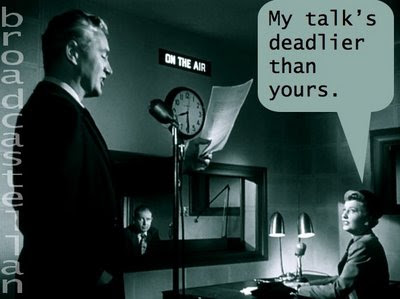
Radio at the Movies: To Please a Lady

She played tougher than anyone else in pictures, and she was better at it. She could get a guy to fall for her and a fall guy to do anything for her, be it to lie, cheat, or kill. To please her was a dangerous game; but to displease her was a deadly one. She could make puppets of men; Charlie McCarthy was just target practice. I’m talking Barbara “Baby Face” Stanwyck, of course, the kind of social climber who shoved the ladder right into the face of those far from selfless fellas who lined up to give a gal a helping hand. In To Please a Lady (1950), Stanwyck proved that her very lips could kill. Well, as newspaper columnist Regina Forbes, Stanwyck had the means to finish the job properly: a microphone, a broadcasting studio, and a weekly radio program.

To Please a Lady makes you wonder what Stanwyck could have done with a regular radio broadcast; she certainly could have out-Hoppered—and, out-Hoopered—Hedda, who simply didn’t have the voice to match her name. That said, Regina Forbes is not quite as eager as Hopper to pick up any name dropped in her lap.

“But you can’t go to Newark tonight,” her secretary exclaims as Forbes rushes out to get a story that piqued her interest. Never mind that she already had an appointment with “Margaret.” “What about Margaret?” Forbes asks. “You know,” she is reminded, “the one who sings.”

That, if you require a footnote, is a reference to the aforementioned Margaret Truman, the President’s daughter. And Forbes had no qualms about standing her up to get the dirt on a disgraced speed racer (smug-as-ever Clark Gable), who, like Forbes, stops at nothing to be first at the finish line.

To Please a Lady is a contrived story, and one that is told none too well. So, as the camera follows Gable for another spin around the track, you get to fantasize about Stanwyck’s voice and the radio and . . . hang on, there’s Ted Husing. Best known for his sportscast, the CBS announcer was also heard on an early Eddie Cantor program and its successor Rhythm at Eight, starring Ethel Merman; an excerpt of a routine for the latter is reprinted in Husing’s book Ten Years Before the Mike (1935).

Of the “grand trouper” Merman, Husing says:

While admitting that television will double her value as a radio performer, I still think she is radiates personality over the air. Her speaking voice is vibrant with health and youth, and is highly individual, while her singing tones are thrilling. What more can you ask of a radio personality?

Television doubling the value of a radio performer? Obviously, this was written before radio took the corner around which it was assumed to be lurking all those years. And when it got there, round that bend, it crushed the competition. While radio was still not yet quite defeated as a dramatic medium back in 1950, there are signs of an impending crash in To Please a Lady.

Forbes may still have her radio program, and Gable as an avid listener, but she gets her news from television, which introduces her to Gable’s mug and convinces her to rush out to interview him. She may still be in a position to knock them dead with the lashings of her tongue—inducing one of her victims to commit suicide—but it is television that is giving her ideas.

Voices like Husing’s were fast becoming a mere adjunct to the flickering images on the small screen, filled as it was with the dust in which it left the art of giving you a mind’s eye view of it all through speech alone. You know, the thousand-and-one words it presumably takes to approximate a single picture.

My Eyes Are in My Heart, Husing told his former listeners in his second autobiography, published in 1959. And so they were. The book was written after he had gone blind. Stanwyck, around that time, was embarking on a career as a television actress and personality, which, aside from guest appearances, ranged from hosting an anthology series bearing her name to playing matriarch Victoria Barkley on The Big Valley. By then, plays for listening had all but vanished from US radio.

Ham and Accents

“Good evening, ladies and gentlemen. The Lady Astor Screen Guild Players have a surprise for you tonight.” Such a promise may well have sounded hollow to many of those tuning in to the Guild program broadcast on this day, 27 March, back in 1944. That it was grandiloquently voiced by the avuncular-verging-on-the-oleaginous Truman Bradley, whom American radio listeners knew as a voice of commerce, hardly imbued such a potential ruse with sincerity. And yet, the program is indeed a surprise, and a welcome one at that. The broadcast is a rarity in scripted radio comedy: one of those occasions when ham is not only sliced generously but consumed with gusto. Granted, I may be somewhat of a hypergelast, the kind of fellow Victorian poet-novelist George Meredith denounced as a fool who laughs excessively. Still, believe me when I say in a voice that has nothing to advertise but its own taste, poor or otherwise: this is one is a riot.

Affable character actor Jean Hersholt, then President of the Motion Picture Relief Fund and star of his own sentimental radio series (Doctor Christian), takes over from the announcer to introduce the players for the evening. You can buy a line from a man like Hersholt. His is a thick, honest-to-goodness accent that sounds trustworthy compared to whatever slips from the trained tongues of promotion.

Tonight, he tells us, “we have Barbara Stanwyck, Basil Rathbone, and director Michael Curtiz, three of filmdom’s outstanding personalities who will offer. . . .” At this moment, Hersholt is cut short by the one who generally occupies that spot, the man entrusted with the dearly paid-for delivery of cheap assurances.

“Uh, just a minute, Jean,” Bradley interjects, “I thought that Jack Benny was supposed to be one of the guests here tonight.” This exchange sets up the slight comedy known as “Ham for Sale,” a fine vehicle for Jack Benny, the master of comic deflation, the jokester known for his largely unfulfilled aspirations as a thespian and classical musician.

According to Hersholt, Benny got “a little temperamental”; so he will not be heard on the program. Hersholt’s recollections give way to a dramatized account of Benny’s response to the proposed broadcast. “I haven’t got anything against you, Jack. But you’re a comedian; and, frankly, I don’t think you have enough dramatic ability to play the lead opposite Miss Stanwyck.” Upon which the slighted comedian sets out to win the part.

The hilarity generated by “Ham for Sale” is not so much scripted than delivered. Greatly responsible for the kicks you’ll get out of this broadcast is the highly regarded, Oscar-winning director of Casablanca, whose Hungarian accent is so pronounced and to radio listeners’ surprising, that it causes Benny to ad-lib and Stanwyck to scream with utterly infectious laughter.

According to Herbert Spencer’s “The Physiology of Laughter” (1860), mankind (or, homo ridens) response in this way when expectations are suddenly disappointed and an excess of energy in our nervous system is discharged in the muscular reflex of laughing. It seems that, as an actress, Stanwyck expected Curtiz to have a great, controlling presence; instead, while to some extent in on it all, he became the hapless brunt of Benny’s jokes: “Between Hersholt and you, I don’t understand anything.” Perhaps, it is the kind of “sudden glory” Thomas Hobbes denounced as a “sign of pusillanimity.” But it sure feels good to salt this “Ham” with your own tears.

It wasn’t exactly a fresh cut. The sketch had already been presented once before (on 20 October 1940), with Benny trying the patience of Edward Arnold, Ernst Lubitsch, and Claudette Colbert. Yet Colbert appeared to have been too controlled an actress to let anything interfere with her live performance that evening; nor did Lubitsch’s accent trigger as many not altogether intentional laughs as that of his fellow director. It is Stanwyck’s reaction to Curtiz’s line readings (just hear him exclaim “stop interrupting”) and Benny’s extemporising to the occasion that makes “Ham for Sale” such an irreverent piece of Schadenfreude.

Relentless and immoderate, laughter here is a response to the “mechanical” (in Bergson’s sense), to the orderly and overly rehearsed—the minutely timed, predictable fare that so frequently went for on-air refreshment.

The Women Who Saved My Reputation

Close, but no big star. That’s what I’ve always felt when I come across Hollywood actor George Brent, the kind of actor I happen upon merely because he happens to be in something or opposite someone I care to see. Capable, certainly. Likable, perhaps; but Brent is lacking in the charisma, the je ne sais quoi that turns mere mortals into icons. There he was again, last night, at the close of a particularly quiet day (another one without telephone or internet here at our cottage). His dashing entrance notwithstanding (a rescuer on skis), I cannot say that I watched him. I sort of look past him, usually at the women with whom he had the fortune to be paired.

In My Reputation (1943, but not released until 1946), the woman in question is Barbara Stanwyck. Now, there’s a leading lady that is impossible to overlook; and in My Reputation she is particularly lovely. Perhaps, a little too lovely to be the questionable woman the title suggests her to be. I was reminded of Trollope’s Can You Forgive Her?, a novel that tends to make readers go “What’s to forgive?” After all, Stanwyck’s character is a widow, not a bigamist. I suppose the Shakespearean Instruct My Sorrows, the title of the novel on which this romance is based, did not strike Hollywood producers as enticing enough.

What saves My Reputation are those minor players that manage to make a major impression in the few minutes they are allotted on the screen; they are supporting in the truest sense of the word. There’s Eve Arden, for instance, in the kind of role she filled in Mildred Pierce; her confidence and wit are always welcome. She often seems to be on her way to a party of her own and you wish she could have handed you an invitation; instead, she picks up her gift and dashes off. Cecil Cunningham walks on memorably, and Esther Dale is comfortingly efficient as the maid. And then there is Lucile Watson.

What a woman! In her expressions of disdain and her haughty delivery, Canadian-born Watson (1879-1962) bears a strong resemblance to Patricia Routledge, best known to television viewers as Hyacinth Bucket (of Keeping Up Appearances). And yet, as Stanwyck’s mother she remains formidable both in her dignity and her indignity, rather than appearing ludicrous in her pretensions. Just watch how she rebuffs the impertinent Brent, how she makes Stanwyck squirm in the above scene. It isn’t her stare alone that compels you to take notice. Hers is a voice made for lectures on etiquette and the uses of conventions. A voice that insists on being heard and heeded. A voice … for radio.

Unfortunately, radio adaptations of Hollywood films like My Reputation had no use for supporting actors, most of whom were replaced by repertoire players like Janet Scott, who was heard in Watson’s part in this Lux Radio Theater production from 21 April 1947. Even when, in this Screen Guild production of Watch on the Rhine (10 January 1944), Watson was given a rare chance to share the microphone with the film’s stars, Bette Davis and Paul Lukas, the script was so severely condensed that her supporting role was reduced to a mere cameo.

Far more interesting are Watson’s personal recollections in this tribute to Ethel Barrymore on Biography in Sound; having played opposite and observed Barrymore on the stage, Watson remarked that she “learned an important lesson in acting”:

When thousands came nightly to be thrilled by her magnetic voice, I was watching something else: the way she listened to the speeches of her fellow players.  And I thank her now for any knowledge I have of what is perhaps the highest art of an actor: the art of beautiful listening.

My Reputation makes plain just how well Watson had learned that lesson; at the same time, the supporting actress claims the center of the stage, defying us to ignore her. More than the leading lady herself, Watson, as Mrs. Kimball, makes you understand Stanwyck’s character: a repressed woman struggling to let go; not to let herself go, exactly, but to let go of the past when forced to confront an uncertain future after the death of her husband.

It is Watson’s performance that explains the pressures and strictures this blameless woman has always been up against. After all, Mrs. Kimball does not simply try to save her daughter’s reputation—she defined it.

The Doll Who Made Puppets of Men

I won’t be in town in time to celebrate her 100th birthday and join in the festivities currently (if somewhat prematurely) underway at the Brooklyn Academy of Music. The celebrated one is Brooklyn-born Barbara Stanwyck, who, on this day, 2 May, in 1943, added a piece of wood to the pile of men she knew how to manage. Charlie McCarthy, that is, a ventriloquist dummy oozing sap after a period of protracted prepubescence. Suddenly, he was sprouting facial hair, some not so hot fuzz with which he hoped to attract “women of the opposite sex.” Yet unlike Marilyn Monroe after her, the Ball of Fire hadn’t come to woo, wow, or wed Charlie. She was going to burn him without having to turn on the heat.
After cutting this log down to size by reminding him that he still worked for a measly salary of 75 cents per week, the shrewd Lady Eve offered Charlie her services as a manager: “Just place yourself in my hands and I’ll put you on a solid basis,” she promised. Apparently, Indemnity wasn’t the only thing this Lady of Burlesque preferred double. And Charlie, eager for a little independence after years of service, promptly rose to the bait.

As he would a few weeks later, when Claudette Colbert invited him to her beach house, Charlie learned another important wartime lesson: not to be too selfish or greedy while Americans were called upon to make sacrifices and lend their support to neighbor and nation alike. As for Ms. Stanwyck, she still walked away with a few extra nickels she had managed to squeeze out of the timbered twerp, who, for once, ended up not having the last word.

Whether or not she had any desire to handle or caress men, she could manage them, all right.

“These Three”: Gay Lovers Straightened through Air-conditioning

The history of taboos sure is shocking. I mean, it is shocking to realize what, over the years, has been hidden from view and banned from our discourse. Interracial marriages. Same sex unions. Gender reassignments. While denial can be as harmful as our tendency to designate, you would have to have been living under that proverbial mineral formation or petrified by the religious fundamentalism that passes for faith these days to regard such realities as unmentionable. They may not be widely understood or tolerated, let alone embraced, but as the facts of life in all its complexities they are too much in the public eye to be ignored.

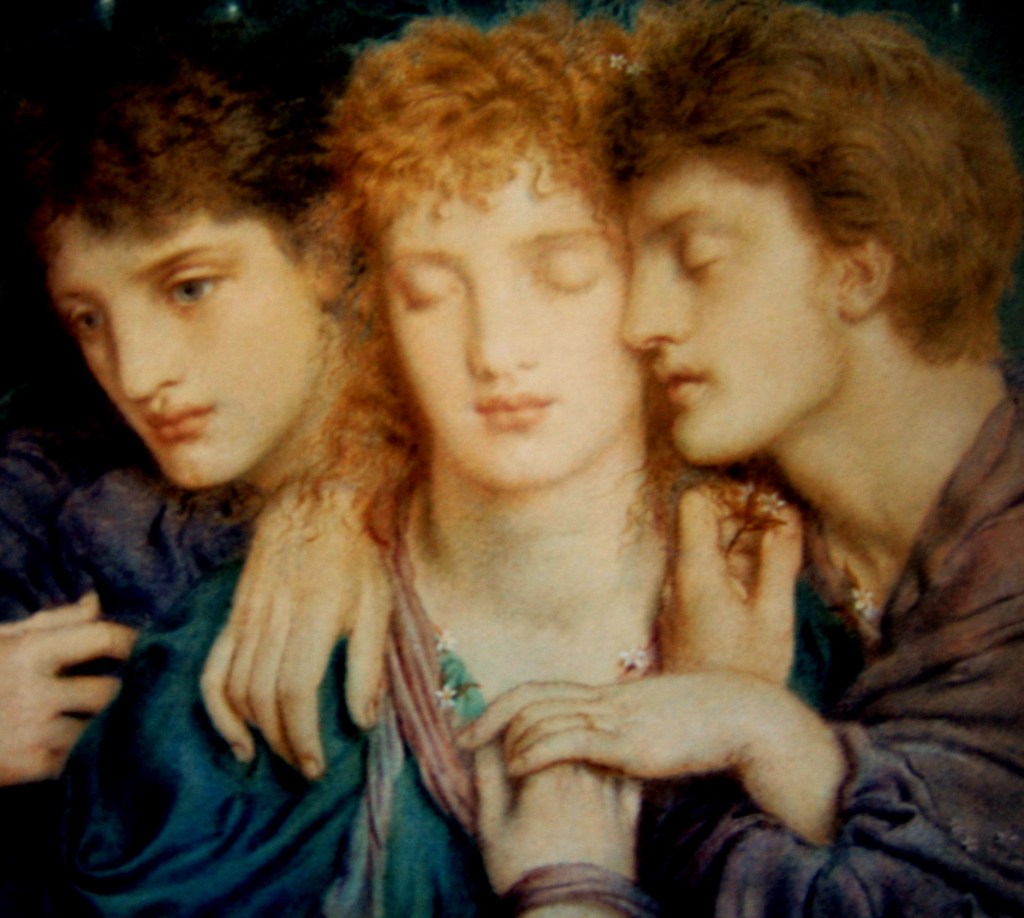
Simeon Solomon, The Sleepers and the One who Watcheth (1870; detail)

Often argued to be responsible for foisting a liberal education on the masses, Hollywood has, in fact, played an important role in keeping quiet about many aspects of our everyday lives. Beginning in the mid-1930s, and for several decades thereafter, the Production Code curtailed what could be shown or talked about in motion pictures.

It was on this day, 6 December, in 1933, that James Joyce’s Ulysses was ruled to be “not obscene,” lifting the ban on its sale in the US; but that, aside from its narrative structure, hardly made Ulysses ( 1922; previously serialised 1918-20) a hot property in Tinseltown. Writers who wanted a share of the profits to be made by selling stories or streamlining them for the silver screen had to deal with the strictures of the code and learn to rework their material accordingly.

One playwright who accepted this challenge was Lillian Hellman, whose 1934 stage success The Children’s Hour was brought to the ears of American radio listeners on this day in 1937.

The Children’s Hour tells the story of two women whose teaching careers and personal lives are wrecked when one of their pupils alleges that they are having an intimate relationship.  Like Hellman’s 1936 screen version of The Children’s Hour, titled These Three, George Wells’s radio adaptation for the Lux Radio Theatre drowns out the unspeakable by suggesting instead a triangulated relationship with a virile heterosexual male at its center.  Wedged between Stanwyck and Mary Astor that night was the presumably irresistible Errol Flynn.

Hollywood had long thrived on love triangles, although they were rarely as ambiguous as in the above painting by the aforementioned queer artist Simeon Solomon.  Indeed, the three-cornered plot is key to the first new genre of production-coded cinema—the screwball comedy, in which heterosexual marriage is challenged by old flames or new rivals until it is ultimately reaffirmed. Although—or perhaps because—These Three is more concerned with libel than with forbidden love, with allegations rather than physical acts, the revision eliminates the unmentionable to make room for a rumor that can be talked about.

As if determined to remove any doubts as to the straightness of the radio adaptation and all those associated with the production, Lux host Cecil B. DeMille opens the program by letting listeners in on a “secret,” a story that had “completely escaped the headlines.” The unheard-of item amounted to little more than the announcement of a recent marriage. According to DeMille’s anecdote, the unconventional Ms. Stanwyck had just attended the wedding of her stableboy, danced with the hired hands, and “made them all forget” that she was the “groom’s boss.” The Lux program presented itself as clean entertainment without wanting to appear stuffy.

What is more stuffy—and objectionable—than the codes governing radio and motion pictures is the subsequent silencing of the history of such hush-ups. A description of the Lux broadcast in a 1995 reference text, for instance, keeps mum about the pedigree of the adaptation by alluding vaguely to “[c]ertain aspects of the stage production’s plot” that “made a straight film version out of the question.” Phobic histories like these not only contribute to our ignorance of past inequalities. They keep us from moving beyond them.