โ€œโ€ฆ unequal emissionโ€: โ€œInterference,โ€ โ€œModern Wireless,โ€ and the “Wilds of Electroniaโ€

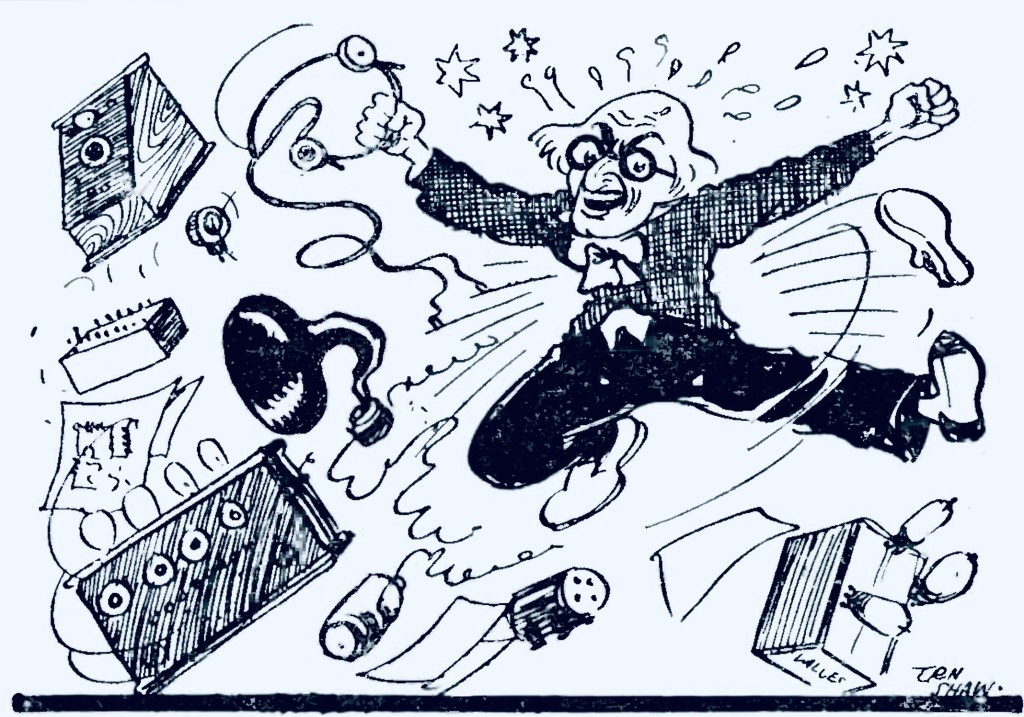
Illustration by Ern Shaw (Modern Wireless, Nov. 1924)

โ€œMany plays have been broadcast, but none of them seems to me to have the pep that is needed to get not merely across the footlights but across the ether.โ€  Complaints such as this one are all too familiar to me; in fact, they were launched so frequently against radio culture that, years ago, they prompted me to contest them. 

To misappropriate the famous question posed by the feminist critic Linda Nochlin, I asked โ€œWhy Are There No Great Radio Writers?โ€ The objective was not to find examples to the contraryโ€”those queer, quirky and quicksilver exceptions that can serve to prove the ruleโ€”but to query the question itself as (mis)leading and to expose the biases underlying it.

Continue reading “โ€œโ€ฆ unequal emissionโ€: โ€œInterference,โ€ โ€œModern Wireless,โ€ and the “Wilds of Electroniaโ€”

Ephemerabiliaphilia: The (Unreturned) Love of Re-Collecting the Largely Neglected

My memory is poor, generally, and getting worse.ย ย My desire to remember the forgotten โ€“ the ostensibly unmemorable โ€“ remains strong.ย ย It is a love rooted in the need to champion the unloved, or, rather, the dis-loved, and to abandon myself to the abandoned.ย ย It is a queer thing, to my thinking, which is queer always and could not be otherwise.ย ย To love, perversely, what has been discarded or deemed unworthy of consideration, means disregarding what is widely held to matter and instead be drawn โ€“ draw on and draw out โ€“ what is devalued as immaterial.ย ย It involves questioning systems of valuation and creating oppositional values.

Commenced in 2005, this journal was dedicated to what I termed โ€œunpopular culture,โ€ the uncollected leftovers that linger on a trash heap beyond our mythical collective memory.  To this day, down to my current project, Asphalt Expressionism โ€“ a curated collection of images engaging with the visual culture of New York City sidewalks โ€“ I carry on caring about the uncared-for and neglected, the everyday past which others tend to walk without taking notice.

There is no such thing as trivial matter.  Nothing is negligible in itself.  What makes something worthless is not a particular quality or lack thereof.  Rather, it is an attitude, an approach, a judgment โ€“ itself often a product of a cultural conditioning.  Nothing is intrinsically trivial, but anything may be trivialized.  As I put it, years ago, when I curated (Im)memorabilia, an exhibition largely of mass-produced prints entirely from my collection โ€“ โ€œTrivia is knowledge we refuse the potential to matter,โ€ whereas โ€œMemorabilia is matter we grant the capacity to mean differently.โ€

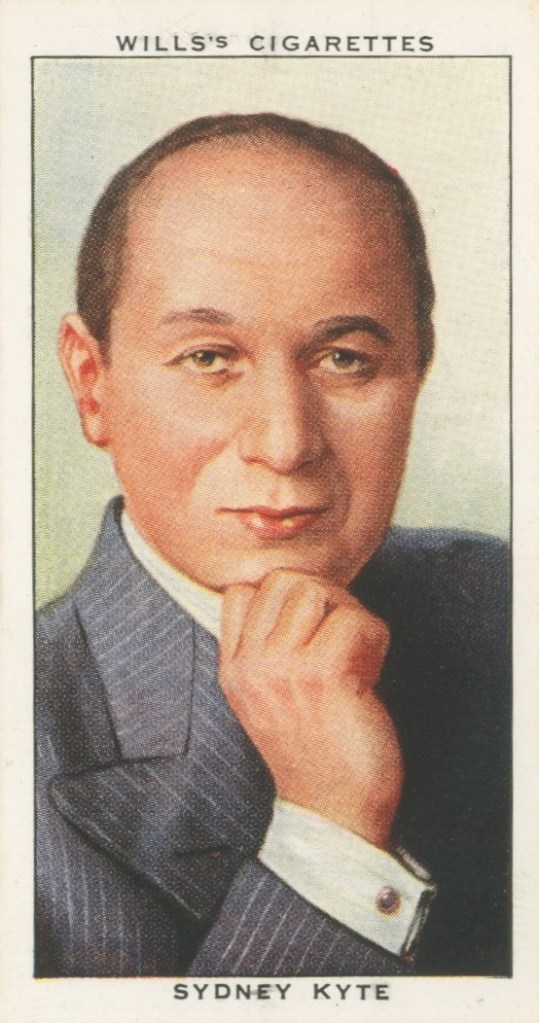
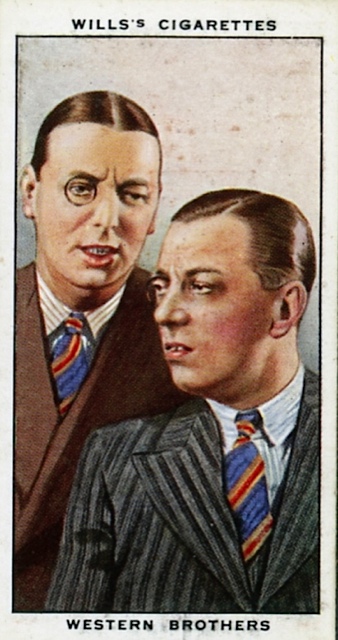
Low as a Kyte? A 1934 Wills’s Cigarette card featuring Sydney Kyte, a bandleader to whom no Wikipedia page is dedicated. The card sells online for under ยฃ1.

A 1930s cigarette card, for instance, may have once served the purpose of boosting sales by prompting smokers to collect cheaply mass-produced images of film stars or flowers or tropical fish.  Collecting them nearly a century later โ€“ long after the advertising campaign has folded and the image has become removed from the product it was designed to promote โ€“ means to extend the lives of such devalued objects by moving them into the sphere of our own temporary existence of which they in turn become extensions.  

Whether or not we take measures to preserve their afterlife, we instill collectibles with new meaning, give them value by investing them with our longings.  I, for one, never regard my belongings as financial investments; I do not collect calculatedly, anticipating that what I gather might be the worth something to someone else some day.

I also refuse to intellectualize my desires; I am wary of turning passion into an academic exercise.  That is, I do not rescue the marginalized for the purpose of demarginalizing my own existence by convincing others of the cultural value or historical significance of devalued objects โ€“ and of the case I make for their value.  Still, there is that longing to be loved, to feel validated, for all the reasons that many, I suspect, would regard as wrong.  

Why waste time on what is waste? Why dig up โ€“ and dig โ€“ what has become infra-dig through the process of devaluing, a hostile attitude toward the multiple, the unoriginal and commercially tainted to which we appear to be conditioned in a capitalist system that makes us feel lesser for consuming the mass-produced within our means so that we aim to live beyond those means, always abandoning one product for another supposedly superior?  There can be no upgrading without degradation, no aspiration without a looking down at what has been relegated to refuse.

I remember a gay friend telling me, decades ago, that when he was a child, drawing in kindergarten or elementary with other children, he would pick the color that was least liked by his fellow creatives.  I did the same thing when toys were being shared.  This unwanted thing could be me โ€“ this is me โ€“ is what must have gone through my mind when I took temporary ownership of the object of just about nobodyโ€™s affection.  And this, I believe, is at the heart of my impulse to make keepsakes of the largely forsaken.

I started writing this on the one-hundredth anniversary of the first radio broadcast in Britain โ€“ 14 November 1922 โ€“ by what was then not yet the BBC.  Sound, after all, is the ultimate ephemera, fleeting if uncollected, lost if not cared for.  The BBC used to erase recordings of its broadcasts, turning the potentially memorable into the immemorabilia beyond my grasp, and, in turn, turning my determination to lift them into my presence into futile longing, a nostalgia for the unrecoverable past.

Air and Grouses; or, 180 Seconds to Mark 90 Years

โ€œGive’m that off-the-air smileโ€

When Radio Times magazine announced a few weeks ago that its 10-16 November issue would celebrate the ninetieth anniversary of the Corporation largely in charge of the medium to which the pages of said venerable British weekly are nominally dedicated, I was very nearly all ears.  That I wasnโ€™t ears entirely is owing to the skepticism I have developed when it comes to the wireless and its status in todayโ€™s mass-mediated society.  Sure enough, the Radio Times celebration fell as flat as my introductory sentence.  The promised โ€œAnniversary Specialโ€ amounted to little more than a few pages of pictures designed to demonstrate that radioโ€”or, strictly speaking, BBC radioโ€”is very much alive. 

Clearly, I havenโ€™t kept my ear to the ground, as most of the personalities depicted on the pages of the Radio Times anniversary issue are no more familiar to me in appearance or voice than the radio stars of yesterday whose images I put on display here to suggest that commemoration and oblivion are not mutually exclusive, and that what is being marked by the โ€œAnniversary Specialโ€ is not so much the birth, infancy or longevity of radio as is its presence and relevance today.

โ€œPrint, they say, is dying,โ€ news presenter Eddie Mair opens his commemorative Radio Times article, and television programs nowadays are โ€œwatched by a fraction of the numbers who used to tune in.โ€  The wireless, on the other hand on the proverbial dial, he argues to be in โ€œrude health,โ€ ninety years after the BBCs mics first went liveโ€ on 14 November in 1922.

“Remember what I said yesterday?”

No doubt, those words are meant to be eulogistically reassuring, albeit less so to the publishers of an ailing print magazine, in deference to whom Mair distances himself from his opening statement by injecting โ€œthey say.โ€  I might addโ€”and shallโ€”that if โ€œthey sayโ€ radio is thriving, then why isnโ€™t there a radio on the cover of that โ€˜anniversaryโ€™ issue?

It isnโ€™t radioโ€™s age, surely, that made editors decide against a shot of an historic wireless set, a glistening microphone, or any number of radio personalities, living or dead.  After all, the editors chose Sir David Attenborough as their cover boyโ€”and he, at 86, is nearly as old as the BBC.

Why Attenborough? Well, he, too, has a broadcasting anniversary worth celebrating; and, apparently, his sixty years of television are worth more to the BBC than its own ninety years of radio broadcasting, marked in the pages of Radio Times with a slim timeline of scant microphone highlights so miniscule that it, like the fine print in advertising, makes you feel what is really wanting is a microscope.

Could it be that the Corporation toned down its self-glorification in light of the scandal surrounding desanctified saint Jimmy Savile and the efforts to cover up or deal with his posthumously emerging history of pedophilia? While this may not be the time for airs and graces, it does not follow that any self-reflexive, critical history the BBC airs disgraces.

“Just who do they think we aren’t?”

Sure if your face is red, you are not inclined to parade it in public; but that does not quite explain, let alone justify, the way in which the wireless anniversary is scheduled to unfold sonically this afternoon.  At 5:33 PM preciselyโ€”the exact time of the first BBC radio broadcast back in 1922โ€”all BBC stations jointly air a newly commissioned composition of music and sound bites, the latter to be contributed by listeners.  However thrilling and noteworthy, the whole rather self-defacing event lasts about three minutes, less time by far than commercial television sets aside for a single block of advertising.

Not quite believing my eyes at the sound of that announcement, I flicked through the pages of Radio Times in search of further commemorative programming.  Alas, it is, for the most part, business as usual.  And even though the โ€œusualโ€ is usually quite satisfactory, the extraordinary sure has a deflated air about it.

Difficult as Pie: A Priestley Postscript

I have never heard J. B. Priestley deliver his famous Postscripts, a series of morale-boosting talks broadcast to the British public during those early, uncertain and hence no doubt most terrifying days of the Second World War.ย  Many decades later, actor Patrick Stewart returned Priestleyโ€™s lines to the airwaves that had once carried them into the homes of millions; but somehow I could not get excited about those recreations.ย  For, no matter how delayed an originally live broadcast, its recording yet retains the immediacy of a first-hand experience that no re-enactment can approach.

Recently, I came across the published Postscripts (1940).  Unlike Stewartโ€™s voiceovers, the printed speeches are unabridged and, their author insists, โ€œexactly as they were, without a speck of retouching.โ€  These are โ€œwireless talks and not essays,โ€ Priestley cautions the reader:

If I had my way they would never have re-appeared in this form, to be examined at leisure instead of being caught on the wing every Sunday at nine-fifteen, but the requests for a volume of them have come in so thick and fast during these last three months, that I felt it would be churlish to refuse.ย  So here they are, and please donโ€™t blame them now, for they have already done the work they were intended to do.

Indeed, reading those scripts aloud now, I can, even in my own indifferent, untrained voice, hear them doing their work.  Priestley indulges in none of the hysterics and hyperboles that so often render alienating what is meant to be persuasive speech.  They are sentimental, these talks, and they are sane. 

As Priestley puts it in the Preface, the

tricks of the writing trade and some fortunate accidents of voice and manner are all very well, but what really holds the attention of most decent folk is a genuine sharing of feelings and views on the part of the broadcaster.ย  He must talk as if he were among serious friendsโ€ฆ.

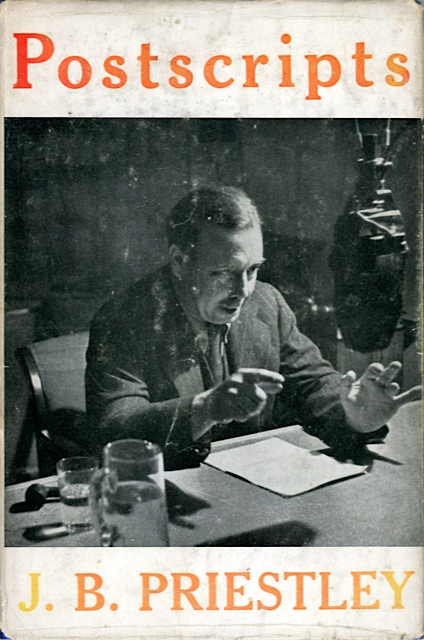
Cover of Postscripts (1940) by J. B. Priestley

Priestleyโ€™s Postscripts are simply words of encouragement, gentle reminders that much of our seemingly inconsequential everyday is worth holding on to as it defines who we are, that the loss of even the slightest thing may be keenly felt as a threat to our identity.  Take a piece of pie, for instanceโ€”and make it a fake one.

That is just what Priestley did, on this day, 29 September, in 1940, when he talked about returning home to Bradford, the โ€œsolid real placeโ€ of his childhood.  The seemingly random devastation caused by a recent air raid, though far less grand in scale than the attacks on London, โ€œmade a far deeper impressionโ€ on Priestley โ€œbecause it somehow brought together two entirely different worlds; the safe and shining world of my childhood, and this insecure and lunatic world of to-day.โ€

The local bakery, too, had suffered during the raid; but there, in the broken, half boarded up window, could still be glimpsed at the giant pie that had fascinated Priestley when, as a child, he saw emanating from it a steady flow of โ€œfine rich appetising steam.โ€ A wondrous, awe-inspiring sight it was to Priestley, the boyโ€”and a wonder it was now to Priestley, the man, that, after all those years and after all those hours of bombing, the pie was still in its place, still in one piece, and still steaming away.

Mindful of the prosaic souls who needed to have their lessons spelled out for them, and who may well have resented as this โ€œyapping about . . . pies and nonsenseโ€ at a time of acute crisis, Priestley added the reminder to โ€œkeep burnished the bright little thread of our common humanity,โ€ a world in which that particular pie had โ€œits own proper place.โ€

If only we had heard a voice like that during the dark days after 9/11, an opportunity seized by warmongers and profiteers.  If only there had been that sane and gentle voice, the raising of which in a time of terror is as difficult as pie.

โ€œ. . . a damโ€™ good shake-upโ€: Death at Broadcasting House

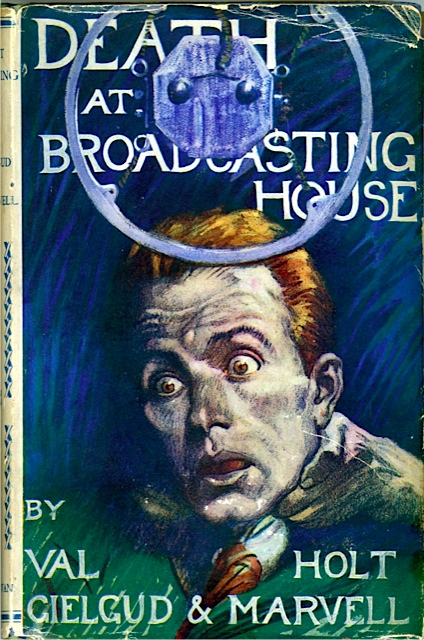
โ€œSnobbish nonsense!โ€ says one shabbily dressed young Londoner to another as they observe a man in a starched shirt and dinner jacket enter Broadcasting House.ย  The man, they reckon, is an announcer about to go on the air, unseen yet meticulously groomed and attired.ย  At the sight of which pointless and paradoxical propriety they sneer: โ€œThat whole place wants a damโ€™ good shake-up.โ€ย  A โ€œdamโ€™ good shake-up.โ€ย  That, in a coconut shell (to employ the most sound-effective nut in the business of radio dramatics), is what Val Gielgud and his collaborator Holt Marvell (the fanciful penname of fellow broadcaster Eric Maschwitz) set out to perform in Death at Broadcasting House (1934), a murder mystery set in and temporarily upsetting the reliable, predictable and frightfully proper BBC. ย Although I had know about it for quite some time, I just finished reading it; ย turns out, it’s a “dam’ good” page-turner, and a compelling commentary on the marginality, the relative obscurity of radio dramatics besides.
ย 
โ€œThereโ€™s not a drop of good red blood about the whole place.ย  Robots engaged in the retailing of tripe! Thatโ€™s broadcasting!โ€ one of the above sidewalk critics of the tried and generally trusted institution declares.ย  It is clear, though, that Gielgud and Maschwitz did not side with the two self-styled โ€œcommunists.โ€ย  The authors were BBC employees and not about to stage a revolution.ย  The โ€œshake-upโ€ was strictly a matter of maracas, a means of making some noise for their own undervalued accomplishments rather than spilling the beans without which those maracas would become utterly useless as instruments of ballyhoo.
ย 
Sure, broadcasting playsโ€”minutely timed, meticulously rehearsed and intensely scrutinizedโ€”were far more mechanic than any other form of dramatic performance.ย  Yet, as Gielgud insisted in one of his many articles on radio drama, โ€œ[i]n spite of [its] machine-like qualitiesโ€ and โ€œin spite of the lack of colour and applause, the work has a fascination of its own.โ€ That the multitude for whom these performances were intended showed so little gratitude was frustrating to an actor-director like Gielgud, who sarcastically remarked a few years earlier that dismissive reviews in the press suggested, at least, that the broadcast play had โ€œpassed the first and most depressing stage of developmentโ€”the stage of being entirely ignored.โ€ย  By 1934, it had clearly not advanced to a stage that could be deemed legitimate.
ย 
What better way to gainsay those naysayers than to spill some of that โ€œgood red bloodโ€ or to stir it properly and to make it run hot and cold by turns. ย โ€œA killing! In Broadcasting House, of all places! Good God!โ€ is the response of General Sir Herbert Farquharson, the corporationโ€™s fictional Controller.ย  He has just been informed that an actor was done away with during the production of a live broadcast.ย  โ€œMy god, sir,โ€ the director of that play exclaims, โ€œdo you realize that everyone who heard that play must have heard him die? That makes it pretty unique in the annals of crime.โ€
ย 
That most folks tuning in thought little of itโ€”that they believed it to be part of the dramaโ€”is owing to the fact that the murder was committed right at the moment when, according to the script, the character played by the victim was scheduled to breathe his last.ย  A crime at once prominent and inconspicuousโ€”like most radio dramas, performed as they were without a studio audience. ย After all, even the Controller, at the time of the murder, was attending a variety program staged in the specially designed Vaudeville Studio instead.
ย 
Death at Broadcasting House is the self-conscious performance of two radiomen, Gielgud and Maschwitz, fighting for the recognition that, for the most part, eludes those working behind the scenesโ€”especially the folks behind the scenes of a largely invisible business.ย  Their book, as they so slyly state, was โ€œdedicated impertinently โ€ฆ to those critics who persistently deny that the radio pay exists, has existed, or ever can exist.โ€ย  Radio plays existed, all right, but, for the most part, they died as soon as they were heard, if they were heard at all.
ย 
Unless, of course, they were blattnerphoned. โ€œBlattnerphone?โ€ the puzzled inspector exclaims.ย  โ€œYes,โ€ the BBCโ€™s dramatic director, Julian Caird, explains:
ย 
โ€œItโ€™s a way of recording a programme on a steel tape so that it can be re-transmitted.ย  We have to do a good deal of it for Empire work.โ€ [โ€ฆ]
ย 
โ€œYou mean we can hear that actual scene over again?โ€
ย 
โ€œWe can hear that scene,โ€ said Caird, โ€œnot only over again, but over and over again.ย  As often as you like.ย  I wonder if the murderer thought of that?โ€
ย 
Probably not.ย  Unless he numbers among the initiated few, folks like Cairdโ€”and Gielgudโ€”who have their fingers at the controls, conjurers who donโ€™t mind revealing some of their tricks to demonstrate just how powerful they are.
ย 
โ€œThe curious thing about the case what that it was both extremely simply and extremely complicated,โ€ the inspector wraps up the business of detection. ย โ€œIt was extremely complicated only because it took place under very remarkable conditionsโ€”conditions which you wouldnโ€™t find repeated anywhere else, and for which, of course, there was absolutely no precedent.โ€ย  The same applies to Gielgud and Maschwitzโ€™s fiction. However witty and engaging, the whodunit is entirely conventional. It is the setting, the broadcasting studio, that makes it unusual.ย  The setting, thus, becomes the star of the productionโ€”a star without whose presence the show simply could not go on.
ย 
Indeed, the crime depends on the complexity of British radio production to be in need of detection.ย  In American broadcasting, by comparison, all actors gathered in the same studio, a congregation that would render the unobserved strangling of one of them not only improbably but impossible.ย  At the BBC, however, plays were produced using a multiple studios, a complex approach Gielgudโ€™s stand-in explains thus:
ย 
[T]he chief reasons why we use several studios and not one, are two.ย  The first is that by the use of separate studios, the producer can get different acoustic effects for his scenes…. ย Secondly, the modern radio play depends for its “continuity” … upon the ability to โ€˜fadeโ€™ one scene at its conclusion into the next.ย  You can see at once that there must be at least two studios in use for these โ€œfadesโ€ to be possible.ย  In an elaborate play, therefore, the actors require as many studios as the varying acoustics of the different scenes require, while … sound effects have a studio of their own, gramophone effects one more, and the orchestra providing the incidental music yet another separate one.
ย 
Anyone who has ever listened to an American radio play of the 1930s, such as the ones produced by the Columbia Workshop, knows that no such complex arrangements are needed for the effective use of multiple fades and changes in acoustics. ย Death at Broadcasting House is a defense of the British system.ย  It turns the multi-studio approach into something to be marveled atโ€”an arcane system fit for a mystery, a puzzle whose solution requires the expertise of the initiated and thus vindicates the existence of the men masterminding the business with their hands firmly on that most complex of all pieces of broadcasting equipment: the dramatic control panel, which, Gielgud enthused elsewhere, enabled the director โ€œto move at will, both in time and space, as simply as if he were travelling on the fabled magic carpet, and to take his audience with him.โ€

Once Upon a Time in Radioland: A Kind of Ruritanian Romance

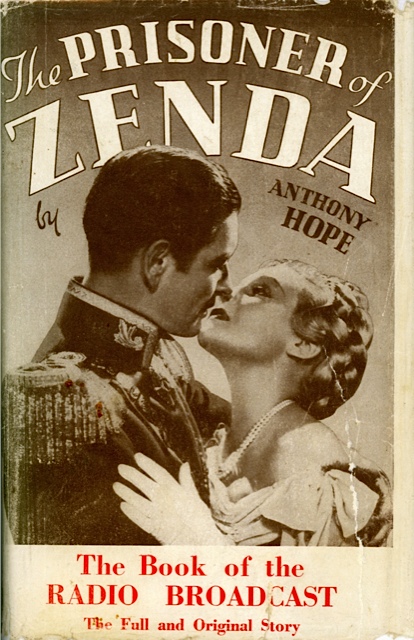
The other day, at my favorite bookstore here in Aberystwyth, I was caught in the eye by what struck me as a highly unusual cover for a 1938 edition of Anthony Hopeโ€™s fanciful pageturner The Prisoner of Zenda. Mind you, Iโ€™m not likely to turns those pages any time soon. Iโ€™m not one for Graustarkian excursions. That I found the old chestnut so arresting is due to the way in which it was sold anew to an audience of Britons to whom such a mode of escape from the crisis-ridden everyday must have beenย sufficiently attractive already. This was the 92nd impression of Zenda; and, with Europe at the brink of war, Ruritania must have sounded to those who prefer to face the future with their head in the hourglass contents of yesteryear like a travel deal too hard to resist.

My copy of the book

Now, the publishers, Arrowsmith, werenโ€™t taking any chances.ย  Judging by the cover telling as much, they were looking for novel ways of repackaging a familiar volume that few British public and private libraries could have been wanting at the time.

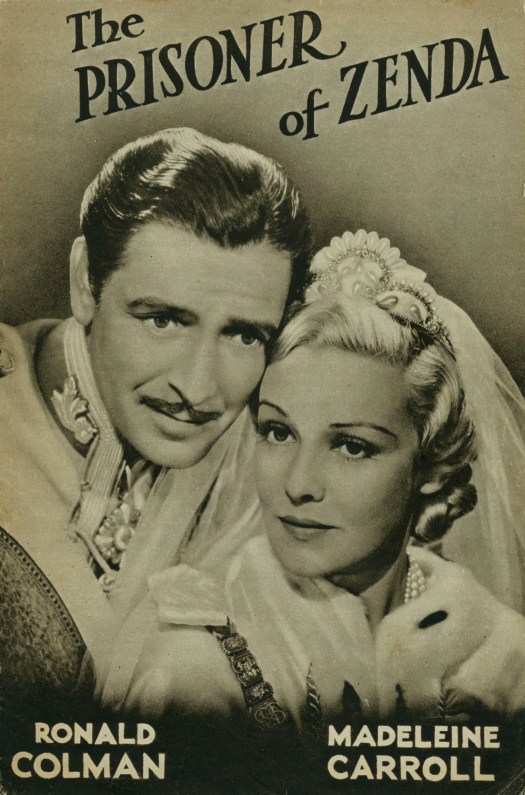
British moviegoers had just seen Ruritania appear before their very eyes in the 1937 screen version of the romance, which make dashing Ronald Colman an obvious salesperson and accounts for his presence on the dust jacket.ย  It is the line underneath, though, that made me look: โ€œThe Book of the Radio Broadcast,โ€ the advertising slogan reads.ย  Desperate, anachronistic, and now altogether unthinkable, these words reminded me just how far removed we are from those olden days when radio ruled the waves.

โ€œThe Prisoner of Zendaย was recently the subject of a highly successful film,โ€ the copy on the inside states somewhat pointlessly in the face of the faces on the cover.ย  Whatโ€™s more, it continues, a โ€œfurther mark of its popularityโ€ was the storyโ€™s โ€œselection by the BBC as a radio serial broadcast on the National Programme.โ€ ย To this day, the BBC produces and airs a great number of serial adaptations of classic, popular or just plain old literature; but, however reassuring this continuation of a once prominent storytelling tradition may be, a reminder of the fact that books are still turned into sound-only dramas would hardlyย sellย copies these days.ย  Radio still sells merchandiseโ€”but a line along the lines of โ€œas heard on radioโ€ is pretty much unheard of in advertising these days.

From my collection of Cinegrams.

โ€œThis book is the original story on which the broadcast was based,โ€ the dust jacket blurb concludes.  I, for one, would have been more thrilled to get my hands or ears on the adaptation, considering that all we have left of much of the BBCโ€™s output of aural drama is such ocular proof of radioโ€™s diminished status and pop-cultural clout.

Perhaps, my enthusiasm at this find was too much tempered with the frustration and regret such a nostalgic tease provokes.  At any rate, I very nearly left Ystwyth Books without the volume in my hands. That I walked off with it after all is owing to our friend, novelist Lynda Waterhouse, who saw me giving it the eye and made me a handsome present of it.  And there it sits now on my bookshelf, a tattered metaphor of my existence: I am stuck in a past that was never mine to outlive, grasping at second-hand-me-downs and gasping for recycled air . . . a prisoner of a Zenda of my own unmaking.

Smoke Gets in Your Ears; or, What Price โ€œButch" and "Georgeโ€?

A keepsake that hasn’t been looked after

The other day, Bob and I drove down to Leominster, England.ย  The objective was to pick up a painting at a local auction house; but we made a day of it, during which we discovered Leominster to be a great town for antiquing.ย  Now, when it comes to treasure hunts, my definition of โ€œpricelessโ€ is โ€œunvalued,โ€ a label (or stigma) attached to objects that somehow donโ€™t matter much and therefore sell for next to nothing.ย  It is to those less prized items that I tend to be drawnโ€”provided they have something to do with the undervalued performance art of radio.ย 

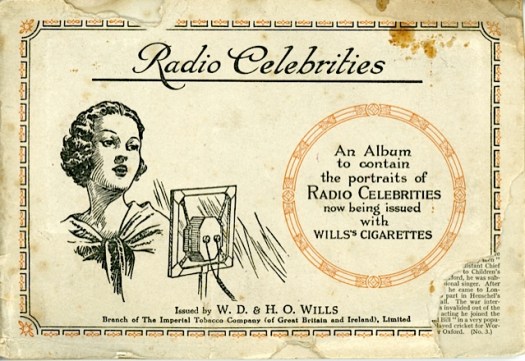
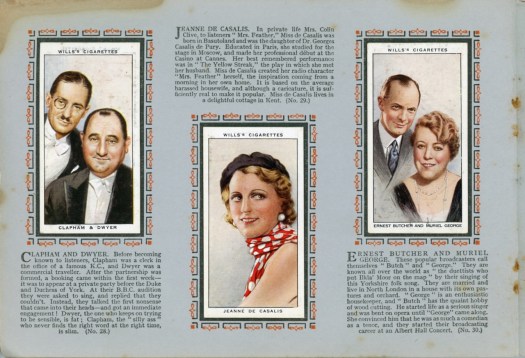
So, for about one hundredth of the cost of our latest oil, I took home a complete if somewhat tatty album of cigarette cards dating from 1934.ย  Since it was issued in Britain (by W. D. & H. O. Wills), the โ€œcelebritiesโ€ displayed in it are all folks heard on the BBC at the timeโ€”and rarely heard of thereafter.

Unlike their American counterparts, whose voices or musical talents are preserved on recordings anyone can readily retrieve online, most of these BBC personalities would be truly forgotten today if they had not made a name for themselves in other media.  Yet even if we remember the performer we are likely to be ignorant of the performance that brought them fame on the air.

A few years ago, Telegraph columnist Christopher Howse happened upon the same album now in my hands and remarked that the โ€œworld seen in [it] is as unfamiliar as the clipped tones of the celebrities it contains.โ€  Flicking through these pages means facing indifference and neglect.  How can we presume to know the 1930s if we canโ€™t recall the names that then were household words, let alone put a voice to them?

Radio Celebritiesโ€”an oxymoron, perhaps?

Back then, the reverse was to be accomplished by those cigarette card collectibles: to put a face to the unseen visitors that millions welcomed into their homes.ย  No doubt, the chief purpose was to sell tobacco productsโ€”but aside from fueling an addiction these albums satisfied the need to turn word to flesh and hold on to fleeting sound by way of printed image.

โ€œFor many years,โ€ the โ€œRadio Celebritiesโ€ album reminded the purchaser, anno 1934, โ€œbroadcasting artistes, announcers and speakers remained rather mysteriously aloofโ€”in the air, as it were!โ€ No more.ย  The โ€œWirelessโ€ and their personalities were becoming โ€œincreasingly popularโ€; and the portraits to be collected and appreciated in this way were meant to โ€œadd a personal touch to namesโ€ that were already so โ€œfamiliar to listeners.โ€

From time to time, I shall return to this album to report on the radio careers of Clapham & Dwyer, โ€œButchโ€ (Ernest Butcher) and (Muriel) โ€œGeorge,โ€ Jeanne De Casalis, and the forty-seven other “Radio Celebrities” that hit it big on the Beeb.

Time and the Airwaves: Notes on a Priestley Season

Both BBC Radio 4 and 7 are in the thick of a J. B. Priestley festival, a spate of programs ranging from serial dramatizations of early novels (The Good Companions and Bright Day) and adaptations of key plays (Time and the Conways and An Inspector Calls), to readings from his travelogue English Journey and a documentary about the writerโ€™s troubled radio days. Now, I donโ€™t know just what might be the occasion for such a retrospective, since nothing on the calendar coincides with the dates of Priestleyโ€™s birth or death. Perhaps, it is the connection with the 70th anniversary of the evacuation of Dunkirk, an event on which Priestley embroidered in June 1941 for one of his Postscript broadcasts, that recalled him to the minds of those in charge of BBC radio programming.

Never mind the wherefores and whys. Any chance of catching up with Priestley is welcome, especially when the invitation is extended by way of the wireless, the means and medium by which his voice and words reached vast audiences during the 1930s and early 1940s, both in the United Kingdom and the United States.

For all his experience as a broadcaster, though, Priestley, who was not so highbrow as to high-hat the mass market of motion pictures, never explored radio as a playwrightโ€™s medium, as a potential everymanโ€™s theater on whose boards to try his combined radiogenic skills of novelist, dramatist, and essayist for the purpose of constructing the kind of aural plays that are radioโ€™s most significant contribution to twentieth-century literatureโ€”the plays of ideas.

Priestley prominently installed a wireless set in Dangerous Corner, a stage thriller whose characters gather to listen to a thriller broadcast. Later, he read his controversial wartime commentaries (titled Postscripts) to a vast radio audience. He even went on one of Rudy Valleeโ€™s variety programs to discuss the fourth dimension. Yet the medium that relied entirely on that dimension, to the contemplation of which he devoted many of his stage playsโ€”Time and the Conways and I Have Been Here Before among themโ€”did not intrigue Priestley to make time and create plays especially for the air.

To be sure, his falling out with the BBC in 1941 (as outlined in Martin Wainwrightโ€™s radio documentary about the Postscript broadcasts) did little to foster Priestleyโ€™s appreciation of the radiodramatic arts. Yet the indifference is apparent long before his relationship with Auntie soured. When interviewed for the 1 September 1939 issue of the Radio Times about his novel Let the People Sing, which was to be read serially on the BBC before it appeared in print, Priestley dismissed the idea that he had written it with broadcasting in mind:

“I realised, of course, that the theme must appeal to the big majority. But apart from that, I thought it better to let myself go and leave the BBC to make it into twelve radio episodes. It would otherwise have cramped my style.”

To Priestley, the โ€œexperimentโ€ of broadcasting his novel lay in the marketing โ€œgambleโ€ of making it publicly available prior to publication, a challenge of turning publishing conventions upside down by effectively turning the printed book into a sort of postscript. Clearly, he looked upon radio a means of distribution rather than a medium of artistic expression.

Reading I Have Been Here Before and listening to the radio adaptation of Time and the Conways, I realized now little either is suited to the time art of aural play. Whereas the Hรถrspiel or audio play invites the utter disregard for the dramatic unities of time and space, Priestley relied on the latter to make time visible or apparent for us on the stage.

The Conways, like the characters of Dangerous Corner before them, are brought before us in two temporal versions, a contrast designed to explore how destinies depend on single moments in timeโ€”moments in which an utterance or an action brings about changeโ€”and how such moments might be recaptured or rewritten to prevent time from being, in Hamletโ€™s words, โ€œout of joint.โ€

โ€œTimeโ€™s only a dream,โ€ Alan Conway insists. โ€œTime doesnโ€™t destroy anything. It merely moves us onโ€”in this lifeโ€”from one peep-hole to the next.โ€ Our past selves are โ€œreal and existing. Weโ€™re seeing another bit of the viewโ€”a bad bit, if you likeโ€”but the whole landscapeโ€™s still there.โ€

In Priestleyโ€™s plays, it is the scenery, the landscape of stagecraft, that remains there, โ€œwholeโ€ and virtually unchanged. The unity of space is adhered to so as to show up changes in attitudes and relationships and to maintain cohesion in the absence or disruption of continuity.

In radioโ€™s lyrical time plays, by comparison, neither time nor place need be of any moment. It is the moment alone that matters on the air, an urgency that Priestley, the essayist and wartime commentator, must surely have sensed.  Priestley, the novelist and playwright did or could not.  Too few ever did.  To this day, a whole aural landscape is biding its time . . .

Dunkirk 70 / Roosevelt 69

This week marks the 70th anniversary of โ€œOperation Dynamo,โ€ an ad hoc rescue mission involving small civilian ships coming to the aid of French and British soldiers who had been forced into retreat at Dunkerque during the for Allied troops disastrous Battle of Dunkirk. The operation, which became known as โ€œThe Miracle of the Little Ships,โ€ was recreated today as more than sixty British vessels, sailing from Kent, arrived on the shores of northern France.

During the course of a single week, nearly 340,000 soldiers were brought to safety, however temporary. Many civilians who had what became known as โ€œDunkirk spiritโ€ were recruited after listening to BBC appeals on behalf of the British admiralty for aid from โ€œuncertified second handsโ€โ€”fishermen, owners of small pleasure crafts, any and all, as the BBC announcer put it, โ€œwho have had charge of motor boats and [had] good knowledge of coastal navigation.โ€

Eager to maintain its neutrality prior to the attack on Pearl Harbor, America was understandably lacking in such public โ€œspirit,โ€ frequent outcries against Nazi atrocities notwithstanding; but even long after entering the war, the US government kept on struggling to explain or justify the need for sacrifices and (wo)manpower to a people living thousands of miles from the theaters of war. On this day, 27 May, in 1941, one year after the operation at Dunkirk began, US President Franklin Delano Roosevelt came before the American public in another one of his Fireside Chats.

Although the nation was โ€œ[e]xpect[ing] all individuals [. . .] to play their full parts without stint and without selfishness,โ€ the Roosevelt administration took considerable pains to explain the significance of the war, the need for โ€œtoil and taxes,โ€ to civilians who, not long recovered from the Great Depression, were struggling to make a living.

If Hitlerโ€™s โ€œplan to strangle the United States of America and the Dominion of Canadaโ€ remained unchecked, FDR warned the public,

American laborer would have to compete with slave labor in the rest of the world. Minimum wages, maximum hours? Nonsense! Wages and hours would be fixed by Hitler. The dignity and power and standard of living of the American worker and farmer would be gone. Trade unions would become historical relics and collective bargaining a joke.

Crucial to Americaโ€™s freedom was the security of the oceans and ports. If, as FDR put it, the โ€œAxis powers fail[ed] to gain control of the seas,โ€™ their โ€œdreams of world-dominationโ€ would โ€œgo by the board,โ€ and the โ€œcriminal leaders who started this war [would] suffer inevitable disaster.โ€

The Presidentโ€™s addressโ€”broadcast at 9:30 EST over CBS stations including WABC, WJAS, WJAS, WIBX, WMMN, WNBF, WGBI and WJRโ€”departs only slightly from the script, published in the 31 May 1941 issue of the Department of State Bulletin. Whatever changes were made were either designed to strengthen the appeal or else to prevent the urgency of the situation from coming across as so devastating as to imply that any efforts by the civilian population were utterly futile.

The address, as scripted, was designed to remind the American public that the US navy needed to be strengthened, alerting listeners that, of late, there had been โ€œ[g]reat numbersโ€ of โ€œsinkingsโ€ that had โ€œbeen actually within the waters of the Western Hemisphere.โ€

The blunt truth is thisโ€”and I reveal this with the full knowledge of the British Government: the present rate of Nazi sinkings of merchant ships is more than three times as high as the capacity of British shipyards to replace them; it is more than twice the combined British and American output of merchant ships today.

In address as delivered, this passage was rendered slightly more tentative as โ€œThe blunt truth of this seems to be,โ€ a subtle change that not so much suggests there was room for doubt as it creates the impression that the great man behind the microphone was weighing the facts he laid bare, that the devastating and devastatingly โ€œblunt truthโ€ was being carefully considered rather than dictated as absolute.

No mention was made of the โ€œMiracle of Dunkirk,โ€ that remarkable demonstration of spirit and resilience. More than a flotilla of โ€œlittle shipsโ€ was required to defend the US from the potential aggression of the Axis powers. The challenge of American propaganda geared toward US civilians was to make the situation relevant to individuals remote from the battlefields, to motivate and, indeed, create a home front.
In Britain, where โ€œignorant armies clashedโ€ just beyond the narrow English Channel and where the battlefields were the backyards, there was less of a need to drive home why the fight against the Axis was worth fighting.

In the US, the driving home had to be achieved by breaking down the perfectly sound barriers of that great American fortress called home, by making use of the one medium firmly entrenched in virtually every American household, an osmotic means of communication capable of permeating walls and penetrating minds. Radio served as an extension to the world; but it was more than an ear trumpet. It was also a stethoscope auscultating the hearts of the listener.

As FDR, who so persuasively employed it in his Fireside Chats, was well aware, the most effective medium with which to imbue the American public with something akin to โ€œDunkirk spiritโ€ was the miracle not of โ€œlittle shipsโ€ but of the all-engulfing airwavesโ€”and the big broadcastsโ€”that helped to keep America afloat.
โ€œMarching backwardsโ€: โ€œThe Great Tennessee Monkey Trialโ€ Is Back on the Air

The Darwin bicentenary is drawing to a close. Throughout the year, exhibitions were staged all over Britain to commemorate the achievements of the scientist and the controversy his theories wrought; numerous plays and documentaries were presented on stage, screen and radio, including a new production of Inherit the Wind (1955), currently on at the Old Vic. I was hoping to catch up with it when next I am in London; but, just like last month, I my hopes went the way of all dodos as only those survive the box office onslaught who see it fit to book early.

Not that setting foot on the stage of the Darwin debate requires any great effort or investment once you are in the great metropolis. During my last visit to the kingdomโ€™s capital, I found myselfโ€”that is to say, I was caught unawares as I walked through the halls of the Royal Academy of Artsโ€”in the very spot where, back in 1858, the papers that evolved into The Origin of Species were first presented.

This week, BBC Radio 4 is transporting us back to a rather less dignified scene down in Dayton, Tennessee, where, in the summer of 1925, the theory of evolution was being put on trial, with Clarence Darrow taking the floor for the defense. Peter Goodchild, a writer-producer who served as researcher for and became editor of the British television series on which the American broadcast institution Nova was modeled, adapted court transcripts to recreate the media event billed, somewhat prematurely, as the “trial of the century.”

Like the LA Theatre Works production before it, this new Radio Wales/Cymru presentation boasts a pedigree cast including tyro octogenarians Jerry Hardin as Judge John Raulston and Ed Asner as William Jennings Bryan, John de Lancie as Clarence Darrow, Stacy Keach as Dudley Field Malone, and Neil Patrick Harris as young biology teacher John Scopes, the knowing if rather naive lawbreaker at the nominal center of the proceedings who gets to tell us about it all.

โ€œI was enjoying myself,โ€ the defendant nostalgically recalls his life and times, anno 1925, as he ushers us into the courtroom, for the ensuing drama in which he was little more than a supporting player. โ€œIt was the year of the Charleston,โ€ of Louis Armstrongโ€™s first recordings, โ€œthe year The Great Gatsby was written.โ€ Not that marching backwards to the so-called โ€œMonkey trialโ€ isโ€”or should ever becomeโ€”the stuff of wistful reminiscences. โ€œBut, in the same year, Hitler wrote Mein Kampf, Scopes adds, โ€œand in Tennessee, they passed the Butler Act.โ€

Darrow called the ban on evolution as a high school subjectโ€”and any subsequent criminalization of intellectual discourse and expressed beliefsโ€”the โ€œsetting of man against man and creed against creedโ€ that, if unchallenged, would go on โ€œuntil with flying banners and beating drums, we are marching backwards to the 16th century.”

He was not, of course, referring to the Renaissance; rather, he was dreading a rebirth of the age of witch-hunts, superstitions and religious persecution. โ€œWe have the purpose of preventing bigots and ignoramuses from controlling the education of the United States, and you know it, and that is all,โ€ Darrow declared.

It is a line you wonโ€™t hear in the play; yet, however condensed it might be, the radio dramatization is as close as we get nowadays to the experience of listening to the trial back in 1925, when it was remote broadcast over WGN, Chicago, at the considerable cost of $1000 per day for wire charges. According to Slate and Cookโ€™s It Sounds Impossible, the courtroom was โ€œrearranged to accommodate the microphones,โ€ which only heightened the theatricality of the event.

I have never thought of radio drama as ersatz; in this case, certainly, getting an earful of the Darrow-Bryan exchange does not sound like a booby prize for having missed out on the staging and fictionalization of the trial as Inherit the Wind.


Related post
โ€œInherit the . . . Air: Dialing for Darwin on His 200th Birthdayโ€