
Lance Sieveking, “The Man with the Flower in His Mouth”

Let me be the first to admit my ignorance. The world being largely ignorant of me, I simply cannot depend on anyone else to do so. That said, I might as well turn the keeping of this journal (complicated as it was today by internet-disrupting hailstorms) into occasions to pick up a little something rather than disperse whatever scraps of knowledge I may already lay claim to after years of study (or intellectual loafing).

One such occasion might be the birthday of British radio and television pioneer Lancelot Sieveking, born, as the Internet Movie Database informed me, on this day, 19 March, back in 1896. Sure, I had come across his name during my research for Etherized Victorians; but, concentrating my efforts on American radio dramatics, I had conveniently overlooked Sieveking’s accomplishments. Even the folks over at the Database have yet to catch up with this man of all media; at least, his death (back in 1972) has thus far escaped them.

It is no overstatement to say that the author of The Stuff of Radio (1934) is a neglected figure today; his name has most recently been dropped in connection to Disney’s first entry in the Chronicles of Narnia series. Narnia author C. S. Lewis had approved of Sieveking’s radio dramatization but dismissed the idea of a film adaptation. During the first season of BBC2 television’s Oxford English Dictionary challenge Balderdash and Piffle, there was some debate about the origin of the phrase “back to square one,” which was argued to lie in an eight-squared drawing meant to assist BBC radio’s football commentators back in 1927. That design, as it turns out, was Sieveking’s.

Fellow BBC radio drama producer Val Gielgud had this to say about the “not altogether fortunate” Sieveking: “He was perhaps over much influenced during his most impressionable years by G. K. Chesterton, and by the theory of that master of paradox that because some things were better looked at inside out or upside down such a viewpoint should invariably be adopted. Talented and imaginative beyond the ordinary, his eyes gazing towards distant horizons, he was liable to neglect what lay immediately before his feet.”

In other words, Sieveking was an audio-visionary, a trier of radiogenic techniques at whom actors and colleagues would “gaze with a certain dumb bewilderment” as he “exhorted them to play ‘in a deep-green mood,’ or spoke with fluent enthusiasm of ‘playing the dramatic-control panel, as one plays an organ.'” There was not much use for such an one in radio. As Gielgud put it, even British radio broadcasting, “provided him with no laboratory in which experiments could be carried out.”

In 1930, when radio drama was still in its protracted infancy (despite earlier trials-by-air like the aforementioned “Comedy of Danger”), Sieveking found a “laboratory” in the still newer medium of television. He collaborated with Gielgud in bringing to British television “The Man with the Flower in His Mouth.” An adaptation of Luigi Pirandello’s short play L’uomo dal fiore in bocca (1923), it aired on 14 July 1930.

Little remains today of Sieveking’s work in sound and images, aside from its blueprints—long-out-of-print scripts and theories. Now, I live in a town with a five-million-volume copyright library (which celebrated its 100th anniversary today); but for a snippet of sound, you might as well saunter over to tvdawn, where you may hear Sieveking’s spoken introduction to “The Man.”

"Endangered Sounds"?

Well, let’s see. No, wait. Let’s listen instead. “Now I will do nothing but listen, / To accrue what I hear into this song, to let sounds contribute / toward it.” Walt Whitman wrote these lines. What are the notes to the song of my self? What are the echoes of my everyday? What do these sounds have to do with me?

When I moved to Wales, far from the hubbub of Manhattan, I had to get used to a whole new soundscape. I haven’t quite gotten used to it yet; particularly not to the howling of the wind. These days, there is a new sound in the living room. Yet it is so old, Whitman might have heard it. It is not a Welsh sound, but one made in Brooklyn. It is the sound of our Ansonia clock, anno 1881 (pictured above), which is now part of the ambiance in which I breathe and move.

I have been listening to the BBC Radio 4 documentary “Endangered Sounds.” What might that be, an endangered sound? In my adolescence, I began to wonder about the perishable fabric of my sonic everday. I began to record noises and voices in an attempt to capture where—and who—I was. I did not trust my archival mind as a storehouse of sonic markers of place and time. We tend to make records of our lives in words and images rather than sound. The image seems to be more desirable as a keepsake—more reliable and persuasive. It dominates our senses. Is it any wonder we feel out of touch with the past if we insist on turning it into graphic objects.

I remember sitting in Central Park one afternoon, thinking how serene my environs were. I recorded the sounds of that afternoon and played them back at home, only to realize how noisy that spot had been. The images were so powerful, they drowned out the sounds of the metropolis—the cars rushing by just behind the trees, the buzz of commerce puncuated by sirens. I took no notice of what was out of sight (though hardly out of earshot); I did not hear what the eye fooled me into believing absent. I listen for them now that I am gone. I miss them more than the sights, stored in my mind, preserved on paper, and displayed in this journal.

“Endangered Sounds” provokes thoughts about our changing environment, about noise pollution, about the loss and luxury of silence: the nostalgia for our silenced past, the awareness that, as technology advances, we lose ourselves soundscapes whose sameness is robbing us of our identity—an alienating, Kmartian sub-urbia, a generic soundtrack as mind-numbing as Muzak. For all this, “Endangered Sounds” frustrates as much as it intrigues, especially since it does not resound with many of the authentic sounds it declares to be on the brink of extinction, some of which were recreated in stock recordings, others crushed in musical beats.

Rather than preserving sound, the program serves as a reminder of loss; it is a memorial service for our silenced past. It suggests that, in the near future, technology will permit us to deaden what we do not wish to hear, to create bubbles of choice sound and tranquility distilled from the din of civilization. Manufacturers of sound are hard at work to sell us back what commerce and progress has robbed us of.

Do we really need highly sophisticated computer technology to create our individual sound spheres? When I lived in Germany and dreamed of New York City, I would listen to the sounds of streets and avenues I had recorded while away from what was not truly home. The sirens, the footsteps on the sidewalks, the babble of the passers-by—they provided more comfort than the electronic tunes I merely consumed. Unlike the artifice of those purchased sounds—a sonic anywhere to take the place of the here and now—the metropolitan noises I had recorded were real and concrete. My feet had touched those steps, my shoulders had brushed against those voices, my nose had taken in the fuel with whose burning the traffic resounded. That was somewhere—a there I felt—and I knew I had to go back there to stay.

These days (owing to the electronic blasts of the past, no doubt) I am somewhat hard of hearing; but instead of deadening my everyday in specious phonics or phoney silences—some New Age orchestrations of an assembly-lined existence—I seek and find comfort in sounds whose source I can identify and take in with my other senses—the fire I feel against my skin, the yawning of our none-too-pleasant smelling dog on the carpet, and the clock on the mantelpiece (which, in the picture above, reflects both me and the dog on its surface); and instead of losing myself in the folds of a custom-made soundcarpet, I wrap myself in this resonant quilt and know myself to be . . . at home.

George Gershwin, "Composer of the Week"

Well, I gave up on it years ago. I lost touch, or the desire to catch up with it. With Pop music, I mean. You know, whatever it is that is being presented to you as the latest and therefore presumably the hottest. The “hottest” is rarely what anyone tells you it is; it is something you’ve got to discover for yourself, no matter how odd, old, or remote it may be from current, industry-generated trends. Trends are for those too inert to develop an individual taste, those who listen, wear, read or see whatever sly marketers have styled “stylish.” There’s a lot of this trendsetting by proxy going on in the blogosphere, which has at last turned into an extension of the advertising racket.

I do not feel sorry for web journalists who go in for and are let down by schemes that promise them a few bucks, at the mere mention of which they forsake their integrity and turn hawkers. No, I do not pity them—I despise them for subjecting me to what can only be described as more or less inept infomercials. For once, amateurs and professionals alike, writers and artists with a creative impulse quickened by exhibitionism are given a chance to publish and display whatever they please, whenever they choose, without any interference from patrons or sponsors. Never before has such an opportunity presented itself to so many. Why squander it all to become a mouthpiece for someone else, rather than your own product, idea, or person?

However incompetent in the arts of self-promotion, I am not averse to conjuring the entrepreneurial spirit; nor am I condemning advertising outright. If that were the case, I could hardly endure, let alone enjoy, American radio drama, the first entertainment designed to sell something above and beside itself. It just ain’t for me, this kind of double-dealing. Instead, I relish in the freedom of sharing whatever crosses my path or tickles my still sensitive fancy. And (commercial free) BBC Radio 3 is certainly doing some tickling these days: its “Composer of the Week” is George Gershwin, a song plugger (some kind of human demo tape) who Tin Pan Alley-ooped himself to the top of the perennial pops.

A tuneful if cursory biography of the composer and the many people who shaped his career (Astaire, Max Dreyfuss, Paul Whiteman and Walter Damrosch, impersonated by accomplished if unidentified radio actors, including Kenny Delmar, Frank Readick, Tom Collins, and Agnes Moorehead) was presented on the Cavalcade of America program on 27 February 1939, a year and half after after Gershwin’s death.

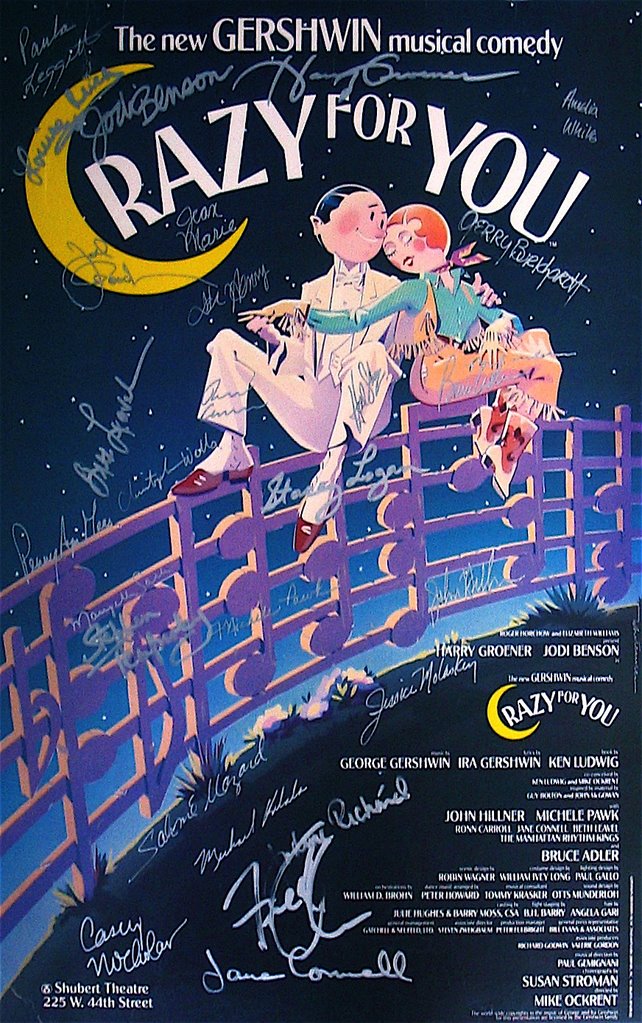
I developed a taste for Gershwin’s music some five decades later when a close friend of mine, himself formerly in show business, invited me to see the cheerful pastiche Crazy for You on Broadway (the above poster, signed by the entire cast, being a memento of that memorable event). Now, I have seen plenty of musical theater since then, anything from Show Boat and Gypsy to Sweeney Todd and The Drowsy Chaperone; but no show has left me humming quite as many long familiar yet ever thrilling tunes as Crazy for You, cleverly billed as a “New Gerswhin Musical Comedy.” Now, I don’t know how I might have felt about it had I seen Pia Zadora and Brady Bunch alumna Ann B. Davis in it (the latter getting far more requests for autographs than the former); let’s just say I was lucky to have experienced it being performed by the original cast.

The five broadcasts of BBC Radio 3’s Composer of the Week series are a serviceable introduction to Gershwin’s works, featuring the voices of Fred and Adele Astaire (“Fascinating Rhythm,” “So Am I”), Al Jolson (the inevitable “Swanee”), Ukulele Ike (“Lady, Be Good!”), Ella Fitzgerald (“The Man I Love”), Audrey Hepburn (“How Long Has This Been Going On”), excerpts from Of Thee I Sing, Strike Up the Band, Porgy and Bess—and plenty of Gershwin at the piano.

Now on the Air: Sam Shepard’s True West

Well, it still does what it has been doing for over eighty years now. If you let it. And on this wet and stormy afternoon, I was ready to let it. Take me to a show, I mean. The radio can do that for you, even today. Drama on the air started out like this, back in the early 1920s: broadcasts right from the Broadway stage. In fact, such home entertainment predates wireless technology. As I discussed here, remote theater-going began in the 1880s by way of the telephone. However grateful for the service, those tuning in to wired or wireless theatricals must have realized right away that something was amiss.

Not being there to see what unfold as the curtain rises makes it difficult to follow all that transpires onstage, especially when characters are speechless or when one responds to the silent actions of another. You cannot hear a hand being raised, a cold shoulder being turned, or a door being opened quietly so as to escape the notice of the characters present.

Obviously, some translations are in order to avoid the chaos of an auditory void. This problem was initially dealt with by an announcer or narrator who filled in the blanks as the action progressed. Soon, however, it became clear that stage plays had to be properly adapted if they were to succeed in the non-visual medium. Carefully reworked, radio adaptations can be both culturally significant and aesthetically satisfying, even though those advocating pure audio drama—plays conceived for the airwaves—deem such efforts at translation inferior or downright detrimental to the of true aural arts.

Yesterday, BBC Radio 3 presented an audio version of Sam Shepard’s dark comedy True West (1980), by now a classic of American drama. The Radio Times heralded this very nearly “True West” as a copy that “could well be the drama of the year.” While that may be an overstatement, the radio adaptation, featuring David Soul in the role of Lee, is certainly an event worth catching. For those ready to grab, the Drama on 3 production by Peter Kavanagh is available online for the entire week; you may listen in (by visiting the BBC’s “Listen Again” page and selecting “Drama on 3”).

It is difficult for me to sit through an eighty-minute radio play. Listening to “True West,” I found myself scrubbing pots and pans, which is something I would not have done (and very rarely do) otherwise. It seems I needed to do something and that listening was not activity enough, as reading most certainly is. After years of studying and taking in radio drama, I still lack the attention span to take in a play I might easily follow in a theater, even if there is as little to see as there is in True West.

It is two brothers engaged in the kind of verbal sparring that makes for good radio drama. One of them is a successful (or at any rate, busy) Hollywood screenwriter, the other a seasoned and desert-hardened crook. They couldn’t be more different, it seems, and at first you can’t help but feel sorry for Austin, the writer, who is so rudely interrupted by his no-good sibling; but, while housesitting for their mother, who is away on a trip, the estranged brothers are forced to brush up on and against each other. In the friction that ensues, the tarnish of the one and the polish of the other rub off, muddling the personae and laying bare the common nature of both, their true insecurities and western discontent.

Soul is excellent as the irascible Lee, even though he sounds rather old for the part (especially when compared to Richard Laing as Austin). He reminded me of the cantankerous Arthur Spooner (Jerry Stiller) on The King of Queens. In fact, the entire play comes across like an extended sitcom episode, rather than a profound comment on the human condition. It also pales somewhat when revisited in the shadow of Spike Jonze’s Adaptation (2002), which pushes a very similar situation quite a bit further. That said, “True West” is still an outing to stay in for, an evening (or afternoon, or morning) of free theater, if you are at home and aching for such.

Unfortunately, the BBC Radio Player does not allow you to fast-forward, to skim and skip, which is bad news in case you, like me, need one or two (or more) intermissions to take in an audio drama of this length. So, I recorded it on my laptop and listened to it in instalments—theater chopped up for easy digestion and ready review—the True West of Silicon Valley.

Curtains Up and "Down the Wires"

Well, aren’t we rather quaint in our high-tech ways? Getting our entertainment via cable? Subscribing to so-called premium channels? Pshaw, old hat! Even Queen Victoria had a home entertainment center. Called the Electrophone, it was a service that allowed those who signed up to tune in to theatrical performances live—not time delayed—from the London Stage. No need to sit through commercials or settle for anything not worth your while. You simply selected a program, dialed in and an operator standing by connected you to the opera, the theater, or—who’s going to tell—a bawdy music hall.

I became aware of this state-of-the-dramatic arts 19th-century invention while researching for my doctoral study, in which I mentioned it in passing as a precursor to radio’s earliest theatrical entertainments, which relied rather heavily on such stage hook-ups. The BBC Radio 4 Archive Hour presentation of “Down the Wires” provides a thorough—and thoroughly engrossing—introduction to the Electrophone’s dial-up service, which gave audiences access to operatic performances, political speeches, and religious services, piped into the sitting room (or wherever you chose to have it installed).

In this fashion, live theater was being made available to home listeners in the 1880s France and 1890s Britain and America. Matthew Parris’s “Down the Wires” (which is once again available online until Saturday), features rare recordings of early 20th-century performers, reformers, and politicians, including the voice of Teddy Roosevelt.

There are accounts as well of those who used this service, which, in the UK, was available for over twenty-five years, until the wireless cut those wires in the mid-1920s. Now, I’m not the nostalgic sort, really, but right now I’m thinking of all the thrilling plays that I might have caught over the phone (that fickle and fiendish device featured in my latest old-time radio podcast) had I been able to afford the considerable fee of £10 per annum for the service, in addition to the charge for the equipment.

Using my horn-honed imagination, which you’d need to flesh out what the stage business did not render intelligible to the home listener, I might have been able to take in sensational melodramas like The Worst Woman in London (1899) or The Ugliest Woman on Earth (1904)—the original Desperate Housewives. The title character of the former is a siren who blackmails her ex-lover, sets fire to his new home, disguises herself as a man and fights it out with his new bride whom she drags by the hair, onto the rooftops of London, until the virtuous rival manages to escape by tip-toeing to safety on a telegraph wire. Now, with my mind supplying the props, that’s an act fit to go “Down the Wires.”

Racket Science: Two Coconut Shells, a Blowlamp, and a Raspberry"

Well, what does it sound like? Home, I mean. The everyday we inhabit. Perhaps, home is a space in which we no longer pay much attention to what our ears can pick up because we are so accustomed to and at ease with our surrounding soundscape. Or perhaps it is that private environment within whose confines we can drown out what is strange with a soundcarpet of our own weaving. Today, my sonic rug received another sound beating, and I guess this is some of the dust that fell off.

There was an awful lot of howling and rattling, produced by the fierce winds that, while no longer unfamiliar to me after two years of living here in Wales, still suggest the foreign, the uncanny, the inhospitable. I guess I could have countered it by turning on the radio or by playing some of my favorite tunes; but I rarely listen to music these days, at least not as a means of muffling the world or creating an alternate one. I am trying to remember past places I called home and the sounds that might have made them such.

Do you recall sounds as easily as images? We tend to take pictures of our friends and surroundings; but, unless we take moving images with our digital cameras, we rarely record our lives in sound. Right now, I am not even sure about my father’s voice, for instance. He died some ten years ago; but I hadn’t talked to him for some time before that. My family was just about as functional as the clan in Little Miss Sunshine, with which I finally caught up this evening at a local cinema.

I was the teenager in that picture—moody, aloof, and not inclined to share my thoughts with the family to which I scarcely belonged. I might have a photograph of the man somewhere. I’m not sure; but I could get my hands on one should I require such supplemental image for the mental ones still vivid. Now, I could not produce a sound portrait of my father; at least not one featuring his own voice. He breathed his last . . . and the “rest is silence.”

Our voice excepting, what sounds might best represent us? That is a challenge few radio artists had to meet: to create a life in non-verbal, non-musical sound. Generally, aural effects were thought of as a crutch to the spoken word. They might create atmosphere, aid in setting scenes or in visualizing a body moving in space. Footsteps and doorslams, that sort of thing. Instead of supplementing or complementing, sounds may also counter the image the word creates. We are told one thing, but hear another, wonder and chuckle at the irreconcilable differences.

There was a little of that in the BBC 4 documentary “Two Coconut Shells, a Blowlamp and a Raspberry”, which is once again available online for a couple of days. However cursory, it tells the story of the BBC sound effects department and the uses of noisemaking in 1940s comedy programs like ITMA (It’s That Man Again). As in the US, the low humor of bodily sounds was frowned upon by the BBC; but there were a few amusing substitutes of the “raspberry” kind to suggest forcefully what escapes all of us from time to time. It rendered as over-the-top what was generally off limits.

Comedy is exempt from the realism often expected of radio drama, the realism for which the medium was famous—and infamous. Last night I watched the MGM musical Hullabaloo, which feebly sends up the panic created by the Mercury Players’s production of “The War of the Worlds.” Some of the humor, such as there was, derived from the sounds coming out of lip-synching Frank Morgan’s mouth, unexpected voices including those of stars like Spencer Tracy, Clark Gable, Hedy Lamarr and Claudette Colbert.

Closing your eyes, you’d see a scene from Boom Town, the box-office hit that Hullabaloo promoted by way of promising, conjuring, and withholding. Sounds can contradict both words and visuals in a way Magritte’s “Ceci n’est pas un pipe” does; but they can also confront each other so as to shatter the mental images we create while listening.

Perhaps I would resort to this sort of playful surrealism in a sonic portrait of my jovial if booze-wrecked father, who, when I created my first audio plays with my tape recorder, advised me not to use a narrative voice but let noises and dialogue speak for themselves. Now, we are well past dialogue, my father and I; but in rendering him, I might use sounds that speak against the revisionist and fragmented image I’ve made up, sham yet real—the mental picture that has become as much of a crutch as the old doorslam.

Now, I was all prepared to review “Two Coconut Shells”; but my mind was unruly tonight and wandered off into the cloud-shrouded sunset like . . . two coconut shells in a gravel box; carried away by the autumnal fury of sound, it decided not to return home in time for today’s post. Instead, it’s that man again, knocking on my windblown mind like the proverbial skeleton in the family closet. He insists on revisiting from time to time, as much as I’d like to send him off with an old-fashioned raspberry.

Wire(less): When Radio Answers the Phone

Well, it only took about five months, but, taking a break from the broadcastellan journal last night, I finally completed my fourth podcast. Titled “The Voice on the Wire,” it explores the relationship between radio and telephone. Its publication coincides with two BBC Radio 4 broadcasts, one documenting the history of radio sound effects (“Two Coconut Shells, a Blow Lamp and a Raspberry”), the other (“Down the Wires”) the development of the Electrophone, an early device for taking in theater over the telephone. I will discuss those two programs later this week; but today I’ll simply play the barker and do a bit of self-promoting:

Step inside, folks, step inside! This way to the big show. That’s your mind, ladies and gentleman, or at least it can be, with pulp-peddlers like me around to give you strange ideas. Be there when an invalid is strangled in her bed; listen to the disembodied voice of a man in the act of committing suicide, and witness assorted cases of murder, mayhem, and madness. Get your wires double-crossed here, folks! You’ll come across the most tremendous and terrifying tales of treacherous telephony. You’ve never heard such smooth operators, such neurotic callers. Busy signals, freak connections, hang-ups and heavy breathing—we’ve got it all. There’s nothing like a case of espionage and betrayal, of lines that go click in the night, of outcasts and shut-ins whose lives are being cut as short as an inconvenient call . . . as long as you are not at the receiving end.

I’ve gone on about thrillers like “Sorry, Wrong Number,” “Meridian 7-1212,” and “Long Distance” at some length in my doctoral study; unlike Roland Barthes, I find it easy to go on about what I love. It’s an even greater thrill to let radio speak for itself, to tune in and sample various melodramas from series including Inner Sanctum Mysteries, Suspense, The Whistler and Radio City Playhouse, and to put together this collage of telephone terror.

While it is the most famous of all plays written for American radio (“The War of the Worlds” being an adaptation, however innovative and radical), “Sorry, Wrong Number”—dubbed “radio’s perfect script”—was only one in a long line of audio dramas that took up the receiver and took it on by shouting across the wire, that means of point-to-point communication for the triumph over which the wireless was originally developed.

For decades, it was the wire that remained triumphant. In the 21st century, this failure has been rectified and “wireless,” an almost forgotten word in the early 1990s, now means both the intimate chat between two individuals and the broadcasting (or podcasting) of voices to the multitude. Still, whenever I see a sign saying “wireless”—and despite the fact that I am using such a network at home and, if lucky, on my travels—I still think of the old cat’s whiskers and the behemoth of a mass medium into which it had transmogrified by the 1930s—a culture of pre-internet voicecasting and sound-snatching turned into a one way operation and forced into commercial service.

As I argue, radio anathematized telephone as the anti-wireless, and for good reasons. Heard on an experimental program that glorified the sound medium and its potentialities, a play like “Meridian 7-1212” demonstrated how private talk, unlike public speech—once it was tele-communicated rather than delivered face to face—promoted selfishness and enabled sinister deeds. Pointing up the failures and dangers of telephonic exchanges, the radio, which has been accused of being a fascist medium, emphasized the public service it rendered by bringing and keeping a people together and glossing over or making a joke of differences, tasks of great importance during economic crises (as confronted in the 1930s) and war (from World War II and Korea to the installation of Russia as the new enemy to beat).

I rarely use the phone these days; and cellular ones are largely a nuisance or a mystery to me. I can manage to keep my appointments—and my distance—without them; but perhaps it was listening to all these tales of terror that convinced me to twist radio’s dial instead of running the risk of dialing wrong numbers.

“. . . leaking out of Neverland”: Peter Pan in Scarlet

Well, I was all set to go on about Les Miserables.  No, not the musical record-trampler recently certified as the longest-milked cash cow in the history of West End and Broadway.  Nor the original yet-another-page turner, either.  I wanted to commemorate the anniversary of a 1942 radio sketch spoofing Hugo’s epic . . . until I realized that I had already done just that last October.  So, before I end up resorting to bottled thought, I’d better lower myself anew into the tortuous sewers of popular culture.  What I came up with, this time, is the idea for a new column.

Noticing that a recording of Fred Allen’s Les Mischief is being presented tonight by the WRVO Playhouse, it occurred to me that, rather than relying on my own library of plays, it might be refreshing to find out what is “Now on the Air,” to highlight programs currently online, broadcasts or podcasts that caught my ear and might be worth your time.

One such discovery is “Peter Pan in Scarlet,” an adaptation of the recently published sequel to the famous play and novel by J. M. Barrie. True, I’d prefer being treated to another helping of Barrie’s comedy As Every Woman Knows, a superb production of which I caught in Manchester, England, a few months ago. I am generally so little inclined to romanticize the alleged wonders of childhood that I was tickled to find “No Room for Peter Pan,” an odd radio play about growing up starring the most famous Every Woman of them all—Miss Helen Hayes.

Not that I’ve been trying to dodge those Peter Panhandlers altogether. Most recently I took in Paramount’s delightful 1924 version featuring the aforementioned Anna May Wong as Tiger Lily; but, having once suffered through Spielberg’s dismal 1991 update showcasing the belatedly juvenile antics of Man of the Year wannabe Robin Williams, I still approach subsequences like Peter Pan in Scarlet with some misgivings.

Mind you, this is an “official” sequel. In 2005, author Geraldine McCaughrean was commissioned to continue the adventures of Peter and Wendy as sanctioned by the trust to whom Barrie granted the rights to his story. On 14 October 2006, shortly after the publication of the legitimized follow-up, BBC Radio 4 presented its authorized dramatization of McCaughrean’s novel, adapted for the sound-only medium by Nick Warburton. Before being issued as an audio book, a recording of the broadcast has been made available in the BBC’s online archive.

The production is a throwback to old-fashioned radio dramatics, replete with a guiding, at times interacting, narrator and a for British radio unusual attention to sound effects. At ninety minutes, however, it might get on your nerves before it can plays itself out in your mind. As much of American radio drama of the so-called golden age, it tries to cram an entire novel through the comparatively narrow slot of a single broadcast; but unlike the former, this production seems to insist on telescoping it all in a nearly seamless Pan-orama rather than editing and segmenting through slow fades, pauses, and musical bridges, without which much gets lost in breathless confusion, a hyperactive storytelling as unruly as Peter himself.

In a nod to that beloved late-20th century fairytale A Nightmare on Elm Street, “Peter Pan in Scarlet” opens with John Darling shuddering to frightful visions of steel-clawed Captain Hook; and, the horrors being communicable, he is not the only one dreading sleep. “I imagine dreams are leaking out of Neverland. So we must find out why,” Wendy determines in her instant diagnosis of John’s case. The cure she prescribes is to “call the old boys together again” and, overcoming the considerable obstacle that is adulthood, to revisit their apparently endangered pal.

In order to take flight, the grown-ups have to become children again, a feat achieved by shrinking into the clothes of their offspring. This provides an occasion for cross-dressing and gender-bending in an update divested of the original’s androgyny and adolescent yearnings. The jolly downsizing is nicely realized by the uncredited sound-effects artists. From then on, bright ideas and dark twists chase one another in what amounts to a frantic and noisy quest for a good night’s rest.

Prominent in the cast is Shakespearean actor Roger Allam, who might have faired better than Fred Allen opposite the megalomaniacal Orson Welles in the radio sketch I had on my mind today. After all, Allam played Inspector Javert in the original West End production of Les Miserables and, not averse to hamming it up (as it struck me when I saw him in early 2005 in a crude pantomime at London’s Old Vic), would have refused to be drowned in the sewers without uttering as much as a line of dialogue. As Pan’s nemesis, he never stays down for long, a sequel-symptomatic resilience bespeaking a writer’s determination to keep a newly invigorated franchise afloat.

Spike Jones: The Man Who Found His Hit in Hitler

Well, this is a tough time for heroes. There might still be a need for them, but we stop short of worship. The nominal badge of honor has been applied too freely and deviously to inspire awe, let alone lasting respect. Even Superman is not looking quite so super these days, his box-office appeal being middling at best. And as much as I loathe the cheap brand of sarcasm that passes for wit these days, I am among those who are more likely to raise an eyebrow than an arm in salute.
Compared to the hero, the villain has proven a more durable figure. After all, it takes considerably more effort to forgive than to forget. Besides, we appreciate the convenience of a scapegoat, of a stand-in for our collective guilt; one hideous visage to represent what we dare not find within ourselves.

In government propaganda, the villain serves to remind us against (and, by indirection, for) what we are supposed to fight—a single face to signal what we must face lest we are prepared to face doomsday.

So, who is the next big thing in villainy—fading pop icons excluded? Is there any such person alive today who is as reviled or dreaded as the man who paved the career of one of the most successful US musicians of the 1940s? Adolf Hitler, I mean. That’s the villain. The musician, of course, was bandleader Spike Jones.

A California native born in 1911, Jones had his breakout hit in the early 1940s with the song “The Führer’s Face,” a merry war mobilizer of a tune that went something like this:

When Der Führer says, “We ist der master race”
We Heil! Heil! Right in Der Führer’s face,
Not to love Der Führer is a great disgrace,
So we Heil! Heil! Right in Der Führer’s face. 

When Herr Goebbels says, “We own der world und space.”
We Heil! Heil! Right in Herr Göring’s face.
When Herr Göring says they’ll never bomb this place,
We Heil! Heil! Right in Herr Göring’s face. 

Are we not the supermen?
Aryan pure supermen?
Ja we ist der supermen,
Super-duper supermen. 

Ist this Nutzi land not good?
Would you leave it if you could?
Ja this Nutzi land is good!
Vee would leave it if we could. 

We bring the world to order.
Heil Hitler’s world New Order.
Everyone of foreign race will love Der Führer’s face
When we bring to der world disorder. 

When Der Führer says, “We ist der master race”
We Heil! Heil! Right in Der Führer’s face,
When Der Führer says, “We ist der master race”
We Heil! Heil! Right in Der Führer’s face.

Are we still singing chart-topping songs like this about any one of our present-day (mis)leader? Should we? Is to laugh at them enough? Might the laughter perhaps be cheap and the joke on us? I don’t presume to have any answers. Listen to Spike Jones and his famous song on BBC Radio 4 this week, a song initially banned by the BBC. Don’t starting hitting your grandma with a shovel, even if yours, as mine, was working for one of Germany’s biggest names in fascism.

Eyrebrushing: The BBC’s Dull New Copy of Charlotte Brontë’s Bold Portrait

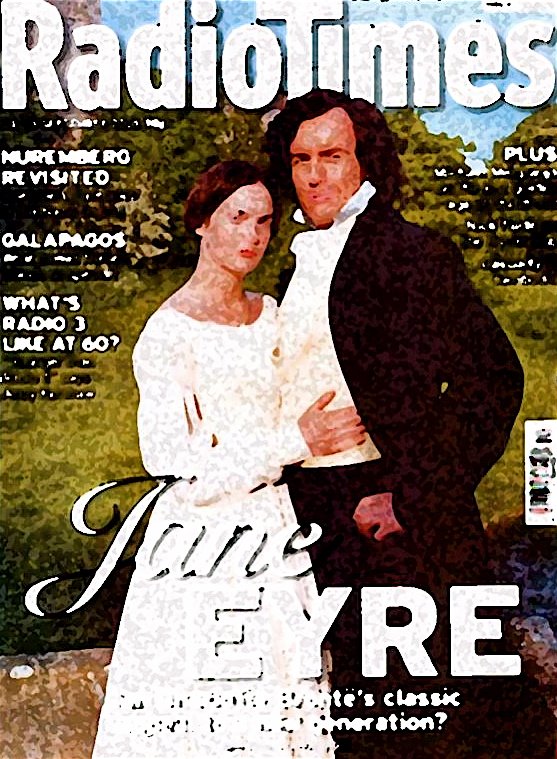
Well, I could blame it on the medication. Or it might be this holiday souvenir of a cold that is dulling my senses. I sure haven’t been able to savor my meals lately. So why should I thrill to yet another warmed over helping of Jane Eyre, a story I have read, written about, and taught, that I have heard and seen more often than any other work of English fiction? Why should anyone get excited about such a much chewed on and oft-reconstituted chestnut? Save college students, perhaps, who may take the BBC’s new television production as an occasion to keep their assigned editions unopened and to watch the plot unravel in four readily digested hour-long installments. If I sound cantankerous, it is neither bronchitis nor Ms. Brontë, I assure you: it is Sandy Welch’s bland rehash of one of the most daring and delicious growing-up stories ever concocted.

So, what’s wrong with this version, apart from production values and camera work reminiscent of 1970s television, apart from plain Jane’s sculptured eyebrows (brought to the job by Rossetti-lipped Ruth Wilson) and swarthy Rochester’s Darcyish looks (courtesy of Toby Stephens), apart from its skimming of some ten chapters (or eight years) and the half-hearted rendering of the novel’s relished if easily overcooked gothic mystery? Perhaps I had expected something rather more dynamic and radical after last year’s sensational adaptation of Bleak House.

Jane Eyre, to be sure, is not a Dickensian novel. It does not depend on bathos and caricature to elicit our responses; it relies instead—and succeeds in relying—on the intimacy of its portrait, the self-portrait of an inexperienced, self-conscious young woman who is given a voice to tell her tale.

That was radical in 1847—and it is still remarkable today, despite millions of blogs reveling in or bogged down by the mundane. Indeed, readers of Brontë’s pseudonymously published tale wondered whether this was fiction at all, or whether it was, perhaps, a thinly veiled if highly romanticized version of a real governess (in the employ of Mr. Thackeray, perhaps?). They wondered, too, whether this story was penned by a woman, considering its frank account of a socially unequal and as such questionable relationship.

Adaptations of Jane Eyre—any reworking worth our while—should make an effort to recreate this sense of realism, which is not found in the novel’s gothic situations, in the screaming but otherwise voiceless character of the presumably mad, Sargasso Sea-swept Bertha, in the fire that consumes Thornfield Hall and temporarily blinds its owner, or in the telepathic connection that reunites a mature Jane with her now helpless and emasculated master. The realism lies in the first-person narration, in the observations of a woman who has the nerve to tell her story, a story of teenage angst filled with humiliation, unease, and doubt. In short, a real story.

Voice-over narration, so closely associated with film noir, assists viewers to reach where the novel invites us to go: under the surface of conventions, beyond appearances, and as straight as Victorians could possibly permit themselves to pry into the heart and mind of a woman whose story is taken from her once she is not permitted to tell it herself.

Even radio, the medium best suited for the exploration of Jane’s mind, often resorted to an omniscient narrator such as this one by Walter Hackett, as performed in the US by the Yankee Players and broadcast in the early 1950s over the Yankee-Mutual Network:

The courtyard of the King George at Millcote is deserted with but the exception of the young girl standing at the entrance. She shivers as the rawness of the late November afternoon strikes through her thin cloak. Suddenly the door of the inn opens and a large-boned, powerfully-built, sullen-featured woman walks across the cobblestones toward the young girl.

It is time to return the story to that “young girl”—or leave it with Charlotte Brontë, who tells it so well. So, would-be dramatists of radio, film and television, take heed: let Jane Eyre speak up, or shut up!