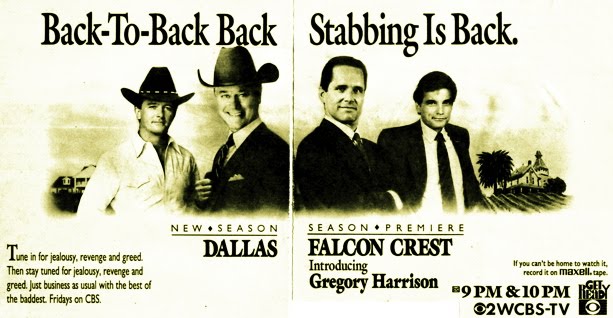
A long time (well, okay, make that ‘about four and a half years’) ago I came to the realization that the key to keeping an online journal—and one’s fingers regularly on the keyboard in its service—is serialization: some kind of evolving plot that, like life and Stella Dallas on a diet, keeps thickening and thinning from Monday till Doomsday until the inevitable sundown that not even Guiding Light could outshine.
Despite this realization, though, I have never managed to make a success of stringing together the latest on my follies and failures, mainly because I did not set out to make my person the axis around which this less than celestial body of essays spins. That, in recent months, the revolutions have ground to a near halt and affairs have become all but devolutionary is largely owing to the series of friction that is my one life to live beyond these virtual pages. These days, writing in installments begins and ends in ‘stall,’ which is the least I tend to do best.
The cast of One Man’s Family
Not that the contemplation of the presumably out-of-date lends itself to frequent updates. I mean, what’s the point of being current when your harvest is raisins? For the love of ribbon mikes, how many times can you run away with the A & P Gypsies and still expect anyone to follow the run-down caravan in which you survey the bygone scene? Good for how many yarns are the bewildering progeny of the Happiness Boys, that old “Interwoven Pair,” until any attempt at catching up with the cat’s whiskers and its litter unravels like knitting gone kitty’s corner? Why go on circulating gossip from the Make Believe Ballroom as the world turns the radio off?
Clearly, there is room for a chorus line of doubt when I now announce the beginning of a new chapter in the cancellation dodging saga of broadcastellan. Anyone hoping for a weekly quintuplet of All My Mind’s Children should be advised that this is going to be more a case of One Man’s Family Planning . . .
“Today, the real humorist is fast disappearing.” The “Today” here is 30 January 1949. The voice is that of satirist Fred Allen, who made the claim when called upon to expound on “The State of American Humor” for the benefit of folks tuning in to NBC’s Living 1949. “Yessir,” Allen declared, “the average comedian is a mouth that speaks the thoughts of others’ brains. Machine age humor, like the automobile, is turned out on the assembly line.” As a wordsmith who preferred to live by his own wit, Allen was the free spirit in a machine that increasingly generated shoddily assembled audience participation programs, the temporary demand for which ran him out of business that year—a dead giveaway that executives were not in it for laughs.
Fred Allen
What Allen in his dread of the mechanical and the mercenary could not foresee is that, sixty years on, the “[m]achine age” would give those determined to publish the thoughts of their own brains an instrument with which to bypass the assembly lines and make a beeline for the byline that would otherwise be hard to come by; a forum in which freely to exchange ideas instead of turning out commercial copy in exchange for a few pay-per-click pennies; and a means of reaching out to the “real” among the virtual whose minds are not of the assembly line persuasion.
One way of acknowledging such commercial-free souls and inspiriting kindred is to bestow the Dardos. It might sound like some post-apocalyptic cult; but in truth it is a token
given for recognition of cultural, ethical, literary, and personal values transmitted in the form of creative and original writing. These stamps were created with the intention of promoting fraternization between bloggers, a way of showing affection and gratitude for work that adds value to the Web.
I am certainly grateful to the two journalists who saw it fit to stamp me thus. After all, Ivan (Thrilling Days of Yesteryear) and Jeff (The Easy Ace) are among the few who share my enthusiasm for broadcast history and historic broadcasts—the kind of kilorecycling that has been going on here for nearly nigh on four years. In felicitous low-fidelity, they are committed, as I am, to re-popularizing the post-popular, to tracing the mainstream that has dried up or run its course into a sea of indifference. Their work “adds value to the Web” all right; but that is rather too prosaic a way of putting it—and, as far as my web experience is concerned, an understatement besides.
Thrilling is what Inner Sanctum’s Lipton Tea lady might have termed “brisk” entertainment. It is entirely without additives or artificial sweeteners, which makes taking refreshment there a guiltless pleasure. Ace, meanwhile, tells it “The Way It Was”; in his matchless on-this-day approach to chronicling “yesteryear,” he easily aces out a less organized mind like mine, which promptly lapsed into a more idiosyncratic mode of relating the past. To relate to them both has been at once “Easy” and “Thrilling.”
The same can be said for the task at hand. In keeping with the “rules,” I
1) accept the Dardos by displaying it here, along with the names of those who bestowed it and a link to their respective journals; and
2) pass it on to another five blogs I deem worthy of this acknowledgement, contacting each of them to let them know they have been selected.
The five journals I single out here have kept this niche in cyberspace from feeling like a padded cell or isolation ward to me. They are all eligible for the “Helen Trent” award, far from mute testament that because a blogger is “thirty-five or more,” an active life online “need not be over,” that blogging “can begin at 35.” The Dardos I bestow upon them because I appreciate their wit, their ebullience and their tenacity; because they do as they please and, by doing so, make me say, “please, keep doing it.”
As Emerson put it, the ‘perception of the comic is a tie of sympathy with other men, a pledge of sanity, and a protection from those perverse tendencies and gloomy insanities in which fine intellects sometimes lose themselves.”
A fine intellect not in danger of gloomy insanities is Doug, who keeps Waking Ambrose. Ambrose Bierce, that is, whose Devil’s Dictionary he translates and updates for the 21st century. What’s more, Doug invites all of us to do the same, and, having acknowledged our contributions, regales us with stories and verse, then finds time to make the rounds and drop us a taut line. In all this interactivity, he is a paragon among bloggers.
There are journalist on the web with whom I keep having imaginary conversations. With Elizabeth of Relative Esoterica, whom I picture as a Myrna Loy unencumbered by a William Powell, I discourse on film noir and biography as we listen to the jazz about which she is not only knowledgeable but passionate. We agree that, while it is unwise to be fanatic about anything, it would be wretched not to feel enthusiastic about something or other.
With Clifton of Canary Feathers I converse about the radio programs that enriched his childhood—be it One Man’s Family or Kaltenmeyer’s Kindergarten—and years in broadcasting as he plays an old but beautifully restored church organ surrounded by cats who flit in and out of a scene brightly lit by . . . a leg lamp. In my daydreams, I can readily dismiss the fact that felines make me sneeze.
With fellow expatriate Fred, he of The Synchronicity of Indeterminacy, I go on about Quiet, Please and the Columbia Workshop as he persuades me to open my mind and ear to contemporary sound artists and aural storytellers. His own stories are a popular and critical success. He might be fascinated by automatons—but is living proof of that the imaginative thinker need not fear extinction. His journal(s) would have put his aforementioned namesake at ease.
With John, the “urbane pagan” of Enchanté, I have had many a conversation; I see him whenever I am back in New York City. A few years ago, he expressed to me his intention of starting a web journal. He finally got underway, and what a way he’s got, casting imaginary musicals—On the Fritz! (“A sparkling new musical about Prussia’s gayest prince [and greatest king]”—or musing about the state of his follicles.
With all of them I feel a certain “tie of sympathy.” That those ties are machine-knit does not make them synthetic. Otherwise, I would hardly be one-hundred percent woolgathering about them . . .
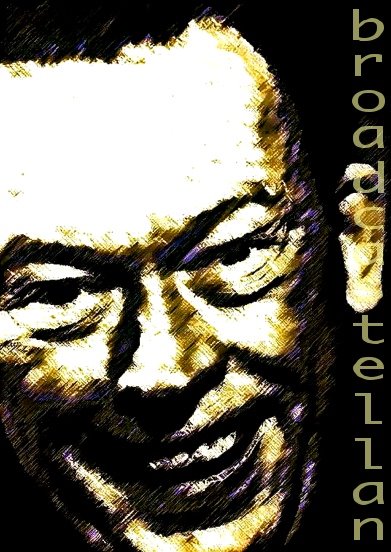
Herewith, my five-hundredth entry in the broadcastellan journal. Without making a big to-do about it, I shall mark this occasion by summoning the irascible, inimitable Thomas Carlyle (1795-1881), whose carte de visite (pictured) lies among the books and papers in my attic room, the “Sage of Chelsea” whose house in 24 Cheyne Row I can be seen inspecting below. Featured here as a character in a radio play about Margaret Fuller, America’s first female foreign correspondent (“The Heart and the Fountain” [28 April 1941], Carlyle had much to say about the press, to which he referred as the “fourth estate.” Perhaps, that makes us web journalists the estate 4.0. What is our role, our place, our worth? Whether derided, courted or ignored, we carry on surveying and opining, spreading and reprocessing what goes for news these days. In my case, chiefly old news.
According to Carlyle, “fourth estate” is no mere “figure of speech, or a witty saying,” but “a literal fact,” and a “very momentous” one at that. Publishing one’s thoughts, the Scottish philosopher-historian remarked, “is equivalent to Democracy: invent Writing, Democracy is inevitable.” What might he have said about the phenomenon of web journalism? I shall put a few words in his mouth, a cheekiness duly signalled by brackets, and update his thoughts as expressed in Heroes and Hero-Worship (1840):
Writing brings [publishing]; brings universal everyday extempore [publishing] as we see at present. Whoever can speak, speaking now to the whole nation, becomes a power, a branch of government, with inalienable weight in law-making, in all acts of authority. It matters not what rank he has, what revenues or garnitures. The requisite thing is, that he have a tongue which others will listen to; this and nothing more is requisite. The nation is governed by all that has tongue in the nation: Democracy is virtually there [. . . ]!
On all sides, are we not driven to the conclusion that, of the things which man can do or make here below, by far the most momentous, wonderful and worthy are the things we call [Blogs]! Those poor [digital bits and bites, . . . ] what have they not done, what are they not doing!—For indeed, whatever be the outward form of the thing [. . . ],
is it not verily, at bottom, the highest act of man’s faculty that produces a [Blog]]? It is the Thought of man; the true thaumaturgic virtue; by which man works all things whatsoever. All that he does, and brings to pass, is the vesture of a Thought. This [modern world], with all its houses, palaces, steam-engines, cathedrals, and huge immeasurable traffic and tumult, what is it but a Thought, but millions of Thoughts made into One—a huge immeasurable Spirit of a Thought, embodied in brick, in iron, smoke, dust, Palaces, Parliaments, [cars, highways], and the rest of it! Not a brick was made but some man had to think of the making of that brick.—The thing we called [digital bits and bites] is the purest embodiment a Thought of man can have. No wonder it is, in all ways, the activest and noblest.
All this, of the importance and supreme importance of [bloggers] in modern Society, and how [web journalism] is to such a degree superseding the Pulpit, the Senate, the academia and much else, has been admitted for a good while; and recognized often enough, in late times, with a sort of sentimental triumph and wonderment. It seems to me, the Sentimental by and by will have to give place to the Practical. If [bloggers] are so incalculably influential, actually performing such work for us [. . .] from day to day, then I think we may conclude that [web journalists] will not always wander like unrecognized unregulated Ishmaelites among us! Whatsoever thing, as I said above, has virtual unnoticed power will cast off its wrappages, bandages, and step forth one day with palpably articulated, universally visible power.
Perhaps, I am squandering this magical potential, the thaumaturgy of casting myself broadly, by writing obscurely on the obscure, all the while revelling in my own obscurity. And yet, without romancing the scale, the struggle and the thrill of writing seem to outweigh any desire I might have to be read, let alone understood . . .
In written communications, I generally refrain from cursing. I am not sure why so many web journalists feel compelled to express their emotions—even their apparent lack thereof—in terms referring to certain uses of the male sex organ or the issue of our daily excretions. I gather that both spell relief, as does the act of swearing. We all have to get it out of our system once in a while; and I am not one to recommend mealy-mouthing the unsavory by resorting to equivalents of a truculently tossed paper napkin; such disingenuous substitutions have been the curse of radio drama.
Back in 1938, for instance, a production of O’Neill’s Pulitzer Prize-winning Beyond the Horizon met with a storm of protest when it was broadcast over NBC’s Blue network. As Francis Chase Jr. recalls in his Sound and Fury (1942), the FCC forced an affiliate in Minneapolis to justify such language under the threat of refusing to renew its license after a single listener complaint about exclamations of “Hell,” “Damnation,” and “For God’s Sake.”
To be sure, I am under no obligation to act in the public interest; and somehow I cannot bring myself to avail myself of defused verbal missiles like “darn,” “drat” or “shucks” (the last of which I, as a German, would have trouble pronouncing during moments of distress). That said, I don’t hold with those who believe that mentioning acts of penetration renders the thought expressed more penetrating. If I censor myself here, it is because I am trying to come to grips with whatever has me by the throat as my hands flit across the keyboard, erasing as much as they produce.
I do not have to recreate verbatim what escaped my lips some time ago, as long as I manage to capture the feeling of that moment. Writing it down does not just mean getting it out; to me, it must also mean getting over it. It is a chance to let go of something rather than to let oneself go all over again and make a display of the discharge. Writing is the process of cleaning up, which is not to say that it is the concealment of disorder. Posture and composure become especially important when life seems to be in the very process of . . . decomposing.
What has been breaking down of late is the non-matter of my online existence. Another Mac has crashed—and that a mere three months after the previous wipeout (as lamented here). Never mind that I have learned little since the last incident and that many a souvenir has gone down the virtual sewer. What I noticed is that the crashes occurred while using iRecord, the software with which I copy audio files on the web. As a lover of radio programs, I use it quite a lot. Make that past tense.
To have one’s computer hard disk erased in the attempt to store what is fleeting is beyond “ironic” (another word I dislike). It is a rotten business, being shipwrecking for one’s love of the airwaves. The phrase “blistering barnacles” comes to mind. Indeed, most of Captain Haddock’s celebrated curses will do nicely just now.
Well, this is it. Twelfth Night. In Elizabethan England, Epiphany (6 January) marked the culmination of the winter revels, that topsy-turvy escape to the kingdom of Upsidedownia. For me, it is an apt time to return to this journal in earnest by looking back at my own follies, being that the first daft act of the year has me lying in bed with a cold. I am feeling—to borrow and immediately discard what unaccountably has been declared word of the year—decidedly subprime (wouldn’t below par or having peaked do just fine? Then again, it is a banking or business term and should therefore be ugly and subliterary). I had meant well, braving the wind and the rain, walking our dog after a three-week separation. Just a few days earlier I observed that 2007 has really been a wonderful year; in case yours has proven otherwise, I apologize for rubbing it in like so much VapoRub.
It was a year of traveling and theater-going that, a fall from a ladder notwithstanding (as a result of which my right pinky is now more likely to remain extended during high tea) was free of strife, hardship, and disappointment. Sure, there were those seemingly endless weeks without phone or wireless internet, there was a move into town that fell through, and there were a few minor upsets in my now sidelined teaching career. And then there was that summer that wasn’t. “For the rain it raineth every day.” Yes, it has been a wet year at that. It began in stormy Glasgow and ended in a drizzle on Waterloo Bridge in London, where the annual firework spectacular disappeared behind a thick curtain of sulphurous mist.
Among the recent theatrical highlights numbered the New World Stages production of Charles Busch’s Die Mommie Die, with the 2003 film adaptation I have caught up since. It had been seven years, almost to the day, since I saw Busch’s rather more conservative Tale of the Allergist’s Wife, starring (opposite Linda Lavin and Tony Roberts) the wonderful Michele Lee. The star of Die Mommie Die, of course, is the playwright himself. Some unnecessary crudity aside, it is a brilliant evocation of the 1960s and the end of the Hollywood era. It is also a darn good mystery—a rather better mystery than Christie’s nonetheless charming Mousetrap.
I am not a lover of camp, which, according to my own definition, is a wilful act of misreading. Die is a careful reading of the state of the women’s picture in the 1960s, the schlock that reduced a number of silver screen A-listers to sideshow freaks.
The heroine of Die Mommie Die is washed up, all right; but Busch does not derive most of his laughs from strapping her into a ducking stool. His play is as much an homage as it is a send-up (catering to those familiar with the histrionics of Crawford, Davis, and Susan Hayward); and it is this careful balance that, despite some vulgar touches, makes his play succeed both as thriller and farce.
Yes, I am rather traditional when it comes to film and theater, but that is not why I did not care much for Matthew Bourne’s Nutcracker (now playing at Sadler’s Wells)—having enjoyed his Car Man earlier this year—and sought refuge at the Prince Edward Theater to take in one of the final performances of Mary Poppins on New Year’s Day. I am not opposed to trying out something new; but I find more pleasure in finding the new in the supposedly out-of-date.
A great while ago the world begun, With hey, ho, the wind and the rain, But that’s all one, our play is done, And we’ll strive to please you everyday.
Yes, I am back, Monday through Friday. And not going on about the weather—until something well nigh catastrophic or at any rate sensational compels me to break this rule . . .
Well, I’ve been struggling to keep up, which makes me feel and appear rather dumber than usual. I have gotten into the habit of editing my journal entries online, of dumping scraps here in hopes of making something of them, eventually. “We must beat the iron while it is hot, but we may polish it at leisure,” Dryden famously said. As a poet, composing in solitude, he probably never thought of doing the polishing in public. At any rate, given the relative obscurity of broadcastellan, I often assume that my composing here is very nearly done in private; but the realization that one looker-on had landed here after scouring the web for references to “Dr. Harry Heuser,” no doubt with the intention of checking my credentials, rather put me off the idea of performance editing. And yet, as dumb as it might be not to wait until such time as the half-cooked turns into a dish fit for tossing into this dumb waiter of a vehicle, I am not easily reformed. It is quite literally too late for that now.
I just got back from an evening of theater. There is always time for that; and the offerings here in the small seaside town of Aberystwyth, just outside of which I reside, is gratifyingly varied. Once again, I can’t wait to share my thoughts, however dumber they will be expressed in the shoddy prose of the moment. Before my memories go stale or my mind blank, I have got to share my thoughts on the Compass Theatre Company‘s production of Pinter’s “Dumb Waiter,” with a “Pair of Chekhov’s Shorts” thrown in.
The shorts suited us just fine. “The Evils of Tobacco” and “The Proposal” (translated by Neil Sissons), are comedy sketches Chekhov wrote for the vaudeville stage early in his career, “Evils” being a monologue and “The Proposal” a one-acter for three characters. Both pieces deal with what is generally thought of as the end of comedy, marriage, by inviting us to see the end of marriage as comedy.
The henpecked husband ostensibly lecturing about the “Evils” of smoking is really more keen on, and indeed desperate to, share his thoughts about his miserable existence as dictated by his controlling spouse. The monologue was delivered with humor and pathos by Michael Onslowe, who was seen in all three pieces. “Evils” would work well on radio, I thought. It is one of my hard-to-kick habits always to think of what I see in the light (or darkness, as it were) of its radiodramatic potentialities.
Nor does “The Proposal” pose any great challenges to the adaptor for radio, even though Sisson deftly exploits the physical aspects of comedy in the slapstick treatment of the suitor’s nervous disposition. As the title suggests, “The Proposal” tells of an intended match, the advancement of which goes awry. However old and slight these two plays, the laughter was not derived from our perception of their datedness; nor did they greatly rely for their effect on the audience’s nostalgia for this kind of entertainment. They simply still work as comic banter.
Pinter’s “Dumb Waiter” is rather more dependent on what is unexpressed, even though Gus, one of the two hapless hitmen waiting for their next job, seemed to have echoed our attitude toward this final play on the bill when he exclaimed: “It’s worse than the last one.” Commenting on the dump of a hotel in which he and his partner Ben are waiting to carry out their next assignment, he adds: “At least there was a wireless there.” Is “Dumb Waiter” radiogenic? Surely not in the way that Pinter’s “A Slight Ache” plays with your mind.
Still, the titular contraption prominently mounted in the center of the stage, and the speaking tube attached to it, made me think of the wireless that Gus was missing. Indeed, it very nearly made me go “Yoo-hoo! Is anybody?” as I thought of Molly Goldberg’s old apartment and the role her dumb waiter played in her everyday communications with the unheard Mrs. Bloom. I guess, a day without radio to me amounts to something like an existential void. It is certainly more than “A Slight Ache.”
Well, what a difference a day makes—at least if you are spending it installing a new router. The wireless woes of recent weeks having passed, I can continue to issue my journal without further “adieu,” this week’s return visit to the Welsh getaway of media mogul William Randolph Hearst and Marion Davies excepting. As much as I enjoy being out and about, I relish staying put to share whatever crosses my mind, free to linger in the presence of kindred spirits or chat online with friends overseas to learn about their struggles and successes in show business and music publishing. I am somewhat short on ambition, I guess, safe for writing my own radio column, come hell or high definition. And, unless I allow myself to stray from the subject or find myself thwarted by technology—I am doing just that right here.
A radio column. That was what got Sammy started. You know, Sammy Glick, the title character of What Makes Sammy Run? (1941), the novelistic debut of Budd Schulberg (whose voice you may hear at the close of this mid-1950s radio documentary about his friend and colleague F. Scott Fitzgerald). Now, Sammy was just a twelve-bucks-a-week nobody running copy for a drama editor at a New York City newspaper when, one day, he announced that he “felt himself ready to conduct the paper’s radio column. Of course,” sneered the narrator (said editor), “the fact that the paper had never had a radio column didn’t seem to discourage him in the least.”
I first read this exchange when I was researching my doctoral study on so-called old-time radio, examining it in relation to other and older media in the 1930s and ’40s. What Makes Sammy Run? provided a vivid example, albeit fictional, of the doubt, dread, and disdain with which the American press eyed, tried to suppress, and pretended to ignore the commercial might of the broadcasting industry. “[W]hy should we plug a setup that’s cutting our advertising?” the editor tells Sammy, the overeager upstart who aims to please with the aim of pleasing himself:
“And just what makes you think you’re prepared to be an expert on matters Marconi?” “What made you think you were an expert on the theater?”
To this blunt challenge, the irked authority feebly replies:
“I always liked the theater. I’ve seen lots of plays.” “Well, I’ve listened to the radio plenty, too,” Sammy said. “That doesn’t mean anything,” I said. “Everybody listens to the radio.” “That’s why there oughta be a radio column,” Sammy said.
Guess what, little Sammy gets his column, and then some. He’s got plenty of nerve and few scruples. Unencumbered by the weight of a conscience and lifted instead by an inflated ego, the boy is getting far, and fast. He even passes off as his own a radio comedy by an inexperienced if gifted nobody who came to ask him for advice, barely giving credit to its original author when he sells the piece as a screen project.
What makes the Sammys of the world outrun us? What makes them run us over and run our lives as we stay put and gaze at them through the cloud of dust those windbags leave behind as they make a dash for whatever it is that is it for them? That is what I ask myself while I remain seated, long after the handfuls of dust have settled, to see the world from my virtual porch . . .
Well, this isn’t exactly the stuff of Hollywood melodrama; but being cut off from the web for weeks—and hairs—on end is likely to have anyone channelling the none too blithe spirit of Mrs. Elbert Stevenson, the telecommunications-challenged anti-heroine of Lucille Fletcher’s “Sorry, Wrong Number.” I realize that “Sorry, No Broadband,” doesn’t quite have the same ring to it; nor does it sound right to be giving you the whole song and dance about it all whenever I do get a chance to vent publicly (that is, while not at home).
Still, the thought of getting one’s dial-uppance after years of making out like a broadbandit is just about as comforting as having the aforementioned First Lady of Suspense shriek bloody murder in your ears. These days, to be sure, Mrs. Stevenson would meet her well-timed end trying to make herself understood at some call center in India. Otherwise, this outcry from the play seems to fit our latest phone bill:
“[. . .] it’s positively driving me crazy. I’ve never seen such inefficient, miserable service.”
Pardon me for turning broadcastellan into an agony column. You see, we were given to understand that repairs of our phone line, apparently requiring the digging up of precious tarmac, would be put on hold so as not to disrupt local traffic . . . until September. I never guessed that my wanting to stay home at the computer would be deemed bad for tourism. To our relief, the phone started ringing again a few days ago; but the world wide web was still being spun without us.
So, I did not get to tell you about the production of West Side Story now playing at the local Arts Centre; or the complaints launched anonymously by a squeamish audience member voicing concerns about a simulated rape scene; or how the scene was subsequently changed so as not to offend, let alone harm the impressionables who should never be left with the impression that any show could go on without them in mind.
Apparently, West Side Story, written by former radio dramatist Arthur Laurents, is now a musical about infantile delinquents. Ours are not Happy Days for social realism. As in the age of the great radio theatricals, censorship is often nothing more than the arrogance of the few speaking up to silence what is quietly appreciated by the many. The world, it seems, is full of meddlesome Mrs. (and Mr.) Stevensons, in the spirit of providing vicarious relief through an imaginary throttling of whom on behalf of us, their long-suffering contemporaries, the revenge fantasy of “Sorry, Wrong Number” was conceived.
Well, it’s a different kind of animal. The kind that digests in the very instance of ingestion. Webjournalism, I mean. It matters little whether or not you write for a living, as long as you write what you are living while you are living it, while you experience or witness what is being stored and storied. My digestive system operates far less efficiently, I’m afraid, which is why I frequently end up with a digest of my day-to-day.
It is not that I regurgitate the past. I very much live in the moment, a skill (or nearsightedness) I developed living the United States, the empire of “now.” And yet, by the time I manage to keep up with them, those moments have lost their momentum. They are memories the writing down of which is the reheating of yesterday’s repasts. Instead of journalizing my journey as it happens, I delay the act of relaying it by sharing recollections edited, according to a Wordsworthian scheme of spontaneity, in motionless and remote tranquility.
This is what I feel compelled to do now—catching up with myself. After all, taking bites out of the Big Apple for a month left me with plenty to digest, even if some of pieces of my intake turned out to be as unpalatable as the Tony Award-winning musical Spring Awakening or as bland as the Terrence McNally’s Deuce, a sentimental exchange starring the ill-served if indefatigable Angela Lansbury.
Only a few days ago I spent an afternoon at Coney Island, walking past Nathan’s (not eating the hot dogs that once got me terribly sick) and riding the old Cyclone—whose twists and curves once caused me to break the bones of my best friend sitting beside me. Today, I am cleaning up after a sick dog that swallowed a bone far too large to be digested, hoping he will be spared an operation, hoping I am going to be spared something akin to “The Odyssey of Runyon Jones” (Norman Corwin’s radio play about a boy determined to retrieve his dead dog from “Curgatory”).
It is retrospection that saves me from exposing myself at my most vulnerable—in the in-between of everyday living. It is life tidied up and tied up neatly. It is loose ends woven into a security blanket. Digest, please!
It seems like I am going to be cut off from the internet for a while. High winds wreaked havoc with the local landlines earlier this year, and keeping my date with the out-of-date has turned into an on-and-offline romance during the past three months. Finally, something amounting to more than darning is going to be done about those rotten wires; even the road to our house will be closed off for the duration. It is going to be a week of silent days, without signals and dispatches. Will broadcastellan have returned by the end of it? Can new wires improve the state of broadband? Might there be a future for carrier pigeons? I won’t ask you to tune in tomorrow to find out all about it because I won’t be able either to tell or share. Nor do I mingle with the crystal ball set who look to a psychic or Mind Reader like Warren William for answers.
What is worse, anyway, a phony medium or one beyond reach, a doubtful telepath or unreliable telecommunications?

 A long time (well, okay, make that ‘about four and a half years’) ago I came to the realization that the key to keeping an online journal—and one’s fingers regularly on the keyboard in its service—is serialization: some kind of evolving plot that, like life and Stella Dallas on a diet, keeps thickening and thinning from Monday till Doomsday until the inevitable sundown that not even Guiding Light could outshine.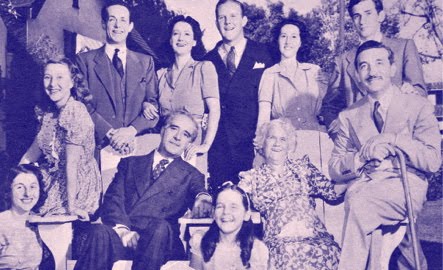
 Herewith, my five-hundredth entry in the broadcastellan journal. Without making a big to-do about it, I shall mark this occasion by summoning the irascible, inimitable Thomas Carlyle (1795-1881), whose carte de visite (pictured) lies among the books and papers in my attic room, the “Sage of Chelsea” whose house in 24 Cheyne Row I can be seen inspecting below. Featured here as a character in a
 In written communications, I generally refrain from cursing. I am not sure why so many web journalists feel compelled to express their emotions—even their apparent lack thereof—in terms referring to certain uses of the male sex organ or the issue of our daily excretions. I gather that both spell relief, as does the act of swearing. We all have to get it out of our system once in a while; and I am not one to recommend mealy-mouthing the unsavory by resorting to equivalents of a truculently tossed paper napkin; such disingenuous substitutions have been the curse of radio drama.

%3F.jpg)


 Harry Heuser