Dunkirk 70 / Roosevelt 69

This week marks the 70th anniversary of “Operation Dynamo,” an ad hoc rescue mission involving small civilian ships coming to the aid of French and British soldiers who had been forced into retreat at Dunkerque during the for Allied troops disastrous Battle of Dunkirk. The operation, which became known as “The Miracle of the Little Ships,” was recreated today as more than sixty British vessels, sailing from Kent, arrived on the shores of northern France.

During the course of a single week, nearly 340,000 soldiers were brought to safety, however temporary. Many civilians who had what became known as “Dunkirk spirit” were recruited after listening to BBC appeals on behalf of the British admiralty for aid from “uncertified second hands”—fishermen, owners of small pleasure crafts, any and all, as the BBC announcer put it, “who have had charge of motor boats and [had] good knowledge of coastal navigation.”

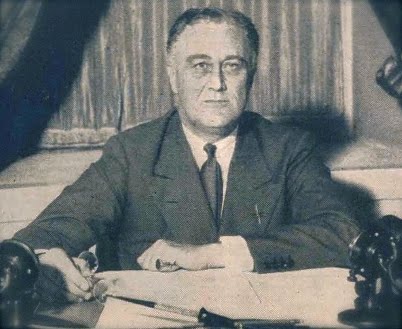
Eager to maintain its neutrality prior to the attack on Pearl Harbor, America was understandably lacking in such public “spirit,” frequent outcries against Nazi atrocities notwithstanding; but even long after entering the war, the US government kept on struggling to explain or justify the need for sacrifices and (wo)manpower to a people living thousands of miles from the theaters of war. On this day, 27 May, in 1941, one year after the operation at Dunkirk began, US President Franklin Delano Roosevelt came before the American public in another one of his Fireside Chats.

Although the nation was “[e]xpect[ing] all individuals [. . .] to play their full parts without stint and without selfishness,” the Roosevelt administration took considerable pains to explain the significance of the war, the need for “toil and taxes,” to civilians who, not long recovered from the Great Depression, were struggling to make a living.

If Hitler’s “plan to strangle the United States of America and the Dominion of Canada” remained unchecked, FDR warned the public,

American laborer would have to compete with slave labor in the rest of the world. Minimum wages, maximum hours? Nonsense! Wages and hours would be fixed by Hitler. The dignity and power and standard of living of the American worker and farmer would be gone. Trade unions would become historical relics and collective bargaining a joke.

Crucial to America’s freedom was the security of the oceans and ports. If, as FDR put it, the “Axis powers fail[ed] to gain control of the seas,’ their “dreams of world-domination” would “go by the board,” and the “criminal leaders who started this war [would] suffer inevitable disaster.”

The President’s address—broadcast at 9:30 EST over CBS stations including WABC, WJAS, WJAS, WIBX, WMMN, WNBF, WGBI and WJR—departs only slightly from the script, published in the 31 May 1941 issue of the Department of State Bulletin. Whatever changes were made were either designed to strengthen the appeal or else to prevent the urgency of the situation from coming across as so devastating as to imply that any efforts by the civilian population were utterly futile.

The address, as scripted, was designed to remind the American public that the US navy needed to be strengthened, alerting listeners that, of late, there had been “[g]reat numbers” of “sinkings” that had “been actually within the waters of the Western Hemisphere.”

The blunt truth is this—and I reveal this with the full knowledge of the British Government: the present rate of Nazi sinkings of merchant ships is more than three times as high as the capacity of British shipyards to replace them; it is more than twice the combined British and American output of merchant ships today.

In address as delivered, this passage was rendered slightly more tentative as “The blunt truth of this seems to be,” a subtle change that not so much suggests there was room for doubt as it creates the impression that the great man behind the microphone was weighing the facts he laid bare, that the devastating and devastatingly “blunt truth” was being carefully considered rather than dictated as absolute.

No mention was made of the “Miracle of Dunkirk,” that remarkable demonstration of spirit and resilience. More than a flotilla of “little ships” was required to defend the US from the potential aggression of the Axis powers. The challenge of American propaganda geared toward US civilians was to make the situation relevant to individuals remote from the battlefields, to motivate and, indeed, create a home front.
In Britain, where “ignorant armies clashed” just beyond the narrow English Channel and where the battlefields were the backyards, there was less of a need to drive home why the fight against the Axis was worth fighting.

In the US, the driving home had to be achieved by breaking down the perfectly sound barriers of that great American fortress called home, by making use of the one medium firmly entrenched in virtually every American household, an osmotic means of communication capable of permeating walls and penetrating minds. Radio served as an extension to the world; but it was more than an ear trumpet. It was also a stethoscope auscultating the hearts of the listener.

As FDR, who so persuasively employed it in his Fireside Chats, was well aware, the most effective medium with which to imbue the American public with something akin to “Dunkirk spirit” was the miracle not of “little ships” but of the all-engulfing airwaves—and the big broadcasts—that helped to keep America afloat.

“You Were Wonderful,” Lena Horne

When I heard of the passing of Lena Horne, the words “You Were Wonderful” came immediately to mind. Expressive of enthusiasm and regret, they sound fit for a tribute. However, by placing the emphasis on the first word, we may temper our applause—or the patronising cheers of others—with a note of reproach, implying that while Horne’s performances were marvellous, indeed, the system in which she was stuck and by which her career was stunted during the 1940s was decidedly less so. No simple cheer of mine, “You Were Wonderful” is also the title of a radio thriller that not only gave Horne an opportunity to bring her enchanting voice to the far from color-blind medium of radio but to voice what many disenchanted black listeners were wondering about: Why fight for a victory that, of all Americans, will benefit us least? As title, play, and cheer, “You Were Wonderful”—captures all that is discouraging in those seemingly uncomplicated words of encouragement.

Written by Robert L. Richards, “You Were Wonderful” aired over CBS on 9 November 1944 as part of the Suspense series, many of whose wartime offerings were meant to serve as something other than escapist fare. As I argued in Etherized Victorians, stories about irresponsible Americans redeeming themselves for the cause were broadcast nearly as frequently as plays designed to illustrate the insidiousness of the enemy. Despite victories on all fronts, listeners needed to be convinced that the war was far from over and that the public’s indifference and hubris could endanger the war effort, that both vigilance and dedication were required of even the most war-weary citizen. “You Were Wonderful” played such a role.

When a performer in a third-rate nightclub in Buenos Aires suddenly collapses on stage and dies, a famous American entertainer (Horne) is rather too eager replace her. “I’m a singer, not a sob sister,” she declares icily, thawing for a tantalizing rendition of “Embraceable You.”

The very name of the mysterious substitute, Lorna Dean, encourages listeners to conceive of “You Were Wonderful” in relation to the perennially popular heroine Lorna Doone, or the Victorian melodramatic heritage in general, and to consider the potential affinities between the fictional singer and her impersonatrix, Lena Horne, suggesting the story to be that of an outcast struggling to redeem herself against all odds.

One of the regulars at the nightclub is Johnny (Wally Maher), an seemingly disillusioned American who declares that his country did not do much for him that was worth getting “knocked off for.” Still, he seems patriotic enough to become suspicious of the singer’s motivations, especially after the club falls into the hands of a new manager, an Austrian who requests that his star performer deliver specific tunes at specified times. The absence of a narrator signalling perspective promotes audience detachment, a skeptical listening-in on the two central characters as they question each other while all along compromising themselves.

When questioned about her unquestioning compliance, Lorna Dean replies:

I’m an entertainer because I like it.  And because it’s the only way I can make enough money to live halfway like a human being.  With money I can do what I want to—more or less. I can live where I want to, go where I want to, be like other people—more or less.  Do you know what even that much freedom means to somebody like me, Johnny?

However restrained, such a critique of the civil rights accorded to and realized by African-Americans, uttered by a Negro star of Horne’s magnitude, was uncommonly bold for 1940s radio entertainment, especially considering that Suspense was at that time a commercially sponsored program.

“[W]e are not normally a part of radio drama, except as comedy relief,” Langston Hughes once remarked, reflecting on his own experience in 1940s broadcasting. A comment on this situation, Richards’s writing—as interpreted by Horne—raises the question whether Horne’s outspoken character could truly be the heroine of “You Were Wonderful.”

Talking in the see-if-I-care twang of a 1930s gang moll, Lorna is becoming increasingly suspect, so that the questionable defense of her apparently selfish behavior serves to render her positively un-American. When told that her command performances are shortwaved to a German submarine and contain a hidden code to ready Nazis for an attack on American ships, she claims to have known this all along.

The conclusion of the play discloses the singer’s selfishness to have been an act. Risking her life, Lorna Dean defies instructions and, deliberately switching tunes, proudly performs “America (My Country ‘Tis of Thee)” instead.

About to be shot for her insubordination, Lorna is rescued by the patron who questioned her integrity, a man who now reveals himself to be a US undercover agent. When asked why she embarked upon this perilous one-woman mission, the singer declares: “Just to get in my licks at the master race.”

“You Were Wonderful,” which, like many wartime programs was shortwaved to the troops overseas, could thus be read as a vindication of the entertainment industry, an assurance to the GIs that their efforts had the unwavering support of all Americans, and a reminder to minorities, soldiers and civilians alike, that even a democracy marred by inequality and intolerance was preferable to Aryan rule.

Ever since the Detroit race riots of June 1943, during which police shot and killed seventeen African-Americans, it had become apparent that unconditional servitude from citizens too long disenfranchised could not be taken for granted. With “You Were Wonderful,” Horne was assigned the task of assuring her fellow Negro Americans of a freedom she herself had to wait—and struggle—decades rightfully to enjoy.

Had it not been for this assignment, Lena Horne may never have been given the chance to act in a leading role in one of radio’s most prominent cycles of plays. Yes, “You Were Wonderful,” Lena Horne—and any tribute worthy of you must also be an indictment.

“. . . there must come a special understanding”: To Corwin at 100

Today, American journalist and radio playwright Norman Corwin turns 100. Whether that makes him the oldest living writer to have had a career in radio I leave it to fact-checkers and record book keepers to determine. I do know that, seventy years ago, he was already the best. Oldest. Best. Why not dispense with superlatives? Corwin has been set apart for too long. Instead, an appreciation of his work calls for the positive and the comparative, as his plays deserve to be regarded at last alongside the prose and poetry of his better-known literary contemporaries.

No survey of 20th-century American literature can be deemed representative, let alone definitive, without the inclusion of some of Corwin’s Whitmanesque performances. What has kept him from being ranked among the relevant and influential writers of the 1940s, and of the war years in particular, is the fact that, during those years, Corwin wrote chiefly for a medium that, however relevant and influential, was—and continues to be—treated like a ghetto of the arts in America.

You might argue that the metaphor is not altogether apt, especially if you bear in mind the distinguished authors and playwrights who did turn to—or agreed to be pulled into—broadcasting during the Second World War; among them poets Archibald MacLeish, Edna St. Vincent Millay, and Stephen Vincent Benét, as well as dramatists like Maxwell Anderson, Marc Connelly, and Sherwood Anderson. And yet, even their scripts are rarely acknowledged to be contributions to literature, the American airwaves being thought of as a cultural site quite beyond that field.

At best, dramatic writings for radio are handled as historical documents that, by virtue of being propagandist or populist, could hardly be regarded as having artistic merit or integrity. As something other—and less—than literature, they were as quickly obliterated as they were produced, stricken from the records so as not to tarnish the reputation of erstwhile writer-recruits most of whom exited the radio camp well before V-J Day.

Norman Corwin never deserted that camp. Rather, the camp was shut down, raided by McCarthy, all but razed to make way for television. Sporadic returns to the old playing field notwithstanding, he was forced to move on. Yes, the air was—and is—Corwin’s playground. For all their wartimeliness, his 1940s plays were never mere means to an end, even if end is understood to mean an end to the war that gave them a reason for being.

To gain an understanding of that past is not the only good reason for being in the presence of Corwin today. Rather than promoting uniformity, which is a chief aim of propaganda, Corwin’s plays challenge the commonplace, encourage independent thinking and the voicing of ideas thus arrived at. Take “To Tim at Twenty,” for instance. It is hardly one of Corwin’s most complex, ambitious or experimental works for radio; in a note to a fellow writer, published in Norman Corwin’s Letters (1994), the playwright himself described it as “the lowest common denominator of simplicity.” Simplicity, in this case, is an achievement. Quietly startling, “To Tim at Twenty” bespeaks the humanity, intellect, and dignity of its author.

Written for the CBS Forecast series, a string of pilot broadcasts designed to test audience responses to potential new programs, the play first aired on 19 August 1940, when it starred Charles Laughton, for whom “To Tim” was expressly written, and Elsa Lanchester. Newly arrived in California, Corwin was staying at the couple’s Brentwood home at the time.

As he shared in a letter to his sister-in-law, he felt “kind of lonely” in Hollywood, and was “getting tired of singlehood.” In times of war—and to Laughton and Lanchester August 1940 was wartime—the thought of growing up and raising a family is compounded by the realization that the future is darkly uncertain instead of rich in potentialities. So, Mr. Corwin wrote a letter.

To Tim at Twenty is an epistolary play, a radiodramatic genre of partially dramatized speeches addressed to an implied audience. The proxy listener, in this case the unheard Tim, suited Corwin since indirection made whatever was conveyed come across as something other than an act of overt indoctrination. The addressee also provided him with a veil behind which to enact his personal conflicts as he contemplated his maturity, mortality, and legacy.

The letter writer is Tim’s father, a British gunner spending a sleepless night in the “barracks of an RAF squadron on the northeast coast of England”; as the narrator-announcer informs us, he is “leaving at dawn on a mission from which there can be no return.”

Once the United States entered the war, lesser writers, melodramatist Arch Oboler among them, would use this kind of set-up to remind American civilians of the sacrifices made for them overseas, of the bravery that must be honored and matched at the home front. Tim, we expect, is asked to honor his father’s memory. Instead, the letter he is to receive tells him that the men of his father’s generation “haven’t made out any too well” in the business of “the running of the earth.”

At the time the letter is composed, Tim is just five years old. His father made a “special point” of asking his wife “not to deliver” it until 1955, at which time he might have had the “man to man” talk with his son that war denied him.

Sentimental, seemingly pacifist messages were not unheard of at the time. They were welcomed by isolationists who counted on big business as usual—and commercial radio, which shunned the controversial, was very big business indeed; but “To Tim at Twenty” suggests something alien to those determined to preserve the status quo. Instead, the belated address of the Englishmen, who knows better than to have faith in things as they are, is meant to instill his son—and Corwin’s listeners—with a “fuller appreciation of women.” To Marshall, they are authorities of humanity superior to men because “there must come a special understanding of the dignity of life to those who grow it in their vitals.”

As the dramatic flashbacks reveal, the lessons he shares with his son were taught Marshall by his wife, who suggested that the voices of the many might have drowned the shrill cries of the few, the “wanton wills” that were not countered by “man’s vast raw materials of love and tenderness and courage” in time to avoid deadly conflict. “There are several kinds of valor,” Tim is to learn from his dead father, “and the least is the kind that comes out of the hysteria of battle.”

I suspect that it was easier to write this message in 1940 than it was to understand it in 1955, when America’s leader was a five-star general, when superpowered dominance was the manly objective of the day and the “appreciation of women” was more a matter of the male gaze than of political influence or workforce equality. By then, there was no place for Corwin in network radio.

Since his climactic “Note of Triumph” in 1945, to which nearly half of the US population was estimated to have tuned in, his voice has been heard by a comparatively few—the fortunate few who, by lending him an ear, are gaining a “special understanding.”

Cranky Doodle Dandy: George M. Cohan Feels So Free

Jumping Jehosophat! It sure feels good to rant about our elected government—some force that, at times, appears to us (or is conveniently conceived of) as an entity we don’t have much to do with, after the fact or fiction of election, besides the imposition of carrying the burden of enduring it, albeit not without whingeing. Back on this day, 4 May, in 1941, the Columbia Broadcasting System allotted time to remind listeners of the Free Company just what it means to have such a right—the liberty to voice one’s views, the “freedom from police persecution.” The play was “Above Suspicion.” The dramatist was to be the renowned author Sherwood Anderson, who had died a few weeks before completing the script. In lieu of the finished work, The Free Company, for its tenth and final broadcast, presented its version of “Above Suspicion” as a tribute to the author.

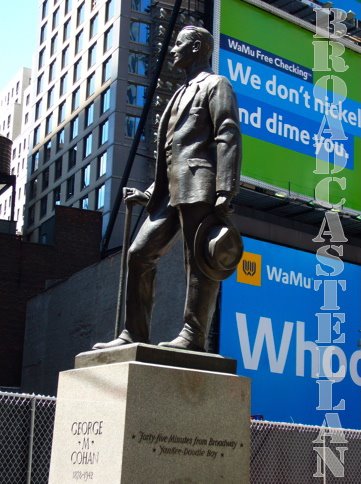
Starred on the program, in one of his rare radio broadcasts—and perhaps his only dramatic role on the air—was the legendary George M. Cohan (whose statue in Times Square, New York City, and tomb in Woodlawn Cemetery, The Bronx, are pictured here). Cohan, who had portrayed Franklin D. Roosevelt in I’d Rather Be Right was playing a character who fondly recalls Grover Cleveland’s second term, but is more to the right when it comes to big government.

The Free Company’s didactic play, set in New York City in the mid-1930s, deals with a complicated family reunion as the German-American wife of one Joe Smith (Cohan) welcomes her teenage nephew, Fritz (natch!), from the old country. Fritz’s American cousin, for one, is excited about the visit. Trudy tells as much to Mary, the young woman her mother hired to prepare for the big day:

Trudy.  Mary, I have a cousin.

MARY.  Yeah, I know, this Fritz.

TRUDY.  Have you a cousin?

MARY.  Sure, ten of ‘em.

TRUDY.  What are they like?

MARY.  All kinds.  One’s a bank cashier and one’s in jail.

TRUDY.  In jail! What did he do?

MARY.  He was a bank cashier, too [. . .].

Make that “executive” and it almost sounds contemporary. In “Above Suspicion,” the American characters are not exactly what the title suggests. That is, they aren’t perfect; yet they are not about to conceal either their past or their positions.

Trudy’s father is critical of the government, much to the perturbation of Fritz, who has been conditioned to obey the State unconditionally:

SMITH.  Jumping Jehosophat [chuckles].  Listen, the State’s got nothing to do with folks’s private affairs.  Nothing.

FRITZ. Please, Uncle Joe, with all respect.  If the State doesn’t control private affairs, how can the State become strong?

SMITH.  Oh, it will become strong, all right.  You know, sorry, it might become too darn strong, I’ll say.  And I also say, let the government mind its own dod-blasted business and I’ll mind mine.

To Fritz, such “radical” talk is “dangerous”; after all, his education is limited to “English, running in gas masks, and the history of [his] country.” He assumes that Mary is a spy and that anyone around him is at risk of persecution. To that, his uncle replies: “Dangerous? Well, I wish it was. The trouble is, nobody pays any attention. By gad, all I hope is that the people wake up before the country is stolen right out from under us, that’s what I hope.”

“Above Suspicion” is a fairly naïve celebration of civil liberties threatened by the ascent of a foreign, hostile nation (rather than by forces from within). Still, it is a worthwhile reminder of what is at stake today. Now that the technology is in place to eavesdrop on private conversations (the British government, most aggressive among the so-called free nations when it comes to spying on the electorate, is set to monitor all online exchanges), we can least afford to be complaisant about any change of government that would exploit the uses of such data to suppress the individual.

“Dictaphones,” Smith laughs off Fritz’s persecution anxieties.

I wish they would some of those dictaphones here.  I’d pay all the expenses to have the records sent right straight to the White House.  That’s what I’d do.  Then they’d know what was going on then.  [laughs]  They’d get some results then, hey, momma?

These days, no one is “Above Suspicion.” Just don’t blame it on Fritz.

“I pulled and she shook”: A Décor to Try One’s Decorum

My dog, Montague, demonstrating his wallpaper training in response to my stripping

All right, so I’m sounding like an aging burlesque queen about to toss her tassels and turn in the G-string that is a turn-on no longer—but, by Gypsy, I am tired of stripping. Wallpaper, I mean. This old Mazeppa has nothing but a scraper for a gimmick, and the only hand she ever got for all her grinding is a mighty sore one. I just could not live with it, though, that dreadful pattern—having it stare me down in defiance, berate me for letting myself be defeated by all the work that needs doing in the old house we plan on inhabiting before long. The idea (not mine, mind) was to paint over it—but I scratched that faster than I could scrape. It might peep out from behind the paint, that ghastly design. It might start to creep up on me if I don’t get at it first—just like in that most famous of all interior decorating nightmares, Charlotte Perkins Gilman’s “Yellow Wallpaper” (1892). To date, Gilman’s feminist tale of terror is the most convincing argument for taking it all off.

To the tormented soul telling the story, the paper she finds in her room—the room in which she is meant to rest—becomes a “constant irritant.” Within a few short weeks of studying it, for want of the intellectual activity denied to her, she is driven to the distraction once classified as hysteria:

The color is hideous enough, and unreliable enough, and infuriating enough, but the pattern is torturing. 

You think you have mastered it, but just as you get well underway in following, it turns a back-somersault and there you are. It slaps you in the face, knocks you down, and tramples upon you. It is like a bad dream.

Unlike the blank, “dead” paper on which she writes in secret, the wallpaper is teeming with life, just below the surface. It is the surface of conventions that Gilman tears down with a vengeance:

This bed will not move!

I tried to lift and push it until I was lame, and then I got so angry I bit off a little piece at one corner—but it hurt my teeth.

Then I peeled off all the paper I could reach standing on the floor. It sticks horribly and the pattern just enjoys it! All those strangled heads and bulbous eyes and waddling fungus growths just shriek with derision!

When Gilman’s story was adapted for US radio, listeners to CBS’s Suspense program may have felt rather differently about this schizophrenic battle when, in a broadcast that aired on 29 July 1948, it was enacted by Agnes Moorehead, who, in tackling the part, had to struggle as well with our memories of the neurotic and disagreeable Mrs. Elbert Stevenson, her most famous Suspense role. “Sorry, Wrong Paper,” I kept thinking as I witnessed the disintegration. And yet, as the hard and cutting echoes of Mrs. Stevenson suggest, paper can beat both rock and scissors—a thought that filled me with renewed terror.

“It dwells in my mind so!” Gilman’s character remarks, tellingly, about the dreaded wall covering. The dwelling has overmastered the dweller, like a wild animal resisting domestication, a beast beyond paper training. The prospect of being dominated or possessed in this way by a questionable décor is a scenario horrifying enough for me to put penknife to paper . . . and keep stripping.

NBC, CBS, and Abe

On the eve of the 200th anniversary of Abraham Lincoln’s birth, I am once again lending an ear to the Great Emancipator. Franklin Delano Roosevelt may have been America’s “radio president”; but in the theater of the mind none among the heads of the States was heard talking more often than Honest Abe. On Friday, 12 February 1937, for instance, at least six nationwide broadcasts were dedicated to Lincoln and his legacy. NBC aired the Radio Guild‘s premiere of a biographical play titled “This Was a Man,” featuring four characters and a “negro chorus.” Heard over the same network was “Lincoln Goes to College,” a recreation of an 1858 debate between Lincoln and Democratic senator Stephen A. Douglas. Try pitching that piece of prime-time drama to network executives nowadays.

Following the Lincoln-Douglas debate was a speech by 1936 presidential candidate Alf Landon, live from the Annual Lincoln Day dinner of the National Republican Club in New York. Meanwhile, CBS was offering talks by Lincoln biographer Ida Tarbell and Glenn Frank, former president of the University of Wisconsin. From Lincoln’s tomb in Springfield, Illinois, the Gettysburg Address was being recited by a war veteran who was privileged to have heard the original speech back in 1863. Not only live and current, the Whitmanesque wireless also kept listeners alive to the past.

Most closely associated with portrayals of Lincoln on American radio is the voice of Raymond Massey, who thrice took on the role in Cavalcade of America presentations of Carl Sandburg’s Abraham Lincoln: The War Years; but more frequently cast was character actor Frank McGlynn.

According to the 14 June 1941 issue of Radio Guide, Lincoln “pop[ped] up” in Lux Radio Theater productions “on the average of seven times each year”; and, in order to “keep the martyred President’s voice sounding the same,” producers always assigned McGlynn the part he had inhabited in numerous motion pictures ever since the silent era. In the CBS serial Honest Abe, it was Ray Middleton who addressed the audience with the words: “My name is Abraham Lincoln, usually shortened to just Abe Lincoln.” The program ran for an entire year (1940-41).

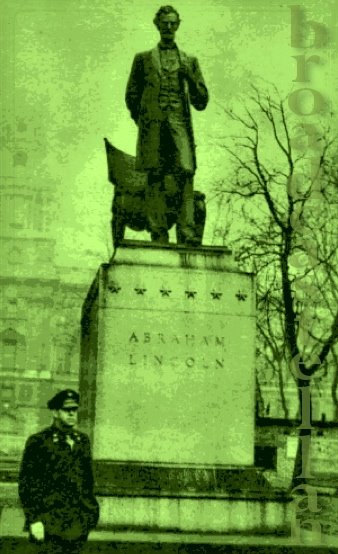
The long and short of it is that, be it in eulogies, musical variety, or drama, Lincoln was given plenty of airtime on national radio, an institution whose personalities paid homage by visiting memorials erected in his honor (like the London one, next to which singer Morton Downey poses above). Nor were the producers of weekly programs whose broadcast dates did not coincide with the anniversary amiss in acknowledging the nation’s debt to the “Captain.” On Sunday, 11 February 1945—celebrated as “Race Relations Sunday”—Canada Lee was heard in a New World A-Coming adaptation of John Washington’s They Knew Lincoln, “They” being the black contemporaries who made an impression on young Abe and influenced his politics. Among them, William de Fleurville.

“Yes,” Lee related,

in Billy’s barbershop, Lincoln learned all about Haiti.  And one of the things he did when he got to the White House was to have a bill passed recognizing the independence of Haiti.  And he did more than that, too.  Lincoln received the first colored ambassador to the United States, the ambassador from the island home of Billy the Barber.  And he was accorded all the honors given to any great diplomat in the Capitol of the United States.  Yes, the people of Harmony have no doubt that Billy’s friendship with ole Abe had more than a lot to do with it.

Six years later, in 1951, Tallulah Bankhead concluded the frivolities of her weekly Big Show broadcast on NBC with a moving recital of Lincoln’s letter to Mrs. Bixby. That same day, The Eternal Light, which aired on NBC under the auspices of the Jewish Theological Seminary of America, presented “The Lincoln Highway.” Drawing on poet-biographer Sandburg’s “complete” works, it created in words and music the “living arterial highway moving across state lines from coast to coast to the murmur ‘Be good to each other, sisters. Don’t fight, brothers.’”

Once, the American networks were an extension of that “Highway,” however scarce the minority voices in what they carried. Four score and seven years ago broadcasting got underway in earnest when one of the oldest stations, WGY, Schenectady, went on the air; but what remains now of the venerable institution of radio is in a serious state of neglect. An expanse of billboards, a field of battles lost, the landscape through which it winds is a vast dust bowl of deregulation uniformity.

Related recording
“They Knew Lincoln,” New World A-Coming (11 Feb. 1945)
Toward the close of this Big Show broadcast, Bankhead recites Lincoln’s letter to Mrs. Bixby (11 Feb. 1951)
“Lincoln Highway,” The Eternal Light (11 February 1951)
My Tallulah salute

Related writings
“Spotting ‘The Mole on Lincoln’s Cheek'”
”Langston Hughes, Destination Freedom, . . .”
A Mind for Biography: Norman Corwin, ‘Ann Rutledge,’ and . . .”
”Carl Sandburg Talks (to) the People”
“The Wannsee Konferenz Maps Out the Final Solution” (on the Eternal Lightproduction of “Battle of the Warsaw Ghetto”)

This [I believe] I Believe

Perhaps we are becoming rather blasé about the phenomenon of web journalism (commonly known and often derided as “blogging”). Many of us still write what we wish, refusing to succumb to the urge or promise of making monetary profits by agreeing to become the mouthpieces of commerce, thereby to surrender the opportunity of sharing something about ourselves other than our apparent greed. How much is it worth to you to write freely, to display whatever you are pleased and prepared to share, what you think, think you know or believe?

It used to be a rare chance indeed to make yourself heard in a public forum comprising of more than a room full of people. The media who can spread news or opinions beyond the small circle of our communities, they always seem to be owned or run by others, be it likeminded or otherwise. That sense of being removed or apart from the media is largely a misconception, at least in democratic societies, a misconception arising from the distrust or apathy of the individual who does not participate, let alone initiate debates. And yet, what went on the air was generally prepared for the listener-turned-consumer by those who chose to enter the radio industry, whether to teach, delight, or exploit.

How exciting it must have sounded to the radio listener of 1951 when a program called This I Believe premiered on CBS, soon to be heard by American and international audiences the world over. This week, BBC Radio 4 is offering an hourlong introduction to This I Believe, its origins, its creators (among them Edward R. Murrow, pictured above), and its participants—an eclectic group of housewives and luminaries).

So, what if you were given four and a half minutes—or no more than 600 words—publicly to express your beliefs (something thousands have done since the revival of This I Believe in 2003)? What would you say? Would you find the words—and the courage—to say it?

However easy it is to say I, I believe that it should take more than a moment’s haphazarding to examine and express one’s philosophy, provided such a philosophy, which lies beyond performance and conformity, can be formulated at all. Yes, it is far easier to say “I” than it is to add “believe” and to follow it with words that truly follow . . .

On This Day in 1944: A Travelogue Introduces Americans to Tel Aviv

Well, it seems that the power lines are beginning to rot. The electric lights went out just after the sun had set, a sun, mind you, that had been hidden for days behind a wind-blown, tattered curtain of clouds. I was rather relieved to find my none-too-successful experimentations in podcasting cut short by this momentary outage, lit a large candle, and began to read a few pages of Mervyn Peake’s epic Gormenghast. In doing so, I was readying myself for a dramatization of this dreadful story—a study in dread—that I am going to attend tomorrow evening.

My reading aloud soon sent my audience (of one) to sleep, just as I have often dozed off listening to recordings of old-time radio programs—a sonically induced somnolence largely responsible for the delay in the completion of my doctoral study. In the image empire of the west, closing one’s eyes is generally associated with rest, rather than heightened attention.

Most of us are too visually trained, weaned on and preoccupied by the ocular, to become fully audile—that is, capable of learning through hearing. It was a challenge that radio producers had to meet when education—or indoctrination—by radio became an essential aspect of mobilizing the masses during the Second World War.

There are a number of radiodramatic techniques that assist listeners in taking in whatever needs to be conveyed; but rather than sharing information—factual specifics or intricate data—radio drama was most successful at creating impressions, stirring sensations, and instilling beliefs. One such belief, slow to take root, was that Americans were not fighting by themselves or for themselves alone, that it was not simply a war against an identifiable enemy, but a struggle for democratic ideals and their realization elsewhere.

In 1943, journalist, poet, and radio dramatist Norman Corwin was asked to create a series that would tell Americans at the home front something about their nation’s gobal allies. Passport for Adams was a sonic travelogue relating the impressions of a small-town newspaper editor assigned to report on the impact of the war on the world’s civilian population; weekly broadcasts transported listeners to Moscow and Marrakesh, to Monrovia and Belem.

As Corwin explains it in his notes on the play “Tel Aviv”—a second production of which was soundstaged by Columbia Presents Corwin on this day, 23 May, in 1944—the “idea was to pull for unity and victory.” The “omission of ugly details was quite beside the point. To have dwelt upon them would have been to play exactly the same tune as Goebbels, who was constantly reminding the world that the British, in their time, were dreadful imperialists.”

To counter the ignorance of his fellow citizens, Corwin created a comic sidekick more naïve than they—a culturally insensitive if good-natured news photographer who greets with wisecracks his colleague’s advice that he prepare for his assignment by “striking up an acquaintance” with Hebrew: “I know plennya Hebrew: aleph, baze, vaze, gimbel, dullard, kibitz, schlemiel, guniff, kosher, gefilte fish, Yehudi Menuhin. . . .”

Poet-journalist Corwin, who, pressed for time, gleaned most of his facts about life in Tel Aviv from a single interview with a former correspondent in Palestine—approached his subject linguistically by making a foreign tongue sound friendly and familiar—a language expressing the ideals known to and embraced by all who fought fascism.

During their tour of the city, Adams and his colleague gather information like pieces of vocabulary, from the shouts of a newsboy (“Davar Iton Erev”) to street signs such as “Rechow Umot Hameuchadot” (Street of the United Nations). Along the way, the ignorant photographer—a man dealing in images rather than words—is set right about the Hora, which he thought of as some “kind of a Jewish jitterbug dance,” while Adams talks to the people of Tel Aviv, among them a construction worker who, once a lawyer in Germany, is proud of having helped laying the bricks of the “Bet-Haam” (House of the People).

The broadcast ends with the word “shalom,” which Adams hopes will gain in a “future not too distant” a “new meaning and a more lasting one than we have ever known.” While “shalom”—or “peace”—is a dream that has yet to be translated into a global reality, radio, as a disseminator of sentiments, kept alive an ideal that kept home front Americans from abandoning the war as a means of achieving it.

Martin Luther Kingfish? Langston Hughes, Booker T. Washington, and the Problem of Representation

It was time to close the fourth broadcastellan poll, for which I had put together a list of radio plays by notable American poets, playwrights, and novelists including Archibald MacLeish, Arthur Miller, and Pearl S. Buck, as well as works by writers more closely associated with the medium (namely Arch Oboler, Morton Wishengrad, and Norman Corwin). I was not surprised that the play receiving the most votes was Lucille Fletcher’s “Sorry, Wrong Number.”

Less surprising still was that just as many voters turned out to declare that they had not heard or read a single one of the works mentioned. My intention was to highlight this anticipated lack of awareness, to suggest, particularly to those already interested in old-time radio, that to tune in to aural drama of the 1930s and ’40s does not mean to sever all connections with thoroughly respectable literature or so-called legitimate drama. Sure, Life Can Be Beautiful—but old-time radio drama can also be thought-provoking, historically relevant, and artistically engaging.

I needed to make this claim when I set out to turn my love for the traditional American Hörspiel (German for audio play) into the subject of a doctoral study in English literature. Long neglected and too infrequently discussed, aural dramatics are far easier to sell, package, and deliver as an historical subject than as an aesthetic one. Anything that may tell us about a people, its past and its paths, is generally deemed worthwhile a prolonged investigation of what is otherwise thought of as artistically negligible or intellectually dubious.

While eager to move discussions about radio drama into the academic circles in which I assumed myself to be spinning for years to come, I was anxious not to distort the subject by paying too much attention to a few isolated literary productions at the expense of the episodic thrillers, comedy-variety shows and dramatic anthologies that made up the bulk of the US networks’ night-time schedules throughout the 1940s. In other words, I did not want to represent the exclusive by excluding the representative.

As it turns out, recovering what was largely absent told me much about the everyday of American broadcasting as commercial construct and historical reality, as well as the democracy of memory.

None of those voting in my poll knew the radio play “Booker T. Washington in Atlanta” by noted African-American poet Langston Hughes; no wonder, since recordings of it have apparently not been preserved and its script has not been published in decades. It aired over the Columbia Broadcasting System to commemorate the Booker T. Washington stamp that was issued on 7 April 1940. Hughes called his play “a special occasion script, as are most scripts dealing with Negro life—since we are not normally a part of radio drama, except as comedy relief.”

Few radio plays captured the black experience, whereas the “stereotype of the dialect-speaking, amiably moronic Negro servant” was the “chief representative of [his] racial group on the air.” Erik Barnouw, who included the play in his anthology Radio Drama in Action (1945), added that “[t]his kind of script” was acceptable in American broadcasting since it “can emphasize Negro accomplishments instead of our society’s failure toward him.”

US radio entertainment was not all Amos ‘n’ Andy—an Anglo-Saxon distortion of the diversity of an ever-evolving culture; nor should it be mistaken for an accurate representation of 1940s America. The average radio audience was largely a construct created by an industry that provided the funding for programming designed to increase its profits and improve its image. Yet however warped, it was nonetheless a composite picture in which millions of individual listeners tried to find themselves.

It is this problem of representation that Hughes addresses in his play: “You’ve spoke in front of northern white folks, and southern colored folks, and us farmers around here too,” a farmer tells Booker T. Washington:

But in Atlanta tomorrow you gonna have city folks and country folks, Yankees and Southerners—and colored folks added to that.  Now, how you gonna please all them different kind o’ folks, Washington? I figger you got yourself in a kinder tight place.

Review by Request: “The House in Cypress Canyon”

Recently, I was asked to write about “The House in Cypress Canyon,” a radio play first heard in the US on CBS’s Suspense program on this day, 5 December, in 1946. Robert L. Richards’s neo-gothic thriller has received some scholarly attention, but it is rewardingly suggestive enough to accommodate multiple readings.

In her essay “Scary Women and Scarred Men: Suspense, Gender Trouble, and Postwar Change, 1942-1950,” Allison McCracken refers to “The House in Cypress Canyon” as a play that “amply demonstrates the particular kinds of domestic horrors that radio thrillers could convey.” Indeed, Suspense specialized in homegrown violence, in the terror of jealousy and the horror of revenge, in the manifestations of greed and green-eyed monstrosities.

Like the film noir, whose first-person voice-over narrations are reminiscent of and influenced by radio storytelling, many 1940s radio thrillers comment on the threat posed to men by independent females in the workplace, by shoulder-padded career women who, rather than being kept contentedly within white picket fences, appeared ruthless enough to impale their male counterparts upon them. At least their assertiveness was portrayed in such a light by the men who fictionalized this very real change in the position of women in wartime America as well as their forced retreat into the home. The first year after the Second World War was in many respects an uneasy period of adjustment.  It was a time out of joint—and “The House in Cypress Canyon” reads the signs of the times by forcing past, present, and future into a bewildering confrontation.

The titular abode is seemingly “ordinary” and “undistinguished.” Part of a pre-war housing complex whose construction was put on hold for the duration, the house was completed after VJ-Day and now awaits occupancy. No doubt, some who might have wished to live here are no longer alive, while those who remain—alone and robbed of future happiness—have no need for it at present. Lives have been put on hold so that life might go on; blood has been shed so that future generations may dwell here. Can any home built under such circumstances truly be ordinary? Not according to the real estate agent who is about to make the house available for rent, who has evidence that something extraordinary is going on inside. That is . . . has it already happened? Is it yet to happen? Is it bound to happen?

Confiding in his detective friend, the agent relates how the construction workers found a manuscript in the as yet unfinished house. It appears to be a diary—an account of life within the house after its completion, the story of how it was rented to Jim Woods (played by Robert Taylor), a chemical engineer, and his wife Ellen (Cathy Lewis), a former schoolteacher; how the “reasonably happy” couple moved in and found one of its closets locked; how the two were awakened by strange howling; how they investigated and found “oozing” from under that closet door something that was “unquestionably blood”; how they left the house in “something very close to a panic” and returned with the “moral support of two stalwart Los Angeles police lieutenants”; and how the couple, having received no assistance from the officers, found their lives forever altered.

Like the title character of Arch Oboler’s “Cat Wife,” Richards’s Ellen undergoes a destructive change; she becomes bestial and predatory but seems entirely unaware of her second nature. That side of her quite literally emerges from a secret closet, a locked room of which she had been unconscious. “If that isn’t a commentary on the housing problem, huh? A woman moving into a house without even knowing where all the closets are,” Ellen laughs.

The opening of that closet is a “commentary,” too, namely on the uncertain boundaries of marital relations, on what lies beyond as the uncommunicated, that realm where the social and the biological converge. Whereas the “den” is being advertized to Jim and Ellen as an “attractive little room, particularly for a man,” there is no such “attractive” nook for the woman of the house. Instead, the blood-oozing closet becomes the scene of Ellen’s transformation from mate to monster. Once it is unlocked, domestic stability as defined by the male architects of heterosexual relations are shattered. Men become Ellen’s vampiric prey.

According to a newspaper clipping attached to the found manuscript, Jim committed suicide after doing away with his spouse, an event said to have occurred on the night after Christmas, the year being unspecified. The real estate agent once again emphasizes that the journal was discovered in the unfinished and as yet uninhabited house. However impressed by the story, the detective does not consider it further and leaves his friend as he puts up the “for rent” sign. The first people to express interest in the place appear almost immediately after the detective’s departure. They are none other than Jim and Ellen Woods.

“Do you know what time it is?” Jim at one point reprimands his wife as she continues to rearrange the furniture while the midnight hour approaches. Do we know what time is it? Is the manuscript found in the “House in Cypress Canyon” a blueprint for a new phase in the battle of the sexes? Will the events described therein play themselves out with the same inevitability that brings Jim and Ellen to the doorstep of their doomed abode? Are the two rehearsing a text that Jim has already written for them, a domestic play that casts the wife as fallen angel in the house?

The dischrono-logic of “The House in Cypress Canyon” drives home the gender role confusion in which men and women found themselves in postwar America and the uneasy future anticipated by skeptics of the seeming consumer comforts of Leave It to Beaverdom.