Little Lady Hee-Haw; or, A Temple Fit for Goebbels

On my only trip requiring an overnight bag during this stay-at-home summer, my husband and I drove from our patch on the west coast of Britain to the thoroughly overcrowded Cotswolds and, upon my urging, made a stop-over at the Welsh town of Hay-on-Wye, an internationally renowned haven for second-hand book lovers.  Now, musty old volumes and COVID-19 do not quite go together – or so I thought – considering that retail spaces generally set aside for them are rarely supermarket-sized.  However, Hay, which depends on the trade, managed to make it work; and, meeting the moment by donning a mask, I got to enjoy an afternoon of socially distanced and sanitized hands-on browsing.

Not that I walked away with any tomes of consequence.  While at the Cinema bookstore – a shop not limited to publications related to motion pictures – I discovered a nook stacked with a curious assortment of ephemera: German movie programs of the 1930s.  I am not sure how they ended up in a Welsh bookshop – but that dislocation may well have extended their shelf life … until a German such as I came along and took an Augenblick to sift through them.

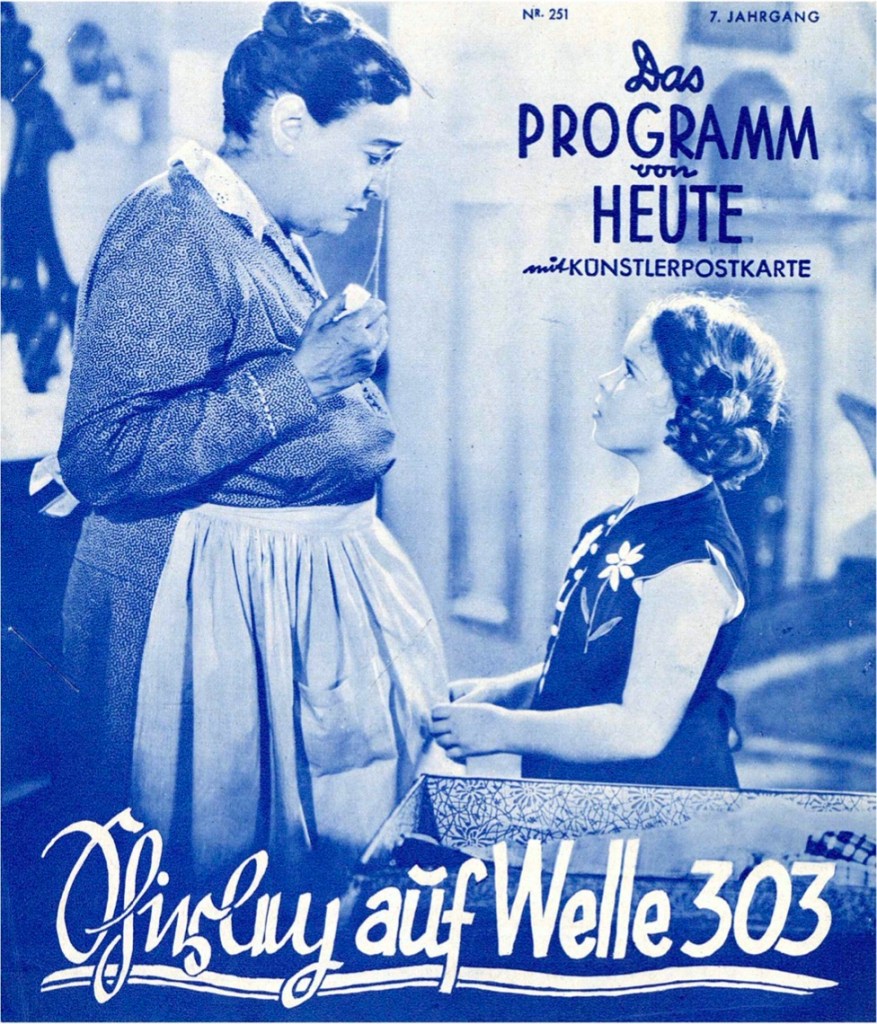
The program pictured above, dating from 1937, left me puzzled for a while.  I am familiar with many of Shirley Temple’s features – but I did not recall any among them bearing a title remotely like “Shirley auf Welle 303,” or “Shirley over Station 303.” So, I picked up this fragile brochure, and a few others besides, if mainly to tap their potential as pop cultural conversation pieces.

The film being deemed worthy of commemoration is Rebecca of Sunnybrook Farm, a DVD of which is gathering dust in my video library.  The title refers to an early twentieth-century children’s literature classic, although the movie version bears so little resemblance to it that it could hardly be considered an adaptation.  Not that the title of the novel would have resonated with German audiences. Meeting this challenge, the marketing people at Fox came up with a new one that might sound more relatable.

I suspect that the servants of the Nazi regime would have objected to the name of the titular character as well, being that Rebecca is Hebrew in origin, meaning “servant of God.” Shirley, on the other hand, was a household name, Ms. Temple having charmed audiences around the world since at least 1934. Like the titles of several other Shirley Temple vehicles released in 1930s Germany, the German version of Rebecca of Sunnybrook Farm therefore bears the first name of its star. Only Heidi stayed Heidi, rather than being translated into “Little Swiss Miss Shirley.”
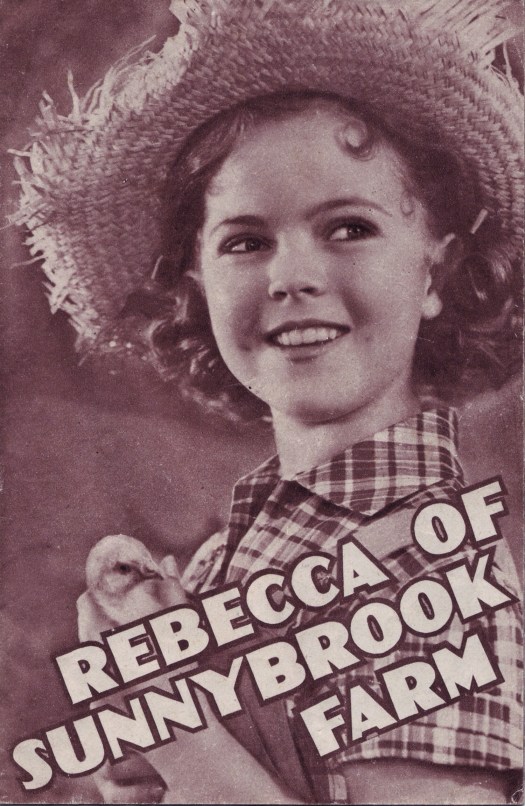
A contemporary British program for the same film, also in my collection.

And yet, the effort to make the film seem more relatable to Nazi Germany’s picture-goers nonetheless resulted in a title that was out of touch with Fascist reality. In 1938, when the film was released in German cinemas, the idea of using radio transmitters for your purposes – or for the purpose of exploiting a child for your own purposes – was inimical to state-controlled broadcasting. On the air, it was always “Germany Calling,” a phrase famously used by the aforementioned Lord Haw-Haw beginning in 1939.

Germans would have struggled in vain to twist the dial and hit on a broadcast like Shirley’s, or they would have paid a price for such twisting.  Many of them listened via the Volksempfänger, a mass-produced receiver that was always tuned in to the Führer’s voice.  Imagine staying tuned to Fox News all day.  Then again, so many who do have the choice not to still do nonetheless, not unlike those who were complaisant during the rise of Fascism in Germany.

The change in title – and the recontextualization it achieves – is peculiar, and only a performer as innocuous as Shirley Temple could have gotten away with what otherwise would have been downright seditious: seizing the microphone and taking to the airwaves in a makeshift studio set up in a remote farmhouse.  Perhaps, the titular bandwidth – 303 – was to signal that Shirley’s broadcast had been sanctioned after all, 30 January 1933 being the date Hitler came to power. In the Third Reich, three was heralded as the charm.
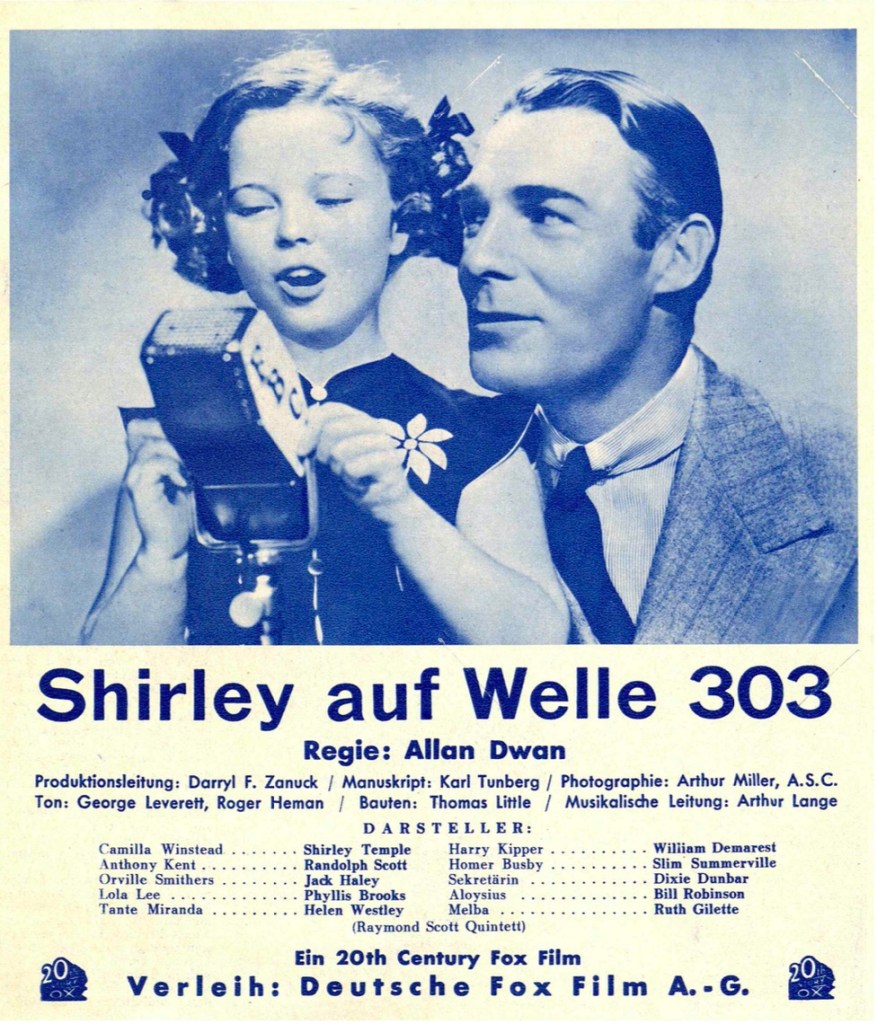
For decades, the German film industry did wonders – or, rather, wilful damage – to international films with its dubbing of their soundtracks; voicing over and voiding the content of the source, there were many opportunities to ready a film more substantive than Rebecca for consumption in Nazi Germany.  I do not recall seeing this movie in my native language, although I do remember a festival of her films airing on West German television in the late 1970s.  Not that watching Rebecca of Sunnybrook Farm in the original is an experience I am eager to repeat, clobbered together a vehicle for an overhyped and overworked child star about to wear out her welcome that it is. Variety dismissed the film at the time as a “weak story,” “indifferently acted and directed,” while claiming its lead to be “at her best.”

The German program does little more than summarize the plot as well as state the principal actors and main players behind the scene of the production; I am sure someone checked whether producer Darryl F. Zanuck was Jewish, which he was not. What struck me about the program was that it mentions the word ‘propaganda’ twice in the first paragraph, where it was used as a substitute for advertising (in German, “Werbung” or “Reklame”).  Sending up the excesses of US consumerism while promoting the ostensible virtues of country living, this trifle of a film – distributed in Nazi Germany by the enterprising and accommodating “Deutsche” Fox – could serve as a vehicle for anti-American propaganda at a time when increasingly few US films were granted a release in Germany.

By making such trifles, and by marketing them for distribution in Nazi Germany, the US film industry contributed to the rise of Fascism, which, only after the attack on Pearl Harbor, Hollywood films began to confront with a suitably glossy vengeance. By that time, US films were banned in Germany, and Shirley Temple ceased to be a leading lady – at least in motion pictures.
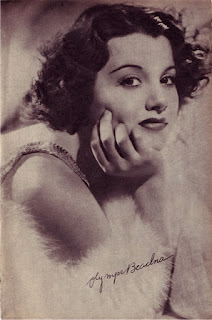
She Said It in English: Olympe Bradna (1920-2012) on Men, Mikes and Milk

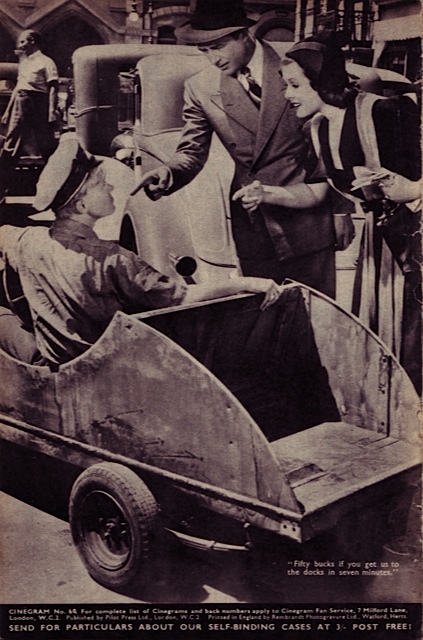
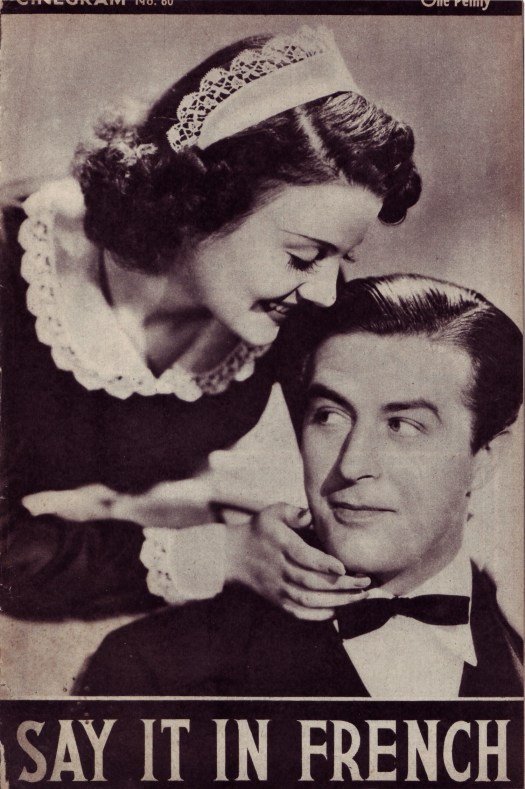
Olympe Bradna is a diplomat of the first rank!” So declared the editors of Cinegram in an issue devoted to Say It in French.  In that now largely forgotten romantic comedy, Bradna co-starred as a French student who impersonates a maid to be close to an American lover (played by Welshman Ray Milland) expected to marry a millionaire’s daughter (Irene Hervey) to save his father’s business.  

The cover of Cinegram No. 60, from my collection

Maybe that sounded better in French, in which the comedy was first staged under the title Soubrette. Never mind.  The “petite morsel of feminine allure,” so the Bradna legend goes, had “only been kissed by two men during her whole lifetime”—that lifetime amounting to eighteen years back in 1938. 

One year into her brief Hollywood career, Bradna had overcome her “anxiety and embarrassment” and forgotten about her vow that she “would never kiss” at all, “either on the screen or off, until she had a ‘steady’ beau.”  Having been teamed with both Milland and Gene Raymond (in Stolen Heaven), the actress was “all in favour” of on-screen romance; but, when asked whose lips she preferred, the teenager refused to kiss and tell. “If I did that, it would be, how do you say? ‘propaganda.’”

In the context of European pre-war clamour and the business of Hollywood glamour, the word choice is peculiar, especially since Cinegram was a promotional effort aimed at British audiences.  It is a telling statement, too, as it suggests Bradna’s questioning of the role she was expected to play in the propagation and exploitation of her own image.

Far from naive, the French-born performer knew all about the real world of make-believe, which is why, in her future pursuit of “real romance,” she was determined to “go outside the show business.”  In the early 1920s, her parents, Jeanne and Joseph Bradna, had a successful bareback riding act at the Olympia Theater in Paris, after which venue Olympe was named and where she made her stage debut when she was not quite two years old.  Hence, I suppose, her expressed need for security: “[A]ctors are fellows with uncertain jobs.  They’re generally honest, gay, intelligent and interesting, but they lack that quality of stability that is so important to a girl who wants to establish a home.”

Presumably, she said all this in English, rather than in her native tongue.  When she first set her dancing feet on the United States as a member of the Folies Bergère and subsequently performed at New York’s French Casino, she was so dismayed at her “lack of English that she determined to learn to speak the language properly.  She succeeded so well,” Cinegram readers were told, “that when it came to making this new picture she had to put in several weeks of hard work under a French tutor to get her French back to standard.”  A Hollywood standard, that is.  After all, in romantic comedy, a French accent was as desirable as a maid’s uniform.

Bradna in Cinegram No. 60

Bradna’s language skills were put to the ultimate test when, on 14 November 1938, she went behind the microphone for the Lux Radio Theater production of “The Buccaneer,” co-starring Clark Gable as French pirate Jean Lafitte; but her part was suitably Old-World, and all over the map besides, to account for any foreignness in her speech.  Bradna assumed the role of Gretchen, which had been played on screen by the Hungarian-born cabaret artist Franciska Gaal.  “Oh, I don’t know how I sound, Mr. DeMille,” Bradna said to in the nominal producer of the program during her scripted curtain call, “a Dutch girl with a French accent in an American play.”  Supported as she was by Gertrude Michael and Akim Tamiroff, both of whom enriched American English with peculiar accents and inflections, she hardly stood out like a sore tongue.

Not that Bradna, who appeared on the cover of the 27 July 1938 issue of Movie-Radio Guide, was a stranger to the microphone.  According to the March 1938 issue of Radio Mirror, Paramount Pictures “put her into five consecutive radio guest-spots for a big build up—but without giving her a nickel.”  Perhaps, DeMille would not have given her a nickel, either, for the privilege of making it into a Lux-lathered version of The Buccaneer, one of his own productions, nor given her an opportunity to promote her latest picture, Say It in French, had he known what British Cinegram readers gathered by flicking through their souvenir program for Say It.  Bradna, they were told, had “startled experts by announcing that the secret of her facial complexion [was] a daily buttermilk massage.”

The makers of Lux Toilet Soap could not have been pleased at Bradna’s insistence, fictive or otherwise, that buttermilk was “all” she needed: “My skin may be ever so parched and dry before the routine, but afterwards it is as fresh and smooth as I could want!

Say It: A rickety vehicle

Wally Westmore, Paramount’s make-up chief, reputedly explained that the “secret”—an age-old French recipe for a youthful complexion perhaps not quite so difficult to achieve at the age of eighteen—lay in the rich oil content of buttermilk, which had the same “softening and freshening effect upon the skin as the most elaborate and expensive preparations used by the stars.”  That, of course, was just the claim Lever Brothers were making each week on the Lux Radio Theater, which might explain why Ms. Bradna was never again heard on the program, whose stars were handsomely remunerated for their implied or stated endorsement of the titular product.  Perhaps, Bradna was not “a diplomat of the first rank” after all . . .

Olympe Bradna died on 5 November 2012 in Lodi, California.

Once Upon a Time in Radioland: A Kind of Ruritanian Romance

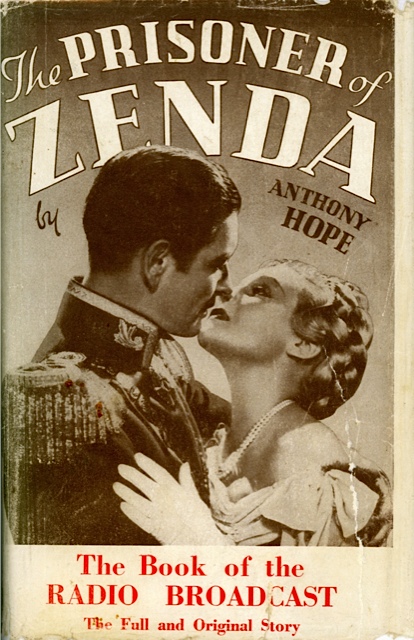
The other day, at my favorite bookstore here in Aberystwyth, I was caught in the eye by what struck me as a highly unusual cover for a 1938 edition of Anthony Hope’s fanciful pageturner The Prisoner of Zenda. Mind you, I’m not likely to turns those pages any time soon. I’m not one for Graustarkian excursions. That I found the old chestnut so arresting is due to the way in which it was sold anew to an audience of Britons to whom such a mode of escape from the crisis-ridden everyday must have been sufficiently attractive already. This was the 92nd impression of Zenda; and, with Europe at the brink of war, Ruritania must have sounded to those who prefer to face the future with their head in the hourglass contents of yesteryear like a travel deal too hard to resist.

My copy of the book

Now, the publishers, Arrowsmith, weren’t taking any chances.  Judging by the cover telling as much, they were looking for novel ways of repackaging a familiar volume that few British public and private libraries could have been wanting at the time.

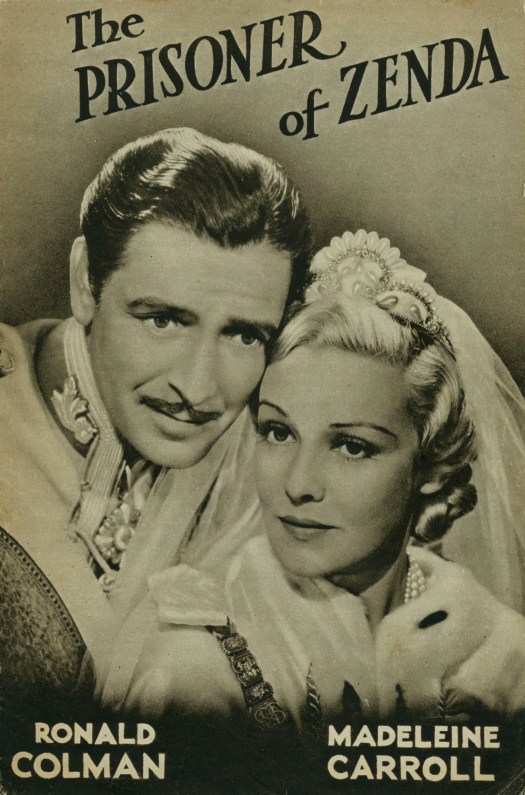
British moviegoers had just seen Ruritania appear before their very eyes in the 1937 screen version of the romance, which make dashing Ronald Colman an obvious salesperson and accounts for his presence on the dust jacket.  It is the line underneath, though, that made me look: “The Book of the Radio Broadcast,” the advertising slogan reads.  Desperate, anachronistic, and now altogether unthinkable, these words reminded me just how far removed we are from those olden days when radio ruled the waves.

The Prisoner of Zenda was recently the subject of a highly successful film,” the copy on the inside states somewhat pointlessly in the face of the faces on the cover.  What’s more, it continues, a “further mark of its popularity” was the story’s “selection by the BBC as a radio serial broadcast on the National Programme.”  To this day, the BBC produces and airs a great number of serial adaptations of classic, popular or just plain old literature; but, however reassuring this continuation of a once prominent storytelling tradition may be, a reminder of the fact that books are still turned into sound-only dramas would hardly sell copies these days.  Radio still sells merchandise—but a line along the lines of “as heard on radio” is pretty much unheard of in advertising these days.

From my collection of Cinegrams.

“This book is the original story on which the broadcast was based,” the dust jacket blurb concludes.  I, for one, would have been more thrilled to get my hands or ears on the adaptation, considering that all we have left of much of the BBC’s output of aural drama is such ocular proof of radio’s diminished status and pop-cultural clout.

Perhaps, my enthusiasm at this find was too much tempered with the frustration and regret such a nostalgic tease provokes.  At any rate, I very nearly left Ystwyth Books without the volume in my hands. That I walked off with it after all is owing to our friend, novelist Lynda Waterhouse, who saw me giving it the eye and made me a handsome present of it.  And there it sits now on my bookshelf, a tattered metaphor of my existence: I am stuck in a past that was never mine to outlive, grasping at second-hand-me-downs and gasping for recycled air . . . a prisoner of a Zenda of my own unmaking.

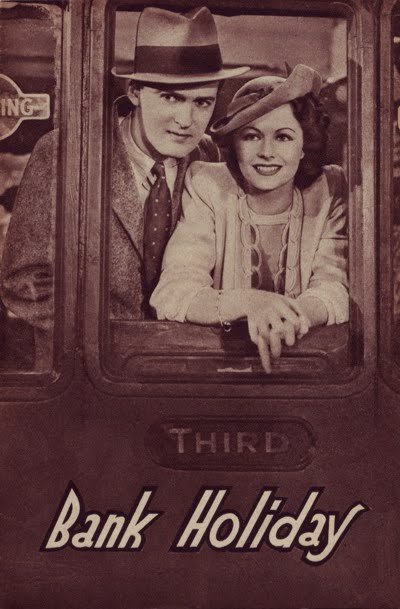
Cinegram No. 21 (Because It’s Some Holiday or Other)

It’s one of those days. I am reaching into my box of memorabilia, building paper bridges between the now and then. As I turn away from this little blue box—and from the scanner that transforms a printed image into a digital one—my eye catches another image, a framed poster on the wall of my study. And, once again, I become carried away, absorbed in the thoughts these two collector’s items—one British, one American—help to conjure, rather than in the appreciation of either. Besides, I have since retreated into our backyard to bask in the sunlight of a glorious spring afternoon. There’s time for all that, today. It is, after all, a holiday. Just what kind, though, I begin to wonder and allow the question to irritate me like ants running away with the picnic.

Now, you might say that a holiday by any other name smells just as sweet; but, if you ask me, “Bank Holiday” stinks. That is what the British insist on calling—or at any rate, are reduced to calling—some of their red letter days, including this one. Granted, considering the state of our financial system or individual finances, we might well be sitting round in a brown study, ruminating on our latter days in the red; but aren’t there any cultural cornerstones, historical milestones, or ancestral gravestones we ought to have our mind’s eye on?

We receive little encouragement from the dates as marked in our calendars. Here in Britain, we’ve got May Bank Holidays, and Spring Bank Holidays, and August Bank Holidays—and none of us are exactly laughing all the way to the nearest money-lending institution. Okay, we are not being pestered with notices demanding our immediate attention, but we don’t express our gratitude for not getting any bills by calling this a Post Office Holiday.

Not that all holidays are mere occasions for slipping into something comfortable or taking it off again at the beach; but we wouldn’t go so far, surely, as to declare Black Tuesday a day of observance by marking the anniversary of Wall Street laying an egg with a leisurely pancake breakfast. Sure, the banks are closed today; but is that what we are asked to celebrate?

How fortunate are those across the pond who can do as they please on Memorial Day. They may be decorating cakes instead of graves, but at least there is enough of a clue in the name to invite contemplation, encourage research or inspire gratitude. There is far more of a chance of drawing a blank if you’ve got nothing but “Bank” to draw on. If no consensus can be arrived at, if no joining of hands or thoughts is to be imposed, let any Bank Holiday become a blank one—and place on each celebrant the burden of making it meaningful . . .

Cinegram No. 14 (Because You Can’t Rely on Air Mail These Days)

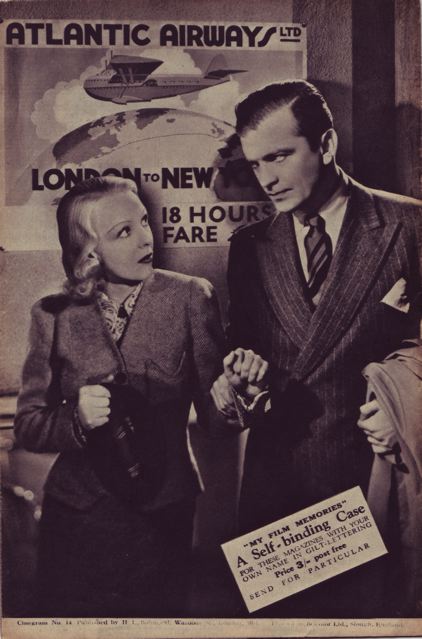
I am taking the passing ash cloud as an occasion to dust off my collection of Cinegrams, a late-1930s to early 1940s series of British movie programs I recently set out to acquire. Immemorabilia, you might call them. Not quite first-rate souvenirs of, for the most part, less-than-classic films like The Return of the Scarlet Pimpernel, or worse. These cheaply printed ephemera were designed—quite pointlessly, it seems—to encourage folks to keep alive their memories of something that may well have been forgettable to begin with. Sure, why not pay a little extra for a few stills of a picture that wasn’t much to look at while in motion? And why not pay still more to keep your “Film Memories” in a self-binding case, with your name on it— in gilt-lettering, no less? That was the offer made to British moviegoers anno 1937, who purchased Cinegram No. 14 to prevent Non-Stop New York from seeming all too fleeting.

Perhaps, I am confusing “forgettable” with “forgotten.” Non-Stop New York which is readily available online, has a lot going for it, quite apart from being a fast-paced romantic vehicle for John Loder and Anna Lee, helmed by Lee’s husband, Robert Stevenson, who would go on to make Flubber and Mary Poppins soar at the box office.

Efficiently if somewhat routinely lensed, this Gaumont-British production might have served as a project for the company’s most notable director, Alfred Hitchcock. Substituting airlanes for tracks, it’s the The Lady Vanishes in the realm of the birds. Except that, in this case, the lady—the young and innocent girl who knew too much—refuses to vanish, which makes the man whose secret she knows all the more eager to see to her disappearance.

The main attraction of Non-Stop New York is not its contrived plot, its charming leads or its rich assortment of goons and ganefs. Rather, it is the film’s setting, the futuristic plane aboard which this pursuit reaches its thrilling climax. It is a large, multi-story aircraft resembling a luxury liner—right down to the outdoor deck on which windblown lovers kiss by moonlight and villains go for the kill. There’s plenty of room for some old-fashioned hide and seek, as passengers are not crowded together but retreat into the privacy of their own cabins. Quite an extravagance, this, considering that the imagined travel time of eighteen hours hardly warrants accommodations fit for on a sea voyage, which mode of transatlantic crossing yet served as a point of reference to the production designers who conceived the vessel.

It took Christopher Columbus ten weeks to cross the Atlantic Ocean, Cinegram No. 14 educated its readers. “Today, ten hours seem to be sufficient to complete the same journey.” Set in the seemingly foreseeable future of 1939, Non-Stop New York

anticipates the regular air service which before long [that is, after the end of the wartime air raids that, even in the age of Guernica, purveyors of escapist entertainment did not trouble themselves to predict] will be flying regularly across the North Atlantic and carrying passengers overnight between London and New York. Already survey flights are being carried out by Imperial Airways and Pan American Airways and these flights have shown that such a service is not longer a dream of the fiction writer, but something which to-morrow will be as commonplace as the many daily services of to-day between London and Paris.

The first experimental flights were made in the Summer of 1937. The British company made a series of flights with two of the Empire class flying boats, the “Caledonia” and the “Cambria.” The terminal points of these flights were Southampton and New York and the route followed was by way of Foynes, on the west coast of Ireland across the Atlantic, 1992 miles, to Botwood, Newfoundland. From there the flying boats went to New York by way of Montreal.

In all, 5 two-way crossings were made and these were carried out without incident and with such certainty that they reached the other side of the Atlantic within a few minutes of schedule.

On the last eastward journey the “Cambria” set up an all time record, making the 1992 miles in 10 hrs. 33 min. or at an average speed of nearly 190 m.p.h.

These flying boats will not be used for the Atlantic service when passengers are carried but it is probably that flying boats of the same type, but with greater power and greater ranger will be used. These flying boats may have a cruising speed of 250 m.p.h., and carry 20-30 passengers in a degree of comfort equal to that of the present luxury liner.

With its promise of a jet-setting tomorrow, a title like Non-Stop New York must have sounded thrilling to picture-goers anno 1937, albeit not nearly as thrilling as such a promise is to any present-day passenger awaiting the all-clear for departure at one of Britain’s dormant airports—among them a friend of ours whose plans for a birthday celebration in Gotham are being pulverized by the largest export of a cash-strapped nation to whom volcanic activity appears to be a natural substitute for banking.

Movies like Non-Stop New York and collectibles such as Cinegram No. 14 remind me that, in living memory, long distance air travel was rare and special indeed. They remind me as well of one momentous April morning in 1985—some quarter century ago—when my younger self first boarded a transatlantic flight to the exhilarating and treacherous metropolis that was New York City. Back then, we still applauded the captain who returned us safely to earth; nowadays, we merely moan when we are grounded for whatever strikes us non-stoppers as too long . . .