That “mental brain from the radio”; or, He Does Duffy’s, Doth He?

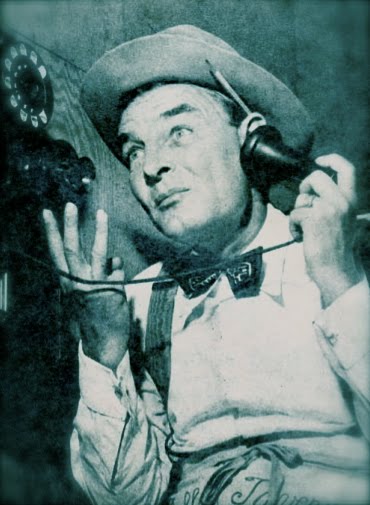
Ed Gardner as Duffy

It wasn’t just the “usual gang of crumbs” gathering at Duffy’s Tavern that evening. Otherwise, Archie would not have replaced the “Watch Your Hats and Coats” sign with one saying “Maintain Scrutiny of Thy Chapeaux and Hats.” Nor would Mrs. Duffy, who wasn’t exactly an authority on high classical authors, have been dusting off the Dostoyevsky, which Archie struggled to classify as animal, mineral, or vegetable. Such categorical impediments aside, there were tell-tale signs that Duffy’s was closer than ever to living up to what Archie always pronounced it to be: a place “where the elite meet to eat.”

To be sure, back in its heyday as the most valued source of news and entertainment, American radio was far from elitist; it was too popular—and too important as a commercial and propagandist medium—to risk being either offensively vulgar or alienatingly esoteric. Still, if it meant reputable or established, you couldn’t be more “elite” than Clifton Fadiman, the “mental brain from the radio.” Known to millions of listeners as host of the intellectual quiz program Information, Please!, Fadiman was scheduled to pay a visit to the beloved neighborhood Tavern on this day, 1 June, in 1943. What’s more, he was to give a literary talk there.

If that impressed Archie any, he didn’t let on. How smart did you need to be to ask questions, especially questions submitted by the audience? In fact, Archie had written the Fadiman lecture himself. And why not, pray? Archie could talk poetry with the best of them. He knew all about the Bard from Stratford Avenue and, as he told Duffy’s regular Finnegan (Clifton Finnegan, that is), he was well versed in “cubic centimeter” and other such poetic matters.

Archie may not have been the proprietor of Duffy’s Tavern but he sure was its resident malaproprietor. And what could be greater lexical fun than getting it wrong just right? Not only do you get to enjoy a play on words, but you also get to indulge in the Schadenfreude of hearing someone lose it.

Nowadays, though, catching up with 1940s radio comedies like Duffy’s can be as scholarly a pursuit as the study of the literary greats, considering that some of the lines in Duffy’s Tavern are so topical, they require footnotes.

For instance, there is Duffy’s confusion as to the identity of guest Kip Fadiman. The unheard tavern owner, whose talks with manager Archie open each half-hour visits at Duffy’s Tavern, assumes that the famous quiz show host is the man who asks questions like “Madam, what is your problem?” on his program. “No, Duffy,” corrects Archie, “you’re thinking of Mark Antony.”

Archie, who has Shakespeare on his mind, is getting all confused. The guy he had in mind was John J. Anthony, a spurious, self-styled marriage counselor who enjoyed popular success on radio’s Goodwill Hour.

Then there is uppity Mrs. Piddleton’s confession that she was forced to take the subway because her limousine was hors de combat, or “out of action.” Archie, unfamiliar with the expression, suggests OPA as an American equivalent meaning “out of gas.” In light of all the propaganda that comedy writers were expected to build into their routines, this was a welcome moment of letting off steam. The OPA was the Office of Price Administration, whose wartime rationing forced dames like Mrs. Piddleton to leave their private conveyances behind and join the real folks underground.

Then and now, listening to programs like Duffy’s Tavern is a thoroughly respectable divertissement. Back then, you could revel in the fact that you had to be Archie’s intellectual superior to get the jokes made at his expense; today, it is the occasional effort you have to make to catch Archie’s drift that makes hanging out at Duffy’s a pleasure far from guilty.
Misinformation, Please: Earl Derr Biggers, Rex Stout, and Charlie Chan’s Sons

Earlier today, I added a few titles to our movie database, a list I try to keep up to date so as not to lose track of our collection. Yesterday, the fifth and final Charlie Chan box set arrived in the mail, containing the seven last entries into the 20th Century Fox series. Among them are some of my favorites: Charlie Chan at the Wax Museum, Castle in the Desert, and Dead Men Tell. Ever since I discovered these movies on German television—in German, mind you—I have been inordinately fond of the much-traveled sleuth, no matter how ramshackle to politically incorrect his vehicles.

As I shared here a few years ago, I never enjoyed a close relationship with my father, long since departed, and the Chan pictures somehow made me, an introvert teenager, long for the kind of bond grown-up sons number one and two maintained with their gentle and generous pop. Charmed by the series, I picked up Earl Derr Biggers’s Chan novels . . . and was greatly disappointed.

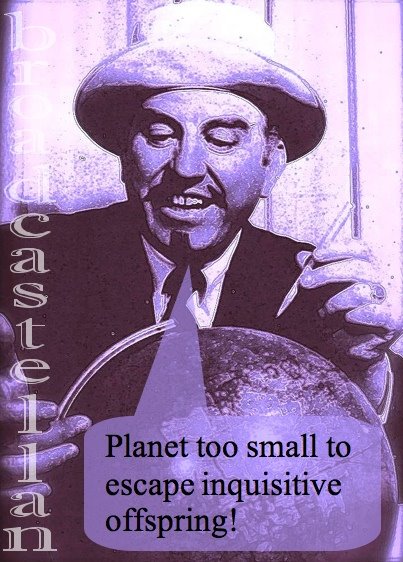
Biggers, whose Seven Keys to Baldpate was being presented on the Lux Radio Theatre on this day, 26 September, in 1938 (as already discussed here) may have been the father of Charlie Chan, but the brainchild, like Frankenstein before him, was passed around so often and given so many transformations that few recalled or bothered with his origins. After the author’s death, there followed such a long line of foster parents that hardly any of the family traits and characteristics can still be traced in the child. Shown above, for instance, is radio Chan Ed Begley (in a picture freely adapted from its source).

Some folks, though, remember. One of them was mystery writer Rex Stout. On this day in 1939, Stout appeared on the quiz program Information, Please! (discussed here) and, along with his fellow panelists, was called upon to answer a number of mystery related questions. In a task posed by a listener from Morristown, Pennsylvania, the panelists were to name heroes of crime fiction who were aided in their detective work by their fathers, their offspring, and their secretaries.

Clearly, this was a subject of which mystery writer Rex Stout could be expected to be familiar. Sure enough, the father of Nero Wolfe was quick to identify Ellery Queen’s paternal helpmate. “I’d hate to ask you to mention the actual titles of books by one of your rivals,” host Clifton Fadiman remarked, “but could you name, er, one or two of Mr. Queen’s books?” He should have said, Messrs. Queen, of course; but never mind.

At any rate, a straight answer from the competitor was not forthcoming, aside from the sly reply “The Adventures of Ellery Queen,” the title of the radio series based on the character but not penned by its creators.

When it came to naming a crime-solving father being assisted by his son, Stout shrouded himself in silence. It’s a “series of books,” Fadiman assisted, that had been successfully adapted for the screen. “Charlie Chan,” fellow panelist Carl Van Doren replied. “Quite right,” said Fadiman. To be sure, the word “assisted” is rather questionable; for, as Chan remarked in Murder over New York (also part of the abovementioned collection), “many cases would have been solved much sooner” had son Jimmy not insisted on getting involved.

Fadiman was ready to move on; but Stout voiced his disagreement. “Pardon me, Mr. Fadiman,” he interjected, “not in any of his books was he aided by his son, except that his son laced up his shoes or something for him.”

“That’s a help,” said the host, brushing aside the objection without giving it any consideration. “Korrektur bitte,” Chan’s German alter ego might well have protested, however mildly. Stout was right. The father-son relationship was created for the movies so as to give the rather austere Chan his Watsonian sidekick.

And very glad I am for this infidelity and the wayward child thus begot. “Does anyone help Nero Wolfe in your own series of stories, Mr. Stout,” Fadiman inquired. “I do, pretty often,” he quipped, missing out on a chance to give Archie Goodwin his due. Not long after the Information, Please broadcast, at a time when even Charlie Chan was enlisted into the Secret Service, Stout turned “lie detective” to expose the misinformation, spread through enemy propaganda, in a series titled Our Secret Weapon.

The "Hat" Is Familiar

Well, I don’t drive. Sitting in the car for a few hours, as I have been on two separate trips to the south of Wales these last few days, and failing to make scintillating company for my partner at the wheel, I pass the time that always seems longer when the body is at rest while in motion by listening to comedy and quiz programs on BBC 4. Quick, witty, and thoroughly radiogenic, shows like I’m Sorry I Haven’t a Clue and Just a Minute continue to provide the kind of smart broadcast entertainment introduced in America back in 1938, when Information, Please! premiered on the CBS radio network.

Like those present day BBC offerings, the Information, Please! program relied in part on well-known guest panelists, mainly writers and entertainers, publicly to make fools of themselves for our private amusement. Now, Information, Please! is still a darn good quiz program; but I tend to listen to it for information other than that requested by host Clifton Fadiman. The program sure tests the memory. It also attests to the transitory nature of what constitutes the memorable and the retrievable, trivia and common knowledge.

To me, the most intriguing questions of Information, Please! are raised by the very voices and names of those who answer. On this day, 18 July, in 1939, Information, Please! featured the voice of one Clarence Budington Kelland. Apparently, the speaker was deemed popular enough to become a celebrity guest guesser. Not only did he join a long list of Information Pleasers including Lilian Gish, Gracie Allen, Rex Stout, and Alfred Hitchcock, he was invited to return and second guess.

On an earlier edition of Information, Please! (the transcript of which was included in an anthology of Best Broadcasts), Kelland was introduced as an “ever popular” author “whose stories and novels have delighted millions” (23 May 1939). While it is clear that those millions did not bother to pass on their delights to future generations, it remains open to speculation just when the “ever popular” made way for “whatever,” the yawn of indifference.

Carl Sandburg Makes a Confession

Well, I didn’t get a pumpkin to carve and, the weather excepting, there is no sign of Halloween around the house. As a German, I did not grow up with the custom; before they realized how to make a killing by marketing this un-holy day, something that did not happen until the 1990s, my country(wo)men skipped the dressing up, parading, and trick-or-treating and went straight to the cemetery to remember the dead, November 1 being a national holiday.

Halloween struck me as an odd mixture of carnival (when Germans do put on costumes to make a spectacle of themselves) and the feast of St. Martins (when, on November 11, their children light lanterns and go caroling from door to door begging for candy); except that, rather than symbolically splitting St. Martin’s mantle in the spirit of charity, some folks in Hollywood decided it was high time to slice open a few random souls in the spirit of Friday, the 13th.

At any rate, donning fanciful guises, stepping into the crowd to be gawked at or approaching the public in hopes of a swift, sweet and easy pay-off is not just a Halloween tradition. It pretty much sums up the advertising racket. On this day, 31 October, in 1939, American poet Carl Sandburg went so far as to assume the role of a quiz show panelist to spread the word about his latest work.

Mind you, that show was Information, Please!, the most longhair or highbrow of all the popular quiz programs on the air. As I argued in a previous entry in the broadcastellan journal, Information, Please! had an ingenious formula that attracted both to the erudite and the illiterate, since questions were sent in by the audience for the express purpose of stumping the so-called experts.

The regular (and rather generously remunerated) panelists—Franklin P. Adams, John Kieran, and Oscar Levant (all pictured above)—were joined by a special guest expert, a noted author, film director, explorer, politician or actor. Would the public succeed in cutting those luminaries down to size? Would these articulate, gifted celebrities falter behind the microphone? That, along with the ensuing banter, accounted for the appeal and success of the program.

The people? No, Mr. Sandburg did not seem to mind them. Indeed, he was so eager to present himself as one of the commoners that the first question posed to him by master of ceremonies Clifton Fadiman, the literary critic of the New Yorker, extracted somewhat of a confession: “What notorious living American author was thrown out on account of his ignorance of arithmetic when he tried to break into the West Point Military Academy?” “Should I answer ‘me’ or give my name?” the poet inquired and, when encouraged to recount the incident, affirmed that he was indeed the “notorious” one, his attempt to enter West Point having been foiled some forty years earlier, back in 1899.

A little while later in the program, Sandburg is again given a question relating to his own life when asked whether he knew of a poem (a word used loosely, since even advertising slogans were deemed acceptable as answers) featuring a description or mere mention of fog. “Little ridiculous,” Sandburg chuckled with a note of embarrassment in his voice. After all, he was being prompted to recall one of his own works describing just such a weather condition (“Fog”):

The fog comes
on little cat feet. 

It sits looking
over harbor and city
on silent haunches
and then moves on.

Again, the author let listeners in on a secret: it had taken him just “about five minutes” to compose those lines—yet, to his professed astonishment, they were not only the best known in all his works, but practically the only ones the general public could recall.

While managing to mention John Wilkes Booth in one of their answers, another nod to Sandburg’s Lincoln biography, panelists did rather poorly that night, failing to recall how the regretful Miss Otis met her death or from which ports Gulliver embarked on his travels, and struggling to come up with five flowers with “masculine names,” Mr. Sandburg advancing “frankincense.” I gather this bit of silliness might have been a relief to its author, considering that there weren’t as many occasions to plant a pun in a serious (and eventually Pulitzer Prize-winning) history than there are opportunities to plant a plug for such a tome in a quiz program.

Lillian Gish Does Not Recall My Name

Mine is not an illustrious one. There are a few others who fared well enough with it; but none among them are my relations. It is uncommon enough to catch my eye or ear whenever it is mentioned, even though my own is frequently misspelled or mispronounced. My surname, I mean. As I shared a while ago in this journal, names hold a special fascination for me. Imagine my surprise when, in search of a broadcast event worth recalling today, I came across the modest proper noun attached to my existence while listening to a recording of an American radio program that aired on this day, 4 July, in 1939.

The program in question is Information, Please!, a quiz show that, as discussed here, invited radio listeners to send in brain teasers and memory testers to “stump” a panel of so-called experts and notable personalities. The guest guesser featured on this day in 1939 was silent screen actress Lillian Gish.

He “wouldn’t be surprised,” host Clifton Fadiman remarked, if Ms. Gish could not answer the first question of the evening, a comment suggesting that the venerable actress was too far removed from the everyday to tune in like regular folk (despite the fact that she had been a panelist on previous occasions).

Whether unable to supply the expected response or unwilling to utter it, Ms. Gish had the smartest reply anyone thus confronted could have given. In keeping with her glorious past and altogether more dignified than the prompted line, her response was silence. You see, the panel was called upon to “give the exact wording” used by announcer Milton Cross in the opening of the program, which, at that time, was sponsored by the makers of Canada Dry. To provide the correct piece of trivia would have meant to parrot a commercial message.

It was a clever game of naming nonetheless. The ostensible poser of said puzzler was awarded a small prize, and the solution, revealed by Fadiman, was rendered even more prominent as a result of it having supposedly managed to elude the experts, much to the amusement of the crowd in the studio.

This introductory bit of product placement was followed by another nominal challenge. The panelists were asked to “name four literary works whose titles consist entirely of initials.” Columnist Franklin P. Adams came up with R.U.R. (short for “Rossum’s Universal Robots”), the science fiction drama by Karel Capek to which we owe the word “robot.” Ms. Gish advanced R.F.D. (for “Rural Free Delivery”), a now obscure volume on farm living in 1930s Ohio by one Charles Allen Smart.

Getting into the spirit of things, Gish then allowed herself to suggest “The Life of the Bee.” She didn’t get away with the pun, but garnered some chuckles, following it up with “Abie’s Irish Rose.” Prepared for such levity with a pun of his own, Fadiman suggested X.L.C.R. as the title of a poem by Longfellow. Controlling herself—and asked not to make another joke—Gish think of R.V.R., a book on Rembrandt by Hendrik Willem van Loon, an essayist whose work (compiled as Air-storming) was regularly heard on US radio back then.

Now, I had to look most of these names up—and quite forgot my own in the process. That name, however, was brought up shortly thereafter on the broadcast, Ms. Gish having been given an opportunity to be anecdotal about silent movies by claiming that she had to smooch a bedpost in Birth of a Nation since no actress was “allowed to kiss the men” in front of camera in those days. The question that followed transported listeners back into the reality of the present day; it concerned names of people in the news. Apparently, one of those names was A. Heuser—H E U S E R.

So, who was this A. Heuser? Ms. Gish left it to fellow panelist John Kiernan, the noted sports columnist who would later host the television version of Information, Please, to answer that question. Turns out, said Herr Heuser was a German prizefighter. Also known as the “Bulldog,” Heuser had been soundly defeated by Max Schmeling two days prior to the broadcast. His first name may have made that defeat sound particularly pleasing to those among the American listeners who kept a watchful eye on Nazi Germany: the initial A. stands for Adolf. That, at least, is an ignominy I do not have to live down.

On This Day in 1938: Americans Are Invited to "Stump the Experts"

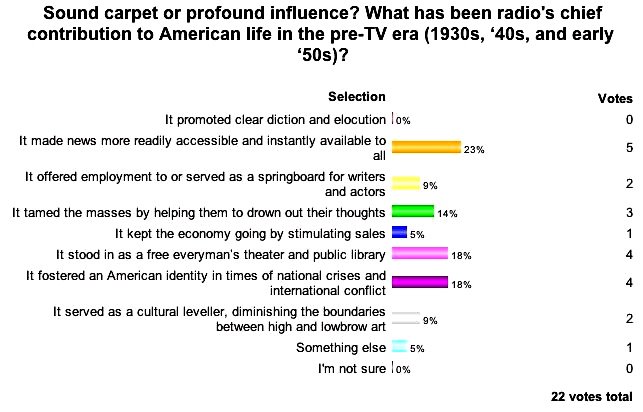
Well, it was time to close the sixth broadcastellan poll, if only to devise another in which you are herewith invited to participate. So, what, in my view, has been radio’s chief contribution to American life in the pre-TV era? There is some validity to all of the proposed replies (which I would not have bothered to list otherwise); and even though the statement that the medium “promoted clear diction and elocution” was endorsed by none, it was not meant to be facetious. Depending so much on the spoken word, radio producers certainly had more respect for it than today’s entertainers, artists whose mumblings are the Brad Pitt-falls of visual storytelling. And “Something else”? It might very well be broadcasting’s influence on the nation’s musical tastes, radio having served not only as an “everyman’s theater and public library,” but as a virtual concert hall.

Polls are nearly as fascinating to me as they are frustrating. I, for one, prefer not to give straight answers; I much rather respond or challenge, preferably after some reflection. The kind of question that can be answered decisively—the kind that requires one particular, supposedly right reply—is either unnecessary or suspect.

Nor can I rely upon my memory as a fail-safe system for the ready retrieval of data, pieces of trivia with which I’d rather not clutter up my mind. So, it is with some trepidation that I note a significant anniversary in American broadcasting: the quiz program Information, Please!, which had its radio premiere on this day, 17 May, in 1938 (and not, as the History Channel website will have you know, back in 1930).

Information, Please! was billed as a celebrity quiz program on which everyday citizens asked the questions that experts from the fields of literature, science, motion pictures or politics were called upon to answer. Noted guest panelists to appear on the show during its first two seasons (along with regulars like the aforementioned Oscar Levant) include movie director Alfred Hitchcock, playwright Moss Hart, as well as authors Ben Hecht, Rex Stout, Louis Bromfield, and Christopher Morley.

Here are some of the questions raised during the first program:

“Correct the following line and name its author. And the line is: ‘In the spring a young man’s fancy always turns to thoughts of love.'”

“In what well-known symphony did the composer include a chord in order to awaken a sleeping audience?”

“How is immigration to the United States from the following nations restricted: England, Brazil, China?”

“Kyosti Kallio is a Greek Island, a dictator of Peru, President of Finland, or the name of a Japanese political party?”

Unlike the quiz and giveaway programs of late 1940s—which had an even more devastating effect on the production of dramatic entertainment than the reality show format has on today’s television storytelling—Information, Please did not depend for its success on shrewdly engendered greed and promises of instant gratification, whether experienced by the participant or felt by the listener. This does not mean, however, that the instincts worked upon by the comparatively sophisticated Information, Please were any less basic.

“Now, folks,” moderator Clifton Fadiman greeted the audience, “any education that you and I may pick up for the next half hour or so is all to the good; but beyond that we’re out simply to play this as a game and have some fun at it.” And the “fun” of Information, Please! was not so much the thrill of getting it right, but of witnessing others of supposedly “towering intellect” (as Fadiman put it, mockingly) struggle and fail to meet the public’s challenge. To “stump the expert” was the objective, which was nothing less than an exercise in ridiculing the artist and the intellectual in a joyous vindication of mediocrity.