The illusion of the stage. The magic of the movies. The glamour of fashion. In a career spanning half a century, Angus McBean (1904–1990) turned instances of make-believe and masquerade into enduring records of enchantment.
Poster design by Neil Holland, from a photograph of Angus McBean by Robert Greetham
McBean was born and raised in South Wales. His father had worked in the collieries. Encouraged by his mother to make art his life, McBean moved to London. After working in banking and retail, he became a theatrical mask-maker and designer before achieving international fame as a photographer.
This year’s exhibition at the School of Art, Aberystwyth University, showcases McBean’s work in advertising, his commissioned portraits, and his annual Christmas cards. It offers rare glimpses of McBean’s private life, holidaying on the continent, as captured in two unique photo albums. Also featured in the exhibition are portraits of McBean at home, in later life, by the contemporary photographer Robert Greetham.
Make/Believe installation view
Not all the personalities on view in this exhibition – Marlene Dietrich, Ruth Draper, Audrey Hepburn, Vivien Leigh, Claire Luce, Laurence Olivier, Maggie Smith, and Welsh icon Ivor Novello among them – are as familiar today as they once were, even though some of them, including Rosemary Harris and Maggie Smith are acting to this day. All of them, like McBean, lived by their passions, whether performing on stage and screen or playing on the tennis court, as Wimbledon champion Helen Wills Moody did.
Make/Believe installation view
McBean’s photographs were made in the pre-digital age of the medium. Using scissors and paste, montage and collage, as well as elaborate sets and props, McBean employed every trick of the trade to bring out the beauty, vitality and personality of his subjects. His photographs were staged, not taken.
Drawing inspiration from Salvador Dalí, whose exact birthday he (incorrectly) claimed to share, McBean ‘surrealized’ many of them. ‘This thing of truth doesn’t really come into it,’ MacBean said in late life of his portraits.
Make/Believe installation view
The theater, to McBean, was ‘fantasy.’ It was ‘what you wished it to be.’ It was also the refuge McBean needed at a time when being queer was a crime. During the Second World War, he endured a two-and-a-half-year sentence of imprisonment and hard labour. His work is a testament to the imperatives of making, believing, and make-believe.
Make/Believe, which draws almost entirely on the School’s collection, opened to the public on 16 May 2022 and runs until 30 September 2022.
Curators: Hannah Beach, David Eccles, Helen Flower, Ellie Hodnett, Mayu Maruyama, Ekene Okoliachu, Lucija Perinic, Joanna Reed, Katerina Vranova, Portia Sastawnyuk, Anna Slater, and Helena Zielinska. with support from Senior Lecturer Harry Heuser (text and concept) and Senior Curator Neil Holland (staging and design).
Ceri H. Pritchard at his solo exhibition Paradoxes, MOMA Machynlleth, 18 Sept. 2021
Some creative sparks managed to rekindle themselves during the pandemic; stoked up by a keenly felt sense of do-or-die urgency, they keep generating alternative realities – or alternatives to reality – out of the deepest blue of mind-numbing, soul-crumbling chaos. While I do not quite succeed in numbering among those motivated mortals, visual artist Ceri H. Pritchard certainly does.
In front of Metamorphosis I at MOMA Machynlleth, with a temporarily unmasked Ceri H. Pritchard
His prodigious output, mordant wit and renewed openness to experimentation are on full display in his latest of a slew of solo shows. Ceri H. Pritchard’s Paradoxes opened on 18 September 2021 at MOMA Machynlleth, one of Wales’s most distinguished contemporary art galleries, and is on view there until 13 November 2021. I have been keeping up with Ceri’s work and am excited to see it transmogrify. I said as much, or as little, in the introductory text panel I was glad to contribute to his exhibition:
Ceri first invited me into his studio in 2015. A few years earlier, I had co-authored monographs on his parents, figurative painter Claudia Williams and the late landscape artist Gwilym Prichard. At the time, I was as yet unfamiliar with Ceri’s decades-spanning international career. It was an unexpected, disorientating encounter – in his parents’ house, no less – with what Ceri here terms ‘Paradoxes.’
I was perhaps too quick to label his paintings ‘neo-surrealist’ in an effort to get an art historical handle on the uncanny with which I was confronted: an otherworldly territory strewn with the detritus of modernity, with outcast and less-than-easy chairs, outmoded models of disconnected television sets, and displaced floor lamps shedding no light on matters.
Resisting further temptations to make sense of it all by trying to place the work, I did not initially consider – but subsequently discussed with Ceri – how his conspicuous enthusiasm for colour and his partiality for patterns is prominent as well in his mother’s work, although in subject and mood Ceri’s paintings could not be further removed from Claudia’s figure compositions expressive of the bond between mother and child.
And yet, the patterns in Ceri’s paintings, too, suggest blood bonds – biological ties, be it the universality of our molecular make-up or the common experience of life and death in the strange new age of COVID-19. Those repeated shapes bespeak at once commonality and change, circulation and evolution – and they remind us that what we share can also keep us apart.
Gwilym Prichard, Landscape (1960), detail
The mostly unpopulated landscapes painted by Ceri’s father, Gwilym, meanwhile, showed a preoccupation with home and belonging, with the uncovering of roots in ancient soil rather than the representation of the iconic sites of his native Wales. Ceri’s work, too, is concerned with home – but his approach to the question of belonging to particular cultures and traditions – is entirely different. It is the paradox of being at home with dislocation and familiar with estrangement.
Claudia Williams, The Toy Basket (1989) detail
The paradoxes that Ceri’s work communicate are not the consolidation of a calculated career move, an effort to set himself apart as much as possible from the tradition represented by his artist parents. They are felt, not fabricated. Ceri’s practice is informed by an international outlook, a transnational engagement with diverse cultures, high and low, in France, Mexico and the United States. The unresolved tension of paradox at play in his compositions reflects and responds to decades of being abroad and of returning as an artist whose paintings redefine the tradition of what it means to be living and working here and now – in twenty-first century Wales.
Upon first seeing Ceri’s work, I felt as if I were about to be let in on a secret: canvases that were still underway, waiting – ready or reluctant – to come out into the open. Catching up with his evolving work in his studio years later, in the middle of the pandemic, I sensed a renewed purpose, a conviction of having arrived at something worth the departure and of forging ahead, destination unknowable.
This is a body of work distinguished by something other than its now familiar set of iconography and ready tropes packaged for public exhibition. There is continued experimentation both in subject and technique – not just a recycling of a haunting image repertoire but a repurposing of found materials as well and an increasing openness to change and chance.
Ceri H. Pritchard, The State of Things (2021)
That air of mystery has not dissipated since I opened Ceri’s solo exhibition The Strange Edge of Reality at Tenby Museum and Art Gallery in 2016. And although encounters with art may become less personal in a museum setting, an institutional space can also contribute to our sense of discovery by making us become more aware of alternative approaches and canonical outliers we may not have expected to find there. Surprise, mystification, and a darkly humorous take on what it means to be alive at a time it seems impossible for future generations to get nostalgic about – all that may be experienced here, but also the realisation of being prompted to become part of a compelling narrative in the making.
Rather than look at Ceri’s paradoxes as puzzles to be solved it might be useful to regard them as open invitations to question our assumptions about culture, heritage, and about art produced in Wales today.
‘Mysteries,’ are ‘like the sun,’ the metaphysical poet John Donne wrote, ‘dazzling, yet plain to all eyes.’ And not unlike the metaphysical poets, Ceri’s compositions yoke together opposites to achieve a kind of reconciliation, a discordia concors (harmonious discord), even though, in Ceri’s case, the aim is not harmony: it is to become reconciled to remaining unsettled.
Like most professionals – secret agents excepting – I talk about my work at the slightest provocation. Besides, academics are expected to drop their names freely in the hope that it may take root in a crowded field scattered with formidable grey matter and fragile egos. There is a reason I have not yet mentioned one of my latest projects – the exhibition “Inconvenient Objects.” For a while, it was my blood pressure monitor that had to do most of the talking, delivering clinical statements geared toward a strictly limited audience listening out for official pronouncements that can be made to serve as quantifiable substitutes for my, to my mind, tell-tale cries of anger and frustration.
The power of words is at once affirmed and eroded in the act of our being rendered speechless, be it by way of silencing or sheer incredulity. There is no irony in the fact that, in this case of speech free and curtailed, seemingly innocuous curls of quotation marks are at the heart of the matter.
And just what was – or is – that matter you may well ask after reading this abstract and oblique preamble?
Since 2012, I have been involved in staging exhibitions in the galleries of the School of Art, Aberystwyth University, where I also teach art history and exhibition curating, as well as serving as Director of Research. Most of those exhibitions – Queer Tastes, Ugly, and Alternative Facts among them – are projects that I, with the assistance of the School’s senior curator, create for and realize with groups of undergraduate students each year. All of those shows draw entirely from the School’s collections of some 25,000 objects of visual and material culture.
The School of Art at Aberystwyth has the distinction of being one of only two art schools in the United Kingdom that also operate as accredited museums. I try to make use of that nearly unique status in all my teaching, and curating – in which many prospective students express an interest in their applications – provides me with an opportunity to link art history, theory and praxis in practical, public-oriented and creative ways.
I have long regarded the School of Art’s museum collections and public galleries as a mother lode for staff and students alike, as it enables them to generate and showcase their research. The project for the current show, with which the galleries reopen to the public after over a year during which our collections lingered in the Pandora’s box that is the pandemic of which the previous project, Seeing Red, had been a casualty, was for students to investigate and interpret objects that might pose challenges to cultural institutions due to their subject matter or the politics and ideologies they bespeak.
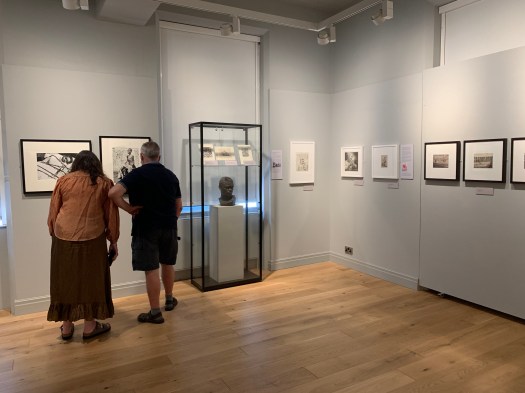
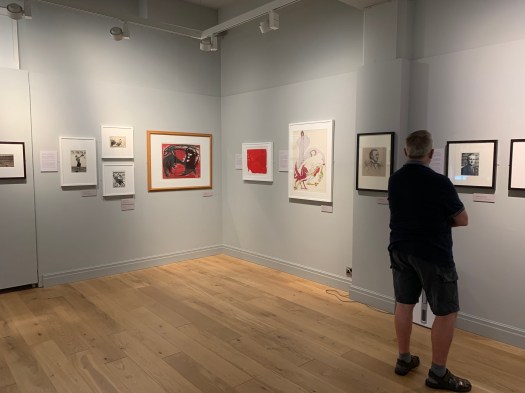
The selected works range from Third Reich photography to a bust of a Congolese pygmy chief, but also feature groups of female nudes executed by male artists, graphic images of starvation in 1970s Ethiopia, unauthorised sketches of patients in a mental institution and scenes of bullfighting. However rewarding the digging, the mother lode, in this instance, turned out to be a minefield.
The mining metaphor is borrowed from and alludes to one of the best-known examples of institutional critique, a practice of interrogating collections and museum spaces that artist-curators have employed since the 1970s. Fred Wilson’s Mining the Museum was one such landmark project in which the legacies of colonialism were made transparent through the juxtapositional display of objects as outwardly disparate but intimately related as silverware and slave shackles to remind us how and on whose backs the wealth of the United States was built.
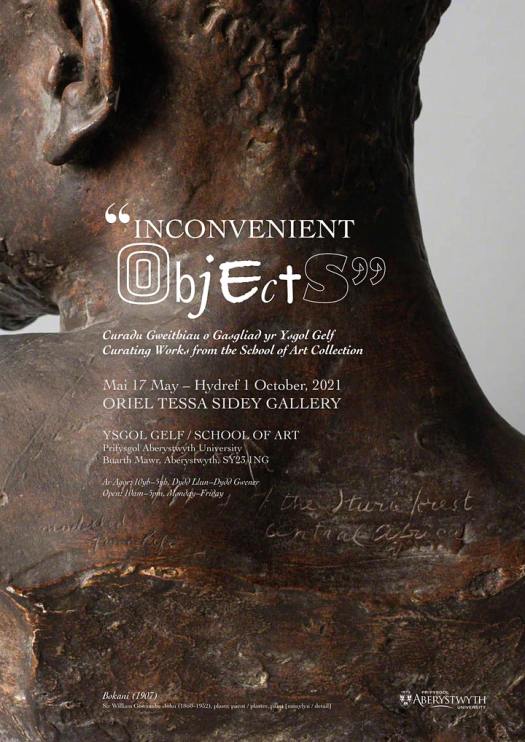
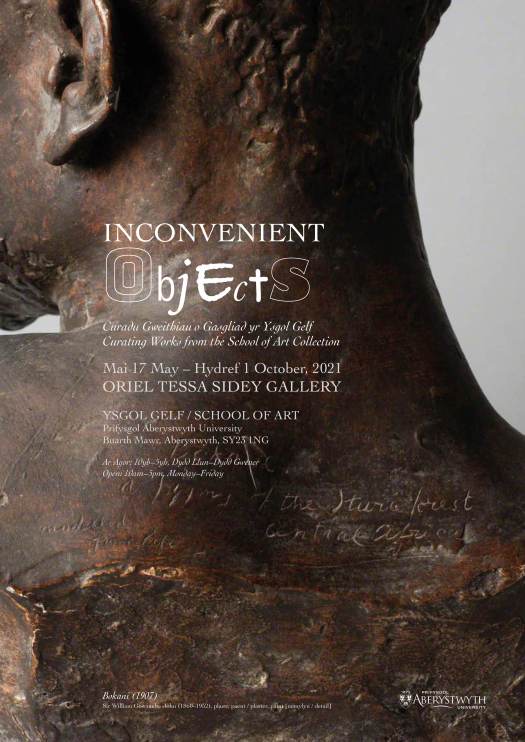
“Inconvenient Objects” was conceived to create awareness about the responsibility of contemporary museums such as ours and the role that exhibition curators play in making artifacts and their at times problematic histories accessible to the public.
The centerpiece of the exhibition, an early twentieth-century bust ostensibly created in the service of science and not intended as a portrait of the subject, Chief Bokani, was previously shown as an ethnographic “specimen” in the University’s geography department. In the context of the exhibition, the plaster bust – created by one of Wales’ foremost sculptors – encourages debates about ethics and ethnicity in art and science.
Wilson, unearthing a similar bust at the Hood Museum of Art, Dartmouth College, New Hampshire in 2005, had asked: ‘[Can we] extricate ourselves from the violence involved in acquiring these objects?’ The question remains whether “we” – as cultural institutions – can fulfil our civic mission by removing ourselves from the public discourse of reckoning? “We” have a lot to answer for if we don’t ask.
“Inconvenient Objects” so fully lived up to its title that it was ordered shut and hidden from view. The word “inconvenient” was apparently central to the university management’s claim that the show posed a reputational risk. I say “apparently” because what issues the university had with the show was never clearly – let alone directly – communicated to the curatorial team.*
Being that I also serve as the School’s “Equality Champion,” I had envisioned “Inconvenient Objects” as an opportunity to demonstrate that our University is committed to participating in the debate surrounding Black Lives Matter and the legacies of colonialism and empire in which sculptural objects such as our bust of Bokani are enmeshed. Some three thousand words of gallery texts were in place to clarify those objectives.
After nearly two months behind closed doors – a hiding away that is now part of its story – the show was once again opened to the public, and it is scheduled to remain so until 1 October 2021. With the addition of a single label, and a sign advising “viewer discretion” at the entrance, nothing has been altered. And yet, everything has changed.
Our senior curator, who designed the poster, was obliged to place the title of the exhibition in quotation marks, indicating that we do not really mean what we say or else that that “we” does not refer to representatives of our institution. In effect, the museum has been disabled from reflecting upon itself because such a critique – widely practiced elsewhere – might reflect poorly on the academic institution under which it is subsumed.
Minor adjustments though they may seem – a concession that allowed us to hold on to the title of the show – those quotation marks signal a disavowal, a lack of commitment and self-confidence. They undermine the common endeavor to mine our public museums, instead of simply minding the store, an engagement with history and civics that should be all of our business.
*Curatorial team: Audrey Corbelli, Ciara Donnellan, Eve King, Orla Mai-Riley, Farrah Nicholson, Lucia Paone-Michael, Katie Rodge and Katarzyna Rynkowska, with contributions from Cara Cullen and Sarai David, and support from Harry Heuser (text and concept) and Neil Holland (staging and design)
Today it is easier than ever to produce and share photographs. Subjects diversify. Perspectives broaden. We no longer have to deal with precious materials or finite rolls of film when determining who or what is worth a shot. Yet images are also more readily manipulated. Realities are filtered and faked. The black-and-white photographs in Matter of Life and Death predate our digital age. Fragile and bold, these infinitely multipliable images of singular moments and individual lives were intended to live and matter as prints.
How do we measure the importance of a life? Who or what is worth remembering? These are some of the questions raised by photographs such as the ones on display in Matter of Life and Death, an exhibition on view from 16 May to 9 September 2016 in the gallery of the School of Art at Aberystwyth University in Wales.
Looking at images of people and places can make us aware of our cultural differences. But it is not difficult to find universals in photographs produced worlds apart. Struggling farm workers in 1930s Alabama are shown alongside striking miners in 1980s Sardinia and South Wales. The town of Aberystwyth, where the exhibition is staged, is featured next to Palermo and Bangkok. Visitors to our gallery will see the faces of children. But they will also face the aged, the dying and the dead.
All of the photographs are from the University’s collection. They were chosen by School of Art students who then debated how to exhibit them and create a narrative. Only the medium and the title had been decided beforehand by me, the instructor of Staging an Exhibition, a course in curating that each year culminates in a show like this one. Previous exhibitions include Queer Tastes, Untitled by Unknown, and Face Value.
The selections students made for Matter of Life and Death are journalistic and surrealist, propagandistic and personal, mass marketed and private. Some photographers – Walker Evans, Mario Giacomelli and Angus McBean among them – are famous. Others are unknown. Learning about the identity of a photographer may well influence the way we look at the work that photographer has produced. A child may look less innocent once we know that the man behind the camera was Erich Retzlaff, a photographer who supported and propagated fascist ideals.
All of the photographs are from the University’s collection. They were chosen by School of Art students who then debated how to exhibit them and create a narrative. Only the medium and the title had been decided beforehand by me, the instructor of Staging an Exhibition, a course in curating that each year culminates in a show like this one. Previous exhibitions include Queer Tastes, Untitled by Unknown, and Face Value.
There is no particular order in which these photographs should be experienced. Themes such as dying traditions or endangered environments are suggested, but there are no conclusions. As in life, material circumstances limit our choices. The paths we forge are our own.
Matter of Life and Death is open to the public until 9 September 2016. Admission is free.
Curators: Megan Evans, Rebecca Fletcher, Suzanne Fortey, Emma Game, Emily Griffin, Elizabeth Kay, Kirils Kirijs, Michael Kirton, Maria Lystrup, Kate Osborne, Amy Preece, Georgia Record, Emma Roberts, Samantha Robinson, Emily Smyth, Bethany Williams, Gemma Woolley; with support from Harry Heuser (text) and Neil Holland (design)





 Harry Heuser