“. . . and it was built to last”: A Message from Buchenwald

I rarely hear from my sister; sometimes, months go by without a word between us. I have not seen her in almost a decade. Like all of my relatives, my sister lives in Germany. I was born there. I am a German citizen; yet I have not been “home” for nearly twenty years. It was back in 1989, a momentous year for what I cannot bring myself to call “my country,” that I decided, without any intention of making a political statement about the promises of a united Deutschland, I would leave and not return in anything other than a coffin. I don’t care where my ashes are scattered; it might as well be on German soil—a posthumous mingling of little matter. This afternoon, my sister sent me one of her infrequent e-missives. I was sitting in the living room and had just been catching up with the conclusion of an old thriller I had fallen asleep over the night before. The message concerned US President Obama’s visit to Buchenwald, the news of which had escaped me.

Just in time, I turned on the television to listen to the President’s speech, and to the words of Buchenwald survivor Elie Wiesel. I was relieved to hear the President talk of the Nazis as “human.” His predecessor would no doubt have resorted to “evil.” How much more meaningful is the word “human”—an acknowledgment of shared responsibility that forces us to relate rather than stand apart from any presumably unmitigated horror, thereby encouraging us to look at ourselves as potentially capable of the acts we are so eager to denounce as “inhuman.”

I was stirred, too, by the seemingly incongruous message of Elie Wiesel, who expressed himself at once doubtful and full of hope, who spoke of the futility of war at the very site of triumph over tyranny. Yet how can one avoid resorting to the violence of the paradox, whether used in the despair of reason or for the purpose of achieving the kind of harmony the metaphysical poets knew as “discordia concors”? How else, if at all, can one account for the life and deaths at Buchenwald, for the monstrously rational, the efficiently profligate, the methodically mad?

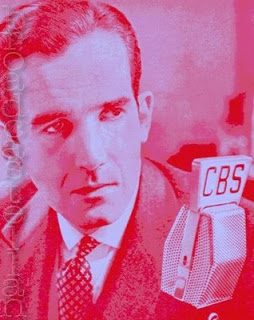
One of the first Americans to have witnessed and documented Buchenwald shortly after its liberation was CBS news commentator Edward R. Murrow. On 15 April 1945, three days after first setting eyes on the concentration camp, Murrow confronted his listeners with a report prefaced by the following disclaimer:

Permit me to tell you what you would have seen and heard had you been with me on Thursday. It will not be pleasant listening. If you’re at lunch, or if you have no appetite to hear what Germans have done, now is a good time to switch off the radio. For I propose to tell you of Buchenwald.

Bringing his eyewitness account to the ears of his fellow Americans, Murrow yokes together the incongruous to evoke the incalculable. Putting his finger on the imbalance of recorded figures and observable facts, he weigh in on the scale of humanity’s failure and thereby succeeds in making the measureless ponderable. Broad statistics are presented alongside minute details. Observations of suffering are contrasted with references to Buchenwald as the “best concentration camp in Germany,” a camp “that was built to last” yet built for annihilation.

Murrow speaks of an orderly pile of bodies, a prominent political figure starved beyond recognition, a warning against pickpockets in a scene of horrendous crime, and a new beginning of Buchenwald’s internees that coincided with the death of Franklin D. Roosevelt.

At one point, Murrow’s report takes us into a “clean” kitchen that supplies next to no food:

[The German prisoner, a communist, in charge of the kitchen] showed me the daily ration: one piece of brown bread about as thick as your thumb. On top of it a piece of margarine as big as three sticks of chewing gum. That, and a little stew, was what they received every twenty-four hours. He had a chart on the wall. Very complicated it was. There were little red tabs scattered through it. He said that was to indicate each ten men who died. He had to account for the rations, and, he added, “We’re very efficient here.”

“If I have offended you by this rather mild account of Buchenwald,” Murrow adds, “I am not in the least sorry.” After all, had he not begun his report with the incongruous invitation to “switch off the radio”?

I knew switching off only too well. As a child and adolescent growing up in West Germany, I felt the incongruousness of being a good German keenly. I was raised in a small village in which a synagogue rotted away unnoticed, history and hope debased as a pigsty. At school, classmates echoed their parents by defending Hitler as the builder of the Autobahn; at home, my paternal grandmother openly spoke of her awareness of what was happening to her Jewish neighbors—and then severed her connections by reducing me to the pink triangle I had pinned on myself by coming out.

I have been weighed down by collective guilt. I have lived under the terror of the extreme left and experienced the lure of the ultra-right as a stance of ultimate defiance. I failed to reconcile my responsibilities of facing history with any chance of personal happiness. So I left.

Perhaps I have been on the run ever since; trying to distance myself from the past I made my present an evasion. My life abroad has been, by and large, an existence in the neither here nor there, its escapism more shameful than my inescapable origins. Yet how else can we expect to make a clean start of it if our feet remain stuck in the soil we are anxious to shake?

It was with some unease that I realized just what I had been watching before my sister returned me to the reality of now: a neat puzzle in which every murder is accounted for and executed according to plan; a “very efficient” murder mystery that reduces horror to a formula borrowed from an old and politically incorrect nursery rhyme; film released, no less, in the year of the death camp liberations. You see, before I listened to the speeches at Buchenwald I had been counting down bodies in And Then They Were None.


Related recording
Edward R. Murrow’s report from Buchenwald (15 April 1945)

Related writings
“The Wannsee Konferenz Maps Out the Final Solution”
“Arthur Miller Asks Americans to “Listen for the Sound of Wings”
“From the House of Terror”
He Calls Them As He Hears Them: Joseph Julian Remembers

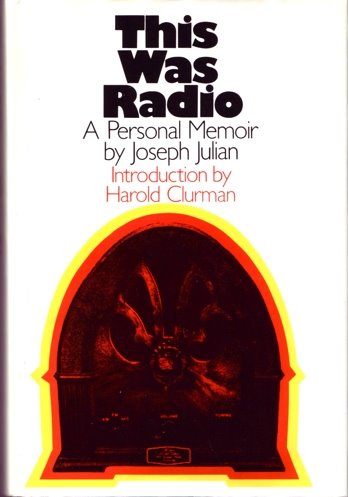
“The small but rich body of radio literature, which [Norman Corwin] brought so lovingly to life, lies languishing in a few libraries and second-hand book shops, under the titles Thirteen by Corwin and More by Corwin—a great shame and deprivation for the present generation!” My sentiments, entirely. Not my words, though, which is why I had to slap quotation marks on them. The man who said so was Joseph Julian, a once highly acclaimed and sought-after radio actor who starred in a number of plays written and directed by Corwin during the early-to-mid 1940s. Today, Julian’s memoir, a copy of which I recently added to my own library of out-of-print books on broadcasting, is one among those “languishing” volumes, a forgotten voice from a medium whose dramatic potentialities have remained largely unsounded since the late 1950s.

This Was Radio came out in the mid-1970s, a time widely deemed ripe for a reassessment of the aural medium and its derelict theater of the mind. Rather than waxing nostalgic—thereby squeezing the last few bucks out of a defunct business which, back then, most American adults still recalled experiencing first-ear, and fondly at that—Julian takes readers on a trip down memory lane that leads into neighbourhoods they would not get to hear about on an official tour.

His Corwinian class acts aside, Julian appeared on thriller programs like The Falcon, The Shadow, Inner Sanctum, Mr. Keen, Broadway Is My Beat, and The Mysterious Traveler. He was first heard on The March of Time, but as an also-ran-off-the-mouth, in re-enactments that called for crowd scenes. Briefly, he served as a sound man, during which stint he learned what noise a human body produces when it is turned inside out.

I can imagine just what kind of sounds emanated from Julian when he learned that the same thing was happening to his career. An established actor by the early 1940s, Julian remained highly successful throughout the decade, until, in 1950, his name appeared in Red Channels. His career as a radio actor declined rapidly; by 1953, his annual income had dwindled to a mere $1630.

Barred from work at CBS, Julian fired back by filing a lawsuit for libel. Character witnesses during Julian’s 1954 trial were Edward R. Morrow (last talked of here) and the aforementioned Morton Wishengrad. It was “an ugly period in American life and in mine,” Julian comments. His “urge” was “to skip over it”; but he felt a

responsibility as a victim to record some of what [he] went through. A whole new generation hardly knows that such a thing ever happened. But the fact is it could easily happen again if we relax our vigilance in defending our freedoms. Control of broadcasting is one of the first major objectives of those who would take them away.

His lawsuit was dismissed; thereafter, Julian virtually unemployed until William Fitelson, a theatrical lawyer and executive producer of the Theater Guild’s US Steel Hour television series staged one of the actor’s own plays in December 1954. Julian’s fortunes changed as quickly as they had declined; and he once again “getting calls for radio acting jobs.”

Without bitterness, Julian tells it as it is. About Myrna Loy, for instance, he remarks that, “if she had to win [her radio] role in a competitive audition with radio actresses, she wouldn’t have been there. Her voice, isolated from her other attributes, was dull and flat. She was selling her name, not her art.” More problematic still was it to perform a dramatic scene with Veronica Lake, who had such a weak, wispy voice” that the sound engineer could not get her and Julian “in proper balance.”

Lake was handed a “separate microphone across the stage” so that the engineer could “could mechanically raise her voice level to mine.” However effective for listeners at home, her faraway whispers had Julian straining to hear his cues. “Especially since they had her facing front so the audience could see her famous peek-a-boo hairdo. Hardly the way to play an intimate love scene with a lady!”

Of the notorious Hummerts, who “grimly dominated their empire” of soap operas, Julian remarks:

There was something darkly foreboding about [them].  Their stiff presence always evoked a sense of insecurity.  And with good reason.  They had a reputation for firing actors who incurred their slightest displeasure.  And authors.  When Mrs. Hummert once told a writer that she wanted “God” on every page of a script, and his answer was “Who will we get to play Him?” he was fired on the spot.  And whey you were fired from one of their shows it was a catastrophe.  It meant being banned from all their nine or ten others that might be on the air at any given time.

Call him fortunate or not, Julian continued to act on the air well into the medium’s decline. On this day, 4 October, in 1959, he was heard on Suspense, one of radio’s last remaining drama anthologies, in the routine thriller “Room 203.” It is a far cry from Julian’s greatest work; but these days, almost any cry uttered on radio seems distant.

This [I believe] I Believe

Perhaps we are becoming rather blasé about the phenomenon of web journalism (commonly known and often derided as “blogging”). Many of us still write what we wish, refusing to succumb to the urge or promise of making monetary profits by agreeing to become the mouthpieces of commerce, thereby to surrender the opportunity of sharing something about ourselves other than our apparent greed. How much is it worth to you to write freely, to display whatever you are pleased and prepared to share, what you think, think you know or believe?

It used to be a rare chance indeed to make yourself heard in a public forum comprising of more than a room full of people. The media who can spread news or opinions beyond the small circle of our communities, they always seem to be owned or run by others, be it likeminded or otherwise. That sense of being removed or apart from the media is largely a misconception, at least in democratic societies, a misconception arising from the distrust or apathy of the individual who does not participate, let alone initiate debates. And yet, what went on the air was generally prepared for the listener-turned-consumer by those who chose to enter the radio industry, whether to teach, delight, or exploit.

How exciting it must have sounded to the radio listener of 1951 when a program called This I Believe premiered on CBS, soon to be heard by American and international audiences the world over. This week, BBC Radio 4 is offering an hourlong introduction to This I Believe, its origins, its creators (among them Edward R. Murrow, pictured above), and its participants—an eclectic group of housewives and luminaries).

So, what if you were given four and a half minutes—or no more than 600 words—publicly to express your beliefs (something thousands have done since the revival of This I Believe in 2003)? What would you say? Would you find the words—and the courage—to say it?

However easy it is to say I, I believe that it should take more than a moment’s haphazarding to examine and express one’s philosophy, provided such a philosophy, which lies beyond performance and conformity, can be formulated at all. Yes, it is far easier to say “I” than it is to add “believe” and to follow it with words that truly follow . . .

Transatlantic Call: From Radio Reportage to Video Conferencing

Now, I am not going to get all sentimental and give you the old “tempus fugit” spiel; but I’d like to mention, in passing, that this post (the 355th entry into the journal) marks the beginning of a third year for broadcastellan. Meanwhile, I am resting with a bad back—in the city that never sleeps, of all places. This afternoon, during an inaugural transatlantic video conference with my two faithful companions back home in Wales, my mind excused itself from my heart and took off in reflections about the ways in which technology has assisted in forging a bond between the US and its close ally across the pond, and the degree to which such tele-communal forgings may come across as mere forgeries when compared to the real thing of an actual encounter.

I was reminded of this again when, a few hours after my chat, I sat, as of old, on a bench by the East River, in a park named after Carl Schurz, a fellow German gone west who likened our ideals to the stars that, however far beyond our touch, yet assist those guided by them to “reach their goal.” In my hand was a signed copy of a newly purchased biography of Edward R. Murrow (by Bob Edwards). It opens with Murrow’s report from the blitz on London, Murrow’s residence during the war.

The broadcasts from London (as featured and discussed here by Jim Widner) did much to enhance the American public’s understanding of the plight of a people, who, due to Hollywood’s portrayal of the British, seemed stuck-up, remote, and about as real as the fog in which Basil Rathbone and Nigel Bruce waded through some of their adventures. Reports from Britain not only brought home a Kingdom but a concept—the notion of brotherhood untainted by the nationalism whose fervor was responsible for the war.

If not as emotional as Herbert Morrison’s report from Lakehurst during the explosion of the Hindenburg, Murrow’s updates from London were delivered by a compassionate journalist who not only listened in but was a part of what he related while on location. On this day, 21 May, in 1950, British novelist Elizabeth Bowen connected wirelessly with her American audience by speaking via transcription on NBC radio’s University Theater. Bowen referred to her novel The House in Paris (1935) as “New York’s child,” the “fruit of the stimulus, the release, the excitement [she] had received here.” Would she have been able to enter into the feelings of a child lost in a strange house, she wondered, if she “had not just returned from another city, equally new and significant to me?”

There are limits to the connections achieved by the wireless, a controlled remoteness that brings home ideas without ever feeling quite like it. Rather than seeing or hearing, being there is believing. I felt far away during my transatlantic call; but I know I will know what home is now once I get back there . . .

Old-time Radio Primer: H Stands for Hiatus

Well, how are you feeling today? According to one British study, 23 June is the happiest day of the year. Montague and I were perfectly content, playing and dozing in the garden and going for walks along the lane. Perhaps, the folks down in the nearby town of Aberystwyth were even happier last Tuesday, when they had several thousand pounds thrown at them on the street by a stranger who just wanted to “spread a little sunshine.”  Apparently, this local story had already travelled around the world (both my sister and my best friend in Germany had heard of it) before it came to my ears, which, no doubt, were too busy picking up the sounds of .
As grateful as I am for ready access and instant replay, recording technology can render our present-day listening quite unlike the experience of tuning in back then. It is difficult to get a sense of a weekly broadcasting schedule, of certain parts of the day being associated with particular programs, of the anticipation of their airing and the space such periodically scheduled events occupied in the minds of the audience in the interim.

To be sure, the middle of June would have been meant a rather prolonged wait for the next tune-in opportunity. It was during this month (rather than May, as on US television nowadays) that most of the crowd-pleasing drama series and comedy-variety shows went on their summer hiatus. Hiatus, from the Latin hiare, meaning “to yawn.”

As I suggested a while ago, the off-season in radio had initially been a response to technical difficulties of broadcasting during the long, bright days of the year. Now, a hiatus can be a precarious wait, which is why I’d never attempt one for broadcastellan. The question is: will the audience greet the news of your return with excitement, or a resounding yawn? That is, will your show go on even in its absence, circulating in the minds of the multitude? Not, perhaps, if your season finale is as disastrous as the second one of Desperate Housewives.

To be sure, broadcasters did not shut down the microphones and close the studios for the duration. Before resorting to reruns, which became customary in the 1950s, they scheduled replacement programs, some of which, like the Forecast series, were designed to test the potential of untried fare. It wasn’t all filler during those summer months. The Mercury Theater, for instance, was first heard in July 1938. Besides, a prestigious timeslot, one occupied by the Lux Radio Theatre demanded high-profile or at least adequate replacements. One of the most highly regarded programs to have its premiere during the summer was the thriller anthology Escape.

On this day, 23 June, in 1950, Escape offered the western melodrama “Sundown,” the “story of a boy who never owned anything . . . but a gun.” The cast was headed by Barton Yarborough, best remembered today for his portrayal of Texan daredevil Doc Long in Carlton E. Morse’s I Love a Mystery serial. Doc and his pals did not break for the summer; they kept audiences suspended, from one cliffhanger to the next. On the very day Yarborough was heard in “Sundown,” another Doc Long (played by Jim Boles) set out for a new adventure in “The Snake with the Diamond Eyes.”

There was time as well for summer schooling. On this day in 1957, Edward R. Murrow introduced the listeners of the CBS Radio Workshop to a word far more ominous than “hiatus,” precisely because it denotes a lingering presence:

A new word has been added to our ever increasing vocabulary.  It’s a small word, dressed in fear.  To pronounce, not very difficult.  To envision, staggering.  This scientific word may well become the most important in all languages and to all peoples. It is pronounced “fallout.” “Fallout.”  Rather a simple word to describe so much.  “Fallout.”  Radiation withheld by quantities of atmosphere that may eventually descend to pillage, burn, kill not only you and me, but the scores of generations unborn.  Quite a word, “fallout.”

Countering the politics of terror, Murrow suggested that this lexical novelty could also denote the harvest of knowledge, as “words, thoughts, ideas,” withheld in an “atmosphere of ignorance,” eventually descend on future generations. Perhaps, this intellectual fallout is rather too gradual and the radiation too slight. With atomic energy once again on the political agenda in Britain, and threats of nuclear warfare not quite a thing of the past, little seems to have been learned from past horrors.

I wish political leaders could be forced to go on hiatus to make room for summer replacements—especially since some of them seem as perverse as that ill-treated teenager in Escape, seeking retribution beyond reason in an atmosphere of fear and its inevitable fallout. To the restless mind, “hiatus” can mean “pause for thought.”

"This . . . is London": Approaching Edward R. Murrow

I have returned from my latest London trip; my stimulated mind is filled with assorted impressions that I now ready for recollection in relative tranquility. Rather than pouring out those impressions like the content of an overstuffed suitcase, I shall meet the challenge of assembling them into a sequence of composite portraits, portraits not so much of myself but of the experience of gathering ideas and collecting thoughts. You might call this manipulation of the everyday a form of “method living”: a mental aligning and creative channelling of life’s vast, fleeting, and potentially overwhelming influences into something resembling a design of my own making.

There is to me nothing more thrilling than the tracing of a pattern in the patched-up fabric of the everyday. Granted, I often impose such a design by snipping off too many of the loose ends and by choosing that to which I expose myself with rather too thorough discrimination, by excluding the ill-fitting piece or neglecting the odd thread. Yet the satisfaction of finding sameness where others might only detect difference is not necessarily the program of a narrow mind. I try to do as much stitching together as I do selecting or cutting away. Atropos, Clotho, and Lachesis—I intend to do the handiwork of all three fates.

One of the threads I chose to follow during my wanderings through the maze that—compared to the comforting simplicity of New York City’s map—is sprawling London was the career of American journalist Edward R. Murrow. In his late 1930s broadcasts from London, Murrow had encouraged Americans to connect with world affairs by bringing the hardship of those under Fascist attack home to radio listeners who, in the confines of their living rooms, might have imagined themselves immune to such devastating influences. Later, he exposed fascism of another kind in his commentaries on misguided patriotism and undemocratic perversions of unity.

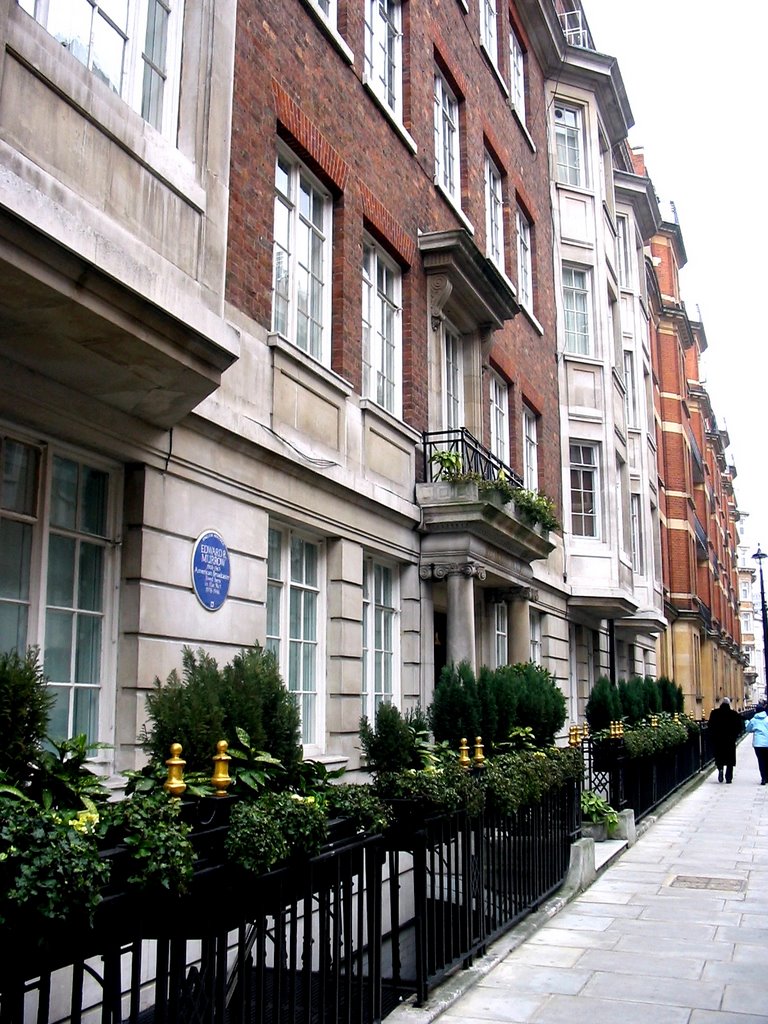
After a brisk two-hour walk from South Kensington, across Hyde Park, I arrived at Murrow’s former residence in Marylebone, not far from the British Telecom tower. I took a few photographs and walked on. I experienced no great stirring of emotions, let alone a spiritual connection. Yet the site itself, along with the act of finding, approaching and appropriating it pictorially became part of a design, enforced by the screening of Good Night, and Good Luck. my mate and I attended a day later. It had not been altogether planned that way; indeed, I was surprised to find the film to be still in such wide circulation.

The quietly impressive motion picture and my altogether unremarkable photographs do not so much amount to a biographical composite sketch of Murrow, a man who shaped history by recording it. Rather than capturing his past they suggest his presence—or our need for it.

Much of what Murray reflected upon in his broadcasts—even in reminiscences such as this one from 3 December 1944—is anything but dated, if only you permit yourself to look beyond the names of places and persons and weave his expressions of hope and fear into the fabric of our current wars and crises:

You remember those mean streets in London where so many died; the men stretching canvas over holes in roofs and walls, trying to patch things up before the winter comes, anything to keep out the rain and cold.  At the airfield you remember that it was just here you watched Mr. Chamberlain descend from his plane when he came back from Munich, waving his written agreement with Hitler and talking about peace in our time.  That was such a long time ago. And you wonder when there will be peace again and what it will be like. . . .

You recall all the talk of a better world, a new social order, a revolution by consent, that marked the desperate days, and you realize that talk of equality of opportunity, of equality of sacrifice, of a peace based on something other than force, comes more readily to the lips when disaster threatens.  There isn’t so much of it now [. . .]. 

Europe for a long time will be concerned with the urgent problems of day-to-day existence. The fundamental economic and social conflicts will not have been settled by this war. [. . .] 

For years after this war Europe will be in torment and [ . . . ] you wonder what part America will play in it all.  In battle and in production we have been magnificent.  We have delivered the planes, tanks, guns and ships and the men to fight with them.  The evidence of our strength can be found all around the world.  We’re not as tired as the others.  Our industrial plant is undamaged.  Our homes have not been blasted.  We enjoy security and relative comfort and our responsibility is frightening, for Europe will look to us—not for charity, advice or admonition, but for an example.  Democracy hasn’t been very fashionable over there in recent years and there are many who doubt that it can survive the strains and stresses of peace. . . .

Is democracy still “fashionable” anywhere? Is it the gear of choice or an imposed uniform that ceases to be fashion by resembling fascism? Has the current war on terror (or the terror of war) done much to preserve it? Are we still talking about a “peace based on something other than force”? The patterns we discover when engaging with the so-called past are often disturbing rather than reassuring. And yet, to ignore them, to refuse recalling them into our everyday, might be more disturbing still—a wilful refusal to connect that, far worse than passivity, is a violent act of tearing apart the fabric along with its flawed design.

"This . . . is London": Getting Ready to Take in the Sounds Again

Broadcasting House, London

Well, it has been a rather gloomy weekend, a few hours of which were spent finding a publishing house and home for Etherized, my doctoral study on old-time radio. I have been slow to send out proposals but am aware that I cannot rest on my laurels until they begin to smell. The fresh air being too damp, cold, and swiftly circulated, I sought shelter by the fire and found pleasant company in an unflappable adventuress by the name of Eve Peabody. Surely you’ve met Eve Peabody, the blues singer whose voice, by her own admission, is strictly of the “bathtub” variety? You know, the gal who once crashed a ritzy social gathering with a pawn ticket for an invitation. Yes, that Eve Peabody—the gold-lamé garbed, Bronx Local-hardened heroine of Mitchell Leisen’s deucedly clever screwball comedy Midnight (1939).

There’s much to be learned from an urbane charmer like Eve (as portrayed with pitch-perfection by Ms. Claudette Colbert). Lessons in picking yourself up, dusting yourself off, and starting all over again, I mean. Having escaped a Monte Carlo disaster—a failed system that left her practically penniless at the roulette table, with the exception of that one French coin with a hole in it—Eve takes a gamble by hopping on a train to not so gay Paris.

Alighting none too delightedly with damp and dreary prospects before her, she inquires with sarcasm, rather than incredulity: “So this, as they say, is Paris?” Not altogether reassured by the conductor, she wryly remarks: “Well, from here it looks an awful lot like a rainy night in Kokomo, Indiana.” I might find myself saying something not unlike this when I step out of the train in London this Wednesday. The forecast is not promising; but, like Eve, I am determined to make the most of my stay.

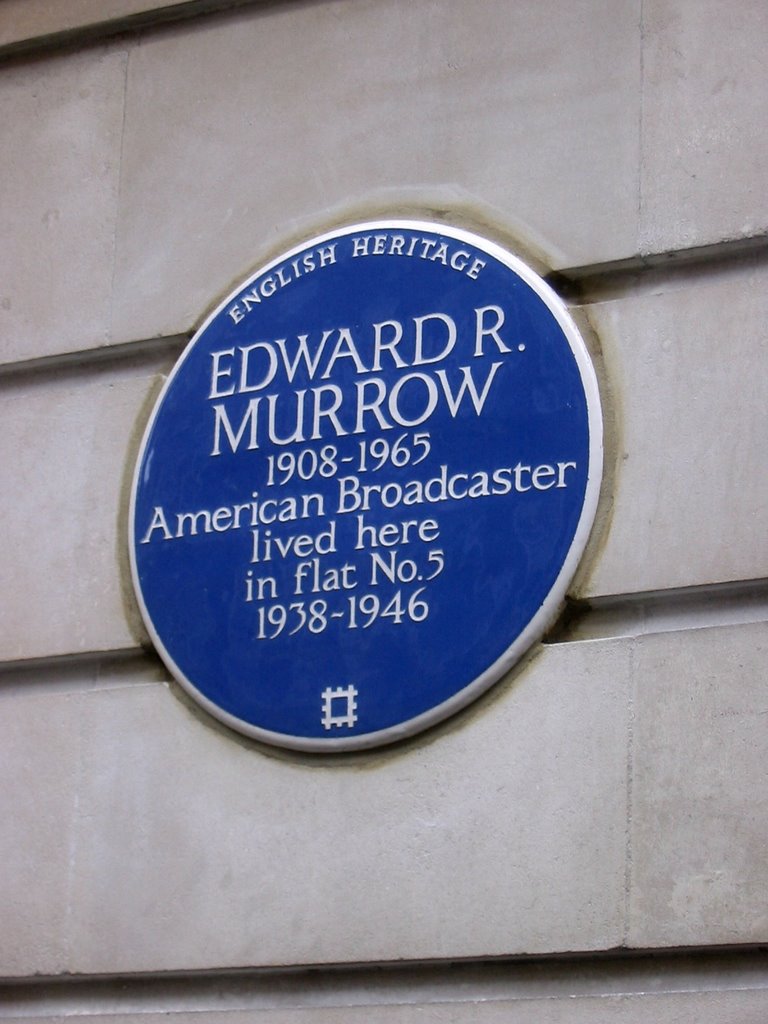
Perhaps, my idea of a good time differs from that of most visitors, but, aside from the shops and a West End show or two, Edward R. Murrow’s house in Hallam Street is right up there on my list of must-see attractions. As I reported a few weeks ago, a blue plaque has been placed on the façade of Weymouth House earlier this year, commemorating the contributions of its former resident, Murrow, to bringing the terrors of the London blitz home to American radio listeners, many of whom may have otherwise been indifferent or downright hostile to the British, quite willing even to let my Nazi ancestors have their way with them.

“This . . . is London,” of course, was Murrow’s famous introduction to his blitz broadcasts. His reports made a distant fight for survival seem real and urgent—unlike that picturesque firework display that stood in for the air raids in the recent Judy Dench-starrer Mrs. Henderson Presents. After all, radio can produce terrors far more immediate than video or photography, provided you have mind, heart, and guts enough to translate dreadful sounds into horrible images.

Walking through London again, I might do what I used to do when I first came to New York City, which is, besides taking in the sights, to take in the sounds as well. When the broadcastellan journal was still in its infancy, rather than its present adolescence, I contemplated the soundscape of Britain. For, surely, London has one of the most distinct sonic designs of any Western metropolis, the chiming of Big Ben being its most memorable earmark. So, as an exercise in getting in tune with said town, I will tune in again to “A Portrait of London” (20 July 1956), a CBS Radio Workshop tour conducted by Winston Churchill’s daughter Sarah, who took American listeners right into the bell tower of Big Ben.

“So this, as they say, is London, huh?” I might find myself saying on Wednesday as I step out onto the platform at Euston Station: but, hearing the inimitable sounds of the big city, I am unlikely to add “Well, to me it sounds an awful lot like a rainy night in the Welsh hills.”

Wireless Women, Clueless Men: Mary Margaret McBride, Commercial Correspondent

There is a plaque at last on Weymouth House, erstwhile London residence of Edward R. Murrow. I’m not sure how much it is owing to Good Night, and Good Luck. (which I have not yet seen); but this recognition was long overdue. They are all over London, those blue signs, telling passers-by of the notables who once lived, worked and made history behind otherwise nondescript façades. Looking up at them makes me feel that I am walking among those who made a name for themselves—or, if the name fails to ring a bell, plain ignorant. What’s in a name? Well, you could look it up, for starters.

Being that I am in the middle of a series devoted to “Wireless Women,” I shall let that plaque speak for itself and switch from the celebrated Ed “This . . . is London” Murrow to one of his most popular if now less well remembered female colleagues: Mary Margaret McBride (seen above in a picture that appeared in the premier issue of Tune In magazine, March 1943).

Born in Missouri (and her voice will tell you as much), McBride began her broadcasting career at station WOR, New York, in 1934, playing the fictitious “Martha Deane,” dispenser of household hints. A few years later, she signed a contract with CBS and was heard thrice weekly interviewing noted contemporaries, writers, actors, and politicians. While few recordings of McBride’s talks are available online, a tantalizing clip from one of her programs is interspersed in this NPR interview with McBride biographer Susan Ware.

McBride is chatting with brazen Tallulah Bankhead, who manages to break a broadcasting rule while politely inquiring about it:

Bankhead: “I can’t say, uh, ‘hell’ on radio, can I?”
McBride: “No.”
Bankhead: “Well, excuse me.”

Not that interviewer McBride was starchy or self-conscious. Indeed, she succeeded in making acceptable what, to the ears of many, listeners and journalists alike, was radio’s dirtiest kind of talk: commercials. Shrewdly enterprising, she was not above promoting the wares of the sponsors. She even turned her audience into advertisers, reading letters she received from loyal tuners-in who had tried the products she endorsed during her talks.

Apart from reaching millions of Americans with her broadcasts, McBride also exerted influence on the younger generation with proto-feminist novels like Tune In for Elizabeth (1945). Subtitled “Career Story of a Radio Interviewer,” Tune In is McBride’s commentary on—and vindication of—her own profession, packaged as a piece of juvenile fiction.

Within the framework of her story, McBride offers advice and encouragement to those who, like everyday heroine Elizabeth Cary, are trying to break into radio without having to churn out serial romances (a career suggested to her by a female colleague): “World War II, it seemed, had cracked completely the walls of the Fourth Estate where women were concerned.”

The title character is one of those aspiring young women who pushed her way through the temporarily loosened patriarchal brickwork at a time when executive doors were still reserved for her male counterparts, too few of whom had gotten, let alone accepted, McBride’s message.

Elizabeth moves from Glendale, Illinois, to New York City in order to pursue a career in journalism. Family connections in the newspaper business notwithstanding, she finds herself drawn to the world of broadcasting; her inspiration is radio interviewer Janet Adams, a fictional stand-in for McBride. Rather than imitating her idol, who started out writing for the papers, Elizabeth is eager to venture straight into radio:

The times—and especially radio—are moving too fast for that. I think a new technique is developing in radio itself. I think that people like Janet Adams are its pioneers

Working for Adams, Elizabeth is impressed how seriously the interviewer is taking her job; she becomes convinced that broadcasting can be an honest business, run with dignity and integrity—despite the commercials that Adams is contractually obligated to read on the air:

[Elizabeth] had thought of commercials as necessary evils, watching the announcer check off the list of products, everything from tea to toffee, as Miss Adams said a few words about each in the course of her broadcast. She had heard from her mother and other sources that housewives all over America trusted Janet Adams, took her advice without hesitation. But she had assumed that the product part of the program was arranged in advance with the sponsors, on the understanding that Miss Adams would feed it into the program as occasion offered. Elizabeth felt a glow of satisfaction. Granted that radio, as it was organized today, could not live without advertising, it was invigorating to learn that one program spoke its mind boldly, even where sponsors were concerned.

In addition to McBride’s justification of her part in radio advertising and the role of commercials in broadcast journalism, the novel emphasizes radio’s respect for the audience. Reading listener mail,

Elizabeth resolved never again to think of people as the public, to be dealt with on the basis of polls and surveys and experts who glibly listed the things ‘They’ liked or told you what they were able to understand. Why, they understood the whole wide world, these men and women from everywhere who tuned you in—or out, as you deserved—and who, if you were wise enough to keep close to them, would guard you from the awful conceit and self-satisfaction that would swiftly wreck both your job and you.

This is how McBride wanted to be perceived by her listeners. Expressing her ideals in uplifting fictions, she improved on—embroidered and enriched—this cherished relationship. In fiction, at least, she could generate fan mail without becoming the mouthpiece of corporations.