
 I’m not sure whether I like the idea. Of me being psychic, I mean. So, I generally come up with some feeble explanation for occurrences not quite so readily explained away. I don’t like the idea of explaining things away either. What’s left to be debated or wondered about once you have gotten to the bottom of the unfathomable? If indeed you truly have. There is room for doubt; and as uncomfortable as I am in that dimly lit chamber, I keep its door unlocked—just in case something peculiar escapes that, without any such doubt, would indubitable have escaped me. This evening, for instance, I answered the question “What’s the movie tonight?”—a question generally posed to me at dinner time—by suggesting Twentieth Century (1934), said to have been George Bernard Shaw’s favorite film. The DVD has been in our library for a while and I have been waiting for just the moment to watch this screwball classic.
It was only a little later that I discovered that the screening would be a timely one, given that today, 28 February, is the birthday of Ben Hecht, who co-wrote the screenplay with Charles MacArthur. To be precise, the screenplay is based on Hecht and MacArthur’s stage comedy of that title, itself based on Napoleon of Broadway by one Charles Bruce Millholland. Anyway. My ostensible choice having having an air of the ethereal, I felt compelled to commune with the spirits by going in search of Hecht’s voice on the ether.
The writer-producer-director of Angels Over Broadway wasn’t hard to find, either. In their introduction to a reprint of Hecht’s sentimental medical mystery “The Fifteen Murderers” (first published in Collier’s Magazine in January 1943), Messrs. Ellery Queen describe its author thus:
Ben Hecht—child-prodigy[,] violinist, circus acrobat, theater owner, reporter, novelist (remember Eric Dorn?), foreign correspondent, columnist, newspaper publisher, playwright (remember The Front Page?—with co-dramatist Charles MacArthur), scenarist, and motion-picture producer, to mention in rough chronological order some of his vocations and avocations [. . .]
Regretting that Hecht “invaded the Coast of Criminalia only on rare occasions,” the editors drew the reader’s attention to the story “Actor’s Blood,” which they recommended as “sheer melodramatic fireworks.” Before the story was reworked as Actors and Sin (1952), with Hecht providing the voice-over narration, the author had narrated his own radio dramatization of it for a Suspense production starring Fredric March (24 August 1944). For Inner Sanctum Mysteries, Hecht acted as the narrator of his short story “The Specter of the Rose,” dramatized on 19 August 1946, just days prior to the premiere of the motion picture adaptation.
Hecht’s stories, stage and screenplays were often reworked for radio, and perhaps none more often than aforementioned The Front Page and its screwball remake His Girl Friday (in a 30 September 1940 Lux Radio Theater broadcast starring Claudette Colbert). As for the swift and shimmering Twentieth Century. it took off again with Elissa Landi (in a Campbell Playhouse production from 24 March 1939); even Gloria Swanson got on board, performing a scene from the play on the Big Show (31 December 1950), whose hostess, Tallulah Bankhead, had read Hecht and MacArthur’s “What Is America?” on the 29 March 1942 broadcast of Command Performance.
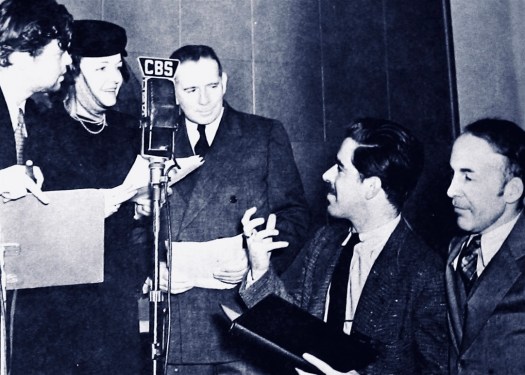
In 1935, Hecht and MacArthur’s musical extravaganza Jumbo, starring Jimmy Durante and featuring songs by Rogers and Hart, was lavishly staged at New York City’s giant Hippodrome, from which venue it was broadcast live in weekly instalments. As biographer William MacAdams points out, Hecht washed his hands of this production after many of his lines were cut as being not easily intelligible in such a large auditorium. He did not, however, turn a deaf ear to the medium. A few years later, he was a panellist on the quiz program Information, Please on 19 July 1938 and 30 August 1938. In the 1950s, he was interviewed for the documentary series Biography in Sound, recalling the lives of Carl Sandburg and Alexander Woollcott.
Considering his resume, it is difficult to not to be exposed to the works of Ben Hecht. That may well be an answer to my psychic experience; but, without question, I appreciate any helping hands and hints from the hereafter, especially if I am being led to a vehicle as bright as Twentieth Century. And now you’ll have to excuse me. I’ve got a reserved seat . . .
 Harry Heuser