“It gets something off my chest, doesn’t it?”: Keeping Norman Corwin’s “Appointment” (1941) Because Liberty Won’t Keep in the Heat of Hatred

Cover of Thirteen by Corwin,
containing “Appointment,”
from my collection of radio-related literature

Speaking out against fascism—publicly and nationally, via the airwaves—used to be regarded in the United States of America as a moral imperative, or at least, in the terms of the Federal Communications Commission (FCC), as an act “in the public interest.”

These days, in the era of MAGA on steroids—and, to be clear, the first “A” in the acronym can be readily substituted to designate any number of imperiled democracies—fascism is no longer the anathema to democratic rule that it used to be understood as constituting.  

This is mainly because democracy itself—as a construct, an ideal and a reality—has become anathema to the members of a growing movement that is celebratory of autocracy and that, perversely and perfidiously, argues anti-fascism to be a threat to autocracy as a preferred system of streamlined government in which checks and balances are discarded and in which oppositional forces and alternative voices are denounced as deleterious and traitorous.

I had been meaning to write about the weaponization of the FCC in the wake of the cancellation and temporary or partial silencing of late night talk shows critical of the Trump administration; but for some reason, and via a route too tedious to trace, I happened, quite fortuitously, as it turns out, on a script for a radio play by poet-journalist Norman Corwin, the unofficial “poet laureate” of US radio during the early to mid-1940s.

I have already devoted a dozen or so posts to Corwin and his work, including plays as diverse as “A Man with a Platform,” “My Client Curley,” and “Seems Radio Is Here to Stay.”   

To this day, one of the most rewarding acknowledgments of my scholarly pursuits, such as they are, remains receiving word from Corwin expressive of his approval of my academic writings on him.

Although I have discussed many of Corwin’s writings for radio in Immaterial Culture, I had somehow failed to show up for his “Appointment”—a play first produced on 1 June 1941 as part of the cycle Twenty-six by Corwin.

Continue reading ““It gets something off my chest, doesn’t it?”: Keeping Norman Corwin’s “Appointment” (1941) Because Liberty Won’t Keep in the Heat of Hatred”
Joan Blondell in Dachau

I am no historian. At least not in a traditional facts-and-figures sense. Early in life, I became doubtful of efforts to account for the present by recounting the past of a place or a people. Growing up – and growing up queer – in Germany during the 1970s and 80s, I was not encouraged to find myself in such accounts.  After all, how could I have developed a sense of being part of a national history? The present did not make me feel representative even of my own generation, while the then still recent past was presented to me as the past of a different country. A different people, even. A people whose history was not only done but dusted to the point of decontamination.

Visiting Dachau, June 2015

That many of those people – those old or former Nazis – were all around me and that the beliefs they held did not get discarded like some tarnished badge was apparently too dangerous a fact to instill. Pupils would have turned against their teachers.  Children would have come to distrust their parents. They might even have joined the left-wing activists who were terrorizing Germans for reasons about which we, endangered innocents and latent dangers both, were kept in the dark.

As I have shared here before – though never yet managed adequately to convey – I left Germany in early adulthood because I felt uneasy about my relationship with a country I could not bring myself to embrace as mine. It’s been a quarter of a century since I moved away, first to the US and then to Wales.  For over two decades, I could not even conceive of paying the dreaded fatherland a visit. 

Eventually, or rather suddenly, that changed. In recent years, I have found myself accepting offers to teach German language, history and visual culture, assignments that made me feel like a fraud for being second-hand when imparting knowledge about my birthplace.  I realized that I needed to confront the realities from which I had been anxious to dissociate myself.

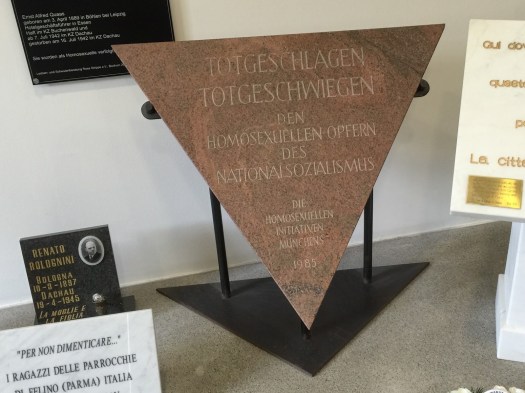
Beaten to death, silenced to death”:
A memorial to the homosexuals killed during
the Nazi regime, made in the year I came out.

This summer, I visited the Dachau concentration camp for the first time.  There, in the face of monumental horrors, I was drawn to one of the smallest and seemingly most inconsequential object on display: a cigarette card featuring the likeness of 1930s Hollywood actress Joan Blondell.

Dates and figures are no match for such a fragile piece of ephemera. To be sure, the macabre absurdity of finding a mass-manufactured collectible—purchased, no less, at the expense of its collector’s health—preserved at a site that was dedicated to the physical torture of real people and the eradication of individuality could hardly escape me.

But it was not this calculated bathos alone that worked on me.  It was the thought that I, too, would have collected such a card back then, as indeed I do now. Investing such a throwaway object with meaning beyond its value as a temporary keepsake, I can imagine myself holding on to it as a remnant of a world under threat.

Lives taken, identities recovered at Dachau.
Unexpectedly, a picture of Joan Blondell

Looking at that photograph of Joan Blondell at Dachau, it was not difficult for me to conceive that, had I been born some forty years earlier, I might have been sent there, or to any one of the camps where queers like me were held, tortured and killed.  That minor relic, left behind in the oppressive vastness of the Dachau memorial site, speaks to me of the need to take history personal and of the importance of discarding any notion of triviality. For me, it drives history where it needs to hit: home—home, not as a retreat from the world but as a sense of being inextricably enmeshed in it.

Joan Blondell, meanwhile, played her part fighting escapism by starring in “Chicago, Germany,” an early 1940s radio play by Arch Oboler that invited US Americans to imagine what it would be like if the Nazis were to win the war.