
Of “historical value”: Hitler’s “Best” Straight Talk and Other Continuity Types

As soon as I decided to make radio plays written in the United States in the 1930s, ‘40s and early ‘50s the subject of my doctoral study, I set out to scour New York City University libraries for scripts published during that period. My degree is in English, and I was keen not to approach broadcasting as a purely historical subject. The play texts and my readings of them were to be central to my engagement with the narrative-drama hybridity that is peculiar to radio storytelling. Whenever possible, I tried to match script with recording—but, to justify my study as a literary subject, I was determined to examine as many print sources as possible. One text that promised to provide a valuable sample of 1930s broadcast writing was Radio Continuity Types, a 1938 anthology compiled and edited by Sherman Paxton Lawton.

Back in the late 1990s, when I started my research, I was too focused, too narrow-minded to consider anything that seemed to lie outside the scope of my study as I had defined it for myself, somewhat prematurely. Instead, I copied what I deemed useful and dutifully returned the books I had borrowed, many of which were on interlibrary loan and therefore not in my hands for long. It was only recently that I added Radio Continuity Types to my personal library of radio related volumes—and I was curious to find out what I had overlooked during my initial review of this book . . .

Radio Continuity Types is divided into five main sections: Dramatic Continuities, Talk Continuities, Hybrid Continuities, Novelties and Specialties, and Variety Shows. Clearly, the first section was then most interesting to me. It mainly contains scripts for daytime serials, many of which I had never heard of, let alone listened to: Roses and Drums, Dangerous Paradise, Today’s Children. There are chapters from Ultra-Violet, a thriller serial by Fran Striker, samples of children’s adventures like Jack Armstrong and Bobby Benson, as well as an early script from Gosden and Correll’s Amos ‘n’ Andy taken from the period when the program’s format was what Lawton labels “revolving plot drama.”

Aside from a melodrama written for The Wonder Show and starring Orson Welles, I got little use out of Lawton’s book, mainly because I concentrated on complete 30-minute or hour-long plays rather than on serials I could only consider as fragments. Besides, I was not eager to perpetuate the notion of radio entertainment as being juvenile or strictly commercial.

Anyway. Looking at the book now, I am struck by Lawton’s choices. Never mind the weather report on page 346 or Madam Sylvia’s salad recipe. How about the editor’s selection of “Occasional speeches”? Historically significant among them are Franklin D. Roosevelt’s first inaugural, a “Welcoming” of Roosevelt by Getulio Vargas, President of Brazil, as well as Prince Edward VIII’s announcement of his abdication.

No less significant but rather more curious are Lawton’s “Straight Talk” selections of fascist propaganda by Benito Mussolini, Joseph Goebbels and Adolf Hitler: “Long live the National Socialist German Reich!” and “Now and forever—Germany! Sieg Heil!” Surely, such lines draw attention to themselves in a volume promising readers “some of the most successful work that has been done in broadcasting.” What, besides calling Goebbels’s “Proclamation on Entry into Austria” and Hitler’s “I Return” speech (both dated 12 March 1938) “straight” and “occasional,” had the editor to say about his selections? And what might these selections tell us about the editor who made them?

In a book on broadcasting published in the US in 1938, neutrality may not be altogether unexpected, as US network radio itself was “neutral”; but Lawton—who headed the department of “Radio and Visual Education” at Stephens College in Columbia, Missouri—seems to have gone beyond mere representations of “types.” Introducing a translation of Hitler’s speech, which comments on the reluctance of “international truth-seekers” to regard the new “Pan-Germany” as a choice of its people, Lawton argued it to represent “some of the best work of a man who has proved the power of radio in the formation of public opinion.” There are no further comments either on technique or intention. No explanation of what is “best” and how it was “proved” to be so. No examination of “power,” “public,” and “opinion.” It is this refusal to contextualize that renders the editor’s stamp of approval suspect.

The “continuity” Lawton was concerned with was of the “type” written for broadcasting—not the “continuity” of democracy or the free world. When he spoke of “historical value,” the editor did so as a “justification for a classification” of the kind of “continuity types” he compiled (among them “straight argumentative talks” by Senator Huey Long and Father Coughlin). And when, in his introduction, he speculated about radio in 1951 (“when broadcasting [would] be twice as old” as it was then), he did not consider what consequences the “best” and “most efficient” of “straight talk” might have on the “types” that were still “in common use” back in 1938.

Given its definition of “historical value,” it hardly surprises that Lawton’s anthology was not in “common use” for long. There was no second edition.

Fa(r)ther?

Historically speaking, it is difficult for me to get the larger picture. When I express anything amounting to a weltanschauung, I go all philosophical. Perhaps, I live too much in the confines of my own peculiar everyday to engage with the political events and developments that shape my existence. Life in the United States has taught—or, at any rate, encouraged—me to live in and for the now, a modus of going about one’s affairs that is more personally rewarding even though it might not always be quite so socially or globally responsible. Seizing the day for the sake of that day and its glories alone is not something to which Germans, in particular, are prone; they are more likely to seize opportunities for the future, or another country, for that matter.
In the old world, people tend to plan for what might happen in generations to come; they are anxious to map out what they presume to lie ahead, sometimes for as much as a thousand years. I suppose that, once those old world futurists went west to seek their fortune, they needed to learn to reconcile themselves to the vagaries of the wilderness, to fight everyday battles, to carve a niche for themselves right out of those woods.

In societies that have a medieval past in which the individual matters less than the tribe, fascism and communism are more likely to flourish than in the United States. Creating order out of the chaos that is time not yet present so as to provide for the future of one’s kind makes even genocide justifiable.

I wonder whether, had I been born American and grown up the in United States during the 1930s, I had possessed the foresight to anticipate just what this kind of mindset is capable of undoing and getting done. Would I have been an isolationist or urged for an involvement in the European conflict? Would I have been all peacetime business as usual or seen war as a way of insuring the future of an ideal?

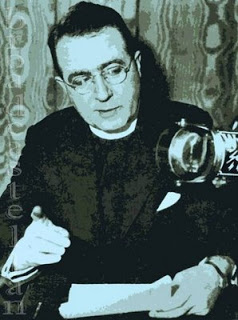
I trust that, for all my shortsightedness, I would have seen right through a man like Father Charles Coughlin, who, back in 1939, continued to rail against the warmongers in the US. Using the microphone and Social Justice magazine as means of reaching the American multitudes, he went so far as to recruit school children for his cause. On 19 March 1939, the notoriously anti-semitic priest offered prizes to any youngster—Christian, Jew, or gentile—who could best express reasons to stay out of a foreign “entanglement” involving military action. One answer suggested by the announcer of Coughlin’s radio addresses, who was also a spokesperson for Social Justice, hailed economic sanctions as a modern mode of warfare.

In 1936, Father Coughlin could still count on a popular magazine like Radio Guide as a forum to pose a challenge to “Franklin Doublecross Roosevelt,” the President he had staunchly supported some six years earlier. By 1940, Coughlin’s influence was vastly diminished, his motives questioned, his hypocrisy exposed. In an issue of Radio-Movie Guide for the week of 16 to 22 March 1940, news editor and radio historian Francis Chase, Jr. shared the outcome of his investigation into Coughlin’s mysterious absence from the airwaves on 4 February of that year when a “series of cryptic and intriguing announcements” informed the listening public that Coughlin “would not appear to speak and intimated that dire and sinister forces were at work to prevent his addressing the radio audience.” Chase’s subsequent

investigations showed that neither [station] WJR nor the Coughlin radio network had censored Coughlin’s address.  Neither had the Catholic Church nor the Federal Communications Commission.  The inescapable conclusion to be drawn, therefore, is that Father Coughlin, and Father Coughlin alone—was responsible for the weird performance after exhorting, through his announcer, all listeners-in to telephone their friends and get them to their loudspeakers.

Apparently, Coughlin was determined to present himself as a martyr threatened to have his tongue cut off by those who did not like what he had to say. Among those who very much liked what Coughlin said—and who liked what his staged disappearance from the airways might imply—where the editors of Hitler’s Völkischer Beobachter, who sneered that, in a so-called free America, Coughlin was facing censorship for the “truths” he dared to speak.

Was Coughlin, who envisioned a fascist “Corporate State” to do away with what he argued to be a corrupt United States, consumed with the larger picture in a foreign frame? Or was he, Canadian-born and barred from the Presidency, picturing mainly himself in whatever frame suited him best or was most likely to accommodate him?

However far-reaching or far-fetched his scheming, much of what the far-righteous Father espoused Chase demonstrated to be personally motivated. When Coughlin denounced the worshipping of the “God of Gold,” for instance, and argued it a “Christian concern” to restore silver to “its proper value,” the US government disclosed that the Thunderer of Royal Oak owned “more silver than any other person in Michigan.” While loudly condemning “Wall Street gambling,” Coughlin was known to have played the stock market.

Sure, even the larger picture—a vision, however ghastly or inhumane—is only a reflection of the minds that conceive it; but in how far are the likes of me, whose frame of mind is too narrow or too feeble to get hold of that larger picture, content to be framed by the masterminds who seize the opportunity of creating, mounting and authenticating it?


Related recordings
Coughlin broadcast 19 March 1939
Coughlin broadcast 4 February 1940

Related Writings
“’I hold no animosity toward the Jews’: The Father Coughlin Factor”

“I hold no animosity toward the Jews”: The Father Coughlin Factor

Listeners tuning in to station WHBI, Newark, New Jersey, on this day, 11 December, in 1938, were reminded that what they were about to hear was “in no sense a donated hour.” The broadcast was “paid for at full commercial rates”; and as long as they desired Father Coughlin into their homes, he would be “glad to speak fearlessly and courageously” from the Shrine of the Little Flower in Royal Oak, Michigan, from whence he spread what was billed as a “message of Christianity and Americanism to Catholic and Protestant and religious Jew.”

As Siegel and Siegel point out in their aforementioned study Radio and the Jews (2007), Father Coughlin was at that time increasingly coming under attack. In the fall of 1938, some stations no longer carried his weekly radio addresses, which had once been heard by as many as forty-five million US Americans. While anxious to defend himself, Coughlin was not about to recant or withdraw.

In his 11 December broadcast, he expounded again on his favorite subject, “persecution and Communism,” by which he meant the persecution of American Christians by Communist Jews. It was his “desire as a non-Jew,” Coughlin insisted, to tell his audience, including “fellow Jewish citizens,” the “truth.”

The adjective “religious,” attached as was by Coughlin only to Jew, not to Catholic or Protestant, was significant in his defense of his special brand of anti-Semitism, a distinction between “good” and “bad” Jews that enabled him to denounce “atheistic Jews” as Communists. “Show me a man who disbelieves in God, and particularly who opposes the dissemination of knowledge concerning God, and I will show you an embryonic Communist.”

In his condemnation of the “insidious serpent” of atheism as manifested in Communism, however, Coughlin made no mention of non-practicing Catholics or non-believing Protestants. According to his preachings, the Jew, rather than the Catholic or Protestant, was that “embryonic” Communist. No other religions got as much as a mention.

Ostensibly to “inform” listeners “what thoughts millions of persons are entertaining,” Coughlin argued that, in “Europe particularly, Jews in great numbers have been identified with the Communist movement, with Communist slaughter and Christian persecution.”

He urged American Jews—the “Godless” among whom were conspiring to do away with “the last vestiges of Christmas practices from our schools”—to disassociate themselves from the Jews in Europe at the very moment in modern history when the Jews in Europe were most in need of support from the free world:

O, there comes a time in the life of every individual as well as in the life of every nation when righteousness and justice must take precedence over the bonds of race and blood.  Tolerance then becomes a heinous vice when it tolerates the theology of atheism, the patriotism of internationalism, and the justice of religious persecution.

While “graciously admit[ing] the contribution towards religion and culture accredited to Jews”; while claiming to have spent “many precious hours” in the “companionship of the prophets of Israel,” Coughlin got down at last to the nastiness that was his business. As he put it,

when the house of our civilization is wrapped in the lurid flames of destruction, this is not the time for idle eulogizing.  When the house is on fire, its tenants are not apt to gather in the drawing room to be thrilled by its paintings and raptured by its sculpture, its poetry, its tomes of music or its encyclopedia of science, which are there on exhibit.  When the house is on fire, as is the house of our civilization today, we dispense with gratifying urbanities and call in the fire department to save our possessions lest they be lost in the general conflagration.

Any acknowledgment that the “conflagration” threatened the Jews more than the Christians so shortly after Kristallnacht—the atrocities of which he gainsaid in his 20 November 1938 broadcast—are relegated to the attic that are the dependent clauses of Father Coughlin’s rhetoric, which, in its far from courageous concessions, is as disingenuous and invidious as the language of Bill O’Reilly today.