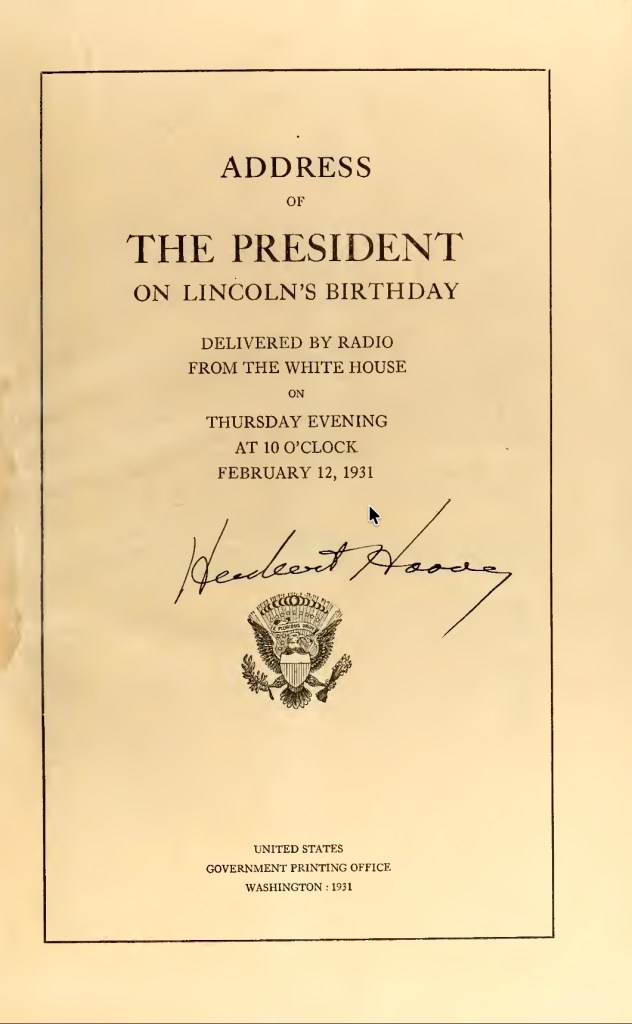
“By the magic of the radio.” Suitably charming if by then well-worn, the phrase served as the opening of a public address by the thirty-first president of the United States, Herbert Hoover. Broadcast from the White House on this day, 12 February, in 1931, and occasioned by the birthday of Abraham Lincoln, the message conveyed in the speech that followed was decidedly less magical than the purported medium of enchantment by way of which it was delivered.
Address of the President on Lincoln’s Birthday (1931)
In lieu of a recording, the script published by US Government Printing Office serves as a reminder of Hoover’s inability to respond with understanding to the needs—and the mood—of the multitudes who tuned in to hear his words. And while its initial reception is now difficult to gauge, the broadcast no doubt contributed to Hoover’s defeat the following year, on 8 November, when Franklin D. Roosevelt won the popular and electoral vote, carrying forty-two states.
FDR came to be known as “the radio president.” His predecessor, however, had already made ample use of the medium, especially after the establishment of national chains—NBC in 1926 and CBS in 1927—significantly increased the possibility of reaching millions of US Americans instantly and simultaneously in their homes.
Just days after Hoover’s radio address on Lincoln’s Birthday in 1931, for instance, his administration launched a “drive against illiteracy in the United States” in cooperation with the Columbia Broadcasting System.
There was little evidence of Hoover’s ability to read the room, however, as his voice passed through the four walls in which so-called members of the far from homogenous public sat alone or in intimate circles to learn about his response to the economic crisis that had left so many of them floundering.
The script for “Chicago, Germany” as it appeared in the June 7-13 issue of Radio Life
Delving into the “Draft and Ideas” folder set aside for this blog, I came across a fragment titled “‘Chicago, Germany’: A 1940s Radio Play for Our Parallel Universe.” It was intended for posting on 10 November 2016 as a response to a “Trump administration having become a reality.” The draft was abandoned, but no other piece of writing was published in its place.
In fact, the next entry in this journal did not appear until 15 May 2017, and it coincided with the opening of Alternative Facts, an exhibition I staged with students at the School of Art, Aberystwyth University, in Wales.
As the abandoned fragment and the ensuing hiatus suggest, the “reality” of the Trump presidency had so rattled me that I could not bring myself to continue a blog devoted to the popular culture of yesteryear, as much as I had always tried to de-trivialize bygone trifles not only by examining them in the context of their time but also by relating them to the realities of the present day.
The exhibition project that kept me busy in the interim, had similar aims. Alternative Facts provided me, as a curator and educator, with an opportunity creatively to engage with the outrage of MAGA by appropriating a phrase that encapsulated the duplicity and travesty of those early days of spurious swamp-draining.
Fast forward to 20 January 2025, the day that Trump returned to office, by the popular demand that is a product of his populist brand, with the singular and single-minded vengeance of a MAGA-loomaniac. Pardon the execrable pun, but I find no words other than that crass neologism adequately to describe a US President who pardons rioters storming the Capitol and defecating on democratic principles, much to the Nazi-salute inspiring enthusiasm of enabling, super-empowered and quite literally high-handed oligarchs who, I suspect, will, rather than Elon-gate this reign, eventually assume the gilded let’s-lay-democracy-to-rest-room that, in the interim, is the seat of Trump’s throne,
It struck me that the time was ripe for—and indeed rotten enough—to pick up pieces of that draft in light or dimness of the current and perhaps irrevocably changed political climate, which, far from incidentally, is the only human-made climate change we are likely to hear about from the US government for the duration, as dramatically shortened for our species and for most lifeforms on our planet as that time may have become in the process.
As a melodramatist who staged the end of the earth both on radio and for the movies (in the 1951 nuclear holocaust thriller Five), Arch Oboler would have much to say about all this—except that what Albert Wertheim has called his “penchant for altered reality” was being “married to his anti-fascist zeal” in propaganda plays sponsored by or at least aligned with the objectives of the US government during the FDR years.
As my motto ‘Keeping up with the out-of-date’ is meant to suggest, I tend to look toward the past; and yet, I resist retreat. Retrospection is not retrogressive; nor need it be it a way of reverencing what is presumably lost or of gaining belated control over what back at a certain time of ‘then’ was the uncertainty of life in progress. I am interested in finding the ‘now’ – my ‘now’ – in the ‘then,’ or vice versa, and in wresting currency from recurrences.
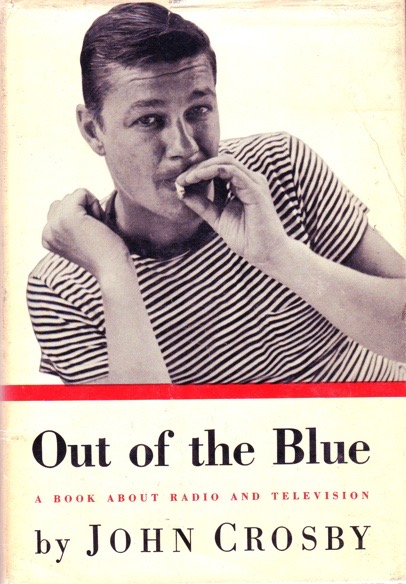
Many articles in Crosby’s column made it into this 1952 volume, which is on my bookshelf. The item discussed here did not.
I also tend to look at the ephemeral and everyday, the disposable objects or throwaway remarks we think or rather do not think of at all and dismiss as immaterial and obsolete, as too flimsy to carry any weight for any length of time. Take an old syndicated newspaper column such as John Crosby’s “Radio in Review,” for instance. Back in November 1948, Crosby, whose writing was generally concerned with programs and personalities then on the air, commented on a US presidential election that apparently no one, at least no one in the news media, had predicted accurately. “Dewey Defeats Truman,” the headline of the Chicago Daily Tribune erroneously read on 3 November that year. Having listened to the words dispensed over the airwave on that day after – or, depending on your politics, in the aftermath of an election that paved the way for another term for President Harry S. Truman – Crosby noted:
‘Perhaps never before have such handsome admissions of error reverb[e]rated from so many lips with such a degree of humility as they did on the air last week.’ Truman had been in office since the death of Franklin D. Roosevelt in 1945; but in 1948, he had confirmation at last that the public – or the majority of those who made their views public and official – agreed that he belonged there. As Crosby pointed out, even seasoned political commentators had predicted a Republican victory.
‘[T]here probably never has been an election post-mortem in which the words “I told you so” were not heard at all,’ the columnist remarked, adding that ‘if they were said, [he] didn’t hear them.’ To his knowledge, ‘[n]o professional commentators … told anyone so.’
Among those who, according to Crosby, got it more wrong than others was the ultra-conservative broadcaster Fulton Lewis Jr., an opportunist and influencer who, Crosby remarked, had gone ‘far beyond’ his fellow commentators by predicting ‘Republican victories in states where most observers foresaw a seesaw battle.’
Speaking from the secular pulpit that was his radio program, Lewis ‘fully admitted his wrongness’ after the fact, Crosby noted, reading aloud the messages he received from listeners who ‘invited him to drop dead,’ to ‘throw himself’ into Chesapeake Bay, or to ‘go soak his head in a vinegar barrel.’ Far from remorseful or self-deprecating, such revelling in controversy is representative of right-wing provocation as we experience it to this day.
A question not posed by Crosby is whether future Barry Goldwater supporter Lewis simply got it wrong – or whether he predicted wrongly to demoralise Truman’s supporters by suggesting that a Republican landslide was a foregone conclusion. Given Lewis’s known bias, the miscalculation was obviously not calculated to rattle Truman supporters out of complacency. So, a question worth asking now not how commentators got it so wrong, but why.
Lowell Thomas, a conservative commentator courting an audience of both major parties, insisted that he had not predicted the election but that he had merely ‘passed along the opinions of others.’ Thomas added, however, that, had he made a prediction, ‘he’d have been as wrong as everyone else.’ Unlike Lewis, this statement suggests, Thomas distinguished between reportage and commentary, the line between which was drawn no more clearly in 1948 broadcasting than it is in today’s mass media, discredited though they are as ‘legacy’ and presumably obsolete by the social media weaponizing political right.
Reporter Elmer Davis who, also unlike Lewis, was critical of then on-the-rise Senator Joseph McCarthy, a Democrat who turned Republican and opposed the Truman presidency for being soft on Communism, provided this statement to his listeners: ‘Any of us,’ he said, ‘who analyze news on the radio or in the papers must hesitate to try to offer any explanation to a public which remembers too well the lucid and convicing explanations we all offered day before yesterday of why Dewey had it in the bag.’ Commentators had ‘beaten’ their ‘breasts’ and ‘heaped ashes’ on their heads since the election, Davis told his audience; but they still looked ‘pretty foolish’ and should probably wait some time before sticking their ‘necks’ out again.
‘Cheer up, you losers,’ veteran newscaster H. V. Kaltenborn declared on his radio program, ‘It isn’t so bad as you think.’ The peculiar mash-up of scoffing, commiserating, mind-reading and prognosticating did not escape Crosby, who wondered just what went on in the ‘mind’ of someone who, more than having misjudged who lost, might himself have lost it.
The ‘explanations as to why President Truman won were almost as identical as the pre-election prediction that he wouldn’t,’ Crosby observed, namely that the nation ‘liked an underdog.’ Just how much of an ‘underdog’ can a presidential incumbent be? Playing one on TV would prove a winning formula for Donald Trump, at least, and the kind of doghouse he managed to furnish for himself, which is so unlike the residence some of us envision as rightfully his, provides support of that theory.
Summing up the state of desperation among commentators, Crosby stated that ‘many’ of them derived rather ‘odd comfort’ from the fact that US ally turned adversary Josef Stalin, who likewise incorrectly predicted a win for Republican candidate Thomas E. Dewey, ‘had been just as wrong as they were.’
Sure, there is momentary relief in Schadenfreude, seeing those who got it wrong having to admit – or trying to avoid admitting – the fact that, in hindsight, they were demonstrably wrong, and, being wrong, on the wrong side of the future. And yet, getting it wrong may also be evidence of wrongdoing, of deceit and deviousness. As someone relegated to the sidelines, I can offer only one reasonable piece of advice to those who prefer a Truman over a Trump: pay attention to but do not trust folks who are determined to convince you that your vote does not matter much by declaring the game to be over when it is still afoot.
As soon as I decided to make radio plays written in the United States in the 1930s, ‘40s and early ‘50s the subject of my doctoral study, I set out to scour New York City University libraries for scripts published during that period. My degree is in English, and I was keen not to approach broadcasting as a purely historical subject. The play texts and my readings of them were to be central to my engagement with the narrative-drama hybridity that is peculiar to radio storytelling. Whenever possible, I tried to match script with recording—but, to justify my study as a literary subject, I was determined to examine as many print sources as possible. One text that promised to provide a valuable sample of 1930s broadcast writing was Radio Continuity Types, a 1938 anthology compiled and edited by Sherman Paxton Lawton.
Back in the late 1990s, when I started my research, I was too focused, too narrow-minded to consider anything that seemed to lie outside the scope of my study as I had defined it for myself, somewhat prematurely. Instead, I copied what I deemed useful and dutifully returned the books I had borrowed, many of which were on interlibrary loan and therefore not in my hands for long. It was only recently that I added Radio Continuity Types to my personal library of radio related volumes—and I was curious to find out what I had overlooked during my initial review of this book . . .
Radio Continuity Types is divided into five main sections: Dramatic Continuities, Talk Continuities, Hybrid Continuities, Novelties and Specialties, and Variety Shows. Clearly, the first section was then most interesting to me. It mainly contains scripts for daytime serials, many of which I had never heard of, let alone listened to: Roses and Drums, Dangerous Paradise, Today’s Children. There are chapters from Ultra-Violet, a thriller serial by Fran Striker, samples of children’s adventures like Jack Armstrong and Bobby Benson, as well as an early script from Gosden and Correll’s Amos ‘n’ Andy taken from the period when the program’s format was what Lawton labels “revolving plot drama.”
Aside from a melodrama written for The Wonder Show and starring Orson Welles, I got little use out of Lawton’s book, mainly because I concentrated on complete 30-minute or hour-long plays rather than on serials I could only consider as fragments. Besides, I was not eager to perpetuate the notion of radio entertainment as being juvenile or strictly commercial.
Anyway. Looking at the book now, I am struck by Lawton’s choices. Never mind the weather report on page 346 or Madam Sylvia’s salad recipe. How about the editor’s selection of “Occasional speeches”? Historically significant among them are Franklin D. Roosevelt’s first inaugural, a “Welcoming” of Roosevelt by Getulio Vargas, President of Brazil, as well as Prince Edward VIII’s announcement of his abdication.
No less significant but rather more curious are Lawton’s “Straight Talk” selections of fascist propaganda by Benito Mussolini, Joseph Goebbels and Adolf Hitler: “Long live the National Socialist German Reich!” and “Now and forever—Germany! Sieg Heil!” Surely, such lines draw attention to themselves in a volume promising readers “some of the most successful work that has been done in broadcasting.” What, besides calling Goebbels’s “Proclamation on Entry into Austria” and Hitler’s “I Return” speech (both dated 12 March 1938) “straight” and “occasional,” had the editor to say about his selections? And what might these selections tell us about the editor who made them?
In a book on broadcasting published in the US in 1938, neutrality may not be altogether unexpected, as US network radio itself was “neutral”; but Lawton—who headed the department of “Radio and Visual Education” at Stephens College in Columbia, Missouri—seems to have gone beyond mere representations of “types.” Introducing a translation of Hitler’s speech, which comments on the reluctance of “international truth-seekers” to regard the new “Pan-Germany” as a choice of its people, Lawton argued it to represent “some of the best work of a man who has proved the power of radio in the formation of public opinion.” There are no further comments either on technique or intention. No explanation of what is “best” and how it was “proved” to be so. No examination of “power,” “public,” and “opinion.” It is this refusal to contextualize that renders the editor’s stamp of approval suspect.
The “continuity” Lawton was concerned with was of the “type” written for broadcasting—not the “continuity” of democracy or the free world. When he spoke of “historical value,” the editor did so as a “justification for a classification” of the kind of “continuity types” he compiled (among them “straight argumentative talks” by Senator Huey Long and Father Coughlin). And when, in his introduction, he speculated about radio in 1951 (“when broadcasting [would] be twice as old” as it was then), he did not consider what consequences the “best” and “most efficient” of “straight talk” might have on the “types” that were still “in common use” back in 1938.
Given its definition of “historical value,” it hardly surprises that Lawton’s anthology was not in “common use” for long. There was no second edition.
While not entirely lacking in fancy or imagination, I generally avoid speculating about roads not taken, avoid taking in prospects retrospectively by asking “What if . . . ?” What if I had never gone to America? What if I had not left again some fifteen years later? What if what I had left had not been a country whose majority had just re-elected George W. Bush? While I would not go so far or sink so low as to substitute that “What if” with a nonchalant “So what,” I much rather ask “What now?” or justify whatever decision I made with a defiant “So there!”
I suppose dismissing the value of such speculations by arguing that any alternate of myself would not be myself at all is a way to avoid accusing myself of not always having chosen the best or most sensible path. Perhaps, a little foresight might have worked wonders greater than could ever be performed by getting myself worked up wondering, in hindsight, what I might have been; but to compound the failure to see the future with the failure of facing up to the past as is strikes me as perversely self-destructive . . .
Now, this is not about me sighing for what might have been. Since I don’t ask “What if,” such regrets rarely present themselves—itself ample justification for not indulging in morosely remorseful constructions of alternate biographies. This is about the alternate history I took with me on that trip back in early November 2004, when I left America for a new life in a part of the old world I had never seen let alone set foot on. The book in my hand luggage was Philip Roth’s The Plot Against America—which, I thought, was just the volume for the occasion, just right for the moment of leaving behind what had been home to me and what, owing to the hysterical war-on-terror politics in the shaping of which I had no right to take part, had felt increasingly less like the freest, the friendliest, much less the only place to be.
In The Plot Against America, Roth considers what might have happened if Charles A. Lindbergh had defeated Franklin D. Roosevelt in 1941 to become President, largely on the strength of a persuasive if false—and unfulfillable—promise of “an independent destiny for America.”
Roth conceives of an alternate 22 June 1941, five months after Lindbergh’s inauguration, while yet adhering to the historical fact that it was the day on which the Treaty of Non-Aggression between Germany and the Soviet Union was broken when the former nation embarked upon Operation Barbarossa in an attempt to conquer the latter.
On that 22 June in AR (Anno Roth) 1941, Lindbergh, as President, addresses his countrymen and women by expressing himself “grateful” that Hitler was waging a war against “Soviet Bolshevism,” a war that “would otherwise have had to be fought by American troops.” Listening with dread to that address over the radio are the central characters of Roth’s nightmarish revision, a Jewish family from New Jersey who are terrorized by the thought that the pursuit of an ostensibly “independent destiny for America” means the alignment with a regime engaged in the Holocaust, that putting America first means putting an end to their civil liberties, which means “destroying everything that America stands for.”
“The terror of the unforeseen,” Roth writes, “is what the science of history hides, turning a disaster into an epic.” Good histories, including alternate ones, may yet provoke terror by not swaddling in the paper logic of hindsight causalities what, however palpable, is yet uncertain and unascertainable as events unfold, and by reminding us not to mistake the unforeseen with the unforeseeable.
I remember opening The Plot sitting at a New York airport named after another American president and finding myself distracted by a German family visibly disquieted by the book’s cover art. There, staring at them was a swastika, the symbol of the terror that could have been foreseen. I was so self-conscious of this act of provocation that I was unable to read on; and once I had arrived in Wales, I was too absorbed in my own altered state—the detachment from what I had known and been—to have much use for any engagement with any alternate past one.
This week, for no particular reason, I picked up the book anew, and I read it as a commentary on two historical pasts—1941 and a 2004 (mis)informed by 11 September 2001—that somehow seems too comfortably remote, the anxieties that had given rise to its creation and my purchase of it being past as well. I can now amuse myself by pointing out that the day I read the abovementioned passage in Roth’s book coincided not only with the anniversary of that imaginary radio address but also with the birthday of Lindbergh’s spouse Anne; I can appreciate references to popular radio programs (“You should be on Information Please”) and personalities like Walter Winchell that render The Plot verisimilitudinous, conveniently to extract them for the sake of yet another cursory entry into this essentially escapist journal whose raison d’être was the sense of homelessness and estrangement I felt when I arrived in Britain on the eve of Guy Fawkes, that celebrated plot against King and Parliament.
What if I had not mislaid—and not even missed—The Plot all these years? What if I had avoided the impulse of discontinuity, of creating for myself a virtual space and time capsule of extra-historic hence fictitious isolation and had made more of an effort instead to participate in the real debates that are shaping my future? By refusing to ask myself “What if . . .?” as I belatedly re-enter The Plot I seem to be defusing Roth’s argument, fully aware that, by doing so, I may well expose myself to—rather than becoming exempt from—that certain “terror” of not foreseeing.
This week marks the 70th anniversary of “Operation Dynamo,” an ad hoc rescue mission involving small civilian ships coming to the aid of French and British soldiers who had been forced into retreat at Dunkerque during the for Allied troops disastrous Battle of Dunkirk. The operation, which became known as “The Miracle of the Little Ships,” was recreated today as more than sixty British vessels, sailing from Kent, arrived on the shores of northern France.
During the course of a single week, nearly 340,000 soldiers were brought to safety, however temporary. Many civilians who had what became known as “Dunkirk spirit” were recruited after listening to BBC appeals on behalf of the British admiralty for aid from “uncertified second hands”—fishermen, owners of small pleasure crafts, any and all, as the BBC announcer put it, “who have had charge of motor boats and [had] good knowledge of coastal navigation.”
Eager to maintain its neutrality prior to the attack on Pearl Harbor, America was understandably lacking in such public “spirit,” frequent outcries against Nazi atrocities notwithstanding; but even long after entering the war, the US government kept on struggling to explain or justify the need for sacrifices and (wo)manpower to a people living thousands of miles from the theaters of war. On this day, 27 May, in 1941, one year after the operation at Dunkirk began, US President Franklin Delano Roosevelt came before the American public in another one of his Fireside Chats.
Although the nation was “[e]xpect[ing] all individuals [. . .] to play their full parts without stint and without selfishness,” the Roosevelt administration took considerable pains to explain the significance of the war, the need for “toil and taxes,” to civilians who, not long recovered from the Great Depression, were struggling to make a living.
If Hitler’s “plan to strangle the United States of America and the Dominion of Canada” remained unchecked, FDR warned the public,
American laborer would have to compete with slave labor in the rest of the world. Minimum wages, maximum hours? Nonsense! Wages and hours would be fixed by Hitler. The dignity and power and standard of living of the American worker and farmer would be gone. Trade unions would become historical relics and collective bargaining a joke.
Crucial to America’s freedom was the security of the oceans and ports. If, as FDR put it, the “Axis powers fail[ed] to gain control of the seas,’ their “dreams of world-domination” would “go by the board,” and the “criminal leaders who started this war [would] suffer inevitable disaster.”
The President’s address—broadcast at 9:30 EST over CBS stations including WABC, WJAS, WJAS, WIBX, WMMN, WNBF, WGBI and WJR—departs only slightly from the script, published in the 31 May 1941 issue of the Department of State Bulletin. Whatever changes were made were either designed to strengthen the appeal or else to prevent the urgency of the situation from coming across as so devastating as to imply that any efforts by the civilian population were utterly futile.
The address, as scripted, was designed to remind the American public that the US navy needed to be strengthened, alerting listeners that, of late, there had been “[g]reat numbers” of “sinkings” that had “been actually within the waters of the Western Hemisphere.”
The blunt truth is this—and I reveal this with the full knowledge of the British Government: the present rate of Nazi sinkings of merchant ships is more than three times as high as the capacity of British shipyards to replace them; it is more than twice the combined British and American output of merchant ships today.
In address as delivered, this passage was rendered slightly more tentative as “The blunt truth of this seems to be,” a subtle change that not so much suggests there was room for doubt as it creates the impression that the great man behind the microphone was weighing the facts he laid bare, that the devastating and devastatingly “blunt truth” was being carefully considered rather than dictated as absolute.
No mention was made of the “Miracle of Dunkirk,” that remarkable demonstration of spirit and resilience. More than a flotilla of “little ships” was required to defend the US from the potential aggression of the Axis powers. The challenge of American propaganda geared toward US civilians was to make the situation relevant to individuals remote from the battlefields, to motivate and, indeed, create a home front. In Britain, where “ignorant armies clashed” just beyond the narrow English Channel and where the battlefields were the backyards, there was less of a need to drive home why the fight against the Axis was worth fighting.
In the US, the driving home had to be achieved by breaking down the perfectly sound barriers of that great American fortress called home, by making use of the one medium firmly entrenched in virtually every American household, an osmotic means of communication capable of permeating walls and penetrating minds. Radio served as an extension to the world; but it was more than an ear trumpet. It was also a stethoscope auscultating the hearts of the listener.
As FDR, who so persuasively employed it in his Fireside Chats, was well aware, the most effective medium with which to imbue the American public with something akin to “Dunkirk spirit” was the miracle not of “little ships” but of the all-engulfing airwaves—and the big broadcasts—that helped to keep America afloat.
“We observe today not a victory of party, but a celebration of freedom—symbolizing an end, as well as a beginning—signifying renewal, as well as change.” With these words, John F. Kennedy opened his inaugural address on this day, 20 January, in 1961. Twenty years earlier, Franklin D. Roosevelt embarked upon his third term as US President by insisting that democracy was “not dying,” whatever the apparent threats upon it or the wavering trust in its vigor. He urged his fellow citizens to “pause” and “take stock,” to “recall what [their] place in history has been, and to rediscover what [they] are and what [they] may be.” Not to do so, he cautioned, would mean to “risk the real peril of inaction.”
Granted, as Harry S. Truman remarked in 1949, “[e]ach period of [US] history has had its special challenges.” Yet somehow, as I listened to these past auguries and reappraisals, they began to echo and respond to each other as well as to the fears, doubts and hopes of our present day. I do not mean to imply that such reverberations betray a certain hollowness in their ready replication or applicability; rather, they begin to sound familiar in unexpected ways.
Outside the context of its time—though not within the vacuum of ahistoricity in which no political speech can ring true or otherwise—passages from FDR’s 1941 address, for instance, brought to mind those terrifying—and terrifyingly uncertain—early days of the 21st century, particularly the repercussions the so-called war on terror has had for US politics and the way the Republic and all it stands for came to be perceived beyond its borders:
The life of a nation is the fullness of the measure of its will to live.
There are men who doubt this. There are men who believe that democracy, as a form of Government and a frame of life, is limited or measured by a kind of mystical and artificial fate that, for some unexplained reason, tyranny and slavery have become the surging wave of the future—and that freedom is an ebbing tide.
But we Americans know that this is not true.
Eight years ago, when the life of this Republic seemed frozen by a fatalistic terror, we proved that this is not true. We were in the midst of shock—but we acted. We acted quickly, boldly, decisively.
These later years have been living years—fruitful years for the people of this democracy. For they have brought to us greater security and, I hope, a better understanding that life’s ideals are to be measured in other than material things.
No doubt, Roosevelt was being somewhat self-congratulatory. Could a Republican successor to George W. Bush have made such a claim and been believed when suggesting that acting “quickly, boldly, decisively” back in 2001 has brought “greater security” or that the years have been “fruitful” ones for a democracy in which freedoms are being curtailed and surrendered in the dubious act of preserving them?
That “ideals are to be measured in other than material things” is an echo of the sentiments Roosevelt shared in his first inaugural address (4 March 1933), in which he told a Depression-stricken audience that the
[r]ecognition of that falsity of material wealth as the standard of success goes hand in hand with the abandonment of the false belief that public office and high political position are to be valued only by the standards of pride of place and personal profit; and [that]there must be an end to a conduct in banking and in business which too often has given to a sacred trust the likeness of callous and selfish wrongdoing.
The lesson, which each generation must learn anew, is, for the most part, not absorbed voluntarily; but this time around the “ideals” have been threatened along with those “material things” many find themselves divested of, partially as a result of failed policy and unchecked opportunism. It is this confidence in “ideals” as “truths” that the present administration is called upon to strengthen, so that the words of FDR, anno 1941, may once again ring true, namely that
[m[ost vital to our present and our future is this experience of a democracy which successfully survived crisis at home; put away many evil things; built new structures on enduring lines; and, through it all, maintained the fact of its democracy.
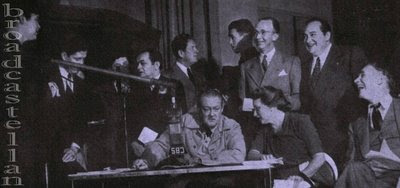
I might as well end this year’s regular programming here at broadcastellan with a bang. This one was sure made an impact, heard by as many as sixty million Americans—at once. Subtitled “A Dramatic Celebration of the American Bill of Rights, Including an Address by Franklin D. Roosevelt,” We Hold These Truths made radio history on this day, 15 December, in 1942. It also made the most of history in the making.
“No other single dramatic performance [. . . ] ever enjoyed so large an audience,” author Norman Corwin remarked in his notes on the published script. The program was “[w]ritten at the invitation of the US Office of Facts and Figures” to commemorate the 150th anniversary of the United States Bill of Rights, which came into effect on 15 December 1791,; but it was already in the works when the attack on Pearl Harbor took place.
“In fact,” Corwin later recalled (in Years of the Electric Ear), “I was on a train travelling from New York to Hollywood, still working on the script when the attack on Pearl Harbor took place.” Now that the United States had entered the war, the broadcast became a rallying cry, a reminder of the rights it is the duty of all those who possess them to protect.
“To many listening Americans,” Movie-Radio Guide summed up in its 3-9 January 1942 issue,
the big “Bill of Rights” program broadcast over the Nation’s networks Monday, Dec. 15, was an utterly unforgettable event. To the many personalities who joined their talents to produce the program it was likewise a memorable privilege. Coming as it did at a time when it could not have meant mere to the nation, the broadcast brought America figuratively to its feet. A transcription of the superb dramatic production [. . .] will be preserved in the archives at Washington.
The cast, as shown above, included Orson Welles, Rudy Vallee, Edward G. Robinson, Bob Burns, James Stewart, Walter Brennan, Edward Arnold, as well as (seated) Lionel Barrymore, Marjorie Main, and Walter Huston.
According to the Movie-Radio Guide, “[o]ne of the highlights of the presentation was the performance of James “Jimmy” Stewart.” So moved was he by the reading that, at the close of the broadcast, he “pulled off his earphones” and “let down his emotions, excusing himself from the studio and reportedly breaking into tears in private.” No wonder, Stewart was called upon to introduce President Roosevelt, who addressed the public from Washington, DC. Upon this experience, the humble actor remarked: “Imagine a corporal introducing a Commander in Chief of the armed forces!”
Four weeks and a day! As the exclamation mark suggests, being that I use it so sparingly, I am not counting down the days to New Year’s Eve here or marvel at the seemingly accelerated passing of time. It is the time my cold has been taking thus far to run its collision course and me crazy into the not so welcome bargain. It could be, though, that today’s headache has been exacerbated by Mickey Rooney.
My attempt to book tickets to his latest show, that is. I tried to get in touch with a sales representative to make sure that the tickets I ordered online won’t be sent to our home, as requested, given that, as it dawned on me only after I had finalized the booking, we are elsewhere during the latter part of December.
The apparently unstoppable octogenarian, Judy Garland’s co-star in a series of musical-comedies, is going to be in one of those pantomimes so popular in Britain during the holiday season; this time, some eighty-two years after his acting debut in motion pictures, he appears at the Hippodrome in Bristol, England, where we had planned to spend the final forty-eight hours of 2008.
The busy Mr. Rooney, slated to appear in four films in the upcoming months, stars opposite British stage and television actress Michelle Collins, whom last we saw backstage at the Shaftesbury Theatre in London (and whose autograph I displayed here). Anyway, I eventually sorted out the mailing situation and can only hope that the constitution of the man formerly known as Andy Hardy will prove sturdier than mine.
I am in the mood for a seasonal tale, tall or otherwise, but would much rather close my eyes than read Christmas Stories with its selection of fiction by Conan Doyle, Damon Runyon, Evelyn Waugh, and, a personal favorite, Anthony Trollope. So, once again, I rely on the radio, or recordings of plays once produced for the medium. On this day, 2 December, in 1945, The Philco Radio Hall of Fame presented a new story, which it predicted to “become a Christmas classic.”
Never mind that this prediction did not quite come true. After all, the woman who made it was not chiefly known as a clairvoyant, even though she had a voice that could induce millions to spend millions on war bonds and forge stars in the smithy of her own radio shows. Announcer Glenn Riggs somewhat needlessly reminded the public that, “as commentator, singer, forceful personality and discoverer of stars,” she had “no equal on the air.” Yes, it was Kate Smith who ventured that guess, no doubt boosting the sales of the volume. When Smith sings, you can count on sales as well as volume.
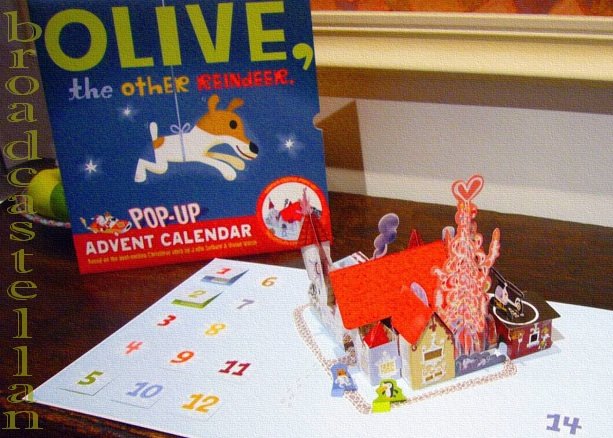
On the Hall of Fame, Smith not only belts out a number of tunes, including “If I Loved You” from the latest Rodgers and Hammerstein musical Carousel and her celebrated rendition of “God Bless America”; as story lady, Smith narrates a dramatized version of Roger Duvoisin’s “The Christmas Whale,” a whimsical paean to ingenuity involving the breakout of a flu epidemic at Santa’s toyshop and the reindeer that flew not because they all came down with it. Perhaps, such susceptibility explains why this year’s advent calendar featuring Olive, the Other Reindeer, arrived a day late in the mail.
The title of Duvoisin’s story leaves no doubt as to the creature lending a helping fin. Perhaps, the sudden substitution was a metaphor for the death of FDR just at the time when things were beginning to look up and the theaters of war were closing, not merely for the duration of the holidays. There is no mention of Harry Truman; but, when asked what Christmas gift she would make General Eisenhower, Smith remarks: “Well, I’d give him a future as great as his past.” Perhaps, she was prophetic after all . . .
“For twelve years, our nation was afflicted with ‘see nothing, hear nothing, do nothing’ government.” That is what President Franklin D. Roosevelt declared in a campaign speech at New York City’s Madison Square Garden on this day, Halloween, in 1936. Make that “eight years,” and a presidential nominee could give the speech today. Count the previous Bush administration and you got those twelve years, an era that the majority of those polled—and the majority of those looking on beyond US borders—are anxious to consider bygone next January.
“The nation looked to that government, but that government looked away,” FDR continued. It had been “nine crazy years at the ticker and three long years in the breadline. Nine mad years of mirage and three long years of despair.” Checking that Wall Street ticker lately, I have come to suspect that those years of despair and breadlines may well lie ahead. They will be a test for the candidate who succeeds next Tuesday.
FDR, who had pulled America out of that crisis, warned that “powerful influences” were “trying to restore that kind of government with its doctrine that that government is best which is most indifferent to mankind.” That, to me, sums up Republican politics, the kind of politics that count on the voters’ lowest impulse, individual greed, to sell its idea of carrying on at the expense of all else, be it nature or the future of mankind.
“For four years now,” FDR reminded his listeners,
you have had an administration, which instead of twirling its thumbs, has rolled up its sleeves. And I assure you that we keep our sleeves rolled up. We had to struggle with the old enemies of peace, business and financial monopoly, speculation, reckless banking, class antagonism, sectionalism, war profiteering. They had begun to consider the government of the United States as a mere appendage to their own affairs; and we know now that government by organized money is just as dangerous as government by organized mob.
Never before in all our history have these forces been so united against one candidate as they stand today. They are unanimous in their hate for me, and I welcome their hatred.
I am sure that many Republicans fear nothing more tonight than the impending end of politics as usual; and they have as good a reason to be afraid as do those who dread the prospect of having to endure such politics for another four, devastating years. Whatever your mask or affiliations, this is the night to be scared together. Happy Halloween!





 Harry Heuser