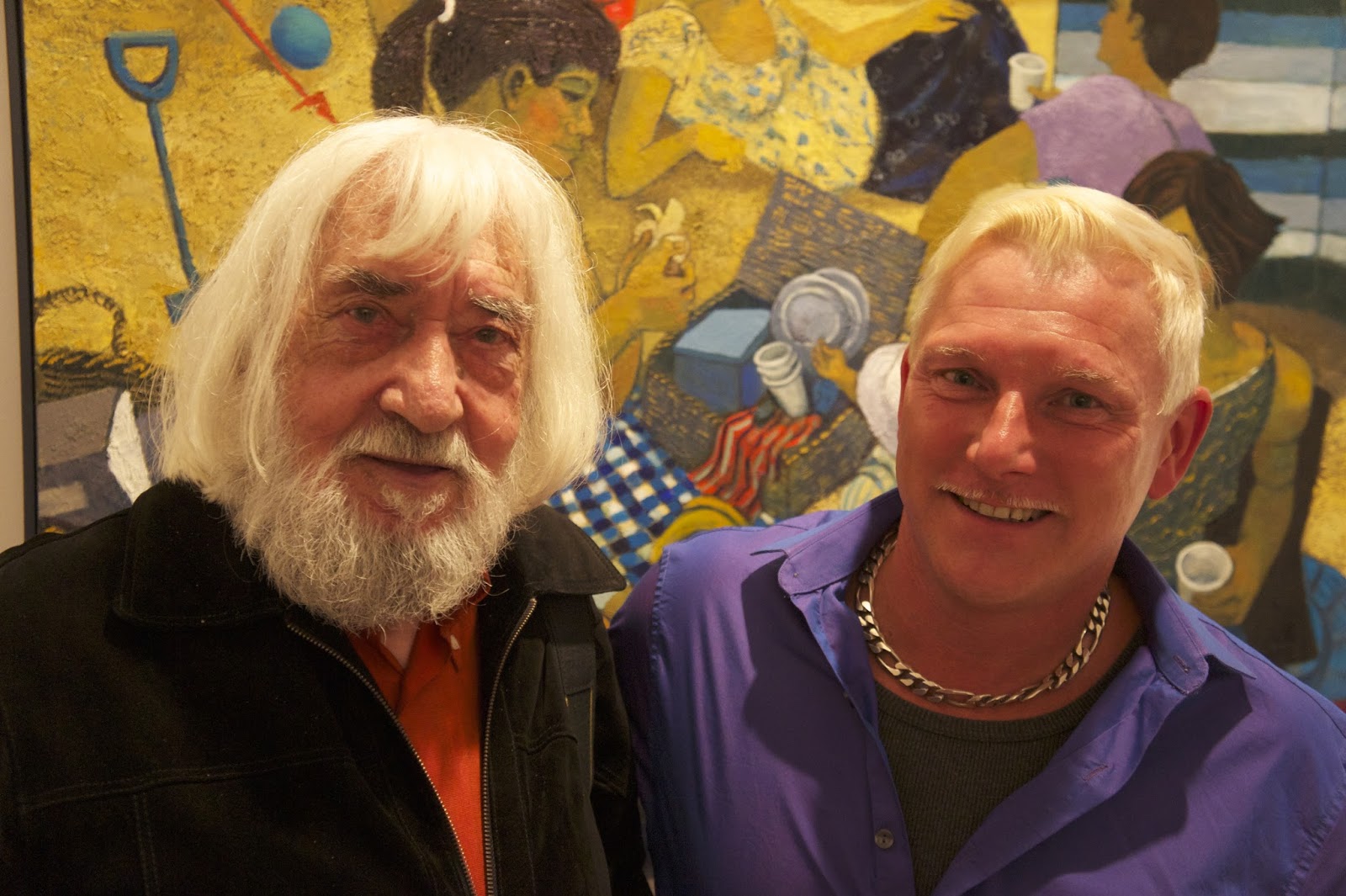
With Claudia Williams at one of her exhibition openings following the publication of An Intimate Acquaintance
I had not long arrived in sweltering New York City for a month-long stay in my old neighbourhood on the Upper East Side when I learned that, across the pond, in my second adopted home in Wales, the painter Claudia Williams had died at the age of 90. I first met Williams in 2005. She was conducting research on a series of drawings and paintings commemorating the flooding of a rural Welsh community to create a reservoir designed to benefit industrial England. With my husband and frequent collaborator Robert Meyrick, who had known Williams for years and staged a major exhibition on her in 2000, I co-authored An Intimate Acquaintance, a monograph on the painter in 2013.
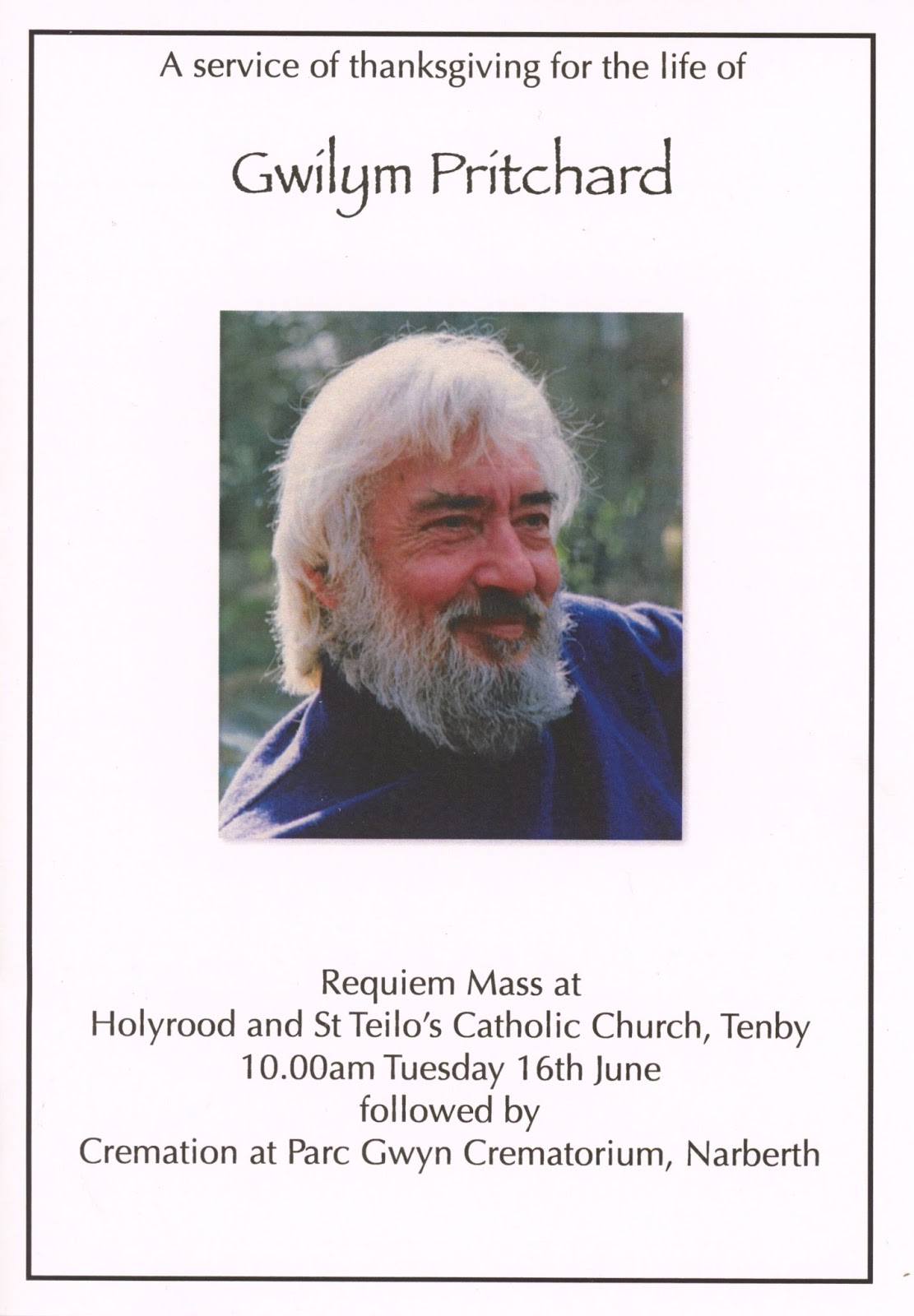
A decade later, an article by me on Williams’ paintings was published online by ArtUK on 28 May 2024; and just days before her death on 17 June 2024, I had been interviewed on her work by the National Library of Wales. So, when given the opportunity to write a 1000-word obituary for the London Times, I felt sufficiently rehearsed to sketch an outline of her life and career, as I had done previously on the occasion of her artist-husband Gwilym Prichard’s death in 2015.
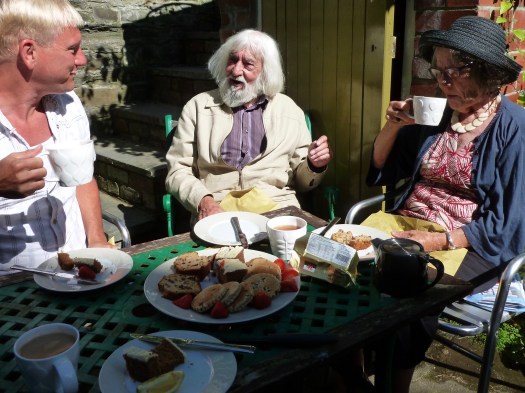
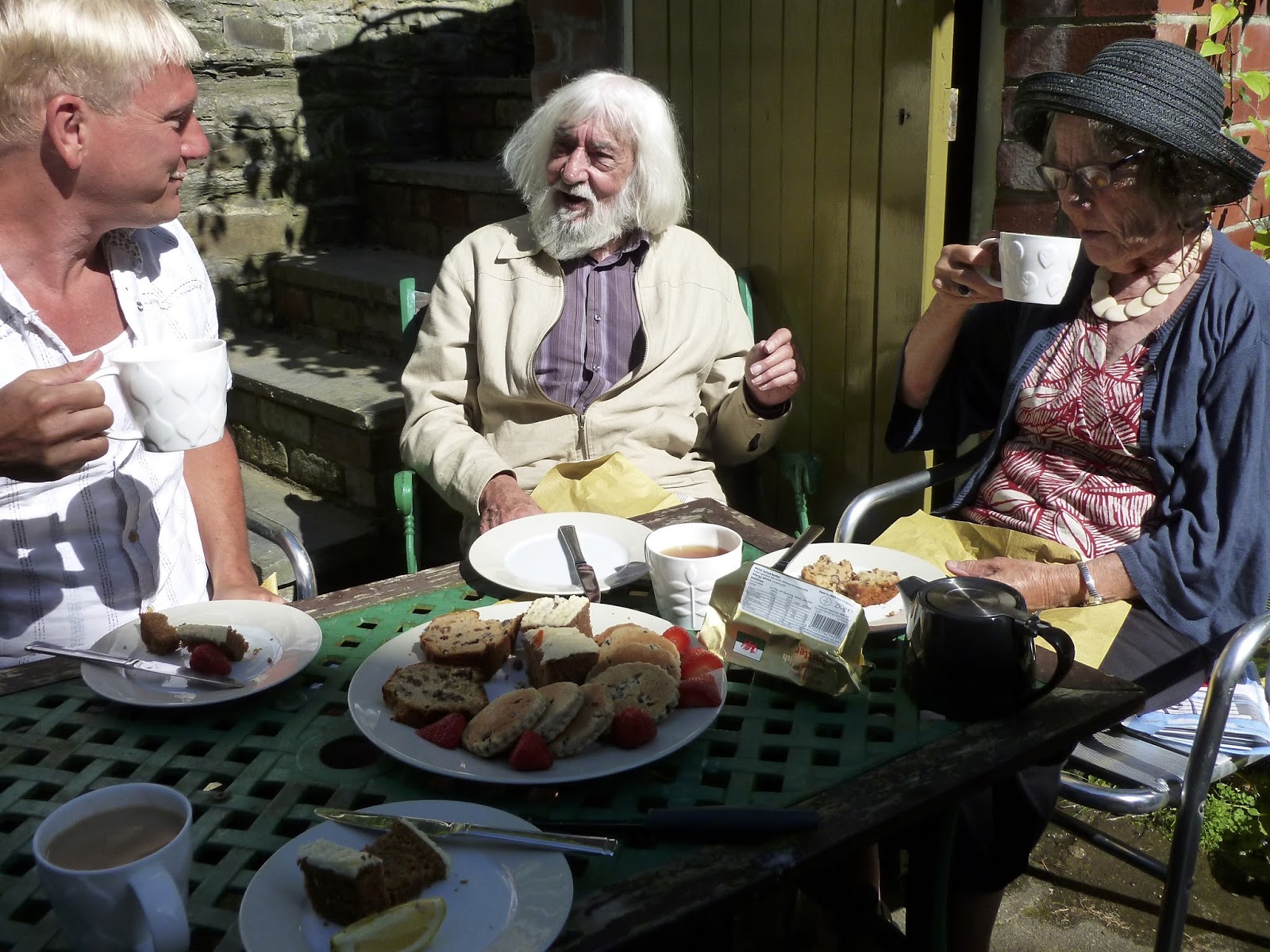
Lunch in the yard with Gwilym Prichard and Claudia Williams
All the same, I was concerned that it might be challenging to write another “original” essay, as stipulated by the Times, on an artist about whom I had already said so much and whose accomplishments I was meant to sum up without waxing philosophical or sharing personal reminiscences. In an obituary, salient facts are called for, in chronological order, as is a writer’s ability to determine on and highlight the essentials.
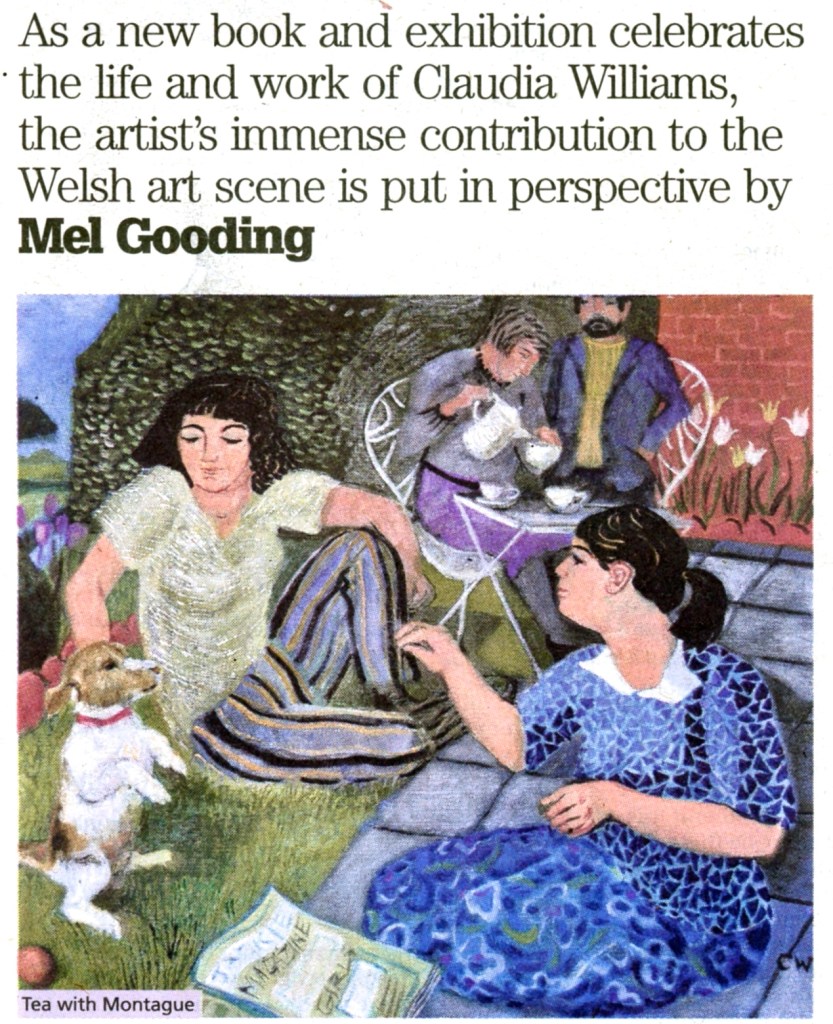
So I omitted recalling the enjoyment Williams derived from watching my Jack Russell terrier begging for food on his hind legs, a sight that inspired her painting Tea with Montague, or the “Mon Dieu” emanating from our bathroom when Williams and her husband, both in their seventies, intrepidly and jointly stepped into the whirlpool bathtub – slight episodes that, for me, capture Williams’ joie de vivre and her enthusiasm for the everyday.
Clipping of a newspaper article on An Intimate Acquaintance featuring my dog Montague as painted by Claudia Williams
In preparation for the monograph, Williams had entrusted me with her teenage diaries and other autobiographical writings, which meant there was plenty of material left on which to draw. Rather than commenting authoritatively on her contributions to British culture, I wanted to let Williams speak as much as possible in her own voice, just as her paintings speak to us, even though we might not always realize how much Williams spoke through them about herself.
What follows is the tribute I submitted to the Times.
Ceri H. Pritchard at his solo exhibition Paradoxes, MOMA Machynlleth, 18 Sept. 2021
Some creative sparks managed to rekindle themselves during the pandemic; stoked up by a keenly felt sense of do-or-die urgency, they keep generating alternative realities – or alternatives to reality – out of the deepest blue of mind-numbing, soul-crumbling chaos. While I do not quite succeed in numbering among those motivated mortals, visual artist Ceri H. Pritchard certainly does.
In front of Metamorphosis I at MOMA Machynlleth, with a temporarily unmasked Ceri H. Pritchard
His prodigious output, mordant wit and renewed openness to experimentation are on full display in his latest of a slew of solo shows. Ceri H. Pritchard’s Paradoxes opened on 18 September 2021 at MOMA Machynlleth, one of Wales’s most distinguished contemporary art galleries, and is on view there until 13 November 2021. I have been keeping up with Ceri’s work and am excited to see it transmogrify. I said as much, or as little, in the introductory text panel I was glad to contribute to his exhibition:
Ceri first invited me into his studio in 2015. A few years earlier, I had co-authored monographs on his parents, figurative painter Claudia Williams and the late landscape artist Gwilym Prichard. At the time, I was as yet unfamiliar with Ceri’s decades-spanning international career. It was an unexpected, disorientating encounter – in his parents’ house, no less – with what Ceri here terms ‘Paradoxes.’
I was perhaps too quick to label his paintings ‘neo-surrealist’ in an effort to get an art historical handle on the uncanny with which I was confronted: an otherworldly territory strewn with the detritus of modernity, with outcast and less-than-easy chairs, outmoded models of disconnected television sets, and displaced floor lamps shedding no light on matters.
Resisting further temptations to make sense of it all by trying to place the work, I did not initially consider – but subsequently discussed with Ceri – how his conspicuous enthusiasm for colour and his partiality for patterns is prominent as well in his mother’s work, although in subject and mood Ceri’s paintings could not be further removed from Claudia’s figure compositions expressive of the bond between mother and child.
And yet, the patterns in Ceri’s paintings, too, suggest blood bonds – biological ties, be it the universality of our molecular make-up or the common experience of life and death in the strange new age of COVID-19. Those repeated shapes bespeak at once commonality and change, circulation and evolution – and they remind us that what we share can also keep us apart.
Gwilym Prichard, Landscape (1960), detail
The mostly unpopulated landscapes painted by Ceri’s father, Gwilym, meanwhile, showed a preoccupation with home and belonging, with the uncovering of roots in ancient soil rather than the representation of the iconic sites of his native Wales. Ceri’s work, too, is concerned with home – but his approach to the question of belonging to particular cultures and traditions – is entirely different. It is the paradox of being at home with dislocation and familiar with estrangement.
Claudia Williams, The Toy Basket (1989) detail
The paradoxes that Ceri’s work communicate are not the consolidation of a calculated career move, an effort to set himself apart as much as possible from the tradition represented by his artist parents. They are felt, not fabricated. Ceri’s practice is informed by an international outlook, a transnational engagement with diverse cultures, high and low, in France, Mexico and the United States. The unresolved tension of paradox at play in his compositions reflects and responds to decades of being abroad and of returning as an artist whose paintings redefine the tradition of what it means to be living and working here and now – in twenty-first century Wales.
Upon first seeing Ceri’s work, I felt as if I were about to be let in on a secret: canvases that were still underway, waiting – ready or reluctant – to come out into the open. Catching up with his evolving work in his studio years later, in the middle of the pandemic, I sensed a renewed purpose, a conviction of having arrived at something worth the departure and of forging ahead, destination unknowable.
This is a body of work distinguished by something other than its now familiar set of iconography and ready tropes packaged for public exhibition. There is continued experimentation both in subject and technique – not just a recycling of a haunting image repertoire but a repurposing of found materials as well and an increasing openness to change and chance.
Ceri H. Pritchard, The State of Things (2021)
That air of mystery has not dissipated since I opened Ceri’s solo exhibition The Strange Edge of Reality at Tenby Museum and Art Gallery in 2016. And although encounters with art may become less personal in a museum setting, an institutional space can also contribute to our sense of discovery by making us become more aware of alternative approaches and canonical outliers we may not have expected to find there. Surprise, mystification, and a darkly humorous take on what it means to be alive at a time it seems impossible for future generations to get nostalgic about – all that may be experienced here, but also the realisation of being prompted to become part of a compelling narrative in the making.
Rather than look at Ceri’s paradoxes as puzzles to be solved it might be useful to regard them as open invitations to question our assumptions about culture, heritage, and about art produced in Wales today.
‘Mysteries,’ are ‘like the sun,’ the metaphysical poet John Donne wrote, ‘dazzling, yet plain to all eyes.’ And not unlike the metaphysical poets, Ceri’s compositions yoke together opposites to achieve a kind of reconciliation, a discordia concors (harmonious discord), even though, in Ceri’s case, the aim is not harmony: it is to become reconciled to remaining unsettled.
“I haven’t kept any diaries as such, apart from the odd word or two in my sketch books. I have never felt the need to write anything and I really cannot see the point why anyone would be interested in what I would have to say.” This is what the painter Gwilym Prichard wrote to me in reply to some questions I had while I was working on a monograph on his life and art. Knowing Gwilym, I also knew that, though he was a man of his word, one word might have to suffice even when I, as a would-be biographer, was hoping for a thousand.
Gwilym talked – and continues to talk – to us through his art; he also talked to his art and had, he told me, private conversations with the works as they came into being on the canvas. He didn’t think much of critics or the need for interpretation. He believed that an artist’s work should speak for itself. Terse as his words to me might sound, they were uttered in humility rather than indignation. “I am grateful,” he added in parenthesis, “that I have had some success with my painting – I really have very little confidence but what I produce or show is stuff that I have painted with love and sincerity. I hope that this comes through.” That love – and the success it brought – was easily documented, mostly through Gwilym’s paintings.
Above Rhostryfan (1982), the painting I chose for my
obituary of Gwilym in the Guardian
“Any more questions?” Gwilym continued his notes, which, much to my surprise, amounted to over thirty handwritten pages. Clearly, he did not mean to cut me off, and wished me and my partner, Robert Meyrick, “all the best with the writing” with which he had entrusted us. He answered every question, right down to the matter of the “t,” the letter he dropped from his surname in midlife whenever he signed his art.
That “writing,” A Lifetime’s Gazing, was a very special assignment for me. Through Bob, I met Gwilym and his artist wife, Claudia Williams not long after I had moved to Wales in November 2004. Back then, I felt distanced from Wales and the Welsh; I found it difficult to find myself or to find any purpose for myself here. In fact, I still struggle with that. I did not know then that I would end up working on Gwilym’s monograph. Though it began years later, the project offered me an opportunity to write about the culture that I, a German with a New York education, could never presume to call my own.
I could relate to Gwilym in his difficulties of expressing himself fully – I mean truthfully and meaningfully – in English, Welsh being his first language, the language of his childhood. Welsh spoke to him differently. “I am a Welsh painter because I am Welsh,” he wrote, refusing to make an issue of what he felt to be at the core of his being … something understood.
Gwilym described himself as “emotional,” and English was perhaps too much the language of adulthood or reason, too abstract for an artist who treasured the concrete – the rock, the sea, and the soil. The concrete had weight and depth for him, a weight and depth he did not have to measure because he felt it as an immeasurably rich presence, a constant in a life full of change and challenge.
How fortunate Gwilym was to have developed such a language; and how lucky we are to be hearing him with our own eyes whenever we look at the works that chart his journey …






 Harry Heuser