Little Lady Hee-Haw; or, A Temple Fit for Goebbels

On my only trip requiring an overnight bag during this stay-at-home summer, my husband and I drove from our patch on the west coast of Britain to the thoroughly overcrowded Cotswolds and, upon my urging, made a stop-over at the Welsh town of Hay-on-Wye, an internationally renowned haven for second-hand book lovers.  Now, musty old volumes and COVID-19 do not quite go together โ€“ or so I thought โ€“ considering that retail spaces generally set aside for them are rarely supermarket-sized.  However, Hay, which depends on the trade, managed to make it work; and, meeting the moment by donning a mask, I got to enjoy an afternoon of socially distanced and sanitized hands-on browsing.

Not that I walked away with any tomes of consequence.  While at the Cinema bookstore โ€“ a shop not limited to publications related to motion pictures โ€“ I discovered a nook stacked with a curious assortment of ephemera: German movie programs of the 1930s.  I am not sure how they ended up in a Welsh bookshop โ€“ but that dislocation may well have extended their shelf life โ€ฆ until a German such as I came along and took an Augenblick to sift through them.

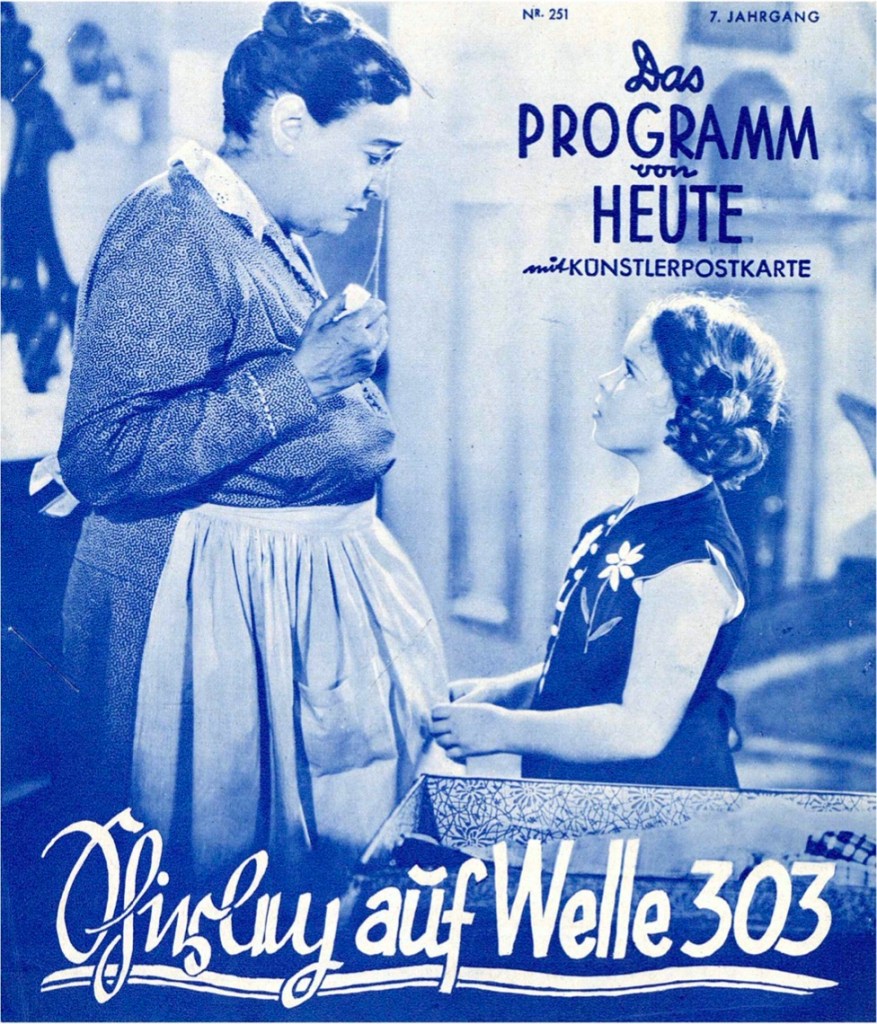
The program pictured above, dating from 1937, left me puzzled for a while.  I am familiar with many of Shirley Temple’s features โ€“ but I did not recall any among them bearing a title remotely like โ€œShirley auf Welle 303,” or โ€œShirley over Station 303.โ€ So, I picked up this fragile brochure, and a few others besides, if mainly to tap their potential as pop cultural conversation pieces.

The film being deemed worthy of commemoration is Rebecca of Sunnybrook Farm, a DVD of which is gathering dust in my video library.  The title refers to an early twentieth-century childrenโ€™s literature classic, although the movie version bears so little resemblance to it that it could hardly be considered an adaptation.  Not that the title of the novel would have resonated with German audiences. Meeting this challenge, the marketing people at Fox came up with a new one that might sound more relatable.

I suspect that the servants of the Nazi regime would have objected to the name of the titular character as well, being that Rebecca is Hebrew in origin, meaning “servant of God.” Shirley, on the other hand, was a household name, Ms. Temple having charmed audiences around the world since at least 1934. Like the titles of several other Shirley Temple vehicles released in 1930s Germany, the German version of Rebecca of Sunnybrook Farm therefore bears the first name of its star. Only Heidi stayed Heidi, rather than being translated into “Little Swiss Miss Shirley.”
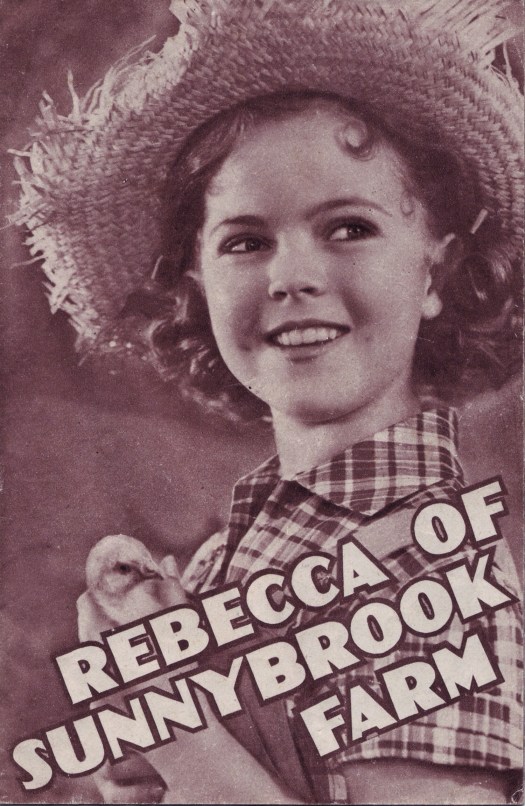
A contemporary British program for the same film, also in my collection.

And yet, the effort to make the film seem more relatable to Nazi Germany’s picture-goers nonetheless resulted in a title that was out of touch with Fascist reality. In 1938, when the film was released in German cinemas, the idea of using radio transmitters for your purposes โ€“ or for the purpose of exploiting a child for your own purposes โ€“ was inimical to state-controlled broadcasting. On the air, it was always “Germany Calling,” a phrase famously used by the aforementioned Lord Haw-Haw beginning in 1939.

Germans would have struggled in vain to twist the dial and hit on a broadcast like Shirley’s, or they would have paid a price for such twisting.ย ย Many of them listened via the Volksempfรคnger, a mass-produced receiver that was always tuned in to the Fรผhrer’s voice.ย ย Imagine staying tuned to Fox News all day.ย ย Then again, so many who do have the choice not to still do nonetheless, not unlike those who were complaisant during the rise of Fascism in Germany.

The change in title โ€“ and the recontextualization it achieves โ€“ is peculiar, and only a performer as innocuous as Shirley Temple could have gotten away with what otherwise would have been downright seditious: seizing the microphone and taking to the airwaves in a makeshift studio set up in a remote farmhouse.  Perhaps, the titular bandwidth โ€“ 303 โ€“ was to signal that Shirleyโ€™s broadcast had been sanctioned after all, 30 January 1933 being the date Hitler came to power. In the Third Reich, three was heralded as the charm.
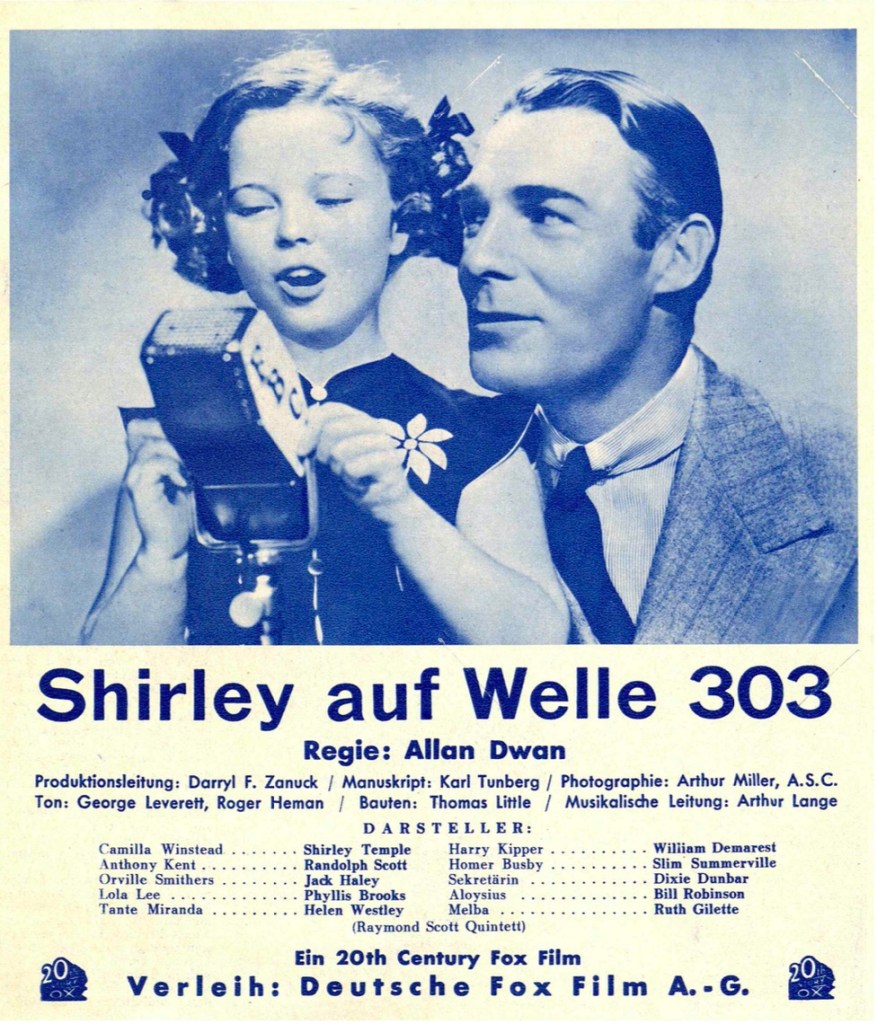
For decades, the German film industry did wonders โ€“ or, rather, wilful damage โ€“ to international films with its dubbing of their soundtracks; voicing over and voiding the content of the source, there were many opportunities to ready a film more substantive than Rebecca for consumption in Nazi Germany.  I do not recall seeing this movie in my native language, although I do remember a festival of her films airing on West German television in the late 1970s.  Not that watching Rebecca of Sunnybrook Farm in the original is an experience I am eager to repeat, clobbered together a vehicle for an overhyped and overworked child star about to wear out her welcome that it is. Variety dismissed the film at the time as a “weak story,” “indifferently acted and directed,” while claiming its lead to be “at her best.”

The German program does little more than summarize the plot as well as state the principal actors and main players behind the scene of the production; I am sure someone checked whether producer Darryl F. Zanuck was Jewish, which he was not. What struck me about the program was that it mentions the word โ€˜propagandaโ€™ twice in the first paragraph, where it was used as a substitute for advertising (in German, “Werbung” or “Reklame”).  Sending up the excesses of US consumerism while promoting the ostensible virtues of country living, this trifle of a film โ€“ distributed in Nazi Germany by the enterprising and accommodating “Deutsche” Fox โ€“ could serve as a vehicle for anti-American propaganda at a time when increasingly few US films were granted a release in Germany.

By making such trifles, and by marketing them for distribution in Nazi Germany, the US film industry contributed to the rise of Fascism, which, only after the attack on Pearl Harbor, Hollywood films began to confront with a suitably glossy vengeance. By that time, US films were banned in Germany, and Shirley Temple ceased to be a leading lady โ€“ at least in motion pictures.

Figured Speech: De-monstrating Lord Haw-Haw

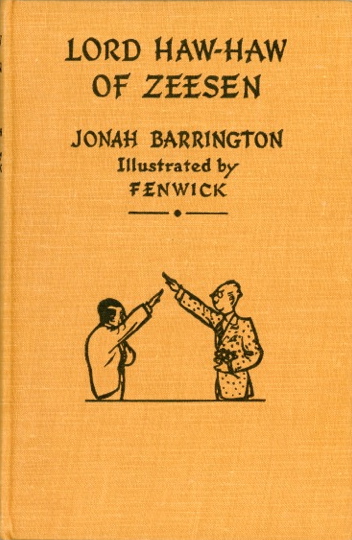
When I picked up this slim and curious volume, Lord Haw-Haw of Zeesen (1939), at an antiquarian bookstore in the Welsh border town of Hay-on-Wye, I was puzzled, to say the least.  I mean, I had heard aboutโ€”and had listened to recordings ofโ€”the notorious Lord Haw-Haw, the fascist broadcaster whose role it was to demoralize the British, to make them turn against their own government by convincing them that to side with the so-called Third Reich was the safest, surest way to march forward. Yet here was a bookโ€”written pseudonymously by a journalist calling himself Jonah Barrington and cartoonishly illustrated by an artist who went by the name of Fenwickโ€”that turned propaganda into satire by lending form and features to a voice of terror that was infiltrating the home front.

Yes, it is a curious performanceโ€”a biographical act of deflating a windbag, of knocking the stuffing out of a nameless, disembodied operative whose dangerous air of mystery was just plain hot by the time Barrington had laughed off the threat by calling it โ€œHaw-Haw.โ€  Those in Britain who, like Barrington, had caught the bizarre broadcasts from station Zeesen in Germany began to speculate about the speaker.  In the absence of evidence, Barrington created a character that, to him, had already โ€œbecome realโ€; and out of the polemics that โ€œnightly pollute[d]โ€ the British air, the journalist set out to weave โ€œsilly fancies.โ€

โ€œLet me make one point perfectly clear,โ€ Barrington added:

Although Fenwick and I have use our imagination in building up the home life and background of Haw-Haw and his fellow propagandists, the actual speeches credited here to them are given verbatimโ€”exactly as broadcast from the stations Hamburg, Cologne and Zeesen (D.J.A).

Lord Haw-Haw of Zeesen defused a crisis by giving a ridiculous shape to uncertain things to come, by making preposterously concrete what had been potentially persuasive or at least dangerously ambiguous hearsay.  Filmmakers and journalists had parodied Nazi figures beforeโ€”but the task of turning rhetoric into a figure of ridicule is a rather more complex strategy of counter-propaganda, especially since, in this case, print was rendering fictive what it had made definitive:

Haw-Haw in print needs stage directions, scene-setting and local colour. ย  And Fenwick neednโ€™t think heโ€™s going to sit back and do nothing, either. ย  You want the best of Haw-Haw, and we give it to youโ€”drawings and all.

Best or worst, readers of Lord Haw-Haw of Zeesen were meant to get the better of him.

โ€œ. . . reduced, blended, modernisedโ€: The Wireless Reconstitution of Printed Matter

Nearly two centuries ago, young Rebecca Sharp marked her entrance into the world by hurling a book out of a coach window. That book, reluctantly gifted to her by the proprietress of Miss Pinkertonโ€™s academy for young ladies, was Johnsonโ€™s dictionary, a volume for which Ms. Sharp had little use, given that she was rarely at a loss for words. By the time her story became known, in 1847, words in print had become a rather less precious commodity, especially after the British stamp tax was abolished in 1835, which, in turn, made the emergence of the penny press possible. Publications were becoming more frequentโ€”and decidedly more frivolous.

Gone were the days when a teenager like Mary Jones, whose story I encountered on a trip to the Welsh town of Bala last weekend, walked twenty-five miles, barefooted, for the privilege of owning a Bible. Sure, I enjoy the occasional daytrip to Hay-on-Wye, the renowned โ€œTown of Booksโ€ near the English border where, earlier this month, I snatched up a copy of the BBCโ€™s 1952 Year Book (pictured). Still, ever since the time of the great Victorian novelists, the reading public has been walking no further than the local lending library or wherever periodicals were sold to catch up on the latest fictions and follow the exploits of heroines like Becky Sharp in monthly installments.

In Victorian times, the demand for stories was so great that poorly paid writers were expected to churn them out with ever greater rapidity, which left those associated with the literary trade to ponder new ways of meeting the supply. In Gissingโ€™s New Grub Street (1891), a young woman assisting her scholarly papa is startled by an

advertisement in the newspaper, headed โ€œLiterary Machineโ€; had it then been invented at last, some automaton to [. . .] turn out books and articles? Alas! The machine was only one for holding volumes conveniently, that the work of literary manufacture might be physically lightened. But surely before long some Edison would make the true automaton; the problem must be comparatively such a simple one. Only to throw in a given number of old books, and have them reduced, blended, modernised into a single one for todayโ€™s consumption.

Barbara Cartland notwithstanding, such a โ€œtrue automatonโ€ has not yet hit the market; but the recycling of old stories for a modern audience had already become a veritable industry by the beginning of the second quarter of the 20th century, during which โ€œgolden ageโ€ the wireless served as both home theater and ersatz library for the entertainment and distraction craving multitudes.

A medium ofโ€”and only potentially forโ€”modernity, radio has always culled much of its material from the past, โ€œReturn with us nowโ€ being one of the phrases most associated with aural storytelling. It is a phenomenon that led me to write my doctoral study Etherized Victorians, in which I relate the demise of American radio dramatics to the failure to establish or encourage its own, autochthonous, that is, strictly aural life form.

Sure, the works of Victorian authors are in the public domain; as such, they are cheap, plentiful, and, which is convenient as well, fairly innocuous. And yet, for reasons other than economics, they strike us as radiogenic. Like the train whistle of the horse-drawn carriage, they seem to be the very stuff of radioโ€”a medium that was quaint and antiquated from the onset, when television was announced as being โ€œjust around the corner.โ€

Perhaps, the followers of Becky Sharp should not toss out their books yet; as American radio playwright Robert Lewis Shayon pointed out, the business of adaptation is fraught with โ€œartistic problems and dangers.โ€ He argued that he โ€œwould rather be briefed on a novelโ€™s outline, told something about its untransferable qualities, and have one scene accurately and fully done than be given a fast, ragged, frustrating whirl down plot-skeleton alley.โ€

It was precisely for this circumscribed path, though, that American handbooks like James Whippleโ€™s How to Write for Radio (1938) or Josephina Niggliโ€™s Pointers on Radio Writing (1946) prepared prospective adapters, reminding them that, for the sake of action, they needed to โ€œretain just sufficient characters and situations to present the skeleton plotโ€ and that they could not โ€œafford to waste even thirty seconds on beautiful descriptive passages.โ€

As I pointed out in Etherized, broadcast writers were advised to โ€œfree [themselves] first from the enchantment of the authorโ€™s styleโ€ and to โ€œoutline the action from memory.โ€ Illustrating the technique, Niggli reduced Jane Eyreโ€”one of the most frequently radio-readied narrativesโ€”to a number of plot points, โ€œbald statementsโ€ designed to โ€œeliminate the non-essential.โ€ Only the dialogue of the original text was to be restored whenever possible, although here, too, paraphrases were generally required to clarify action or to shorten scenes. Indeed, as Waldo Abbotโ€™s Handbook of Broadcasting (1941) recommended, dialogue had to be โ€œinvented to take care of essential description.โ€

To this day, radio dramatics in Britain, where non-visual broadcasting has remained a viable means of telling stories, the BBC relies on 19th-century classics to fill much of its schedule. The detective stories of Conan Doyle aside, BBC Radio 7 has just presented adaptations of Thackerayโ€™s Vanity Fair (1847-48), featuring the aforementioned Ms. Sharp, and currently reruns Trollope’s Barchester Chronicles (1855-67). The skeletons are rather more complete, though, as both novels were radio-dramatized in twenty installments, and, in the case of Trollopeโ€™s six-novel series, in hour-long parts.

BBC Radio 4, meanwhile, has recently aired serializations of Trollope’s Orley Farm (1862), Wilkie Collinsโ€™s Armadale (1866) and Mary Elizabeth Braddonโ€™s Lady Audleyโ€™s Secret (1862). Next week, it is presenting both Charlotte Brontรซโ€™s Villette and Elizabeth Gaskellโ€™s Ruth (both 1853), the former in ten fifteen minute chapters, the latter in three hour-long parts.

Radio playwright True Boardman once complained that adaptations for the aural medium bear as close a relation to the original as โ€œpowdered milk does to the stuff that comes out of cows.โ€ They are culture reconstituted. โ€œ[R]educed, blended, [and] modernisedโ€œ, they donโ€™t get a chance to curdle . . .

Note: Etherised Victorians was itself ‘reduced and blended,’ and published as Immaterial Culture in 2013.


Related writings (on Victorian literature, culture and their recycling)
โ€œHattie Tatty Coram Girl: A Casting Note on the BBCโ€™s Little Dorritโ€
โ€œValentine Vox Pop; or, Revisiting the Un-Classicsโ€
“Curtains Up and ‘Down the Wires'”
Eyrebrushing: The BBC’s Dull New Copy of Charlotte Brontรซ’s Bold Portrait”

In My Library: Radio Drama and How to Write It (1926)

The man behind the counter looked none too pleased when I handed over my money. This one, he said, had escaped him. The item in question is a rare little volume on radio drama, written way back in 1929, at a time when wireless theatricals were largely regarded, if at all, as little more than a novelty. In his foreword, Productions Director for the BBC, R. E. Jeffries, expressed the not unfounded belief that its author, one Gordon Lea, had the “distinction of being the first to publish a work in volume form upon the subject.”

Nothing to get excited about, you might say. I know, it is not exactly a prize pony, this old hobbyhorse of mine. Few who come across it today care to hop on, let alone put any money on it, particularly now that it has been put out to the pasture known as the internet, the playing field where culture is beaten to death. So, should not any bookseller be pleased to part with Mr. Lea’s reflection on echoes? Not, perhaps, when the money exchanged amounts to no more than a single pound coin. History often comes cheaply; it is the price for ignoring it that is high.

I had been on the lookout for Radio Drama and How to Write It while researching for Etherized Victorians, my doctoral study on old-time radio in the United States. After no volume could be unearthed in the legendary and much-relied on vaults of the New York Public Library, let alone anywhere else, I gave up the search, comforted by the thought that Mr. Lea was, after all, a British hobbyhorse fancier, far removed from the commercial network circus in which I had chosen to study that ill-treated bastard of the performing arts.

It helps to take the blinders off. After all, I spotted the obscure volume last weekend, on another trip to Hay-on-Wye, the Welsh bordertown known the world over (by serious collectors, at least) as the “town of books.” Now, I am always anxious to put my loot on display. And so, rather to let it sit on my bookshelf, I shall let Mr. Lea’s pioneering effort speak for itself:

It is asserted that no play is complete until it has an audience. This is untrue. One might as well say that a tragedy of emotion between man and wife, enacted in the privacy of their own drawing room, is not a tragedy, because the general public are not invited to watch it. A play is complete when once it is conceived by its author. But, inasmuch as this fallacy is still popular, playwrights still construct their plays with an audience in mind.[. . .].

Thus, Lea reasons, the stage play

must be such as can appeal to a crowd, as distinct from the individual. This is a difficult thing to do, but such is the power of crowd-psychology, that if the play appeals to a section of the crowd, the disparate elements can be conquered and absorbed into the general atmosphere. An audience may, at the beginning of the play, be a company of individuals, but before long hey are by the devices of stage-production welded into one mass with one mind and one emotion. If the play is incapable of this alchemy, it fails to please and becomes a thing for the solitary patron. 

There, then, are the conditions which govern the production of the stage-play, and [ . . .] within the limitations of the theatre are wonderfully efficacious. 

But, is it necessary to accept these limitations? Is there no other medium more flexible?

In stage drama there is “always the problem of the fourth wall,” the solving (or dissolving) of which lead to intriguing if unsatisfactory compromises. In a production of The Passing of the Third Floor Back, for instance, the footlights were turned into an imaginary fireplace. “[V]ery ingenious,” the author quips,

but the effect is that, when the players sit before the fire, you have the spectacle of people staring straight at you, and, unless you imagine yourself to be a lump of coal or a salamander, you don’t get the right angle.

I was reminded of my experience seeing What Every Woman Knows at the Royal Exchange in Manchester, which thrust me into a similar hot spot I did not relish.

Sure, sound-only drama can readily break the barriers of convention. Yet when Lea dreams of the new medium and its potentialities, he has technology, not commerce or politics, in mind. Whether state-run or commercially sponsored, radio was never quite as free and free as the air. The audience, its size and sensibilities, always mattered more than the voice of the single speaker.

Nor am I convinced that a play is a play without playing itself out before or within an audience, whatever its number. A thought must be communicated to mean, and indeed to be. It is for this reason that I air out my library from time to time, to dust off those forgotten books and share what I find there in this, the most flexible medium of all . . .

Many Happy Reruns: Katharine Hepburn and Leslie Charteris

Well, I prefer doing it slowly, in narrow, dusty aisles, surrounded by strangers. Browsing for second-hand books, I mean. Nowadays, it is so much easier, and often cheaper, to pick up that elusive volume by going online, rather than making a day of it in out-of-the-way bookstores, antique shops, or flea markets. Iโ€™m not giving up on that experience, thoughโ€”on the thrill of the hunt and the triumph of the catch. Hay-on-Wye, where I went yesterday, is the very place for such a literati safari. It is a tiny Welsh village with a population of about 1500; but its narrow streets are lined with about forty bookstores, some of which specialize in Hollywood cinema and crime fiction. That’s where Hepburn and Charteris, both born on this day in 1907, will come in . . . eventually.

Yesterday, I came home with a little something for my Claudette Colbert collection (pictured), with another copy of Norman Corwinโ€™s Thirteen by Corwin (a fine one with dust jacket, previously owned by the BBC research department), and a title from the Directors Guild of America Oral History series, an interview with television pioneer Worthington Miner.

Prior to entering television in the late 1930s (yes, NBC did have a television schedule back then, even though only a few thousand Americans owned a set), Miner had been a theatrical producer in the 1930s; and, in March 1937, his leading lady was none other than Ms. Hepburn, who starred in an adaptation of Jane Eyre (previously discussed here).

According to Miner,

Katie was a wonderful Jane; it was her cup of tea, and she sparkled. But we had a dreadful Rochester and an even worse last act. [. . .] As a result, we decided to book it on the road for a few months and not risk bringing it into New York. For weeks on end it battled the elements, storms and tornados, floods and disasters, without an empty seat in the house. Katieโ€™s name was already a prodigious drawn in the hinterlands. Jane Eyre made a tidy profit, but the kudos was nil for any of us, even Katie herself.

Years, later, Miner was involved in securing the rights Long Day’s Journey Into Night for another producer, with whom Miner strongly disagreed about Hepburn in the role of Mary Tyrone. Miner believed that Hepburnโ€”a “mercurial, unpredictable performer”โ€”was utterly โ€œwrongโ€ for the part. In the “right” role (Tracy Lord in The Philadelphia Story, for instance, which she reprised in several radio productions) she was โ€œincomparable, a class unto herself.โ€ When miscast, however, she could be “aggressively, monstrously bad.” To me, Undercurrent comes to mind; Hepburn was just not cut out to be the victim, even when permitted to fight back.

Someone very much angered by Hollywood casting was Saint creator Leslie Charteris, who shares Hepburn’s birthday. I have mentioned previously (and have been corrected on some muddled facts by Saint expert Burl Barer), that Charteris was not at all pleased when George Sanders took over the role of his Robin Hood of Modern Crime. He much preferred Louis Hayward, who had portrayed Simon Templar in The Saint in New York.

Now, one of the writers involved in adapting Charteris’s novel for the screen was Irwin Shaw, whose play Bury the Dead Miner had produced on Broadway and whose final radio play, “Supply and Demand,” he directed for the Columbia Workshop in the spring of 1937, when Hepburn was touring with Jane Eyre.

Perhaps I am overly fond of such six-degrees-of-separation games; but with some Miner assistance, I could almost send Hepburn and Charteris on a dinner date, discussing a role that might have been swell as a follow-up for Bringing Up Baby: a sophisticated screwball-mystery of The Thin Man variety.