
Joan Blondell in Dachau

I am no historian. At least not in a traditional facts-and-figures sense. Early in life, I became doubtful of efforts to account for the present by recounting the past of a place or a people. Growing up โ€“ and growing up queer โ€“ in Germany during the 1970s and 80s, I was not encouraged to find myself in such accounts. ย After all, how could I have developed a sense of being part of a national history? The present did not make me feel representative even of my own generation, while the then still recent past was presented to me as the past of a different country. A different people, even. A people whose history was not only done but dusted to the point of decontamination.

Visiting Dachau, June 2015

That many of those people โ€“ those old or former Nazis โ€“ were all around me and that the beliefs they held did not get discarded like some tarnished badge was apparently too dangerous a fact to instill. Pupils would have turned against their teachers.ย  Children would have come to distrust their parents. They might even have joined the left-wing activists who were terrorizing Germans for reasons about which we, endangered innocents and latent dangers both, were kept in the dark.

As I have shared here before โ€“ though never yet managed adequately to convey โ€“ I left Germany in early adulthood because I felt uneasy about my relationship with a country I could not bring myself to embrace as mine. Itโ€™s been a quarter of a century since I moved away, first to the US and then to Wales.ย  For over two decades, I could not even conceive of paying the dreaded fatherland a visit.ย 

Eventually, or rather suddenly, that changed. In recent years, I have found myself accepting offers to teach German language, history and visual culture, assignments that made me feel like a fraud for being second-hand when imparting knowledge about my birthplace.ย  I realized that I needed to confront the realities from which I had been anxious to dissociate myself.
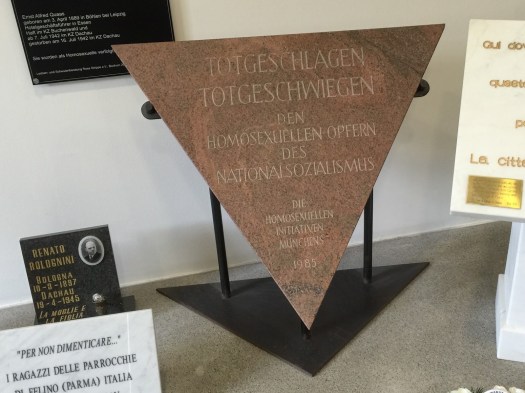
Beaten to death, silenced to death”:
A memorial to the homosexuals killed during
the Nazi regime, made in the year I came out.

This summer, I visited the Dachau concentration camp for the first time.  There, in the face of monumental horrors, I was drawn to one of the smallest and seemingly most inconsequential object on display: a cigarette card featuring the likeness of 1930s Hollywood actress Joan Blondell.

Dates and figures are no match for such a fragile piece of ephemera. To be sure, the macabre absurdity of finding a mass-manufactured collectibleโ€”purchased, no less, at the expense of its collectorโ€™s healthโ€”preserved at a site that was dedicated to the physical torture of real people and the eradication of individuality could hardly escape me.

But it was not this calculated bathos alone that worked on me.ย  It was the thought that I, too, would have collected such a card back then, as indeed I do now. Investing such a throwaway object with meaning beyond its value as a temporary keepsake, I can imagine myself holding on to it as a remnant of a world under threat.
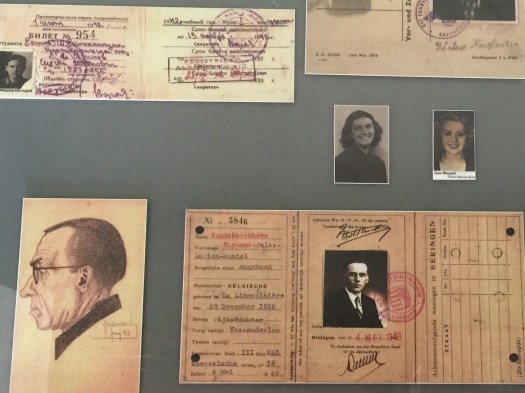
Lives taken, identities recovered at Dachau.
Unexpectedly, a picture of Joan Blondell

Looking at that photograph of Joan Blondell at Dachau, it was not difficult for me to conceive that, had I been born some forty years earlier, I might have been sent there, or to any one of the camps where queers like me were held, tortured and killed.  That minor relic, left behind in the oppressive vastness of the Dachau memorial site, speaks to me of the need to take history personal and of the importance of discarding any notion of triviality. For me, it drives history where it needs to hit: homeโ€”home, not as a retreat from the world but as a sense of being inextricably enmeshed in it.

Joan Blondell, meanwhile, played her part fighting escapism by starring in “Chicago, Germany,” an early 1940s radio play by Arch Oboler that invited US Americans to imagine what it would be like if the Nazis were to win the war.
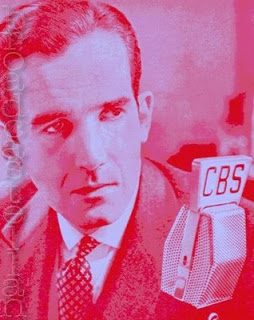
โ€œ. . . and it was built to lastโ€: A Message from Buchenwald

I rarely hear from my sister; sometimes, months go by without a word between us. I have not seen her in almost a decade. Like all of my relatives, my sister lives in Germany. I was born there. I am a German citizen; yet I have not been โ€œhomeโ€ for nearly twenty years. It was back in 1989, a momentous year for what I cannot bring myself to call โ€œmy country,โ€ that I decided, without any intention of making a political statement about the promises of a united Deutschland, I would leave and not return in anything other than a coffin. I donโ€™t care where my ashes are scattered; it might as well be on German soilโ€”a posthumous mingling of little matter. This afternoon, my sister sent me one of her infrequent e-missives. I was sitting in the living room and had just been catching up with the conclusion of an old thriller I had fallen asleep over the night before. The message concerned US President Obamaโ€™s visit to Buchenwald, the news of which had escaped me.

Just in time, I turned on the television to listen to the Presidentโ€™s speech, and to the words of Buchenwald survivor Elie Wiesel. I was relieved to hear the President talk of the Nazis as โ€œhuman.โ€ His predecessor would no doubt have resorted to โ€œevil.โ€ How much more meaningful is the word โ€œhumanโ€โ€”an acknowledgment of shared responsibility that forces us to relate rather than stand apart from any presumably unmitigated horror, thereby encouraging us to look at ourselves as potentially capable of the acts we are so eager to denounce as โ€œinhuman.โ€

I was stirred, too, by the seemingly incongruous message of Elie Wiesel, who expressed himself at once doubtful and full of hope, who spoke of the futility of war at the very site of triumph over tyranny. Yet how can one avoid resorting to the violence of the paradox, whether used in the despair of reason or for the purpose of achieving the kind of harmony the metaphysical poets knew as โ€œdiscordia concorsโ€? How else, if at all, can one account for the life and deaths at Buchenwald, for the monstrously rational, the efficiently profligate, the methodically mad?

One of the first Americans to have witnessed and documented Buchenwald shortly after its liberation was CBS news commentator Edward R. Murrow. On 15 April 1945, three days after first setting eyes on the concentration camp, Murrow confronted his listeners with a report prefaced by the following disclaimer:

Permit me to tell you what you would have seen and heard had you been with me on Thursday. It will not be pleasant listening. If youโ€™re at lunch, or if you have no appetite to hear what Germans have done, now is a good time to switch off the radio. For I propose to tell you of Buchenwald.

Bringing his eyewitness account to the ears of his fellow Americans, Murrow yokes together the incongruous to evoke the incalculable. Putting his finger on the imbalance of recorded figures and observable facts, he weigh in on the scale of humanityโ€™s failure and thereby succeeds in making the measureless ponderable. Broad statistics are presented alongside minute details. Observations of suffering are contrasted with references to Buchenwald as the โ€œbest concentration camp in Germany,โ€ a camp โ€œthat was built to lastโ€ yet built for annihilation.

Murrow speaks of an orderly pile of bodies, a prominent political figure starved beyond recognition, a warning against pickpockets in a scene of horrendous crime, and a new beginning of Buchenwaldโ€™s internees that coincided with the death of Franklin D. Roosevelt.

At one point, Murrowโ€™s report takes us into a โ€œcleanโ€ kitchen that supplies next to no food:

[The German prisoner, a communist, in charge of the kitchen] showed me the daily ration: one piece of brown bread about as thick as your thumb. On top of it a piece of margarine as big as three sticks of chewing gum. That, and a little stew, was what they received every twenty-four hours. He had a chart on the wall. Very complicated it was. There were little red tabs scattered through it. He said that was to indicate each ten men who died. He had to account for the rations, and, he added, “We’re very efficient here.โ€

โ€œIf I have offended you by this rather mild account of Buchenwald,โ€ Murrow adds, โ€œI am not in the least sorry.โ€ After all, had he not begun his report with the incongruous invitation to โ€œswitch off the radioโ€?

I knew switching off only too well. As a child and adolescent growing up in West Germany, I felt the incongruousness of being a good German keenly. I was raised in a small village in which a synagogue rotted away unnoticed, history and hope debased as a pigsty. At school, classmates echoed their parents by defending Hitler as the builder of the Autobahn; at home, my paternal grandmother openly spoke of her awareness of what was happening to her Jewish neighborsโ€”and then severed her connections by reducing me to the pink triangle I had pinned on myself by coming out.

I have been weighed down by collective guilt. I have lived under the terror of the extreme left and experienced the lure of the ultra-right as a stance of ultimate defiance. I failed to reconcile my responsibilities of facing history with any chance of personal happiness. So I left.

Perhaps I have been on the run ever since; trying to distance myself from the past I made my present an evasion. My life abroad has been, by and large, an existence in the neither here nor there, its escapism more shameful than my inescapable origins. Yet how else can we expect to make a clean start of it if our feet remain stuck in the soil we are anxious to shake?

It was with some unease that I realized just what I had been watching before my sister returned me to the reality of now: a neat puzzle in which every murder is accounted for and executed according to plan; a โ€œvery efficientโ€ murder mystery that reduces horror to a formula borrowed from an old and politically incorrect nursery rhyme; film released, no less, in the year of the death camp liberations. You see, before I listened to the speeches at Buchenwald I had been counting down bodies in And Then They Were None.


Related recording
Edward R. Murrowโ€™s report from Buchenwald (15 April 1945)

Related writings
โ€œThe Wannsee Konferenz Maps Out the Final Solutionโ€
โ€œArthur Miller Asks Americans to “Listen for the Sound of Wings”
โ€œFrom the House of Terrorโ€

Holocaust Ending: The Boy in the Striped Pyjamas

โ€œEnjoy the movie.โ€ That is the response we get when we tell friends and acquaintances that we are on our way to the cinema. And while it is true that we generally seek enjoyment, whether by looking at separated lovers or severed heads, movie-going can be a disconcerting, unsettling event well beyond the shocks and jolts provided by horror and romance. The Boy with the Striped Pyjamas (a British film in its British spelling), is likely to be such an experience to anyone with a pulse and a sense of humanity ready for the tapping. To me, it was nothing short of devastating. I am not resorting to hyperbole when I say that I was rendered speechless; those accompanying me can attest to my disquietude. It has been a decade since last I watched a film (Saving Private Ryan) that has stirred and traumatized me to such a degree that, coming out of the theater, I felt sick to my stomach. No wonder. I had just been coerced into walking straight into the gas chamber of a concentration camp.

Whimsical and naรฏve, The Boy with the Striped Pyjamas is a suitably misleading title for a story that is out to challenge and deceive you. It is not your traditional Hollywood response to the horrors of the Third Reich, which is why I refer to the filmโ€™s conclusion as a Holocaust ending. Hitchcock might have voiced his objections, as he did in the case of his own Sabotage (previously discussed here); but the dark twist in Mark Hermanโ€™s melodrama is no cheap device to rattle your nerves: it is both heart wrenching and thought provoking, as the emotions it elicits will be mixed, depending on whose life, whose position you examine: those engaged in the horror or those consumed by it.

The Boy with the Striped Pyjamas is largely told from the perspective of a child, which is to say that it casts a familiar and much examined world into a twilight of the uncannyโ€”the known revisited as the hazily uncharted in the act of exploration. The Boy is about as un-Hollywood in its exploration of childhood and fascism as Panโ€™s Labyrinthโ€”and similarly gruesome. In its final scenes, in which terrified parents run through the woods in search of their son, it resembles the horror of a Grimmโ€™s tale before Disney got his fingers on it.

The Boy is uncompromisingly bleak. The title character, as you might have guessed, is a Jewish child in a Nazi concentration camp. As I was reminded on a recent visit to Riga, Latvia, the camp uniform does indeed resemble old-fashioned sleep ware, a comparison all the more poignant if we consider that the camps were the final resting place for most of its inmates.

The central character, though, is the son of a Nazi officer. Eight years old, he is unaware of what is going on beyond the walls of his austere new home, the one to which his family moved from Berlin after his father was assigned with the supervision of the nearby concentration camp. To the boy in his cheerless isolation, the camp is farm, a lively community where he might make new friends. Day after day, he ventures through the woods to the electric fence behind which he descries a boy is own age, a fellow whose life seems mysterious and exciting to him. Why should he accept that his new playmate is separated from him? Why not ignore or overcome this barrier? Why not wear โ€œstriped pyjamasโ€ to be just like his new friend?

We have the answers to those questions; history provided them, and everyday life often confirms them. We know what happened. We might even know what is going on right now. Some of us know and are ready to confess to the limits of our humanity, the margins beyond which fall those whom we consider in the abstract of numerals rather than as individuals. The Boy is too intimate a story to be called metaphorical. We are being sentenced to death, and the filmโ€™s ending is our own. Facing it, we realize that beyond knowing lies the challenge of understanding.

"Well, excuse me for living, Anita Bryant"

Most of us have what in common parlance is known as baggage. If you were to rummage through mine, you’d come across a few reels of film. Moving images that get pushed around like a burden too heavy to carry, celluloid that somehow came to deposit itself under the by now leathery skin of my much travelled case. One such movie, to me, is Robert Wise’s I Want to Live (1958). Few moments in film made a greater impression on me than Susan Hayward’s final scenes in this hysterical nightmare of a melodrama, which I first saw when I was a child of seven or eight (we have so few accurate records for experiences such as watching television).

I was staying with my grandmother who saw it fit to sit me in front of the tube all day, flicking between the two available channels, and letting me โ€œgorge and guzzleโ€ like an Augustus Gloop picking the plate of Mike Teavee until I had to be taken back to my parents after developing a fever from the exposure to all those images flashing before me. I have not watched I Want to Live since. Since last night, that is.

Violent and brash, I Want to Live is hardly what you might call family fare; here in Britain, it still carries an advisory label suggesting the age of fifteen as the appropriate time for exposure. How terrifying it was for me, the boy I still know, to witness the execution of a human being, the slow death by poison staged with minute precision. There was that phone that would not ring, that call that would not come. After all these years, I was convinced it would be ringing, after all, if only too late to save the life of Barbara Graham (played by Susan Hayward, pictured above).

As I said, I had not seen this film since that first time. Along the way, I heard it mentioned, gradually realizing it to be an iconic picture, a title in scarlet lettering, the kind of incendiary pulp to which the likes of me are drawn. I knew early on what “the likes of me” were; but I was as yet unfamiliar with the secret language shared among my kind, something understood.

Years later, living in New York, I caught a rerun of the Golden Girls, the sitcom to which I, a non-immigrant German studying in the US, owed much of my colloquial English. There was Sophia Petrillo, locking herself up in the bathroom, upset that her daughter Dorothy does not approve of her wedding (to her Jewish boyfriend, Max Weinstock). The caterer storms in, overhearing the reconciliation of elderly mother and grown-up child. “This is more moving,” he breaks out, “than Susan Hayward’s climactic speech in I Want to Live.โ€ “You’re ready to fly right out of here,” sneers Dorothy’s roommate Blanche at the sight of this Pangbornian display. “Well, excuse me for living, Anita Bryant!” the insulted caterer fires back.

I am with the caterer. In fact, I have been with the caterer and their friend Dorothy since I was about five. Perhaps, this is why I responded so strongly then to what the film claims to be a wrongful sentencing, the incarceration and sacrificing of an exuberant outcast. Not that I am trying to hand out psychoanalytic cheese puffs here.

Still, it was strange to revisit Graham’s final moments last night, so many decades later, seeing myself watching an old movie, still recognizing that boy. What was my grandmother thinking? It struck me that this was the woman who, years later, told me that she knew about the concentration camps and the gassing of the Jews. The same woman who refused to talk to or correspond with me after it had become clear that I was to remain a caterer and would never have that wedding.

There she sat with me, watching a woman going into the gas chamber. Was she reminded of the many deaths she had condoned? Was there a secret chamber of her heart into which no poison could rush? Would she have turned the switch on me and my pink triangular kind?

As if any underscoring of such melodramatic excesses were needed, Graham went out with a bang. Not just metaphorically. The lamp of our movie projector (one of those $500 bulbs) imploded just before she was led to that chamber. There won’t be any screenings for a while, except for those pictures that keep flickering on the back of my eyelids, reels in the baggage to be pushed around until it is time for me to push off . . .

On This Day in 1942: The Wannsee Konferenz Maps Out the Final Solution

An engagement with old-time radio need not be an escape from the world; it can be a return to the very realities we may have been desirous to avoid or void altogether. Listening to recordings of historical broadcasts can become a confrontation with the past, its representation, and, in the act of relating, with the present itself. Today, for instance, marks the anniversary of the Wannsee Conference at which, on 20 January 1942, the fate of eleven million European Jews was being debated and decided upon with the matter-of-factness and statistical precision known as the โ€œfinal solutionโ€ (the minutes of which genocidal get-together can be found here). Few radio playwrights were as committed to representing the Jewish experience as Morton Wishengrad, whose 1942 play “The Battle of the Warsaw Ghetto” is as chilling and relentless as the calculated cruelty of the master(race)minding behind the massacre on which it comments.

Wishengrad, a prolific and politically engaged playwright whom noted radio actor Joseph Julian once called the only writer beside Corwin to have created a “body of radio literature that deserves a perennial life,” lets the record speak for itself in his chilling echo of fascist calculating and cataloguingโ€”of a nationโ€™s counting, counting down, and accounting of murder millionfold. In “The Battle of the Warsaw Ghetto,” first heard on NBC on the eve of Yom Kippur in 1943, the personal story of a holocaust victim, related from the grave, is reinforced by the sound of โ€œblack trucksโ€ rolling out of the Ghetto to the concentration camps, by the three voices of fate (the three fates?) calling up the facts with a statistical precision that echoes the calculated ruthlessness of the acts planned and committed:

VOICE I. July 22, 1942.
VOICE II. Six thousand two hundred and eighty-nine.
VOICE III. Destination . . . Tremblinka.
VOICE I. July 23rd.
VOICE II. Seven thousand eight hundred and twenty.
VOICE III. Destination . . . Oswiantzem.
VOICE I. July 24th.
VOICE II. Seven thousand four hundred and forty-four.
VOICE III. Destination . . . Belzec.ย 

(Biz: Voices and truck sounds hold under narrator.)ย 

NARRATOR. Done with method, precise, efficient, recorded. ย To Tremblinka, Oswiantzem, Belzec, Sobibor, Majdanyโ€”a lethal gas chamber, an electric furnace, a poison pit, an execution field, a cemetery. ย And add also ten thousand brave, hopeless, tragic men who seized sticks and stones and knives and bare fists and charged the tanks and tried to halt the trucks. ย Add their bodies to the list for the ten days of June, 1942. Make your total and then add two precise, methodical, documented months in August and September, 1942. ย Reckon it. ย Do it carefully. ย You cannot do it on your fingers. ย No! Let me give you the sum. ย Listen, 275,954 fewer bread cards in the Ghetto! Swift, accurate, final. ย Quicker than typhus, surer than hunger.

The records of the Wannsee Konferenz became instrumental in the gathering of evidence for the Nuremberg Nazi trials, another somber occasion dramatized on 16 October 1946 by playwright Arnold Perl, whose docudrama “The Empty Noose” suggested that, while the masterminds of the Third Reich had been hanged, the thoughts behind their actions were still very much alive, both in America and abroad. The regularly scheduled whodunitย The Adventures of Ellery Queenย was not heard that night.

“The medium needs writers who have something to say about the culture,โ€ Wishengrad remarked in his foreword to The Eternal Light, an anthology of scripts from the series. Old-time radio drama also deserves listeners who take in and respond with their ears and minds open.