
" . . . from numberless and nameless agonies": The Bill of Rights Remembered

I might as well end this year’s regular programming here at broadcastellan with a bang. This one was sure made an impact, heard by as many as sixty million Americans—at once. Subtitled “A Dramatic Celebration of the American Bill of Rights, Including an Address by Franklin D. Roosevelt,” We Hold These Truths made radio history on this day, 15 December, in 1942. It also made the most of history in the making.

“No other single dramatic performance [. . . ] ever enjoyed so large an audience,” author Norman Corwin remarked in his notes on the published script. The program was “[w]ritten at the invitation of the US Office of Facts and Figures” to commemorate the 150th anniversary of the United States Bill of Rights, which came into effect on 15 December 1791,; but it was already in the works when the attack on Pearl Harbor took place.

“In fact,” Corwin later recalled (in Years of the Electric Ear), “I was on a train travelling from New York to Hollywood, still working on the script when the attack on Pearl Harbor took place.” Now that the United States had entered the war, the broadcast became a rallying cry, a reminder of the rights it is the duty of all those who possess them to protect.

“To many listening Americans,” Movie-Radio Guide summed up in its 3-9 January 1942 issue,

the big “Bill of Rights” program broadcast over the Nation’s networks Monday, Dec. 15, was an utterly unforgettable event. To the many personalities who joined their talents to produce the program it was likewise a memorable privilege. Coming as it did at a time when it could not have meant mere to the nation, the broadcast brought America figuratively to its feet. A transcription of the superb dramatic production [. . .] will be preserved in the archives at Washington.

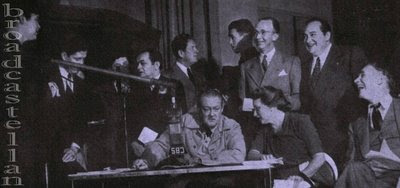
The cast, as shown above, included Orson Welles, Rudy Vallee, Edward G. Robinson, Bob Burns, James Stewart, Walter Brennan, Edward Arnold, as well as (seated) Lionel Barrymore, Marjorie Main, and Walter Huston.

According to the Movie-Radio Guide, “[o]ne of the highlights of the presentation was the performance of James “Jimmy” Stewart.” So moved was he by the reading that, at the close of the broadcast, he “pulled off his earphones” and “let down his emotions, excusing himself from the studio and reportedly breaking into tears in private.” No wonder, Stewart was called upon to introduce President Roosevelt, who addressed the public from Washington, DC. Upon this experience, the humble actor remarked: “Imagine a corporal introducing a Commander in Chief of the armed forces!”

Rosalind Russell and James Stewart Entertain with Cheap Silverware

The first cut is the deepest.  Less profound words have been said and sung about love and longing. Even so, to call a new line of cutlery “First Love” doesn’t strike me as such a sharp idea. That’s exactly what Rosalind Russell was hawking on the radio, though—and it was purportedly all her idea, too. Some time before she discovered the magic of “Jungle Red,” Ms. Russell was slicing the baloney rather thickly when, on this day, 3 October, in 1937, she stepped behind the microphone to sell cheap silverware. Granted, there was a little more to this knife-throwing act. Ms. Russell was parting the curtain for a new and ambitious series of radio theatricals called The Silver Theater—and a young James Stewart was hand-on-mike to assist her.

Unlike the flatware, the new program was aptly named The Silver Theater, considering that it was sponsored by the International Silver Company, makers of 1847 Rogers Brothers, billed as “America’s finest silver plate.” Undoubtedly inspired by the success of the Lux Radio Theater, the “Silver Company” went for radio advertising in a major way. It sponsored a weekly drama anthology featuring some of Hollywood biggest stars, players like Cary Grant and Clark Gable, Carole Lombard and Bette Davis. The stories were, for want of a better word, original. They were written for radio, that is, regardless of their merit as audio-only plays.

For the premiere of the program, heard on this day in 1937, the sponsors secured the talent of Oscar-nominated screenwriter Grover Jones, who penned an all too familiar story of a girl trying to strike it rich in cutthroat Hollywood. The girl, of course, was Rosalind Russell, and the guy she settles for, James Stewart. Nearly two decades after this outing, Stewart would star in his own radio series, The Six Shooter; but back in 1937, the comedic mumbler was not yet cut out for radio. Russell, on the other hand, was in fine voice. She sure knew how to talk both fast and clearly, a talent that would serve her well in His Girl Friday.

For the premiere of the Silver Theater, Russell agreed to play Girl Friday to the sponsors. That is, she not only committed herself to play, live, in a four part series, to be aired Sunday afternoons from CBS’s West Coast studios; she also became a spokesperson for International Silver. According to the announcer, she happened upon the name of the company’s new line of flatware, “First Love,” which the savvy producers rendered more prominent still by turning it into the title of the opening play. Why, when she saw the cutlery, Ms. Russell professed, she “just fell right in love with it. Any woman would. You see, well, what I mean to say is, if you saw it. . . .” At this point the announcer graciously cuts in, so to speak, relieving Ms. Russell from the well rehearsed task of peddling flatware . . . until next week.

One year later, Russell would return to the Silver Theater, once more playing opposite James Stewart; she was heard again on the program in 1941 and 1943. Her cut was apparently substantial enough to warrant a return engagement. The Silver Theater, while never reaching the fame or popularity of the Lux program, continued to raise its curtain until 1947. In radio dramatic terms, its most distinguished writer was playwright True Boardman, who later referred to the business as a “prison,” the “thickness” of whose walls and the “strength” of whose “bars” would “vary with different sponsors,” but whose “four walls” would always remain.

Hearing your lines come out of the mouth of Rosalind Russell? I guess even prison walls have a silver lining.