Please, Mr. Memory: Concussion on The Thirty-Nine Steps

I felt torn last night. Torn between The Falcon’s Brother (in which George Sanders passes the thriller franchise to sibling Tom Conway) and John Buchan: Master of Suspense, a television documentary about the author of The Thirty-Nine Steps. Quandaries like these are peculiar to life in a single-TV household. Considering that I am going on a New Year’s trip to Glasgow (where Buchan grew up) and just saw a dramatization of his classic spy novel in London, I decided in favor of the latter. Not that the documentary (part of BBC Four’s Adventures for Boys season) did much to clear the muddle my mind, at work under the influence of Patrick Barlow’s stage adaptation, has made of the Steps, one of those books everyone claims to know but few ever read, let alone without preconceptions.

Now, I have read Buchan’s 1915 novel (available online here); and, like most readers who come to it by way of Alfred Hitchcock’s 1935 adaptation, I was astonished at the film’s brazenfaced infidelity. I was disappointed, as well. Missing was the wit that Hitchcock and writer Charles Bennett brought to the original by reworking it in the screwball comedy tradition. It Happened One Flight, they might as well have called what amounts to conclusive proof that tying a male hero to a dame (absent in Buchan’s story) does not have to slow down a fast-paced chase. Infusing sex appeal rather than sentimentality, Hitchcock’s cinematic update created a new adversary for the already much-beleaguered hero, Richard Hannay, who finds that a lot can go wrong in the effort to do right.

Barlow’s dramatization, by comparison, aims at demonstrating that a lot can go right in the effort to do wrong. When I read that John Buchan’s “The 39 Steps” was playing at London’s Criterion Theatre (where it can bee seen until April 2007), I had reason to expect an update of the novel, rather than a recreation of the film, however farcical the treatment (as reviews and poster art suggested).

As it turns out, Buchan’s novel has little to do with the nightly frivolities at the Criterion. The attribution to Buchan in the title of Barlow’s play (based on an “original concept” by Simon Corble and Nobby Dimon) seems to be part of an elaborate practical joke—a set-up in which spectators gladly take the fall since they are being coddled by travesty into assuming themselves superior to the material, whatever its source. Being tongue-in-cheek is a convenient escape, a laughing away of what could—and perhaps ought to—have been an engagement or confrontation with Buchan’s story, a tale of espionage and persecution anxities so relevant in this age of terror and so-called anti-terrorism.

Aside from the material of which John Buchan’s “The 39 Steps” makes light, the main attraction of the play lies in its being performed by a cast of only four actors, who dare to take on well over a hundred characters. With a small supply of basic props, those nimble four are shown in the ludicrous struggle to recreate the screenplay as realized by Hitchcock (who, in one of the many inspired moments of silliness, makes a cameo appearance in silhouette). This minimalist-absurdist approach to adaptation was not entirely a novelty act to me, having previously attended a production of The Importance of Being Earnest acted out by a cast of two.

Overly familiar as well felt the play’s reflexivity, its awareness of and delight in the improbability of being equal either to Buchan’s spy story or Hitchcock’s screwball caper. Many self-conscious remakes operate in this manner, escaping the challenge of finding the new in the old by making a mockery of the attempt at renewal and a mess of what is presumably so outmoded that it deserves nothing more than a send-up.

There is enjoyment in seeing things go awry, no doubt; and John Buchan’s “The 39 Steps” rewards theatergoers for their knowledge of the Hitchcock version (one of three film adaptations of the story). Cineastes will appreciate the effort that went into finding ways of making it almost work, whereas those who read and respect Buchan may regret how much is being squandered by ignoring his paradigm. After all, his thrills, too, depend on the pleasure derived from seeing things go awfully wrong, albeit with far higher stakes for the protagonist and his world.

Calling the play John Buchan’s The 39 Steps obscures the fact that the first motion picture adaptation was already a comic revision of Buchan’s rip-roaring yarn. Going after Buchan, Hitchcock managed to be fresh (both new and irreverent) without losing sight of the hunter-on the-run formula that would serve him so well, without neglecting the task of dusting off this decades-old story for action-seeking motion picture audiences. Forgoing thrills, sentiment, and politics alike, Barlow is strictly after laughs.

That said, the bungled dramatization is a chuckles-filled joyride for those who take pleasure in playing fast and loose with supposed literary classics. I gladly go along, provided I can still pride myself in being able to tell a sly impostor from the real thing. Instead, the theatrical experience has given me somewhat of a concussion, leaving me in a state of confusion that neither the aforementioned documentary nor the numerous American radio dramatizations (by the Lux Radio Theater and the Mercury Players, for instance) are likely to clear up. Was Richard Hannay a South African, a Canadian, or a Scotsman? Was he driven by the impulse to save a crumbling empire, to counter boredom, or to clear his name? Come to think of it: just who built The Thirty-Nine Steps, an unstable architectural composite of which now arises before my mind’s eye?

Even Mr. Memory won’t be of much assistance to me, I suspect. Besides, he is . . . but you know the story.

To the Moon

It has been hailed as “magnificent” and “mesmerizing.” Kevin Spacey’s performance in the Old Vic production of Eugene O’Neill’s A Moon for the Misbegotten, I mean. After seeing the Old Vic’s take on The Philadelphia Story last year, in which Spacey, the theater’s artistic director, acted less-than-Cary Grantly opposite Jennifer Ehle, I was skeptical, to say the least. The Spacey age at the Old Vic has proven a troubled one.
I have yet to experience anything “mesmerizing” at the Old Vic, where, aside from Spacey’s turn in A Moon and Philadelphia Story, I also watched Sir Ian McKellen camping it up as Widow Twankey in Aladdin, which struck me, unaccustomed to the Christmas panto tradition, as disenchanting and tawdry. A Moon is well beyond both of those trifles, without quite rising above unevenness. I am not sure, though, whether to attribute my dissatisfaction with it to the script, the production, the performances, or to a perverse streak all my own—which accounts for the mess I made of these oft-revised notes.

To begin with Spacey, whose career I’ve been following since the early 1990s, when I was introduced to him by a mutual friend, backstage at the Richard Rodgers Theatre on Broadway, where the man who would be Lex Luthor appeared with whatever-happened-to-Academy-Award-winner Mercedes Ruehl in Neil Simon’s Lost in Yonkers. No doubt, I have been trying to discover the man in his parts ever since, which does not help matters. Spacey’s off-stage persona has irked me at times, an uneasy, calculated ease that threatens to render his acting as disingenuous as an act. Then again, selecting his roles for stage or screen, he seems most comfortable and convincing in the skin of the con, the trickster, or the sham.

In A Moon, Spacey is Jim Tyrone, a middle-aged, self-confessed “third-rate ham” who lays bare his conscience-tormenting past while under the influence, in a state where men are most likely to drop their masks. Spacey’s Jim is a queer duck, more likely to drop a glass than a hint of hidden truths: there are elements of camp in his gestures and postures, suggesting a self-indulgent act rather than honesty.

In his “reflections” on A Moon (published in the playbill), Spacey claims that the challenge of impersonating a drunk is to play him “so he doesn’t become monotonous.” Was it just that, or could playing the lush be an opportunity to go “gay all of a sudden” (to quote Grant’s character in Bringing Up Baby) and explain such release as temporary spasms?

A Moon is a play of lost schemes and the schemers who get lost in them, who struggle to redeem themselves by scrapping their act or getting it together. The central character is Josie Hogan, a farmer’s daughter whom O’Neill envisioned as “so oversize for a woman that she is almost a freak,” a dated, gender-stereotyping description Eve Best could not be expected to fit. Just as Spacey’s Jim may not know as much about loving women as he claims, being that he is more likely to adore or assault than to embrace them, Josie only puts on the act of a wanton to conceal that she is virtuous, a quality she derides as being “worse than decent.”

Despite his flaws, Josie has fallen in love with Jim; or, rather, she loves him for his vulnerability when exposing them. She might have more satisfaction forgoing the company of men altogether, considering that she is being manipulated into becoming a mantrap for Jim in order keep a roof over the pighead of her father (Colm Meaney). While not lacking in willfulness, she is the only one of Hogan’s children to remain on the farm, having assisted in the escape of her younger brother, a “New England Irish Catholic Puritan, Grade B” (played by an altogether miscast Eugene O’Hare, who seemed to have gotten into the first act on a Guy Madison scholarship).

Disregarding O’Neill’s instructions, Bob Crowley, the designer in charge at the Old Vic, places what there is of action in a surrealist set reminiscent of the Dust Bowl conceived by Dali instead of a September day in the Connecticut of the early 1920s. As a symbol of farmer Hogan’s crookedness and his lost dream of a plot, this hovel of a crazy house created in me a sense of dislocation that even the earthy performance of Irish actor Meaney could not counter. And yet, it is a set fit for a play that seems set on estrangement, that sets you up by setting out as comedy but never quite settles there.

There are shades of Ah, Wilderness!, the lightest, least controversial of O’Neil’s works, considered inoffensive enough to be frequently adapted for American radio during his lifetime; but then this Moon, considered unfit for Broadway until long after the playwright’s death in 1953, turns on you and the light-heartedness gives way to some heavy-handed, drawn-out confessionals.

The audience, like the titular satellite, is being compelled to keep circling what amounts to a rehearsal for a funeral during which fears and failings are exposed and confessed, talked about rather than dealt with, let alone resolved. Redemption has rarely felt quite this unredeeming. If the lack of resolution may be considered a triumph of modernism, the orbiting in the sphere of words strikes me as a failure in dramaturgy.

The circular and roundabout are not without their returns; but, I’d rather be spinning quietly in a chairoplane (like the one at the fun fair on London’s Leicester Square, pictured above) than sit through what amounts to a cycle of remorse and unfulfilled desires.

Being Here: Living Reconciled to Virtuality

Well, it has been two weeks since my last entry in the broadcastellan journal. I have been on trips to England’s two largest cities, London and Birmingham (pictured, in my rather futuristic snapshot), spending time with friends, taking in culture high and low. I rarely stay away that long from this virtual nook I call home. Whenever there is living to be done, I tend to fall behind with the chronicling of same; and when I finally catch up with myself in writing, the reporting seems pointless, the moment past. Perhaps it is this inability to reconcile actuality to virtuality that convinced me to keep a journal devoted to the presumably out-of-date.

Instead of summing up the fortnight that was, I am looking ahead, announcing the pieces I am going to share in the days to come. For what remains of the year (and of my time online), I shall file a few belated reports from the theaters, virtual and otherwise.

For the most part, it has been “otherwise” rather than otherwise. After my short trip to Birmingham, where I was introduced to Patrick Hughes’s mind-teasing “Superduperspective” (on view, free of charge, at the Waterhall until 17 February 2007), I went to see the aged Ron Moody as Scrooge in a touring production of Dickens’s A Christmas Carol. While in London, I took in A Moon for the Misbegotten starring Kevin Spacey (whose career I have been following ever since I was introduced to his work by a mutual friend); an irreverent adaptation of Hitchcock’s The Thirty-Nine Steps, performed by a cast of four; and the musical Daddy Cool, based on the once hugely popular songs of Frank Farian (of Milli Vanilli infamy), many of which provided a soundtrack for my childhood in Germany. I am going to devote one essay each to these diverse stage entertainments, and am likely to toss in the occasional reference to American radio dramatics, the formerly free theater for the multitude.

There isn’t much “free” theater to be had these days; and, judging from the American accents I picked up only infrequently while in the UK capital, London is rather too expensive to attract many Western travelers, particularly at this time of year, when many forgo culture for commerce in their search of bargains. Although I moved from the US to Britain quite some time ago, I still think in dollars and convert pounds into US currency to assess costs. It is a habit that made the ticket prices at London’s movie theaters seem all the more outrageous. I guess we laughed more at our folly than at the penguin antics when we found ourselves paying $25 per person to see Happy Feet. Somewhat less pricey were screenings of Casino Royale (an antemeridian matinee at London’s premier movie house, the Odeon Leicester Square) and Stranger Than Fiction, playing at a much smaller venue.

Going to the pictures has gotten pricey; and that applies not only to those in motion: the current exhibition of paintings by Velasques at the National Gallery requires the forking over of an eyepopping £12. As price tags raise expectations, the paintings seemed to lose some of their lustre when considered in the light losing itself in empty pockets. No wonder I keep turning to the comparatively cheap thrills of old-time radio drama for my day-to-day amusement.

Though no longer free, there was much on offer at home, if only I had been listening to the radio. Still to be enjoyed are Sir Ian McKellen in Sir Gawain and the Green Knight and a production of Shakespeare’s Cymbeline, both aired on BBC radio The BBC makes programming available online for a week, and I am now trying to catch up with some of the outstanding or noteworthy dramas presented in recent days—from the gay wedding at The Archers to the five-part adaptation of A Room to Let, a story collaboratively conceived by Charles Dickens, Wilkie Collins, and Elisabeth Gaskell—broadcasts I missed while wirelessly away in England.

Mind you, I could have enjoyed wireless access at our hotel—for the price of £15 a week; but, more than the cost itself, I resented being prompted to provide personal data in order to be granted a privilege that ought to be free like the air itself. Paying for air charged with the particles of commerce? Being charged yet again for exposing myself to a deluge of online advertising while depriving myself of an opportunity to recharge? Progress? Bah, humbug!

"This . . . is London": Casting John Donne’s Shadow

If Gothic Nightmares at the Tate Britain failed to send shivers down my receptive spine, the National Portrait Gallery’s Searching for Shakespeare sure did nothing less. I am generally not one to wax poetic at the sight of artefacts that may or may not have belonged to some literary so-and-so. For the most part, I don’t really care what a writer looked like, as long as his or her prose or poetry is to my liking. To be sure, having studied and taught Shakespeare during my college and university days, I am sufficiently impressed by the sight of an old Folio edition. Something else caught my mind’s eye at that exhibition; and it was not one of the supposed likenesses of Shakespeare—many of which have long been proven spurious—but the portrait of one of his contemporaries.

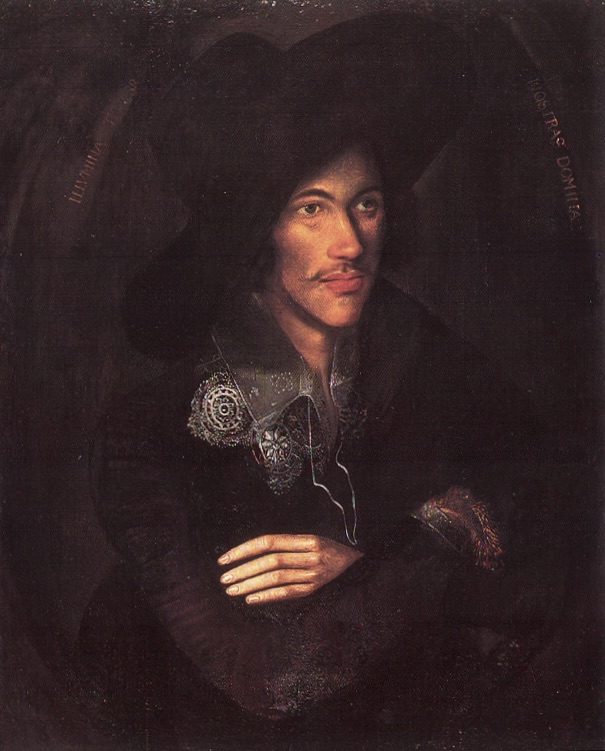
Portrait of John Donne by an unidentified artist (c. 1595) National Portrait Gallery, London

The portrait in question is that of John Donne, a painting currently being offered to the National Portrait Gallery, which is trying to raise funds in the amount of £1,652,000 to obtain it before the purchasing opportunity expires at the end of May. So, the picture now hangs in the Shakespeare exhibition, where visitors have to pay to get a glimpse of it. It is well worth a glimpse, I assure you. I confess the pleasures I derive from being moved by a work of art, whether considered trifling or momentous, and it is not rare that I stand before a painting with tears welling in my eyes or goose bumps sprouting on my skin. Composed by an unknown artist around 1595, the Donne portrait is decidedly of the gooseflesh variety.

It is in poems like “His Picture” and “Witchcraft by a Picture” that Donne speaks to us about attempts at portraiture, about the art or hubris of capturing life, the act of imitating nature or surpassing creation—troubling thoughts for a former Roman-Catholic growing up in the turmoil of the Reformation and its sanctioned smashing of images. In the former poem, Donne writes:

I fix mine eye on thine, and there
Pity my picture burning in thine eye;
My picture drown’d in a transparent tear,
When I look lower I espy;
Hadst thou the wicked skill
By pictures made and marr’d, to kill,
How many ways mightst thou perform thy will?

But now I’ve drunk thy sweet salt tears,
And though thou pour more, I’ll depart;
My picture vanished, vanish all fears
That I can be endamaged by that art;
Though thou retain of me
One picture more, yet that will be,
Being in thine own heart, from all malice free.

In the latter piece, Donne suggests the mental image and the imaged man to be at odds; a painting is a memento mori, which, fixed in time, turns into an unlikeness of fleeting life.

Here take my picture; though I bid farewell,
Thine, in my heart, where my soul dwells, shall dwell.
‘Tis like me now, but I dead, ’twill be more,
When we are shadows both, than ’twas before.

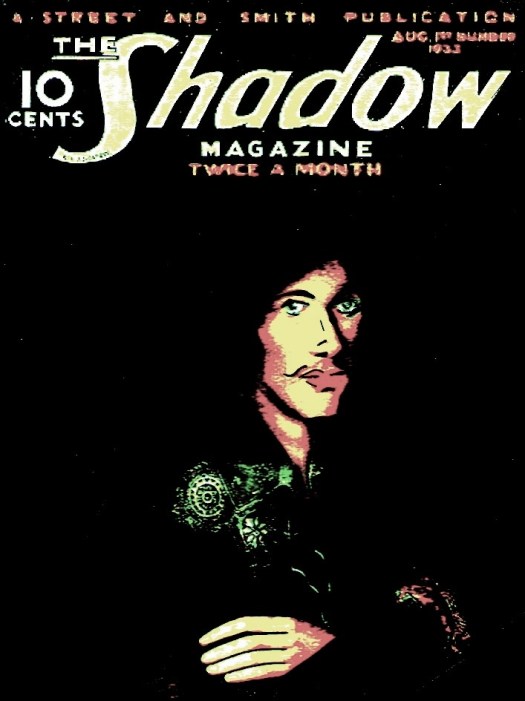
To his own portrait, lost and mislabeled for centuries, Donne referred as “that picture of mine which is taken in shadows.” In my irreverent mind, the striking features of Donne’s shadow-cast face began to resemble that of The Shadow, Lamont Cranston—the secret avenger who, striking hidden from view, laughed death in the face and had a sermon for all who dared to defy the law: “The weed of crime bears bitter fruit.”

Sermonizing Donne, who once wrote “A Lecture upon the Shadow,” approached the challenge of death in one of his most famous sonnets:

Thou art slave to fate, chance, kings and desperate men
And dost with poison, war and sickness dwell,
And poppy or charms can make us sleep as well
And better than thy stroke; why swell’st thou then?
One short sleep past, we wake eternally,
And death shall be no more; death, thou shalt die.

Donne’s portrait has captured my imagination; yet, having too often crossed—and all but crossed out—the uncertain boundaries between high art and low, it is The Shadow who now runs away with it. In my mind, I hear Lamont Cranston’s defiant laugh as I gaze at the poet’s likeness, “taken in shadows.”

"This . . . is London": "Searching for Shakespeare" at the Novello, the National Portrait Gallery, and on My iPod

Well, I hardly need to travel all the way down to London to go in search of him. After all, the man—or a stained-glass likeness of him—looks over my shoulder each time I fetch a volume from my bookshelves. His raised eyebrow and faint smile seem to say, “Come now, there must be something else beside radio drama to pique your interest.” For some time now, Shakespeare’s works, along with those of many other acknowledged topnotchers of western prose and poetry, have been relegated to the shelves upstairs to make room for my growing collection of books on American broadcasting and radio dramatics. Yet the bard need not consider himself debarred; even on American radio, he enjoyed a prominent position.

The Radio Guild, the first major American drama anthology for the airwaves, chose Romeo and Juliet for its premiere back in 1929. Subsequently, Orson Welles brought his acclaimed production of Julius Caesar to radio’s Mercury Theater (as discussed here), the irreverent Norman Corwin invited audiences to “[s]tand by to hear a Dane evaporate” as he faded out a production of Hamlet, and the CBS Radio Workshop went so far as to stage an interview with the playwright to investigate just “who wrote the works of William Shakespeare?”

As has often been argued, few dramatic works are as radiogenic as Shakespeare’s plays. They were written for the “wooden O” of an almost bare stage and, though hardly without action, rely much more on the spoken word than the elaborate masques, pantomimes, and melodramas of subsequent generations of playwrights.

When Shakespeare is translated for the contemporary boards, for big screen or small, text is often in competition and at times at odds with context, as costumes and stagecraft conspire to make the spoken word sound dated or the settings seem anachronistic. On the other hand, producers who opt for the blank canvas of a stripped stage in an effort to let Shakespeare’s words speak for themselves, give the eye so little to play with or feast on that they might as well lead us to the theater of the mind by handing out headphones and recordings.

The Royal Shakespeare Company production of As You Like It, now playing at the newly refurbished Novello Theatre in London’s West End, reduces the forest of Arden (or Ardenne) to a single tree. Yet it proves entirely sufficient to suggest a pastoral setting, to allow for some hide and seek among lovers, and to give poor Orlando, pining for his Rosalind, the requisite branches on which to pin his clumsy (and double entendre peppered) verse:

If a hart do lack a hind,
Let him seek out Rosalind.
If the cat will after kind,
So, be sure, will Rosalind.
Wintered garments must be lined,
So must slender Rosalind.
They that reap must sheaf and bind,
Then to cart with Rosalind.
“Sweetest nut hath sourest rind,”
Such a nut is Rosalind.
He that sweetest rose will find
Must find love’s prick, and Rosalind.

Orlando, of course, doesn’t altogether mind the prick of Rosalind (charmingly portrayed by a somewhat Ellen DeGeneresque Nia Williams); professing to cure his aching heart, she makes love to him while disguised as Ganymede, a simulated shepherd whose name spells boytoy of the gods. To be sure, the gender illusions of dramas designed for an all-male cast play out differently for today’s audiences (unless those of the all-male Propeller Company, whose production of The Winter’s Tale I saw last December). It is in these explorations of gender that radio can be more sophisticated and mature by being less provoking.

Non-visual theater can either obscure differences and tone down what may strike some as Charley’s Auntics and encourage us to look past gender markers like skirts and trousers to discover the humanity underneath. As cross-dressing all but fades into thin air, the sexual confusions take on a new subtlety, however drastic the cuts and unfortunate the synopsizing. Hear for yourself in Margaret Webster’s soundstaging of As You Like It, which was produced by the Columbia Workshop on 7 December 1939, and in which Webster gives her vocal chords a winningly understated if all too brief Victor/Victoria workout.

Regrettably, the single-trunk woods where Orlando woos Rosalind will be felled this weekend, when the Novello will stoop so low as to present an adaptation of the faux ’60s musical Footloose. If you care to go “Searching for Shakespeare” elsewhere, there is an exhibition of artifacts and portraits on display at the nearby National Portrait Gallery, my impressions of which I shall share tomorrow.

"This . . . is London": Fuseli’s Nightmare Revisited

Sometimes it takes questionable taste in art to make us realize how unpalatable or insipid our ready-meal answers to life’s challenges can be. In the bourgeois mediocrity of German suburbia, where I was obliged to wade through the quagmire of adolescence, an installation by performance artist Santiago Sierra is currently creating no inconsiderable controversy by daring to turn a synagogue into a gas chamber.

Media Nightmare

I suspect that quite a few of Sierra’s detractors who think such confrontations of violent history with artistic violence reprehensible will be less disturbed to learn that, some forty years after the end of World War II, the building had been a symbol of Germany’s inability to deal with its horrible past: obscured from public view and unknown to schoolboys like myself, who passed it daily, it had been permitted to deteriorate to such a state of dereliction that it was only deemed fit to serve as a barn or pigsty.

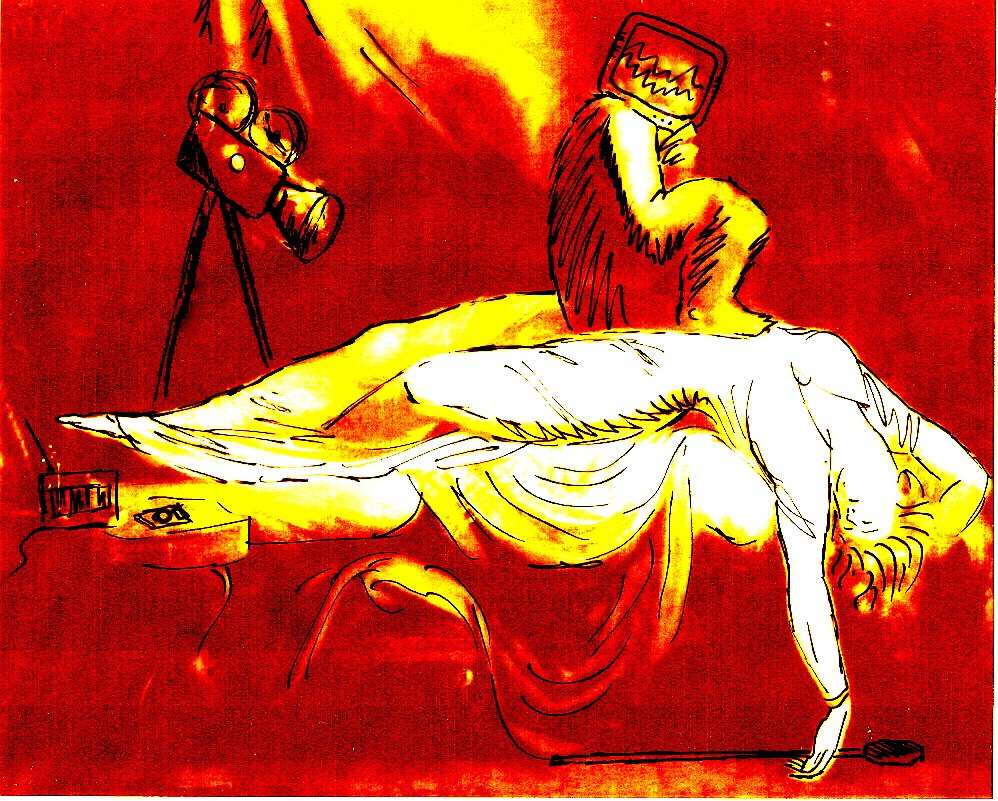
Fuseli’s Nightmare

Iconoclasm, barbarism, and unreason—these were also pre- occupations of 18th-century Gothic art, samples of which are now on display at the Tate Britain. Unfortunately, Gothic Nightmares: Fuseli, Blake and the Romantic Imagination suggests nothing more forcefully than that visual representations of horror are often less than horrifying; less horrifying, that is, than the terrors of which a fertile imagination can conceive and a methodic mind rent from humanity can implement without scruple. Instead, the shock-and-schlock artistry of Fuseli and his followers comes across as juvenile rather than rejuvenating, as cheap rather than free-spirited, as exhausted rather than inspired.

Gothic images are often too crude and obvious to stir the emotions, not unlike the gag-reflex testing effects achieved by today’s horror movies. Aiming at our throats, these lesser Romantics often extract mere giggles and at times guffaws.

Another version of Fuseli’s Nightmare

Not surprisingly, Fuseli’s (in)famous Nightmare painting was frequently mocked, especially in its day, when it served as a template for political caricatures such as the one attempted by me here, one in which liberty is being haunted by images of the Middle East (the camel in our bedrooms) and the ineptitude or rampant ambitions of a certain world leader.

How infinitely more stimulating, I thought, while wandering through the exhibition—which does some violence of its own by pairing sublime Blake with silly Fuseli, or by confronting the pre-cinematic Phantasmagoria with French-revolutionary Romanticism—is the suggestive terror of the airwaves, compared to the horror of the image, whether still or moving.

Of course, I am resorting to another caricature of my own to support—and thus undermine—my point: that the imagination, stifled or silenced by clamorous images, suffered its greatest defeat with the deposition of short-reigning radio by the matter-over-mind medium of television.

"This . . . is London": Florence Foster Jenkins, Again

Well, it doesn’t always take “practice, practice, practice” to get to Carnegie Hall. Sometimes, delusions of grandeur—and a few thousand gawkers in search of the proverbial train wreck—will do. If you are among those who still marvel at the American public’s decision to include Kevin Covais among this year’s American Idol finalists, consider the career of a tone-deaf diva who brought the William Hung-factor to classical music: Florence Foster Jenkins, a coloratura-blind soprano so astonishingly awful that audiences are still pricking up their ears in disbelief some sixty years after her silencing. Call it “Schadenfreude schöner Götterfunken.”
When last I was in New York City, I went to see Souvenir, a “fantasia on the life of Florence Foster Jenkins” starring Judy Kaye (and reviewed it here). A few weeks later, I was surprised to discover that another not-so-musical portrait of the miss-most-notes notable was on display in London, where it can be taken in at the Duchess Theatre until the end of April. Of course, I had to see and hear for myself how La-la-la Jenkins was being treated overseas, so far from the famed hall she brought down in the fall of 1944, within weeks of her exit at age 76.

As conceived by Peter Quilter, patched-together from what little he could find about the performer in print, Glorious is the sort of guilty theatrical pleasure few people permit themselves these days, given the exorbitant ticket prices that make the legitimate stage a recycle bin for acknowledged classics and crowd-pleasing musicals. Glorious doesn’t quite live up to its title. It is unambitious, trivial, and decidedly silly. Maureen Lipman, whom I had previously seen opposite Sir Ian McKellen in a rather chintzy reproduction of the pantomime Aladdin, delivers the broad jokes and broader slapstick with pitch-perfection. Only too rarely, when addressing us as Jenkins’s audience, does she become as captivating or “glorious” as the original herself must have been to 1940s concert-goers.

Unlike Souvenir‘s Judy Kaye, Lipman does not go far beyond shtick, not being required or encouraged to do so by Quilter’s cartoonish script, which at times seems little more than an assortment of rather ho-hum puns, few of which you would get away with even in intoxicated company.

Unlike Ms. Kaye—who was just and judiciously supported by a pianist-narrator based on Jenkins’s own accompanist, Cosme McMoon—Lipman is being surrounded by a host of sitcom characters: an irascible Hispanic maid, a womanising admirer, a ditzy confidante, and a society lady appalled at her caterwauling. The situations derived from these fictional foes and associates are far less inspired than the close-up of Jenkins at her self-delusional best.

And, unlike Ms. Kaye, Lipman is unable to end on the moving high note both Quilter and Stephen Temperley (the writer of Souvenir) chose for their flourish. Both playwrights attempt to bring home Ms. Jenkins’s blissful ignorance of her tone-deafness by letting us hear the dulcet tones the performers assumes to be producing. Musical star Judy Kaye gets an opportunity to sing “Ave Maria,” while Lipman merely lip-synchs to a recording. The audiences of Souvenir are offered a glimpse, at least, of the diva’s doubts and fears, while those seeing Glorious will encounter a consummate mis-performer sheltered by a stupefying lack of self-awareness.

“[I]t was certainly rather wonderful living in the head of this unique woman,” Quilter remarks in his notes on the play. Unfortunately, we get to enter neither his mind nor hers. Instead, we are being treated to two hours of Will and Disgrace.

"This . . . is London": Approaching Edward R. Murrow

I have returned from my latest London trip; my stimulated mind is filled with assorted impressions that I now ready for recollection in relative tranquility. Rather than pouring out those impressions like the content of an overstuffed suitcase, I shall meet the challenge of assembling them into a sequence of composite portraits, portraits not so much of myself but of the experience of gathering ideas and collecting thoughts. You might call this manipulation of the everyday a form of “method living”: a mental aligning and creative channelling of life’s vast, fleeting, and potentially overwhelming influences into something resembling a design of my own making.

There is to me nothing more thrilling than the tracing of a pattern in the patched-up fabric of the everyday. Granted, I often impose such a design by snipping off too many of the loose ends and by choosing that to which I expose myself with rather too thorough discrimination, by excluding the ill-fitting piece or neglecting the odd thread. Yet the satisfaction of finding sameness where others might only detect difference is not necessarily the program of a narrow mind. I try to do as much stitching together as I do selecting or cutting away. Atropos, Clotho, and Lachesis—I intend to do the handiwork of all three fates.

One of the threads I chose to follow during my wanderings through the maze that—compared to the comforting simplicity of New York City’s map—is sprawling London was the career of American journalist Edward R. Murrow. In his late 1930s broadcasts from London, Murrow had encouraged Americans to connect with world affairs by bringing the hardship of those under Fascist attack home to radio listeners who, in the confines of their living rooms, might have imagined themselves immune to such devastating influences. Later, he exposed fascism of another kind in his commentaries on misguided patriotism and undemocratic perversions of unity.

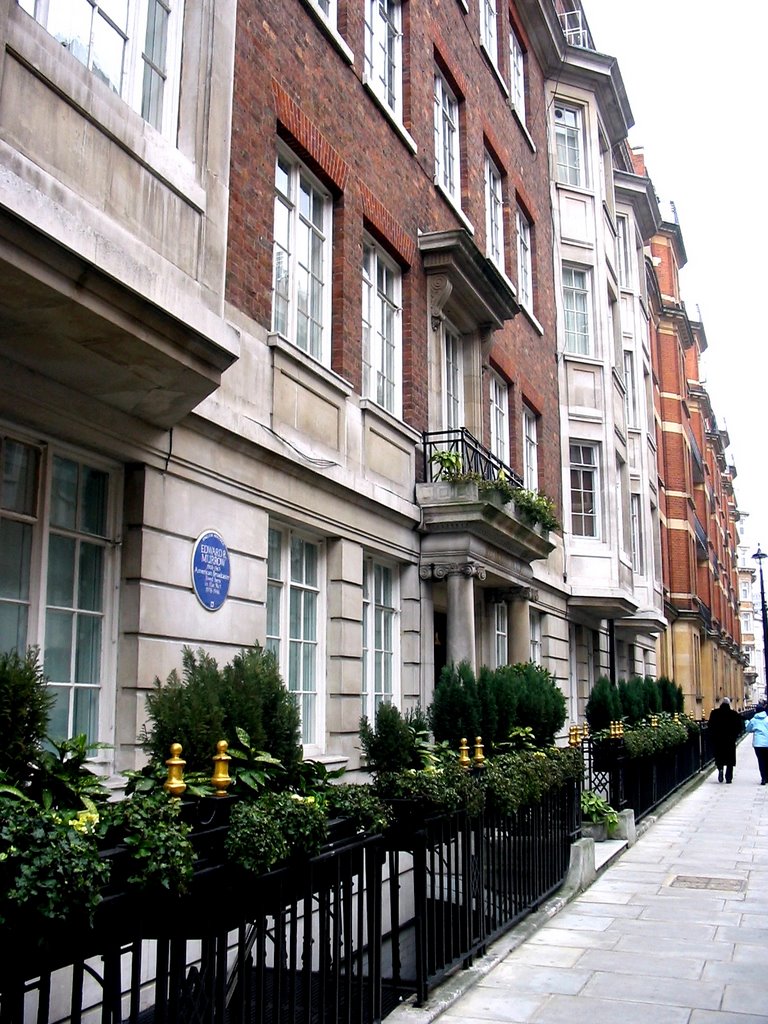
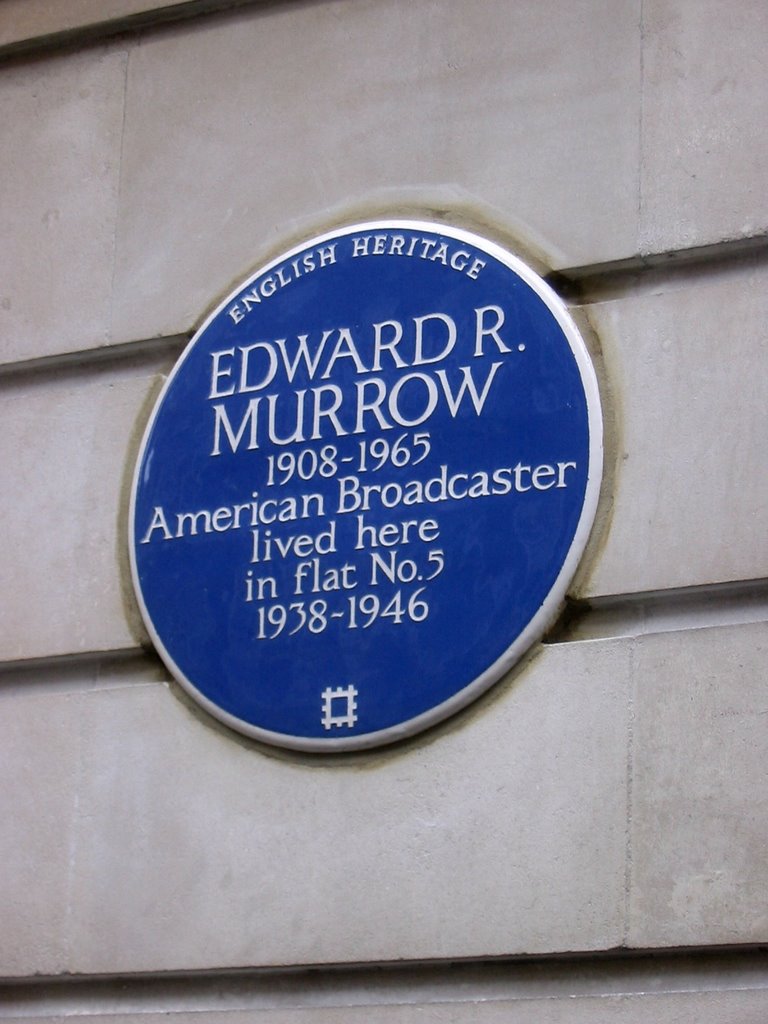
After a brisk two-hour walk from South Kensington, across Hyde Park, I arrived at Murrow’s former residence in Marylebone, not far from the British Telecom tower. I took a few photographs and walked on. I experienced no great stirring of emotions, let alone a spiritual connection. Yet the site itself, along with the act of finding, approaching and appropriating it pictorially became part of a design, enforced by the screening of Good Night, and Good Luck. my mate and I attended a day later. It had not been altogether planned that way; indeed, I was surprised to find the film to be still in such wide circulation.

The quietly impressive motion picture and my altogether unremarkable photographs do not so much amount to a biographical composite sketch of Murrow, a man who shaped history by recording it. Rather than capturing his past they suggest his presence—or our need for it.

Much of what Murray reflected upon in his broadcasts—even in reminiscences such as this one from 3 December 1944—is anything but dated, if only you permit yourself to look beyond the names of places and persons and weave his expressions of hope and fear into the fabric of our current wars and crises:

You remember those mean streets in London where so many died; the men stretching canvas over holes in roofs and walls, trying to patch things up before the winter comes, anything to keep out the rain and cold.  At the airfield you remember that it was just here you watched Mr. Chamberlain descend from his plane when he came back from Munich, waving his written agreement with Hitler and talking about peace in our time.  That was such a long time ago. And you wonder when there will be peace again and what it will be like. . . .

You recall all the talk of a better world, a new social order, a revolution by consent, that marked the desperate days, and you realize that talk of equality of opportunity, of equality of sacrifice, of a peace based on something other than force, comes more readily to the lips when disaster threatens.  There isn’t so much of it now [. . .]. 

Europe for a long time will be concerned with the urgent problems of day-to-day existence. The fundamental economic and social conflicts will not have been settled by this war. [. . .] 

For years after this war Europe will be in torment and [ . . . ] you wonder what part America will play in it all.  In battle and in production we have been magnificent.  We have delivered the planes, tanks, guns and ships and the men to fight with them.  The evidence of our strength can be found all around the world.  We’re not as tired as the others.  Our industrial plant is undamaged.  Our homes have not been blasted.  We enjoy security and relative comfort and our responsibility is frightening, for Europe will look to us—not for charity, advice or admonition, but for an example.  Democracy hasn’t been very fashionable over there in recent years and there are many who doubt that it can survive the strains and stresses of peace. . . .

Is democracy still “fashionable” anywhere? Is it the gear of choice or an imposed uniform that ceases to be fashion by resembling fascism? Has the current war on terror (or the terror of war) done much to preserve it? Are we still talking about a “peace based on something other than force”? The patterns we discover when engaging with the so-called past are often disturbing rather than reassuring. And yet, to ignore them, to refuse recalling them into our everyday, might be more disturbing still—a wilful refusal to connect that, far worse than passivity, is a violent act of tearing apart the fabric along with its flawed design.

“This . . . is London”: Departures for, of, and at the Theater

Well, I’m afraid this journal entry is going to be all over the place—like my luggage, as I am preparing for tomorrow’s trip to London. I would have enjoyed sharing one of my “What Those Who Remembered Forgot” obituary footnotes to commemorate the radio career of Oscar and Tony winner Maureen Stapleton (1925-2006); but I could not find any recordings of her performances heard on Best Plays, a US drama anthology that premiered on 8 June 1952 with a production of Winterset. Nor have I come across Stapleton’s guest appearances on radio’s Quiz Kids program. So, after some searching, I had to give up on the tribute and continued to plan my theatrical entertainments for the days ahead.

I have yet to see a truly great stage production in London, most of the plays I attended during my previous visits having been less than scintillating. Let’s see, there were the lackluster revivals of The Philadelphia Story and Once in a Lifetime, starring Kevin Spacey and David Suchet, respectively. While colorful and quirky, Matthew Bourne’s adaptation of Edward Scissorhands (discussed here) was choreographically far less impressive than his Swan Lake.

Rather more to my liking was the staging of Agatha Christie’s And Then There Were None, which, as discussed here, offered few surprises (being faithful to the novel), but a genuinely creepy finale.

Then again, I’ve always been fond of unabashed melodrama, even though, at today’s prices, theatrical thrillers are a decidedly rare and guilty pleasure. Gone are the days when everyday people flocked to the theater for some choric hissing of villains in plays with titles like The Worst Woman in London or The Ugliest Woman on Earth. I’d settle for a production of William Archer’s The Green Goddess, but doubt whether our politically correct climate—in which even a cast member of South Park balks after discovering his scientologically reconstituted conscience—still allows for the blossoming of such vulgar delights, now relegated to that slowly deteriorating hot house of popular culture, the movie theater.

Imagine a scene like this—as described by Charles Dickens—at one of today’s West End temples of drama:

We were a motley assemblage of people [. . .] . Besides prowlers and idlers, we were mechanics, dock-labourers, costermongers, petty tradesmen, small clerks, milliners, stay-makers, shoe-binders, slop-workers, poor workers in a hundred highways and byways. Many of us—on the whole, the majority—were not at all clean, and not at all choice in our lives of conversation. But we had all come together in a place where our convenience was well consulted, and where we were well looked after, to enjoy an evening’s entertainment in common. [. . .]
Between the pieces [a pantomime and a melodrama], we almost all of us went out and refreshed [. . .]. The sandwich—as substantial as was consistent with portability, and as cheap as possible—we hailed as one of our greatest institutions. It forced its way among us at all stages of the entertainment, and we were always delighted to see it; its adaptability to the varying moods of our nature was surprising; we could never weep so comfortably as when our tears fell on our sandwich; we could never laugh so heartily as when we choked with sandwich; Virtue never looked so beautiful or Vice so deformed as when we paused, sandwich in hand, to consider what would come of that resolution of Wickedness in boots, to sever Innocence in flowered chintz from Honest Industry in striped stockings. When the curtain fell for the night, we still fell back upon sandwich, to help us through the rain and mire, and home to bed.

Perhaps I could have done without those assorted noises and scents after all; but I sure enjoy an evening of unpretentious theater. Unfortunately, both Jerry Herman’s silent-screen musical Mack and Mabel and Noel Coward’s Hay Fever, starring Judy Dench, won’t open until April.

Instead of such revivals, I might be singing the Resurrection Blues. There is Robert Altman’s production of Arthur Miller’s play of that title, of course; but I have never been particularly fond of Miller, mostly due to his denunciations of radio, the medium that not only sustained him during the lean 1940s, but that influenced the mind-as-stage explorations attempted in plays like Death of a Salesman and After the Fall. I’d much rather see Altman’s latest movie, A Prairie Home Companion, Garrison Keillor’s own adaptation of his popular radio series.

I’ve still got my eye on Glorious!, that other play about the odd career of vocally challenged Florence Foster Jenkins, one version of which, titled Souvenir, I enjoyed when last I was in New York City. Well, we shall see what tickets I can manage to snatch up at the half-price booth. Next week, at any rate, I hope to share some souvenirs from what I trust will amount to a glorious time in the metropolis.

"This . . . is London": Getting Ready to Take in the Sounds Again

Broadcasting House, London

Well, it has been a rather gloomy weekend, a few hours of which were spent finding a publishing house and home for Etherized, my doctoral study on old-time radio. I have been slow to send out proposals but am aware that I cannot rest on my laurels until they begin to smell. The fresh air being too damp, cold, and swiftly circulated, I sought shelter by the fire and found pleasant company in an unflappable adventuress by the name of Eve Peabody. Surely you’ve met Eve Peabody, the blues singer whose voice, by her own admission, is strictly of the “bathtub” variety? You know, the gal who once crashed a ritzy social gathering with a pawn ticket for an invitation. Yes, that Eve Peabody—the gold-lamé garbed, Bronx Local-hardened heroine of Mitchell Leisen’s deucedly clever screwball comedy Midnight (1939).

There’s much to be learned from an urbane charmer like Eve (as portrayed with pitch-perfection by Ms. Claudette Colbert). Lessons in picking yourself up, dusting yourself off, and starting all over again, I mean. Having escaped a Monte Carlo disaster—a failed system that left her practically penniless at the roulette table, with the exception of that one French coin with a hole in it—Eve takes a gamble by hopping on a train to not so gay Paris.

Alighting none too delightedly with damp and dreary prospects before her, she inquires with sarcasm, rather than incredulity: “So this, as they say, is Paris?” Not altogether reassured by the conductor, she wryly remarks: “Well, from here it looks an awful lot like a rainy night in Kokomo, Indiana.” I might find myself saying something not unlike this when I step out of the train in London this Wednesday. The forecast is not promising; but, like Eve, I am determined to make the most of my stay.

Perhaps, my idea of a good time differs from that of most visitors, but, aside from the shops and a West End show or two, Edward R. Murrow’s house in Hallam Street is right up there on my list of must-see attractions. As I reported a few weeks ago, a blue plaque has been placed on the façade of Weymouth House earlier this year, commemorating the contributions of its former resident, Murrow, to bringing the terrors of the London blitz home to American radio listeners, many of whom may have otherwise been indifferent or downright hostile to the British, quite willing even to let my Nazi ancestors have their way with them.

“This . . . is London,” of course, was Murrow’s famous introduction to his blitz broadcasts. His reports made a distant fight for survival seem real and urgent—unlike that picturesque firework display that stood in for the air raids in the recent Judy Dench-starrer Mrs. Henderson Presents. After all, radio can produce terrors far more immediate than video or photography, provided you have mind, heart, and guts enough to translate dreadful sounds into horrible images.

Walking through London again, I might do what I used to do when I first came to New York City, which is, besides taking in the sights, to take in the sounds as well. When the broadcastellan journal was still in its infancy, rather than its present adolescence, I contemplated the soundscape of Britain. For, surely, London has one of the most distinct sonic designs of any Western metropolis, the chiming of Big Ben being its most memorable earmark. So, as an exercise in getting in tune with said town, I will tune in again to “A Portrait of London” (20 July 1956), a CBS Radio Workshop tour conducted by Winston Churchill’s daughter Sarah, who took American listeners right into the bell tower of Big Ben.

“So this, as they say, is London, huh?” I might find myself saying on Wednesday as I step out onto the platform at Euston Station: but, hearing the inimitable sounds of the big city, I am unlikely to add “Well, to me it sounds an awful lot like a rainy night in the Welsh hills.”