Mr. Benny Gets the Key to Baldpate

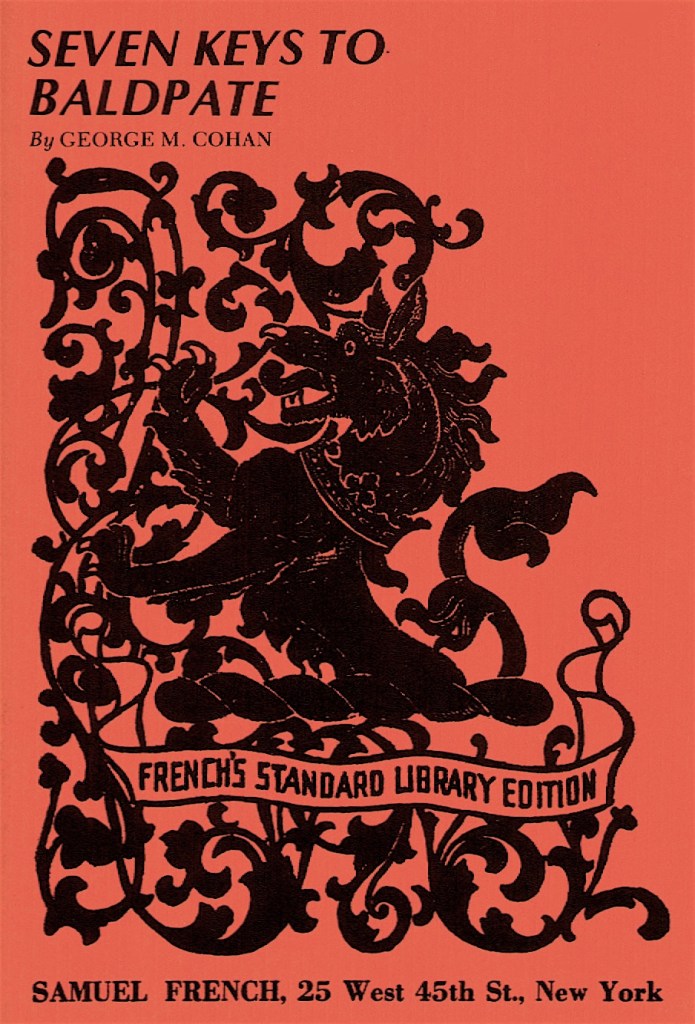
Well, I feel rather less prickly than yesterday. My cold seems to be on its way out and, having spent some time out of doors in the warmth of the autumn sun, I feel somewhat more serene and benevolent. Speaking of doors (a transition more creaky than the farce I am writing about today): Having complained previously (and elsewhere) about the conventional and therefore superfluous adaptation of Jane Eyre now flickering in weekly installments on British television, I am going to mark the anniversary of a decidedly more inspired variation on what was once a similarly familiar work of fiction, Seven Keys to Baldpate, a crowd-pleaser that was revived for radio on this day, 26 September, in 1938.

Granted, it is easier to rework a piece that does not warrant the reverence befitting a literary classic such as Jane Eyre, a respect that can be artistically stifling when it comes to revisiting or revising what seems to demand fidelity rather than felicitous tinkering. A mystery novel conceived by Earl Derr Biggers, the creator of Charlie Chan, Seven Keys opened many more doors after going through the smithy of theater legend George M. Cohan. Unlike Biggers, Mr. Cohan did not play it straight, but turned the thriller into what he then sold as a “Mysterious Melodramatic Farce”—starring himself.

In Cohan’s farce, the thriller writer Bill Magee accepts the $5000 challenge of a friend who dares him to pen a novel within twenty-four hours. To achieve this, the author is being given what he believes to be peace and quiet—the only key to a remote resort shut down for the winter.

During his night at Baldpate Inn, the supposedly single guest is disturbed by an assortment of singular strangers, lunatics and villains, until his friend shows up to confess that the bizarre goings-on were a practical joke designed to illustrate the ridiculousness of the author’s improbable plots. The epilogue of Seven Keys discloses, however, that the action of the play was a dramatization of the novel Magee actually managed to complete that night. He won the wager by fictionalizing the challenge.

Opening on 22 September in 1913, the play became an immediate and oft-restaged favorite with American theatregoers. It was subsequently adapted for screen and radio. When, some twenty-five years after its premiere, the producers of the Cecil B. DeMille hosted Lux Radio Theatre got their hands on this potboiler, they slyly revamped it as a commercial property fit for the latest medium of dramatic expression.

In his introductory remarks, DeMille promises the listener a “special treatment” of the play—and that, for once, was no overstatement. As I have discussed at length in Etherized Victorians, my study on old-time radio, the broadcast revision is not so much a rehash as it is an media-savvy update of the original.

Whereas Cohan’s version celebrates the victory of popular entertainment, of readily digested pulp fictions churned out for a quick buck, Lux writer-adaptor George Wells transforms Seven Keys into a radio story—a story about radio that parodies the anxiety of former vaudevillians-turned-broadcast artists to achieve lasting success, to be remembered long after the shows in which they starred week after week had gone off the air—to become cultural icons despite their invisibility. And those keys to uncertainty were handed to the man who had been through it all and stayed on top by knocking himself down, fall guy comedian Jack Benny.

Instead of a successful novelist, the artist now up for a crazy night at Baldpate is Jack Benny, as “himself,” a frustrated thespian who accepts the challenge of developing a suitable dramatic vehicle for himself after having been turned down for serious dramatic parts time and again. Benny’s challenger is no other than Mr. DeMille, who, in a rare stunt, not only introduces and narrates the play, but acts in it, and that without having to drop his director-producer persona. Throw in a few Lux Flakes and it comes out a clever bit of promotion all round.

The unpretentious yet self-conscious reworking of a play as old hat as Baldpate into a comment on the recycling business of radio entertainment—and a demonstration of how to lather, rinse, and repeat successfully—is one of Lux‘s most ingenious and engaging productions.

"Chained" to the Mike: Joan Crawford Goes Live Reluctantly

Well, they come to the remotest of spots, spreading their words—or the word—undaunted by the indifference or hostility with which they are greeted. Jehovah’s Witnesses, I mean. This morning, I’ve been listening for about an hour to two of these travelling preachers, one of whom likened our lack of receptiveness and knowledge to sitting in front of a broken television set. Actually, the two reminded me of radio announcers: hawkers with a mission who come into your home (or as near as you let them) to sell you ideas and convince you to tune in tomorrow—a tomorrow so protracted it might have been conceived by a soap opera writer if it weren’t quite so blissful.

Radio announcers, of course, were being paid for delivering promotional messages they did not compose; and it sufficed for them to feign conviction and enthusiasm in their pushing of ideas, services and products. Rather than turning the dial or twisting the doorknob on those Witnesses and their ill-concealed prejudices, I kept listening to their mythological broadcastings, even though my life at present is so serene that I do not long for another or any hereafter.

We are being sold so many mass-marketed keys to happiness that, when one of them finally fits into the lock, the confounded peddlers and their less-than-satisfied customers importune us to question whether we’ve got the right door. Once achieved, happiness is reduced to a token of stupor or proof of lacking ambition, a mark missed rather than hit. After all, there is business in creating desire and none in realized contentment.

Now, the elusive happily ever after is an illusion often smashed to great effect. The creators of melodrama, the theater of the contested status quo, turned the struggle for a joyous or secure future into a chief generatrix of storylines. The characters of melodrama often seek happiness by looking for something not belonging to them and find it by discovering that what they want is close by, however obscured by conventions or removed from their everyday by the chains of society. In all this strife, melodrama often insists on destiny, on a path chosen not by us, but for us, a path to be discovered instead of forged.

On this day, 27 July, in 1936, Joan Crawford stepped behind the microphone she dreaded to struggle against such conventions—and succumb to others—by recreating her role of Diana (or Dinah) Lovering in Chained, which was adapted for a production of the Lux Radio Theater.

Diane is a secretary of a well-to-do, “middle-aged, but attractive steamship magnate.” She vows to marry him—once his wife consents to set him free. In the meantime, she falls in love with a younger man, played by Crawford’s husband, Franchot Tone, a man who poses a challenge, rather than showering her with affections. There is little excitement in the triangle, a routine love affair in which Crawford is blandly smooth, rather than edgy. Perhaps the greatest achievement of Crawford’s performance is that the actress, reputedly uneasy about speaking live before an invisible audience of millions (as previously mentioned here), displays no audible signs of mike fright.

Setting the scene with an apposite if contrived Hollywood legend, Lux Radio Theater host Cecil B. DeMille explains that Crawford and Tone, whom he had never before met professionally, were meant for each other by virtue of their ancestry. “Their romance, which began in 1933, was more than a courtship,” he suggests. “It was a coincidence which had its beginnings in 1798, when an undecided Corsican named Bonaparte was lighting the fuse that was to explode all Europe and an Irish patriot named Wolfe Tone was enlisting French aide in a revolt against England.” Sure, Ms. Crawford, who married the descendant of said Wolfe Tone, was born Lucille LeSueur; but the “little French girl” was born closer to Paris, Texas, than to the French capital.

Aided by the continuity writers of the Lux Radio Theater, DeMille was able to craft a compelling theme out of such historic strains, even if it meant to strain historic facts in the crafting. For all his vision, though, DeMille was no seer. Between the second and final acts of “Chained,” the famed director introduces Helen Burgess, one of his recent discoveries for the screen. She might have been groomed for stardom, but, as Billips and Pierce remind us in Lux Presents Hollywood, the on-air promotion was futile. The promising starlet died on 7 April 1937, shortly before her twenty-first birthday.

Crawford, meanwhile, kept returning to the microphone, relieved, no doubt, when the era of live radio drama came to an end in the late 1940s.

Amelia Earhart Is Late

I could tell things wouldn’t go my way today. The evidence was right there on the carpet, and next to it, with a wet cloth, was I, trying to ameliorate the situation. Jack Russell terrier Montague, who has been our companion for a week now, has finally made his mark. I guess I should be thankful that it was only exhibit number one, not number two. Then was the computer giving me grief by making it impossible for me to access my own homepage. Now, I am no fastidious Phileas Fogg; but such vagaries are the antithesis of an orderly, well-structured existence.

In old-time radio, there was little tolerance for anything amounting to chaos, be it disorder or nothingness. The broadcast schedule was tight, and any deviance from it meant to alienate both the listening public and the corporate sponsors who footed the bills. On this day, 28 June, in 1937, millions of Americans expected to meet on the air the leading lady in it. The famed aviatrix (pictured above, right, next to screen stars Ruth Chatterton and Kay Francis) was scheduled to appear on the Lux Radio Theatre; not as an actress in a play, but as an added attraction, a latter-day Phileas Fogg whose life in flight was the very stuff of melodrama.

Announcer Melville Ruick was forced to offer tuners-in the following apology: “We had hoped at this time to bring you Ms. Amelia Earhart. However, she has not yet completed her sensational around-the-world flight; so, will be heard instead next Monday evening from the Lux Radio Theatre, will she have arrived by that time.”

Ms. Earhart, who was on her way to New Guinea, would not appear in the following broadcast. In fact, a few days after her delay was announced, she would disappear altogether when her plane was lost somewhere in the Pacific Ocean, more than 6000 miles from her destination. During the subsequent Lux broadcast, the last of the season, host Cecil B. DeMille read the following statement:

Somewhere in a distant corner of the South Pacific is Ms. Amelia Earhart, who had planned at this moment to be on the stage of the Lux Radio Theatre. I know everyone hearing me now joins in our hope that the rescuers of Ms. Earhart and her navigator, Fred Noonan, will reach them swiftly and find them safe. I’ve just spoken with George Palmer Putnam, husband of Ms. Earhart at Oakland. Considerably more encouraged than he was yesterday, Mr. Putnam says that after a careful check of all reports, he believes the fliers are on land believes. He adds that they have adequate supplies, which will last Ms. Earhart and Captain Noonan until the arrival of rescue ships or planes.

You might say that Ms. Earhart was done in by radio; radio navigation, that is, which let her down in the clouds. To find her turned out to be the most costly mission yet undertaken by the US government. It was an effort to no avail. Her body vanished into the thin air that had failed to carry her, the air that did not transport her into millions of homes as publicized. The rest, speculation about her reappearance or her being killed by the Japanese, is legend. Within days after her final scheduled appearance on the radio, such speculations would be all over the front pages of the world’s newspapers.

The Front Page—that was the name of the play heard on the Lux Radio Theatre on the night she was originally slated to speak. At hand to lend realism to the role of unscrupulous newshound Hildy Johnson was one of America’s most celebrated and controversial news columnists, Walter Winchell. He was meant to have met his match not only in Hildy but in the living news story invited to relate her own tale. While he performed admirably in the Hecht/MacArthur comedy-drama staple (previously discussed here), the real scoop was beyond his reach.

On This Day in 1936: Silent Vamp Talks of Revamping

Well, it can be cruel. It can be tempting and frustrating. It may be doing something for you—but it can also be your undoing. And just when you think you’ve caught up with and mastered it, it dashes off and kicks the dust of your futile endeavours straight into your bloodshot eyes. Technology, I mean—the vamp that demands constant revamping. As a blogger and tyro podcaster, I am not sure whether I reproduce myself by means of technology or whether I am myself the product of technology. These perhaps overly binary reflections were brought on, at least, by an encounter with Elbot (whose wit, I learned today, is inspired in part by an episode of the old-time radio thriller anthology Quiet Please). Apparently, even a supposedly outmoded medium like radio can continue to be regenerative. A consummate tease, radio enjoys being turned on by receptive minds.
Rather counting on that garrulous generatrix was Theda Bara, cinema’s original vamp, who, on this day, 8 June, in 1936, was media savvy enough to grab a microphone and announced to the world (or some western region of it) that she was back in business. Oh, but how that business had changed since the queen of silent melodrama last tempted audiences, anno 1926.

In Hollywood, a ten-year hiatus is a one-way ticket to oblivion. And when your metier is quite dead, a comeback is just about out of the question. Bara was nonetheless asking for a return engagement. She could count on an audience of millions—the “public” she was in hopes of recapturing—when she stepped inside the Lux Radio Theatre for a chat with motion picture director W. S. Van Dyke. “Woody” Van Dyke admitted to having “admired” Bara “from afar when she was doing such magnificent spectacles as Cleopatra” and he was “just an extra.” Considering that Van Dyke had the voice of a gruff senior, that must have sounded a lifetime ago even then.

Reminiscing about that role, Bara talked of the challenges of silent moviemaking. Yes, Hollywood entertainment had “developed amazingly” since Cleopatra was released in 1917; but film is an actor’s medium, and dedicated performers like herself could do and did much to turn nickelodeon thrills into cinematic art. Preparing for that role, Bara claimed to have worked for months with a curator of Egyptology at the Metropolitan Museum in New York City. Now that silent movies were treated like the ancient history she once studied, it may have been too late to excavate her own career.

Her bold announcement that she was “going to do some motion picture work” was followed by a more tentative explanation: “I am considering an offer now, running through scripts and ideas. Oh, I just hope everyone will be as happy about another Theda Bara picture as I am. The public has been very good to me in the past.” The public—good, bad or indifferent—never heard her emote on the screen thereafter.

Ms. Bara, as you may hear in my next podcast, had a charming voice, quite capable of delivering lines of sophisticated comedy. She would have done well on the air, even as the lines in her face might have argued against her reappearance in sizeable movie roles. Perhaps, producers were not willing to see the vamp in any other way. When confronted by the narrow minds of big business, dazzling technology has the tendency to turn into a mute siren. She isn’t tamed, mind you. She is just not turned on by the calculating kind.

On This Day in 1955: After Twenty Years of Pushing Stars and Peddling Soap, a Hollywood Institution Closes Down

Well, I have no knack for it. Storytelling, that is. Not that I haven’t dabbled in fiction and drama—everything from attempting that great American novel (a Germanic variation, mind you) to co-authoring a college soap opera for public access television. I even wrote my memoirs, at age sixteen, and passed them around to my classmates so that they might have something sensational to read. Teenage angst notwithstanding, I was fairly certain that my story wasn’t finished; and I didn’t bother pretending it had a beginning I could recall, a middle I could make sense of, or an end I could foresee.

When it comes to connecting loose strands of thoughts to form something amounting to a composition, the essay is my yarn of choice. I guess I find it easier to write about or around something than getting around to writing something worth writing home about.

Making sense is as satisfying a creative activity as it is problematic. Just when you have put it all in a nutshell (granted, a cocoanut shell, given my prolixity), you should force yourself to go nuts and smash it all to pieces again. It is the only way to find out whether you have been rather too proud of the husk at the expense of ensuring the proper development of the kernel.

I doubt that I could take on the challenge of rendering the essence of someone else’s life, for instance. I would be too conscious of the act of imposing a structure, of connecting the dots and erasing others for the sake of providing a clear picture. After all, a dotted line with a beginning, middle, and end is an Aristotelian construction that, the blogging phenomenon notwithstanding, most of us still expect in a written composition. It is a dotted line on a contract between reader, writer, and subject I can’t bring myself to sign.

All this occurred to me again last night, when I watched the television premiere of Stan, a biographical drama about the friendship of comedy stars Stan Laurel and Oliver Hardy. In one hour, Stan creates a double portrait and sums up the relationship between its two sitters. Indeed, even the sitters are doubled—Stan and Ollie at the end of their lives looking back at the beginning and height of their career in film. I am looking forward to discussing the challenges of writing such a piece with its author, Neil Brand, who will be our houseguest next weekend. Perhaps, there’ll be an essay in that.

In the meantime, this is getting rather too long as an exposition to what I wanted to relate in the first place. Something about soap, and stars, and radio, the hook of which is the anniversary of the closing of a great Hollywood institution on this day, 7 June, in 1955. The institution in question was the Lux Radio Theatre, a highly popular program featuring adaptations from stage and screen as performed by practically all the great actors of the studio era.

Now, historical facts are not particularly interesting to me. You can always look those up, as I did this morning. To reproduce them is no great feat, unless you also question their veracity or ponder their significance. There is not enough storage space in my cranium to squander it on trivia. Besides, there’s a fine reference text on the subject by Connie Billips and Arthur Pierce, called Lux Presents Hollywood, which I frequently consult.

To me, the most fascinating aspect of the Lux program is its design, which is rather too intricate to be called a three-act drama interspersed with toilet soap commercials. The Lux Radio Theatre, which was my introduction to , is not so much a dramatic program as it is a theatrical one. Instead of attempting dramatic realism, it created the illusion of putting on a show. It celebrated its own composition, which brought together the diverging strands of promoting Hollywood and pushing soap, of packaging its familiar (if at times unrecognizable) stories with bits of backstage talk that gave listeners the impression of being theater insiders, of acting as creators and patrons of a show, rather than simply being its audience. After all, something more than sitting at home enjoying free entertainment was expected of them.

The masters of ceremony (most notably among them Cecil B. DeMille) reminded listeners that their loyalty to the sponsor’s product kept it going. The stars, who promoted themselves as well as the studios that employed them, came across as working citizens rather than distant idols. They, too, used that soap, or at least claimed as much when they delivered the sales talk. Sometime, as the host did not hesitate to point out to the home audience, they were even spotted in the crowd of the Music Box Theater, from where the broadcasts originated.

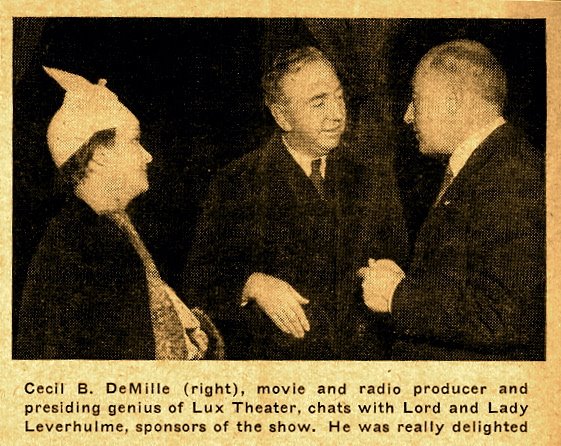
It all sounds like a friendly family business; in fact, DeMille was practically born into the job of hawking the wares of Lord and Lady Leverhulme (the show’s sponsors, pictured above), considering that, as he pointed out to the listener, the motto on his family crest was “Lux Tua Vita Mea.”

Now there’s a story of British industry and American showmanship, a success story not unlike the fortuitous if complicated Hollywood teaming of Englishman Stan Laurel with that big guy from Georgia. I won’t be telling it, though. I am too busy weaving the voices heard on the Lux into another podcast, this one featuring Marilyn Monroe’s 1947 broadcasting debut as an “intermission guest” on Lux—before the young starlet had even been cast in a single motion picture. Three-and-a-half decades later, such a commercial association did wonders for the career of Michelle Pfeiffer, who made a name for herself peddling the aforementioned soap in the early 1980s by creating the illusion that she already was a big name in Hollywood.

Our lives are compositions co-authored by a great many people, which is why some of us are so eager to assume control over this muddle of influences by turning it into our very own story. It’s the victory of the elaborate shell over the elusive kernel.

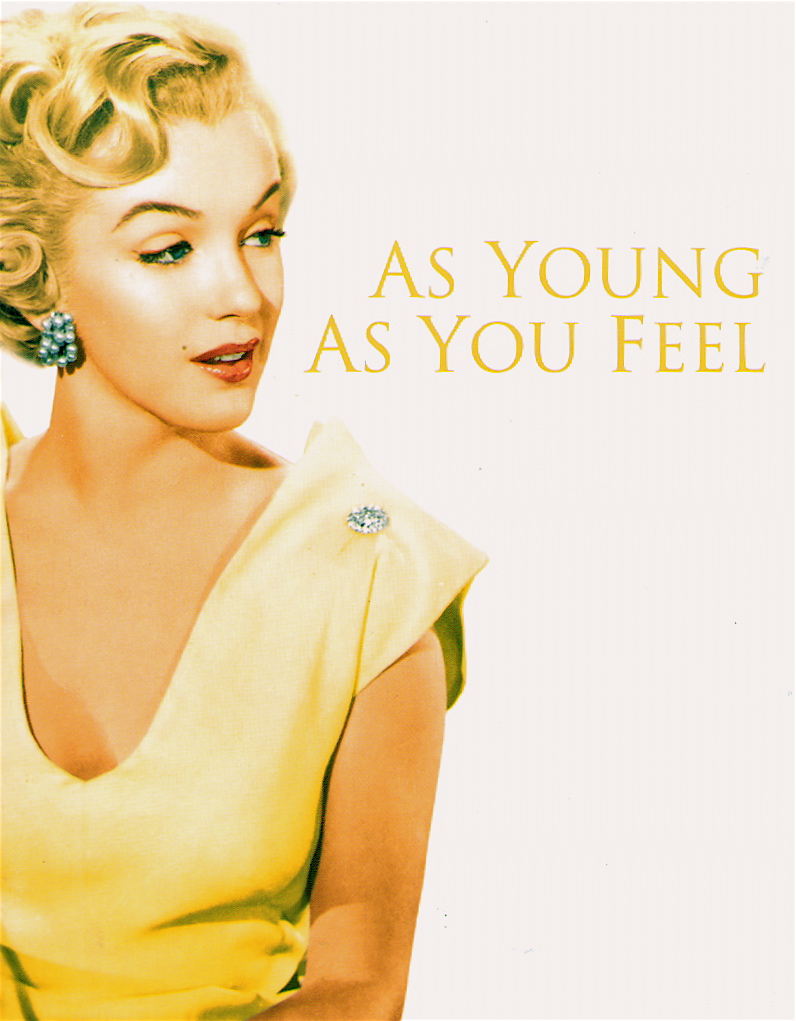
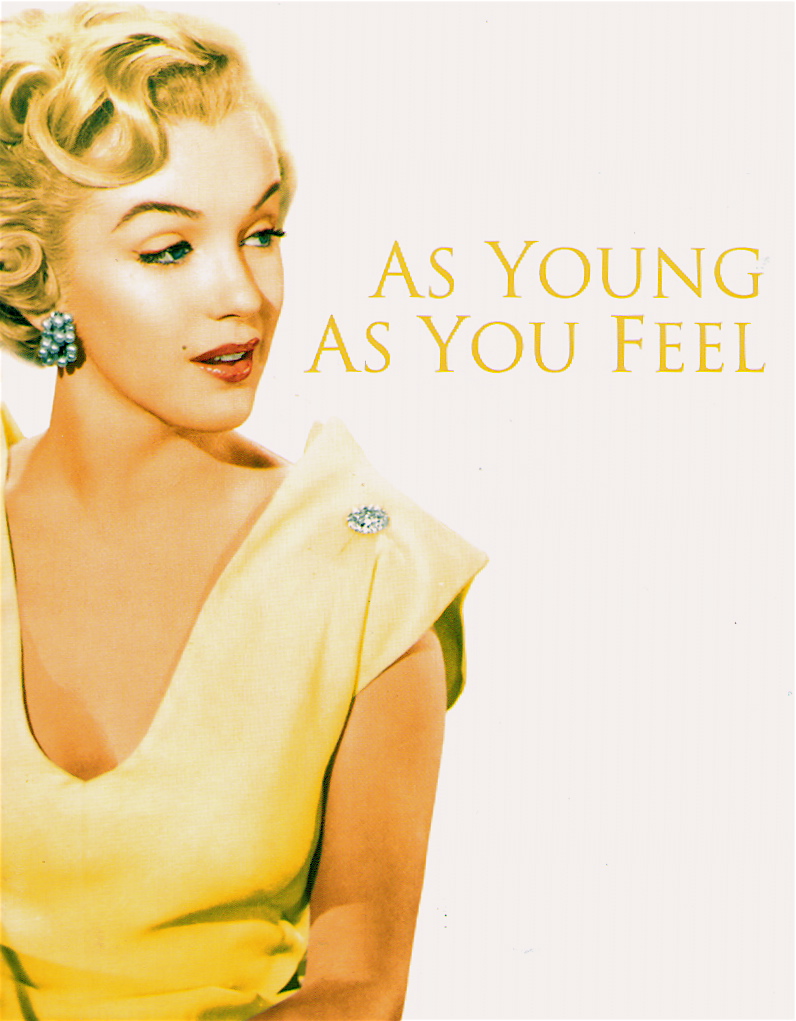
Many Happy Reruns: Marilyn Monroe at Eighty

I have been accused, at times, of exaggerating matters; but this just about proves it: radio, as a storytelling medium, is dead. I’ve conducted searches on Google and Technorati this morning, using the keywords Gelbart and Abrogate. The result: only 28 mentions in well over 40 million blogs! And no more than 444 via Google, the first entry of which refers searchers to broadcastellan. Considering that thousands of web journals are devoted to American politics and thousands more to the media in general, the lack of publicity a broadcast satire about the Bush administration has been receiving is remarkable.

I am referring, of course, to M*A*S*H creator Larry Gelbart’s “Abrogate,” a recording of which is still available on the BBC homepage. Had Barbara Bush been levitating on television (as she is in Gelbart’s utopia), had her son been denounced as the spawn of Satan (as he is in the fictive senate hearing of “Abrogate”), had Condoleezza Rice, Lynn Cheney and Ms. Bush been likened to the three hags in Macbeth (an image suggested by the radio play), there sure would have been some noise about it.

Radio used to popularize products and people, plays and personalities; now it appears to be the black hole of the multi-media universe. A few weeks ago, I recalled how Marilyn Monroe was being sent on the air to promote her studio, Fox, which had so little use for the young contract player during the late 1940s. She got flustered and faltered, delivering her few lines with less than confidence.

Her radio debut on 24 February 1947 (previously discussed here) was less than auspicious. The play presented that night on the Lux Radio Theatre was an adaptation of the costume drama Kitty. Marilyn was not in it, but was heard instead during a commercial break, peddling soap and plugging the latest film of Betty Grable, her future co-star. She had just been subjected to her first Technicolor screen test, but would remain limited to walk-ons in lesser black and white fare for years to come.

Such rare broadcasts reveal something about the personality of a performer that can be obscured on the screen. On live radio, unlike in the movies, there were no second (or twenty-second) takes. There was the microphone, demanding and daunting. There was the crowd of spectators, gawking at the performers in the studio. And there was Monroe, a nervous young woman, not yet twenty-one, clutching the script she had been instructed to read.

Monroe would have become an octogenarian today; not a pretty picture, perhaps—at least to those who see the aging process as a series of cumulative imperfections. How would the girl formerly known as Norma Jean have matured as a performer? Were she alive and among us now, would she be appearing in television dramas? Would she be discussing her latest autobiography with Larry King? Or would she be hiding from prying eyes, living in seclusion and hoping instead to be recalled as young as she was when Fox finally revealed her charms in Technicolor and Cinemascope? Given Western culture’s obsession with youth, she might now be embracing the microphone she once feared.

Recalling her not as she was or was made out to be, but calling her forth as she is to me, I am going to close my eyes now and listen to Marilyn as she returned to radio on 13 December 1952, with somewhat more assurance and considerably more box-office draw. By then she was being romanced by Charlie McCarthy, the first voice thrown into a ring littered with neglected hats.

Going on the air with Edgar Bergen’s wooden friend was risky business, considering what that chip of a chap had done to the broadcasting career of Mae West (as reported here). Not satisfied with fantasizing about her, Charlie was determined to woe and wed her, taking her home on behalf of us. Theirs was a short-lived engagement. Mine is a lasting passion . . .

On This Day in 1937: Claudette Colbert Gets Her “Hands” on Lombard’s Part

Well, we’ve all got them, I guess. Those lists of favorite books, or blogs, or breakfast cereals, or some such itemized accounts of our current predilections. They are supposed to tell others something we deem important about ourselves at some point of our lives; but, looked upon in retrospect, they can become a revelation to us, confronting us with time capsules of our likes, longings, and limitations. Here, for instance, are the top three entries on a list of all-time favorite movies as I compiled it back in 1986:

  1. Holiday (George Cukor; 1938)
  2. Hands Across the Table (Mitchell Leisen; 1935)
  3. Fade to Black (Vernon Zimmerman; 1980)

Now, I have not seen Fade to Black since the 1980s. It is a slasher movie for cinemaniacs, which is why I could identify with it back then. For reasons I did not yet fully comprehend, I was drawn, fairly early in my life, to the films and figure of Mitchell Leisen, a tremendously successful designer-director, but not a particularly well-remembered or highly regarded craftsman nowadays.

Claudette Colbert and Joel McCrea
on Lux Radio Theatre

Hands Across the Table is a simple you-can-have-your-beefcake-and-eat-it romance starring Carole Lombard as a penniless manicurist, Ralph Bellamy as a rich invalid who’d like to get his hands on her, and Fred MacMurray as a carefree man-about-town with dubious work ethics who eventually sweeps her off her feet. That pretty much sums it up—unless, of course, I’d have to explain the feeling of being torn between having my nails polished by gorgeous Lombard and running my fingers through MacMurray’s hair.

On this day, 3 May, in 1937, Hands Across the Table went on the air in an adaptation produced by that most prestigious and popular of radio theatricals, the Cecil B. DeMille hosted Lux Radio Theatre. It was this series, along with my love for 1930s and early 1940s screwball comedies that got me interested in old-time radio.

Once you have exhausted the classics, you will find a worthwhile substitute in American radio programs like Lux, which give you not only an opportunity to catch a different reading of films so familiar to you that they play before your mind’s eye, but also allow you to re-imagine them with alternate casts.

What, for instance, if Suspicion had starred Olivia de Havilland, rather than her sister, Joan Fontaine? How would Barbara Stanwyck or Ida Lupino fare in Merle Oberon’s role as Cathy in Wuthering Heights [thanks to André Soares for editing]? And what, if anything, could Loretta Young do when called upon to take over for Bette Davis in Jezebel? It all happened on the Lux program.

In Lux‘s audio version of Hands Across the Table, Carole Lombard’s role was performed by Claudette Colbert, who would later be Leisen’s leading lady in Midnight (1939). It was Colbert’s fourth appearance on the show, whose sponsors not only paid handsomely for such brief encounters with the microphone (up to $5000 for top-notchers), but also promoted the stars’ movie careers (by mentioning, in Colbert’s case, the upcoming releases I Met Him in Paris and Tovarich).

Heard in the Fred MacMurray part is Colbert’s Palm Beach Story co-star Joel McCrea (pictured above, with Colbert, reading the “Hands Across” script). Introducing the two leads, showman DeMille credited himself with their discovery:

Greetings from Hollywood.  Tonight’s event, with its glittering stage, its scientific wizardry that carries our voices to all corners of the earth and its audience of millions is a thing that I couldn’t have predicted when I first knew Claudette Colbert and Joel McCrea.  The Lux Radio Theater was then as remote from Hollywood as the moon.  But I predicted the eventual triumph of these two young people and was privileged to contribute to it.  I gave Joel McCrea his first motion picture contract.  Claudette was not then the favorite of millions, allowed to choose her stories, directors, and writers. The studio insisted I give her a dialogue test before casting her.  I did—and starred her in The Sign of the Cross and Cleopatra.

For the privilege of putting her hands on Lombard’s part—and the generous remuneration on the table—Colbert was obliged to declare that they had touched nothing but Lux toilet soap ever since her first appearance on the New York stage (in the 1920s). As I put it in Etherized Victorians, my doctoral study on old-time radio, it was all a matter of one hand washing the other.

Many Happy Reruns: Charlotte Brontë

Well, I am feeling strangely liberated. A few days ago, I learned that my BlogMad account had been wiped out as a result of some database corruption—a common occurrence, if comments from fellow web journalists are any indication. I chose not to sign up anew right away, luxuriating instead in the thought of temporarily forgoing those new-fangled ways in favor of an old-fashioned book. Despite my doctorate in literature, I don’t read nearly as much as I ought to these days. So, I took advantage of the first warm day of the season, ripped off my shirt, and grabbed . . . a Trollope. Anthony Trollope, that is, who happens to be one of my favorite authors. Recently, I picked up his Cousin Henry (my, doesn’t this begin to sound so Carry On!) after discovering that this novel is set in Wales, that strange and wild country west of England I am still struggling to call my home.

Now, Trollope was a decidedly pragmatic novelist. His novels, on the whole, do not concern boys and girls in the throes of love, but—how refreshing!—mature men experiencing various kinds of moral dilemmas or sophisticated quandaries. Elizabeth Bowen wrote a radio play about the author and his characters, but I have yet to come across a production of it. For romance I turn instead to something like Jane Eyre, whose author, Charlotte Brontë, was born on this day, 21 April, in 1816.

What it does not tell you, of course, is that Jane Eyre happens to be one of the most frequently radio-dramatized novels of the Victorian era or, for that matter, of any era. Next to Dickens’s “Christmas Carol,” no other story has aired more often than Jane’s, even though she was often rendered next to unrecognizable in the process.

To those familiar with and fond of the original narrative, the liberties taken by the version-crafters for screen and radio can be rather exasperating. Yet the disdainful sophisticates who dismiss the resulting pop-cultural bastards sight unseen (or sound unheard) sure miss out on some audacious rackets, such as the pitch made by the announcer of the Lux Radio Theatre in the introduction to the 14 June 1948 broadcast of Jane Eyre (or some such gal’s tale)! To accommodate the show’s sponsor, the spokesperson for Lever Brothers was called upon to ponder the question how Ms. Brontë—who, according to one biographer, liked lace—ever managed to wash her clothes without the benefit of Lux Flakes.

Rather more insightful was a radio lecture delivered on 3 April 1949 during the NBC University Theater production of Jane Eyre, in which Deborah Kerr (pictured above, in another kind of commercial dilemma) portrayed the titular heroine. Noted novelist James Hilton provided a brief but smart commentary, touching upon the reception of the novel, its biographical background, its historical significance, and its relevance for twentieth-century audiences.

To be sure, Hilton conceded, Jane Eyre was a “good story with all the popular ingredients—melodrama, romance, and a happy ending”; but

what gave it life is what gave it birth: a quality of passionate imagination which could make a shy spinster governess the equal, in her own mind and by her own showing, of a Sappho or a Cleopatra.

Come to think of it, Hilton’s mentioning of H. G. Wells’s Ann Veronica in this context recently induced me—someone more readily influenced by smart authors than smarmy advertisers—to get hold of a copy of the latter novel as well.

Many cuts and bruises were inflicted upon plain Jane during those supposedly aureate days of radio; and, with an emphasis on romantic melodrama at the expense of narration, more attention was drawn to that screaming madwoman in the attic than to the reflections of the troubled young governess who discovered her secret. In this respect, old-time radio was like a Victorian orphanage: expect to find negligence, exploitation, and very little recognition, let alone respect, for the suffering brainchild.

Through it all, Jane Eyre survived considerable hardship and cruelty to remain, to this day, one of the most robust heroines of all fiction.

Up Frenchman’s Creek; or, How (Not) to Prepare for a Vacation

Well, I’ve been home barely twenty-four hours and already I am packing my suitcase again. After a weekend up north in Manchester, I’ll be off tomorrow on a weeklong trip down south to Cornwall. Instead of flicking through my travel guides this morning, I started reading Daphne du Maurier’s Jamaica Inn. Now, there’s a description of scenery you wouldn’t get from your travel agent:
[There] was a lashing, pitiless rain that stung the windows of the coach, and it soaked into a hard and barren soil. No trees here, save one or two that stretched bare branches to the four winds, bent and twisted from centuries of storm, and so black were they by time and tempest that, even if spring did breathe on such a place, no buds would dare to come to leaf for fear the late frost should kill them. It was a scrubby land, without hedgerow or meadow; a country of stones, black heather, and stunted broom. 

There would never be a gentle season here. [. . .] 

Not much more hospitable is the seascape depicted in the opening chapter of du Maurier’s Frenchman’s Creek:

When the east wind blows up Helford river the shining waters become troubled and disturbed and the little waves beat angrily upon the sandy shores [. . .].

The long rollers of the Channel, travelling from beyond Lizard point, follow hard upon the steep seas at the river mouth, and mingling with the surge and wash of deep sea water comes the brown tide, swollen with the last rains and brackish from the mud, bearing upon its face dead twigs and straws, and strange forgotten things, leaves too early fallen, young birds, and the buds of flowers.

Perhaps reading du Maurier’s Cornish romances is not such an ideal way to get into the spirit of things, especially not when one is hoping for spring and renewal. At least their author was familiar with the locations described. Listening to the 10 February 1947 Lux Radio Theatre version of Frenchman’s Creek, I got no sense of the locale at all; nor, for that matter, much sense of the story. There was too little of it left to suggest the illicit passion of a married woman for a dashing pirate.

The radio version is not so much an adaptation of the novel, but of radio dramatist Talbot Jennings’s screenplay for Paramount’s 1944 technicolor production, which cleaned up du Maurier’s act in accordance with Hollywood’s production code. Mitchell Leisen’s film, of course, was not shot in Cornwall either, but in Jenner, California, which also stood in as Devon in The Uninvited, an old-fashioned ghost story featuring the novelty of a sun rising in the west.

I don’t suppose Alfred Hitchcock’s reworking of Jamaica Inn is any more useful as an introduction to Cornwall; I’ve always confused it with Under Capricorn, another one of Hitchcock’s misguided forays into period piece froufrou (although I confess having enjoyed his Waltzes from Vienna). And since there is little time to dip into the poetry of John Betjeman, I think I’d better get back to my travel guide after all—and finish packing. I will try to relate my impressions upon my return next Wednesday—provided I can find a radio drama angle.

Another “Wrong Number,” a False Start for Marilyn, and the Right Answer at Last

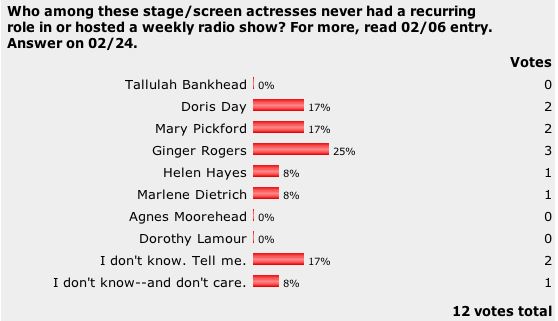
For the past three weeks I have been commemorating the dames, gals, and ladies of the airwaves; but now, the correct answer to the question posed in first broadcastellan quiz can finally be revealed. Thanks to all those who guessed or knew or couldn’t care less—and told me so. Tallulah Bankhead, Doris Day, Mary Pickford, Helen Hayes, Marlene Dietrich, Agnes Moorehead, and Dorothy Lamour—they were all radio regulars at some point in their careers, whereas others, including Ginger Rogers, the lady in question (as guessed by three readers), limited their air time to occasional guest appearances on dramatic programs like the Lux Radio Theatre. And others still, Marilyn Monroe among them, started out in commercials.

On this day, 24 February, in 1947, more than five years before she became a major star, a noticeably nervous Monroe, having waited months for her first movie role while already under contract at Fox, was pushed before the microphone to appear in a commercial break for the Lux production of “Kitty.” Within the few seconds allotted for her radio debut, Monroe was faced with the task of initiating her career (by mentioning her first Technicolor screen test), plugging Betty Grable’s The Shocking Miss Pilgrim (whose costume she got to wear during the test shoot), and peddling Lux “flakes” (which ostensibly kept those costumes fresh and colourful). However alluring her timbre, Monroe fumbled. She could not even get the name of the announcer straight; her voice was rarely broadcast thereafter, even as her film roles remained scarce and undistinguished.

A pleasant voice, while an asset, was not a radio requisite. As I mentioned previously, Louella Parsons did quite well without one, notwithstanding her consternation when being told she had to do without the larynx of Ms. Rogers, who allegedly insisted on getting paid to be interviewed. The giggles and high-pitched screechings of comedy actresses aside, the most celebrated woman’s voice on American radio was the less than pleasing one emanating from Agnes Moorehead. Her virago vocals, by which Joseph Cotton’s character in Since You Went Away claims to have been haunted across the Atlantic, was ideally suited to the role of irate Mrs. Stevenson in that most famous of original old-time radio plays, Lucille Fletcher’s “Sorry, Wrong Number.”

On this day in 1944, Moorehead, shown left during a performance of “Sorry,” once again starred in the role she had originated on the radio thriller anthology Suspense in May 1943. The part was subsequently translated for motion picture audiences and television viewers (by Barbara Stanwyck, Mildred Natwick, Ida Lupino, and Shelley Winters); but, however bitter Moorehead might have been losing the role to Stanwyck on the big screen, no actress would snatch the original from the “First Lady of Suspense.”

It was not until long after Moorehead’s death that Claire Bloom (recently seen on UK television in the last of the second season of Marple), made an attempt at superseding the “First Lady,” not only by recreating the role for radio in 1999, but by starring in a sequel of sorts.

While she had nothing to do with that sequel, radio dramatist Lucille Fletcher was responsible for the 1948 film adaptation. Her involvement did not, however, assure the aesthetic success of the latter, which, for all its high melodrama, has little of the tension generated by the original play. With its numerous flashbacks, the film destroys the intensity of a drama unfolding in real time. Like Allan Ullman’s novelization of Fletcher’s screenplay, it fails to approximate, let alone recreate, the excitement of eavesdropping on someone in mortal danger, someone whose life, like the live broadcast during which it plays out—runs on a decidedly tight schedule beyond our control and influence.

“I wanted to write a show that was ‘pure medium,'” Fletcher remarked about “Sorry, Wrong Number.” She succeeded so well that any adaptation would amount to nothing short of mediocre impurity.