Believing in Labels; or Long-distance Travel, Hands On

I am somewhat of a ‘jacket potato,’ as my mother-in-law recently labelled a certain garden-variety of vegetables, soi-disant, that ostensibly thrive in domestic interiors.  A book-jacket potato, perhaps; but straitjacket comes to mind as well in these sport-jackets-are-for-hangers days of sitting none-too-pretty.  

Not that, in my case, being pomme-de-terrestrial is a recent development.  When I was a child, my mother-by-law used to admonish me for being what in my native tongue is called a Stubenhocker: someone not readily dissuaded from following an inclination not to venture beyond the threshold.

I was that all right; but persuading in other than laid hands-on ways was complicated by the fact that I grew up in one of the most unappealing and polluted parts of flat-as-tarmac North Rhine-Westphalia.  There’s a pre-industrial reference to that region in the opening paragraph of Candide, which the editors of Norton’s explain thus to the reader: ‘Westphalia is a province of western Germany, near Holland, and the lower Rhineland.  Flat, boggy, and drab, it is noted chiefly for its excellent ham.’  Voltaire himself, so the editors note, described the region as ‘vast, sad, sterile, detestable countryside.’  A frank enough assessment to cure any ham of homesickness.

Creating a new virtual home for myself was one of the projects this summer; and my Sitzfleisch (buttocks to you) was sorely tested as I was scanning items from my ephemera collection for online display.  Take these luggage labels, for instance, which I exhibited as part of my (Im)memorabilia exhibition back in 2014 and reserved another spot for in Travelling Through in 2018.  Their erstwhile collector, whose Latvia-to-London history of wartime displacement is still waiting to be told, probably did not visit most of these places and ‘palaces,’ but the labels may well have been a source of vicarious enjoyment as the trading of Glanzbilder – glossy pictures sold in sheets at the local kiosk for trading among pocket-money possessed youngsters – was for my former self in bleak Westphalia.

But I am in danger of veering off-topic, self-imposed and accommodating as it is.  I was speaking travel – a language that’s beginning to sound a lot like Latin.  There is so little of it this year that the aforementioned outing to Hay-on-Wye seemed like an exploratory mission to a Shangri-La of normalcy.  To think that, in 2019, I started out in Sydney and ended up in Lisbon, with extended visits to my old neighborhood in Manhattan and trips to Amsterdam, London, and Florence in between.  It’s the Stubenhocker in me that shall pull me through the pandemic; that, and lexical acrobatics.

I picked up some examples of these former suitcase adornments and searched online for the places they advertise.  Are any of them still operating, I wondered? Or might this year have dealt a final blow to yet another pile of real and conceptual bricks in the service of an industry that, for decades, naturalised and solidified our bourgeois divisions of home and abroad, work and leisure, of holiday and everyday?
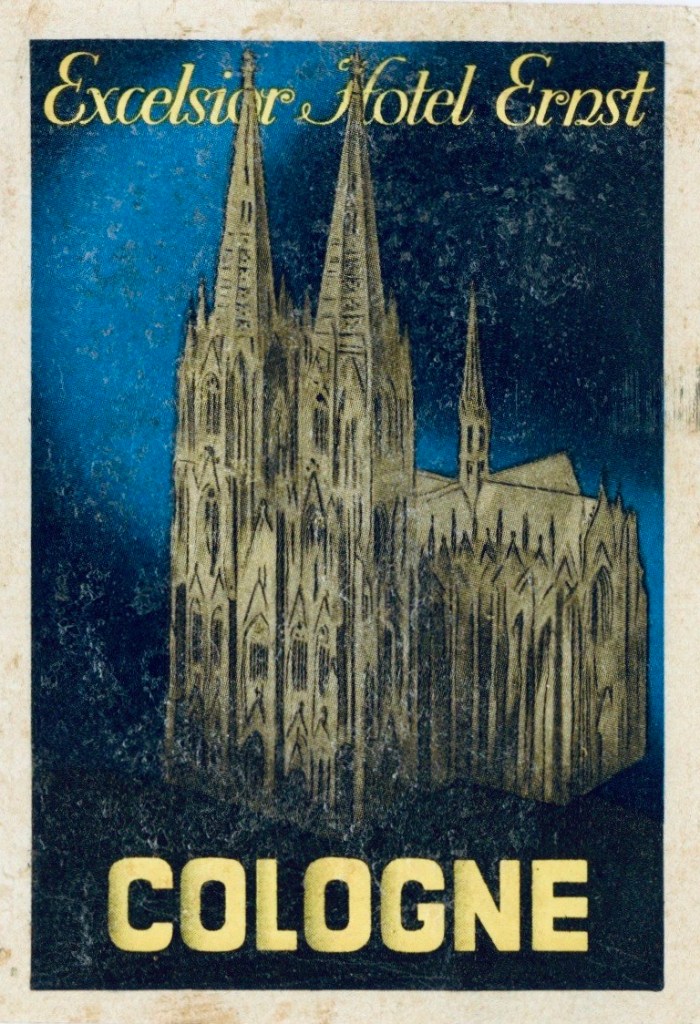
Luggage label, Excelsior Hotel Ernst, Cologne, Germany

Cologne Cathedral caught my eye – natch – and brought back memories of countless walks past that sooty Gothic spire rising next to the main train station that was my terminal for entering and exiting the ancient city of Köln.  It’s a sight that, decades later, became a lingering presence in my Gothic Imagination lectures – the cathedral, I mean, not the station, although, come to think of it, the back then equally sooty and rather more mysteries-filled and fantasy-fueling Hauptbahnhof haunts my teaching as well.

The Excelsior Hotel Ernst was – and is – about as likely a place for me to flop as is the Tomb of the Three Magi that is housed in the cathedral nearby.  The only five-star hotel in the old part of the city, it is so close to Dom, in fact, as to warrant its domination of the label design.  On its booking website, the establishment claims to have been privately owned since 1863; but the original building, which predates the 1880 completion of the permanent construction site that is the cathedral, was torn down in 1909.   Two decades later, the rebuilt hotel was reserved for the British army, which occupied it and much else besides until 1926.  Another two decades after that, it was still standing, albeit not without damage, having survived, like the battered Dom, the air raids of the Second World War.  And, yes, it weathered the economic fallout of COVID-19, opening again in May 2020 after a brief shutdown.  The fragile label, meanwhile, has lost little of its gloss.
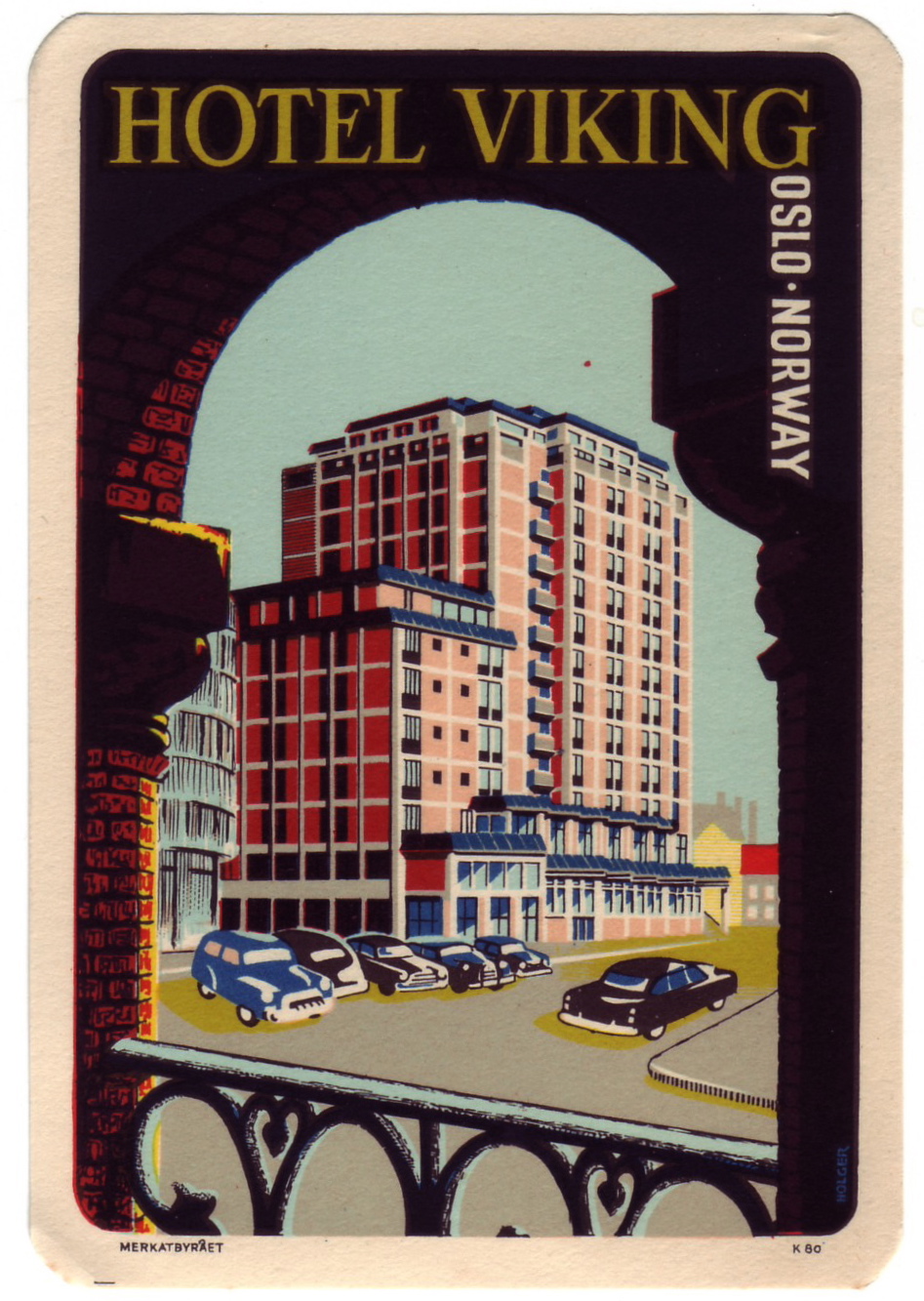
Luggage label, Hotel Viking (now Hotel Royal Christiania), Oslo, Norway

Resisting my cultural conditioning – the notion of vacationing, in my German childhood, being associated with going down south – I picked up the label promoting the Hotel Viking in Oslo.  It opened in 1951, an influx of visitors being expected in 1952, the year Oslo hosted the Winter Olympics; it was the first year in which Germany (both East and West) were permitted to participate since Berlin hosted in 1936.  Norwegians were not likely to relish the idea of uniformed German delegates and their concomitant supporters invading their capital.  The label design frames the new site in a traditional context, suggesting that, even when viewed from more venerable landmarks, it is a sight to behold. The hotel, now called the Royal Christiania – thus declaring itself traditional by referencing the erstwhile name of the city – is still open for business. The label drives home that the hotel was modern by declaring it to be approachable by car; these days, advertisers are less likely to turn the parking space into a feature.

Luggage label, Hotel Wittebrug, Den Haag, Netherlands

Now, I have never been to Oslo; but on one of my most recent trips to the continent – if ‘recent’ is the word – my husband and I took the train from Amsterdam to spent a few hours in Den Haag, where I had never been until then.  I now lecture in landscape art, so seeing paintings of that genre right where they were created in the seventeenth-century Dutch Republic was as thrilling to me as the fantasy of time travel, dismissed as such pictures were by eighteenth-century academics, and many now still under their influence, as prosaic.  However, I would have looked in vain for the Hotel Wittebrug, which was torn down in 1972.

The labels are the stuff of daydreams for me at the moment; but they certainly invite further research.  Who designed them, and when? How does the design correspond with, or misrepresent, the site depicted? It is a project for someone who, like me, does not believe in the label ‘fine art’ and is not dismissive of products of culture that, like seventeenth-century Dutch landscapes, were commodities sold and bought on the market long before they ended up, removed from our everyday, in pay-to-enter venues set apart for our veneration of them and of the collections that now hold them.  

Handling these flimsy pieces of paper now, I am reminded most of all of what I am missing while the world is a world away.  Being out of touch does not quite feel as joyous when the sense of touch cannot be exercised occasionally by hugging an old friend or holding onto what seems more echt, or genuine, if it can be had, momentarily, for the holding …
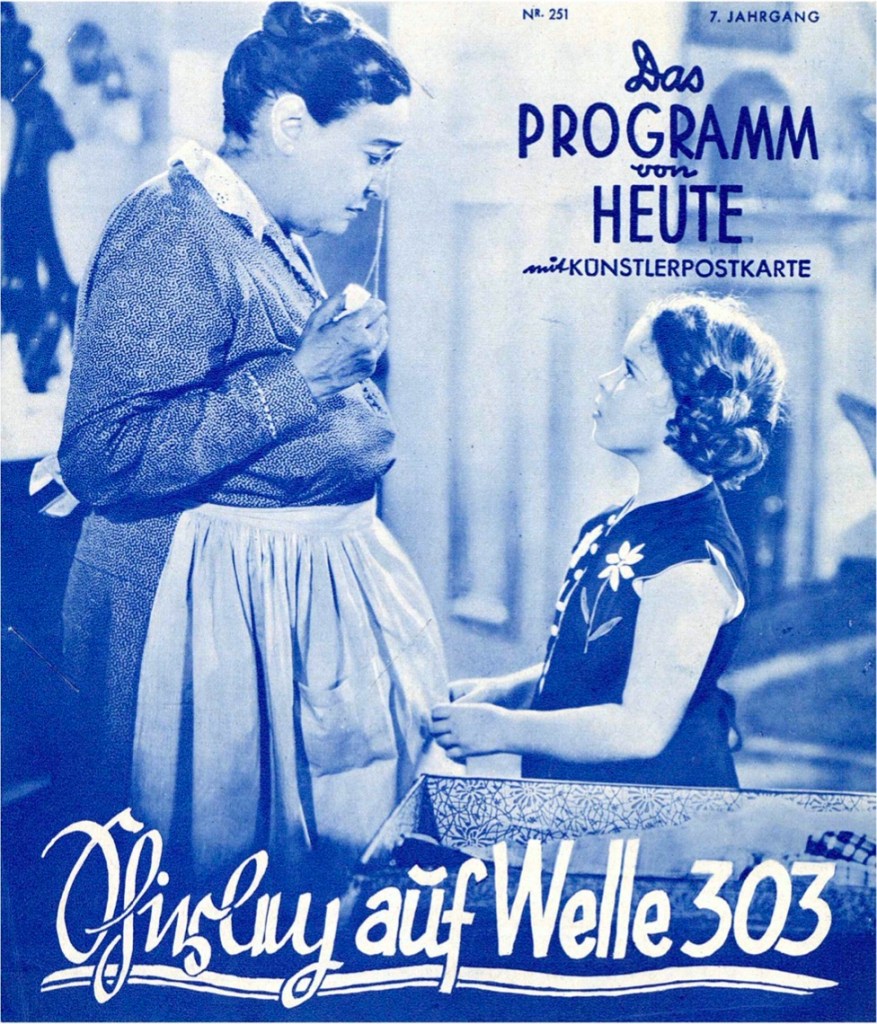
Little Lady Hee-Haw; or, A Temple Fit for Goebbels

On my only trip requiring an overnight bag during this stay-at-home summer, my husband and I drove from our patch on the west coast of Britain to the thoroughly overcrowded Cotswolds and, upon my urging, made a stop-over at the Welsh town of Hay-on-Wye, an internationally renowned haven for second-hand book lovers.  Now, musty old volumes and COVID-19 do not quite go together – or so I thought – considering that retail spaces generally set aside for them are rarely supermarket-sized.  However, Hay, which depends on the trade, managed to make it work; and, meeting the moment by donning a mask, I got to enjoy an afternoon of socially distanced and sanitized hands-on browsing.

Not that I walked away with any tomes of consequence.  While at the Cinema bookstore – a shop not limited to publications related to motion pictures – I discovered a nook stacked with a curious assortment of ephemera: German movie programs of the 1930s.  I am not sure how they ended up in a Welsh bookshop – but that dislocation may well have extended their shelf life … until a German such as I came along and took an Augenblick to sift through them.

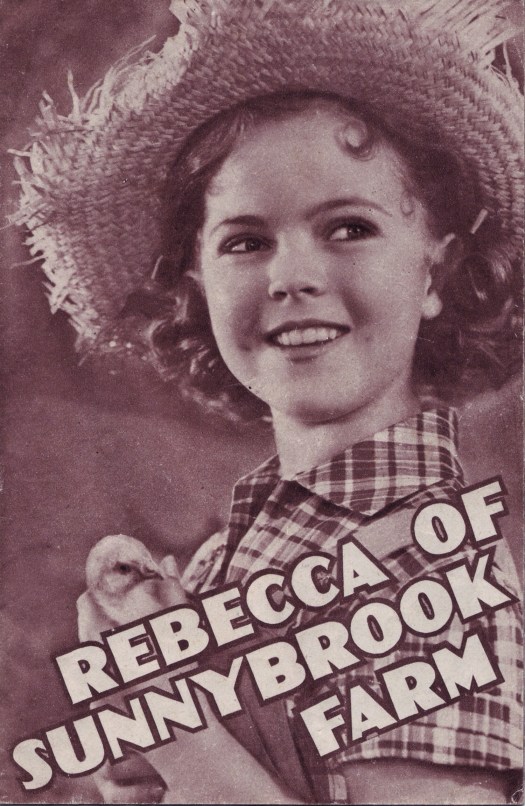
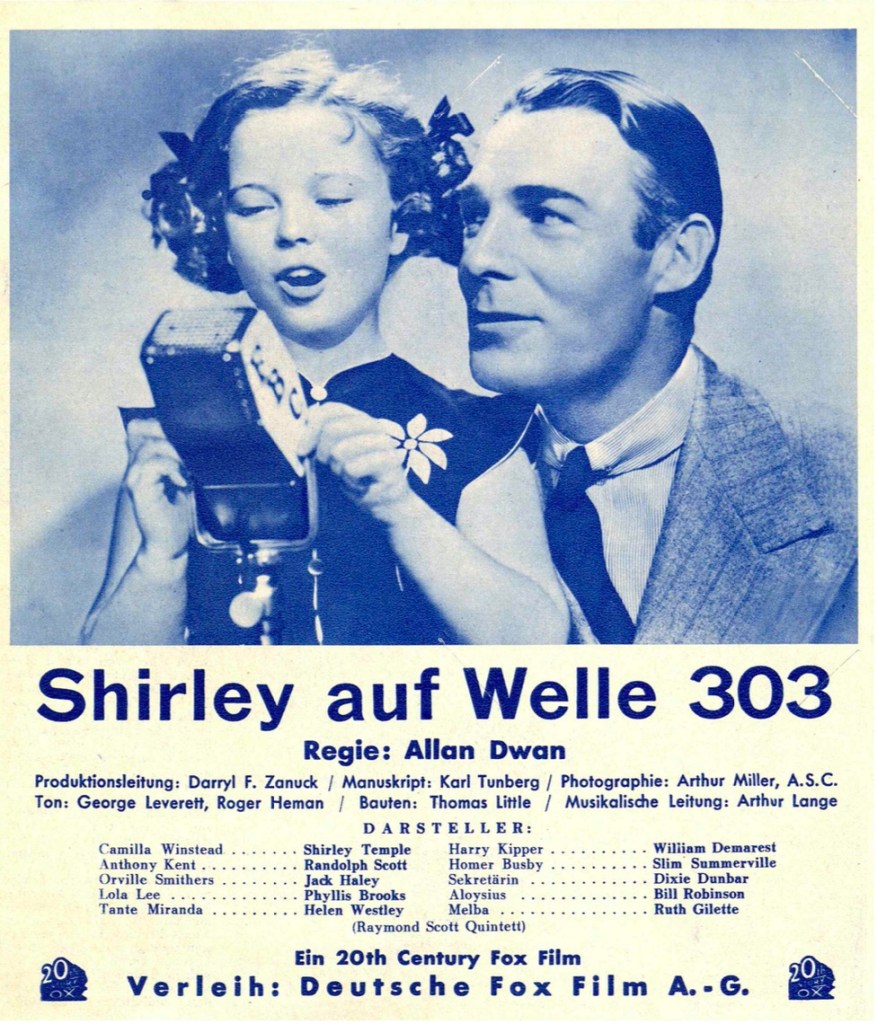
The program pictured above, dating from 1937, left me puzzled for a while.  I am familiar with many of Shirley Temple’s features – but I did not recall any among them bearing a title remotely like “Shirley auf Welle 303,” or “Shirley over Station 303.” So, I picked up this fragile brochure, and a few others besides, if mainly to tap their potential as pop cultural conversation pieces.

The film being deemed worthy of commemoration is Rebecca of Sunnybrook Farm, a DVD of which is gathering dust in my video library.  The title refers to an early twentieth-century children’s literature classic, although the movie version bears so little resemblance to it that it could hardly be considered an adaptation.  Not that the title of the novel would have resonated with German audiences. Meeting this challenge, the marketing people at Fox came up with a new one that might sound more relatable.

I suspect that the servants of the Nazi regime would have objected to the name of the titular character as well, being that Rebecca is Hebrew in origin, meaning “servant of God.” Shirley, on the other hand, was a household name, Ms. Temple having charmed audiences around the world since at least 1934. Like the titles of several other Shirley Temple vehicles released in 1930s Germany, the German version of Rebecca of Sunnybrook Farm therefore bears the first name of its star. Only Heidi stayed Heidi, rather than being translated into “Little Swiss Miss Shirley.”

A contemporary British program for the same film, also in my collection.

And yet, the effort to make the film seem more relatable to Nazi Germany’s picture-goers nonetheless resulted in a title that was out of touch with Fascist reality. In 1938, when the film was released in German cinemas, the idea of using radio transmitters for your purposes – or for the purpose of exploiting a child for your own purposes – was inimical to state-controlled broadcasting. On the air, it was always “Germany Calling,” a phrase famously used by the aforementioned Lord Haw-Haw beginning in 1939.

Germans would have struggled in vain to twist the dial and hit on a broadcast like Shirley’s, or they would have paid a price for such twisting.  Many of them listened via the Volksempfänger, a mass-produced receiver that was always tuned in to the Führer’s voice.  Imagine staying tuned to Fox News all day.  Then again, so many who do have the choice not to still do nonetheless, not unlike those who were complaisant during the rise of Fascism in Germany.

The change in title – and the recontextualization it achieves – is peculiar, and only a performer as innocuous as Shirley Temple could have gotten away with what otherwise would have been downright seditious: seizing the microphone and taking to the airwaves in a makeshift studio set up in a remote farmhouse.  Perhaps, the titular bandwidth – 303 – was to signal that Shirley’s broadcast had been sanctioned after all, 30 January 1933 being the date Hitler came to power. In the Third Reich, three was heralded as the charm.

For decades, the German film industry did wonders – or, rather, wilful damage – to international films with its dubbing of their soundtracks; voicing over and voiding the content of the source, there were many opportunities to ready a film more substantive than Rebecca for consumption in Nazi Germany.  I do not recall seeing this movie in my native language, although I do remember a festival of her films airing on West German television in the late 1970s.  Not that watching Rebecca of Sunnybrook Farm in the original is an experience I am eager to repeat, clobbered together a vehicle for an overhyped and overworked child star about to wear out her welcome that it is. Variety dismissed the film at the time as a “weak story,” “indifferently acted and directed,” while claiming its lead to be “at her best.”

The German program does little more than summarize the plot as well as state the principal actors and main players behind the scene of the production; I am sure someone checked whether producer Darryl F. Zanuck was Jewish, which he was not. What struck me about the program was that it mentions the word ‘propaganda’ twice in the first paragraph, where it was used as a substitute for advertising (in German, “Werbung” or “Reklame”).  Sending up the excesses of US consumerism while promoting the ostensible virtues of country living, this trifle of a film – distributed in Nazi Germany by the enterprising and accommodating “Deutsche” Fox – could serve as a vehicle for anti-American propaganda at a time when increasingly few US films were granted a release in Germany.

By making such trifles, and by marketing them for distribution in Nazi Germany, the US film industry contributed to the rise of Fascism, which, only after the attack on Pearl Harbor, Hollywood films began to confront with a suitably glossy vengeance. By that time, US films were banned in Germany, and Shirley Temple ceased to be a leading lady – at least in motion pictures.

A Mighty Joe! But not without a plan …

Poster design by Neil Holland
using a 1940s concept drawing for Mighty Joe Young
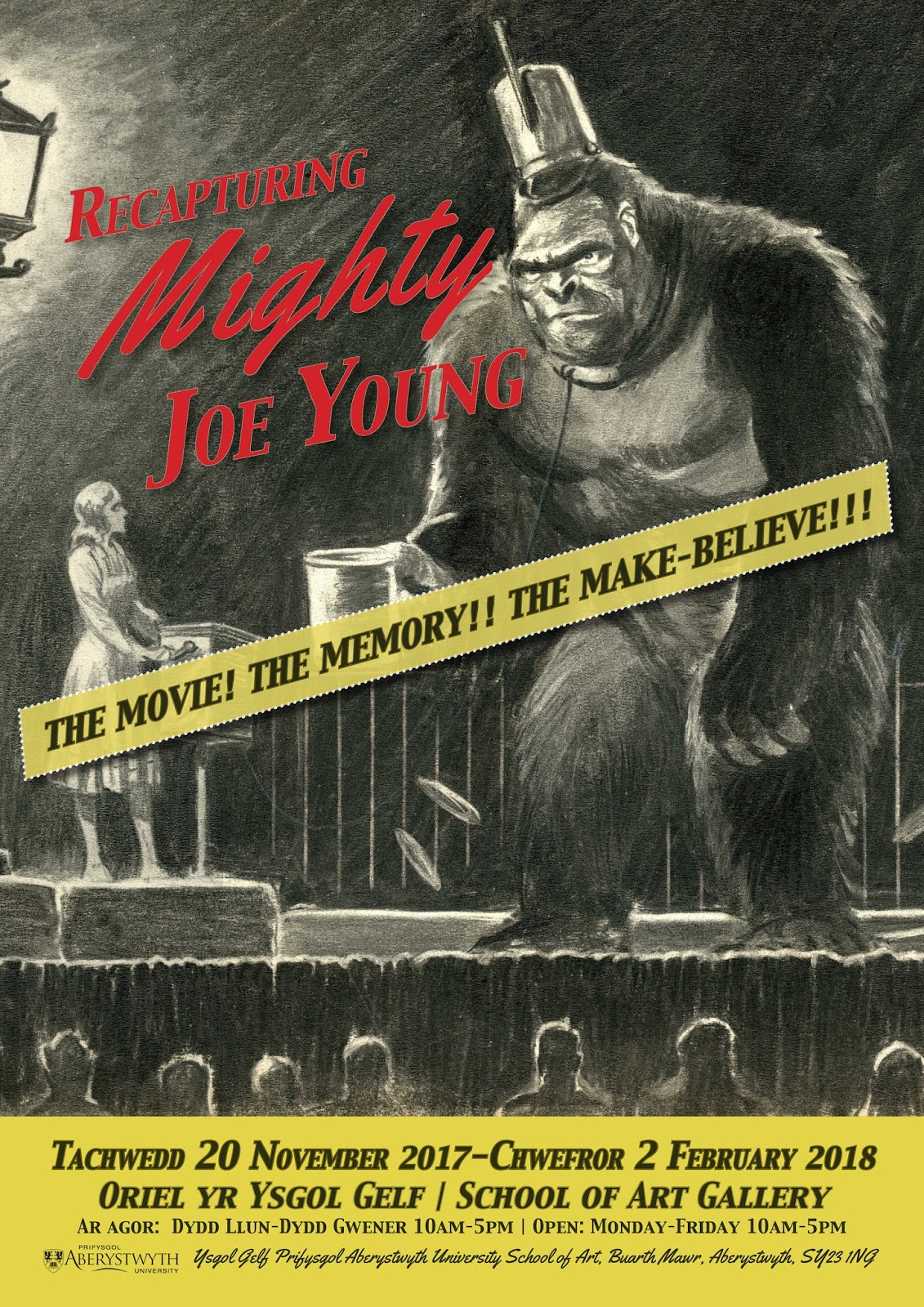
As announced in my previous post, I am staging the exhibition Recapturing ‘Mighty Joe Young’ at the School of Art, Aberystwyth University (see poster for details).

This is my introductory text panel for the show:

From adaptations of Edgar Allan Poe’s “Murders in the Rue Morgue” (1841) to the latest installment in the Planet of the Apes saga, non-human primates have played a prominent part in the evolution of motion pictures. Ridiculous and sublime, they act as uncanny doubles of our uncouth selves.

 
Until well into the 1980s, silver screen simians were often aped by actors in hairy suits. A memorable exception is the original Kong, the uncrowned King of Skull Island. Mighty Joe Young (1949) is one of his descendants.
 
Joe was brought to life by the creative team responsible for King Kong (1933) and its sequel, Son of Kong (1933). The large volume displayed in the centre of the gallery is Joe’s baby album.
 
The album commemorates the collaborative efforts that earned Mighty Joe Young an Academy Award for Special Effects. Showing off the tools and tricks of the trade, it contains documentarian photographs as well as drawings and watercolour paintings by Willis ‘Obie’ O’Brien, the film’s ‘Technical Creator.’  The album also records the work of Obie’s apprentice, Ray Harryhausen, whose name became synonymous with pre-CGI fantasy film and stop-motion animation.
 
The album is on public display for the first time. It was compiled retrospectively, probably by a member of the crew.  Along with hundreds of books and journals, it was bequeathed to Aberystwyth University by the film historian Raymond Durgnat (1932–2002), to whose legacy this exhibition pays tribute.
 
Surrounding the album are posters, promotional materials as well as 1940s concept drawings for animated movies produced by Walt Disney and Fleischer Studios. Also on show are prints by Gustave Doré and John Martin.  Their fantastic and awe-inspiring images were precursors of cinematic spectacles. Both O’Brien and Harryhausen referenced them in their work.
 
As a curator, educator and writer, I aim to promote interconnections between the arts as well as the creative industries and academic disciplines devoted to them. Instead of imposing a context in which our album might be contained, I let it take over the gallery to disclose its stories and open new associations.
 
The public is invited to shape this evolving display by sharing responses to Joe in animation workshops scheduled during the show’s run. Like the homage in Lego you encounter in our gallery, the videos created in those workshops will become part of this exhibition.

She Said It in English: Olympe Bradna (1920-2012) on Men, Mikes and Milk

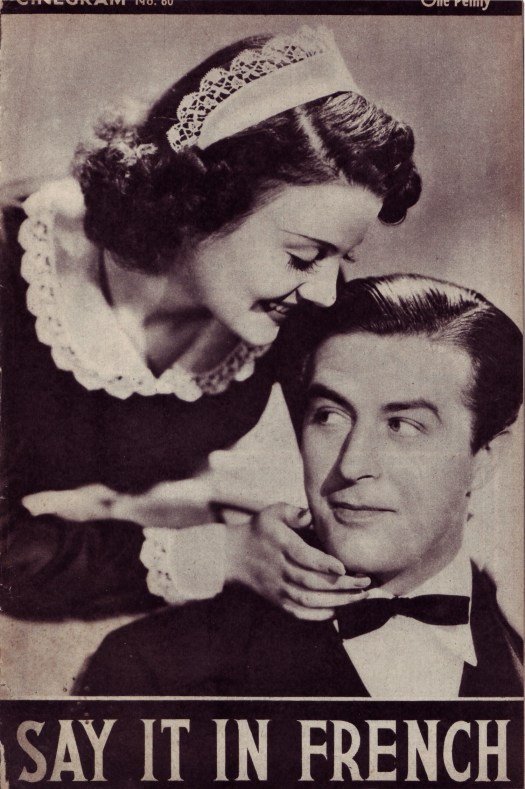
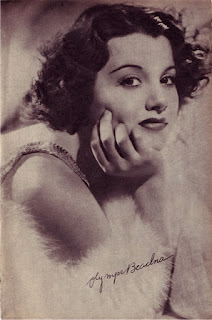
Olympe Bradna is a diplomat of the first rank!” So declared the editors of Cinegram in an issue devoted to Say It in French.  In that now largely forgotten romantic comedy, Bradna co-starred as a French student who impersonates a maid to be close to an American lover (played by Welshman Ray Milland) expected to marry a millionaire’s daughter (Irene Hervey) to save his father’s business.  

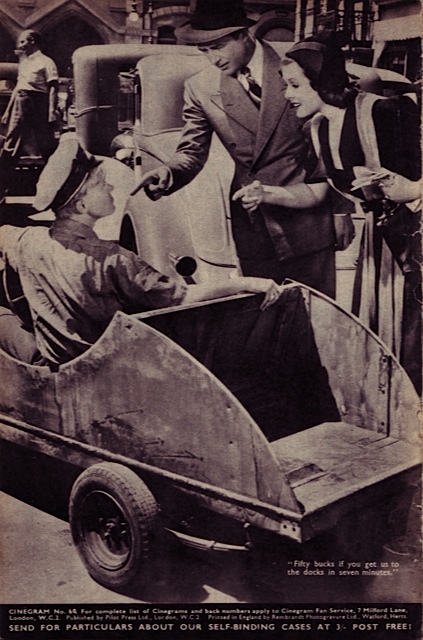
The cover of Cinegram No. 60, from my collection

Maybe that sounded better in French, in which the comedy was first staged under the title Soubrette. Never mind.  The “petite morsel of feminine allure,” so the Bradna legend goes, had “only been kissed by two men during her whole lifetime”—that lifetime amounting to eighteen years back in 1938. 

One year into her brief Hollywood career, Bradna had overcome her “anxiety and embarrassment” and forgotten about her vow that she “would never kiss” at all, “either on the screen or off, until she had a ‘steady’ beau.”  Having been teamed with both Milland and Gene Raymond (in Stolen Heaven), the actress was “all in favour” of on-screen romance; but, when asked whose lips she preferred, the teenager refused to kiss and tell. “If I did that, it would be, how do you say? ‘propaganda.’”

In the context of European pre-war clamour and the business of Hollywood glamour, the word choice is peculiar, especially since Cinegram was a promotional effort aimed at British audiences.  It is a telling statement, too, as it suggests Bradna’s questioning of the role she was expected to play in the propagation and exploitation of her own image.

Far from naive, the French-born performer knew all about the real world of make-believe, which is why, in her future pursuit of “real romance,” she was determined to “go outside the show business.”  In the early 1920s, her parents, Jeanne and Joseph Bradna, had a successful bareback riding act at the Olympia Theater in Paris, after which venue Olympe was named and where she made her stage debut when she was not quite two years old.  Hence, I suppose, her expressed need for security: “[A]ctors are fellows with uncertain jobs.  They’re generally honest, gay, intelligent and interesting, but they lack that quality of stability that is so important to a girl who wants to establish a home.”

Presumably, she said all this in English, rather than in her native tongue.  When she first set her dancing feet on the United States as a member of the Folies Bergère and subsequently performed at New York’s French Casino, she was so dismayed at her “lack of English that she determined to learn to speak the language properly.  She succeeded so well,” Cinegram readers were told, “that when it came to making this new picture she had to put in several weeks of hard work under a French tutor to get her French back to standard.”  A Hollywood standard, that is.  After all, in romantic comedy, a French accent was as desirable as a maid’s uniform.

Bradna in Cinegram No. 60

Bradna’s language skills were put to the ultimate test when, on 14 November 1938, she went behind the microphone for the Lux Radio Theater production of “The Buccaneer,” co-starring Clark Gable as French pirate Jean Lafitte; but her part was suitably Old-World, and all over the map besides, to account for any foreignness in her speech.  Bradna assumed the role of Gretchen, which had been played on screen by the Hungarian-born cabaret artist Franciska Gaal.  “Oh, I don’t know how I sound, Mr. DeMille,” Bradna said to in the nominal producer of the program during her scripted curtain call, “a Dutch girl with a French accent in an American play.”  Supported as she was by Gertrude Michael and Akim Tamiroff, both of whom enriched American English with peculiar accents and inflections, she hardly stood out like a sore tongue.

Not that Bradna, who appeared on the cover of the 27 July 1938 issue of Movie-Radio Guide, was a stranger to the microphone.  According to the March 1938 issue of Radio Mirror, Paramount Pictures “put her into five consecutive radio guest-spots for a big build up—but without giving her a nickel.”  Perhaps, DeMille would not have given her a nickel, either, for the privilege of making it into a Lux-lathered version of The Buccaneer, one of his own productions, nor given her an opportunity to promote her latest picture, Say It in French, had he known what British Cinegram readers gathered by flicking through their souvenir program for Say It.  Bradna, they were told, had “startled experts by announcing that the secret of her facial complexion [was] a daily buttermilk massage.”

The makers of Lux Toilet Soap could not have been pleased at Bradna’s insistence, fictive or otherwise, that buttermilk was “all” she needed: “My skin may be ever so parched and dry before the routine, but afterwards it is as fresh and smooth as I could want!

Say It: A rickety vehicle

Wally Westmore, Paramount’s make-up chief, reputedly explained that the “secret”—an age-old French recipe for a youthful complexion perhaps not quite so difficult to achieve at the age of eighteen—lay in the rich oil content of buttermilk, which had the same “softening and freshening effect upon the skin as the most elaborate and expensive preparations used by the stars.”  That, of course, was just the claim Lever Brothers were making each week on the Lux Radio Theater, which might explain why Ms. Bradna was never again heard on the program, whose stars were handsomely remunerated for their implied or stated endorsement of the titular product.  Perhaps, Bradna was not “a diplomat of the first rank” after all . . .

Olympe Bradna died on 5 November 2012 in Lodi, California.

You Can’t Take It With You; or, I Scan, Therefore I Am

I call them inventory days, those first few weeks of a new calendar year. It is a time when I play secretary to myself, when I organize and catalogue, shelve and throw away, when I look back at the places I’ve been to, the things I have done, the people I have met. Perhaps, I am getting it all wrong: the year is crisp—so, why am I rehashing what has been, obsessively reconstructing the past with the aid of notes in my calendar, correspondences, receipts and ticket stubs? I am not attached to the material evidence of my prior whereabouts and activities, mind. I jot down what I can glean from each scrap of paper and discard it posthaste. The records are gone, but my recordings of them remain. Such nonchalance is the prerogative of a diarist: not to feel obliged to prove—let alone account for—his or her existence to anyone else. I recount events in order to make them count rather than become accountable for them . . .

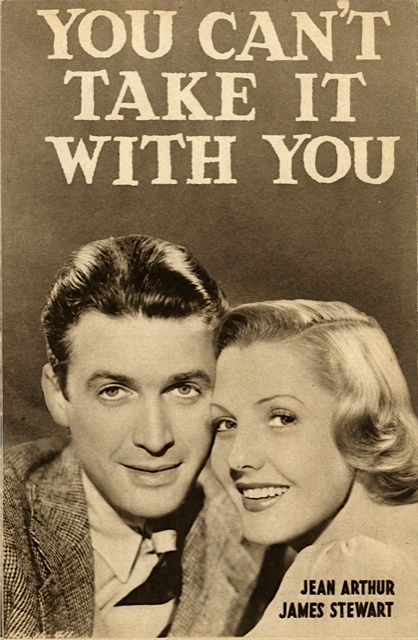
You can’t take it with you—but does that mean I should dispose of whatever I have consumed? I am not quite so indifferent when it comes to artifacts that, unlike my mind and body’s scant body of work, might be of consequence to posterity. I feel free to dispose of a photograph of myself after I scan it; but I am uneasy about doing the same to a piece of ephemera such as this souvenir program (from my collection of motion picture memorabilia). May the copy be a feast for greedy eyes as long as the original is removed from greasy fingers.

Sure, I enjoy surrounding myself with meaningful objects; but, my childhood teddy bear excepting, I am not attached to belongings. To have is utility; to hold, futility.

The chance of having and not holding is what attracted me to the immaterial world of radio dramatics. These days, I mostly collect what goes into one ear and, playing with it, delay the moment at which it comes out of the other. I amass what has no mass: digital recordings, not the physical vehicles on which they used to be stored (shellac, vinyl, magnetic tape).

Everything I have gathered is at my fingertips, nothing is filed away. My world and my vault are one. The files are backed up (this much I have learned from past losses)—but they are ready to go wherever I am. I can take it all with me; and doing so rather than storing things away enriches my life.

That said, I have to learn to cut short my inventory days; last year, they lasted for months. To cut a long time in storage short, I have booked a trip to New York this January. No doubt I will be both gathering new stuff for living and, as my past record tells me, look back and catch up. I know my failings. No saints need apply to preserve me.

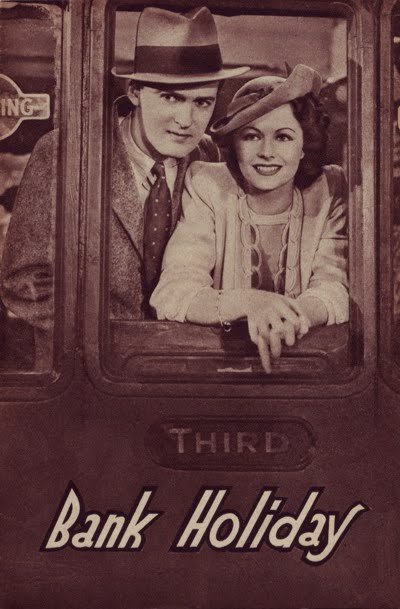
Cinegram No. 21 (Because It’s Some Holiday or Other)

It’s one of those days. I am reaching into my box of memorabilia, building paper bridges between the now and then. As I turn away from this little blue box—and from the scanner that transforms a printed image into a digital one—my eye catches another image, a framed poster on the wall of my study. And, once again, I become carried away, absorbed in the thoughts these two collector’s items—one British, one American—help to conjure, rather than in the appreciation of either. Besides, I have since retreated into our backyard to bask in the sunlight of a glorious spring afternoon. There’s time for all that, today. It is, after all, a holiday. Just what kind, though, I begin to wonder and allow the question to irritate me like ants running away with the picnic.

Now, you might say that a holiday by any other name smells just as sweet; but, if you ask me, “Bank Holiday” stinks. That is what the British insist on calling—or at any rate, are reduced to calling—some of their red letter days, including this one. Granted, considering the state of our financial system or individual finances, we might well be sitting round in a brown study, ruminating on our latter days in the red; but aren’t there any cultural cornerstones, historical milestones, or ancestral gravestones we ought to have our mind’s eye on?

We receive little encouragement from the dates as marked in our calendars. Here in Britain, we’ve got May Bank Holidays, and Spring Bank Holidays, and August Bank Holidays—and none of us are exactly laughing all the way to the nearest money-lending institution. Okay, we are not being pestered with notices demanding our immediate attention, but we don’t express our gratitude for not getting any bills by calling this a Post Office Holiday.

Not that all holidays are mere occasions for slipping into something comfortable or taking it off again at the beach; but we wouldn’t go so far, surely, as to declare Black Tuesday a day of observance by marking the anniversary of Wall Street laying an egg with a leisurely pancake breakfast. Sure, the banks are closed today; but is that what we are asked to celebrate?

How fortunate are those across the pond who can do as they please on Memorial Day. They may be decorating cakes instead of graves, but at least there is enough of a clue in the name to invite contemplation, encourage research or inspire gratitude. There is far more of a chance of drawing a blank if you’ve got nothing but “Bank” to draw on. If no consensus can be arrived at, if no joining of hands or thoughts is to be imposed, let any Bank Holiday become a blank one—and place on each celebrant the burden of making it meaningful . . .

Pulp: A Tissue of Lies

In the house I now call home, I am surrounded by a great many works of art, from oils and etchings to ceramics and stained glass. When I moved in the walls were already crowded with images; and I felt strangely if understandably disconnected from them and my new surroundings. For this simple reason, our Welsh cottage soon came alight each evening in the ersatz glow of moving images imported from the Hollywood of the 1930s, ‘40s, and ‘50s (a few exceptions notwithstanding). These pictures are projected onto a blind behind which unfolds the celebrated beauty of the Welsh landscape which, on a cloudless night, is more silver than the screen. For weeks after moving here from New York City (back in November 2004), a move worthy of a Daphne du Maurier thriller, were it not for my genial partner, I was unable to draw the blinds without bursting into tears, no matter how serene the scenery (our living room view being this or, as the season changes, that).

Not that there weren’t objects in the house to which I could relate. In our library, for instance, I am greeted by the no-one-else-likes of Chaucer and Shakespeare (who, along with Francis Bacon, are being sent from room to room, with Bacon now diurnally aglow in the window of our bedchamber). These stained-glass likenesses were installed for the very purpose of making me, a former literary scholar, feel welcome, familiar, and understood. It is in the attic that I am harboring the rather more lowbrow art churned out by Hollywood’s advertising machinery, all of which feature my favorite leading lady, Ms. Claudette Colbert. The most recent acquisitions to my collection—a Valentine’s treat—are these two posters for The Secret Fury (1950), a thriller whose fierce but fallacious (and ultimately pointless) pushing I previously discussed after getting my hands on this piece of promotional literature.

The smattering of rousing captions that accompany the images sure smacks of desperation. How do you sell a forgettable thriller as a must-see? You resort to words and phrases like “kill” and “cold blood, “evil” and “insane,” “murder” and “monstrous secret” to align the indifferent material you are pushing with the neo-gothic literature known to sell. In radio dramatics, no words were more prominent than “murder” and “death.” “Love” doesn’t sell half as well as death. “Sex” might, but radio was too cautions to go where most minds—and the species at large—are on a regular basis. To this date, US entertainment is more tolerant of mutilation than titillation, owing chiefly if indirectly to the violence that is religion.

Even though its solution relies on a prominent visual clue, The Secret Fury was produced on radio by the Screen Guild. A recording of the broadcast is no longer extant; but a picture of its leads, Colbert and Robert Ryan, posing with the script appears in David R. Mackey’s Drama on the Air (1951). I don’t mind being taken in; in fact, looking at poster art like that (or this one for Colbert’s Sleep, My Love), I am approaching the dramatic territory of the radio thriller. I am being given just enough clues to let my mind’s eye imagine a pretty sensational picture.

“Could She Kiss and Kill . . . and Not [Be] Remember[ed]”

Well, it had been a few years since the movie-going public lined up for a helping of The Egg and I (1947), the back-to-the-farm comedy that proved to be Claudette Colbert’s last major screen success. Still in print today, the non-fiction bestseller by Betty MacDonald on which the franchise-hatching hit movie is based has just been selected as BBC Radio 4’s Book at Bedtime (for a 1947 radio drama version starring Ms. Colbert and her co-star, Fred MacMurray, click here). Considerably less enthusiasm was generated by Mel Ferrer’s The Secret Fury (1950), a box office egg that, even upon delivery, was anything but farm fresh.

In 1944, Colbert left Paramount, the studio that had shaped and protected her image—spirited, smart and sophisticated, after initial siren turns in DeMille features. Despite being a shrewd businesswoman, the by then middle-aged actress stumbled from one middling project to another, playing roles emblematic of an identity in a state of crisis and a career in uneasy flux: a crime-solving nun, a terrorist-beset Planter’s Wife, a Texas Lady. Even her outstanding performance in Three Came Home (1950), for the ordeal of filming which she lost her chance at starring in All About Eve, had gone largely unnoticed.

The Secret Fury, the hysterical melodrama she starred in next, was filmed at a time when audiences were being swept away by a new wave of crime stories that were tough, gritty and low on frills. Unconvincing and anachronistic, it is an irritatingly contrived variation on one of those neo-gothic mysteries in which newlywed heroines distrust their brain much rather than those who stand to gain from addling it.

As if to compensate for the mediocre material or to suit her acting to the overwrought plot, the refined and often reserved Colbert was, for once, woefully overacting. Two years earlier, she had played a similar role in Douglas Sirk’s Sleep, My Love (1948)—the thrills-promising poster for which I acquired last fall—and audiences had reason to be less than embracing of mature (if immaturely acting) women who put their lives and careers in peril by marrying into the wrong families or listening to the advice of their Hollywood agents.

When The Secret Fury was sold to theaters in Britain, it was promoted with the help of the Exhibitors’ Campaign Book pictured above. The latest artifact to have made it into my collection of Colbert memorabilia, it affords a fascinating glimpse at the industry’s marketing machinery. Aside from offering cinema displays and providing advertising copy to be fed to the press, it encouraged exhibitors to adopt various strategies of getting a potential audience excited about the motion picture. Suggested activities were contests in which audiences were asked to match Colbert’s eyes, to share their wedding pictures, or accurately to recall recent events in their lives (something Colbert’s character struggles to do in the film).

Another “stunt” to create interest in the film was this “Visualised Brain Test Reaction, followed by the instructions:

Make an enlarged copy of this graph to serve as a teaser display in the theatre foyer, along with an explanatory caption and film credits. Lead off with a display caption: “Did these brain waves reveal the truth of her mysterious week-end?”

Meanwhile, my own head is gradually clearing after a recent fever; no longer content to feast on television sitcoms, I am going to take in one of Colbert’s earlier comedy triumphs . . . the wintersporting romantic triangle I Met Him in Paris (1937). As DeMille pointed out in his introduction to the radio adaptation another Colbert comedy, The Gilded Lily (produced by the Lux Radio Theatre on this day, 11 January, in 1937), the actress had been somewhat of a “starmaker.” Those who were allowed to throw their arms around her became leading men in their own right, as had Charles Boyer and Gilded Lily co-star MacMurray. Back then, Colbert had her pick of roles and other halves, and brains enough to go for the right ones.

I’m Not a Fan

Well, I’m not a fan of . . . anything. That is to say, I am not a fan of the word. Fan, fanatic, fanaticism. Those lexical expressions of inflexibility, those dictionary indicators of obduracy ought to be reserved for folks who are determined to blow themselves up for what they believe to be their beliefs, for the indiscriminals who are prepared to take the lives of others around them for the sake of an idea or an ostensible ideal (I’ve got Glasgow and London on my mind). No, I am not inclined to go quite so far in my devotion. It does not follow, however, that I am incapable of getting passionate or downright pigheaded, even when such fervor goes against my better judgment.

Permit me to opine for the sake of defining. For instance, I strongly disliked Britain’s former Prime Minister, Tony Blair, simply because I could not stand his grin and his (to me) mannered way of speaking; never mind his policy in Iraq, which was reason enough to disdain him. I have nothing yet to say about Gordon Brown, who mercifully abstains from mugging. I am opposed to Britain’s newly enforced smoking ban, no matter how many lives could presumably be saved by such a curtailing of pleasure. I refuse to visit my native country of Germany, along with Switzerland and France, and have choice words for those who turn down a nice cut of meat in favor of bean sprouts or tofu.

Unlike notions, opinions are never vague. Voicing them—a hazardous prerogative these days—is a retreat into what lies past caution, beyond apprehensions of censure known as political correctness, adjustments in expressed thought commonly disguised as reason, or, at any rate, as what is reasonable. Uttering what you can barely get away with can be a welcome getaway from the sincerity-divested shelter of platitude to which the mealy-mouthed have chosen to confine themselves. That goes only for the intelligent and open-minded; the unthinking, who can do nothing but opine, have no use for such relief, which makes them far more dangerous than any strongly voice opinion could ever be.

Meanwhile, I much rather rave than rant. I prefer to reserve my energy—and this little nook in the web—for things I look upon with uncommon fondness (such as radio, whose neglected virtues I extol in this journal) and people I adore in a manner that I, an atheist, refuse to label idolatry. A few decades ago, I decided that, while not fanatic, I fancied a certain leading lady of Hollywood’s aureate days. The lady in question is Claudette Colbert. French-born, no less. My latest acquisition—above poster for the 1947 thriller Sleep, My Love—arrived today and awaits a spot on whatever wall remains to display it. Space, by now, is at a premium; only yesterday, I made room for this announcement for Colbert’s 1941 vehicle Skylark. It is probably not what you’d expect to find in a Welsh cottage—unless, that is, you knew me and knew I had come to live there with someone so willing to humor my foibles and fancies.

So, what is the difference between a fan and a fancier? The fan cannot see; the fancier has a selective gaze. The fan discriminates; the fancier is discriminating. The fan is dead to the rest of the world; the fancier is alive to the idiosyncrasies of his or her passions. No, I am decidedly not a fan . . .