Cover of Thirteen by Corwin, containing “Appointment,” from my collection of radio-related literature
Speaking out against fascism—publicly and nationally, via the airwaves—used to be regarded in the United States of America as a moral imperative, or at least, in the terms of the Federal Communications Commission (FCC), as an act “in the public interest.”
These days, in the era of MAGA on steroids—and, to be clear, the first “A” in the acronym can be readily substituted to designate any number of imperiled democracies—fascism is no longer the anathema to democratic rule that it used to be understood as constituting.
This is mainly because democracy itself—as a construct, an ideal and a reality—has become anathema to the members of a growing movement that is celebratory of autocracy and that, perversely and perfidiously, argues anti-fascism to be a threat to autocracy as a preferred system of streamlined government in which checks and balances are discarded and in which oppositional forces and alternative voices are denounced as deleterious and traitorous.
I had been meaning to write about the weaponization of the FCC in the wake of the cancellation and temporary or partial silencing of late night talk shows critical of the Trump administration; but for some reason, and via a route too tedious to trace, I happened, quite fortuitously, as it turns out, on a script for a radio play by poet-journalist Norman Corwin, the unofficial “poet laureate” of US radio during the early to mid-1940s.
Although I have discussed many of Corwin’s writings for radio in Immaterial Culture, I had somehow failed to show up for his “Appointment”—a play first produced on 1 June 1941 as part of the cycle Twenty-six by Corwin.
The script for “Chicago, Germany” as it appeared in the June 7-13 issue of Radio Life
Delving into the “Draft and Ideas” folder set aside for this blog, I came across a fragment titled “‘Chicago, Germany’: A 1940s Radio Play for Our Parallel Universe.” It was intended for posting on 10 November 2016 as a response to a “Trump administration having become a reality.” The draft was abandoned, but no other piece of writing was published in its place.
In fact, the next entry in this journal did not appear until 15 May 2017, and it coincided with the opening of Alternative Facts, an exhibition I staged with students at the School of Art, Aberystwyth University, in Wales.
As the abandoned fragment and the ensuing hiatus suggest, the “reality” of the Trump presidency had so rattled me that I could not bring myself to continue a blog devoted to the popular culture of yesteryear, as much as I had always tried to de-trivialize bygone trifles not only by examining them in the context of their time but also by relating them to the realities of the present day.
The exhibition project that kept me busy in the interim, had similar aims. Alternative Facts provided me, as a curator and educator, with an opportunity creatively to engage with the outrage of MAGA by appropriating a phrase that encapsulated the duplicity and travesty of those early days of spurious swamp-draining.
Fast forward to 20 January 2025, the day that Trump returned to office, by the popular demand that is a product of his populist brand, with the singular and single-minded vengeance of a MAGA-loomaniac. Pardon the execrable pun, but I find no words other than that crass neologism adequately to describe a US President who pardons rioters storming the Capitol and defecating on democratic principles, much to the Nazi-salute inspiring enthusiasm of enabling, super-empowered and quite literally high-handed oligarchs who, I suspect, will, rather than Elon-gate this reign, eventually assume the gilded let’s-lay-democracy-to-rest-room that, in the interim, is the seat of Trump’s throne,
It struck me that the time was ripe for—and indeed rotten enough—to pick up pieces of that draft in light or dimness of the current and perhaps irrevocably changed political climate, which, far from incidentally, is the only human-made climate change we are likely to hear about from the US government for the duration, as dramatically shortened for our species and for most lifeforms on our planet as that time may have become in the process.
As a melodramatist who staged the end of the earth both on radio and for the movies (in the 1951 nuclear holocaust thriller Five), Arch Oboler would have much to say about all this—except that what Albert Wertheim has called his “penchant for altered reality” was being “married to his anti-fascist zeal” in propaganda plays sponsored by or at least aligned with the objectives of the US government during the FDR years.
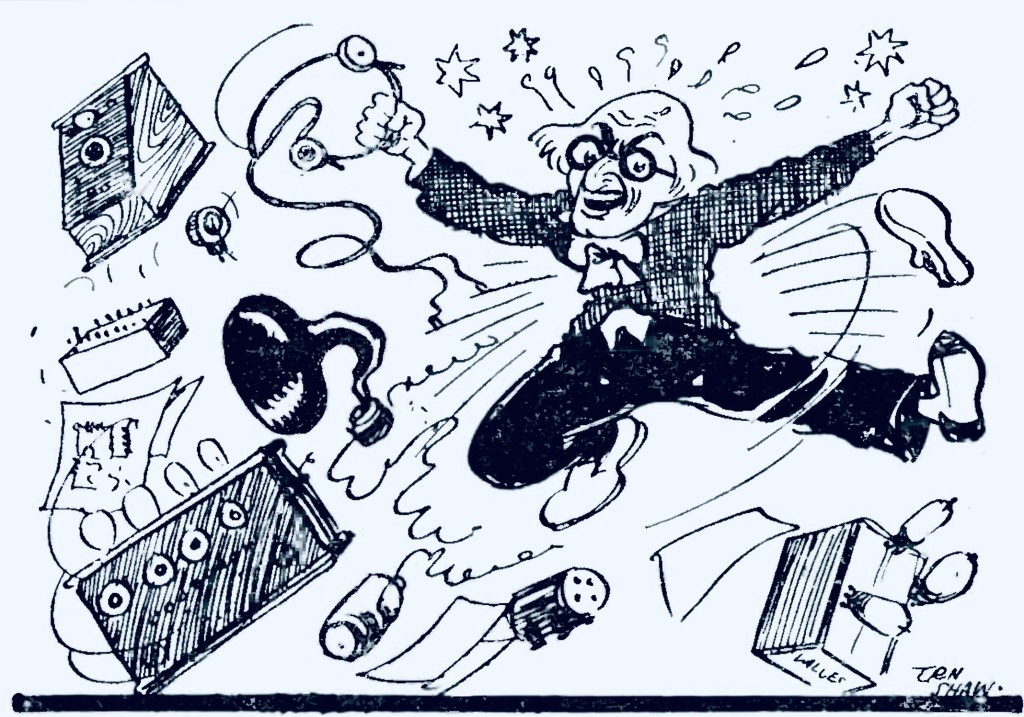
Illustration by Ern Shaw (Modern Wireless, Nov. 1924)
“Many plays have been broadcast, but none of them seems to me to have the pep that is needed to get not merely across the footlights but across the ether.” Complaints such as this one are all too familiar to me; in fact, they were launched so frequently against radio culture that, years ago, they prompted me to contest them.
To misappropriate the famous question posed by the feminist critic Linda Nochlin, I asked “Why Are There No Great Radio Writers?” The objective was not to find examples to the contrary—those queer, quirky and quicksilver exceptions that can serve to prove the rule—but to query the question itself as (mis)leading and to expose the biases underlying it.
Taking the radio play to the library has long been an ambition of mine, given that dramatic and literary works written for the medium of sound broadcasting occupy comparatively little space on the bookshelves. Taking the first of its kind to a national library—the National Library of Wales, no less—is a chance of a lifetime amounting to poetic justice. Allow me to shed a modicum of light on that, and on my benightedness besides.
So that meaningful conclusions may be drawn from my peculiar challenge of commemorating one hundred years of radio dramatics in just a few minutes, it strikes me as essential that the centenary first be quartered, a fate I hope to escape on 22 February 2024, the date set for the event.
Obituaries often begin like this: The world (the art world, the theater world, the world of miniature golf, or what have you) has lost one of its leading, brightest, most prominent so-and-so’s. But that won’t do. Not if the so-and-so is Norman Corwin. The formula would not be worthy of him, for one. Stylistically alone, it would be un-Corwinian; it would be Hummertsian. Nor would it fit the occasion of commemorating his life’s work since the formula cannot contain it. The application would lead instead to inaccurate, misleading statements such as this one: The world of radio drama lost one of its greatest writers.
True, Norman Corwin, who died on 18 October 2011 at the age of 101, was a leading light in that dark theater of the mind. But he was also a journalist, a teacher, a screenwriter, a director, a producer, and, what has yet to get into the heads of those who assemble the anthologies of American Literature, a poet. He inhabited and enriched many worlds—and yet, for the past sixty years or so, Corwin has not been known the world over. You might say that we, most or millions of us, lost Norman Corwin decades ago because we, or some somebodies we permitted to act in our stead—though not on our behalf—decided that the world Corwin helped create and never forgot should be written off, abandoned, and depopulated of its talent like the ghost of a mine whose ore is no longer deemed worth our digging . . .
In the United States, the world of radio drama is such a lost world—and those, like cretaceous me, who keep on living in this world even if we can no longer live by it, might as well be dwelling on some dark star in a parallel universe. Unlike today’s listeners, radio writers did not have that choice back in the late 1940s, unless they were content, as Corwin put it in retrospect, to be “apolitical except for strong support of home and motherhood,” “inoffensive to the world in all its parts (although in radio practice, exceptions are often made in the case of minority-opinion groups which cannot possibly reply)” and prepared to “keep within the pale of clichés of character and situation so traditional there is a mellow patina on them.”
“I believe that artistic radio, whether commercial or otherwise, will not develop without a willing and interested leadership on the part of those who control programming, budget and time,” Corwin exclaimed in 1947. “That is all.”
That was all. One year later, Corwin felt compelled to remind those in control that he was still there, waiting and willing to take on another creative assignment—another Twenty-Six by Corwin, perhaps, another One World Flight. “I Can Be Had,” he announced; but those in “control” would not have him back.
“The artists are around, and there is nothing occult about the process of dialing their telephone numbers and talking it over.” Apparently, no one bothered to touch that dial. After years of restraint, commercial radio was eager to get richer even it that meant becoming culturally less enriching. It was a short-lived strategy of cashing in before television would take over and pretty much close the theater of the mind for good. Never again would a single play written for the ear reach and move an audience of sixty million in no more than two performances—as Corwin’s “On a Note of Triumph” did in 1945.
Forced to exit network radio because executives no longer commissioned verse plays, dramatic documentaries or travelogues in sound—three genres that are quintessentially Corwinian—Norman Corwin began travelling between worlds, the worlds of film, journalism, and the academia. Television, at least initially, was too small, too restrictive a realm to attract, let alone accommodate an imagination as vast as his. To Corwin, the audiovisual upstart was but a “poor bastard among the arts, having the benefit of neither the full scope and mobility of cinema, the immediacy of the legitimate theatre, nor the powerful suggestibility of radio’s unillustrated spoken word.”
The American theater of the mind may have been shut up, but Corwin’s mind stayed open. For over sixty years, he kept on journeying, searching and yearning. That’s the spirit that sustains you until you’re 101. Lucky are those who encountered him along the way. I prize the words of encouragement he wrote to me when, a few years ago, I dusted off my obscure dissertation on the American play to share my chapter on Corwin with the very man. I think of those words whenever I feel that, not being quite as eager as he to venture elsewhere, I lost my way; that I am lost to most of the image-minded world, untravelled, unraveling, yet all the while revelling in the “unillustrated spoken word.” I got the words, all right; Corwin had the wisdom as well.
I shall leave this entry in my otherwise image-filled journal “unillustrated.” I imagine Mr. Corwin appreciates the gesture . . .
(For those ready to catch up or on, the entire run of Twenty-Six by Corwin is currently being rebroadcast by John and Larry Gassman of Same Time, Same Station.)
Today, American journalist and radio playwright Norman Corwin turns 100. Whether that makes him the oldest living writer to have had a career in radio I leave it to fact-checkers and record book keepers to determine. I do know that, seventy years ago, he was already the best. Oldest. Best. Why not dispense with superlatives? Corwin has been set apart for too long. Instead, an appreciation of his work calls for the positive and the comparative, as his plays deserve to be regarded at last alongside the prose and poetry of his better-known literary contemporaries.
No survey of 20th-century American literature can be deemed representative, let alone definitive, without the inclusion of some of Corwin’s Whitmanesque performances. What has kept him from being ranked among the relevant and influential writers of the 1940s, and of the war years in particular, is the fact that, during those years, Corwin wrote chiefly for a medium that, however relevant and influential, was—and continues to be—treated like a ghetto of the arts in America.
You might argue that the metaphor is not altogether apt, especially if you bear in mind the distinguished authors and playwrights who did turn to—or agreed to be pulled into—broadcasting during the Second World War; among them poets Archibald MacLeish, Edna St. Vincent Millay, and Stephen Vincent Benét, as well as dramatists like Maxwell Anderson, Marc Connelly, and Sherwood Anderson. And yet, even their scripts are rarely acknowledged to be contributions to literature, the American airwaves being thought of as a cultural site quite beyond that field.
At best, dramatic writings for radio are handled as historical documents that, by virtue of being propagandist or populist, could hardly be regarded as having artistic merit or integrity. As something other—and less—than literature, they were as quickly obliterated as they were produced, stricken from the records so as not to tarnish the reputation of erstwhile writer-recruits most of whom exited the radio camp well before V-J Day.
Norman Corwin never deserted that camp. Rather, the camp was shut down, raided by McCarthy, all but razed to make way for television. Sporadic returns to the old playing field notwithstanding, he was forced to move on. Yes, the air was—and is—Corwin’s playground. For all their wartimeliness, his 1940s plays were never mere means to an end, even if end is understood to mean an end to the war that gave them a reason for being.
To gain an understanding of that past is not the only good reason for being in the presence of Corwin today. Rather than promoting uniformity, which is a chief aim of propaganda, Corwin’s plays challenge the commonplace, encourage independent thinking and the voicing of ideas thus arrived at. Take “To Tim at Twenty,” for instance. It is hardly one of Corwin’s most complex, ambitious or experimental works for radio; in a note to a fellow writer, published in Norman Corwin’s Letters (1994), the playwright himself described it as “the lowest common denominator of simplicity.” Simplicity, in this case, is an achievement. Quietly startling, “To Tim at Twenty” bespeaks the humanity, intellect, and dignity of its author.
Written for the CBS Forecast series, a string of pilot broadcasts designed to test audience responses to potential new programs, the play first aired on 19 August 1940, when it starred Charles Laughton, for whom “To Tim” was expressly written, and Elsa Lanchester. Newly arrived in California, Corwin was staying at the couple’s Brentwood home at the time.
As he shared in a letter to his sister-in-law, he felt “kind of lonely” in Hollywood, and was “getting tired of singlehood.” In times of war—and to Laughton and Lanchester August 1940 was wartime—the thought of growing up and raising a family is compounded by the realization that the future is darkly uncertain instead of rich in potentialities. So, Mr. Corwin wrote a letter.
To Tim at Twenty is an epistolary play, a radiodramatic genre of partially dramatized speeches addressed to an implied audience. The proxy listener, in this case the unheard Tim, suited Corwin since indirection made whatever was conveyed come across as something other than an act of overt indoctrination. The addressee also provided him with a veil behind which to enact his personal conflicts as he contemplated his maturity, mortality, and legacy.
The letter writer is Tim’s father, a British gunner spending a sleepless night in the “barracks of an RAF squadron on the northeast coast of England”; as the narrator-announcer informs us, he is “leaving at dawn on a mission from which there can be no return.”
Once the United States entered the war, lesser writers, melodramatist Arch Oboler among them, would use this kind of set-up to remind American civilians of the sacrifices made for them overseas, of the bravery that must be honored and matched at the home front. Tim, we expect, is asked to honor his father’s memory. Instead, the letter he is to receive tells him that the men of his father’s generation “haven’t made out any too well” in the business of “the running of the earth.”
At the time the letter is composed, Tim is just five years old. His father made a “special point” of asking his wife “not to deliver” it until 1955, at which time he might have had the “man to man” talk with his son that war denied him.
Sentimental, seemingly pacifist messages were not unheard of at the time. They were welcomed by isolationists who counted on big business as usual—and commercial radio, which shunned the controversial, was very big business indeed; but “To Tim at Twenty” suggests something alien to those determined to preserve the status quo. Instead, the belated address of the Englishmen, who knows better than to have faith in things as they are, is meant to instill his son—and Corwin’s listeners—with a “fuller appreciation of women.” To Marshall, they are authorities of humanity superior to men because “there must come a special understanding of the dignity of life to those who grow it in their vitals.”
As the dramatic flashbacks reveal, the lessons he shares with his son were taught Marshall by his wife, who suggested that the voices of the many might have drowned the shrill cries of the few, the “wanton wills” that were not countered by “man’s vast raw materials of love and tenderness and courage” in time to avoid deadly conflict. “There are several kinds of valor,” Tim is to learn from his dead father, “and the least is the kind that comes out of the hysteria of battle.”
I suspect that it was easier to write this message in 1940 than it was to understand it in 1955, when America’s leader was a five-star general, when superpowered dominance was the manly objective of the day and the “appreciation of women” was more a matter of the male gaze than of political influence or workforce equality. By then, there was no place for Corwin in network radio.
Since his climactic “Note of Triumph” in 1945, to which nearly half of the US population was estimated to have tuned in, his voice has been heard by a comparatively few—the fortunate few who, by lending him an ear, are gaining a “special understanding.”
“Salut au monde!” That is a greeting the narrator of Norman Corwin’s “New York: A Tapestry for Radio” extended to the never quite statistically average American listener—anybody tuning in to the nationally broadcast play cycle Columbia Presents Corwin back during World War II. And that is how I, returned again to my old yet ever changing neighborhood in uptown Manhattan, am reaching out to the potentially even more multifarious roamers of the World Wide Web.
Why Salut, though? Why go for the highfalutin when something lowbrow like hiya would do? After all, French is not among the languages most closely associated with the Big Pomme. Sure, there is that French lady who greeted the multitudes who came across the big pond to get a bite out of it; but only because she’s made of copper doesn’t make her a coined phrase.
Corwin was not going for the definitive—the single, representative tongue with which to tie up an argument only to contradict it. Symbolic of the promises and failures of the Versailles treaty, the imported salutation is part of a pattern designed for a sonic romancing of immigration central, where nations become nabes and the world’s people are “living side by side so effortlessly, no one calls it peace”—a cosmopolitan locale to which nothing could be more foreign than the homogenous or the homo-logos.
As LeRoy Bannerman describes it, Corwin’s voice collage advocated world unity, exemplified in the polyglot harmony of New York’s people. It possessed threads taut with the strain of war and the urgency of an all-out effort, symptoms of concern that greatly colored Corwin’s work with tints of patriotism.
The colors in Corwin’s fabric—that crowd-pleasing fabrication of Gotham (what do you call it? Gothamer)—are red, white and blue all right; but when Corwin waves the flag, he does not make difference stand out like a blot on Old Glory. Corwin’s aural tapestry is rich in the variations that the theme demands, distinguished by the “speakers of the foreign and the ancient tongues,” the “conjoined creeds—the Jew, the Christian, the Mohammedan.”
The speech is American, which is to say that it is not exclusively, let alone officially, English or any variation thereof. “Do not mistrust [folks] because of their accent,” the narrator cautions those who stand their ground by calling it common, “for we ourselves might be incomprehensible in Oxford.” The Queen’s English ain’t the English of Queens, New York.
“The people of the city are the main design,” the narrator insists. Seemingly random utterances by speakers nameless to the audience constitute the “individual threads” of an intricately woven fabric whose pattern, unlike the grid formed by the city’s streets, cannot be visually apprehended. “How can you tell, from Seat No. 5 on the plane from Pittsburgh, what goes on here?” Nor can it be comprehended by the unaided ear—at least not by anyone well out of earshot. As I put it in Etherized Victorians, the way to arrive at the design is microphonic, not macroscopic.
The narrator invites “Americans on this wave length” to follow the threads of “interwoven hopes” by “listening acutely” to the peoples of New York City, be they from “German Yorkville” or the “outlying Latin quarters.” Their voices are brought into a meaningful relation through the aid of the radio, of which the main speaker as receiver, amplifier and transmitter is an abstraction.
At the moment—and being in it—it is easy to lose sight of the wireless, even as I walk past Radio City. I feel no need for a hearing aid or a translator. I am a part of a grand, Whitmanesque design, which is both spoken and understood.
Let’s start by setting forth That it is good to take a swig of fancy every now and then, A nip or two of wonderment, To jag the mind.
It’s good to send your thoughts excursioning Beyond the paved and well-worn alleys of your life If only as a form of exercise [. . .]
The man who prescribed this “form of exercise” in “Seems Radio Is Here to Stay” some seventy years ago, back in April 1939, is producer-director-writer Norman Corwin. Today, he turns 99. Radio’s foremost playwright was forced, however, to take the exercise outside the medium he loved. By the late-1940s, there was no room in US radio for “excursioning,” and a frustrated Corwin advised anyone who wanted to “make a living from radio” to be “mediocre.” The “writer who wants to do the best work in his power, in defiance of formula, I say: Forget radio.”
Corwin insisted that he was writing “neither with cynicism, anger, nor contempt.”
My only emotion is that of sadness for an old friend, now bedridden, who has been kind and generous to many writers, including me. The disease is probably incurable. Radio may well die, as a cultural force, of the after-effects of the childbirth of television. The complications are greed, venality and social irresponsibilities. Its spawn, the half-breed that is neither pictures nor radio but both, is already devouring everything around it, an omniphage chomping steadily into the economy of books, sports, movies and radio itself.
No, Corwin was not about to defect, like radio’s talent, sponsors and audiences, to the rivaling medium of television. Unless its producers were ready to “apply as much money and time to serious experimentation on the level of the old Columbia Workshop,” he would “continue to be more interested in radio, films, and print.” To a dramatist concerned with the play of ideas, television had “neither the full scope and mobility of cinema, the immediacy of the legitimate theatre, nor the powerful suggestibility of radio’s unillustrated spoken word.”
It is of this “suggestibility” that the body of Norman Corwin’s work remains one of the most persuasive illustrations.
I’ve had quite a few “silent nights” here at broadcastellan lately (to use an old broadcasting term); and yet, I have been preparing all along for the weeks and months to come, those dark and cheerless days of mid-winter when keeping up with the out-of-date can be a real comfort. Not that the conditions here in our cottage have been altogether favorable to such pursuits, given that we had to deal with a number of blackouts and five days without heating oil, during which the “room temperature” (a phrase stricken from my active vocabulary henceforth) dropped below 40F. Not even a swig of brandy to warm me. I have given up swigging for whatever duration I deem fit after imbibing rather too copiously during the New Year’s Eve celebrations down in Bristol.
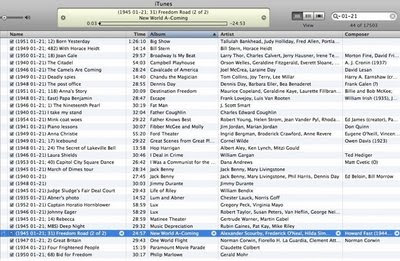
Those are not the blanks (let alone the ones in my short-term memory) that I intend to fill here. The gaps in question are in my iTunes library, which currently contains some 17500 files ranging from the recent BBC adaptation of Anthony Trollope’s Orley Farm to World War I recordings. The vast majority of these files are American radio programs. They are readily gathered these days; but the work involved in cataloguing them for ready retrieval can be problematic and time consuming. For now, I am not lacking time; at least not until our long planned and much delayed move into town, real estate crisis be damned. Anyway . . .
For the past few weeks, I have been filling in each of the fields as shown above, verifying dates, checking the names of performers, comparing the sound quality of duplicate files, and researching the source materials for adaptations. It took a while to arrive at a convenient system. When I started the project anew (after the crash of an earlier Mac), I made the mistake of entering the date after the title of the broadcast (entries in lower case denoting descriptive ones).
As a result, I could not readily listen to a serial in the order in which its chapters were presented. I would have been at a loss to follow and follow up today’s installment of Chandu the Magician (1949), as if having missing out on the chance of getting my hands on Chandu’s “Assyrian money-changer” by sending in a White King toilet soap box top sixty years ago were not difficult enough to bear.
Listing, though, is to me almost always less satisfying than listening; it is also far less difficult and engaging. Listening often results in research, in comparing adaptation to source, in reading up on the performers, or in finding contemporary reviews. About the 21 January 1946 premiere of I Deal in Crime, for instance, broadcast critic Jack Gould complained that it “creeps along at a snail’s pace” and that Ted Hediger’s monologue-crowded narrative style was “not helped” by William Gargan’s “rather lackadaisical” delivery.
While he did not have instant access to thousands of such programs, Gould nevertheless noted the sameness of such nominal thrillers and their “stock situations.” To him, Paul Whiteman’s Forever Tops was the “real lift” of the evening’s new offerings on ABC, a reference that compels me to find a recording of that broadcast . . . .
In this way I spend many an hour before once again sending another missive into the niche of space I, as keeper of past broadcasts, have grandiloquently styled broadcastellan.
I might as well end this year’s regular programming here at broadcastellan with a bang. This one was sure made an impact, heard by as many as sixty million Americans—at once. Subtitled “A Dramatic Celebration of the American Bill of Rights, Including an Address by Franklin D. Roosevelt,” We Hold These Truths made radio history on this day, 15 December, in 1942. It also made the most of history in the making.
“No other single dramatic performance [. . . ] ever enjoyed so large an audience,” author Norman Corwin remarked in his notes on the published script. The program was “[w]ritten at the invitation of the US Office of Facts and Figures” to commemorate the 150th anniversary of the United States Bill of Rights, which came into effect on 15 December 1791,; but it was already in the works when the attack on Pearl Harbor took place.
“In fact,” Corwin later recalled (in Years of the Electric Ear), “I was on a train travelling from New York to Hollywood, still working on the script when the attack on Pearl Harbor took place.” Now that the United States had entered the war, the broadcast became a rallying cry, a reminder of the rights it is the duty of all those who possess them to protect.
“To many listening Americans,” Movie-Radio Guide summed up in its 3-9 January 1942 issue,
the big “Bill of Rights” program broadcast over the Nation’s networks Monday, Dec. 15, was an utterly unforgettable event. To the many personalities who joined their talents to produce the program it was likewise a memorable privilege. Coming as it did at a time when it could not have meant mere to the nation, the broadcast brought America figuratively to its feet. A transcription of the superb dramatic production [. . .] will be preserved in the archives at Washington.
The cast, as shown above, included Orson Welles, Rudy Vallee, Edward G. Robinson, Bob Burns, James Stewart, Walter Brennan, Edward Arnold, as well as (seated) Lionel Barrymore, Marjorie Main, and Walter Huston.
According to the Movie-Radio Guide, “[o]ne of the highlights of the presentation was the performance of James “Jimmy” Stewart.” So moved was he by the reading that, at the close of the broadcast, he “pulled off his earphones” and “let down his emotions, excusing himself from the studio and reportedly breaking into tears in private.” No wonder, Stewart was called upon to introduce President Roosevelt, who addressed the public from Washington, DC. Upon this experience, the humble actor remarked: “Imagine a corporal introducing a Commander in Chief of the armed forces!”






 I’ve had quite a few “silent nights” here at broadcastellan lately (to use an old broadcasting term); and yet, I have been preparing all along for the weeks and months to come, those dark and cheerless days of mid-winter when keeping up with the out-of-date can be a real comfort. Not that the conditions here in our cottage have been altogether favorable to such pursuits, given that we had to deal with a number of blackouts and five days without heating oil, during which the “room temperature” (a phrase stricken from my active vocabulary henceforth) dropped below 40F. Not even a swig of brandy to warm me. I have given up swigging for whatever duration I deem fit after imbibing rather too copiously during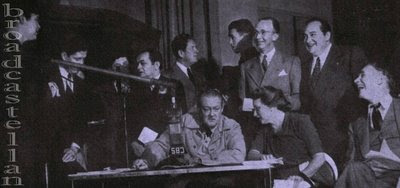
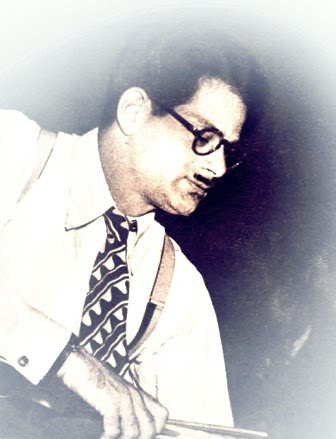
 Harry Heuser