
Fat Lies Tuesday; or, Time to Love and Time to Hate

This is a day for disguises, and a night of unmasking. A time to let yourself go, and a time to let go of something. A night to make an ass of yourself, and a morning to mark yourself with ash. Shrove Tuesday, Mardi Gras, Fastnacht. Back where I come from—Germany’s Rhineland—carnival is a major holiday, an interlude set aside for delusions, for letting powerless misrule themselves: laborers parading in the streets without demanding higher wages, farmers nominating mock kings and drag queens to preside over their revels; women storming the houses of local government to perform the ritual of emasculation by cutting off the ties that hang from the necks of the ruling sex. It is a riotous spectacle designed to preserve what is; a staged and sanctioned ersatz rebellion that exhausts itself in hangovers.

Sometimes, the disillusionment creeps up on you only gradually. Upon reflection, that wondrous “what if” begins to sound more like sobering “as if!” You may have had a good time—but, when it comes right down to it, you’ve been had.

As a political instrument, the radio is not unlike Mardi Gras. Tuning in after a day’s work is a carnivalesque experience—the partaking of a communal pancake made from the eggs with which you didn’t dare to pelt those who own most of the chicken. It is the allotted substitute for the half-forgotten voice that those content to listen tend to deny themselves. Broadcasting was, after all, an industry in the service of keeping things as they are or as they ought to be—according to those who operate (within) it.

Radio’s most prominent voices belonged to the fools and the tricksters—Ed Wynn, Baron Munchausen, and the irreverent, imaginary Charlie McCarthy; but during the lean years of depression and war, a period when the medium was at its most influential, radio also coaxed listeners into making sacrifices by driving home their frugality or fortitude could make a difference.

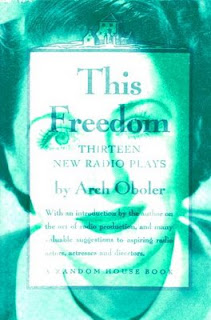
One such Atwater-Lent offering was “The Women Stayed at Home,” first heard on this day, 24 February, in 1940. It was written by Arch Oboler, the medium’s foremost melodramatist. If one contemporary source is to be believed, Oboler penned more than four hundred plays between 1935 and 1940 alone. The bulk of his output may be classified either as schlock or as propaganda; except that much of his work is not either, it is both.

There is jolly little cheer in “The Women Stayed at Home,” starring Norma Shearer, whose 1939 screen success The Women may well have suggested the title. Not that, aside from the performer and the spurious message of female empowerment, there are any similarities between those two vehicles. The opening scene of the latter is the “wind-wept” coast of an unspecified country:

It is night. For once the sea is calm. It waits ominously upon the edge offshore where sits a woman and an old man. For a long time they have sat quietly, but now woman speaks to the old man, and her words lift out to the sea on the rush of the wind. . . .

The woman is Celia. The old man is one of us—a listener. Shortly after her wedding, Celia’s fisherman husband perishes at sea. When war breaks out, she feels that she has nothing for which to live or fight. Being refused a chance to be of use to the community, she decides to drown herself. In the attempt, she happens upon a body in the water, the body of a man yet living—a “man from an enemy boat.”

Torn between her civic duty and her moral responsibility, Celia decides to be a nurse to Carl, the German stranger whose needs and gratitude imbue her with a sense of purpose that gradually turns into love. Aware of having placed Celia in a precarious position, Carl disappears; but Celia, no longer lonely, is convinced that he will return to her one day.

There was a market for such sentiment prior to the attack on Pearl Harbor, when the isolationist lobby was still strong and outspoken responses to fascism were rarely heard on the air. In 1942, when the play was published, Oboler tried to justify its inclusion in This Freedom by arguing that “after a while, you find yourself hating too much”—a justification clearly tagged on since, back in 1940, even a prominent writer like Oboler could not get away with overtly opposing the policy of neutrality by inciting anger and directing it toward a foreign national target.

When the play was revived almost exactly four years later, in February 1944, the situation had long changed and the playwright was quick to adjust the message to suit the occasion that was Everything for the Boys, a variety program for American servicemen. Oboler had turned into a staunch advocate of hatred. That is, he argued it to be more effective to make Americans hate the enemy than love their own country. It was hate that got things done.

The pseudo-pacifist “Women,” now headed by Mercedes McCambridge, became a patriotic morale booster set in Norway under German occupation. The stranger washed ashore is now a British flyer (played by Ronald Colman). Celia’s dilemma: whether to hide the man or nurse him back to fighting form. After he is gone, a newly invigorated Celia declares: “I like to think that he knows I’m fighting now, too. For the good people. Some day the fighting will be over. It must end. He’ll come back to me. I’ll never be lonely any more.”

“The Women Stayed at Home” is clearly of the ready-mix, on demand variety; but it takes a comparative taste test to expose both versions as sham. Real conflict is reduced to melodramatic opportunity; genuine emotion whipped up to achieve whatever was expedient. Sure, there was a time to love and a time to hate—and Arch Oboler had just the words to paint the sign of the times in whatever color suited the mood.

When anti-war laments were popular, Oboler taught them be mindful of how Johnny Got His Gun and what good it did him. He introduced Americans to a “Steel” worker ashamed of being in the service of making war. “The Women Stayed at Home” betrays the opportunist who knew how to keep the pot boiling, a trader in sentiment who did not hesitate to discard supposedly outmoded principles like so many rotten eggs.

Whatever you give up for Lent, keep your integrity.


Related recordings
”The Women Stayed at Home,” Everyman’s Theater (24 Feb. 1940)
“The Women Stayed at Home,” Everything for the Boys (22 February 1944)

Related Writings
“Senseless: One Soldier’s Fight to Speak Against War” (on Oboler’s adaptation of Johnny Got His Gun)
“Bette Davis Gives Birth to Arch Oboler’s ‘American’”
“‘. . . originally written for Bette Davis’: Arch Oboler’s ‘Alter Ego’”
“Hollywood Star Kay Francis Makes Paralysis Sound Like Paradise”
“Mercedes McCambridge, Airwaves Advocate”
"We must be prepared for anything at any time": A Word from the Little Flower

Lying in bed last night, I was troubled by the sensation that, should I fall asleep, I might never wake again. I thought of what I would leave behind, and the catalogue of my accomplishments was so short that I was forced to change the subject for want of material. It was a rare moment of anxiety brought on by the dizzying headache that, I presume, is one symptom of a five-week-old cold I cannot seem to shake. I wonder how many folks, even in the best of health, had that feeling back in December 1941 when, instead of mind’s eyeing the seasonal shop windows, they were confronted with the likelihood that their world was coming to an end.

The raid on Pearl Harbor on this day, 7 December, in 1941, forced many Americans to reexamine their life or, perhaps, examine it for the first time. Wondering about the future and their part in shaping it, civilians no doubt asked of themselves what, if anything, they might be able to contribute, although we should not rule out that some were busy conceiving ways of avoiding any such contributions.

I well recall that feeling of utter worthlessness during the days following the attack on the World Trade Center, when I dutifully took the train (or the bus, or whatever mode of transportation would run) up to the Bronx to teach college students not to split their infinitives or dangle their modifiers. In light of the deadly strike and the uncertainties ahead, making my mark in red ink struck me as petty and pointless. The most troubling sight, the most nauseating response was anything suggesting “business as usual.” It was not so much reassuring as offensive, this make-believe of “life goes on.”

In his radio address to the people of New York, Mayor Fiorello La Guardia, known as the Little Flower, still had to bring home that business in the city was going to be far from usual. Being that the city itself had not come under attack and there were no immediately signs of violent change, many of those tuning in to WNYC had to be reminded of the urgency of the situation and its possible effects on a city thousands of miles from either Hawaii or Europe.

“I want to warn the people of this city that we are in an extreme crisis,” La Guardia addressed the public:

Anyone familiar with world conditions will know that the Nazi government is masterminding Japanese policy and the action taken by the Japanese government this afternoon. It was carrying out the now known Nazi technique of murder by surprise. So there is no doubt that the thugs and gangsters now controlling the Nazi government are responsible and have guided the Japanese government in the attack on American territory and the attack on the Philippine Islands. 

Therefore, I want to warn the people of this city and on the Atlantic coast that we must not and cannot feel secure or assured because we are on the Atlantic coast and the activities of this afternoon have taken place in the Pacific. We must be prepared for anything at any time.

While ordering “all Japanese subjects to remain in their homes until their status [was] determined by [the] federal government,” La Guardia urged citizens to be “calm,” arguing that there was “no need of being excited or unduly alarmed.”

Listening to such historical recordings, I imagine myself in the moment, imagine the bewilderment of those who had stayed out of world politics, the irritation of those to whom such a disruption of the holiday season meant inconvenience or financial loss, the immigrant who would be subjected to the suspicion and the hatred of their neighbors.

Perhaps it is my own sense of historical insignificance that makes it possible for me to imagine what it was like to wake up on the morning of Monday, 8 December 1941, of feeling the burden of living, and of taking on the challenge of translating such an onus into a chance to matter, if only for a little while—to be prepared for death as well as life.

". . . between the zodiac and Orson Welles": A Play Scheduled for Pearl Harbor

Well, it wasn’t exactly business as usual on this day, 7 December, back in 1941. Mind you, lucre-minded broadcasters tried hard to keep the well-oiled machinery of commercial radio running. There were soap operas and there was popular music, interrupted in a fashion rehearsed by “The War of the Worlds,” by updates about the developments of the attack on Pearl Harbor (previously commemorated here). Unlike on the day now known as 9/11, when advertising came to an immediate standstill to make way for propaganda and regular (that is, commercial) programming ceased for hours and days to come, radio back then was slow to adapt. There was no precedent; and, having ignored the signs of the time, not much preparation.

Minding the business of its sponsors, broadcasters had no master plan for a response to the masterminds behind the plans for the master race and its allies. It was, however briefly, overmastered; or flummoxed, at least. For an industry relying on minute timing, the attack and subsequent declaration of war were most inopportune. Big business was, for the most part, not behind a war that would translate into major financial losses.

Until that day, broadcasters had counted on being inconsequential; it was the commerce stimulated by the sales talk punctuating the chatter and musical interludes proffered “in the public interest,” that mattered.

The Screen Guild was fortunate. After previous crowd pleasers like “Penny Serenade” and “If You Could Only Cook,” the Gulf Motor Oil sponsored Hollywood-rehash factory had scheduled a play that just fit the bill. For that fateful night it had prepared a live production of Norman Corwin’s “Between Americans,” previously staged in June 1941. “By one of those mystic and infallible arrangements between the zodiac and Orson Welles,” the playwright would recall, this broadcast was the

first uninterrupted half-hour on the CBS network after the bombing of Pearl Harbor. All afternoon the news had come pounding in—comment, short-wave pickups, rumors, analyses, flashes, bulletins. Programs of all kinds were either brushed aside or so riddled by special announcements that they made no sense. But by 7:30 PM EST all available news on the situation was exhausted, and the Screen Guild, which had long ago scheduled “Between Americans” and Welles for this date, was given clear air.

According to Corwin, the greatest living American radio dramatist, indeed the greatest radio playwright of any time anywhere (whose 97th birthday I celebrated here), the “staggering news of the previous hours made the show far more exciting than it had any right to be.” The studio audience reacted enthusiastically, a response the playwright attributed to the moment, rather than to anything of moment in his play.

A war only four hours old is an emotion, an intoxication, a bewilderment [. . .]. People felt reassured by it. They heard the piece as a statement of faith. They were moved; they laughed extra loud; they applauded like mad when the show was over. I am certain it was Pearl Harbor that made the show so electric that night, and not so much the work of Welles, Corwin, or Harry Ackerman, who directed it.

“Between Americans” had not been prepared for the day; indeed, it had been produced five months earlier, with actor Ray Collins (whose voice Welles regarded as the best in the business) as narrator. According to Corwin, who is none too fond of the play, there were some 22,000 requests for scripts and rebroadcasts. No wonder, with lines like these:

You ever asked yourself what America means to you? Does it mean 1776? “Columbia, the Gem of the Ocean”? Big business? The Bill of Rights? Uncle Sam? Chances are it means none of these things. Chances are it means something very personal to each of you. Something close to your heart, which you’d miss like the very blazes if you were stranded abroad. It might have nothing to do with quotes from Madison or Acts of Congress. It might be just the feeling of crisp autumns in New England and the smell of burning leaves. It might be the memory of the way they smooth off the infield between the games of a double-header. It might be a thing as small as your little finger [that is, a cigarette].

“Big business” and personal memories. They merge at the moment of listening. Big business counted on that.

The 7 December 1941 program is a fascinating record of an industry coming to terms with the role it was called upon to play. The commercial structure remained remarkably intact; but the play was being shrewdly exploited as “one of the most timely programs ever heard on the Gulf Screen Guild Theater:

Broadcast at any time, we believe this program would make every American’s heart beat a little faster, make him hold his head just a little higher. But since the tragic and foreboding news that came today, this program, “Between Americans,” now becomes an American Odyssey. In just a moment, our story will begin.

“But first,” listeners had to hear the words from the sponsor, who had this topical message prepared for the occasion:

Right. And here is an easy way to change from a pessimist into an optimist. If you are wondering now how long you may have to keep your present car, and wondering too if it will last, if it will stay in good condition, just look on the bright side of the picture. Remember, when you give the wearing parts of your car good protection that helps it stay young and act young a long, long time. So, give your automobile the modern method of lubrication . . .

Yes, radio was a well-oiled machine . . . until the rationing of its parts set in.

January 4, 1942: What’s On?

I am one of those forward-looking folks who peruse the television and radio listings as if they were stock market reports or racing forms. Determined not to miss a winner of a program, I prepare myself by wielding the ever ready text marker as I wend my way through the weekly offerings. Today, though, I am seriously late in my planning. Before me is the US broadcast schedule from 4 January 1942 as it appeared in an issue of the Radio-Movie Mirror.

Having just watched “Static,” a 1961 episode of The Twilight Zone—shared with me by a fellow web journalist and consummate teller of fantastic tales—I am in a time-warped frame of mind. It is not for the sake of self-indulgent nostalgia, mind you, that I am revisiting the past, but in order to reconsider the boundaries of escapism. If the present does not turn us on, how can we, in this multimediated world of ours, expect to switch off entirely?

“Static” does not look kindly on television and the getaways it promises; it suggests that there is no escaping the challenges we dare not face as we stare at that small screen on which Westerns, quiz shows, and commercials flicker while life flashes by. Instead, it romances what, by 1961, was nearly a forgotten or at any rate woefully neglected medium in America; it gives two middle-aged people a second chance at realizing their dreams by transporting them, as if on radio waves, to the early 1940s, when first they met. The radio entertainments of that period—Fred Allen, Major Bowes, and the music of Tommy Dorsey—stand ins for what was presumably a time at once rich in possibilities and free from the mindnumbing influences of that set to which Americans had gotten so attached over the years.

All this romancing aside, the early 1940s were hardly an innocent period in modern history; and rather than coming true, many a dream had to be deferred or abandoned altogether. In this moment of uncertainty, at least one business comforted consumers by attempting to keep business running as usual. Worried or bewildered about the war, wondering what changes it would impose on their everyday existence—from blackouts to rationings, from irritating inconveniences to the loss of lives—those sitting at home could still depend on radio for escapist entertainment.

On 4 January 1942, an “Appointment for Murder” was kept by Raymond, host of The Inner Sanctum, Humphrey Bogart and Claire Trevor were heard in Screen Guild reconstitution of High Sierra, and Sherlock Holmes embarked on the virtually spotless “Adventure of the Second Stain,” first related by Conan Doyle some four decades earlier. Meanwhile, Jack Benny was overhead in a flashback episode recounting his botched New Year’s Eve celebrations, a belatedness indicative of the radio industry’s reluctance to catch up with the times.

Beholden to the sponsors who footed the bills, commercial radio was slow to adjust; and none of the programs broadcast during the weeks immediately following the attack on Pearl Harbor appear to have any relation to the realities of war. By comparison, even undemanding and apolitical publications like the Movie-Radio Guide, from which the above schedule was ripped, were quick to recontextualize the entertainments they were designed to bring to the attention of prospective listeners.

“A little over three weeks ago,” the Editors of the Guide commented, “a third-rate power with autocratic, imperialist ambitions and no scruples, attacked the United States as was to be expected—by hitting below the belt.” The propaganda still wanting on the air was already being provided by publications catering to the radio industry.

Responding to the demand for information, the Movie-Radio Guide promised to keep “pace with the nation’s war effort” and the “needs” of its readers by “inaugurated” an “enlarged short-wave department.” To the reader’s inquiry “What’s on?” the Guide replied in no uncertain terms: A war, that’s what was on.

How much does your entertainment guide of choice remind you of the fact that 2007 is by no means shaping up to be a time of peace?

"We will interrupt all programs": Radio Drops a Bombshell

It certainly threw a wrench into the well-oiled works of radio as a commercial enterprise. The attack on Pearl Harbor, that is. On this day, December 7, in 1941, American broadcasters had to find ways of accommodating the “word from our sponsor” to the considerably more “important message” that would alter—or end—the lives of people the world over. Comedians Edgar Bergen and Jack Benny were both on the air as scheduled that Sunday, entertaining the multitude with their commercially sponsored programs.

Both broadcasts were prefaced by the following announcements: “Ladies and gentlemen. We will interrupt all programs to give you latest news bulletins. Stay tuned to this station.”

The bombing of Pearl Harbor and the subsequent declaration of war on Japan and its allies marked an uneasy transition of American radio as a source of advertising to one of propaganda, of information and indoctrination. As US President Franklin D. Roosevelt declared in his public radio address on 9 December 1941, “free and rapid communication” needed to be restricted in wartime.

It was “not possible to receive full and speedy and accurate reports” from all theaters of war, since even in those “days of the marvels of the radio” it was “often impossible for the Commanders of various units to report their activities by radio at all, for the very simple reason that this information would become available to the enemy and would disclose their position and their plan of defense or attack.”

Still, the medium that had long fallen into the hands of corporations, had an obligation toward the American public it ostensibly served, a duty to operate in the “public interest” that it might have neglected over the years, notwithstanding the President’s occasional and popular Fireside Chats.

Necessary delays in reporting aside, Roosevelt vowed “not hide facts from the country” if such were known and the enemy would “not be aided by their disclosure.” He reminded “all newspapers and radio stations, “all those who reach the eyes and ears of the American people,” that they had a “most grave responsibility to the nation now and for the duration of this war.”

While “sudden” the “criminal attacks” were but the “climax of a decade of international immorality,” Roosevelt argued. From Japan’s invasion of Manchukuo, Italy’s invasion of Ethiopia, Hitler’s occupation of Austria and his invasion of Czechoslovakia, Poland, Norway, Denmark, the Netherlands, Belgium, Luxembourg, and Russia; Italy’s attack on France and Greece, the Axis domination of the Balkans, and the Japanese attacks on Malaya and Thailand, to the bombing of Pearl Harbor—each occurring “without warning”—the events were “all of one pattern.”

America had “used” their awareness of that pattern “to great advantage. Knowing that the attack might reach us in all too short a time,” the US “immediately began greatly to increase” its “capacity to meet the demands of modern warfare.” The war, Roosevelt cautioned, would not only be “long” but “hard,” warning of shortages and a general cutting down on consumerism. He expressed himself confident that businesses and individuals alike would “cheerfully give up those material things that they are asked to give up,” and that they would “retain all those great spiritual things without which we cannot win through.”

Those who recall the attack on and fall of the World Trade Center towers might recall the sudden change in significance of a medium that could be relied upon for its mindless and commercials-riddled entertainment one day and then, suspending all advertising and most regular programs, engaged in an image blitz on a stunned audience that, having had so little introduction to the events leading up to them, regarded them as unprovoked, inexplicable, and without any historical connection to the dramatically altered present.

The image bombardment and the relative blackout of comprehensive world news by a largely irresponsible commercial medium did much to get Americans in the mood for the war that is still being waged and lost to this day. By comparison, the broadcasting day following the attack on Pearl Harbor proceeded pretty much according to schedule; it was only gradually that commercials made way for—or merged with—public announcements, that comedians told topical jokes and soap operas dealt with the realities of war. Before one can fully understand what it means never to forget, one has a lot of catching up to do with the world.

Having spread this “important message” about the imperative of keeping up with and following up on the allegedly out-of-date and the seemingly unrelated or tiresomely repetitive news of the world, the broadcastellan journal will go on a brief hiatus and won’t resume regular day-to-day postings until the beginning of 2007, aside from a few scattered reports of cultural events and reviews of seasonal radio and television offerings. If you have glanced at, read, perhaps even enjoyed, a few of the roughly two hundred essays shared here throughout the year, I encourage you to drop me a line.

Now As Then: "Thanksgiving Day—1941"

Well, it took me some time to get it. Thanksgiving, I mean. Being German, I was unaccustomed to the holiday when I moved to the United States in the early 1990s. I didn’t quite understand what Steve Martin’s character in Trains, Planes & Automobiles was so desperately rushing home to . . . until I had lived long enough on American soil to sense the significance of this day. Now that I am living in Britain and, unlike last year, not flying back to America to observe it, I wish I could import the tradition.

I don’t mean to ship over all the trimmings and fixings, the pies and the parade. Just the concept of an annual get-together that encourages one to reflect upon what matters in life—provided that those who matter as “family” are understood to be any gathering of people (and, Montague insists, pets) whose presence spells home.

To the horror of some, an Americanized Halloween has caught on big time here during the last few years. Why not a grown-up holiday like Thanksgiving, regardless of the direction in which the Pilgrims were heading? With an eye to the future, I am not even being ahistorical.

A feast in defiance of the old saw that you can’t go home again, Thanksgiving is often thought of as an occasion to wax nostalgic. Sure, it is a time to look back; but that does not mean it should exhaust itself in sentimentality. It can be an incentive to pull through, an event for which people pull themselves and one other together in the face of adversities.

Belittled as a ritualistic tripping on tryptophan, bemoaned as an annual family headcount that starts with the headache of getting there and ends in a bellyache getting back, Thanksgiving still compels millions to travel hundreds of miles and, unlike Christmas, has remained remarkably free from commercialism. It mobilizes more folks than a national election. It is a day of the people, not of corporation (unless you are running an airline). And despite its culinary excesses, it is simple, solid, and reassuringly primal in its cheering of the harvest and the life we owe the land and its natural riches.

A celebration “wholly of our earth,” is how the aforementioned American poet Stephen Vincent Benét expressed the meaning of the day in a speech delivered by actor Brian Donlevy and broadcast on 19 November 1941, just a few weeks before the US entered the Second World War. “This year it is and must be a sober feast,” Benét reminded the listener. Even if the attack on Pearl Harbor was a surprise, the bombs over London were clear enough signs of the perils ahead:

Today, one hundred and thirty million Americans keep the day they first set apart.  We all know what Thanksgiving is—it’s turkey day and pumpkin pie day—the day of the meeting of friends and the gathering of families.  It does not belong to any one creed or stock among us, it does not honor any one great man.  It is the whole family’s day when we can all get together, think over the past months a little, feel a sense of harvest, a kinship with our land. It is one of the most secure and friendly of all our feasts.  And yet it was first founded in insecurity, by men who stood up to danger.  And that spirit is still alive.

“The democracy we cherish,” Benét concluded,

is the work of many years and many men.  But as those first men and women first gave thanks, in a dark hour, for the corn that meant life to them, so let us give thanks today—not for the little things of the easy years but for the land we cherish, the way of life we honor, and the freedom we shall maintain.

If it is set aside to cherish land, life, and liberty, Thanksgiving cannot mean a retreat into the home, a shutting of doors and a closing of one’s eyes to the responsibilities that lie beyond the closest circle of relatives and friends: the duties of citizenship and the challenges of living in a global community. Some of the liberties fought for, the life and the land enjoyed in the past are now being threatened; not by foreigners alone, but by those of us who rely on or deal in outmoded constructs, who promote the concept of nation while defying the communal for their own profit.

“There are many days in the year that we celebrate,” Benét remarked, “but this one is wholly of our earth.” Although he might have meant his native ground—his speech being a pep talk to potential soldiers and a rallying cry for the home that soon would turn front—it won’t hurt to misread him, to consider “our earth” to be that truly common ground we share and to reflect on the global crises that may lie ahead and that, if at all, can only be met jointly. I hope we are “still alive” to this “spirit” and am thankful to those who keep on conjuring it.

“Dark World”: Arch Oboler Makes Paralysis Sound Like Paradise

Nothing ends a joyful gathering more abruptly than an emergency phone call. We were taking in the sun on this mild afternoon here in Ceredigion when one in our party was being told that her mother had a wasp in her tea and was rushed to the hospital. I refrained from relating the story I had been told a few months ago during our trip to Cornwall, where I heard that the same dietary supplement had meant the end of a beloved pet. Best wishes and hopes for a speedy recovery was all I could impart at parting. True, I prefer looking on the bright side and make light of dark matters—an approach to life it has taken me decades to adopt. Still, sometimes the bright side is downright garish and irritating, a neon artifice that cons or comforts none. Take the story melodramatist Arch Oboler shared with US radio listeners on this day, 3 August, in 1942.

The play was “Dark World” and was soundstaged for the anthology program This Is Our America. Heard in the leading role was screen actress Kay Francis, who is enjoying considerable critical attention these days and is being celebrated in one of my favorite webjournals, Trouble in Paradise. On that August day back in 1942, Ms. Francis had several million Americans in her spell—but what a dizzying one it was.

As might be expected, particularly given the title of the series in which it was featured, “Dark World” is a comment on the horrors of warfare. It certainly was a change from the jingoism of the day, delivered by the creator of the fiercely pacifist and similarly themed “Johnny Got His Gun,” adapted by the same playwright. And yet, Mr. Oboler was one of the chief advocates of hate as a motivator in wartime; and “Dark World,” which was first produced nearly two-and-a-half years prior to the attack on Pearl Harbor, is ambivalent, which is the academic term for murky and muddled.

“Dark World” opens as two nurses lean over and contemplate the body of a dead patient, the paralytic Carol. “I just don’t get it!” one nurse tells the other. “All the time you’ve been on the staff, I’ve never seen you act this way over losing a case! And especially this one—blind—paralyzed—helpless. . . .” “That’s just it!” her colleague responds. “For twenty-five years—from the hour she was born—Carol Mathews had nothing but loneliness and misery! And then to die like this—never having known anything but darkness—it isn’t fair—it isn’t fair!” Has Carol’s existence been worthless? Is her death a relief? It is the dead woman herself who has the last word on the matter:

Hello, Amy. . . .  Hello, Amy. . . .  No, you can’t hear me, can you? And yet I must speak—while I’m still here close to you.  You said I’d never known anything but darkness. . . . You’re very wrong, Amy.  There was never any darkness in my world. How cold there be? The skies that I saw never clouded.  The flowers never faded.  The trees were always green and fresh.  I saw a lovely world in my darkness, Amy—lovely. . . .

It was a world inhabited by the words of Victor Hugo and Joseph Conrad, “and all the rest,” Carol insists; “theirs weren’t just words printed on white pages as you read them to me! They were white, flaming magic that carried me so far away from here—to the sea. . . .” It was a “world of space and freedom, where each man had a dignity of self so great the he could not bear the hurt of other men who are all as himself.”

Carol’s friends were the “Brownings—oh, such charming people—and Shakespeare—I used to argue with him! And Keats”; and “Walt Whitman—yes, he was here, too. . . . He taught me not to be afraid!” and “Schubert and Brahms and Mozart and Tschaikowsky—all of them—my friends!”

Carol claims to have “made a world” in her” darkness,” a world “where everyone walk in loveliness—where things were as they might some day be.” Thanking the nurse for her pity, she reminds her that “pity is for those who have nothing—and I had a world where all was beauty.”

Is “Dark World” advocating isolationism? Is it a perverse escape fantasy in which passivity, however involuntary, is deemed preferable to resistance and strife? In the triumph of mind over matter, Oboler’s play celebrates the medium; and in its sentimentalizing of inaction, it takes the side of the radio audience, those having stories read to them, stories that take on a life in the imagination of each receptive listener. It was the very passivity and solitary play that most propaganda drama, including Oboler’s own, worked hard to combat.

Dark is the world in which a case of paralytic blindness may be presented as a prelapsarian vision.

Celebrated East-West Menace Starts Out Selling US Magazines

Well, I hadn’t intended to continue quite so sporadic in my out-of-date updates, especially since a visit to my old neighborhood in New York City is likely to bring about further disruptions in the weeks to come, however welcome the cause itself might be. A series of brief power outages last Friday and my subsequent haphazard tinkering with our faltering wireless network are behind my most recent disappearance. It is owing to the know-how of this creative talent that broadcastellan is now back in circulation. So, it seems fitting that, upon returning today, I should commemorate the career of a man who was particularly adept at vanishing, of casting his voice, and of having a laugh at matters least laughable: The Shadow. After all, he first went on the air on this day, 31 July, in 1930.

As expert Anthony Tollin relates it in The Shadow Scrapbook, the invisible man with the menacing laugh was at first little more than a radio announcer—a mouthpiece for Street and Smith, a company specializing in the cheap thrills of magazine fiction. While radio had little drama to offer during those early days of network broadcasting, its promotional prowess had long been proven by sharks, shysters, and shamans alike. As is often the case, the advertisement took on a life of its own, as tuners-in were more intrigued by the voice than by the product it was called upon to peddle. So, The Shadow was rushed into the limelight and, after being promoted to the narrator of Street and Smith’s Detective Stories, stories, became a bona fide superhero in print and on the air.

As the Orient—that is, the US concept of such non-Western territory with traditions predating the old world of Europe—was then all the rage, The Shadow is somewhat of a Fu Manchurian candidate, casting himself under an imported family tree from which branches dangle the wise Charlie Chan, the magical Chandu, and the sly Mr. Moto.

All those Americanized adventurers and much-relied-upon crime solvers owe some of their mystique to an element of the sinister or suspicious, even though this quality became diluted and, in the case of Charlie Chan, was obscured over the years whereas Mr. Moto was sent on leave when the allure of the extra-occidental seemed irreconcilable with the cultural reorientation of the US after Pearl Harbor and the expediencies of wartime propaganda.

Lamont Cranston, as listeners of The Shadow were told each week, had brought back a secret from the Orient—the hypnotic power to “cloud men’s minds so that they cannot see him.” He revelled in this invisibility, the hunt, hide and seek it made possible; as his menacing laugh suggests, he was no kindly Mr. Keen, no detached Sherlock Holmes, no matter-of-fact gumshoe. He enjoyed feeding his enemies the “bitter fruit” borne by the “weed of crime” and of feasting on its juices, on employing powers which, on this day in 1938, for instance, helped him to catch a group of western diamond mine raiders with the aid of a non-western sage turned servant who passed on “The Message from the Hill,” through “mental telepathy, the oldest wireless in the world.”

It is a telling case of a Hollywood identity crisis that screen villain Bela Lugosi first played Chandu’s archenemy and then returned to impersonate the radio original himself in subsequent movie serial sequels; nor should it be surprising that someone as typecast to play outcasts as Peter Lorre was chosen to play Mr. Moto. The duality—the duplicity—of Easterners gone West or Westerners under Oriental influences suggests something adulterated, ominous, and forbidding. It is a spinning forth of yarns like Dracula and The Green Goddess, stories of an East that not so much meets West but infiltrates it or insinuates itself.

Perhaps, in today’s global market, the Shadow might have started out as a hawker of Japanese electronics, the hardware of choice with which western media produce latter-day broken blossoms of diplomacy. It strikes me as disingenuous or incongruous, at least, that melodramatic Orientalism is deemed politically incorrect while demonizations of Iran and North Korea and the anxieties triggered by Communist China, by a distant Asia or Arabia—a far or middle east—are being propagated by a West that glorifies diversity but relies for its cultural survival and economic supremacy on demonstrations of its vulnerability, on images of threatened borders and threatening barbarians.