Of Myrt and Marge-inal “interest”; or, Getting It in the “hinterland”

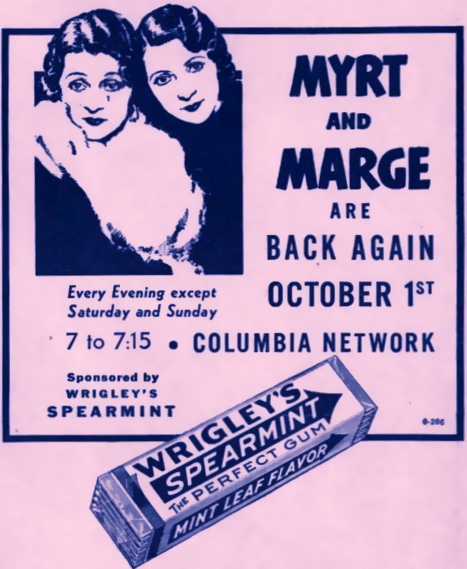
Amos ‘n’ Andy is old-fashioned,” radio critic Darwin L. Teilhet complained as early as 1932. “Its dramatic machinery creaks.”  He much preferred Myrt and Marge, a 42nd Street-smart if way-off-Broadway Melody then in its inaugural season.  To Teilhet, Myrt and Marge was not only “very good serialized melodrama,” it was the “most advanced program of its type now on the air.” 
For all its popularity—and its groundbreaking granddaddy-of-them-all status—Amos ‘n’ Andy sure was “old-fashioned.”  Indeed, its success depended on that comforting, reassuring recognizability—comforting and reassuring, that is, to folks who thought a black face routine less troubling than the effectuation of racial equality.  The early 1930s were highly competitive times of economic hardship, and to hear potential competitors bumbling and make fools of themselves must have been comic relief to the paler faces in the crowd, the faces that mattered most to sponsors.

So, how fresh-faced were Myrt and Marge by comparison? And why was it that, by January 1933, their serialized adventures came pretty close to rivaling Amos ‘n’ Andy in the ratings? Never having been enthusiastic about the latter, I was eager to find out.

As next to nothing is left of the program’s initial run, I had to take the critics’ ear and word for the “it” of listening.  Teilhet, for one, was wowed by the “swift lines,” which he found to be “very different from Amos’ and Andy’s ponderous exchanges.”

Indeed, those “swift lines” translated into swell curves in the critic’s mind.  “Miss [Donna] Damerel [as Marge] provides a sweet and pure sex interest,” Teilhet opined, “which can be safely gulped down by the hinterland without making the children go to bed before their proper hour.”  It took an adult’s imagination of adulterated purity to figure that not all that occurred in the lives of chorines Myrt and Marge was altogether “sweet and pure,” least of all by the puritan standards commercial radio was obliged to uphold.

According to Teilhet, the “tempo” set by the two leads was “hard and glittering.”  Myrt and Marge was quick to respond to the public’s fascination with Al Capone and Little Caesar by turning the backstage drama into an “exciting gangster story.”  It brought a touch of Dillinger to the dilly-dalliance of romantic serials, then still a genre in search of a formula.  By doing so, and by implicating its leads, Myrt and Marge came as close to pre-code Hollywood as network radio could get.

What’s more, Teilhet remarked, that “tempo” was “directly traceable to the vaudeville antecedents” of Myrtle Vail, who created the serial, wrote and starred in it.  “The things she has seen—and experienced,” winked Radio Guide’s Arthur Kent in 1934.  Kent attributed the program’s success to the fact that the title characters were played by actresses who were mother and daughter in real life and that Myrtle Vail had “lived in three great epochs of show business: epochs dominated, respectively, by stage, movies and radio.”  Having “been though it all,” Vail now wrote “the life of the theater as well as her own life into her script.”   Like a true trouper, she carried on even after the death of her co-starring daughter in 1941.

At least on one occasion, the realism was inspired by actual events.  “That tearful episode of Myrt and Marge last week was not the result of an emotionally successful script, m’dears,” readers of Radio Guide’s issue for the week ending 1 February 1936 were told.  “No, it was because the cast almost was overcome by tear gas fumes released when the bank adjoining the CBS studios tested out its automatic vault system.” 

I am surprised that listeners, if not overcome by the vapors, weren’t positively fuming at some of the backstage goings-on.  Perhaps they were overcome, which may account for the lack of documented complaints, radio’s chief tool of self-censoring.  Could they have been oblivious of the program’s other or third “sex interest”—that flaming figure in the dressing room?

What Myrt and Marge brought into American homes, if they didn’t already have one in the closet—and what contributed to renewed interest in the serial, albeit as a mere pop-cultural footnote—was Clarence Tiffingtuffer, the queer sidekick responsible for the gowns worn by the show-busy leads, and for considerable gossip besides.

If listeners were clueless, the hoofers sure weren’t.  When teenager Marge, the newest member of Hayfield Pleasures celebrated precision chorus, feels uncomfortable about being fitted by a man, one of her fellow chorines hisses “Don’t worry, he’ll never harm a hair o’ your head, dearie.”  Rather than being the brunt of it, Clarence dishes out some “swift lines” of his own. “Those gams of yours are practically parenthetical,” he remarks upon the alleged assets in his sartorial care.

Now, belated followers of Myrt and Marge have to make do with a mid-to-late 1940s revival of the serial (although a 1933 film version featuring the radio cast is extant).  Gone are the true-to-life leads; gone, too, is much of what had seemed “different” or “advanced” about the serial back in 1932.  Yet even though we now have to settle for Myrt and Marge-arine, the substitute still retains a flavor of the first outing, as the actor originating the part of Clarence, Ray Hedge, reprises the role he made his own.

I can imagine that, had I been growing up in the early 1930s, Myrt and Marge would have made me feel a little less marginal by moving someone recognizably like me—yet way out there, enjoying a career and a life of make-believe—into the center of the action.  How thrilling it would have been to hear Myrt and Marge take to the soundstage set by their better-known seniors, Gosden and Correll, and listen to them tear down that old minstrel show-on-taxi cab wheels.  With Clarence in their midst, and on my mind, it sure would have sounded like the “most advanced program of its type.”

To be continued, as they say in soap opera land.
Blind Justice; or, ‘1000 for Verdicts’

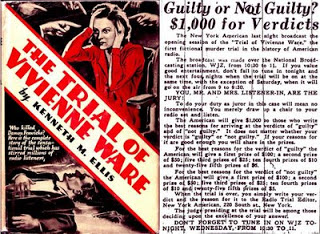
“It does not matter whether your verdict is ‘guilty’ or ‘not guilty.’ If your reasons for it are good enough you will share in the prizes.” With this peculiar invitation, millions of US Americans were lured to their radios, tuned in to WJZ, for a trial in which they, the listening public, were called upon to act as jurors. As previously mentioned here, it all began on this day, 25 November, in 1930.

The judge in the case was none other than New York Senator Robert F. Wagner, lending gravitas to a spectacle that was, in more sense than one, a trial broadcast. Would listeners find fictional society beauty Vivienne Ware guilty of the murder of millionaire architect Damon Fenwicke, a crime for which she could be sentenced to the electric chair? And would they leap out of their armchairs to boost not only their own circulation but that of their local paper by rereading what they just heard on the air?

“It is no part of your duty to decide whether or not she shall die,” Senator Wagner insisted. That, he told the listeners,

is the function of the Court and the Law.  But you must remember that in endeavoring to secure a conviction of this young and beautiful defendant the District Attorney is but pursuing the business to which you, the people of this State, have set him.  You will consider carefully all the evidence as it is presented for you from the witness stand.

Whether or not their voices could kill, those tuning in nevertheless derived their thrills from the importance of the interactive role granted to them. Tune in, have your say, all for a chance to win a substantial amount of dough—what’s not to love!

Leave it to a Hearst paper to conceive of a reality show like The Trial of Vivienne Ware—a trial that sold papers and bought the jury. Those who caught up with the daily broadcasts from the courtroom and read transcripts and analyses in their daily Hearst paper were rewarded for being informed enough to arrive at the verdict they were invited to mail in. No attendance, no deliberations with fellow jurors required. All that was needed, aside from a radio set and a few cents for daily tabloids, was curiosity, rhetoric, and greed.

You might say it was just fiction, this fictitious call for justice; but the Hearst press, known to have started a war with mere words, was doing its utmost to make the trial seem as real as the joined media of radio and the press could make it, all with the aim of a very real boost in sales through a cleverly manipulative marketing campaign.

More than a radio serial, The Trial of Vivienne Ware is one of the most elaborate and dubious media events ever staged. All that remains of it now are a number of newspaper articles and a book touted as “an innovation in both the radio and publishing worlds”—the “first radio novel.”

To be sure, Kenneth M. Ellis’s “novel”—a combination of faux news reportage and courtroom dialogue—has none of the thrills of the original experience. Its failure to excite and convince convincingly argues the power of the media to create a sense of reality through the realities we glean from sensation.

Soaps to Dial For: My Nights with That Noble Woman

I’ve been having sleepless nights recently, what with this cold and all the rest I am getting throughout the day. It is a testament to my restraint that you still don’t know the half of it. Since I’m not one to crochet or get crotchety, I generally substitute sound sleep for a generous if gentle dose of sound. There’s nothing like canned melodrama to fill the dark hours with images just mute enough not to clash with your pajamas. No thrillers like Inner Sanctum or Suspense, if you please. Too jarring by far! No Fred Allen or Vic and Sade to induce chuckles when it’s snores I’m after. No plays I’d be itching to follow, no tunes I’d be eager to hum. So, I kept my ears peeled for some pop-cultural flotsam that could send me adrift, and presto. The other sleepless night, I finally turned to the kind of fare I rarely try, particularly not when I am in fine fettle. My fettle being decidedly not fit to be in, I contrived to make a late night date with Mary Noble, Backstage Wife.

Backstage Wife belongs to that genre known as “soap opera,” defined by James Thurber as a

kind of sandwich, whose recipe is simple enough, although it took years to compound. Between thick slices of advertising, spread twelve minutes of dialogue, add predicament, villainy, and female suffering in equal measure, throw in a dash of nobility, sprinkle with tears, season with organ music, cover with a rich announcer sauce, and serve five times a week.

If you serve that platter past midnight, rather than at lunchtime, the sandwich appears to become more spicy than soggy. After all, what Thurber left out of that list of ingredients is the listener’s imagination, which tends to get saucier once you hit the sheets.

Fodder for radio satirists Bob and Ray’s “Mary Backstage, Noble Wife,” the “story of Mary Noble and what it means to be the wife of a famous star” was on the air for a quarter of a century. A small but sizeable helping of that run is readily available online, namely a storyline involving the scheming Claudia Vincent, a woman who fires shots at man to gain the confidence of another. That the other man is Mary Noble’s husband, Larry, makes Claudia Vincent’s obvious maneuverings all the more delicious.

Not that my taste buds can be trusted in times likes these, but the last thing I wanted was my mouth to start watering. Now my nights are spent wondering about Mary, Larry, Claudia and Rupert, knowing that I shall never hear the end of it, for want of extant chapters. Of course, serial dramas are not about endings. They, like all melodramas, are about the protracted middle, the main courses and the side dishes, about the precariousness of the status quo and all our attempts to stay as we are or get what is presumably owed us. For all its sensational scenes and rhetorical bombast, melodrama is truest to life, far more real, to be sure, than tragedy and comedy. In those aged and unadulterated models of drama, all endings are final; in melodrama, there is plenty of room for doubt, for turns and returns, for the “what ifs” that, I should have known, are keeping me asking for seconds and up for hours.

The current season of Desperate Housewives being so listless you cannot even claim it to have mustered energy enough to jump the shark, I am only too grateful for a bit of cheddar and ham as only those horrid Hummerts could slice it. Now pardon me while I dim the lights. It’s time for my sandwich.

Hattie Tatty Coram Girl: A Casting Note on the BBC’s Little Dorrit

They are still after him, those producers of television drama. And they know that many of us are eager to follow. In a way, we cannot help being After Dickens, to borrow the title of a study on “Reading, Adaptation and Performance” by John Glavin. It is a sly title, that. After all, we are belated in our pursuit; we do more than simply try to catch up. We are bringing something to the game that is the act of reading. We are making sense, and we remake it, too.

Andrew Davies, the writer responsible for the award-winning dramatization of Bleak House, subsequently tackled Little Dorrit (1855-57), one of the lesser-known works in the Dickens canon. Having greatly enjoyed Bleak House when it first aired back in 2005, I was again drawn away from the wireless, to which most of the posts in this blog are dedicated, to go after what is being shared out—in installments, not unlike in Dickens’ day—by radio’s distant and rich relation.

Now, it has been some time since I read Little Dorrit. During my graduate studies, the novel tantalized me with its perplexing nomenclature, an uncrackable code of names and monikers that inspired me to dabble in the dark art of onomastic speculation. The result of my academic labors, “Nominal Control: Dickens’s Little Dorrit and the Challenges of Onomancy,” is available online.

While many of the names heard in the adaptation of Little Dorrit still ring the proverbial bell for me, some of the faces, as made up for us by the adaptor, seem less familiar. Never mind Arthur Clennam, who is rather younger than the middle-aged man Dickens was so bold to place at the center of his novelistic commentary on the manners, mores, and money matters of Victorian Britain. The character of Tattycoram is the one to watch out for and puzzle over: a foundling turned changeling.

In the original story, Tattycoram (alias Harriet Beadle, alias Hattey—the act of naming is that complicated in Little Dorrit) is introduced as a “handsome girl with lustrous dark hair and eyes, and very neatly dressed.” As portrayed by Freema Agyeman, the televisualized Tatty certainly fits the bill: a young woman with dark hair and eyes, and, my metaphorical hat off to the costume department, handsomely outfitted.

Hang on, though. The color of her skin, to which no reference is made in the novel, appears to have been adjusted; and, in a crowd of pale faces, it is a change that really makes a difference. Has Tattycoram just “growed” that way?

It surely is not simply a case of equal opportunity for television actors like Agyeman, if such cases are ever simple. A black Tattycoram transforms the very fabric of Little Dorrit. It imposes an historical subtext on our reading of the story and the young woman’s part in it.

Adaptors, like translators, frequently engage in such updates, if that is the word for what can amount not only to anachronisms but to presentism, the latter being the imposition of a viewpoint contemporary with the audience of the new version. I was not bothered by the lesbian characters the BBC insisted on sneaking into the staid and psychologically none too complex mysteries of Agatha Christie, even though such reorientations seem gratuitous. The determination adaptors made regarding Tattycoram’s ethnicity is altogether more problematic.

While slavery was abolished in Britain prior to its publication, Little Dorrit is set some thirty years in the past, the possible implications of which present-day television audiences are not given sufficient context to ponder and may not even notice. I had certainly forgotten about the dating of the action prior to the coronation of Queen Victoria. Little Dorrit, unlike Dickens’ A Tale of Two Cities and Barnaby Rudge, is not an historical novel, however; nor is it a commentary on the slave trade.

Concerned with prison reform, and the injustices of the debtor’s prison in particular, the novel refers to slavery only metaphorically to signify systems of oppression and forms of thraldom, perceived or actual. At one point, the orphan Harriet is taken in as a companion by the fiercely independent Miss Wade who, in readings of the novel, has been outed as a lesbian. In a first-person narrative, Miss Wade reflects on her earlier experience as a governess: “I was not bought, body and soul. She [Miss Wade’s employer] seemed to think that her distinguished nephew had gone into a slave-market and purchased a wife.” Clearly, in this questionable equation of servitude and slavery, no comment on the reality of the slave trade was intended by Dickens in this expression of a character’s anger regarding her station and the transgression of which she believes herself to have been accused.

In the Victorian novel, the black or “mulatto” figure remained largely invisible, or else was the brunt of derision. One such laughing-stock character is Thackeray’s Miss Swartz, the “rich woolly-haired mulatto from St. Kitt’s” who parades through Vanity Fair being “about as elegantly decorated as a she chimney-sweep on May-day.” In Dickens’ Bleak House, concerns about black lives in the colonies are dismissed as the folly of “educating the natives of Borrioboola-Gha, on the left bank of the Niger.”

Of the nearly one hundred, mostly flat characters that flit in and out of Little Dorrit—which, according to the Radio Times, were reduced to around seventy-five in the process of compression—it is Tattycoram, an orphan named after the notorious Coram hospital in London, who now stands out as an individual struggling to emerge from a socially imposed conspicuous invisibility that, the adaptation insists, is owing to her ethnicity. Thus, a marginal character takes center stage by an imposed discourse on the nature of her marginalization. In other words, the attention paid to her, belatedly, is justified mainly by the postcolonial narrative grafted on the novel in which the Harriet in question is treated as if she were the brainchild of Beecher Stowe.

Showing a little skin, and revealing it to be black, Davies’ retailoring may strike some audiences who are acquainted with the genuine article as a bold new cut. And yet, in the process of giving the old Empire new clothes, the Dickensian fabric is suggested to be more than a little Tatty. Perhaps, instead of such alterations, the assumption that, with strategic trimming, Dickens can still meet our aspirations needs adjusting.

They are still after Dickens, all right. The question is: are they even trying to get him or, riding on his coat-tails, are they out get at something he just hasn’t got?

“Madagascar Madness”; or, It Takes a Houdini to Get Out of That One

Tickled by Canary Feather’s account of being an accompanist for silent movies, I was in the mood for another non-talkie. The term may be unhappy in its connotation of lack, yet seems preferable to “silent movie,” considering that, prior to the late 1920, the sound for motion pictures was supplied by those playing the piano or the organ; even sound effects artists and entire orchestras were not unheard.

Having had my fill of non-talkie comedy of late, I chose a melodrama likely to wear out the most resourceful and nimble-fingered of pianists: The Master Mystery a 1919 thriller underscored by Stuart Oderman, whom I have often heard and seen playing the piano to movies screened at the Museum of Modern Art in New York. Intolerance, Grandma’s Boy, and Caligari—Lillian Gish biographer Oderman has articulated them all.

In the case of The Master Mystery, the pianist must have been relieved that his accompaniment was being recorded, rather than performed live. However fragmentary, the film still runs an epic 238 minutes. With an attention span shortened by broadband and a clock ticking down the last minutes of the day, I was resolved to take in this thriller as it was conceived; that is, as a weekly chapter play.

From the first instalment, I expected little more than an exposition, an introduction of the main characters, and the obligatory cliffhanger. After all, The Master Mystery stars the famed escape artist Harry Houdini (previously encountered on a boat about to go over Niagara Falls).

Now, I pride myself in not readily throwing in the remote control; but The Master Mystery, with its secret identities, its corridors and hidden caves stalked by an pre-RUR automaton, and its cases of Madagascar Madness—proved too complex to master at that late hour. The opening title card should have been ample warning. The “Foreword” reads:

International Patents, Inc., is a firm whose vast fortune has been made by inducing inventors to trust the marketing of inventions to their care and after obtaining sole rights—they suppress the manufacture of these inventions—much to the financial gain of the owners of already existing patents.

However intriguing, this is hardly the most effective way of opening a chapter play. We have not yet been introduced to any of the characters, but are confronted instead with a corporation and with legalities not quite the stuff of melodramatic action. Equally frustrating is the introduction of characters by indirection, that is, as a name on a title card not referring to the character shown. The secretary of businessman Peter Brent, for instance, is identified as being “secretly in the service of Balcom,” before we are shown the latter.

My own shortcomings aside, was it writerly ineptitude that caused me to get lost in the muddle? Was it owing to the fragmentary state of the surviving print, segments of which have been “rearranged” to create the “illusion of completeness”? Or was it, perhaps, all part of a shrewd design? I was determined to fill in the blanks with whatever notes I could find. Notes? How about an entire book!

In May 1919, Masters of Mystery was published as a novelization co-written by Arthur B. Reeve, one of the scenarists credited as the “authors” of the serial. Yes, viewers lost in the maze from which only Houdini could extricate himself were promised a key to it all in the form of a tie-in book, replete with stills from the film. I wonder just how many moviegoers resorted to a purchase in hopes of mastering this Mystery?

Here is how the opening title card is translated into some semblance of a narrative:

“I will see Mr. Brent,” insisted the new-comer, as he pushed past the butler. “Mr. Brent!” he cried, advancing with a wild light in his eyes. “I’m tired of excuses. I want justice regarding that water-motor of mine.” He paused, then added, shaking his finger threateningly, “Put it on the market—or I will call in the Department of Justice!”

Brent scowled again. For years he had been amassing a fortune by a process that was scarcely within the law. For, when inventions threaten to render useless already existing patents, necessitating the scrapping of millions of dollars’ worth of machinery, vested interests must be protected.

Thus, Brent and his partner, Herbert Balcom, had evolved a simple method of protecting corporations against troublesome inventors and inventions. They had formed their own corporation, International Patents, Incorporated.

Their method was effective—though desperate. It was to suppress the inventor and his labor. They bought the sole rights from the inventor, promising him glittering royalties. The joker was that the invention was suppressed. None were ever manufactured. Hence there were no royalties and the corporations went on undisturbed while Brent and Balcom collected huge retainers for the protection they afforded them.

Thus Brent Rock had come to be hated by scores of inventors defrauded in this unequal conflict with big business.

While the perfunctory prose suggests that the book is not always better than the movie, I was at least caught up with the story and prepared to follow Houdini as he gets in and out of scrapes to a score by Stuart Oderman . . . next week.

All Washed Up: A Lament for Those Soap Sisters

“Poor Old Helen Trent,” a fellow webjournalist exclaimed the other day. It is right and proper to join in this lament; not only was she single, middle-aged, and beset by troubles into which she was drawn each quarter hour to tease but never quite satisfy those members of the radio audience who had the morbid curiosity that is a requisite for serial listening. She now has very little to show for all those years of turmoil. While still recalled by many who used to follow her getting nowhere fast, she is very nearly silenced today, with only a few chapters of the long-running serial readily available to anyone desirous to catch up. Even worse is the fate of Stella Dallas (pictured), who does not get a single mention in Robert C. Allen’s Speaking of Soap Operas (1985), one of the books I consulted for the occasion.

When I began to research American radio drama and narrative (there is something dissatisfying to me in the term “radio drama,” considering the importance of the narrator in most of these fictions), I wondered whether I would ever get to hear the programs I had hoped to write about. In my recovery efforts, I went so far as to dig up MA theses and dissertations written during the 1930s, ‘40s, and ‘50s, if only to marvel at the material accessible to a student tuning in back then. Sure, I could have asked some of the old ladies whose Manhattan apartments I was cleaning back then; but, my memory being less than elephantine, I have come to distrust the recollections of others and much rather consult contemporary sources. One such is “The Radio Serial,” an unpublished thesis by Stanley Robert Rowe, who received his MS in 1949 from Boston University.

As Rowe puts it, his “treatise is based upon six weeks of regular listening in July and August 1948 to all the dramatic serials offered by the two radio networks which broadcast them [i.e. NBC and CBS].” Can you imagine? Six weeks with Stella Dallas, Helen Trent, and Ma Perkins! These days, one has to make due with isolated chapters; and, in some cases, with less.

In the summer of 1948, over thirty daytime serials were being broadcast each weekday over CBS and NBC alone. Beginning at 10:30 AM and concluding at 5:45 PM, NBC presented, in order of their broadcast time, the serials Road of Life, Joyce Jordan, MD, This Is Nora Drake, We Love and Learn, Lora Lawton, Claudia, Today’s Children, Light of the World, Life Can Be Beautiful, Ma Perkins, Pepper Young’s Family, Right to Happiness, Backstage Wife, Stella Dallas, Lorenzo Jones, Young Widder Brown, When a Girl Marries, Just Plain Bill, and Front Page Farrell.

CBS began airing its line-up of serials at 11:45 AM; by 3:15 PM, listeners could tune in to Rosemary, Wendy Warren, Aunt Jenny, Helen Trent, Our Gal Sunday, Big Sister, Ma Perkins, Young Doctor Malone, Guiding Light, Second Mrs. Burton, Perry Mason, This Is Nora Drake, Evelyn Winters, David Harum, and Hilltop House.

Now, why would anyone be willingly subjected to such programs? Why, to have something to say about them, of course. Stating his “reason for wanting to listen to all the serials,” Rowe explained:

First, I hoped to have as many examples as possible to substantiate and illustrate any conclusions I reached; and also, I wished to be able to write authoritatively about all the serials offered on a nation-wide network and determine the range and variety they represented. Far too much criticism is made of radio which is based on too little actual knowledge of the medium and its programs. In auditing all the radio serials, I hoped to be able to avoid sweeping generalizations which overlooked significant exceptions.

Yes, this is how writing about radio needs to start: with listening. Which, alas, is precisely why I have to remain silent about poor Stella Dallas and her sudsy sisterhood . . .

On This Day in 1930: ‘”Mystery Gun” Disappears As Lights Go Out’ in Invisible Courtroom

I don’t suppose I shall ever get used to it. The Welsh weather, I mean, the nocturnal roars and howlings of which I often drown out by listening to the familiar voices of old-time radio, reassuring and comforting voices like those of Harry Bartell or Elliot Lewis, both of whom were born on this day, 28 November, in 1913 and 1917, respectively. Storms are part of the Welsh soundscape, much like the bleating of sheep on the hills. If such climate conditions were faced by the people of New York, among whom I numbered for some fifteen years of my life, I wager that the local television newscasts would report little else. To be sure, last night’s storm did make headlines, being that a tornado wreaked havoc in a village just a few miles from my present home.

Thanks to some well-chosen radio thriller, I managed to sleep through it all, losing myself in dreams that, once radioactivated, tend to become particularly vivid. I often wonder just how much my mind, conscious or not, is influenced by the popular culture I consume by listening in. Sometimes, though, it is what we hear about, and not what we perceive, that stirs our imagination. There are a few listening experiences I can only dream of, plays I have only read or read about and consequently fascinate me no end. One such unheard soundplay is the serial The Trial of Vivienne Ware (previously mentioned here and discussed at some length in Etherized, my study of American radio dramatics). Pulled by the Hearst press and propagated on the air by station WJZ, New York, it was a spectacular publicity stunt designed to promote Hearst’s less than reputable papers.

Those tuning in did not only get to hear the proceedings, but were cast as jurors. They stood a chance of being awarded $1000 for coming up with the most convincing verdict (be it “guilty” or “innocent”), thus making it unnecessary for the author of the story—one Kenneth M. Ellis—to determine upon a reasonable conclusion and the fate of his titular character.

From the 25th to the last day of November, the fictional trial was broadcast live, with eminent figures of law and politics, New York Senator Robert F. Wagner and prominent attorney Ferdinand Pecora, heading a cast that included noted stage actress Rosamund Pinchot. Here is how the New York American, the Hearst paper sponsoring the series, described the session of 28 November 1930:

It was almost at the close of the session that the lights suddenly were extinguished and the court plunged into total darkness. Women’s screams, the shouts and bustle of court attaches, and the hammering of the gavel filled five or six black seconds with sound. Then the lights came on again—but the .38 caliber revolver which George Gordon Battle, chief counsel for Vivienne Ware, had just introduced as evidence had disappeared from the table where it lay.

Now, that’s a melodramatic conjuring act fit for the airwaves. It probably wouldn’t do much good during a stormy night, though, since such interactive thrills—let alone the pondering of the verdict, and what to do with the prize money—are, unlike much else that was presented on American radio with comforting predictability, anything but soporific.

Wireless Women, Clueless Men: Gertrude Berg, Everybody’s Mama

Well, I am back from my three-day getaway to Manchester, my makeshift Manhattan. And what a poor substitute it has proven once again. The only bright spot of an otherwise less than scintillating weekend was the production of James M. Barrie’s comedy What Every Woman Knows at the Royal Exchange Theatre. While I prefer the traditional proscenium arch over an arena that to me suggests circus acrobatics or boxing matches rather than verbal sparring, I eventually got past the irritation of being dazzled by confronting stage lights, of having to watch the action through a fireplace or other obstructing props, and of looking into the faces of audience members opposite while the players turned their backs to me.

I was won over, tickled then touched by the excellent performances in this smart and sentimental piece, particularly by Jenny Ogilvie’s knowing portrayal of Maggie, whose “every woman” charm eludes the very man for whom she so devotedly works her magic: her clueless husband, that is. I will have more to say about Barrie’s play—and the hazards of adaptation—in a journal entry coinciding with its 2 March 1947 soundstaging by the Theatre Guild on the Air, on which occasion Helen Hayes was heard as Maggie.

Hayes is one of the leading ladies mentioned in the first broadcastellan quiz; and whether or not she ever had her own radio program is something for you to ponder should you choose to join in before the answer is revealed on 24 February. Until then, I could not possibly let Ms. Hayes or her interpretation of Maggie take center stage. That spot is reserved today for “every woman” Mollie (or Molly) Goldberg and her creator Gertrude Berg, who also portrayed the role for decades on radio, stage, big screen and small.

As vaudevillian-turned radio personality Eddie Cantor once remarked, Berg “captured the charm” of New York’s East Side, and “through her sketches runs the entire gamut of human emotions, from laughter to tears.” It was no charmed life on Pike Street those days, but surely one with whom many radio listeners could readily identify.

Jewish immigrants Mollie, her husband Jake, and her two children, Sam and Rosie, came to NBC radio on 20 November 1929, just a few weeks after Wall Street laid that proverbial egg. Recordings of those first broadcasts are not known to have survived, but the early struggle of the Goldberg family has been preserved in print, in a 1931 novelization of the scripts to accompany the popular series.

Mollie is introduced as a woman whose worries are largely domestic and sometimes imaginary. Anxious because her son, Sammy, is late from school, Mollie speculates that he might have gotten himself “runned over by a cabsitac”; after all, “[d]ey run around so fast like cackroachers.” Mollie, you see, lacked a formal education in American English—unlike her children, who were quick to correct her. “De chicks is loining de rooster!” Mollie exclaimed in exasperation.

Husband Jake, meanwhile, was clueless about Mollie’s desire to improve herself; he was too busy with his struggling business. “Oy, vat beezness!” Mollie sighed, “Saturday, Sonday, holledays. Plain talking all de time! Vy don’t you buy a bed and slip dere and finished! And dat’s beezness? It’s a slavery—jost like in Oncle Tom’s Cabinet!”

Sure, Mollie loved going to the pictures watching movies like “Oy, vot a fool I am,” by “Ruddy Kipland” or “de Four Horsemen in de Apoplexies.” She also marvelled at technological advances such as the newly installed telephone in her home (“Mr. Telephon Company, vhere do you put de nickels?”). Yet, like Barrie’s Maggie, Mollie was eager to learn even that which not every immigrant homemaker was expected to know. For that purpose, she enrolled in a reading and writing course at a neighboring night school. So, as much as listeners were invited to laugh at Mollie’s malapropisms, they were also taught to admire her courage and perseverance:

Ay, ay, Amerike, Amerike! Everybody vhat only vants, can become here a somebody. An education is like in de fairy story, “Open see-saw open.”  Vhen you got an education den everyting; all de doors from de vorld stands open far you.  You could even understand yourself, and vhat’s more important dan dat, ha? You’ll vouldn’t be ashamed from your mama, ha, Rosiely?

Years later, Berg commented on the significant contribution of the serial to American democracy. The “daytime serial,” she said, “can be a very effective force in bringing to the American people a deeper understanding of the democratic way of life” since it was capable of “revealing the meaning of democracy in people’s lives,” and of doing so far more effectively “than any speech.”

During the war, however, Berg agreed to address the radio audience in her own educated, if not nearly as charming, voice, imploring those listening to the Treasury Star Parade to be mindful of the fight for democracy, rather than wasteful of the material benefits deriving from it.

“Women like us fight with the bonds we buy, the rubber we save, the food prepare and the fat we save.” It’s what every woman needed to know back then. And who was more ideally suited to tell them than Gertrude Berg, the mother of radio’s surrogate mom?

On This Day in 1930: Murder Trial Broadcast Summons Millions to Court

Well, it is Black Friday here in New York—the stores are opening at preposterously early hours and shoppers are lured away from their leftover turkey with promises of early bird specials and nest egg busting savings. Too lazy after a sumptuous Thanksgiving meal, I am not partaking of any 5 AM bargain debasements. Instead, I am going to celebrate yet another milestone in radio drama history—The Trial of Vivienne Ware, which opened on this day, 25 November, in 1930 and ushered in a new age of cross-promotional multimediacy.

“There’s murder in the air,” the New York Times had announced in its Sunday radio section, predicting that The Trial of Vivienne Ware would “occupy the attention of listeners over WJZ’s network for six consecutive nights beginning Tuesday.” Considerably more enthusiastic was the New York American, which declared the six-part serial to be “one of the most stirring mystery radiodramas ever presented,” quoting NBC president M. H. Aylesworth as saying that its script “established a new standard in the creation of radio plays. The simplicity and fidelity of the theme, together with the colorful word and character pictures, stand out in this new field of adaptive writing.”

The New York American—the Hearst “paper for people who think”—had good reason to eulogize the as yet unaired serial as “one of the best radio dramas ever written,” given that the program had been conceived by one of its own feature writers.

Every effort was made to prevent the program from appearing like a cheap marketing ploy and to convince WJZ, New York—the flagship station of NBC’s Blue network—to produce the series in its glass-curtained Times Square studio atop the New Amsterdam Theatre and to broadcast the event locally instead of making the required six half-hour spots available to national advertisers.

Certain to impress NBC executives was the fact that—along with Ferdinand Pecora, Assistant District Attorney of New York, and prominent New York attorney George Gordon Battle—none other than US Senator and Supreme Court Justice Robert F. Wagner had agreed to participate in the mock trial by assuming the role of the presiding judge. The titular heroine was played by Rosamund Pinchot, a stage actress who had appeared in Max Reinhardt’s celebrated staging of The Miracle, and the entire spectacular was supervised by well-known Broadway producer John Golden.

“Ladies and Gentlemen of the Radio Jury,” Wagner addressed the audience during the inaugural broadcast:

You have been called to one of the most trying tasks which befalls the lot of a citizen. You are to try a fellow being on a charge of first degree murder.  It is the more difficult for you in that this defendant has everything which would make life for any young woman most desirable.  Yet it may become your solemn duty to deprive her of her enjoyment of that life.

Standing to gain cash prizes for the most convincing verdict, readers of the New York American were advised to prepare themselves by taking in the published “information” daily, since they might miss “important loop-holes” if they did not “carefully follow the testimony and the evidence” as presented on the radio. “By reading the New York American every morning” throughout the trial and by “tuning in on WJZ each night at the specified time,” readers should be able to form their verdict as to Miss Ware’s guilt or innocence—“just like any other juror.”

According to Radio Digest, verdicts, letters of congratulations, and demands for a sequel were received from places as remote as Canada and Virginia, as well as from ships at sea; an estimated 14,000 listeners eventually acquitted the fictional heroine on trial, with about 2000 arguing the “society girl” to be guilty. More significant for the publisher was that the serial had increased the circulation of the New York American “far in excess of expectations,” as a result of which Hearst papers in San Francisco, Chicago, Los Angeles, Washington, and Omaha sponsored the trial with different casts of local luminaries.

A follow-up trial involving the murder victim’s less privileged “friend,” nightclub singer Dolores Divine, was staged a few weeks after the acquittal of the first defendant. A generic version of the radio scripts for both serials, prefaced by excepts from the printed reports and concluding with the audience verdict, was subsequently published by Grosset and Dunlap, which marketed Kenneth M. Ellis’s The Trial of Vivienne Ware as the “first radio novel, an innovation in both the radio and publishing worlds.”

Unfortunately, no recordings of this interactive multi-media event seem to have survived. I sure would have enjoyed tuning in . . .

Listening to “The Thing That Cries in the Night”; (Chapter Fifteen): Radio Is a Deserted Home

Well, Heavenly Days! This morning, I caught a glimpse of the Great Gildersleeve and the McGees (Fibber and Molly, that is), who were featured in a triple bill of radio-takes-the-pictures comedies on Turner Classic Movies. Of course, radio always takes the pictures, provided the audience has a mind’s eye keen enough to develop them. Soon I’ll head out to pay a visit to the Museum of Television and Radio. As I noticed yesterday, the bookstores, second-hand or otherwise, are not exactly well stocked with radio-related publications; the late-1990s resurgence of interest in radio dramatics and pre-TV broadcasting here in the US seems to have died before it could mature as an independent, sustained, and regenerative field of study.

My own study on the subject of old-time radio, Etherized Victorians, doesn’t have much of a chance in a market that caters to people with short memories or nostalgic longings, instead to those who, like me, think of audio drama as alive if largely abandoned.

Today, my rather unsuccessful attempt at creating enthusiasm about Carlton E. Morse’s I Love a Mystery must come to an end. On this day, 18 November, in 1949, “The Thing That Cries in the Night” stopped bawling at last.

In his fifteenth and final chapter of “The Thing,” Morse keeps on postponing the prosaic business of making sense, until he eventually explains away the mystery of the voice without a body and solving the case of the name without a face.  Not that Jack Packard, one of Morse’s trio of adventurers, finds pleasure in lifting the veil.

“The House of Martin has fallen,” he concludes, soberly; the collapse has proven too devastating and deadly to call for celebration.  The story of a house under the corrupting influences of Hearst and Hollywood, “The Thing That Cries in the Night” is also a chapter in the history of radio, the medium for which Morse chose to write. Exposing the double life of the not-so-sweet Charity, the secret career and inglorious demise of a radio voice and its bodied double, Morse turns ventriloquism into a metaphor for the depersonalizing business of commercial broadcasting and its body of tongue-tied artists and scribes who, generally barred from speaking their mind and forced to mind their speech, stomached ignominy while devising various modes of indirection.

The dark art of casting voices, narrowly or broadly, is exposed as a duplicitous act, an impersonation in whose impersonal nature we can descry the corruption of communication and the unwholesome fragmentations of modern life.

Thus concludes my adventure in radio listening. Had it met with a more favorable reception—or just more of a reception, for that matter—I might have fixed my mind’s eye on a longer serial, such as Chandu the Magician. Instead, I will listen to the sounds of the city for a while as I mingle with the more tangible multitude. Perhaps you’ll be here when I return.