Listening to “The Thing That Cries in the Night”; (Chapter Three): Faith Is a Secret Sharer

Last night, as the winds were yowling and pushing against the window panes with autumnal ferocity, I dug deep into our video library and retrieved the threadbare but engaging Dressed to Kill (1946), the final entry in Universal’s long-running series of Sherlock Holmes mysteries. I dropped off toward the end, truth be told; but, as my eyes closed in spite of myself, I thought what a fine radio thriller this particular picture would have made. Not that there wasn’t anything to see or worth watching; but the plot, involving a treasure hunt for three plain-looking music boxes whose tunes contain secret messages, is ideally suited to audio-dramatization.

I was reminded of a discussion I had a few years ago with a friend of mine who starred in the off-Broadway production of Perfect Crime. To what extent does or should a mystery depend on the medium in which it is played out? How much does its unraveling rely on visual clues, how much on the spoken word? Hush now, here comes the third installment of Carlton E. Morse’s radio thriller “The Thing That Cries in the Night” (originally aired on 2 November 1949).

Jack is in conference with Mrs. Randolph Martin, the formidable matriarch who previously confessed to “granddaughter trouble” but is unwilling to expound on the subject. “The Martin girls can do no wrong,” she declares. Yet one among her troubled charge prefers plain talk to false pride and etiquette. She is Faith Martin, the self-professed “vulgarian” of the family. And when she’s through flinging her nasty little character sketches at Jack, we can no longer doubt that the Martins are virtuous in name only.

According to Faith (who, eager to drop the misnomer, insists on being called Fay), the other members of the household are Hope, “the family wench,” and Cherry (Charity), a “plain dope, afraid of her own shadow”; there’s also a brother, Job, who seems to drown his sorrow in a steady stream of potent liquor. They are all very devoted, Fay explains—just not to staying on the path of righteousness:

. . . one day Job found out about firewater, and now he’s devoting his life to it. And one day I found out that there are some wonderfully disgusting words in the English language for self-expression. I’m devoting my life to them. And Hope discovered chauffeurs, and she’s devoting her life in that direction.

And Cherry, the “whispering mouse”? According to her sister, she “hasn’t discovered much of anything yet. So, she’s devoting her life to being afraid.

The “stench of a decaying family tree” which Jack senses to be “permeating the environment” is released at last in a barrage of epithets; but are these labels the real article? Are they any more apt than the names they denounce as ill-fitting, any more precise than the pronounced “they”—the menacing entities Cherry claims to be slashing her skin.

Even Fay feels compelled to revise her candid assessment of the Martin clan when she notices those marks on her sister’s arms. The wounds, at least, are concrete signs of danger; but how much value can we give to “ocular proof” if it only proves that someone is suffering?

Jack insists on evidence, on verifiable facts: “Who is the parent of the baby we heard crying?” he inquires. “Nonsense,” old Mrs. Martin protests. “There’s not a baby in this house. There hasn’t been for years,” Fay adds. Yet they all heard it—the eponymous “Thing.” And, as Cherry tells them in a tremulous whisper, “every time it cries, something horrible happens.”

What a way to end a chapter! Charity Martin’s prophetic tease leaves us dangling, defying us not to hang on; it undermines the certainties we thought we were dealt by Fay’s refreshingly plain talk. Now, this airing of family secrets, the gossipy revelation of a multitude of sins, makes way for a mystery decidedly more dreadful and dark . . .

Say, do you prefer your mysteries hard-boiled or gothically embroidered?

Listening to “The Thing That Cries in the Night”; (Chapter Two): Charity Is a Wounded Stranger

Twenty-four hours have elapsed since last I caught up with Jack, Doc, and Reggie. After leaving them at the airport, in front of that mysterious limousine, I took a little Halloween detour and screened Charlie Chan at the Opera (1936), starring Boris Karloff. It is a neatly spun yarn, recycling threads of the Gaston Laroux classic, tossing in references to Faust and Frankenstein, and boasting an operatic score by Oscar Levant. Like I Love a Mystery, the film borrows freely from its literary ancestors, rather than stealing from them. The difference is in the wink, the knowing smile it produces on the lips of an audience who will not only pardon the borrower but appreciate the sharing. Genre-defying yet enriched by his artistic influences, Morse understood well to be tongue-in-cheek without losing his bite. And there is plenty of bite in the second installment of “The Thing That Cries in the Night.”

The stalling is over (don’t you agree?) and things, however intangible, are developing rather rapidly. Jack, Doc, and Reggie find themselves in the mansion of a certain—or rather uncertain—Randolph Martin, a host who does not deign to greet them. The house, as Jack describes it, is “overflowing with the refinements and niceties of an old family,” with “signs of the family tree almost everywhere.” Before they can continue with their inspection and speculations, the three adventurers encounter a distraught young woman who appeals to them in a tremulous voice: “Look. Somebody slashed me.”

It is a voice of someone not quite there—of someone forlorn, longing, or haunted. It is an anemic voice, but the speaker’s blood is flowing freely. It is the voice of a victim, all right, but who is her attacker? The woman’s reply to this pragmatic question is as insubstantial as the volume of her speech; “they” did it, she whispers, and “they” are trying to kill her.

Having dressed her wounds, Jack observes that it is “apparent that the family tree is beginning to show signs of decay.” “Rotten clean down to the root,” Doc agrees. Might the Martin residence be another House of Usher? Is the “family tree” of “The Thing” chopped from the same wood as Poe’s Gothic?

The wounded one is Charity, one of three sisters living in the stately home of the elusive Randolph Martin: Faith (the “armful” in the limousine), Hope, and Charity. “Whoever heard of naming girls Faith, Hope, and Charity?” Doc protests, “Sounds like a Texas camp meeting.” What’s in a name? With little more than proper nouns to go by, the listener is invited to put the Martin clan to the test, to determine whether the names rightly adhere to their bearers like a Dickensian label or whether the three women are virtuous in name only.

Suddenly, the air is filled with the cries of an infant, followed by sounds of a body taking a tumble. The noise subsides. A voice, stern, elderly and female, demands to know what happened. Before the perplexed guests can utter her name, the woman introduces herself as Randolph Martin.  “And I need help, she adds, “I am having granddaughter trouble.”

What might be the trouble? Blood on the carpet and secrets underneath? Having already been fooled once by a name—a woman called Randolph—listeners are advised to approach the ladies of the house with some trepidation. It is an intriguing naming game that Morse plays with us; after all, in radio drama, there is little more concrete to be had than uttered sounds.

Without an omniscient narrator to guide us, without any tangible clues in sight, we are at the mercy of each speaker. Well, you might argue, reality is a baby crying—but should we believe our ears?

Listening to “The Thing That Cries in the Night”; (Chapter One): Danger Is a Block-Long Limousine

Today, as I have been announcing for quite some time now, broadcastellan will commence an experiment in shared listening. Perhaps, “experiment” is rather too scientific a term. It’s the sharing that matters. My idea was to listen to a popular American radio serial as audiences would have done in the 1940s—that is, in week-daily doses, rather than an omnibus edition. I have always wanted to experience Dickens’s fictions that way: not as stories all wrapped up in one complete volume, but as an adventure in reading that unfolds in installments. That is why I appreciate the current BBC TV adaptation of Bleak House, which recreates the cliffhanger sensation Victorian readers enjoyed as, week after week, they followed their favorite stories in the issues of periodicals like Household Words.

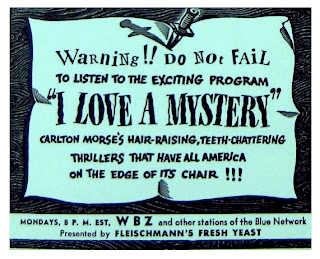
An expert storyteller in this tradition was Carlton E. Morse, whose radio thriller serial I Love a Mystery continued on this day, Halloween, in 1949, with a sequence bearing the invitingly penny-dreadful title “The Thing That Cries in the Night.”

Yes, even though it tossed listeners a new storyline on that Monday night, I Love a Mystery nevertheless continued where it had left off on the previous Friday. So, the first chapter of “The Thing That Cries in the Night” is best read not so much as a beginning than as a connecting piece in a continuous puzzler.

Following I Love a Mystery‘s sonic signature of train whistle, screeching tires, the strains of Sibelius’s “Valse Triste,” the chimes of a clock (and a narrated prologue no longer extant), “The Thing” takes off in mid-air.

The first sound we hear is the noise of a plane engine. The three central characters—adventurers-for-hire Jack (voiced by Russell Thorson), Doc (Jim Boles) and Reggie (Tony Randall)—are on their way. Up in the clouds and high on adventure, they recall the thrills and challenges of their last mission and debate what is to be done with the reward money they just pocketed.

During the ten minutes we spend with the trio, we witness little more than an exercise in comic deflation, as Texan “he-fighter” Doc Long is being joshed by his comrades (as they used to be called prior to the excesses of late 1940s anti-communism) and cut down to size by a stewardess immune to his macho charms.

Much to Doc’s chagrin, the young woman (portrayed by radio drama stalwart and I Love a Mystery regular Mercedes McCambridge) is entirely unimpressed by the newspaper account of Doc’s fight with a mountain lion, lines the “modern Tarzan” can’t help rereading with great relish. “Pooh!” she taunts him, “My folks live on a mountain ranch up in Washington. My mother scares mountain lions out of her chicken yard by shushing her apron at them.” To Doc, those are fighting words—and the downsized daredevil must find another fight to prove he is still all that.

When I first heard this banter back in the mid-1990s, I was as yet unfamiliar with the codes of Morse’s writing. New to radio dramatics and still bewildered by speech unsupported by visuals, I was pleased to realize how effortless it was for me to get acquainted with the characters and take part in their adventure; at the same time, I was frustrated that there was so little of it (adventure, that is) in this lighthearted vignette. All talk, no action.

Revisiting this first installment of “The Thing” now, listening to it as a transition, rather than an opening chapter, I can appreciate more fully the skill with which Morse developed his multi-part thrillers. Those three amigos are not, as Doc has it, “a bunch of doggone heroes.” Despite their daily derring-do, they are decidedly not super-human; they talk themselves into our everyday and become real to us in their foibles and shortcomings.

As Morse made clear, life’s adventures can await anywhere—in the jungles of South America and the streets of L.A. So, when Jack, Doc, and Reggie are surprised by a black limousine, “a block long,” waiting for them at the airport, something wicked and perilous is bound to come our way. Unable to resist the pretty “armful of girl” in the back seat, Doc exclaims: “Let’s climb in. What are we waiting for?”

In the economics of radio writing, I argued in Etherized Victorians, the comic deflation of Doc’s ego serves to counteract the “potential erosion of the serial’s thrill value. To characters so puerile and vulnerable, hopping into an unsolicited auto may be as hazardous as hunting werewolves and vampires.”

Of course, “What are we waiting for?” is the very question on the minds of Morse’s listeners. Whose car is this? Why is it there? Where will it take us? The chief benefit of a serial is that such unanswered questions linger in the imagination of the audience. The stalling is over—and the next installment will have to prove worth the wait.

Say, don’t just wait for the next installment of my blog. As Sibelius’s waltz fades out, tell me how “The Thing That Cries in the Night” keeps swirling round in your mind’s eye!

An Invitation to Murder by Installments!

Last night I was in on Charlie Chan’s Secret (1936). If somewhat deficient in atmosphere, this old whodunit has many of the key elements of early twentieth-century mystery melodramas like Seven Keys to Baldpate and The Cat and the Canary. Let’s see: there’s a large family fortune and plenty of heirs who’d like to lay claim to it; bogus visitations from the realm the dead; murders ingeniously plotted but thwarted; and a wealthy elderly matriarch in a neo-gothic mansion who is in desperate need of a detective to sort out the family closet.

Come to think of it, that sounds rather a lot like “The Thing That Cries in the Night,” one of the sequences of Carlton E. Morse’s radio thriller I Love a Mystery. Now, there’s a serial I wouldn’t mind reviewing . . . again.As I said previously, I don’t have anything against radio serials, if only they did not insist on such a commitment on my part to be intelligible, let alone enjoyable. Of course, I Love a Mystery is not one of those open-ended daytime serials that go anywhere, and nowhere fast. By the way, I did follow up what happened to Mrs. Goldberg and her chicken venture, but still couldn’t make much sense of the not-going-ons over at Molly’s house.

Morse’s storytelling is byzantine, to be sure, but it is not interminable; each cliffhanger takes you closer to a solution, even though the inevitable conclusion is never as satisfying as our journey and gradual advancement toward it.

On 31 October 1949, the East Coast revival of I Love a Mystery began its investigation of “The Thing That Cries in the Night.” For fifteen nights, listeners were invited to follow the bizarre adventures of three soldiers of fortune—Jack, Doc and Reggie—in an old house whose closets were filled with the proverbial family skeletons. Even though I devoted a lengthy chapter to it in my dissertation, I have never enjoyed this serial as it was offered to the radio audience—as a mystery whose solution is purchased on an installment plan.

So, inspired by the shared viewings going on over at the Charlie Chan Family Home, I am proposing a shared listening experience of “The Thing That Cries in the Night.” It would require little more than ten minutes each day to listen to each of the fifteen episodes (available online here) and a few minutes more to exchange ideas about it on this blog. If you miss an episode, you can always catch up with the convoluted plot here. I will even continue my reviews while away for a visit to my former home, the Big Apple.

Anyway, let me know whether you accept my invitation to go in search of the mysterious “Thing,” starting this Halloween . . .