Ekphrasis My Eye; or, An Ear for Tulips

How many times have I said to myself, “Wake up and hear the tulips”? Literally, never.  But the improbability of following such a directive has crossed my mind, especially during the pandemic that has kept us from venturing out into the world and fully to engage all of our senses.  Seeing images of flowers is hardly the same thing as experiencing spring.  

The limitations of vicarious living online have made themselves felt.  I, for one, am not feeling it anymore, this ersatz world of keeping in touch without touching, of being nosey without the chance of a whiff, of getting a taste of what it’s like out there without getting as much as a morsel of it inside me.

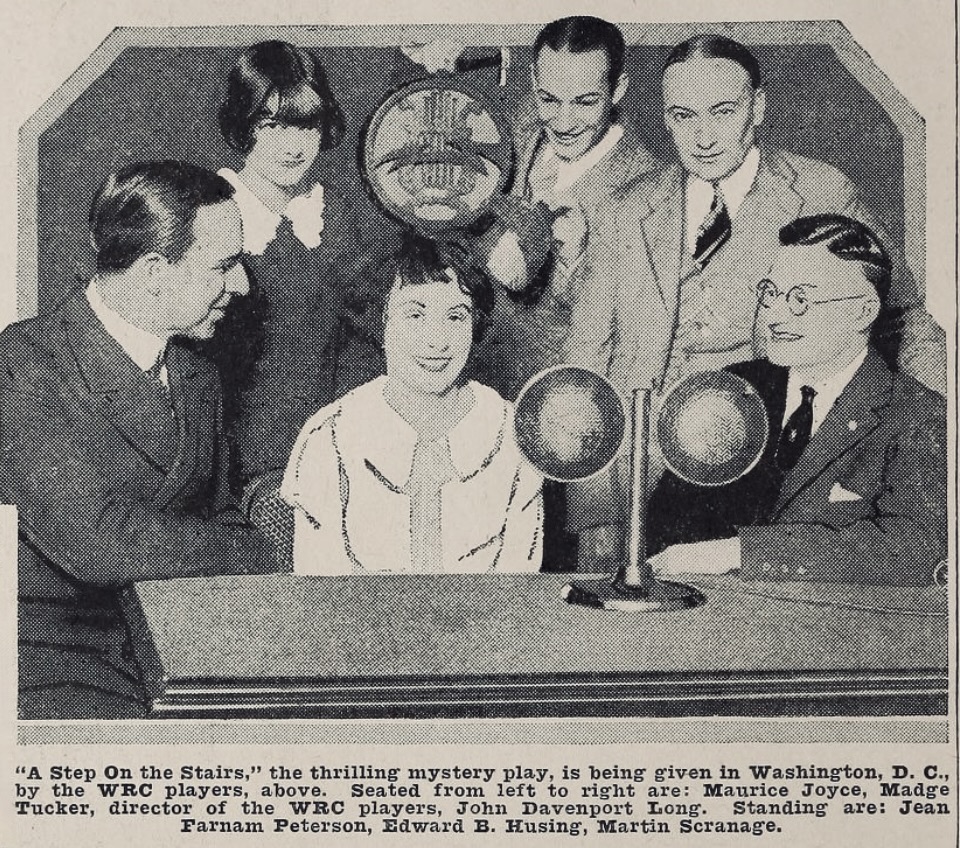
That said, here I am online, flicking through digitized magazines and newspapers of yesteryear, a forest of ancient pulp springing back to life for a belated flowering.  Searching for nothing in particular, I came across this headline in an edition of Radio Dial dating from 20 May 1937: “Ted Husing to Describe Tulip Festival.”  Is there anything less phonogenic than an oversized still life of flowers?

More incongruous than the idea of devoting a sound-only broadcast to such a spectacle is the choice of Ted Husing as the guy to try out his ekphrastic skills on it. Was not Husing a celebrated sportscaster, typecast as such in movies like To Please a Lady (1950), as I mentioned here a long while back?  It must have been challenging for him to get animated when tasked with the assignment of making Liliaceae sound lively through verbal acrobatics.  I’m guessing.  I never heard the broadcast.

‘Actually,’ sports were only one aspect of his career in radio. Husing remarked in retrospect that he ‘logged far more broadcasting time on music and special events.’  He claimed to have been responsible for the discovery or promotion of entertainers including Rudy Vallee, Guy Lombardo, Bing Crosby, and Desi Arnaz.  

Husing had a nose for radio’s no-show business, all right.  In fact, he had it broken for that very purpose, as he explained it in his first autobiography, Ten Years Before the Mike (1935):

Some of the acoustics experts and sinus engineers decided my voice would have a bit more resonance if my antrums were widened. Or is it antra? Anyhow, since the technical people had spent years perfecting microphones especially for my vocal vibrations, I couldn’t see how I could hold back on my antrums, personal as they are to me. So I went to the sawbones, took a couple of shots of coke, and had ’em broken out.

Having gone through such lengths, you might as well travel to Holland to tell folks at home what tulips look like.  In fact, Husing only went as far as Holland, Michigan, where the festival in question was held annually.  And it wasn’t all about the tulips, either, as tiptoers were given a run for their money by the ‘Klompen Dance,’ an orchestrated clacking of thousands of wooden shoes on the pavement.  The article also threatened folk songs.  Not much demand for subtle word-painting there.

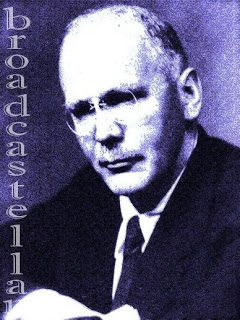
Antrum, tantrum.  However he felt that day, Husing was lucky to have had assignments like this, to have spent years translating observed sights into spoken words.  Lucky, because he ended up losing his eyesight after a brain tumor operation.  I imagine that spending much of his life on the air, creating a world made of sound helped him to shape a life for himself that was focused on the vision he only partially recovered.

Sure, radio is a sound-only medium; but it encourages the translative act of hearing that opens us up to the senses that we might lose sight of if we rely too much on our eyes. No need to cue those Klompen Dancers to drive the point home.

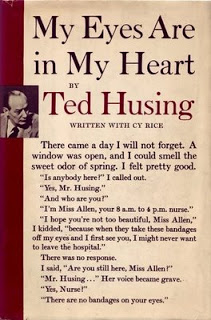
Blind Medium: My Eyes Are in My Heart (1959) by Ted Husing

Sometimes, when my heart is not in in, my mind’s eye begins to stray. That was what happened a while back when I tried To Please a Lady. Tried to follow it, that is. The Lady in question is one of Barbara Stanwyck’s decidedly lesser vehicles, and the horsepower on display in it is not likely to get my heart a-racing. Still, as previously reported, it has what it takes to get me excited about even the dullest of features: a radio angle. When I spotted announcer Ted Husing in one of the racetrack scenes, I started to reread my notes on Ten Years Before the Mike, his autobiography. I do not own a copy of that one; and, looking for it online, I realized that the chances of my adding it to my library are fairly slim at the moment.

During my search, I did come across another book by Husing, one of which I had not been aware. Nor had I been aware, seeing Husing on the screen, that he was plagued by something he was hiding from the world, tormented all the more by keeping everyone around him in the dark. At the time To Please a Lady was shot, in 1950, Husing was suffering from dizzy spells and began dragging his right foot. Years of denial and secrecy led to several accidents, all of them the result of a tumor that grew, undiagnosed, on Husing’s brain. Six years on, having finally faced an operation, one of the biggest and highest-paid voices in radio lost his eyesight and the will to live.

All this and more is shared in Husing’s second autobiography, My Eyes Are in My Heart (1959). While much of his life in broadcasting had already been recounted in his first, the two decades that had elapsed between the publications—and the misfortune that befell its author—make the later reminiscences not only more retrospective but also more introspective. “My values then were superficial,” Husing reflects. “Since then, I have learned to separate the real from the false. But this took many years, much suffering and much re-evaluation.”

Like many people who enjoyed a life and career that is considered a success based on obvious measures of fortune and fame, Husing shows himself remorseful, believing his affliction to have been a punishment, and a just one at that. For having been ashamed that his parents spoke with a pronounced German accent, for instance. For not having been a good husband and father. For having been too enamored with celebrity.

Now, I’ve never bought this kind of argument. If such retribution existed, it would appear that any disabled person is a sinner at heart. Luckily, Husing keeps his humility well in check, telling many an amusing anecdote about his decades in broadcasting, dropping names like a traveller, eager to be the envy of his friends, drops picture postcards into a mailbox hundreds of miles from home. Has he really been responsible for the discovery or promotion of entertainers including Rudy Vallee, Guy Lombardo, Bing Crosby, and Desi Arnaz?

Ted Husing was chiefly known as a sports announcer. “Actually,” though, as he points out, he “logged far more broadcasting time on music and special events.” Today, his name does not ring a bell resonant enough to make the multitudes pay attention; but, back in the 1930s, ’40, and ‘50s, that bell could open the doors to the swankiest New York City nightclubs. Never mind those places. What makes My Eyes Are in My Heart such a fascinating book is the insight it provides into a by now lost world of broadcasting during what is often referred to as radio’s golden age. Reminiscing about the life of radio and his life in it, Husing not only knows but is what he talks of: a blind medium.

As for a certain tough to please Lady . . . she does not even get a mention.

” … from hell to breakfast”: H. V. Kaltenborn Reporting

Listening selectively to US broadcast recordings of the 1930s, ‘40s, and ‘50s—the period often referred to as the radio’s golden age—I often neglect the kind of program that, during the late 1930s was fast gaining in significance as millions of Americans, many of whom were immigrants from Europe and Russia, were following reports from the Old World they had left. On this day, 22 September, in 1939, news commentator H. V. Kaltenborn kept CBS listeners abreast of the situation in Europe, paying special attention to the politically unstable kingdom of Romania.

As I learned yesterday, reading My Eyes Are in My Heart by aforementioned radio announcer Ted Husing, the King and Queen of Romania were savvy people not averse to selling out or forging lucrative alliances. On a tour of the United States back in 1926, Queen Maria of Romania, made a splash in the advertising world, agreeing to appear on radio, promote products, and be seen shopping in certain stores, all for the right sum of money.

Romania had one particularly valuable commodity, and the country, still neutral in the fall of 1939 was keen on keeping good relations with the nation that was about to swallow the continent. On 21 September, premier Armand Călinescu was assassinated by Romania’s fascist Iron Guard and Gheorghe Argeşanu, former Minister of War, was named as his successor. Here is how Kaltenborn (whose German title would have been Baron von Kaltenborn-Stachau, had he not been born and raised in Wisconsin) described the situation to American listeners:

That means that they are going to have a military government, as strong a government as King Carol [II] could possibly create, and it needs to be strong in view of the situation faced by imperiled Romania. Russian armies are menacing from the north.  German armies are menacing from the west.

While Russia was anxious to regain territory lost to Romania after Germany needed Romanian oil, Kaltenborn explained; and in trying not to offend either giant, Romania was on the brink of becoming another Poland.

Speaking rapidly and with animation, Kaltenborn occasionally stumbled in his commentary; he generally used notes rather than a prepared script, a technique that lent urgency to his reportage.

By 1939, he was a veteran, his beginnings in broadcasting dating back to 1922 (as you will learn listening to this Recollections tribute from 3 April 1957). As early as 1926, he had remarked upon “Radio’s Responsibility as a Molder of Public Opinion,” upon radio’s role as the Fifth Estate. “Public opinion is the king of America, and radio must assume a more conscious responsibility as democracy’s kingmaker,” he had cautioned.

World War II had only just begun; but news analysts like Kaltenborn were preparing the ignorant, the indifferent, and the isolationists for the inevitable, however tentative and cautious they were in their warnings:

I spent a good part of yesterday in Washington, I interviewed members of the Cabinet, outstanding leaders of the Senate, some of the most outspoken leaders of the opposition to lifting the embargo [against sending military aid to European countries facing threats from Germany and Russia, an embargo maintained as part the US Neutrality Act that FDR had urged Congress to repeal on 21 September], and got a picture of the atmosphere of Washington.  There is general apprehension in Washington that somehow, in some way, in spite of our not wanting it, that the country may be pushed towards war.

“Let those who seek to retain the present embargo position,” Kaltenborn insisted,

be wholly consistent and seek new legislation to cut off cloth and copper and meat and wheat and a thousand other articles from all the nations at war.  I seek a greater consistency through the repeal of the embargo provisions and a return to international law.

Kaltenborn then read a bulletin from the United Press, which stated that the isolationists in the Senate intended to fight the President on the embargo repeal “from hell to breakfast.”

Recordings of broadcast news and commentaries like this (which you may find in this invaluable Old Time Radio Researchers Group compilation), bring to life a time of fear and uncertainty without an awareness of which classic radio plays like “The War of the Worlds” cannot be fully understood.

Radio at the Movies: To Please a Lady

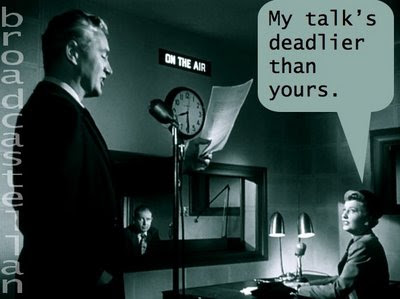
She played tougher than anyone else in pictures, and she was better at it. She could get a guy to fall for her and a fall guy to do anything for her, be it to lie, cheat, or kill. To please her was a dangerous game; but to displease her was a deadly one. She could make puppets of men; Charlie McCarthy was just target practice. I’m talking Barbara “Baby Face” Stanwyck, of course, the kind of social climber who shoved the ladder right into the face of those far from selfless fellas who lined up to give a gal a helping hand. In To Please a Lady (1950), Stanwyck proved that her very lips could kill. Well, as newspaper columnist Regina Forbes, Stanwyck had the means to finish the job properly: a microphone, a broadcasting studio, and a weekly radio program.

To Please a Lady makes you wonder what Stanwyck could have done with a regular radio broadcast; she certainly could have out-Hoppered—and, out-Hoopered—Hedda, who simply didn’t have the voice to match her name. That said, Regina Forbes is not quite as eager as Hopper to pick up any name dropped in her lap.

“But you can’t go to Newark tonight,” her secretary exclaims as Forbes rushes out to get a story that piqued her interest. Never mind that she already had an appointment with “Margaret.” “What about Margaret?” Forbes asks. “You know,” she is reminded, “the one who sings.”

That, if you require a footnote, is a reference to the aforementioned Margaret Truman, the President’s daughter. And Forbes had no qualms about standing her up to get the dirt on a disgraced speed racer (smug-as-ever Clark Gable), who, like Forbes, stops at nothing to be first at the finish line.

To Please a Lady is a contrived story, and one that is told none too well. So, as the camera follows Gable for another spin around the track, you get to fantasize about Stanwyck’s voice and the radio and . . . hang on, there’s Ted Husing. Best known for his sportscast, the CBS announcer was also heard on an early Eddie Cantor program and its successor Rhythm at Eight, starring Ethel Merman; an excerpt of a routine for the latter is reprinted in Husing’s book Ten Years Before the Mike (1935).

Of the “grand trouper” Merman, Husing says:

While admitting that television will double her value as a radio performer, I still think she is radiates personality over the air. Her speaking voice is vibrant with health and youth, and is highly individual, while her singing tones are thrilling. What more can you ask of a radio personality?

Television doubling the value of a radio performer? Obviously, this was written before radio took the corner around which it was assumed to be lurking all those years. And when it got there, round that bend, it crushed the competition. While radio was still not yet quite defeated as a dramatic medium back in 1950, there are signs of an impending crash in To Please a Lady.

Forbes may still have her radio program, and Gable as an avid listener, but she gets her news from television, which introduces her to Gable’s mug and convinces her to rush out to interview him. She may still be in a position to knock them dead with the lashings of her tongue—inducing one of her victims to commit suicide—but it is television that is giving her ideas.

Voices like Husing’s were fast becoming a mere adjunct to the flickering images on the small screen, filled as it was with the dust in which it left the art of giving you a mind’s eye view of it all through speech alone. You know, the thousand-and-one words it presumably takes to approximate a single picture.

My Eyes Are in My Heart, Husing told his former listeners in his second autobiography, published in 1959. And so they were. The book was written after he had gone blind. Stanwyck, around that time, was embarking on a career as a television actress and personality, which, aside from guest appearances, ranged from hosting an anthology series bearing her name to playing matriarch Victoria Barkley on The Big Valley. By then, plays for listening had all but vanished from US radio.