You’ve Got Mail, Herr Hitler

As of this writing, various episodes of The Shadow have been extracted some four-hundred thousand times from that vast, virtual repository of culture known, no, not as YouTube, but as the Internet Archive. This seems encouraging. At least, the most famous of all radio thrillers is still being remembered or rediscovered today, in part due, no doubt, to the misguided efforts of bringing Lamont Cranston back to the screen that cannot contain or render him. It is rather disheartening, though, that what is being so widely regarded as classic radio, perhaps even representational of American culture, is not the kind of non-matter likely to induce anyone to consider the aural arts as . . . art.

Sure, The Shadow has provided material for quite a few cultural studies, including this journal, and no history of popular entertainment in the United States ought to be called comprehensive, let alone complete, without at least a mention of this conceptually inspired if at times dramatically insipid neo-gothic phenomenon. Still, an injustice is done to a generation that had more on its mind and in its ears than vicarious thrills.

Few who rummage for old-time radio in the Archive appear to have been sufficiently intrigued by an item curiously labeled Dear Adolf. I, for one, was excited to find it there, having read the published scripts and discussed them in my dissertation without having come across those recordings. I argued against reading in lieu of listening; but, in the case of Dear Adolf, it would have been a mistake not to make a compromise and consider what I deem ersatz for ear play.

The series, after all, was written by the aforementioned Stephen Vincent Benét, a once highly regarded American poet who has long fallen out of fashion. While it did not do much damage to the name of Edna St. Vincent Millay, the writing of radio propaganda may have discredited Benét, along with his insistence on telling stories or retelling history, rather than being lyrical, experimental, or elitist.

Dear Adolf is unjustly neglected by those who enjoy such ready access to recordings from radio’s so-called golden age. The six-part program, tossed into the hole left by shows on summer hiatus back in 1942, was commissioned by the Council of Democracy and designed to turn detached listeners into active contributors to the war effort. As the title suggests, Dear Adolf was a proposed as a series of open letters to the enemy, written, we are to imagine with the help of seasoned performers from stage, screen, and radio, by ordinary Americans seizing a rare opportunity to communicate their fears, their hatred, and their defiance to the German dictator.

On this day, 12 July, in 1942, it was Helen Hayes’s task to portray an American “Housewife and Mother.” Well known to millions of listeners, the previously featured Hayes was one of the few theater actresses to embrace radio early on, if mainly, by her own admission, to be able to devote more time to her family and her rose garden.

The war suggested more urgent reasons for stepping behind the microphone, and the airwaves became a passage through which playwrights, poets, and performing artists could exit their ivory retreats and present themselves to the broader public for a cause worth the tempering of high art with an appeal to the lowest common denominator—the need for a clear image of what America stood for and was up against during a war whose objectives, it seems surprising today, were not appreciated or understood by a great many of its citizens. Their support—their money—was needed to provide the funds for a war of uncertain duration and, initially at least, less certain success.

Without becoming an outright fascist tool in a democratic society, radio needed to function as a unifier. In doing so, it had to address and engage a populace rather than assuming it to be homogenous. As I pointed out in my study, “Letter from a Housewife and Mother” is particularly interesting in this respect. Playing the part of a homemaker and part-time First Aid instructor, Hayes is meant to be—and her character insists on being—representative of free women everywhere. Rarely questioned, much less contested, in network radio, her white voice is being countered by that of a black woman, who protests:

Free women? What of me?
What of my millions and my ancient wrong?
What of my people, bowed in darkness still?

Despite her awareness that the enemy would further drive her people back to the “old slavery of whip and chains,” the speaker expresses her disillusionment with American democracy:

And yet, even today, we find no place
Even in war, for much that we could do
And would do for—our country.

However manipulative in its attempt to calm such unrest, the play is remarkable for its acknowledgment of such dissatisfaction with the status quo among those who felt themselves to be disenfranchised. It is a rare moment in American radio drama, far removed from the popular exploits of Amos ‘n’ Andy, which depended for its success on the general acceptance of conditions it refused to problematize.

Minds not clouded by crowd-pleasing commercial fare like The Shadow might appreciate Dear Adolf as an experiment in leveling with the marginalized rather than assuming or declaring their differences leveled. While in the business of pleasing everybody, radio did not always reduce difference to the aural stereotypes of regional and ethnic accents.
Shadow Players

When I read that Lamont Cranston is being resurrected for another big screen adventure scheduled to begin in 2010, I decided to catch up with one of the earlier Shadow plays. The Shadow, of course, always played well on the radio. On this day, 26 June, in 1938, he was again called into action when a “Blind Beggar Dies” after refusing to share his pittance with a gang of racketeers. The blind beggars alive to such melodrama and asking for more were millions of American radio listeners tuning in to follow the exploits of that “wealthy man about town” who was able to “cloud men’s minds” while opening them to the wonders of non-visual storytelling.

On the screen, the Shadow never quite managed to immaterialize; a previous attempt at delineating The Shadow on the screen, in the form and figure of Alex Baldwin, failed to attract audiences large enough to warrant a franchise.

Considerably less accomplished than the 1994 adaptation was the 1937 feature The Shadow Strikes, which bears little resemblance to the myth conceived for radio (initially as a mere sales gimmick for Street and Smith story magazines, publications popular during the first half of the 20th century).

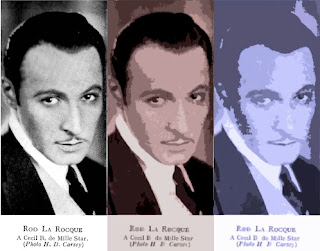
At just about the time when Orson Welles made his debut in the role on radio (as mentioned here), the mysterious crime fighter was impersonated on the screen by silent screen star Rod La Rocque, whose image I came across today while leafing through the recently acquired rarity Alice in Movieland, a gossipy little volume written back in 1927, when La Rocque was still remembered as a major Cecil B. DeMille player by, well, almost everyone:

You would have thought Rod La Rocque and Vilma Banky [the silent screen star with whom La Rocque was about to tie the knot] sure to be recognized at sight anywhere short of the South Pole. But not so!

At a preview of a DeMille picture at a Hollywood theater, seats had been roped off for the stars, as one among whom La Rocque was not being recognized by the usher.

Rod and Vilma crept away. Slow fade-out! I think, however, they did contrive later to annex the two worst seats in the theatre, behind a pillar of something. But all the easier to hold hands.

One of La Rocque’s last movies, The Shadow Strikes, is strictly of the ‘slow fade’ variety, even though the character La Rocque portrayed was so in the 1930s that a follow-up was released half a year later, featuring the same leading man.

Never mind that La Rocque does not get to utter that menacing laugh and is not equipped with mental powers superior to those of other popular crimefighting acts just outside the law, the Falcon, say, or the Saint. The producers of the movie did not even bother to check the spelling of the name of his alter ego when it appeared on the cover of a newspaper.

So, what fate awaits this great figure of 20th-century popular culture? Will he return only to receive a final blow, like a beggar too impoverished to pay up? Will those who watch him on the screen follow him back to the airwaves, into the shadows where he truly belongs?

Celebrated East-West Menace Starts Out Selling US Magazines

Well, I hadn’t intended to continue quite so sporadic in my out-of-date updates, especially since a visit to my old neighborhood in New York City is likely to bring about further disruptions in the weeks to come, however welcome the cause itself might be. A series of brief power outages last Friday and my subsequent haphazard tinkering with our faltering wireless network are behind my most recent disappearance. It is owing to the know-how of this creative talent that broadcastellan is now back in circulation. So, it seems fitting that, upon returning today, I should commemorate the career of a man who was particularly adept at vanishing, of casting his voice, and of having a laugh at matters least laughable: The Shadow. After all, he first went on the air on this day, 31 July, in 1930.
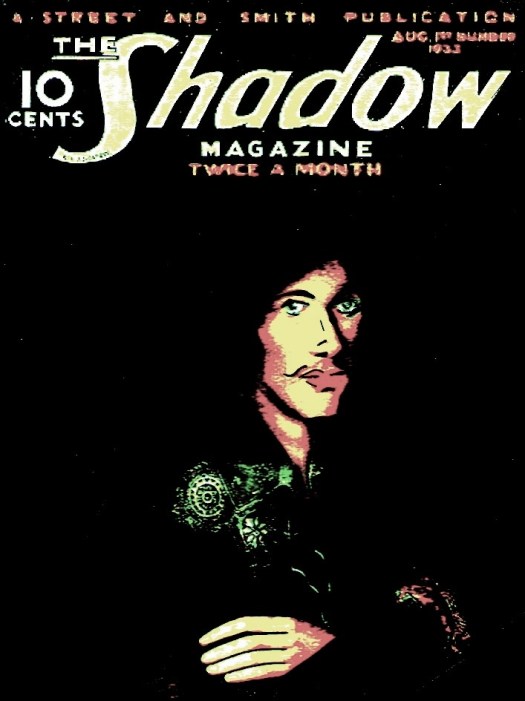
As expert Anthony Tollin relates it in The Shadow Scrapbook, the invisible man with the menacing laugh was at first little more than a radio announcer—a mouthpiece for Street and Smith, a company specializing in the cheap thrills of magazine fiction. While radio had little drama to offer during those early days of network broadcasting, its promotional prowess had long been proven by sharks, shysters, and shamans alike. As is often the case, the advertisement took on a life of its own, as tuners-in were more intrigued by the voice than by the product it was called upon to peddle. So, The Shadow was rushed into the limelight and, after being promoted to the narrator of Street and Smith’s Detective Stories, stories, became a bona fide superhero in print and on the air.

As the Orient—that is, the US concept of such non-Western territory with traditions predating the old world of Europe—was then all the rage, The Shadow is somewhat of a Fu Manchurian candidate, casting himself under an imported family tree from which branches dangle the wise Charlie Chan, the magical Chandu, and the sly Mr. Moto.

All those Americanized adventurers and much-relied-upon crime solvers owe some of their mystique to an element of the sinister or suspicious, even though this quality became diluted and, in the case of Charlie Chan, was obscured over the years whereas Mr. Moto was sent on leave when the allure of the extra-occidental seemed irreconcilable with the cultural reorientation of the US after Pearl Harbor and the expediencies of wartime propaganda.

Lamont Cranston, as listeners of The Shadow were told each week, had brought back a secret from the Orient—the hypnotic power to “cloud men’s minds so that they cannot see him.” He revelled in this invisibility, the hunt, hide and seek it made possible; as his menacing laugh suggests, he was no kindly Mr. Keen, no detached Sherlock Holmes, no matter-of-fact gumshoe. He enjoyed feeding his enemies the “bitter fruit” borne by the “weed of crime” and of feasting on its juices, on employing powers which, on this day in 1938, for instance, helped him to catch a group of western diamond mine raiders with the aid of a non-western sage turned servant who passed on “The Message from the Hill,” through “mental telepathy, the oldest wireless in the world.”

It is a telling case of a Hollywood identity crisis that screen villain Bela Lugosi first played Chandu’s archenemy and then returned to impersonate the radio original himself in subsequent movie serial sequels; nor should it be surprising that someone as typecast to play outcasts as Peter Lorre was chosen to play Mr. Moto. The duality—the duplicity—of Easterners gone West or Westerners under Oriental influences suggests something adulterated, ominous, and forbidding. It is a spinning forth of yarns like Dracula and The Green Goddess, stories of an East that not so much meets West but infiltrates it or insinuates itself.

Perhaps, in today’s global market, the Shadow might have started out as a hawker of Japanese electronics, the hardware of choice with which western media produce latter-day broken blossoms of diplomacy. It strikes me as disingenuous or incongruous, at least, that melodramatic Orientalism is deemed politically incorrect while demonizations of Iran and North Korea and the anxieties triggered by Communist China, by a distant Asia or Arabia—a far or middle east—are being propagated by a West that glorifies diversity but relies for its cultural survival and economic supremacy on demonstrations of its vulnerability, on images of threatened borders and threatening barbarians.

"This . . . is London": Casting John Donne’s Shadow

If Gothic Nightmares at the Tate Britain failed to send shivers down my receptive spine, the National Portrait Gallery’s Searching for Shakespeare sure did nothing less. I am generally not one to wax poetic at the sight of artefacts that may or may not have belonged to some literary so-and-so. For the most part, I don’t really care what a writer looked like, as long as his or her prose or poetry is to my liking. To be sure, having studied and taught Shakespeare during my college and university days, I am sufficiently impressed by the sight of an old Folio edition. Something else caught my mind’s eye at that exhibition; and it was not one of the supposed likenesses of Shakespeare—many of which have long been proven spurious—but the portrait of one of his contemporaries.

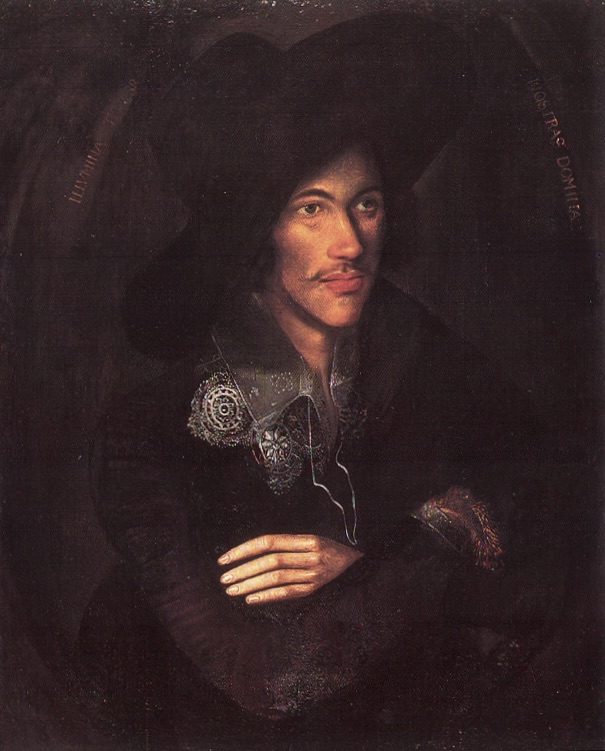
Portrait of John Donne by an unidentified artist (c. 1595) National Portrait Gallery, London

The portrait in question is that of John Donne, a painting currently being offered to the National Portrait Gallery, which is trying to raise funds in the amount of £1,652,000 to obtain it before the purchasing opportunity expires at the end of May. So, the picture now hangs in the Shakespeare exhibition, where visitors have to pay to get a glimpse of it. It is well worth a glimpse, I assure you. I confess the pleasures I derive from being moved by a work of art, whether considered trifling or momentous, and it is not rare that I stand before a painting with tears welling in my eyes or goose bumps sprouting on my skin. Composed by an unknown artist around 1595, the Donne portrait is decidedly of the gooseflesh variety.

It is in poems like “His Picture” and “Witchcraft by a Picture” that Donne speaks to us about attempts at portraiture, about the art or hubris of capturing life, the act of imitating nature or surpassing creation—troubling thoughts for a former Roman-Catholic growing up in the turmoil of the Reformation and its sanctioned smashing of images. In the former poem, Donne writes:

I fix mine eye on thine, and there
Pity my picture burning in thine eye;
My picture drown’d in a transparent tear,
When I look lower I espy;
Hadst thou the wicked skill
By pictures made and marr’d, to kill,
How many ways mightst thou perform thy will?

But now I’ve drunk thy sweet salt tears,
And though thou pour more, I’ll depart;
My picture vanished, vanish all fears
That I can be endamaged by that art;
Though thou retain of me
One picture more, yet that will be,
Being in thine own heart, from all malice free.

In the latter piece, Donne suggests the mental image and the imaged man to be at odds; a painting is a memento mori, which, fixed in time, turns into an unlikeness of fleeting life.

Here take my picture; though I bid farewell,
Thine, in my heart, where my soul dwells, shall dwell.
‘Tis like me now, but I dead, ’twill be more,
When we are shadows both, than ’twas before.

To his own portrait, lost and mislabeled for centuries, Donne referred as “that picture of mine which is taken in shadows.” In my irreverent mind, the striking features of Donne’s shadow-cast face began to resemble that of The Shadow, Lamont Cranston—the secret avenger who, striking hidden from view, laughed death in the face and had a sermon for all who dared to defy the law: “The weed of crime bears bitter fruit.”

Sermonizing Donne, who once wrote “A Lecture upon the Shadow,” approached the challenge of death in one of his most famous sonnets:

Thou art slave to fate, chance, kings and desperate men
And dost with poison, war and sickness dwell,
And poppy or charms can make us sleep as well
And better than thy stroke; why swell’st thou then?
One short sleep past, we wake eternally,
And death shall be no more; death, thou shalt die.

Donne’s portrait has captured my imagination; yet, having too often crossed—and all but crossed out—the uncertain boundaries between high art and low, it is The Shadow who now runs away with it. In my mind, I hear Lamont Cranston’s defiant laugh as I gaze at the poet’s likeness, “taken in shadows.”

On This Day in 1937: The Shadow Gets a Voice-over

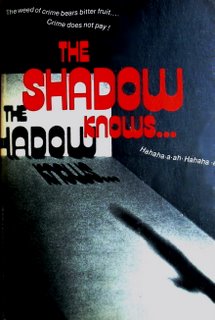
I remember the first time I heard the menacing voice of The Shadow—and it was not over the radio. I was a college student in New York City and was cleaning the Upper East Side apartment of a fading southern belle. Well, I needed the cash and she was too much of a spoiled socialite to do more around her place than pet her Shih Tzu and point out the offending dust particles. She told me about some prank phone calls she had been receiving from a rather peculiar and not-so-secret admirer in her neighborhood. I think she had filed a restraining order, but that did not stop this cookie character from entering her sphere telephonically. The eerie message he left on her answering machine, which she did not hesitate to play back for me, was as ominous as a line from David Lynch’s Twin Peaks. It was not ‘Fire walk with me,’ though, but “Who knows what evil lurks in the hearts of men?” followed by a declarative but less than clarifying ‘The Shadow knows!’ Sinister laughter concluded this bizarre tele-communication. Let’s just say I was glad to put down the feather duster that afternoon and make off with my meagre earnings.

Several months later I came across those very words once more—and I could not get out to escape them, as I was already home.  I had just discovered the thrills of old-time radio and now realized that the unnerving telephone message etched in my mind was nothing but an imitation—albeit a brilliant one—of the most memorable signature in American radio drama. Yes, those lines sure tolled a bell, even though the knell was delivered in a different voice and accompanied by the somber and to me as yet unfamiliar strain of Saint-Saens’s Le Rouet d’Omphale.

The alter ego of Lamont Cranston—’wealthy young man about town’ who used his mysterious ‘power to cloud men’s minds’ to aid the forces of law and order—The Shadow was a man of many voices. Since he always had to have the last laugh, his strained vocal chords seemed to require a number of replacements.  On this day, 26 September, in 1937, when The Shadow returned to the airwaves after a thirty-month-long hiatus, Cranston received another one of those vocal makeovers, this time courtesy of Orson Welles.

Welles has gotten rather too much credit for his portrayal of The Shadow; after all, he was neither the first actor to play the role nor the one who stuck with it the longest. He spoke condescendingly of the popular program—an attitude common among actors and writers who used radio as a career springboard or a temporary cash cow—and asserted that he read his part without rehearsals (an unlikely story, given the fastidiousness of the sponsors and Welles’s youthful inexperience). To be sure, Welles’s first disappearing act as The Shadow—in an episode titled “Death House Rescue”—was neither a dramatic nor a thespian marvel.

In a story about Cranston’s efforts to save the life of an alleged cop killer on death row, Welles comes across as pompous and disdainful; since he always sounded like none other than Orson Welles, overgrown ‘boy wonder,’ it is difficult to determine whether he was sneering in character or at his character—a ham hampered by an attitude of I’m-way-above-such-baloney.  Agnes Moorehead, who played opposite Welles, managed a less self-conscious performance as Cranston’s companion, the “lovely Margot Lane,” whatever trifle of a line she was being tossed. Unlike Welles, Moorehead inhabited her role rather than interrogating it, which made her a most valuable and much admired player in commercial radio drama.

Still, his pretensions notwithstanding, Welles’s subsequent fame served The Shadow quite well. It encouraged scholars to dig up transcriptions of the long-running series and contributed to their preservation, although surveys of Welles’s distinguished theatrical and cinematic repertoire generally devote little more than a few footnotes to these broadcast performances. Some scripts from the final months of the series (not preserved on tape) even resurfaced in print—as a 1970s high school textbook (pictured above).

As may have become apparent, I could never quite warm to Welles or wring chills from his impersonation of The Shadow. Then again, I always thought of The Shadow as the voice of a creep on the answering machine of a dislocated Scarlett O’Hara gone twilight. What an introduction!