The Medium Is the Murder: Technology, Human Nature, and โ€œThe Voice That Killedโ€ (1923)

Illustration for “The Voice That Killed” (1923) by Leo Bates (1890-1957)

โ€œThere is a modern touch about this story that stamps it with the brand of originality.โ€ That is how the editors ofย Detective Magazineย introduced โ€œThe Voice That Killed,โ€ a short work of fiction that firstโ€”and, as far as I can tell, lastโ€”appeared in print on 28 September 1923.ย ย The man responsible for this slight but nonetheless noteworthy โ€œtouchโ€ of the โ€œmodernโ€ was Gwyn Evans (1898-1938), a writer best known for his fanciful contributions to the sprawling Sexton Blake Library.

While I am not prepared to pursue Evansโ€™ trail into the far recesses of that vault of once popular culture, I have read enough of his stories to get the impression that โ€œThe Voice That Killedโ€ is representative of Evansโ€™ none-too original fascination withโ€”or, perhaps, his adroit cashing in on the widespread ambiguity of his readers towardโ€”modernity and the rapidity with which, in the years between the two World Wars, technology was transforming every aspect of human life, consuming some lives in the process.

Continue reading “The Medium Is the Murder: Technology, Human Nature, and โ€œThe Voice That Killedโ€ (1923)”

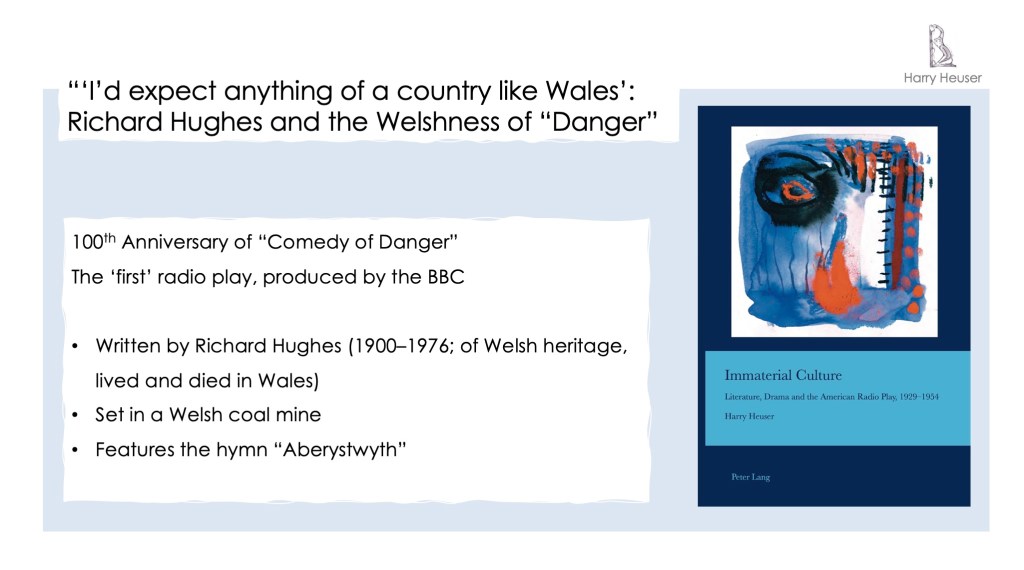
โ€œThe lights have gone out!โ€: Commemorating One Hundred Years of Plays for Radio

First slide of my presentation

Taking the radio play to the library has long been an ambition of mine, given that dramatic and literary works written for the medium of sound broadcasting occupy comparatively little space on the bookshelves.  Taking the first of its kind to a national libraryโ€”the National Library of Wales, no lessโ€”is a chance of a lifetime amounting to poetic justice.  Allow me to shed a modicum of light on that, and on my benightedness besides.

So that meaningful conclusions may be drawn from my peculiar challenge of commemorating one hundred years of radio dramatics in just a few minutes, it strikes me as essential that the centenary first be quartered, a fate I hope to escape on 22 February 2024, the date set for the event.

Continue reading “โ€œThe lights have gone out!โ€: Commemorating One Hundred Years of Plays for Radio”

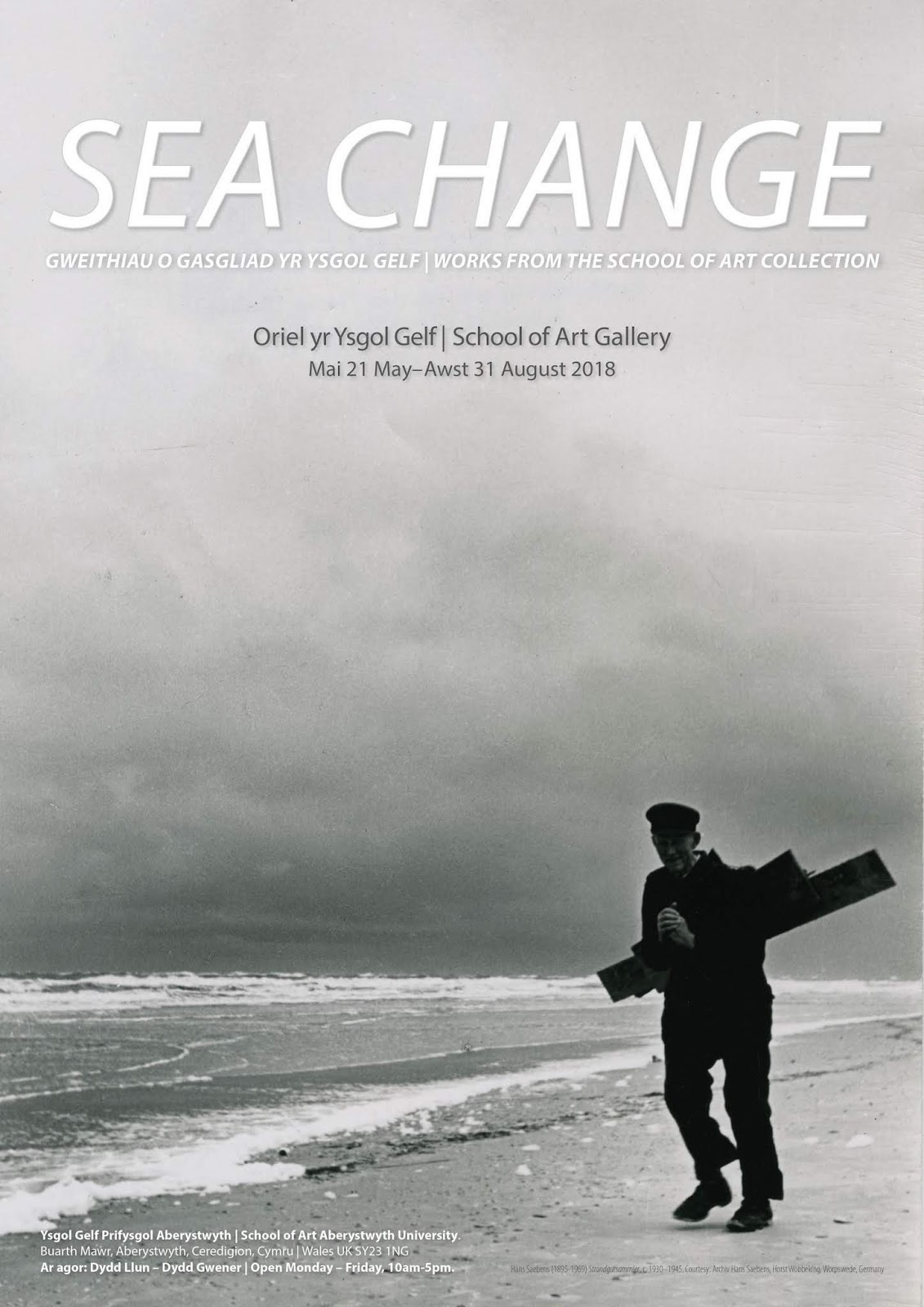
Sea Change at Aberystwyth University

Poster by Neil Holland, based on a design by Lauren Evans

Once a year, I stage an exhibition with undergraduate students of my module “Curating an Exhibition” at the School of Art, Aberystwyth University. ย The student curators choose objects from the School’s collection, which, over a period of about three months, they research, interpret and narratively arrange in relation to a given theme. The theme for the 2018 exhibition (on show from 21 May until 28 September) is “Sea Change.” ย 

The idea for it came to me watching CNN, where the phrase is frequently heard in promotional spots for Fareed Zakaria’s program. ย What, I thought, would happen if we considered the literal meanings of each part of the phrase to examine how life along the coast is transformed and transforming as a result of environmental and socio-political developments.

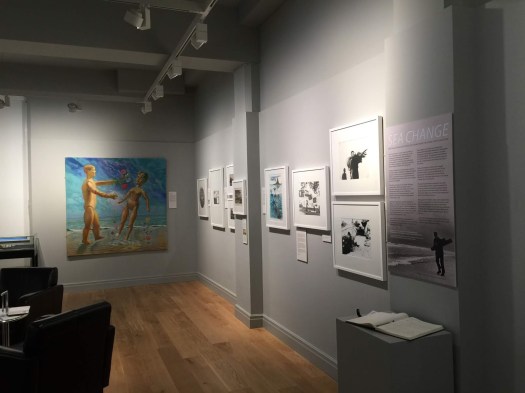
Installation view showing John Roberts’s large painting Fond Farewell (1973)

As always, the narrative evolved gradually, shaped by the objects selected by the exhibition curators.  This is the text panel introducing the exhibition:

โ€˜Sea changeโ€™ is one of the many expressions introduced to the English language by Shakespeare. It appears in The Tempest as a reference to death โ€“ and transformation โ€“ by drowning.

This exhibition of works from the School of Art collection explores both the metaphorical and the literal meanings of the phrase.

Today, โ€˜sea changeโ€™ is widely used to suggest moments of upheaval and reorientation. It may denote the end of a personal relationship or a geopolitical shift affecting the lives of millions. Whatever its measurable repercussions, โ€˜sea changeโ€™ is always felt to be profound.

Change may be dreaded or desired. It can mean at once breakdown and a chance for renewal. The storm that wrecks a ship and lays waste to dreams brings firewood to the beachcomber. The engines that turned villages into mill towns also transported workers to holidays by the sea.

Plate, from the series Cumbrian Blue(s) (1998) by Paul Scott

Many aspects of modern society were shaped in the Victorian era. Seaside towns like Aberystwyth owed their transformation to the Industrial Revolution. Since then, our coastal communities have continued to adapt. New challenges, from Global Warming to Brexit, lie ahead as Wales is celebrating the โ€˜Year of the Sea.โ€™

The prints, paintings, photographs and ceramics on display encourage us to consider what we gain or lose through stability and change.

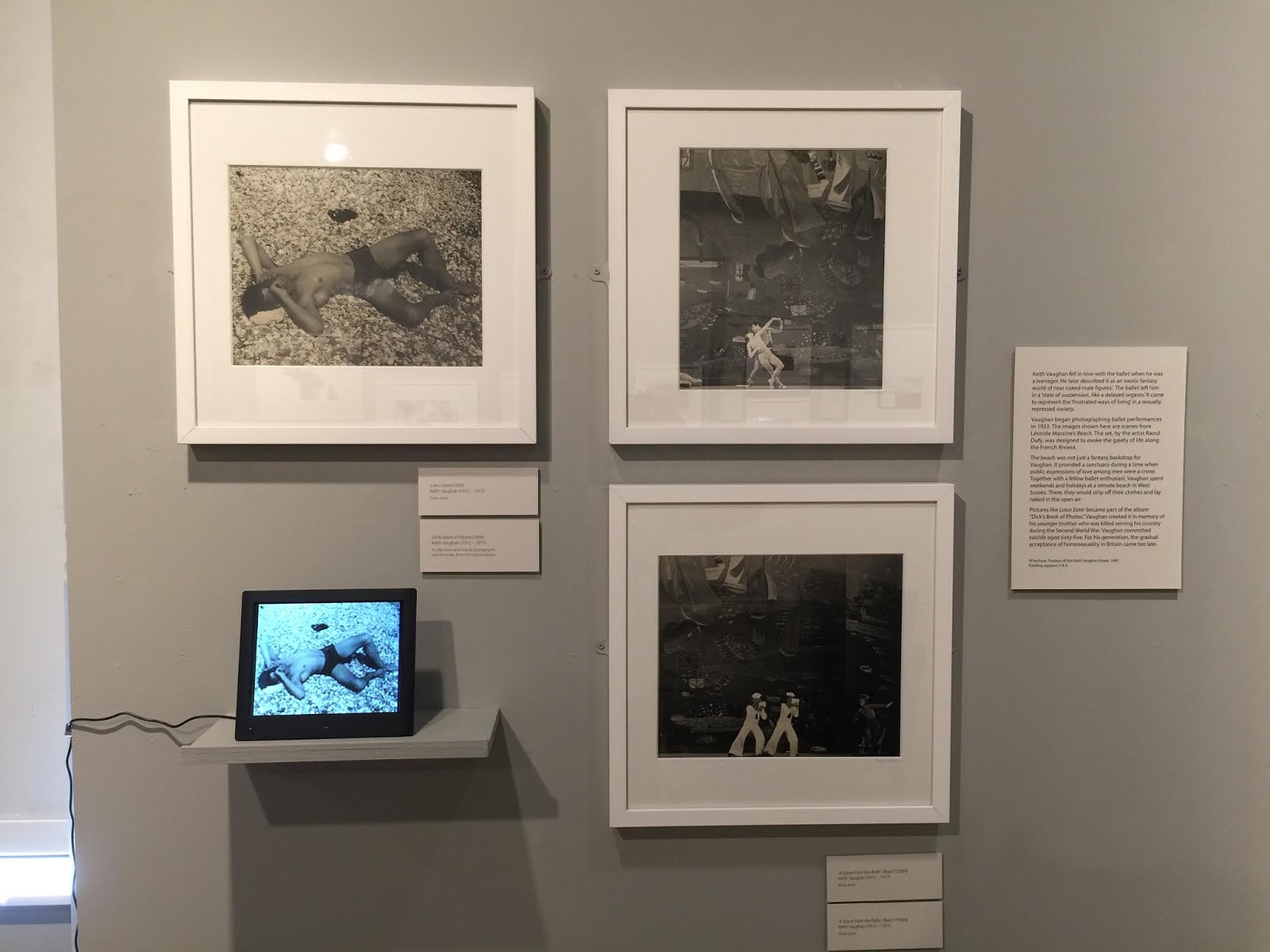
Works by Keith Vaughan feature prominently in the exhibition

Artists whose works are featured in this exhibition include Jean-Antoine Thรฉodore Gudin (1802โ€“1880), Honorรฉ Daumier (1808โ€“1879), Wilhelm Kรผmpel (1822โ€“1880), Hans Saebens (1895 โ€“ 1969), Carlo Bevilacqua (1900 โ€“ 1988), Gertrude Hermes (1901โ€“1983), Keith Vaughan (1912 โ€“ 1977), Robert Tavener (1920โ€“2004), Gwyn Martin (1921 โ€“ 2001), John Vivian Roberts (1923โ€“2003), Bernard Cheese (1925โ€“2013), Terry Bell-Hughes (b. 1939), Chris Penn (1943โ€“2014), Alistair Crawford (b. 1945), Paul Scott (b. 1953), and Kate Malone (b. 1959).

Curators: Lauren Evans, Gerry McGandy, Mike Kirton, Clodagh Metcalfe, Sophie Mockett, Ivy Napp, John Roberts, and Michelle Seifert; with support from Harry Heuser (text and concept) and Neil Holland (staging and design).  Additional assistance by Karen Westendorf

โ€˜To hell with nature!โ€™: An Exhibition of Charles Tunnicliffe Prints

I am grateful for second chances. Following on from the 2017 Royal Academy exhibition “Second Nature,” which Robert Meyrick and I prepared in conjunction with the publication of our catalogue raisonnรฉ of Charles Tunnicliffe’s prints, I created a new show exploring the painter-printmaker’s career. “‘To hell with nature!’: A Reappraisal of Charles Tunnicliffe Prints” is on display at the School of Art Museum and Galleries, Aberystwyth University, in Wales, until 12 March 2018.
Poster design by Neil Holland, showing
a detail of Tunnicliffe’s The Stuck Pig (1925)
The new show has been curated to highlight four phases of Tunnicliffe’s printmaking career: his student days, in which work on the family farm became the subject of his autobiographical prints; his success as a maker of fine art prints; his second career as an illustrator and commercial artist after the collapse of the print market in the early 1930s; and his ‘decorative’ works featuring birds to whose study he devoted much time after he moved to Anglesey in North Wales.

Charles Tunnicliffe (1901โ€“1979) grew up and worked on a farm near Macclesfield in Cheshire. A scholarship enabled him to study at the Royal College of Art in London. Soon after his studies, he gained a reputation and a market in Britain and the United States as an etcher of farming subjects.

In 1929, Tunnicliffe married a fellow art student, Winifred Wonnacott. The couple settled in Macclesfield. Although Tunnicliffe enjoyed the theatre and the movies, as his diaries tell us, London never featured in his fine art prints. In middle age, not long after the end of the Second World War, Charles and Winifred Tunnicliffe relocated to Anglesey, where Tunnicliffe became an avid birdwatcher. Today, Tunnicliffe is closely associated with his study of birds and is widely regarded as Britainโ€™s foremost twentieth-century wildlife artist.

Towards the end of a career spanning six decades, Tunnicliffe was awarded the Gold Medal of the Royal Society for the Protection of Birds. It may seem somewhat incongruous that, in an interview published in the Societyโ€™s magazine, Tunnicliffe stated:

โ€˜I have shocked quite a lot of people by saying โ€˜To hell with nature!โ€™ Nature is made to be used, not to be dictator, as far as the dyed-in-the-wool artist is concerned.โ€™
I used this exclamation as the starting point for my exploration of Tunnicliffe’s career. To me, it expresses the frustration of an artist whose pictures are often judged on the strength of their fidelity to nature. Instead, Tunnicliffeโ€™s prints show us nature transformed by culture and outdone by art. They demonstrate their makerโ€™s knowledge of art history, his love of design, and the need to tell his own story.

It was printmaking that earned Tunnicliffe his Royal Academy of Arts membership in 1954. By then, however, he rarely produced fine art prints. For decades, Tunnicliffeโ€™s work in various media appeared in magazines, on calendars and biscuit tins.

The stock market crash of 1929 had made it necessary for Tunnicliffe to rethink his career. Turning from etching to wood engraving, he became a prolific illustrator. His first project was Tarka the Otter.

Anglesey was no retreat for Tunnicliffe. Working on commission, he created colourful paintings he described as โ€˜decorations for modern rooms.โ€™ He also continued to turn out mass-reproduced designs that promoted anything from pesticides to the Midland Bank. The messages these images conveyed were never the artist’s own.

Since the mid-1930s, Tunnicliffeโ€™s work has been appreciated mainly second-hand. Until last year, when Robert Meyrick and I put together a catalogue raisonnรฉ of his etchings and wood engravings, Tunnicliffe never had a printmaking exhibition at the Royal Academy.

For some of his early prints, we were unable to trace contemporary impressions. The plates, which Tunnicliffe retained, were proofed by School of Art printmaker Andrew Baldwin.

Exhibitions like ‘To hell with nature!’ remind us what many histories of twentieth-century art omit in order to sustain their focus on the avant-garde. Tunnicliffeโ€™s career does not fit into the narrative of Modernism. It is a product of modernity. In his work, at least, he never said โ€˜to hellโ€™ with culture. Pragmatic yet passionate, he made images to make a living.

The Pink Standard: Legally Blonde at Aberystwyth Arts Centre

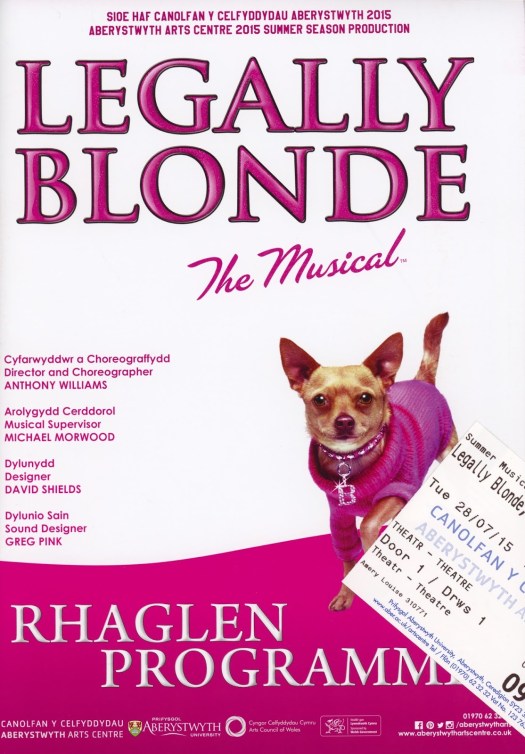
Okay, I am blond, gay and European. So it isnโ€™t all that difficult for me to relate to this yearโ€™s summer season offering at the Arts Centre here in Aberystwyth. โ€œPositiveโ€ and โ€œOmigod You Guys,โ€ itโ€™s Legally Blonde: The Musical. Ever since I relocated, for love and legal reasons, to this little Welsh town โ€“ from an island, no less, that has Broadway running through it โ€“ I have not missed a single one of these seasonal spectaculars. After all, they are often the only indication that summer actually takes place here. And since that very first show โ€“ which was Oliver! back in 2005 โ€“ I have been coming back to the scene it would be a crime to miss.

Iโ€™ve also seen the summer season grow up over the years, and the characters along with it, from a criminally mistreated but dutifully hoofing and oh-so-adorable Victorian orphan to a stylish, twenty-first-century Harvard Law graduate who seems to be fighting a lost cause but ends up winning her first case and her true love besides.ย 

Inย Legally Blonde, justice is served as in Dickensian days, except that what you deserve is no longer dished out as a helping of destiny. I wonโ€™t say that either way is โ€œSo Much Betterโ€ than the other โ€“ for entertainment purposes, at least โ€“ but it sure is about time to have, at the heart of it all, three persevering females who donโ€™t have to suffer Nancyโ€™s fate so that the Olivers of this world can enjoy the twist of their own.

Legally Blondeย does its part to โ€œBendโ€ if not quite โ€œSnapโ€ the long string of boy-meets-girl plots of theatrical yesteryear; at the same time, it cheekily pays tribute to the ancient laws of Western drama, right down to its cheerleading Greek Chorus. The conventions are not discarded here but effectively โ€œWhipped Into Shape.โ€ And what it all shapes up to be is an updated fairytale of boy meets girl in which girl ditches boy since boy doesnโ€™t meet the standards girl learns to set for herself.

The lads, meanwhile, perform parts traditionally forced upon the ladies: they are the chosen or discarded partners of the women taking charge. Unless they are objectionable representatives of their sex, like the opportunistic Warner Huntington III (convincingly played by Barnaby Hughes), the men ofย Legally Blondeย are mainly paraded as sex objects, flesh or fantasy. ย Exhibit A: stuff-strutting Kyle (inhabited by a delivering Wade Lewin). ย Exhibit B: gaydar-testing Nikos (gleefully typecast Ricardo Castro, returning to Aberystwyth after last yearโ€™s turn as Pabloย in the divineย Sister Act). ย Come to think of it, even the two dogs in the show are male โ€“ and how well behaved these pets are in the hands, or handbags, of the women who keep them.

Not that it looks at first like the women have a clue or a fighting chance. I mean, how can a gal be oblivious for so long to the connubially desirable qualities of gentle, reliable if fashion-unconscious Emmett Forrest (played by David Barrett, who was unmissable as Mr. Cellophane in the Aberystwyth production ofย Chicago)? That Elle Woods ultimately finds her way and gets to sings about it is the so not gender-blind justice ofย Legally Blonde.

And that we side with the spoiled, seemingly besotted sorority sister is to a considerable degree owing to Rebecca Stenhouseโ€™s ability to make Elle mature in front of our eyes, from bouncily naรฏve and misguided to fiercely determined yet morally upright. And, as her character gets to prove, a valedictorian is not just Malibu Kenโ€™s girlfriend in a different outfit.ย Legally Blondeย demonstrates beyond the shadow of a doubt that you can be pretty and โ€œSeriousโ€ in pink, even though I, personally, have failed on both accounts.

Depending on Elleโ€™s success in getting her act together is the life and career of Brooke Wyndham (energetically played by endorphin-level raising Helena Petrovna), a celebrity on trial whose fitness empire is endangered by a dirty secret of a potential alibi. And if you are a cynic out for a hanging, just wait and see what Brooke (and Petrovna) can do with a piece of rope.

As it turns out, Brooke does not have to make a case for orange being the new pink, which of course was the old black. Ultimately, not wardrobe but a serious case of TTP saves the day, for which the production hairdresser can take some credit. Follicles play nearly as big a part inย Legally Blondeย as inย Hairspray, to name another property Aberystwyth Arts Centre has laid its skilled hands on in recent years. And if that production had a showstopper in โ€œbig, blonde and beautifulโ€ Motormouth Maybelle,ย Legally Blondeย has down-but-not-out stylist Paulette Bonafonte, a role Kiara Jay makes her own with warmth, knowing and extensions in her voice that reach from here to “Ireland.”

Legally Blondeย is not without its share of injustices. It takes a seasoned professional like Peter Karrie to accept a plea bargain of a part that allows him to be the villain of the piece but denies him the moment his Phantom-adoring followers may have been hoping for. It was Karrie I saw in that memorableย Oliver!ย production, and he is back here as Professor Callahan, a suave shark with a nose for โ€œBlood in the Water.โ€ Like Fagin, he is a law unto himself; but unlike Fagan, the professor is ill served by a book that bars him from tunefully โ€œReviewing the Situation” once he gets his just deserts. Not that you won’t be gasping at the scene that constitutes his downfall.

Now, had I a Manhattan-sized โ€œChip on My Shoulder,โ€ I could object that, if โ€œWhat You Wantโ€ to produce is a musical, you might consider putting a few instruments back into the pit. I mean, with sets as swanky as Acapulco, why should the singing be practically a cappella? The overture out of the way, any such objections are largely overruled, given the plain evidence that these troupers hardly depend on orchestral crutches. “Break a leg” to all of them โ€“ dancing, skipping and rollerskating โ€“ for keeping the pace brisk and makingย Legally Blondeย such an infectiously high-spirited show.

This was the first season I attended as a legally married blond, gay European โ€“ and I think it is no overstatement to say that, for all their heterosexual pairings, shows likeย Legally Blondeย have helped to take on patriarchal bullies, to rethink masculinity and what means to โ€œTake It Like a Man.โ€ Itโ€™s not the American flag alone that is prominently on display here. Whatever your angle, I can bear witness to the fact that, by any standard โ€“ gold, platinum blonde, or otherwise โ€“ the Aberystwyth Summer Season is in the pink.

"Cofion, G": Remembering Gwilym Pri[t]chard

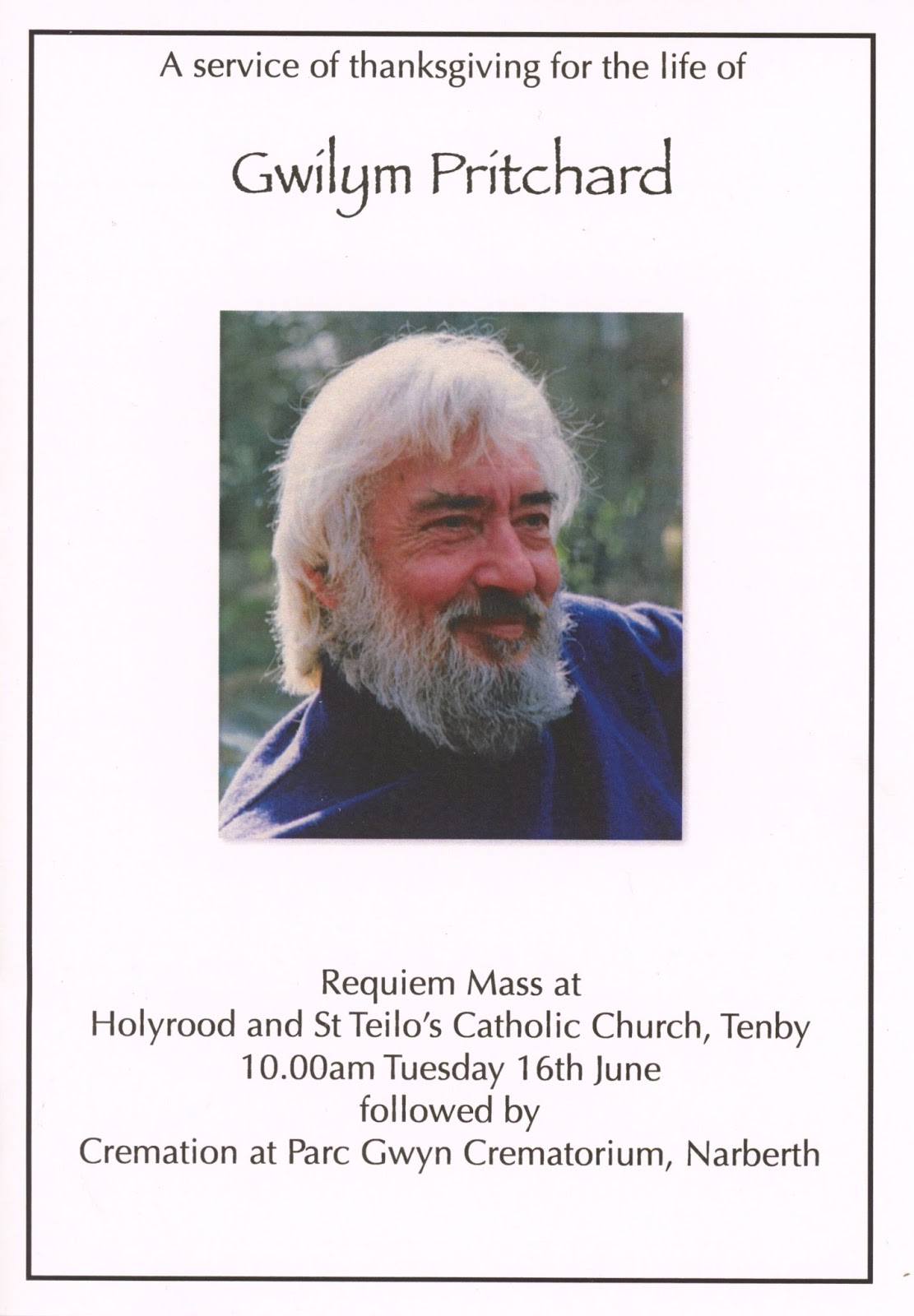
โ€œI havenโ€™t kept any diaries as such, apart from the odd word or two in my sketch books.  I have never felt the need to write anything and I really cannot see the point why anyone would be interested in what I would have to say.โ€  This is what the painter Gwilym Prichard wrote to me in reply to some questions I had while I was working on a monograph on his life and art.  Knowing Gwilym, I also knew that, though he was a man of his word, one word might have to suffice even when I, as a would-be biographer, was hoping for a thousand.


Gwilym talked โ€“ and continues to talk โ€“ to us through his art; he also talked to his art and had, he told me, private conversations with the works as they came into being on the canvas.  He didnโ€™t think much of critics or the need for interpretation.  He believed that an artistโ€™s work should speak for itself.  Terse as his words to me might sound, they were uttered in humility rather than indignation.  โ€œI am grateful,โ€ he added in parenthesis, โ€œthat I have had some success with my painting โ€“ I really have very little confidence but what I produce or show is stuff that I have painted with love and sincerity.  I hope that this comes through.”  That love โ€“ and the success it brought โ€“ was easily documented, mostly through Gwilym’s paintings.

 
Above Rhostryfan (1982), the painting I chose for my 
obituary of Gwilym in the Guardian

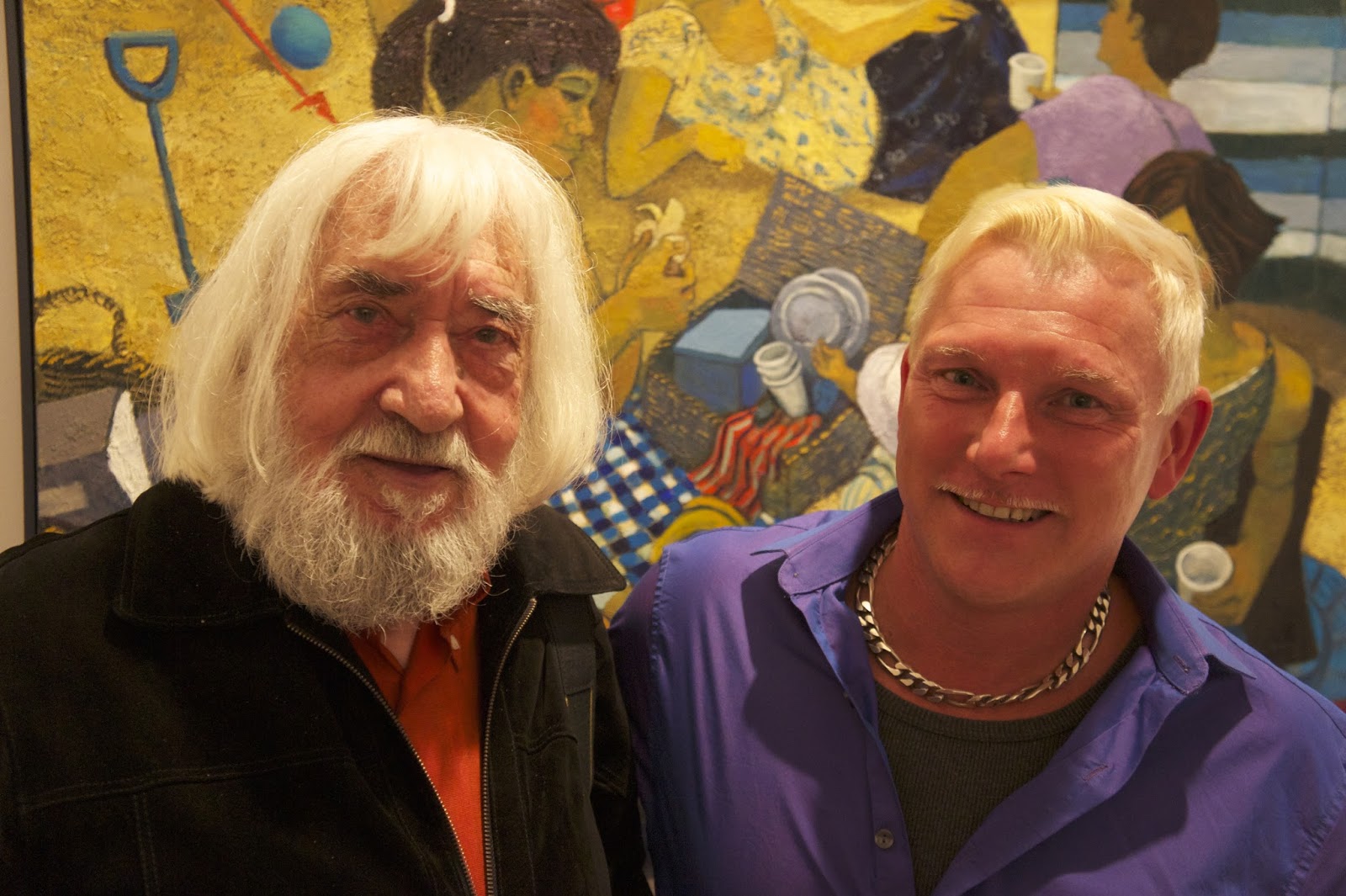
โ€œAny more questions?โ€ Gwilym continued his notes, which, much to my surprise, amounted to over thirty handwritten pages.  Clearly, he did not mean to cut me off, and wished me and my partner, Robert Meyrick, โ€œall the best with the writing” with which he had entrusted us.  He answered every question, right down to the matter of the “t,” the letter he dropped from his surname in midlife whenever he signed his art.

 
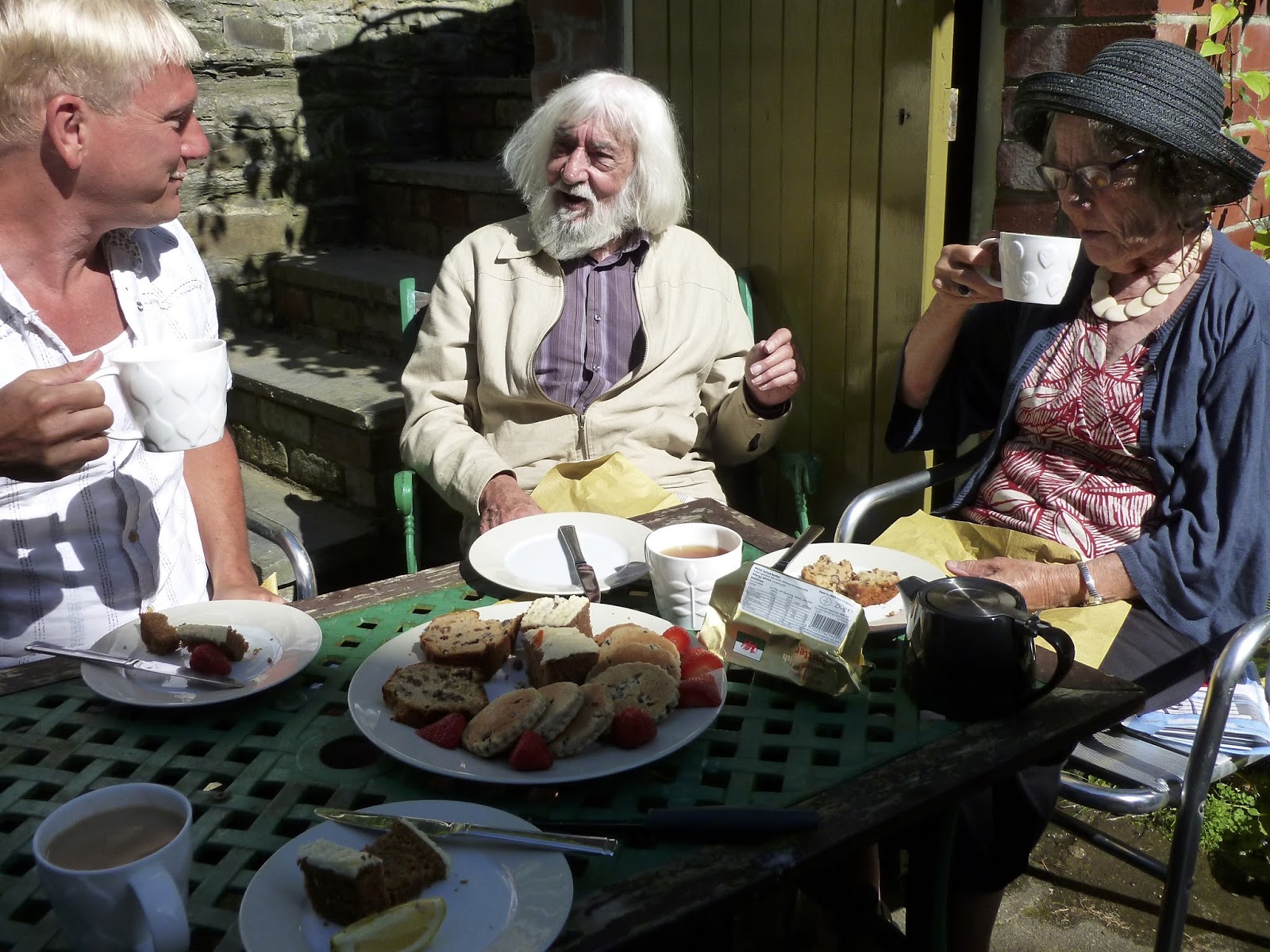
That โ€œwriting,” A Lifetimeโ€™s Gazing, was a very special assignment for me.  Through Bob, I met Gwilym and his artist wife, Claudia Williams not long after I had moved to Wales in November 2004.  Back then, I felt distanced from Wales and the Welsh; I found it difficult to find myself or to find any purpose for myself here.  In fact, I still struggle with that.  I did not know then that I would end up working on Gwilymโ€™s monograph.  Though it began years later, the project offered me an opportunity to write about the culture that I, a German with a New York education, could never presume to call my own.
 

I could relate to Gwilym in his difficulties of expressing himself fully โ€“ I mean truthfully and meaningfully โ€“ in English, Welsh being his first language, the language of his childhood.  Welsh spoke to him differently.  “I am a Welsh painter because I am Welsh,” he wrote, refusing to make an issue of what he felt to be at the core of his being … something understood.


Gwilym described himself as โ€œemotional,โ€ and English was perhaps too much the language of adulthood or reason, too abstract for an artist who treasured the concrete โ€“ the rock, the sea, and the soil.  The concrete had weight and depth for him, a weight and depth he did not have to measure because he felt it as an immeasurably rich presence, a constant in a life full of change and challenge.

How fortunate Gwilym was to have developed such a language; and how lucky we are to be hearing him with our own eyes whenever we look at the works that chart his journey โ€ฆ

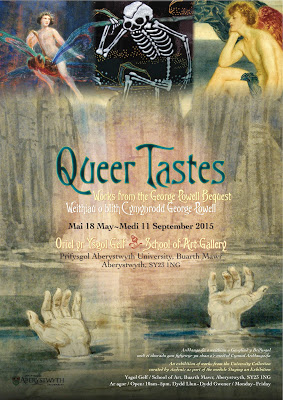
Queer Tastes: Works from the George Powell Bequest

George Powell
Poster design by Neil Holland

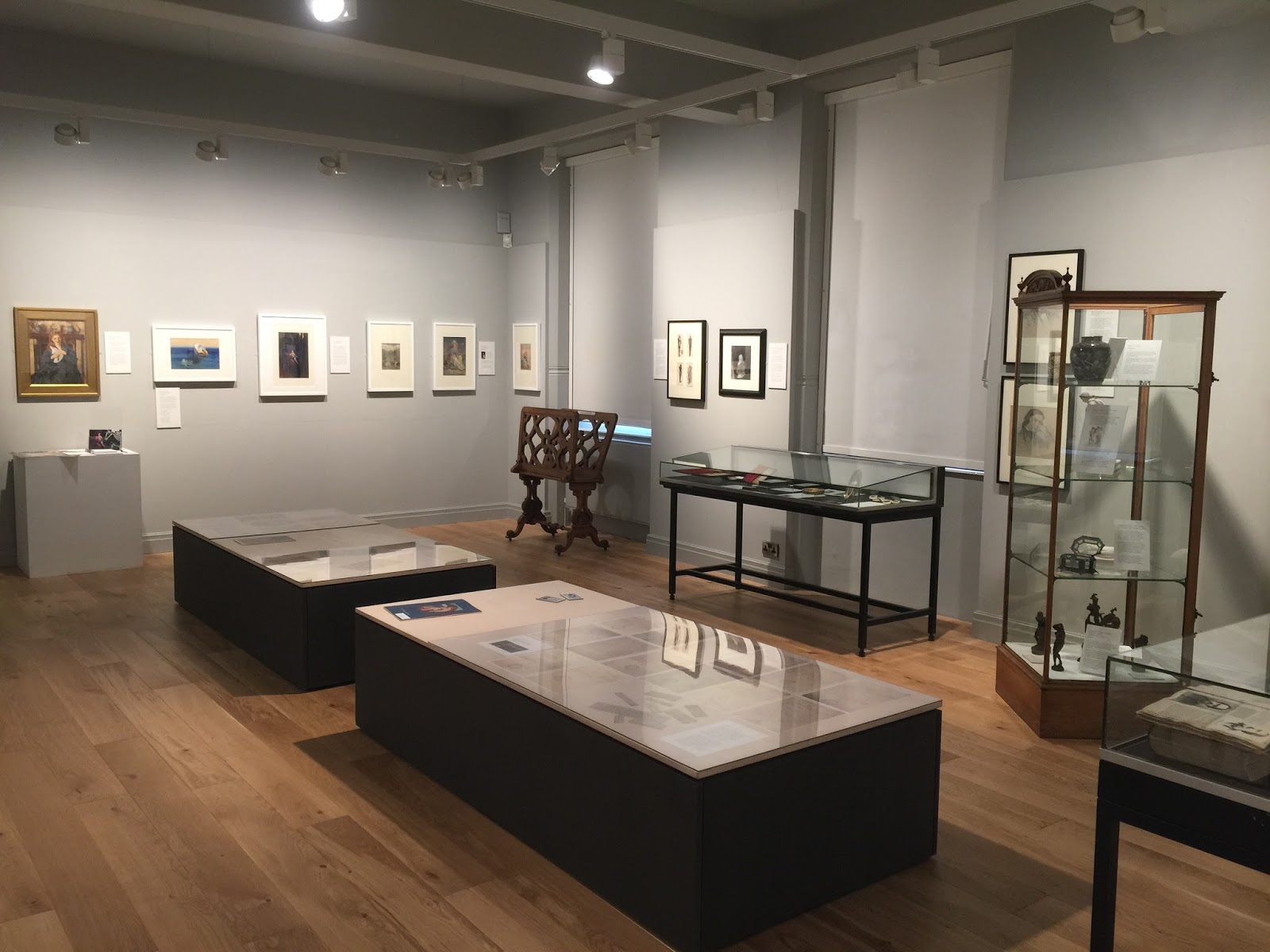
Queer Tastes is an exhibition I curated with students of my undergraduate module Staging an Exhibition at the School of Art, Aberystwyth University. Each year, the module culminates in a student-curated show on a given theme.


This year’s exhibition, which is open to the public from 18 May to 11 September, explores the identity of the Welsh-English dilettante George Ernest John Powell (1842 โ€“ 1882) through the collection that he bequeathed to Aberystwyth University. The objects were selected by students of the School of Art, which holds part of Powellโ€™s bequest.  

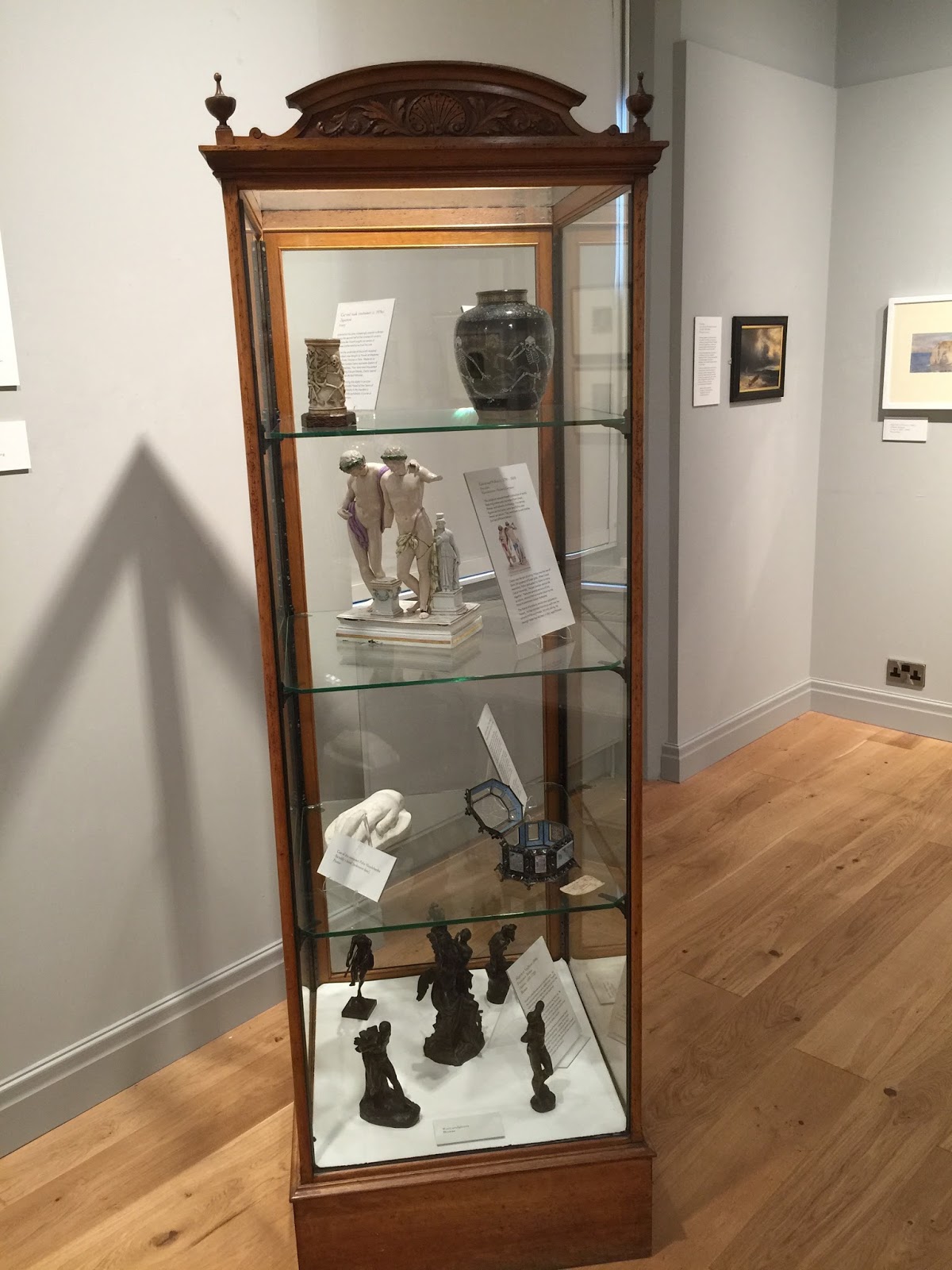
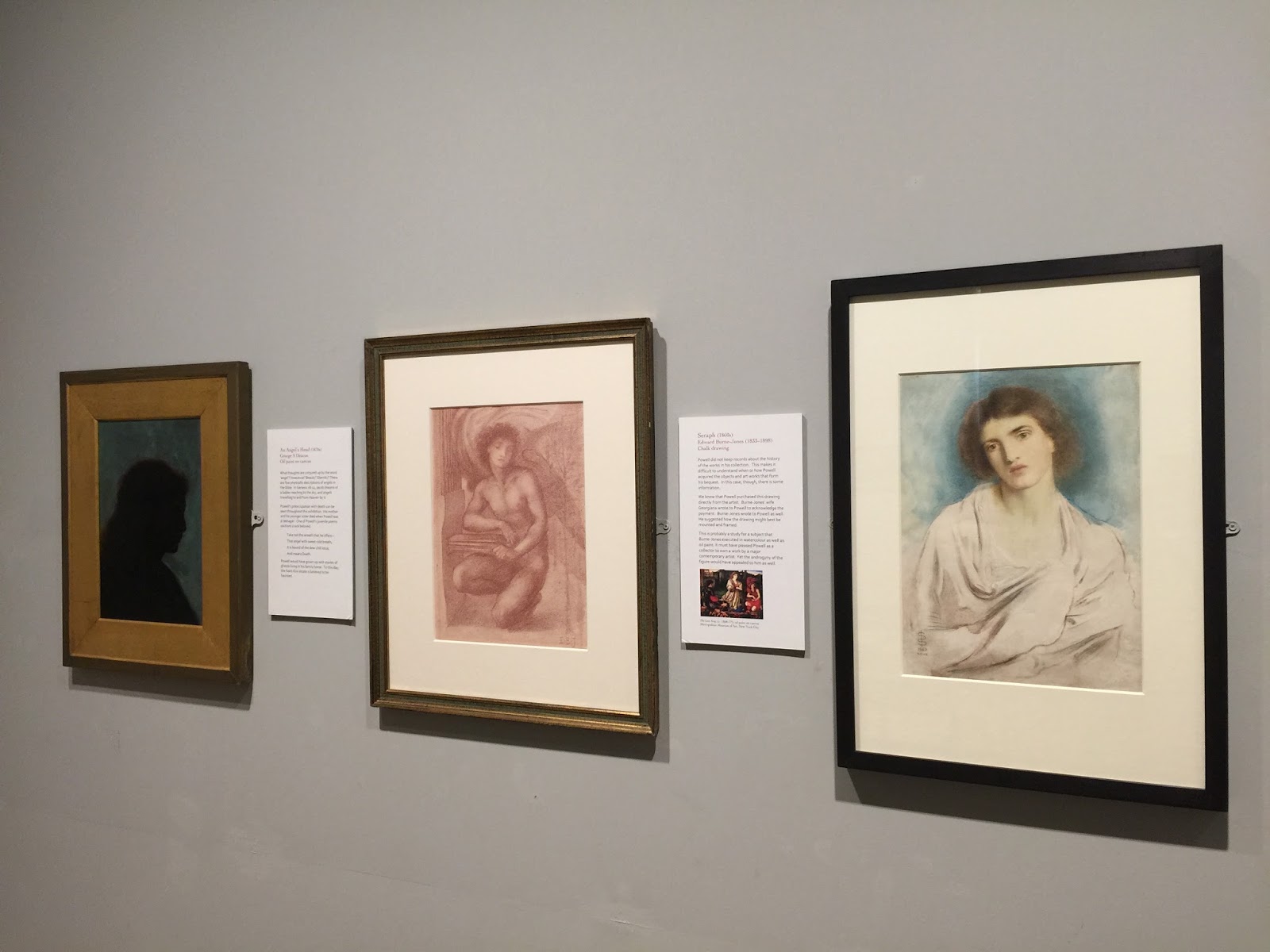
The exhibition includes works by Simeon Solomon, Rebecca Solomon, Edward Burne-Jones, Richard Westall and Hubert von Herkomer as well as artefacts and curios ranging from a plaster cast of Felix Mendelssohn-Bartholdy’s hand and a glass casket that allegedly once contained a splinter from Robert Schumann’s coffin.

The Powell family owned the Nant-Eos estate a few miles inland from Aberystwyth. Educated at Eton and Oxford, George Powell spent little time at Nant-Eos, which he would inherit in 1878. It was an unhappy place for him. His parents were estranged. His mother and younger sister died when Powell was a teenager.


Powell was a dreamer, much to his fatherโ€™s disappointment. Instead of going hunting, the boy wrote poems about death, loss and betrayed love. Eager to get away, Powell travelled to Europe, Russia, North Africa and Iceland. In the company of the poet Algernon Charles Swinburne, Powell spent summers on the Normandy coast. There, he entertained writers and artists in a cottage he named after a bisexually promiscuous character in de Sadeโ€™s Philosophy in the Bedroom.

Powell has been called โ€˜eccentricโ€™, โ€˜sinisterโ€™ and โ€˜sadโ€™. He has also been labelled โ€˜homosexualโ€™, a term not used in his day. โ€˜Queerโ€™ suggests something โ€“ or someone โ€“ strange or at odds with our views. It asks that we trace our responses to otherness in ourselves.

A man of the world, Powell wanted to be remembered back in Wales as a patron and benefactor. He offered parts of his collection to Aberystwyth Town Council, on provision that a public gallery be created for their display. When the deal fell through, Powell gave the objects you see here to the University of his โ€˜dear but benighted townโ€™.

Making our possessions public is in a way a โ€˜coming outโ€™. It invites others to wonder about our past. It also means saying โ€˜I matterโ€™. Collections like Powellโ€™s encourage us to question how a personโ€™s worth is determined.
Curators: Danielle Harrison, Kayla McInnes, Alice Morshead, Jenny Skemp, Valerija Zudro, with support from Harry Heuser (text and concept) and Neil Holland (staging and design).
Powellโ€™s life and collection are the subject of my essay “โ€˜Please don’t whip me this timeโ€™: The Passions of George Powell of Nant-Eos” in the forthcoming anthology Queer Wales (University of Wales Press).


Blind Manโ€™s Stuff: Alec Templeton in Time and Space

Last night, I had the good fortune to hear the music of Alec Templeton. Live and by proxyโ€”and right here in town. Templetonโ€™s compositions, among them barrier-obliterating and class-unconscious numbers like “Bach Goes to Town” and “Debussy in Dubuque,” were performed at the National Library of Wales, Aberystwyth. Pianist Simon Crawford-Phillips was ably assisted by Templeton himself, whose voice and ways on the keyboard were heard in a variety of radio recordings from the 1930s, โ€˜40s, and โ€˜50s.

Why here? Why now? Well, Templeton was a Welshman by birth, a fact that seems to have eluded most of the Welsh who pride themselves to be a nation of song. So, last night was as good and as high a time as any for his countrymen and women to acknowledge Templeton’s remarkable against-almost-all-odds career, even if the will to embark upon it took the composer-pianist as far West from the West of Britain as Hollywood. The countrywoman who did the acknowledging was Rhian Davies, teller of Templeton’s life in words and images. Davies, who generously acknowledged as well all the support and assistance her project received from broadcasting buffs and music lovers around the inter-networked world, has known about Templeton practically all her life. Eager to share her readily transmitted enthusiasm, she brought home to us, the assembled audience, that it is always Alec Templeton Time.

Templetonโ€™s life is the stuff of legend. Born blind, he developed an ear so keen and a wit so sharp that he was destined to play tunes made for the cutting of rugs. That he was an expert at middlebrow musical culture has a lot to do with the fact that the eyes beneath his brows saw nothing and that his ears saw nothing but potential. Others, left in the dark yet accustomed to light, might have seen an insurmountable impediment.

The mindโ€™s eye of Alec Templeton saw no such manifestations of doubt. He saw, say, Lower Basin Street … and took it. It may be that sightless people, who sense space by feeling their way around and listening intently, are not so much impressed by the walls facing them as their seeing contemporaries, not so much concerned with apparent boundaries, be they cultural or national.

โ€œI understand,โ€ a writer for Radio Guide remarked in 1936, โ€œwhy his friends, when you start glooming about his sightless eyes, smile superciliously and say: โ€˜Save your sympathy for someone who needs it.โ€™โ€

The stuff sighted folks concern themselves with is so much nonsense to a man like Templeton. Sensing a universe where others might imagine chaos, he crossed the waves and made a home for himself on the airwaves, authoring an etherized existence.

โ€œRadio,โ€ Templeton reportedly said, โ€œis to me the greatest miracle of manโ€™s ingenuity. My ears are my eyes, and I tune in at every opportunity, listening to everything from Vic and Sade to Toscanini.โ€

Hearing Templetonโ€™s music performed live and seeing his career celebrated was a thrill. Yet as pleased as I was that all this happened in the little Welsh town where I now live, I wonder what claim Wales has to her native son. After all, the place of his birth, like his blindness, was not of his choosing. Indeed, he chose to unfurl his pinions, take to the air, and come to live for all willing to be all ears, in a medium whose art is not limited by space but that is instead the stuffโ€”the no-matterโ€”of time.   Make that Alec Templeton Time.

โ€œ. . . from a civilized land called Walesโ€: A Puzzlement Involving The King and I

I rose before the sun, and ran on deck to catch an early glimpse of the strange land we were nearing; and as I peered eagerly, not through mist and haze, but straight into the clear, bright, many-tinted ether, there came the first faint, tremulous blush of dawn, behind her rosy veil [ . . .]. A vision of comfort and gladness, that tropical March morning, genial as a July dawn in my own less ardent clime; but the memory of two round, tender arms, and two little dimpled hands, that so lately had made themselves loving fetters round my neck, in the vain hope of holding mamma fast, blinded my outlook; and as, with a nervous tremor and a rude jerk, we came to anchor there, so with a shock and a tremor I came to my hard realities.

With those words, capturing her first impression and anticipation of a โ€œstrange landโ€ as, on 15 March 1862, it came into partial viewโ€”the โ€œoutlookโ€ being โ€œblindedโ€โ€”aboard the steamer Chow Phya, Anna Harriette Leonowens commenced The English Governess at the Siamese Court (1870), the โ€œRecollections of Six Years in the Royal Palace at Bangkok.โ€ The account of her experience was to be followed up by a sensational sequel, Romance of the Harem (1872), both of which volumes became the source for a bestselling novel, Margaret Landonโ€™s Anna and the King of Siam (1944), several film and television adaptations, as well as the enduringly crowd-pleasing musical The King and I.

Conceived for musical comedy star Gertrude Lawrence, the titular โ€œIโ€ is currently impersonated by Shona Lindsay, who, until the end of August 2009, stars in the handsomely designed Aberystwyth Arts Centre Summer Musical Production of the Rodgers and Hammersteinโ€™s classic.

The title of the musical personalizes the story, at once suggesting authenticity and acknowledging bias. Just as it was meant to signal the true star of the original productionโ€”until Yul Brynner stole the showโ€”it seems to fix the perspective, assuming that we, the audience, see Siam and read its ruler through Annaโ€™s eyes. And yet, what makes The King and I something truly wonderfulโ€”and rather more complex than a one-sided missionaryโ€™s taleโ€”is that we get to know and understand not only the Western governess, but the proud โ€œLord and Masterโ€ and his daring slave Tuptim.

Instead of accepting Anna as model or guide, we can all become the โ€œIโ€ in this story of identity, otherness and oppression. Tuptimโ€™s experience, in particular, resonates with anyone who, like myself, has ever been compelled, metaphorically speaking, to โ€œkiss in a shadow,โ€ to love without enjoying equality or protection under the law. Tuptimโ€™s readily translatable story, which has been rejected as fictive and insensitive, is emotionally rather than culturally true.

โ€œTruth is often stranger than fiction,โ€ Leonowens remarked in her preface to Romance of the Harem, insisting on the veracity of her account. Truth is, truth is no stranger to fiction. All history is narrative and, as such, fictionโ€”that is, it is made up, however authentic the fabric, and woven into logical and intelligible patterns. Whoever determines or imposes such patternsโ€”the historian, the novelist, the reporterโ€”is responsible for selecting, evaluating, and shaping a story that, in turn, is capable of shaping us.

Tuptimโ€™s adaptation of Uncle Tomโ€™s Cabin, which strikes us at first strange and laughableโ€”then uncanny and eerily interchangeableโ€”in its inauthentic, allegorical retelling of a fiction that not only made but changed history, is an explanation of and validation for Rodgers and Hammersteinโ€™s sentimental formula. Through the estrangement from the historically and culturally familiar, strange characters become familiar to us, just Leonowens may have been aided rather than mislead by an โ€œoutlookโ€ that was โ€œblindedโ€ by the intimate knowledge of a childโ€™s love.

Strange it was, then, to have historicity or nationality thrust upon me as Anna exclaims, in her undelivered speech to the King, that she hails โ€œfrom a civilized land called Wales.โ€ It was a claim made by Leonowens herself and propagated in accounts like Mrs. Leonowens by John MacNaughton (1915); yet, according to Susan Brownโ€™s โ€œAlternatives to the Missionary Position: Anna Leonowens as Victorian Travel Writerโ€ (1995), โ€œno evidence supportsโ€ the assertion that Leonowens was raised or educated in Wales.

Still, there was an audible if politely subdued cheer in the Aberystwyth Arts Centre auditorium as Anna revealed her fictive origins to us. Granted, I may be more suspicious of nationalism than I am of globalization; but to define Leonowensโ€™s experience with and derive a sense of identity from a singleโ€”and rather ironic reference to homeโ€”seems strangely out of place, considering that the play encourages us to examine ourselves in the reflection or refraction of another culture, however counterfeit or vague. Beside, unlike last yearโ€™s miscast Eliza (in the Arts Centreโ€™s production of My Fair Lady), Anna, as interpreted by Ms. Lindsay, has no trace of a Welsh accent.

As readers and theatergoers, we have been โ€œgetting to know you,โ€ Anna Leonowens, for nearly one and a half centuries now; but the various (auto)biographical accounts are so inconclusive and diverging that it seems futile to insist on โ€œgetting to know all about you,โ€ no matter now much the quest for verifiable truths might be our โ€œcup of tea.โ€ What is a โ€œpuzzlementโ€ to the historians is also the key to the musical, mythical kingdom, an understood realm in which understanding lies beyond the finite boundaries of the factual.


Related writings
“By [David], she’s got it”; or, To Be Fair About the Lady
Delayed Exposure: A Man, a Monument, and a Musical

Related recordings
โ€œMeet Gertrude Lawrence,โ€ Biography in Sound (23 January 1955)
Hear It Now (25 May 1951), which includes recorded auditions for the role of Prince Chulalongkorn in The King and I

Another Manโ€™s Ptomaine: Was โ€œThe Undertakerโ€™s Taleโ€ Worth Exhuming?

Bury this. Apparently, it was with words not much kinder that the aspiring but already middle-aged storyteller Samuel Clemens was told what to do with โ€œThe Undertakerโ€™s Tale.โ€ Written in 1877, it was not published until this year, nearly a century after the authorโ€™s death. The case of the premature burial has not only been brought to light but, thanks to BBC Radio 4, the disinterred matter has also been exposed to the air (and the breath of reader Hector Elizondo). So, you may ask after being duly impressed by the discovery, does it stink?

To be sure, even the most minor work of a major literary figure is deserving of our attention; and โ€œThe Undertakerโ€™s Taleโ€ is decidedly minor. It derives whatever mild titters it might induce from the premise that one manโ€™s meat is another manโ€™s poison or, to put it another way, one manโ€™s dead body is anotherโ€™s livelihood.

โ€œWe did not drop suddenly upon the subject,โ€ the narrator ushers us into the story told to him by his โ€œpleasant new acquaintance,โ€ the undertaker, โ€œbut wandered into it, in a natural way.โ€ We should expect slow decay, then, rather than a dramatic exitโ€”and, sure enough, there is little to startle or surprise us here.

There isnโ€™t much of a plot eitherโ€”but a lot of them. The eponymous characterโ€”one Mr. Cadaverโ€”is a kind-hearted chap who cheers at the prospect of an epidemic and who fears for his family business whenever the community is thriving. To him and his lovely, lively tribe there can be no joy greater than the timely demise of an unscrupulous vulture (some simulacrum of a Scrooge), whichโ€”death ex machina and Abracacaver!โ€”is just what happens in the end.

In its time, “The Undertaker’s Tale” may have been dismissed as being in poor taste; what is worse, though, is that it is insipid. To bury it was no doubt the right decision as it might have ended Clemens’s literary career before it got underway by poisoning the public’s mind against him. A death sentence of sorts.

It may sound morbid, but, listening to this unengaging trifle, I drifted off in thoughts of home. My future home, that is. No, I am not about to check out; but within a few days now I am going to move to a town known, albeit by very few, as Undertakerโ€™s Paradise.

Back in 2000, the Welsh seaside resort of Aberystwyth served as the setting for a dark comedy thriller with that title. Starring Ben Gazzara, it concerns an undertaker rather more enterprising than Mr. Cadaver in the procuring of bodies. Like Twainโ€™s story before it, the forgotten film is waiting to be dug up and appreciated anew. Unlike Twainโ€™s story, it has no literary pedigree to induce anyone to pick up a shovel. Shame, really. Itโ€™s the better yarn of the two.


Related writings
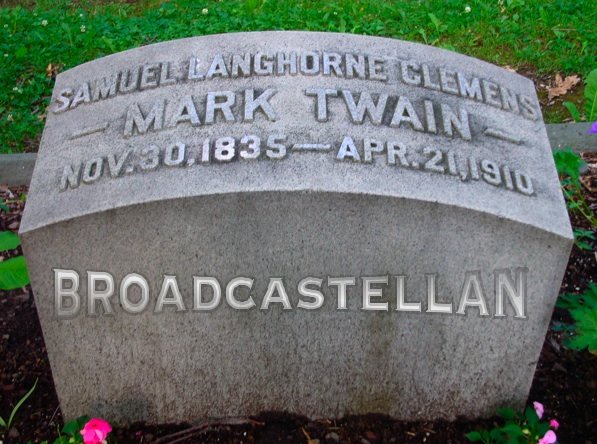
“Mark Twain, Six Feet Underโ€
“What Those Who Remembered Forgot: Don Knotts (1924-2006) on the Airโ€