That’s No Lady. That’s an Executive: Robert Hardy Andrews’s Legend of a Lady (1949)

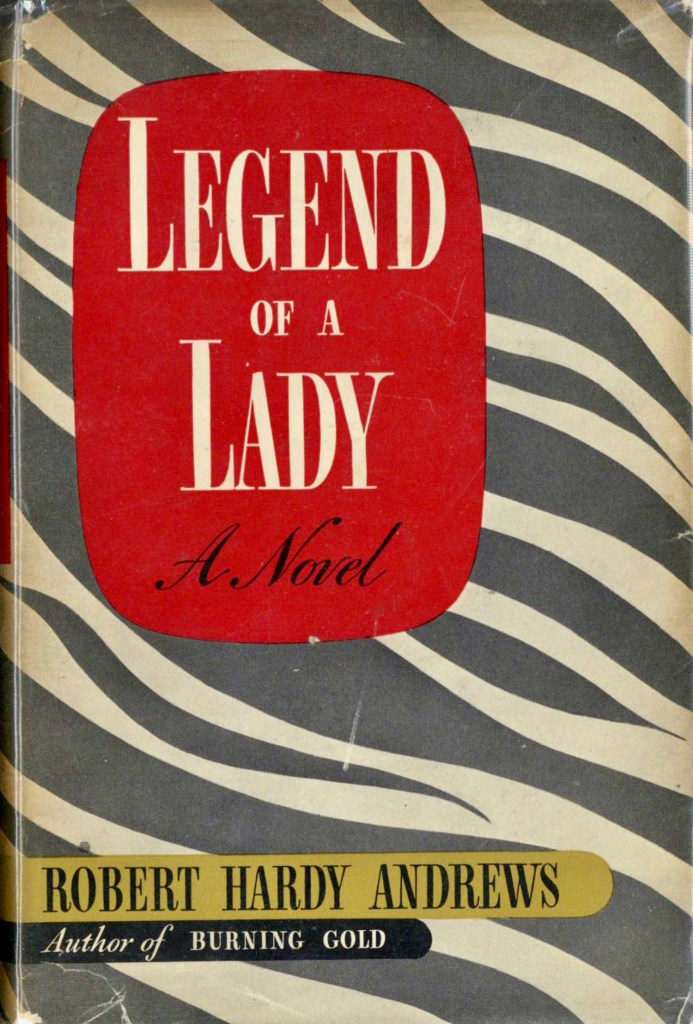
Dust jacket of my copy of Legend of a Lady, which I added to my library in June 2020

In “‘Hawkers of feces? Costermongers of shit?’: Exits and Recantations,” the final chapter of Immaterial Culture, I briefly discuss how creative talent working in the US broadcasting industry during the 1930s and 1940s tended to recall their experience upon closing the door to the world of radio in order to pursue careers they deemed more lofty and worthy.  Few had anything positive to say about that world, and their reminiscences range from ridicule to vitriol.

Within a year or two after the end of the Second World War, attacks on the radio industry became widespread and popular; most notable among them was The Hucksters, a novel by Frederic Wakeman, a former employee of the advertising agency Lord & Thomas.  Between 1937 and 1945, Wakeman had developed radio programs and sales campaigns for corporate sponsors, an experience that apparently convinced him to conclude there was ‘no need to caricature radio.  All you have to do,’ the author’s fictional spokesperson sneers, ‘is listen to it.’

Such ‘parting shots,’ as I call them in Immaterial Culture, resonated with an audience that, after years of fighting and home front sacrifices, found it sobering that Democratic ideals, the Four Freedoms and the Pursuit of Happiness were being reduced to the right – and duty – to consume.  After a period of relative restraint, post-war radio went all out to spread such a message, until television took over and made that message stick with pictures showing the latest goods to get and guard against Communism.

Following – and no doubt encouraged by – the commercial success of The Hucksters, the soap opera writer Robert Hardy Andrews published Legend of a Lady, a novel set, like Wakeman’s fictional exposé, in the world of advertising.  Andrews probably calculated that like The Hucksters and owing to it Legend would be adapted for the screen, as his novel Windfall had been.

Unlike in The Hucksters, the industry setting is secondary in Legend of a Lady.  Andrews has less to say about radio than he has about women in the workforce.  And what he has to say on that subject the dust jacket duly proclaims: ‘Legend of a Lady is the story of pretty, fragile Rita Martin, who beneath her charming exterior is hell-bent for personal success and who tramples with small, well-shod feet on all who stand in her way.’  The publisher insisted that ‘it would be hard to find a more interesting and appalling character.’

I did not read the blurb beforehand, and, knowing little about the novel other than the milieu in which it is set, I was not quite prepared for the treatment the title character receives not only by the men around her but by the author. The Legend of the Lady, which I finished reading yesterday, thinking it might be just the stuff for a reboot of my blog, opens intriguingly, and with cinematic potential, as the Lady in question picks up ‘her famous white-enameled portable typewriter in small but strong hands’ and throws it ‘through the glass in the office widow,’ right down onto Madison Avenue, the artificial heart of the advertising industry.

This is Mad Women, I thought, and looked forward to learning, in flashback, how a ‘small but strong’ female executive gets to weaponise a tool of the trade instead of dutifully sitting in front of it like so many stereotypical office gals.  Legend of a Lady is ‘appalling’ indeed, reminding readers that dangerous women may be deceptively diminutive, that they are after the jobs held by their male counterparts, and that, rest assured, dear conservative reader, they will pay for it.  In the end, Rita Martin, a single mother trying to gain independence from her husband and making a living during the Great Depression, exists an office ‘she would never enter again.’  Along the way, she loses everything –spoiler alert – from her sanity to her son.

The blurb promises fireworks, but what Legend of a Lady delivers is arson.  It is intent on reducing to ashes the aspirational ‘legend’ of women who aim to control their destiny in post-war America.  The world of soap opera writing and production serves as mere a backdrop to render such ambitions all the more misguided: soap operas are no more real than the claim that working for them is a meaningful goal.  As a writer of serials for mass consumption, Robert Hardy Andrews apparently felt threatened and emasculated working in a business in which women achieved some success in executive roles.  In a fiction in which men big and small suffer deaths and fates worth than that at the delicate hand of Rita Martin, Andrews created for himself a neo-romantic alter ego – the rude, nonchalant freelance writer Tay Crofton, who refuses to be dominated by a woman he would like to claim for himself but does not accept as a partner on her own terms, presumably because she cannot be entrusted with the power she succeeds in wresting from the men around her without as much as raising her voice.

Devoid of the trimmings and trappings of Hollywood storytelling, without glamor or camp, without gowns by Adrian or brows by Crawford, Legend of a Lady serves its misogyny straight up – but it couches its caution against ‘small’ women in spurious philosophy by claiming that, for men and women alike, there is life outside the proverbial squirrel cage that Andrews relentlessly rattles for his agonizing spin on the battle of the sexes.

Dunkirk 70 / Roosevelt 69

This week marks the 70th anniversary of “Operation Dynamo,” an ad hoc rescue mission involving small civilian ships coming to the aid of French and British soldiers who had been forced into retreat at Dunkerque during the for Allied troops disastrous Battle of Dunkirk. The operation, which became known as “The Miracle of the Little Ships,” was recreated today as more than sixty British vessels, sailing from Kent, arrived on the shores of northern France.

During the course of a single week, nearly 340,000 soldiers were brought to safety, however temporary. Many civilians who had what became known as “Dunkirk spirit” were recruited after listening to BBC appeals on behalf of the British admiralty for aid from “uncertified second hands”—fishermen, owners of small pleasure crafts, any and all, as the BBC announcer put it, “who have had charge of motor boats and [had] good knowledge of coastal navigation.”

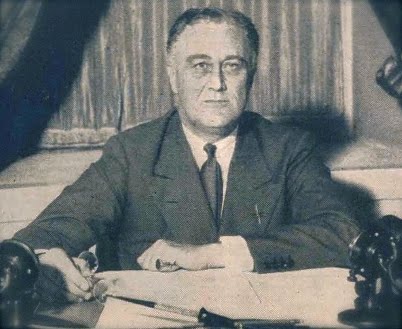
Eager to maintain its neutrality prior to the attack on Pearl Harbor, America was understandably lacking in such public “spirit,” frequent outcries against Nazi atrocities notwithstanding; but even long after entering the war, the US government kept on struggling to explain or justify the need for sacrifices and (wo)manpower to a people living thousands of miles from the theaters of war. On this day, 27 May, in 1941, one year after the operation at Dunkirk began, US President Franklin Delano Roosevelt came before the American public in another one of his Fireside Chats.

Although the nation was “[e]xpect[ing] all individuals [. . .] to play their full parts without stint and without selfishness,” the Roosevelt administration took considerable pains to explain the significance of the war, the need for “toil and taxes,” to civilians who, not long recovered from the Great Depression, were struggling to make a living.

If Hitler’s “plan to strangle the United States of America and the Dominion of Canada” remained unchecked, FDR warned the public,

American laborer would have to compete with slave labor in the rest of the world. Minimum wages, maximum hours? Nonsense! Wages and hours would be fixed by Hitler. The dignity and power and standard of living of the American worker and farmer would be gone. Trade unions would become historical relics and collective bargaining a joke.

Crucial to America’s freedom was the security of the oceans and ports. If, as FDR put it, the “Axis powers fail[ed] to gain control of the seas,’ their “dreams of world-domination” would “go by the board,” and the “criminal leaders who started this war [would] suffer inevitable disaster.”

The President’s address—broadcast at 9:30 EST over CBS stations including WABC, WJAS, WJAS, WIBX, WMMN, WNBF, WGBI and WJR—departs only slightly from the script, published in the 31 May 1941 issue of the Department of State Bulletin. Whatever changes were made were either designed to strengthen the appeal or else to prevent the urgency of the situation from coming across as so devastating as to imply that any efforts by the civilian population were utterly futile.

The address, as scripted, was designed to remind the American public that the US navy needed to be strengthened, alerting listeners that, of late, there had been “[g]reat numbers” of “sinkings” that had “been actually within the waters of the Western Hemisphere.”

The blunt truth is this—and I reveal this with the full knowledge of the British Government: the present rate of Nazi sinkings of merchant ships is more than three times as high as the capacity of British shipyards to replace them; it is more than twice the combined British and American output of merchant ships today.

In address as delivered, this passage was rendered slightly more tentative as “The blunt truth of this seems to be,” a subtle change that not so much suggests there was room for doubt as it creates the impression that the great man behind the microphone was weighing the facts he laid bare, that the devastating and devastatingly “blunt truth” was being carefully considered rather than dictated as absolute.

No mention was made of the “Miracle of Dunkirk,” that remarkable demonstration of spirit and resilience. More than a flotilla of “little ships” was required to defend the US from the potential aggression of the Axis powers. The challenge of American propaganda geared toward US civilians was to make the situation relevant to individuals remote from the battlefields, to motivate and, indeed, create a home front.
In Britain, where “ignorant armies clashed” just beyond the narrow English Channel and where the battlefields were the backyards, there was less of a need to drive home why the fight against the Axis was worth fighting.

In the US, the driving home had to be achieved by breaking down the perfectly sound barriers of that great American fortress called home, by making use of the one medium firmly entrenched in virtually every American household, an osmotic means of communication capable of permeating walls and penetrating minds. Radio served as an extension to the world; but it was more than an ear trumpet. It was also a stethoscope auscultating the hearts of the listener.

As FDR, who so persuasively employed it in his Fireside Chats, was well aware, the most effective medium with which to imbue the American public with something akin to “Dunkirk spirit” was the miracle not of “little ships” but of the all-engulfing airwaves—and the big broadcasts—that helped to keep America afloat.

Clash by Day: A D-Day Reminder

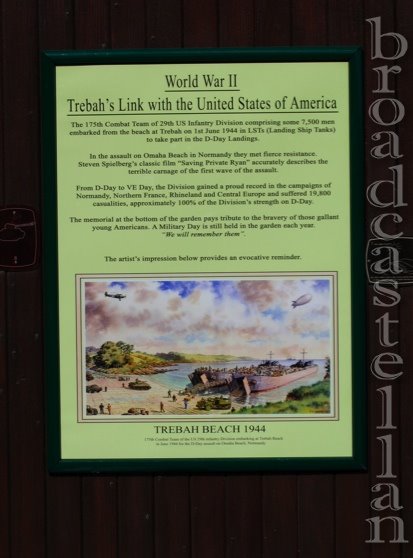
It was a crisp, bright afternoon in April when we visited Trebah Garden, one of the most beautiful spots in all of Cornwall. The sun had come out from behind a curtain of threatening clouds and the air was fragrant with a promissory note of summer that even the leafless, wintry trees in the distance were powerless to gainsay. As we walked down the sloping path, past the Rhododendron and Magnolias, beyond the dell of young Gunnera plants that, in time, would grow into a subtropical jungle, we reached a gate that led to a secluded beach. The sea was calm, peaceful the prospect; and even though the name of Trebah had been recorded in the Domesday Book, I felt far removed from the affairs of the world, present and past, as if sheltered in a reserve beyond the reach of history.

When I turned back toward the gate, that sense of detachment was shattered in an instant. I was reminded just how connected I was, even here, with the history of the world. I was yanked out of this perceived Eden by no uncertain notice of our fall: a sign telling me that, from it this secluded spot, thousands went into battle to secure the peace that I had enjoyed.

The memorial at Trebah tells of the 175th Combat Team of the 29th US Infantry Division, some 7,500 strong. On the 1st of June in 1944, those men embarked from that very beach to take part in the D-Day landings and, by carrying out their duty, face all but certain death.

“This is the hour,” Edna St. Vincent Millay wrote in her “Poem and Prayer for an Invading Army,” recited by Ronald Colman during a special radio broadcast on D-Day,

this is the appointed time.
The sound of the clock falls awful on our ears,
And the sound of the bells, their metal clang and chime,
Tolling, tolling,
For those about to die.
For we know well they will not all come home, to lie
In summer on the beaches.

And yet weep not, you mothers of young men, their wives,
Their sweethearts, all who love them well—
Fear not the tolling of the solemn bell:
It does not prophesy,
And it cannot foretell;
It only can record;
And it records today the passing of a most uncivil age,
Which had its elegance but lived too well,
And far, o, far too long;
And which, on History’s page,
Will be found guilty of injustice and grave wrong.

At Trebah Garden, where a Military Day is still being held each year, I was found guilty of the “grave wrong” it is to be walking in the splendor of oblivion. I shall not soon forget that sudden admonishment, that unsought clash by day.

Related recording
“Poem and Prayer for an Invading Army” (6 June 1944)

"Bleiben Sie wohl und halten Sie sich munter": A Visit at Kaltenmeyer’s

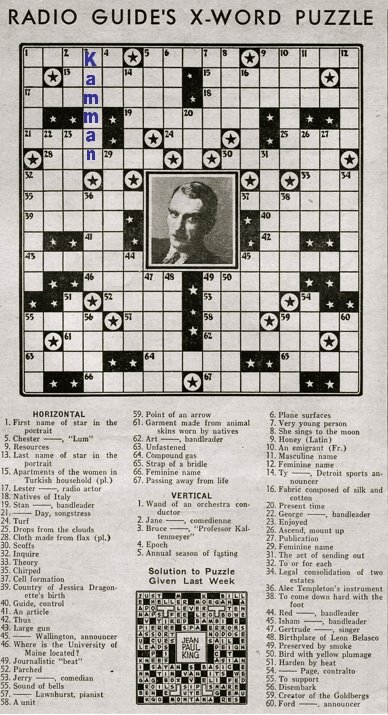
K A M M A N. I am sure a lot of readers of Radio Guide magazine would have found “Bruce ___, ‘Professor Kaltenmeyer” as easy a crossword puzzle clue as “Jane ___, comedienne” or “___ Wallington, announcer.”

From 1932 onwards, Bruce Kamman played the good-natured and much put upon teacher of the gang at Kaltenmeyer’s Kindergarten, a weekly comedy program that originiated from WMAQ, Chicago. Kaltenmeyer’s is one of those popular programs that have all but disappeared into thin air, the exception being the 12 December 1936 broadcast (which you may access on Jerry Haendiges’s invaluable “Same Time, Same Station” site). Reminiscent of and anticipating German schoolboy comedies like Heinrich Spoerl’s Feuerzangenbowle or Erich Kästner’s Das Fliegende Klassenzimmer (both 1933), Kaltenmeyer is a winsome trifle of a show. Each week, the Kindergarten opened with the catchy signature “Just for Fun”:

Kaltenmeyer’s starting,
Let’s all go to school.
In this kindergarten,
Where nonsense is the rule.

Indeed, much of it is nonsense, some of it song. Fibber McGee and Molly team Jim and Marian Jordan were featured on the program; until the fall of 1936, they were among the Professor’s international crowd of poopils. The 12 December 1936 broadcast (an excerpt of which was later rebroadcast on Recollections at Thirty) includes the somewhat incongruously wistful “Sweetheart, Let’s Grow Old Together” and offers at least one memorable pun involving the definition of the word “indisputable,” which one Kaltenmeyer’s rambunctious kids (adults all) manages to put into the following sentence: “Indisputable weather we’re having.”

It is Bruce Kamman’s voice, though, that adds “indisputable” charm to the nonsense. It is the kind of Sig Ruman-Frank Reichert voice—warm, avuncular, and too Jean Hersholt to be altogether ridiculously, let alone threateningly Teutonic. According to Francis M. Nevins’s The Sound of Detection, the Cincinnati-born Kamman, who entered radio as early as 1920, would continue his broadcasting career off mike, namely by producing and directing episodes of the Ellery Queen mystery-cum-celebrity quiz program.

Kamman’s days as Kaltenmeyer came to an end once the Germans began to wage war in Europe. In 1940, well before the United States entered the Second World War, Kaltenmeyer stopped saying “Auf Wiedersehen.” The character was removed from the Kindergarten, and what was left of the show folded soon thereafter.

I guess, when you make a career of sounding like Sig Ruman, you were expected to start shouting “Sieg Heil!” or hiss sinisterly and subsequently expire, rather than be permitted to send kindly greetings like “Bleiben Sie wohl und halten Sie sich munter” (“stay well and cheerful”) to the American people, whatever their heritage or dialect. Clearly “good old days” recalled in the theme song were over.

Now, let’s all go to back to the school that was radio and solve the puzzle . . .

"Everybody talks too much": Dylan Thomas and the Long-Lost "Art of Conversation"

“To begin at the beginning.” Thus opens what is undoubtedly the most famous of all plays written for radio: Under Milk Wood, by Welsh poet Dylan Thomas. BBC radio first produced the play in January 1954, with fellow Welshman Richard Burton in the role of the narrator. It had been previously performed in New York, shortly before Thomas’s death in November 1953 (which is the subject of a new book, Fatal Neglect by David N. Thomas, whose previous biography was the source for the motion picture The Edge of Love. Thomas’s poetry is still widely read today; but little is known generally about his other works for the wireless, about which there is generally little talk these days.

Thomas’s most popular story, “A Child’s Christmas in Wales” (published posthumously in 1955) was originally written for radio, as may be deduced from the attention Thomas’s pays to descriptions of sounds and voices, from the “most unducklike sound, a mewing moo that an ambitious cat might make who wished to be a cow” to that “small, dry voice, like the voice of someone who has not spoken for a long time,” a “small, dry, eggshell voice from the other side of the door: a small dry voice through the keyhole.”

Indeed, as I learned from Douglas Cleverdon’s introduction to the Folio edition of Under Milk Wood, Thomas had been on the air, whether as poet, critic, or actor, since 1939. Among his broadcast features is “Return Journey” (1947), a precursor to “Mad Town” (as Under Milk Wood was initially titled); it has been published in the anthology Wales on the Wireless (1988). Earlier this year, another play for voices by Dylan Thomas has been discovered and is now being given its first production on the air. Titled “The Art of Conversation,” it is available online until 9 December.

The title is somewhat misleading, since the play is really about shutting up. It is a Second World War propaganda piece, commissioned as part of a “Loose Lips Sink Ships” campaign, the sort of cautionary talk on the virtue of silence exemplified in the US by mystery writer Mignon Eberhart’s “The Enemy Is Listening” (Cavalcade of America, 7 June 1943). In it, a sinister voice (Everett Sloane’s) replies to remark that no “real American intends to give information to the enemy,” that

sometimes, sometimes someone forgets.  A word overheard and repeated. A small fact passed on to someone else may mean little to you.  It may mean nothing to the person to whom you repeat it.  But the third or the fourth person or the tenth or the twentieth may be your enemy. Your enemy.

Thomas’s “The Art of Conversation” is a rather more subtle performance. It permits us to indulge in the excesses of talk by Britain’s most celebrated conversationalists, only to remind us that there are times when—and subjects about which—the word should be “mum.” “I don’t think you’ll find Mr. Hitler with a little notebook under our table, do you?” one careless talker quips; but, just to be on the safe side, the idle talk that ensures is being censored.

Like Eberhart, Thomas weaves a web of compromising voices; yet he dispenses with melodrama and, indeed, as is typical of his compositions, with plot altogether. Instead, he opts for an informal lecture (replete with audience) punctuated by “the lantern slides of sound”: a multitude of voices, some distinct, others choric. All are preliminaries and subject to shushing:

Hundreds of odds and ends of hundreds of hearsays and rumours may, and can, be brought together into such a pattern that a whole Allied enterprise is thwarted or destroyed. A wagging tongue may sink a ship; a stray word over a mild-and-bitter may help to murder children.

However chatty and playful, “The Art of Conversation” eventually gets down to business and brings its message across; at least, it might have done, had it not disappeared for decades—apparently before it was ever broadcast. According to the current issue of the Radio Times, there is no evidence that the play was intended for radio; but you need only to listen to know that it could have hardly been written with any other medium in mind.

Alison Hindell’s belated production slightly condenses the original script (available here in its entirety), but otherwise takes few liberties with Thomas’s prose and directions; a 1920s “nigger” is turned into “negro,” a concession to our politically corrected sensibilities. Few US radio dramatists were treated with such respect.

The single exception is the rather pointless addition of an opening line that is not part of Thomas’s “Art,” but the famous introduction to Under Milk Wood, quoted above. No doubt, the presenters intended to draw the famous poet into his forgotten “Conversation,” so as to validate this lesser performance; but, instead of indulging in such self-conscious reverberations, they should have left themselves out of it, especially since there is enough of Thomas in it to make the lecture worth our while.

If only a discovery like this could get us talking again about radio . . .

January 4, 1942: What’s On?

I am one of those forward-looking folks who peruse the television and radio listings as if they were stock market reports or racing forms. Determined not to miss a winner of a program, I prepare myself by wielding the ever ready text marker as I wend my way through the weekly offerings. Today, though, I am seriously late in my planning. Before me is the US broadcast schedule from 4 January 1942 as it appeared in an issue of the Radio-Movie Mirror.

Having just watched “Static,” a 1961 episode of The Twilight Zone—shared with me by a fellow web journalist and consummate teller of fantastic tales—I am in a time-warped frame of mind. It is not for the sake of self-indulgent nostalgia, mind you, that I am revisiting the past, but in order to reconsider the boundaries of escapism. If the present does not turn us on, how can we, in this multimediated world of ours, expect to switch off entirely?

“Static” does not look kindly on television and the getaways it promises; it suggests that there is no escaping the challenges we dare not face as we stare at that small screen on which Westerns, quiz shows, and commercials flicker while life flashes by. Instead, it romances what, by 1961, was nearly a forgotten or at any rate woefully neglected medium in America; it gives two middle-aged people a second chance at realizing their dreams by transporting them, as if on radio waves, to the early 1940s, when first they met. The radio entertainments of that period—Fred Allen, Major Bowes, and the music of Tommy Dorsey—stand ins for what was presumably a time at once rich in possibilities and free from the mindnumbing influences of that set to which Americans had gotten so attached over the years.

All this romancing aside, the early 1940s were hardly an innocent period in modern history; and rather than coming true, many a dream had to be deferred or abandoned altogether. In this moment of uncertainty, at least one business comforted consumers by attempting to keep business running as usual. Worried or bewildered about the war, wondering what changes it would impose on their everyday existence—from blackouts to rationings, from irritating inconveniences to the loss of lives—those sitting at home could still depend on radio for escapist entertainment.

On 4 January 1942, an “Appointment for Murder” was kept by Raymond, host of The Inner Sanctum, Humphrey Bogart and Claire Trevor were heard in Screen Guild reconstitution of High Sierra, and Sherlock Holmes embarked on the virtually spotless “Adventure of the Second Stain,” first related by Conan Doyle some four decades earlier. Meanwhile, Jack Benny was overhead in a flashback episode recounting his botched New Year’s Eve celebrations, a belatedness indicative of the radio industry’s reluctance to catch up with the times.

Beholden to the sponsors who footed the bills, commercial radio was slow to adjust; and none of the programs broadcast during the weeks immediately following the attack on Pearl Harbor appear to have any relation to the realities of war. By comparison, even undemanding and apolitical publications like the Movie-Radio Guide, from which the above schedule was ripped, were quick to recontextualize the entertainments they were designed to bring to the attention of prospective listeners.

“A little over three weeks ago,” the Editors of the Guide commented, “a third-rate power with autocratic, imperialist ambitions and no scruples, attacked the United States as was to be expected—by hitting below the belt.” The propaganda still wanting on the air was already being provided by publications catering to the radio industry.

Responding to the demand for information, the Movie-Radio Guide promised to keep “pace with the nation’s war effort” and the “needs” of its readers by “inaugurated” an “enlarged short-wave department.” To the reader’s inquiry “What’s on?” the Guide replied in no uncertain terms: A war, that’s what was on.

How much does your entertainment guide of choice remind you of the fact that 2007 is by no means shaping up to be a time of peace?

Now As Then: "Thanksgiving Day—1941"

Well, it took me some time to get it. Thanksgiving, I mean. Being German, I was unaccustomed to the holiday when I moved to the United States in the early 1990s. I didn’t quite understand what Steve Martin’s character in Trains, Planes & Automobiles was so desperately rushing home to . . . until I had lived long enough on American soil to sense the significance of this day. Now that I am living in Britain and, unlike last year, not flying back to America to observe it, I wish I could import the tradition.

I don’t mean to ship over all the trimmings and fixings, the pies and the parade. Just the concept of an annual get-together that encourages one to reflect upon what matters in life—provided that those who matter as “family” are understood to be any gathering of people (and, Montague insists, pets) whose presence spells home.

To the horror of some, an Americanized Halloween has caught on big time here during the last few years. Why not a grown-up holiday like Thanksgiving, regardless of the direction in which the Pilgrims were heading? With an eye to the future, I am not even being ahistorical.

A feast in defiance of the old saw that you can’t go home again, Thanksgiving is often thought of as an occasion to wax nostalgic. Sure, it is a time to look back; but that does not mean it should exhaust itself in sentimentality. It can be an incentive to pull through, an event for which people pull themselves and one other together in the face of adversities.

Belittled as a ritualistic tripping on tryptophan, bemoaned as an annual family headcount that starts with the headache of getting there and ends in a bellyache getting back, Thanksgiving still compels millions to travel hundreds of miles and, unlike Christmas, has remained remarkably free from commercialism. It mobilizes more folks than a national election. It is a day of the people, not of corporation (unless you are running an airline). And despite its culinary excesses, it is simple, solid, and reassuringly primal in its cheering of the harvest and the life we owe the land and its natural riches.

A celebration “wholly of our earth,” is how the aforementioned American poet Stephen Vincent Benét expressed the meaning of the day in a speech delivered by actor Brian Donlevy and broadcast on 19 November 1941, just a few weeks before the US entered the Second World War. “This year it is and must be a sober feast,” Benét reminded the listener. Even if the attack on Pearl Harbor was a surprise, the bombs over London were clear enough signs of the perils ahead:

Today, one hundred and thirty million Americans keep the day they first set apart.  We all know what Thanksgiving is—it’s turkey day and pumpkin pie day—the day of the meeting of friends and the gathering of families.  It does not belong to any one creed or stock among us, it does not honor any one great man.  It is the whole family’s day when we can all get together, think over the past months a little, feel a sense of harvest, a kinship with our land. It is one of the most secure and friendly of all our feasts.  And yet it was first founded in insecurity, by men who stood up to danger.  And that spirit is still alive.

“The democracy we cherish,” Benét concluded,

is the work of many years and many men.  But as those first men and women first gave thanks, in a dark hour, for the corn that meant life to them, so let us give thanks today—not for the little things of the easy years but for the land we cherish, the way of life we honor, and the freedom we shall maintain.

If it is set aside to cherish land, life, and liberty, Thanksgiving cannot mean a retreat into the home, a shutting of doors and a closing of one’s eyes to the responsibilities that lie beyond the closest circle of relatives and friends: the duties of citizenship and the challenges of living in a global community. Some of the liberties fought for, the life and the land enjoyed in the past are now being threatened; not by foreigners alone, but by those of us who rely on or deal in outmoded constructs, who promote the concept of nation while defying the communal for their own profit.

“There are many days in the year that we celebrate,” Benét remarked, “but this one is wholly of our earth.” Although he might have meant his native ground—his speech being a pep talk to potential soldiers and a rallying cry for the home that soon would turn front—it won’t hurt to misread him, to consider “our earth” to be that truly common ground we share and to reflect on the global crises that may lie ahead and that, if at all, can only be met jointly. I hope we are “still alive” to this “spirit” and am thankful to those who keep on conjuring it.

So Proudly We Hail(ed); or, Movies They Dare Not Make Today

Well, they sure don’t make them as they used to. I don’t know how many times you have uttered that line, indifferent to the rules of grammar, whether as a lament or a sigh of relief. Take So Proudly We Hail, for instance, the 1943 war drama I watched last night. Until I decided that doing so would be rather too self-indulgent (considering my love for a certain leading lady), I thought of discussing it yesterday, corresponding with the anniversary of the radio version in which stars Claudette Colbert, Paulette Goddard, and Veronica Lake reprised their original roles (along with the long forgotten Sonny Tufts) on the Lux Radio Theatre.

So Proudly We Hail is a well-crafted, surprisingly unsentimental, and highly engaging melodrama about US army nurses serving their country in the battlefield that was the Philippines during the Second World War; as such, it is also unabashed wartime propaganda. I do not think that any producer in Hollywood today would dare to remake it, say, with Julia Roberts, Winona Rider, and Scarlett Johansson (to pick three contemporary actresses approximately of the respective ages of the three original leads). Why not? Allow me to speculate.

There’s a war on, lest we forget; but it doesn’t seem to reunite the West (or any Western nation) against a clearly defined enemy. Instead, we find ourselves in a war on terror—and the terror appears to be as much the cause as it is the effect, violence and violations being brought on by so-called anti-terrorist measures that continue to provoke it.

This is not a time in which to express pride in one’s country or its elected representatives; and those making decisions in Hollywood today seem least inclined foster a sense of loyalty and regard. I don’t think, though, that widespread dissatisfaction and skepticism—a critical attitude only the thoughtless or unthinking ever entirely suppress—account for the current rejection of propaganda drama.

As the reception of Clint Eastwood’s latest film suggests, people are not lining up to see movies with a political message. They might accept a controversial documentary inviting us to take sides; but they no longer appreciate being manipulated or swayed by dramatic fare. Propaganda is a dirty word these days, dirtier by far than advertising, which is still being tolerated.

However much we might groan, we tend to allow the promotion of a product, but get squeamish when it comes to the advancement of an idea. Corporations have taken a prominent place in—or even taken the place of—the government; and when peddling products, advertisers appeal to the individual, whereas propaganda seeks to motivate the community. It simply pays to stimulate division and selfishness, a targeting strategy generally marketed as choice. There no longer is a public, it seems; there are only people; and for advertising purposes, several million of these supposed individuals will do.

Unlike today’s conflicts, the Second World War was not endorsed by big business; companies were not eager to surrender sales or give up the production of consumer goods for a nation that needed to consolidate precious resources. So, I don’t think we’ll get to see Scarlett Johansson grabbing a hand grenade and blowing herself up for the sake of her country (as Veronica Lake’s character does) or picking up an empty can of soda for the benefit of the planet. Instead, she’ll grab that soft drink or lipstick or pair of designer shoes and fight for what she believes in . . . or what those placing the products in her hands want us to believe.

I did not grow up in a country or an age in which it was easy or felt right to be proud of one’s people; and, watching a film like So Proudly We Hail I sense that to be a profound loss. We so proudly hail individuality these days because corporations hand out the flags and buttons to match, knowing that we are at our most receptive and vulnerable when we are at our greediest.

Celebrated East-West Menace Starts Out Selling US Magazines

Well, I hadn’t intended to continue quite so sporadic in my out-of-date updates, especially since a visit to my old neighborhood in New York City is likely to bring about further disruptions in the weeks to come, however welcome the cause itself might be. A series of brief power outages last Friday and my subsequent haphazard tinkering with our faltering wireless network are behind my most recent disappearance. It is owing to the know-how of this creative talent that broadcastellan is now back in circulation. So, it seems fitting that, upon returning today, I should commemorate the career of a man who was particularly adept at vanishing, of casting his voice, and of having a laugh at matters least laughable: The Shadow. After all, he first went on the air on this day, 31 July, in 1930.

As expert Anthony Tollin relates it in The Shadow Scrapbook, the invisible man with the menacing laugh was at first little more than a radio announcer—a mouthpiece for Street and Smith, a company specializing in the cheap thrills of magazine fiction. While radio had little drama to offer during those early days of network broadcasting, its promotional prowess had long been proven by sharks, shysters, and shamans alike. As is often the case, the advertisement took on a life of its own, as tuners-in were more intrigued by the voice than by the product it was called upon to peddle. So, The Shadow was rushed into the limelight and, after being promoted to the narrator of Street and Smith’s Detective Stories, stories, became a bona fide superhero in print and on the air.

As the Orient—that is, the US concept of such non-Western territory with traditions predating the old world of Europe—was then all the rage, The Shadow is somewhat of a Fu Manchurian candidate, casting himself under an imported family tree from which branches dangle the wise Charlie Chan, the magical Chandu, and the sly Mr. Moto.

All those Americanized adventurers and much-relied-upon crime solvers owe some of their mystique to an element of the sinister or suspicious, even though this quality became diluted and, in the case of Charlie Chan, was obscured over the years whereas Mr. Moto was sent on leave when the allure of the extra-occidental seemed irreconcilable with the cultural reorientation of the US after Pearl Harbor and the expediencies of wartime propaganda.

Lamont Cranston, as listeners of The Shadow were told each week, had brought back a secret from the Orient—the hypnotic power to “cloud men’s minds so that they cannot see him.” He revelled in this invisibility, the hunt, hide and seek it made possible; as his menacing laugh suggests, he was no kindly Mr. Keen, no detached Sherlock Holmes, no matter-of-fact gumshoe. He enjoyed feeding his enemies the “bitter fruit” borne by the “weed of crime” and of feasting on its juices, on employing powers which, on this day in 1938, for instance, helped him to catch a group of western diamond mine raiders with the aid of a non-western sage turned servant who passed on “The Message from the Hill,” through “mental telepathy, the oldest wireless in the world.”

It is a telling case of a Hollywood identity crisis that screen villain Bela Lugosi first played Chandu’s archenemy and then returned to impersonate the radio original himself in subsequent movie serial sequels; nor should it be surprising that someone as typecast to play outcasts as Peter Lorre was chosen to play Mr. Moto. The duality—the duplicity—of Easterners gone West or Westerners under Oriental influences suggests something adulterated, ominous, and forbidding. It is a spinning forth of yarns like Dracula and The Green Goddess, stories of an East that not so much meets West but infiltrates it or insinuates itself.

Perhaps, in today’s global market, the Shadow might have started out as a hawker of Japanese electronics, the hardware of choice with which western media produce latter-day broken blossoms of diplomacy. It strikes me as disingenuous or incongruous, at least, that melodramatic Orientalism is deemed politically incorrect while demonizations of Iran and North Korea and the anxieties triggered by Communist China, by a distant Asia or Arabia—a far or middle east—are being propagated by a West that glorifies diversity but relies for its cultural survival and economic supremacy on demonstrations of its vulnerability, on images of threatened borders and threatening barbarians.

On This Day in 1944: A Travelogue Introduces Americans to Tel Aviv

Well, it seems that the power lines are beginning to rot. The electric lights went out just after the sun had set, a sun, mind you, that had been hidden for days behind a wind-blown, tattered curtain of clouds. I was rather relieved to find my none-too-successful experimentations in podcasting cut short by this momentary outage, lit a large candle, and began to read a few pages of Mervyn Peake’s epic Gormenghast. In doing so, I was readying myself for a dramatization of this dreadful story—a study in dread—that I am going to attend tomorrow evening.

My reading aloud soon sent my audience (of one) to sleep, just as I have often dozed off listening to recordings of old-time radio programs—a sonically induced somnolence largely responsible for the delay in the completion of my doctoral study. In the image empire of the west, closing one’s eyes is generally associated with rest, rather than heightened attention.

Most of us are too visually trained, weaned on and preoccupied by the ocular, to become fully audile—that is, capable of learning through hearing. It was a challenge that radio producers had to meet when education—or indoctrination—by radio became an essential aspect of mobilizing the masses during the Second World War.

There are a number of radiodramatic techniques that assist listeners in taking in whatever needs to be conveyed; but rather than sharing information—factual specifics or intricate data—radio drama was most successful at creating impressions, stirring sensations, and instilling beliefs. One such belief, slow to take root, was that Americans were not fighting by themselves or for themselves alone, that it was not simply a war against an identifiable enemy, but a struggle for democratic ideals and their realization elsewhere.

In 1943, journalist, poet, and radio dramatist Norman Corwin was asked to create a series that would tell Americans at the home front something about their nation’s gobal allies. Passport for Adams was a sonic travelogue relating the impressions of a small-town newspaper editor assigned to report on the impact of the war on the world’s civilian population; weekly broadcasts transported listeners to Moscow and Marrakesh, to Monrovia and Belem.

As Corwin explains it in his notes on the play “Tel Aviv”—a second production of which was soundstaged by Columbia Presents Corwin on this day, 23 May, in 1944—the “idea was to pull for unity and victory.” The “omission of ugly details was quite beside the point. To have dwelt upon them would have been to play exactly the same tune as Goebbels, who was constantly reminding the world that the British, in their time, were dreadful imperialists.”

To counter the ignorance of his fellow citizens, Corwin created a comic sidekick more naïve than they—a culturally insensitive if good-natured news photographer who greets with wisecracks his colleague’s advice that he prepare for his assignment by “striking up an acquaintance” with Hebrew: “I know plennya Hebrew: aleph, baze, vaze, gimbel, dullard, kibitz, schlemiel, guniff, kosher, gefilte fish, Yehudi Menuhin. . . .”

Poet-journalist Corwin, who, pressed for time, gleaned most of his facts about life in Tel Aviv from a single interview with a former correspondent in Palestine—approached his subject linguistically by making a foreign tongue sound friendly and familiar—a language expressing the ideals known to and embraced by all who fought fascism.

During their tour of the city, Adams and his colleague gather information like pieces of vocabulary, from the shouts of a newsboy (“Davar Iton Erev”) to street signs such as “Rechow Umot Hameuchadot” (Street of the United Nations). Along the way, the ignorant photographer—a man dealing in images rather than words—is set right about the Hora, which he thought of as some “kind of a Jewish jitterbug dance,” while Adams talks to the people of Tel Aviv, among them a construction worker who, once a lawyer in Germany, is proud of having helped laying the bricks of the “Bet-Haam” (House of the People).

The broadcast ends with the word “shalom,” which Adams hopes will gain in a “future not too distant” a “new meaning and a more lasting one than we have ever known.” While “shalom”—or “peace”—is a dream that has yet to be translated into a global reality, radio, as a disseminator of sentiments, kept alive an ideal that kept home front Americans from abandoning the war as a means of achieving it.