Gone South . . . and Very Pacific: Broadway on an Off Day

I suppose I am back in my element (earth, mingled with dust), being that I can reminisce at last about my recent trip to New York City from the comfort of my own patch of terra firma across the pond. Okay, so I never managed to turn writing into a living; but I sure can turn life into writingโ€”provided I can go on about past experiences once I am good and ready, once that which has been going on and gone through my mind is bona fide bygone. Not one to multitask, I somehow cannot both be living and writing simultaneously, which is why Twitter is not for me. I am not cut out to be an on-the-spot correspondent. You wonโ€™t catch me with my finger on the pulse of anything yet living other than in my thoughts where, quickened by imagination, anything presumably dead and gone is readily revived.

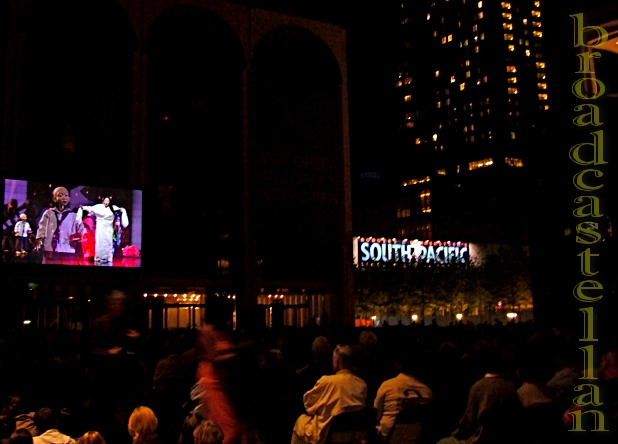
Perhaps, going live is not the same as being in the moment; at least, performances need not be, by virtue of being live, worth a moment of my time. For the record (and this is a new record to me, for I am about to change my tune): canned performances are not necessarily inferior to live ones. At least I thought so a few weeks ago while watching a recorded broadcast of a dazzling Metropolitan Opera production of Madama Butterfly, screened on the plaza in front of the building housing that venerable institution.

There I was (leaning against a trash can, no less), joined by hundreds of strangers, to take in, free of charge, the musical equivalent of cured meat, a pickled delicacy shared out to lure those partaking into the venue to shell out serious money for the supposedly real thing. Maybe Iโ€™ll think differently tomorrow at the local cinema, where I will be catching a high definition broadcast of the current National Theatre production of Shakespeareโ€™s Allโ€™s Well That Ends Well, live from London; but I sure realized that live is not to be confused with lively when I went to see South Pacific at New Yorkโ€™s Lincoln Center Theater, just a few feet from the screen where Madama Butterfly had flickered before my teary eyes.

South Pacific left my peepers dry, even though I was on the brink of welling up when I reminded myself that I had let go of more than $90 for a discount ticket to for the dubious privilege of beholding said spectacle. What I witnessed was Broadway on an off night, some less than โ€œEnchanted Eveningโ€ during which the cast went through the motions like Zombies on sabbatical. I knew as much when I opened my playbill to discover one of those white slips that, on the Great White Way, are equivalent to a pink one: Paulo Szot, the celebrated lead, had been replaced for the evening (and several weeks to come) by one William Michals.

Turns out, Mr. Michals had all the charm and thespian animation of a Bela Lugosi. Not that Laura Osnes (as Nellie Forbush) was out-Mitziying Ms. Gaynor. She did not as much try to wash that man right outa her hair as dispose of him with a purple rinse. As I remarked to my fellow onlooker, the pair had less going on between them as might be generated by a preschoolerโ€™s chemistry set.

Almost everything about this potentially engrossing play seemed to have been rehashed on a desperately reduced flame. I, for one, was boiling; it wasnโ€™t โ€œHappy Talkโ€ youโ€™d have overheard had you been eavesdropping on us as we left the theater. Sure, the production had been running for a year and a half and wasnโ€™t exactly โ€œYounger Than Springtimeโ€; but the Pacific, never more deserving of the name, has rarely felt quite this tepid. A rousing rendition of โ€œThere Is Nothinโ€™ Like a Dameโ€ and the still-spirited performance of Danny Burstein (as Billis) aside, the promise of Bali Haโ€™i never left anyone feeling quite this low . . .

Yoo-hoo! Isn’t anybody anymore?

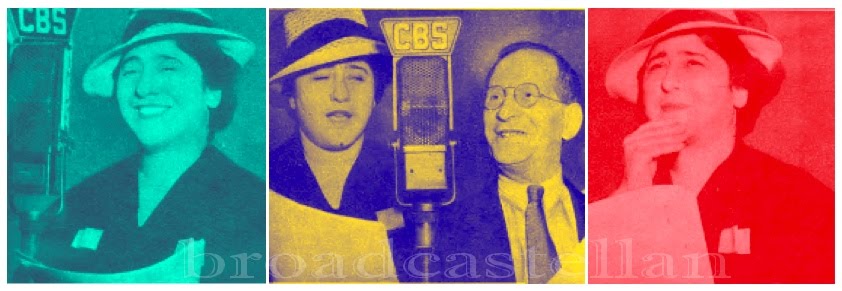
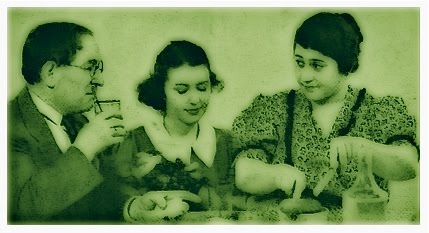
Remembering Gertrude Berg, that is. Having been to Fleischmanns last year (without spotting her tombstone there), I was thrilled to be catching Aviva Kempnerโ€™s much reviewed if ultimately unsatisfying documentary Yoo-Hoo, Mrs. Goldberg at the Quad Cinema in Manhattan last week. After all, it is not a film you are likely to see in Europe (or, for that matter, in any US multiplex); and I doubt whether it will ever be released in Wales, my present home. Who, after all, remembers (or ever had the opportunity of) tuning in to The Goldbergs, or The Rise of the Goldbergs, as Bergโ€™s program was initially called in the days before television?

Kempnerโ€™s filmic memorial to Berg and her creationโ€”heard on radio and seen on stage, television and the moviesโ€”aims at countering the oblivion to which the writer-producer-actress and her signature character have long been consigned; but, judging from the elderly, Jewish audience among which I found myself, aside from my good friend, Brian, Mrs. Goldberg is not likely to find new admirers through Kempnerโ€™s polite and downright reverent re-introduction, however deserving she may be of praise.

โ€œWhy, for all her popularity and apparent influence, is Gertrude Berg so little remembered today?โ€ Paul Farhi of the Washington Post asked back in July 2009. It is a question Kempner does not trouble herself to answer, other than with a resounding โ€œWhy indeed?โ€ Predating but overshadowed by I Love Lucy, The Goldbergs come across as little more than a noteworthy, ethnic curiosity, a historical footnote, the stuff of nostalgia. At least, Kempnerโ€™s documentary, which New York Post critic V. A. Musetto called โ€œfawning and formulaic,โ€ did little to convince me otherwiseโ€”and I donโ€™t need convincing.

โ€œUlleright, ulleright!โ€ For all its shortcomings, Yoo-Hoo, Mrs. Goldberg is still a welcome and overdue tribute to of a long overlooked icon of American popular cultureโ€”and an enterprising, emancipated woman at that; but it is also a rather perfunctory and historically questionable piece of bio-cinematography, replete with a poorly reenacted scene from Bergโ€™s earliest radio script.

Except for a few tantalizing clips of Edward R. Murrow’s interview with Berg on Person to Person and those seemingly random excerpts from The Goldbergs kinescopes, the documentary, like most pieces of ocular proof, is at a loss to fill the screen, resorting to images only remotely related to the subject; or, else, to talking heads like Ed Asnerโ€™s and Ruth Bader Ginsburg (who recalls being addressed as Mrs. Goldberg). Meanwhile, the snippets from Bergโ€™s radio and television broadcasts are often unintelligible, if it werenโ€™t for the subtitles. The result is about as funny as a translated jokeโ€”and certainly not remotely as amusing or charming as Bergโ€™s glossy autobiography Molly and Me (1961).

Here, for instance, is how autobiographer Berg made the connection between her parentage and her wireless offspring. Those watching Kempnerโ€™s documentary never get to hear about it. To them, Molly is a kindly woman leaning out of a window, chatting to her neighborsโ€”and an audience long since dispersedโ€”or praising the miracle of Sanka Coffee, instead of yelling โ€œYoo-hoo, is anybody?โ€ into a telephonic darkness just beyond her Bronx apartment:

My father was a special fan of the dumbwaiter and when radio was invented, he gave up the shaftway only because of the better coverage. But until that time it was through the dumbwaiter that he got to know everybody, not by their names, but by their locations. He predicted divorce for Mr. and Mrs. 5-D because of their nightly arguments; he knew that Mrs. 3-Aโ€™s son was going to leave home before even Mrs. 3-A. It didnโ€™t take second sight; all it took was a good ear and a comfortable chair near the dumbwaiter door.

Kempnerโ€™s film is so reverent and nostalgic, it sentimentalizes the already saccharine confection of Mother Goldberg, whose Jewish Amos โ€˜nโ€™ Andyisms enliven the early scripts for her radio serial, extant only in print, before the series-turned-daytime serial settled for at times โ€œsoap-operaishโ€ melodrama.

โ€œ[E]verything about The Goldbergs changed but the theme song, โ€˜Toselliโ€™s Serenade,โ€™โ€ Berg explains in Molly and Me. Those encountering Molly in Kempnerโ€™s documentary are unlikely to see Molly as an early Lucy, or, come to think of it, as a prototype for linguistically challenged immigrant Ricky Ricardo.

โ€œSo come down a liddle after,โ€ Mrs. Goldberg once yoo-hooed to her neighbor, Mrs. Bloom, โ€œmaybe veโ€™ll go to a mofieโ€”is playing de Four Horsemen in de Apoplexies.โ€ Well, you almost got it, Molly. Apoplexies are the kind of movie theaters that leave you angry at your lack of choices. Too bad that even the exceedingly rare art house simplexes are not likely to rescue you from the fate of being trampled to death by the pale horse of apathy.


Related writings
The House of [Broken] Glass
Wireless Women, Clueless Men: Gertrude Berg, Everybody’s Mama
On This Day in 1941: Molly Goldberg Nearly Chickens Out

“Chew that bacon good and slow”: Our Town Like You’ve Never Seen It

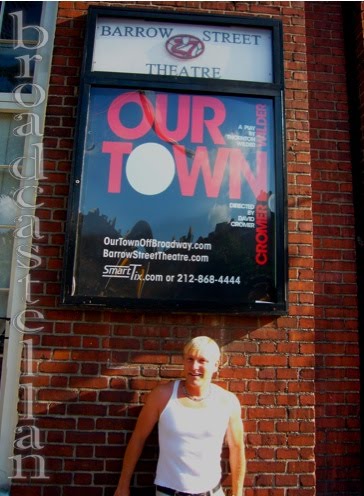
Okay, so Iโ€™ve been cutting a few corners during my present, month-long stay in New York City; but I wasnโ€™t about to cut Groverโ€™s Corners. Our Town, that is, a new production of which is playing at the Barrow Street Theatre in Greenwich Village. These days, there isnโ€™t much on Broadway to tempt me into letting go of whatever is left in my wallet. I mean, Shrek the Musical? Whatโ€™s next, Pac-Man of the Opera? A concert version of Saved by the Bell? Secret Squirrel on Ice? I am all for revisiting the familiarโ€”a tendency to which this journal attestsโ€”as long as I feel that such recyclings are worth my impecunious (hence increasingly persnickety) whileโ€”and theatrical retreads of The Addams Family, 9 to 5 or Spider-Man are not. Come to think of it, I had never seen a performance of Thornton Wilderโ€™s Pulitzer Prize-winning Our Town, which I always thought of as the ideal radio play. Well, let me tell you, David Cromer sure made me see it differently.

Our Town was produced on the air at least three times, even though the Lux Radio Theatre version (6 May 1940) is a reworking of the screenplay, replete with a tacky, tagged-on Hollywood ending and ample space for commercial copy between the acts. Wilderโ€™s 1938 play is decidedly radiogenic in its installation of a narrator (or Stage Manager) and its insistence of doing away with props or scenery. The Barrow Street Theater production seemed to be in keeping with the playwrightโ€™s instructions; and I was all prepared to watch it with my eyes closed.

There are two tables on the small stage; and the props do not amount to more than a hill of string beans. The Stage Manager points into the audience, inviting us to envision a small town in New Hampshire, anno 1901:

Along here’s a row of stores. ย Hitching posts and horse blocks in front of them. First automobile’s going to come along in about five years belonged to Banker Cartwright, our richest citizen . . . lives in the big white house up on the hill.

Here’s the grocery store and here’s Mr. Morgan’s drugstore. ย Most everybody in town manages to look into those two stores once a day.

Public School’s over yonder. ย High School’s still farther over. ย Quarter of nine mornings, noontimes, and three o’clock afternoons, the hull town can hear the yelling and screaming from those schoolyards.

Some eyes followed the pointed finger in my direction, faces in the crowd briefly looking past me in hopes of making out the Methodist and Unitarian churches just behind my back. Now, Iโ€™m not saying that the actors were not worth looking at, Jennifer Grace as Emily Webb being particularly charming. Still, at the end of the first act, I could not figure out what Frank Scheck of the New York Post referred to as โ€œrevolutionary staging.โ€ Two tables, eight chairs, string beans?

By act three, I understood. David Cromer defies Wilderโ€™s instructions (โ€œNo curtain. No sceneryโ€)โ€”and to startling effect. I never thought that the smell of bacon could be so overwhelming, so urgent and direct. Sure, it has often made my mouth waterโ€”but my eyes? Whether or not you are a staunch vegetarian, there is reality in the scent, just as there is a revelation behind that curtain. Our Town may be a wonderful piece of pantomime; but Cromer deserves some props.

โ€œOh, Mama, just look me one minute though you really saw me,โ€ the dead Emily implores the unseeing childhood vision of her mother. โ€œMama, just for a moment we’re happy. Let’s look at one another.โ€ Seeing this fragrant scene acted out made me realize anew the importance of coming to all of oneโ€™s senses, of partaking by taking in, of grabbing hold of the moment (which we Germans call an Augenblick, a glance) by beholding what could be gone at the blink of an eye.


Related recordings
“Our Town,” Campbell Playhouse (12 May 1939)
“Our Town,” Lux Radio Theatre (6 May 1940)

Crosstown Stitch: Embroidering on a Favorite Subject

โ€œSalut au monde!โ€ That is a greeting the narrator of Norman Corwinโ€™s โ€œNew York: A Tapestry for Radioโ€ extended to the never quite statistically average American listenerโ€”anybody tuning in to the nationally broadcast play cycle Columbia Presents Corwin back during World War II. And that is how I, returned again to my old yet ever changing neighborhood in uptown Manhattan, am reaching out to the potentially even more multifarious roamers of the World Wide Web.

Why Salut, though? Why go for the highfalutin when something lowbrow like hiya would do? After all, French is not among the languages most closely associated with the Big Pomme. Sure, there is that French lady who greeted the multitudes who came across the big pond to get a bite out of it; but only because sheโ€™s made of copper doesnโ€™t make her a coined phrase.

Corwin was not going for the definitiveโ€”the single, representative tongue with which to tie up an argument only to contradict it. Symbolic of the promises and failures of the Versailles treaty, the imported salutation is part of a pattern designed for a sonic romancing of immigration central, where nations become nabes and the worldโ€™s people are โ€œliving side by side so effortlessly, no one calls it peaceโ€โ€”a cosmopolitan locale to which nothing could be more foreign than the homogenous or the homo-logos.

As LeRoy Bannerman describes it, Corwinโ€™s voice collage
advocated world unity, exemplified in the polyglot harmony of New Yorkโ€™s people. It possessed threads taut with the strain of war and the urgency of an all-out effort, symptoms of concern that greatly colored Corwinโ€™s work with tints of patriotism.

The colors in Corwinโ€™s fabricโ€”that crowd-pleasing fabrication of Gotham (what do you call it? Gothamer)โ€”are red, white and blue all right; but when Corwin waves the flag, he does not make difference stand out like a blot on Old Glory. Corwinโ€™s aural tapestry is rich in the variations that the theme demands, distinguished by the โ€œspeakers of the foreign and the ancient tongues,โ€ the โ€œconjoined creedsโ€”the Jew, the Christian, the Mohammedan.โ€

The speech is American, which is to say that it is not exclusively, let alone officially, English or any variation thereof. โ€œDo not mistrust [folks] because of their accent,โ€ the narrator cautions those who stand their ground by calling it common, โ€œfor we ourselves might be incomprehensible in Oxford.โ€ The Queenโ€™s English ainโ€™t the English of Queens, New York.

โ€œThe people of the city are the main design,โ€ the narrator insists. Seemingly random utterances by speakers nameless to the audience constitute the โ€œindividual threadsโ€ of an intricately woven fabric whose pattern, unlike the grid formed by the cityโ€™s streets, cannot be visually apprehended. โ€œHow can you tell, from Seat No. 5 on the plane from Pittsburgh, what goes on here?โ€ Nor can it be comprehended by the unaided earโ€”at least not by anyone well out of earshot. As I put it in Etherized Victorians, the way to arrive at the design is microphonic, not macroscopic.

The narrator invites โ€œAmericans on this wave lengthโ€ to follow the threads of โ€œinterwoven hopesโ€ by โ€œlistening acutelyโ€ to the peoples of New York City, be they from โ€œGerman Yorkvilleโ€ or the โ€œoutlying Latin quarters.โ€ Their voices are brought into a meaningful relation through the aid of the radio, of which the main speaker as receiver, amplifier and transmitter is an abstraction.

At the momentโ€”and being in itโ€”it is easy to lose sight of the wireless, even as I walk past Radio City. I feel no need for a hearing aid or a translator. I am a part of a grand, Whitmanesque design, which is both spoken and understood.

The House That Jack Sat

โ€œFrankly, Iโ€™m a little worried,โ€ comedian Jack Paar confided in announcer Hy Averback on this day, 17 August, in 1947. He was, after all, merely a โ€œsummer replacement,โ€ a โ€œfellow who broadcasts during the hot weather to give the other actors time to count the money theyโ€™ve made all winter.โ€ For the past twelve weeks, Paar had been sitting in for his first-namesake, skinflint Jack Benny, and had held warm that cozy place on the summer sun dial quite nicely at that. Still, while the reception had been far from icy, his โ€œbrief summer careerโ€ was fast coming to an end as radio was โ€œgetting ready for the winter again.โ€

Unintelligible as they might seem to most of todayโ€™s readers, there were tell-tale signs: Edgar Bergen โ€œrepainting Charlie McCarthy,โ€ Fibber McGee โ€œwaxing Harlow Wilcox,โ€ and Phil Harris switching to โ€œantifreeze, with an olive.โ€

Resigned as he was to his autumnal fate, the soon-to-be displaced replacement did not go gentle into the night; instead, he took it upon himself to find his โ€œwinter replacementโ€ by staging a talent contest.

The first applicants auditioning for Paar are a midget sister act. The sisters do not impress Paar much, even though his assessment suggests that he was not quite at home in the non-visual medium. I mean, having bags under his eyes didnโ€™t send Fred Allen packing; nor did being a trifle wooden hurt Charlie McCarthyโ€™s career.

PAAR. ย Maybe I was listening wrong. ย Did you say you do card tricks with mice?

ACT 2. ย Yes. ย Here. ย Pick a mouse.

PAAR. ย [ . . .] Donโ€™t you do any of the conventional magicianโ€™s tricks, like, maybe, sawing a woman in half?

ACT 2. ย Oh, but monsieur, I shall never saw a woman in half again. ย I was never so humiliated. ย I was on the stage of the Orpheum Theater, you see . . .

PAAR. ย You mean, something went wrong with the trick?

ACT 2. ย Oh, yes. I donโ€™t know how it happened, but I was sawing this woman in half when, all of a sudden, I heard . . . blup, blup, blup, blip . . .

PAAR. ย Poor Simone Simon.

The third act is somewhat more promising or, at any rate, more familiar. It is, donโ€™t you know, Jack. Benny, that is, โ€œcomedian and violin virtuoso.โ€

โ€œI was the original Jack Armstrong, the All-American Boy,โ€ Benny insists as he lists his spurious radio credentials. โ€œWhen you were a boy, we didnโ€™t have all of America,โ€ Paar retorts. To prove that, until his season ended some twelve weeks ago, he was โ€œone of the funniest men in radio,โ€ the self-important Benny reads some lines from one of his scripts. So convinced was he of his own genius, that he did not bother to fill in the blanks left by his absentee sidekicks:

Thank you, Don. ย Well, hello Mary. ย Phil, you gotta do something about that band. ย Sing, Dennis. ย Rochester, answer the door. ย Yikes. ย Well, what do you know, itโ€™s Ronnie and Benita. ย But I think. ย But I. ย But. ย But. ย But. ย Bu . . . weโ€™re a little late. ย So, good night, folks.

Whether boasting Benny looked in on his replacement to give the latter a boost or to let listeners know that the spot was still his, I donโ€™t know; but rarely has a reminder of being replaceable made a comedian on hiatus sound so incomparable.

Meanwhile, just to remind myself that summer ainโ€™t over yet, even though it sure feels like autumn here on the Welsh coast, I booked a trip to visit the old place. Yes, hold your wax, Harlow, beginning next week, I am back in New York. Itโ€™s a neat trick, considering that the new place weโ€™ve been doing up still demandss so much of our attention and time. Displacement activity, you say? I should be scratching paint rather than scrape pennies and scram? Aw, go pick (on) a mouse!

Related recording
Jack Paar (17 August 1947)

Kitsch as Hitch Can: Waltzes, Missteps, and a Sense of Direction

Ernst Lubitsch, Preston Sturges, and Alfred Hitchcockโ€”those were the Hollywood directors in whose films and careers I became interested in my youth, a by now but vaguely remembered period in my life during which most movie-going adolescents associated the business of making pictures with names like Rocky Balboa, Indiana Jones, or Luke Skywalker. My folks rarely went to the cinema, least of all together; so, my image of Hollywood emerged on the small screen and its dated, black-and-white offerings. Owing to my fatherโ€™s lingering doubt about the advances of tube technology, film to me had been chiefly a monochrome medium anyway; and as much as it irked me at the time to be missing out on the colorful and the current, I am retrospectively grateful for this early if belated introduction to classic filmmakingโ€”the happy by-product of a less happy family life.

Prolific, long-lived and distinctive, Hitchcock is a particularly good usher into the world of traditional cinema, to dramatic and filmic technique, even though we are rather too readily drawnโ€”with him and by himโ€”into the mythos of auteurism, of a directorโ€™s control of what is presumed to be his work. Why is it that we think of classic cinema as being โ€œdirected by,โ€ whereas stage and radio drama are primarily thought of (if thought of at all) as being written? Granted, from the framing of a shot to the editing of the reels, the director of a motion picture is called uponโ€”or in a positionโ€”to supervise and coordinate more aspects of the creative process than the director of a stage play or radio production. Still, filmmaking is much more collaborative than we tend to recognize.

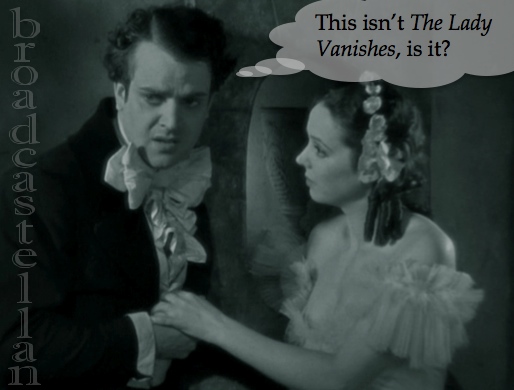
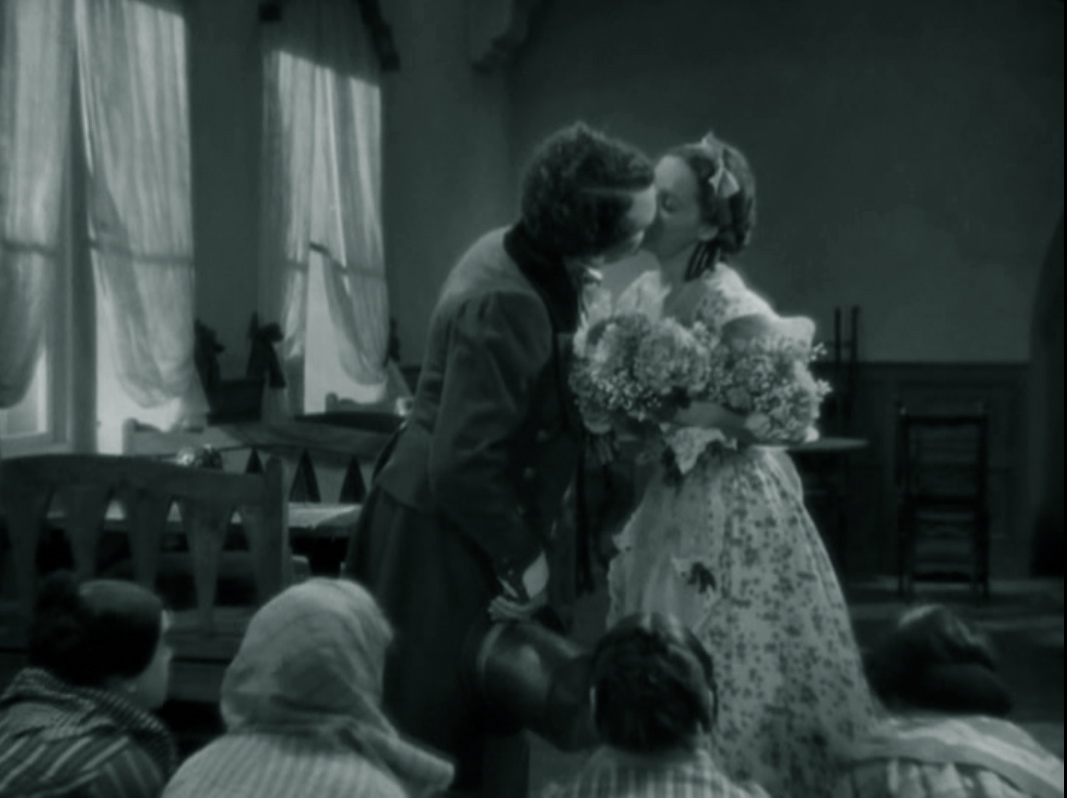
Quite a few pictures directed by Alfred Hitchcock are hardly what we think of as Hitchcock, for which reason we conveniently overlook or dismiss them, just as Hitch tended to brush them aside to preserve his auteur image. One of those non-Hitch Hitches is the 1934 confection Waltzes from Vienna, shot during a period when the director was not yet in a position to choose his projects. Irreverent as I am, I screened it last night in commemoration of the 110th anniversary of the celebrated suspense meisterโ€™s birth.

โ€œIt had no relation to my usual work,โ€ Hitchcock told Franรงois Truffaut in an interview that served as the source for one of the most insightful books on filmmaking. I bought my first (German) copy of it when I was sixteen; my mother and I were about to visit my father, who was working at a plant in Libya at the time. Faced with the prospect of spending seven weeks in a land hostile to Western culture (those visa stamps sure looked suspicious to the immigration officials when first I traveled to the US), I decided to pack plenty of page-turners, the Truffaut volume among them. Too excited to sleep on the night before our journey, I had turned the pages of the Truffaut volume before we headed for the airport. I donโ€™t recall ever reading a non-fictional book quite this fast and with such enthusiasm.

Still, familiar only with the directorโ€™s most iconic works, I was unable to enter the conversation, let alone contest Hitchcockโ€™s self-assessment. It was not until 1999, the centennial of Hitchcockโ€™s birth, that I caught up with Waltzes at the Museum of Modern Art in New York City; before then, the supposed misstep had been little more than a few brusque words and a couple of stills to me.

As it turns out, Waltzes, a “musical without music,” is not quite the, “cheaply” done and โ€œvery badโ€ movie its director made it out to be; nor is it true that it bears โ€œno relationโ€ to his โ€œusual work,โ€ unless โ€œusualโ€ refers strictly to genre, in which case one would have to regard as unrelated comedies and costume dramas like The Trouble With Harry and Jamaica Inn. What relates these and most of Hitchcockโ€™s works to each other is not suspense but irony, not thrills but bathos. Waltzesโ€”which tells of Johann Strauss Jr.โ€™s attempt to come into his own as a composer and the intervention on his behalf of a sly benefactress who, in turn, is a threat to the sonโ€™s loverโ€”may have been a more suitable project for Lubitsch, just as Hitchcockโ€™s Mr. and Mrs. Smith is the kind of screwball material in which we expect Preston Sturges to excel; but it is only when Hitchcock looks more like Fritz Lang that he strikes me as The Wrong Man for the job.

In his setting of scenes, as in his staging of the battle of the sexes, Hitchcock relies on queer juxtapositions that elicit laughter even as they excite us. In the opening scenes of Waltzes, set in and around a burning building, those most at risk are entirely indifferent to danger, consumed as they are by the flames of passion.

In the climactic scene, a confrontation between young Strauss and the jealous husband of his benefactress, the crowds cheer the new composer, believing him to be having the time of his life, while the rhapsodized one is being thrashed by his ostensible rival, just as the true competitor, Strauss Sr., over at a deserted bandstand, comes to term with the fact that he has been upstaged. Whether employed to unsettle or amuse, incongruity plays a key role in Hitchcockโ€™s storytelling.

While hardly danced as masterly or memorably as The Thirty-Nine Steps, Waltzes, too, benefits from clever and far from haphazard cinematography, as well as a strong interplay between image and sound, be it word or music. I suppose that in most cases, the collaborative effort is so successful that we ultimately give credit chiefly to the one we assume to have been at the helm of it all.

These days, though, a director seems to matter far less than an investor in pulling the strings, which are mostly wrapped around purses. Now that popular motion pictures are increasingly, if not primarily, a medium for special effects artists, one might be forgiven for turning to a misstep like Waltzes for a sense of direction, and for pursuing the auteurโ€”a mere Hitchcock-and-bull story such a romance may beโ€”along the meandering, mythical and nominally blue Danube.


Related writings
The (T)error of Their Ways: Conrad, Hitchcock, and the Aftermath of the London Bombings
Hang On! It’s That Girl from Number Seventeen

โ€œ. . . reduced, blended, modernisedโ€: The Wireless Reconstitution of Printed Matter

Nearly two centuries ago, young Rebecca Sharp marked her entrance into the world by hurling a book out of a coach window. That book, reluctantly gifted to her by the proprietress of Miss Pinkertonโ€™s academy for young ladies, was Johnsonโ€™s dictionary, a volume for which Ms. Sharp had little use, given that she was rarely at a loss for words. By the time her story became known, in 1847, words in print had become a rather less precious commodity, especially after the British stamp tax was abolished in 1835, which, in turn, made the emergence of the penny press possible. Publications were becoming more frequentโ€”and decidedly more frivolous.

Gone were the days when a teenager like Mary Jones, whose story I encountered on a trip to the Welsh town of Bala last weekend, walked twenty-five miles, barefooted, for the privilege of owning a Bible. Sure, I enjoy the occasional daytrip to Hay-on-Wye, the renowned โ€œTown of Booksโ€ near the English border where, earlier this month, I snatched up a copy of the BBCโ€™s 1952 Year Book (pictured). Still, ever since the time of the great Victorian novelists, the reading public has been walking no further than the local lending library or wherever periodicals were sold to catch up on the latest fictions and follow the exploits of heroines like Becky Sharp in monthly installments.

In Victorian times, the demand for stories was so great that poorly paid writers were expected to churn them out with ever greater rapidity, which left those associated with the literary trade to ponder new ways of meeting the supply. In Gissingโ€™s New Grub Street (1891), a young woman assisting her scholarly papa is startled by an

advertisement in the newspaper, headed โ€œLiterary Machineโ€; had it then been invented at last, some automaton to [. . .] turn out books and articles? Alas! The machine was only one for holding volumes conveniently, that the work of literary manufacture might be physically lightened. But surely before long some Edison would make the true automaton; the problem must be comparatively such a simple one. Only to throw in a given number of old books, and have them reduced, blended, modernised into a single one for todayโ€™s consumption.

Barbara Cartland notwithstanding, such a โ€œtrue automatonโ€ has not yet hit the market; but the recycling of old stories for a modern audience had already become a veritable industry by the beginning of the second quarter of the 20th century, during which โ€œgolden ageโ€ the wireless served as both home theater and ersatz library for the entertainment and distraction craving multitudes.

A medium ofโ€”and only potentially forโ€”modernity, radio has always culled much of its material from the past, โ€œReturn with us nowโ€ being one of the phrases most associated with aural storytelling. It is a phenomenon that led me to write my doctoral study Etherized Victorians, in which I relate the demise of American radio dramatics to the failure to establish or encourage its own, autochthonous, that is, strictly aural life form.

Sure, the works of Victorian authors are in the public domain; as such, they are cheap, plentiful, and, which is convenient as well, fairly innocuous. And yet, for reasons other than economics, they strike us as radiogenic. Like the train whistle of the horse-drawn carriage, they seem to be the very stuff of radioโ€”a medium that was quaint and antiquated from the onset, when television was announced as being โ€œjust around the corner.โ€

Perhaps, the followers of Becky Sharp should not toss out their books yet; as American radio playwright Robert Lewis Shayon pointed out, the business of adaptation is fraught with โ€œartistic problems and dangers.โ€ He argued that he โ€œwould rather be briefed on a novelโ€™s outline, told something about its untransferable qualities, and have one scene accurately and fully done than be given a fast, ragged, frustrating whirl down plot-skeleton alley.โ€

It was precisely for this circumscribed path, though, that American handbooks like James Whippleโ€™s How to Write for Radio (1938) or Josephina Niggliโ€™s Pointers on Radio Writing (1946) prepared prospective adapters, reminding them that, for the sake of action, they needed to โ€œretain just sufficient characters and situations to present the skeleton plotโ€ and that they could not โ€œafford to waste even thirty seconds on beautiful descriptive passages.โ€

As I pointed out in Etherized, broadcast writers were advised to โ€œfree [themselves] first from the enchantment of the authorโ€™s styleโ€ and to โ€œoutline the action from memory.โ€ Illustrating the technique, Niggli reduced Jane Eyreโ€”one of the most frequently radio-readied narrativesโ€”to a number of plot points, โ€œbald statementsโ€ designed to โ€œeliminate the non-essential.โ€ Only the dialogue of the original text was to be restored whenever possible, although here, too, paraphrases were generally required to clarify action or to shorten scenes. Indeed, as Waldo Abbotโ€™s Handbook of Broadcasting (1941) recommended, dialogue had to be โ€œinvented to take care of essential description.โ€

To this day, radio dramatics in Britain, where non-visual broadcasting has remained a viable means of telling stories, the BBC relies on 19th-century classics to fill much of its schedule. The detective stories of Conan Doyle aside, BBC Radio 7 has just presented adaptations of Thackerayโ€™s Vanity Fair (1847-48), featuring the aforementioned Ms. Sharp, and currently reruns Trollope’s Barchester Chronicles (1855-67). The skeletons are rather more complete, though, as both novels were radio-dramatized in twenty installments, and, in the case of Trollopeโ€™s six-novel series, in hour-long parts.

BBC Radio 4, meanwhile, has recently aired serializations of Trollope’s Orley Farm (1862), Wilkie Collinsโ€™s Armadale (1866) and Mary Elizabeth Braddonโ€™s Lady Audleyโ€™s Secret (1862). Next week, it is presenting both Charlotte Brontรซโ€™s Villette and Elizabeth Gaskellโ€™s Ruth (both 1853), the former in ten fifteen minute chapters, the latter in three hour-long parts.

Radio playwright True Boardman once complained that adaptations for the aural medium bear as close a relation to the original as โ€œpowdered milk does to the stuff that comes out of cows.โ€ They are culture reconstituted. โ€œ[R]educed, blended, [and] modernisedโ€œ, they donโ€™t get a chance to curdle . . .

Note: Etherised Victorians was itself ‘reduced and blended,’ and published as Immaterial Culture in 2013.


Related writings (on Victorian literature, culture and their recycling)
โ€œHattie Tatty Coram Girl: A Casting Note on the BBCโ€™s Little Dorritโ€
โ€œValentine Vox Pop; or, Revisiting the Un-Classicsโ€
“Curtains Up and ‘Down the Wires'”
Eyrebrushing: The BBC’s Dull New Copy of Charlotte Brontรซ’s Bold Portrait”

"I started Earlyโ€”Took my Dog . . ."

“. . . and visited the Sea.” I have not read the poetic works of Emily Dickinson in many a post-collegiate moon; yet, as wayward as my memory may be, I never forgot those glorious opening lines. You might say that is has long been an ambition of mine to utter them, to experience for myself the magic they evoke; but, until recently, I have failed on three accounts to follow Emily in her excursion. That is, I had no dog to take along; nor did I never live close enough to the sea to approach it on foot, at least not with the certain ease that might induce me to undertake such a venture.
Now that there is Montague in my life and Cardigan Bay practically at our doorsteps, the only thing that prevents me from having such a Dickinsonian moment is a habitual antemeridian tardiness. If โ€œAllโ€™s right with the worldโ€ when โ€œMorningโ€™s at seven,โ€ as Robert Browning famously put it, then I might as well roll over and let it bask in its easterly lit serenity. It is for the early birds to confirm of refute such a Browning version of bliss.

Besides, as Victorian storyteller Cuthbert Bede once remarked, it is โ€œwell worth going to Aberystwith [. . .] if only to see the sun set.โ€ So, Iโ€™m starting late instead and take my dog for evening visits to the sea. No โ€œMermaidsโ€ have yet come out of the โ€œbasementโ€ to greet me; nor any of those bottlenose dolphins that are on just about every brochure or poster designed to boost the townโ€™s tourist industry. They are out there, to be sure; but unlike Ms. Dickinson, Iโ€™m not taking the plunge to get up close and let my โ€œShoes [ . . .] overflow with Pearlโ€ until the rising tide โ€œma[kes] as He would eat me up.โ€

Not with Montague in tow. Dogs are not allowed on the beach this time of year. It is a sound policy, too, given that Montague frequently manages to confound me by squatting down more than once, especially when I am only equipped with a single repository with which to dispose of the issue. Is it any wonder that Iโ€™d much rather start late, preferably under cover of night?

On this sunless Tuesday morning, though, I started just early enough to keep Montagueโ€™s appointment with the veterinarian. No walk along the promenade for the old chap, to whom the change of schedule was no cause for suspicion. Now, I donโ€™t know what possessed me to agree to his being anesthetized to have his teeth cleaned, other than Montagueโ€™s stubborn refusal to permit us to brush them. I trust that, once he has forgiven me for this betrayal of his trust, that we have many more late starts to meet and mate with the sea . . .

โ€œ. . . from a civilized land called Walesโ€: A Puzzlement Involving The King and I

I rose before the sun, and ran on deck to catch an early glimpse of the strange land we were nearing; and as I peered eagerly, not through mist and haze, but straight into the clear, bright, many-tinted ether, there came the first faint, tremulous blush of dawn, behind her rosy veil [ . . .]. A vision of comfort and gladness, that tropical March morning, genial as a July dawn in my own less ardent clime; but the memory of two round, tender arms, and two little dimpled hands, that so lately had made themselves loving fetters round my neck, in the vain hope of holding mamma fast, blinded my outlook; and as, with a nervous tremor and a rude jerk, we came to anchor there, so with a shock and a tremor I came to my hard realities.

With those words, capturing her first impression and anticipation of a โ€œstrange landโ€ as, on 15 March 1862, it came into partial viewโ€”the โ€œoutlookโ€ being โ€œblindedโ€โ€”aboard the steamer Chow Phya, Anna Harriette Leonowens commenced The English Governess at the Siamese Court (1870), the โ€œRecollections of Six Years in the Royal Palace at Bangkok.โ€ The account of her experience was to be followed up by a sensational sequel, Romance of the Harem (1872), both of which volumes became the source for a bestselling novel, Margaret Landonโ€™s Anna and the King of Siam (1944), several film and television adaptations, as well as the enduringly crowd-pleasing musical The King and I.

Conceived for musical comedy star Gertrude Lawrence, the titular โ€œIโ€ is currently impersonated by Shona Lindsay, who, until the end of August 2009, stars in the handsomely designed Aberystwyth Arts Centre Summer Musical Production of the Rodgers and Hammersteinโ€™s classic.

The title of the musical personalizes the story, at once suggesting authenticity and acknowledging bias. Just as it was meant to signal the true star of the original productionโ€”until Yul Brynner stole the showโ€”it seems to fix the perspective, assuming that we, the audience, see Siam and read its ruler through Annaโ€™s eyes. And yet, what makes The King and I something truly wonderfulโ€”and rather more complex than a one-sided missionaryโ€™s taleโ€”is that we get to know and understand not only the Western governess, but the proud โ€œLord and Masterโ€ and his daring slave Tuptim.

Instead of accepting Anna as model or guide, we can all become the โ€œIโ€ in this story of identity, otherness and oppression. Tuptimโ€™s experience, in particular, resonates with anyone who, like myself, has ever been compelled, metaphorically speaking, to โ€œkiss in a shadow,โ€ to love without enjoying equality or protection under the law. Tuptimโ€™s readily translatable story, which has been rejected as fictive and insensitive, is emotionally rather than culturally true.

โ€œTruth is often stranger than fiction,โ€ Leonowens remarked in her preface to Romance of the Harem, insisting on the veracity of her account. Truth is, truth is no stranger to fiction. All history is narrative and, as such, fictionโ€”that is, it is made up, however authentic the fabric, and woven into logical and intelligible patterns. Whoever determines or imposes such patternsโ€”the historian, the novelist, the reporterโ€”is responsible for selecting, evaluating, and shaping a story that, in turn, is capable of shaping us.

Tuptimโ€™s adaptation of Uncle Tomโ€™s Cabin, which strikes us at first strange and laughableโ€”then uncanny and eerily interchangeableโ€”in its inauthentic, allegorical retelling of a fiction that not only made but changed history, is an explanation of and validation for Rodgers and Hammersteinโ€™s sentimental formula. Through the estrangement from the historically and culturally familiar, strange characters become familiar to us, just Leonowens may have been aided rather than mislead by an โ€œoutlookโ€ that was โ€œblindedโ€ by the intimate knowledge of a childโ€™s love.

Strange it was, then, to have historicity or nationality thrust upon me as Anna exclaims, in her undelivered speech to the King, that she hails โ€œfrom a civilized land called Wales.โ€ It was a claim made by Leonowens herself and propagated in accounts like Mrs. Leonowens by John MacNaughton (1915); yet, according to Susan Brownโ€™s โ€œAlternatives to the Missionary Position: Anna Leonowens as Victorian Travel Writerโ€ (1995), โ€œno evidence supportsโ€ the assertion that Leonowens was raised or educated in Wales.

Still, there was an audible if politely subdued cheer in the Aberystwyth Arts Centre auditorium as Anna revealed her fictive origins to us. Granted, I may be more suspicious of nationalism than I am of globalization; but to define Leonowensโ€™s experience with and derive a sense of identity from a singleโ€”and rather ironic reference to homeโ€”seems strangely out of place, considering that the play encourages us to examine ourselves in the reflection or refraction of another culture, however counterfeit or vague. Beside, unlike last yearโ€™s miscast Eliza (in the Arts Centreโ€™s production of My Fair Lady), Anna, as interpreted by Ms. Lindsay, has no trace of a Welsh accent.

As readers and theatergoers, we have been โ€œgetting to know you,โ€ Anna Leonowens, for nearly one and a half centuries now; but the various (auto)biographical accounts are so inconclusive and diverging that it seems futile to insist on โ€œgetting to know all about you,โ€ no matter now much the quest for verifiable truths might be our โ€œcup of tea.โ€ What is a โ€œpuzzlementโ€ to the historians is also the key to the musical, mythical kingdom, an understood realm in which understanding lies beyond the finite boundaries of the factual.


Related writings
“By [David], she’s got it”; or, To Be Fair About the Lady
Delayed Exposure: A Man, a Monument, and a Musical

Related recordings
โ€œMeet Gertrude Lawrence,โ€ Biography in Sound (23 January 1955)
Hear It Now (25 May 1951), which includes recorded auditions for the role of Prince Chulalongkorn in The King and I

โ€œ. . . and all the ships at seaโ€: A Kind of Homecoming

This is not going to be one of those โ€œthe dog ate my homeworkโ€ sort of posts, which are as much an excuse for not writing as they are a woeful excuse for writing anything at all. Besides, I could hardly blame Montague, our terrier, for keeping me from keeping my journal. Rather, it is the home work that has done the biting, gnawing and tearing at the hours I would otherwise earmark for sinking my incisors into stale pop-tartsโ€”you know, those cultural marginalia with which I am wont to occupy my mind.

While I have rarely been all at sea when it comes to the leisurely pursuit of gathering and examining pop-cultural jetsam, my mind does not take to creative recycling when my limbs are aching after having performed some burdensome chore; and these past three months, my limbs have had quite a workout. We have been readying our late-Victorian house in the Welsh seaside town of Aberystwyth for its present trio of occupants, only the four-legged one of whom appears to be as blithe and sprightly as of old, albeit saltier.

We have moved in at last; and even though much remains to be done to make and keep the place shipshape, especially now that the house guests are checking in and up on our work, the sofas and easy chairs are in place from which to let out a defiant โ€œLater!โ€ and take off instead in further explorations of the airwaves or some such neglected channel.

The waves! Even though you would have to climb to the top floor of our house to get a glimpse of the bay, the surf and the seagulls are very much part of the enveloping soundscape. I suspect that the sights and sounds of the sea are going to feature prominently in subsequentโ€”and decidedly more frequentโ€”entries. It was not quite so easy for me to work the business of scraping wallpaper into my reflections; but the sea is another kettle of fish altogether.

So, โ€œGood evening Mr. and Mrs. America, from border to border and coast to coast and all the ships at sea,โ€ as famed newscaster and lexicon-artist Walter Winchell used to sayโ€”and which greeting I extend to Mr., Mrs., and Ms. Internet surfer the world overโ€”โ€œLet’s go to press . . .โ€


Related writings (featuring Walter Winchell or an Impersonator)
โ€œBeing But Blogmad North-Northwestโ€
โ€œAmelia Earhart Is Lateโ€
โ€œOld-time Radio Primer: B Stands for broadcastellanโ€