Gong-ho: A Time-Delayed Cheer for Going Live

There was a time when much of what was on the air, first on radio, then on television, was live. Whatever drama unfolded, it played out on a stage the size of a nation. Nowadays, only breaking news can arrest our promiscuous gazeโ€”the rest will have to wait until we are ready to take it in. With all the technology at our fingertips, we are in danger of losing that sense of sharing and partaking that is live theater. In an age when we can communicate with one another instantly while on the go, we are far less inclined to sit down and make time for anyone speaking to or performing for us. Sure, we all got our home theatersโ€”but we pride ourselves on being able to determine just when the curtain is going up.

Broadcasters got wary of going live, and audiences are weary of waiting for the end of the commercial breaks that have gotten way longer than our attention span. Does anyone still watch American Idol without recording it first? I donโ€™t have that option, mind, being that, here in Britain, the program is shown a day or two after it airs on Fox; but I surely could not be asked to set aside two hours for what amounts to, what, forty minutes of entertainment?

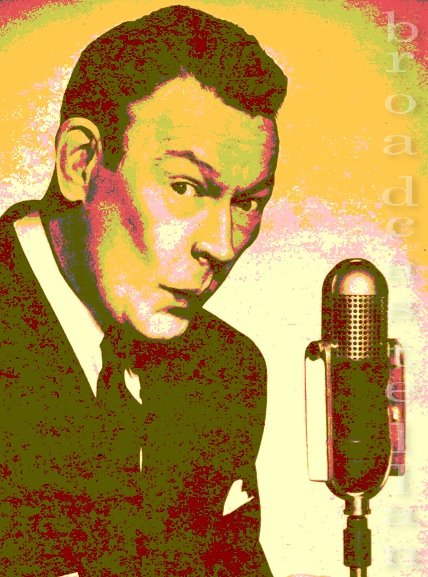
The only programming format not in danger of getting canned is the call-in, the kind of theatrical presentation that depends for its drama on the audienceโ€™s possibility of getting in on the act. You might say that audience participation programs like Stop the Music spelled the end of comedy on radio; but, aside from greed, what kept listeners glued to their sets was a sense of urgency and immediacy, of being in the here and now when it mattered, of tuning in at just the time when being live could change your life.

Seventy-five years ago, a man called Major Edward Bowes created a sensation by exploiting that very concept: give the audience a say, turn them into voters and judges, leave them with the impression that, should they chose to do so, they, too, could be on that stage, and phones will start ringing. The Amateur Hour, heard locally in 1934 on New York station WHNโ€”of which the Major was the directorโ€”went national on 24 March 1935. “You within sound of my voice are just as much part of this show as the youngsters that come to the microphone,” the Major insisted, urging listeners to “telephone [their] choice, telephone early, telephone often. You decide the winners, and the winners will receive immediate professional engagement.”

And call they did. According to the June 1936 issue of Radioland, the program

brought a rush of business to the telephone company, which had to install 200 special lines to handle the vast volume of incoming phone calls registering the preferences of voters on the Majorโ€™s talent. Ordinarily this might seem to be a nice piece of business for the late Mr. Bells concern, but company officials earnestly deprecate any such assumption. Very few nickels roll into their coffers, they explain, for most of the incoming calls are placed by subscribers who are entitled to a minimum number of calls per month as part of their service charge. Be this as it may, thereโ€™s something heartening to watch 200 nimble-fingered young women registering votes quicker than you can say โ€œMajor Bowesโ€โ€”all to the fatalistic end that a yodeler or a man who extracts music from a saw may have his chance at fame.

On that first national broadcast, at least, on the first anniversary broadcast (24 March 1935), the yodeler got the gong. “You mustn’t applaud too long,” the Major good-naturedly admonished the studio audience. “He was through the Boer War and we went through one of his yodels. So, it’s even-steven.” Winners during that first season included the Duchess of Torlonia, a Singing Garbage Man, a Chinese Hillbilly, and some Texas Cowboys from Norwich, Connecticut. The oldest contestant was 110.

Since the phone company had no stake in the matter, listeners could cast multiple votes with one call. Radio Guide put this to the test when, its representative claiming to be one of sixty-seven listeners at the Sinai Temple in Mount Vernon, New York, was able to cast sixty-seven votes all at once. The amateur for whom he voted was one Orville Edwards, an undercover Radio Guide reporter posing as a โ€œcorn-fed tenorโ€ to investigate the audition process, which, from writing the application to being on the program, lasted a mere three weeks. Proving that โ€œballot-stuffingโ€ was part of the game, Edwards came in third on the 23 February 1936 broadcast.

โ€œThe wheel of fortune spins,โ€ Edward quipped, imitating the words made famous by Major Bowes, โ€œโ€˜Round and round she goes, and where she stops, nobody knowsโ€”except the Major, and Radio Guide.

The Major and his minions were amateurs compared to the folks operating Dame Fortuneโ€™s wheel these days. Whether or not every vote counts, they make sure that it costs. Meanwhile, the results, however quickly they are tallied, are being reported at a dayโ€™s delay.

I guess we owe it to the less than choice ingredients, and a ladle now firmly in the hands of those who hunger for profits, if we are no longer feasting together at the community table. Itโ€™s a pity, really. Canned goods may be convenient; but we are missing out on the flavor of the moment.


Related writings
โ€œA-spinning goes our weekly wheel of fortune . . .”
โ€Back in the X Factory; or, the Legacy of Major Bowesโ€

โ€œAlone Togetherโ€: A Portrait of the Artist as an Artistโ€™s Spouse

โ€œSo, here he is. My father. In a churchyard in the furthest tip of Llลทn. Eighty years old. Wild hair blowing in the wind. Overcoat that could belong to a tramp. Face like something hewn out of stone, staring into the distance.โ€ The man observing is Gwydion, the middle-aged son of R. S. Thomas (1913-2000)โ€”โ€œPoet. Priest. Birdwatcher. Scourge of the English. The Ogre of Wales.โ€ With this terse description opens Neil McKayโ€™s โ€œAlone Together,โ€ a radio play first aired last Sunday on BBC Radio 3 (and available online until 28 March).
The voice of the Nobel Prize nominated poet (as portrayed by Jonathan Pryce) is heard reading lines from his works, the words that are, to us, a stand-in for the man. None of them escape the commentary of his estranged son: โ€œYes, you could tell yourself this is him, the real R. S. Thomas,โ€ the observer, filial yet unloving, remarks. โ€œBut youโ€™d be entirely wrong.โ€ As his fatherโ€™s old voice keeps on reciting, he adds: โ€œOh, heโ€™d be happy enough for you to fall for it . . . and to fall for the version he tells of his own life.โ€

What compels the son to revise this โ€œversionโ€ of a life is the life of another, a figure that, to his mind, is concealed or mispresented in the autobiography of the father. The figure is Elsi, the Welsh poetโ€™s English wife (1909-1991), whose fifty-year-relationship with R. S. was compressed by him in these lines:

She was young;
I kissed with my eyes
closed and opened
them on her wrinkles.

Speaking of their first encounter, R. S. introduces Elsi as โ€œa girl who was lodging fairly close by,โ€ the kind of icy understatement with which Thomas, writing about himself in the third person, kept his distance from his readers, just as the people he knew and wrote about were turned into abstracts on a page. โ€œHe doesnโ€™t even give her a name,โ€ the son comments, โ€œand thatโ€™s where it starts to unravel.โ€

The churchyard in which we are introduced to the father is Elsiโ€™s burial place; it is Gwydionโ€™s ambition and quest to bring her to life for us, to let us see her in something other than the austere words of an introverted, discontented, and tormented manโ€”an Anglican rector who sought isolation in the remote west of “the real Wales,” who, advocating Welsh independence and separation from England, was consumed by what the Welsh call “Hiraeth”: a longing for home. In how far did this longing, this radical yet futile attempt at forging an identity alien to him, prevent R. S. from making a home for the two, the three, of them?

Searing, severe, yet profoundly moving, โ€œAlone Togetherโ€ is a compelling play at biography; listening to it, I was reminded of the above self-portrait of Elsi, who, as an artist, was known as Mildred Eldridge, respected and sought-after long before R. S. published a line of poetry. Until now, whenever I looked at it, hanging there on a wall of our home, I have never considered it as an autobiographical act.

Both their approaches to rendering the self seem indirect, his being the third person singular, hers a reflection. Eldridge does not assume the center of the frame; nor does she give us a close-up of the face in the looking-glass; and yet, her self-portrait, tentative as it may be, allows us a glimpse at her perception. The distant self in her husbandโ€™s performance, by comparison, seems a construct, the artifice of an entire controlled performance. Unlike her husband, Eldridge appears before us the first person singular, letting us see her as only she sees herself: a mirror image.

In how far are written or spoken words a path toโ€”or a vessel forโ€”the essence of the one writing or speaking? Is anyone knowable through the vocables that are a locum for self and experience? Cautioned not to take a fatherโ€™s word for whatever โ€œitโ€ amounts to verity, can we now trust the estranged son in his voice-over, his over-writing of the words he claims to be false or misleading?

โ€œAlone Togetherโ€ suggests that, for all his accomplishments as a writer, R. S. Thomasโ€”who yearned to be Welsh but could not speak it, who, as Elsi puts it, โ€œadopted the vowels of an Oxford Donโ€ to hide the shame of being, as he puts it, an โ€œignorant Taff from Cardiffโ€โ€”envied the ease with which his accomplished artist wife communicated in a language beyond words, expressed herself freely on a blank canvas . . . and felt at home there.

Floyd and the Flood

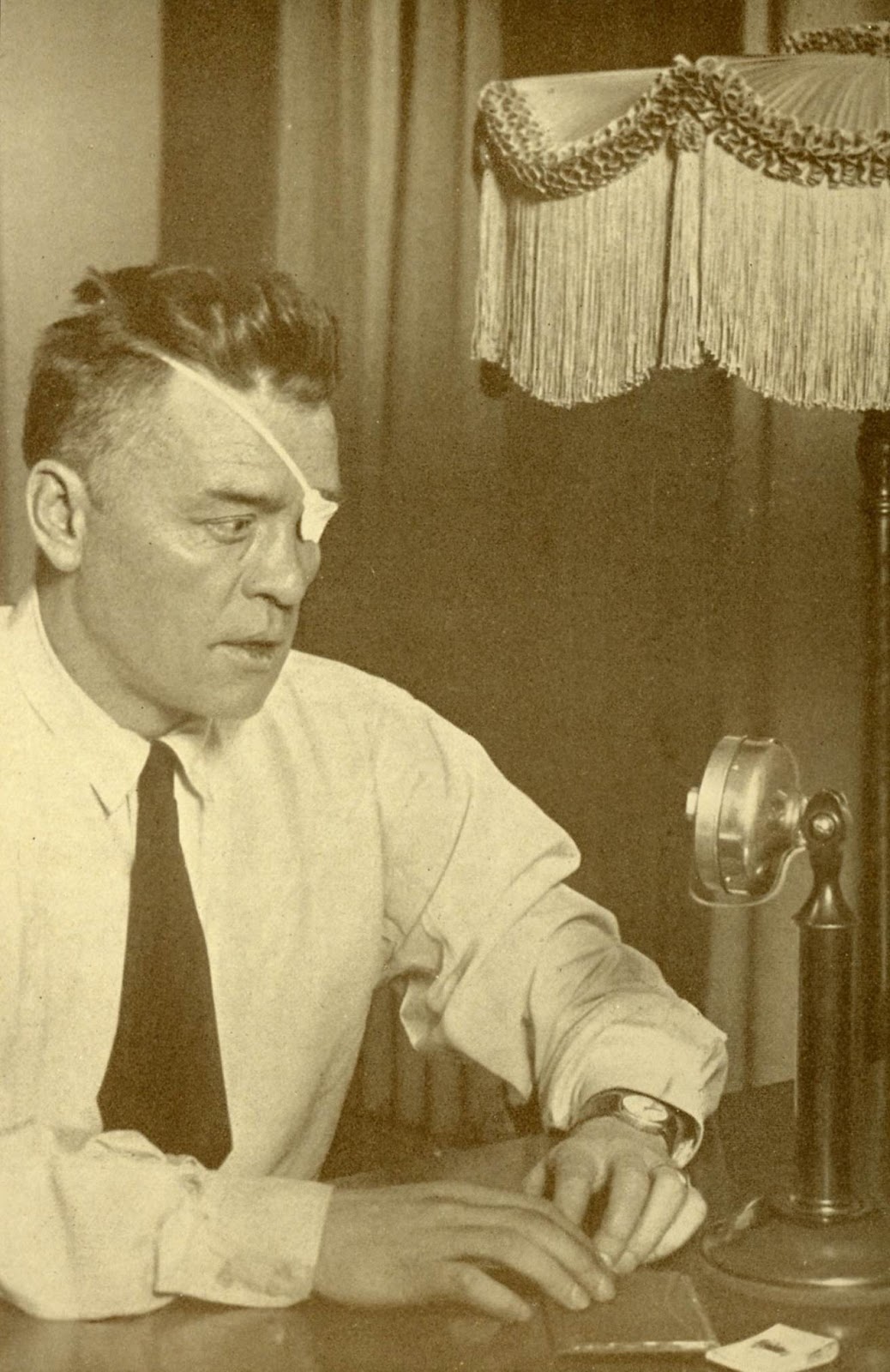
Wherever fighting men are in actionโ€”wherever disaster shakes the earthโ€”wherever history is in the makingโ€”there youโ€™ll find Headline Hunter Gibbons, the machine-gun stylist of words.

His record is 217 words a minute, steady flow for sustained speech. But what a price he has paid for the background that makes his record possible!โ€”His body is crosspatched with bullet wounds and sword cuts. The spot where his left eye should be is covered by a white patch. Heโ€™s bivouacked on the feverish sands of Mexico, India and Egypt. His toe joints have been frozen on the arctic waste of Manchuria.

But heโ€™s happy. It is his life and he loves it.

That is how a 1934 article in Radio Guide (for the week ending 17 November) introduced Floyd Gibbons (1887-1939), a news commentator whose life was as thrilling and fast-paced as the one he breathed into the scripts he readโ€”or, rather, performedโ€”on the air.

Delivering his lines, and with such rat-a-tat rapidity, was not easy for the battle-scarred Headline Hunter. According to Robert Eichbergโ€™s Radio Stars of Today (1937), Gibbons was with the American army at Belleau Wood, France, when, on 6 June 1918, the major leading his troop was struck down by German machine gun fire:

Suddenly a bullet struck Floyd in the left shoulder, and another tore through his left arm. Still he crept toward the stricken officer, only to have a third shot pierce his steel helmet, fracturing his skull, and blind him in his left eye.

As one of his colleagues, John B. Kennedy, recalls (in Robert Westโ€™s 1941 broadcasting history The Rape of Radio), Floyd โ€œused to have his scripts typed in jumbo type so that he could read easily. โ€˜With that big type he would come to the studio with forty or fifty pages of stuff, almost four times as many as the rest of us used!’โ€

Little now survives of Gibbonsโ€™s celebrated broadcasts, aside from a couple of reports aired on the Magic Key program. In March 1936, Gibbons returned to the airwaves after nearly seven months, โ€œgladโ€ to be getting away from the crisis in Ethiopia to focus instead on a natural catastrophe much closer to home: the Connecticut River Valley flood. A few years earlier, he had abandoned his coverage of the Sino-Japanese conflict to rush to Hopewell, New Jersey, to get in on the sensational story of the Lindbergh baby kidnapping.

In his Magic Key notes from 22 March 1936, which Jim Widner shares in his tribute to the man, Gibbons referred to the overflowing of the Connecticut River as โ€œthe worst flood in the history of the last half century.โ€ Seen, as he had it, from aboveโ€”a view not generally afforded his listenersโ€”the valley looked like a โ€œvast inland seaโ€ on which Gibbons spotted โ€œdismal, un-milked cowsโ€ and โ€œbedraggled wet chickensโ€ that were โ€œperched bewilderedโ€ upon โ€œisolated elevations like animated weather cocks.โ€

Gibbons talked of the โ€œwithered mushroomsโ€ that were the gas and oil tanks of the refining companies, each containing โ€œhundreds of thousands of explosive fuel which in turn represent fire and disaster should these enormous receptacles be torn loose from their foundationsโ€ and โ€œlose their fiery contents.โ€ Those at work to prevent further disaster looked like โ€œLilliputiansโ€ as they tried to โ€œtie down these deadly metallic giants.โ€

Meanwhile, in the riverbed,

in which ambitious men had hoped to incarcerate old man river with dikes and dams of stone and steel, the prisoner [ was] lashing, foaming, writhing like a serpent striking back with frightful force and power, an unexpected fury.

Some nine months before his death, Gibbons gave a brief account of his exploitsโ€”riding with Pancho Villa in Mexico, sailing on the Laconia when it was torpedoed and sankโ€”to listeners of the Lux Radio Theater (16 January 1939). In it, he remarked that

the best and most truthful report of any happening is that of the personal eye-witness who can honestly say “I saw it. I was there when it happened.” He has to keep in mind the importance of the main event, but must not overlook the apparently unimportant little facts that prove the truth of the story.

In the rush of his reportage, โ€œlittle factsโ€ at times made way for great effects. According to West, Gibbonsโ€™s report of the Ohio River Flood of 1937 referred to โ€œsensational happeningsโ€ that had not actually taken place as described. Gibbons was sued for two hundred and fifty thousand dollars in damages by a scriptwriter who argued that โ€œhis reputation had been marred.โ€

What Gibbonsโ€™s rapid-fire imagery does convey, though, is the fury of the scenes we imagine he beheld. In a rhetorical style long fallen out of favor but so vital to depiction in the absence of visuals, Gibbons personified the threatening force of the raging Connecticut River to capture the truth of the moment in a torrent of pathetic fallacies:

Like a slave, freed from the chains of his presumptuous would-be masters, the river is striking back in wild retaliation. It seems to say: for years, for years I have turned your wheels and lighted your cities and watered your fields and cattle, and heated your homes and transported your commerce; and now, now comes my day of revolt, to show you my strength.

At the conclusion of his report from the Connecticut River Valley, Gibbons paid his respect to those who kept their ears to the flooded ground and saved โ€œthousands of livesโ€ simply through word of mouth: a โ€œnewly developed class of men and women,โ€ the โ€œshort and long wave amateur operatorsโ€ who, โ€œ[w]hen landlines and other means of high-power communications became disruptedโ€ by the flood, โ€œstuck to their dangerous postsโ€ and โ€œkept going a running fire of information.โ€

Few understood better than the Headline Hunter how to keep that fire from dying out; and to men like him we must turn to rekindle our imagination in a world awash with images.

Hand a Swellhead a Pin and Heโ€™ll Make It His Scepter

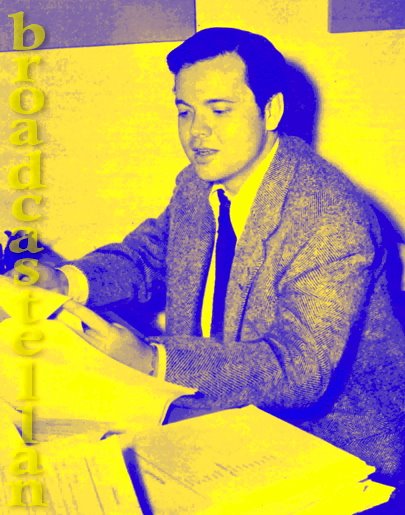
Personally, your editors don’t like Mr. Welles. He is the seven-year-old kid next door who has a vocabulary twice his size. He is the good-looking young man who walks off with your best girl. He is the braggart who says impossible things and then does them. Your editors are average people. Thatโ€™s why they personally are not fond of the man who is too good and knows it and shows it! . . . Your editors donโ€™t like him because everything he does is perfect, from movies to radio plays. But heโ€™s good, drat it, he is!

That is what the readers of a May 1941 issue Movie-Radio Guide were being told about the most talked about man in radioโ€”Orson Welles.

I wouldn’t be surprised if this backhanded compliment had been dictated by the erstwhile Wunderkind himself. However uneven his career, however fickle his fortunes in Hollywood, the kid from Kenosha kept the conceit of his genius alive on the radio, which, immediate and expedient, proved just the medium for putting on airs.

In March of 1943, when comedian Jack Benny was unable to carry on with his weekly broadcasts, Welles was chosen to fill in for “old sniffle snoot.” The format of the Grape Nuts Flakes Program remained intact, and Jackโ€™s gang was at hand to become foilsโ€”or fodderโ€”for the theatrical showman-thespian.

Now, Benny had pretty much perfected the comedy of deflation by creating the persona of a pompous, vain, miserly and slightly delusional performer at whose character flaws listeners felt at ease to laugh even if the act held a distorting mirror to them by accentuating their own failings. It was not so with Welles, for whom self-deflation seemed to have been just another means of boosting his ego.

Whereas Benny presents us with a caricature whose features are not unlike some of our own, Wellesโ€™s persona was always larger than life, and as such untouchable. โ€œI have spent years inflating the balloon that is Welles,โ€ the guest tells Benny regular Dennis Day: โ€œPlease do not puncture it.โ€ Fat chance, really.

On the 21 March 1943 broadcast, Welles was not so much filling in for Benny as he was filling up the studio with his aura, dimming the sunny atmosphere by shrouding it in layers of Orson. It might be a gasโ€”but, aside from Welles’s hilarious take on the Grape-Nuts commercialโ€”it isn’t quite nitrous oxide. As Simon Callow puts it in Orson Welles: Hello Americans,

[p]art of the problem is that, unlike the Jack Benny character, which is preposterous and bears no relations to the real man, this โ€œOrson Wellesโ€ is uncomfortably close to the real one: are we laughing at or with him?

Indeed, the โ€œballoonโ€ act seems โ€œself-serving,โ€ an advertisement for what could be too readily taken for the man himself. Aided by Bennyโ€™s writers, Welles in his grandeur does not have to suffer one scratch from Mary Livingstoneโ€™s barbs (“Gee, I like this guy”) or Eddie Andersonโ€™s retorts (“Mr. Welles, working for you is paradise”). Being that the entire act revolves around him, none of his fellow players gets an opportunity to cut him down to any size other than super. The familiar casting skit, in which Welles rehearses a scene that gives none beside him a chance to get a word in, works far better on the Fred Allen Show, where one genius was pitted against another, where the war of the words and the battle for a line becomes a genuine sparring match.

โ€œOrson Welles is a genius,โ€ Don Wilson concludes the broadcast, โ€œbut this program was written by Bill Morrow and Ed Beloin.โ€ That remark, drowned out by the applause from the studio audience is about the only jab at Welles, who was known for taking all the credit. No, the โ€œballoon that is Wellesโ€ was not in danger of popping, โ€œprickโ€ being a noun in this case. If only Welles had permitted himselfโ€”or been permitted by those who helped to fashion and fix his personaโ€”to accept the pin without turning it into a scepter.


Related recordings
Grape Nuts Flakes Program, 21 March 1943

East If With Eagle

For the reward of a single dollar, readers of Movie-Radio Guide used to send in โ€œbonersโ€โ€”fluffed or unintentionally funny lines they had caught on the air. On 29 Feburary 1940, for instance, Olive Doeling of Petaluma, California, tuned in to station KGO and heard Benny Walker (Benny Walker?) say: “Wish you could see her, folks. She’s lugging a saxophone almost as big as she is behind her.โ€ Another buck went to a listener from Jackson, Mississippi, who reported the following exchange between Major Bowes and a contestant on his Amateur Hour broadcast from 7 June 1936:

CONTESTANT. I was a dressmakerโ€™s model and then I married.
MAJOR. Wholesale or retail?

Reading lines like these makes me want to tune in the original program, to find the recording and hear for myself.

The other day, when I read that Mary Livingstone was supposed to have giggled โ€œJack, Iโ€™ll never forget the look on that ski house when it saw your face,โ€ I wondered whether that was indeed what she had said and how her husband, the cast, and the studio audience had responded. Listening to a recording of the 25 February 1940 broadcast of the Jell-O Program, I heard no such fluff. โ€œIโ€™ll never forget the impression on your face when you crashed in the ski house,โ€ Livingstone said instead. Had J. N. Lawrence from San Diego earned that dollar? Was the โ€œbonerโ€ bona fide or bogus?

Well, before accusing any of those tuners-in, I had to remind myself that many of the live programs of the past were staged twiceโ€”once for the East Coast, then for the West. What J. N. Lawrence had picked up on California was not what anyone living East could have heardโ€”or anyone listening to a recording of the East Coast broadcast.

How different the two broadcast could be was demonstrated on 20 March 1940, when a certain Mr. Ramshaw caused a riot on the Fred Allen Show. Mr. Ramshaw was a celebrated Golden Eagle who toured the US with his British trainer, falconer Captain C. W. R. Knight. The Captain was encouraged by Allen to let the Mr. Ramshaw fly around in the studio; but, as it turned out, he had little success in convincing the bird to return to him as rehearsedโ€”and not until he had left his mark on the members of the audience assembled in studio 8-H, Radio City, New York.

Actually, as Allen recalled in Treadmill to Oblivion, Mr. Ramshaw had narrowly “missed the shoulder of a student who had come down from Fordham University to advise [Allen] that [he] had won a popularity poll at the school.”

Responding to a complaint from the vice president of NBC, a less than apologetic Allen remarked: “i thought i had seen about everything in radio but the eagle had a trick up his feathered colon that was new to me,” to which he added: “i know you await with trepidation the announcement that i am going to interview sabu with his elephant some week.”

There was no getting back to the script that evening; and the commotion that ensued was another forceful reminder that, for all his talent as a writer, Allen was in even finer feather when he did not have to stick to the ink from his mechanized quill. Now, winging it, or flying by the seat of oneโ€™s pants, was not condoned by those who footed the bill of comedy-variety programs and kept an eagle eye on their production. Everything had to be performed as scriptedโ€”and strictly within the time allotted for each number, sketch, and broadcast.

So, when Allen had to repeat his program three hours laterโ€”at midnightโ€”for the West Coast audience, the spokesperson of Young and Rubicam, the advertising agency working on behalf of the showโ€™s sponsor, did not permit Mr. Ramshaw to make an encore. The segment was out, and, as Stuart Hample (author of โ€œall the sincerity in hollywoodโ€ told Max Schmid in a 4 November 2001 interview over WBAI, New York, Allen was forced to revise the script and remove the offending segment.

Allen defended his feathered guest by claiming that Mr. Ramshaw had resented the censor’s “dictatorial order” and, “deprived by nature of the organs essential in the voicing of an audible complaint, called upon his bowels to wreck upon us his reaction to [Mr. Royal’s] martinet ban.”

The feather “l’affaire eagle” added to Allen’s cap never got to tickle his West Coast listeners. Network radio programs may have had a coast-to-coast audience; but, be it an eagle, a turkey, or a lark, some of what took off or managed to escape in the East could never fly or land in the West.


Related recordings
Fred Allen Show, 20 March 1940

Fa(r)ther?

Historically speaking, it is difficult for me to get the larger picture. When I express anything amounting to a weltanschauung, I go all philosophical. Perhaps, I live too much in the confines of my own peculiar everyday to engage with the political events and developments that shape my existence. Life in the United States has taughtโ€”or, at any rate, encouragedโ€”me to live in and for the now, a modus of going about oneโ€™s affairs that is more personally rewarding even though it might not always be quite so socially or globally responsible. Seizing the day for the sake of that day and its glories alone is not something to which Germans, in particular, are prone; they are more likely to seize opportunities for the future, or another country, for that matter.
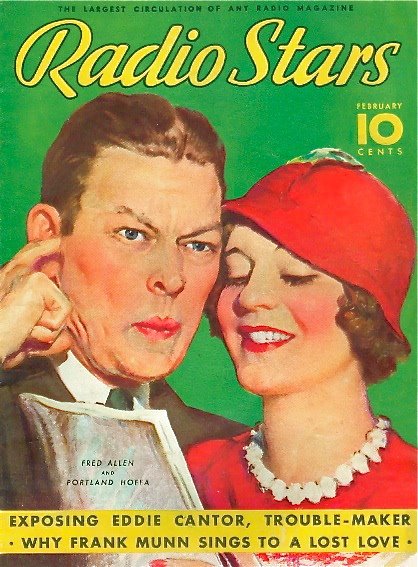
In the old world, people tend to plan for what might happen in generations to come; they are anxious to map out what they presume to lie ahead, sometimes for as much as a thousand years. I suppose that, once those old world futurists went west to seek their fortune, they needed to learn to reconcile themselves to the vagaries of the wilderness, to fight everyday battles, to carve a niche for themselves right out of those woods.

In societies that have a medieval past in which the individual matters less than the tribe, fascism and communism are more likely to flourish than in the United States. Creating order out of the chaos that is time not yet present so as to provide for the future of oneโ€™s kind makes even genocide justifiable.

I wonder whether, had I been born American and grown up the in United States during the 1930s, I had possessed the foresight to anticipate just what this kind of mindset is capable of undoing and getting done. Would I have been an isolationist or urged for an involvement in the European conflict? Would I have been all peacetime business as usual or seen war as a way of insuring the future of an ideal?

I trust that, for all my shortsightedness, I would have seen right through a man like Father Charles Coughlin, who, back in 1939, continued to rail against the warmongers in the US. Using the microphone and Social Justice magazine as means of reaching the American multitudes, he went so far as to recruit school children for his cause. On 19 March 1939, the notoriously anti-semitic priest offered prizes to any youngsterโ€”Christian, Jew, or gentileโ€”who could best express reasons to stay out of a foreign โ€œentanglementโ€ involving military action. One answer suggested by the announcer of Coughlinโ€™s radio addresses, who was also a spokesperson for Social Justice, hailed economic sanctions as a modern mode of warfare.

In 1936, Father Coughlin could still count on a popular magazine like Radio Guide as a forum to pose a challenge to โ€œFranklin Doublecross Roosevelt,โ€ the President he had staunchly supported some six years earlier. By 1940, Coughlinโ€™s influence was vastly diminished, his motives questioned, his hypocrisy exposed. In an issue of Radio-Movie Guide for the week of 16 to 22 March 1940, news editor and radio historian Francis Chase, Jr. shared the outcome of his investigation into Coughlinโ€™s mysterious absence from the airwaves on 4 February of that year when a “series of cryptic and intriguing announcementsโ€ informed the listening public that Coughlin โ€œwould not appear to speak and intimated that dire and sinister forces were at work to prevent his addressing the radio audience.โ€ Chaseโ€™s subsequent

investigations showed that neither [station] WJR nor the Coughlin radio network had censored Coughlinโ€™s address. ย Neither had the Catholic Church nor the Federal Communications Commission. ย The inescapable conclusion to be drawn, therefore, is that Father Coughlin, and Father Coughlin aloneโ€”was responsible for the weird performance after exhorting, through his announcer, all listeners-in to telephone their friends and get them to their loudspeakers.

Apparently, Coughlin was determined to present himself as a martyr threatened to have his tongue cut off by those who did not like what he had to say. Among those who very much liked what Coughlin saidโ€”and who liked what his staged disappearance from the airways might implyโ€”where the editors of Hitlerโ€™s Vรถlkischer Beobachter, who sneered that, in a so-called free America, Coughlin was facing censorship for the โ€œtruthsโ€ he dared to speak.

Was Coughlin, who envisioned a fascist โ€œCorporate Stateโ€ to do away with what he argued to be a corrupt United States, consumed with the larger picture in a foreign frame? Or was he, Canadian-born and barred from the Presidency, picturing mainly himself in whatever frame suited him best or was most likely to accommodate him?

However far-reaching or far-fetched his scheming, much of what the far-righteous Father espoused Chase demonstrated to be personally motivated. When Coughlin denounced the worshipping of the โ€œGod of Gold,โ€ for instance, and argued it a “Christian concern” to restore silver to โ€œits proper value,โ€ the US government disclosed that the Thunderer of Royal Oak owned “more silver than any other person in Michigan.โ€ While loudly condemning “Wall Street gambling,โ€ Coughlin was known to have played the stock market.

Sure, even the larger pictureโ€”a vision, however ghastly or inhumaneโ€”is only a reflection of the minds that conceive it; but in how far are the likes of me, whose frame of mind is too narrow or too feeble to get hold of that larger picture, content to be framed by the masterminds who seize the opportunity of creating, mounting and authenticating it?


Related recordings
Coughlin broadcast 19 March 1939
Coughlin broadcast 4 February 1940

Related Writings
โ€œ’I hold no animosity toward the Jews’: The Father Coughlin Factor”

โ€œ. . . a world between two soundsโ€; or, the Librarian Who Turned Up the Volume(s)

I could not have faulted anyone for brushing me off with a terse โ€œnone of your lip,โ€ considering that my kisser had taken on the appearance of an over-boiled frankfurter abandoned during a picnic invaded by flesh-eating ants. 

Luckily, sight at the time mattered less than sound, and the painkillers had not entirely divested me of whatever powers of articulating my ideas I yet possess. Yesterday morning, during a meeting with administrators at the local university, interest was once again expressed in a course I had proposed a few years earlier. I fancifully titled it โ€œWriting for the Ear,โ€ which was meant to distinguish the module from more traditional classes in radio writing as they are still being taught here in Britain.

I had previously turned down an offer to teach a course in writing for the medium, as I have no experience in developing scripts aimed at those in charge of productions at the BBC.

Besides, todayโ€™s technology makes it possible for anyone to have a voice in the forum, to podcast talks and engage in sonic experimentation. With these opportunities in mind, I outlined a course exploring the relationship between the spoken and the written that would make those who express themselves typographically alive of the value of sounds and the potentialities of silences.

Too much of the most eloquent prose and sonorous poetry is being silenced. Words written hundreds of years ago are still being pored over, but they are far less frequently voiced and heard. In classroom and study, printed words are scrutinized, paraphrased, underlined, crossed out, and annotated; they are dissected like so many toads in the imaginary garden, well before they get a chance to let out a single distinctive croak.

Lending your own voice to written lines is an act of resuscitationโ€”of breathing life into the thoughts of those who came before you, of triggering a startling echo in what was assumed to be a soundproof vault. Silences, too, speak volumes, especially when they enter into a dialogue with the spoken and the sounded.

Someone who had a lot to say on the subject of the word made sound was Archibald MacLeish, the Pulitzer Prize winning poet who, from 1939 to 1944 served as Librarian of Congress. Before being appointed Assistant Secretary of State for Public and Cultural Relations, MacLeish brought to radio a series of lectures titled The American Story. At a time of global conflict, the program was designed to emphasize

the experience in common of the American peoples, the story set down in the accounts of those who knew the American experience at first hand or were part of it. Whatever their race may have been, or their faith, or their language.

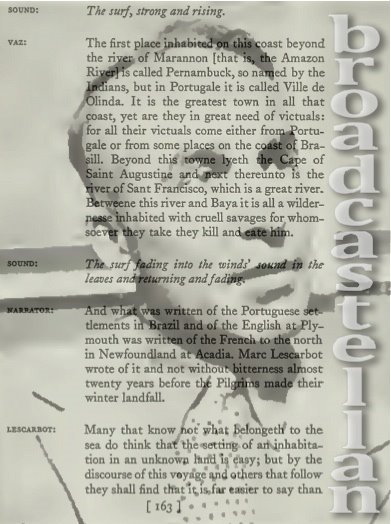
In other words, it took a scholarly approach to what Carmen Miranda accomplished in the conga line of duty. On this day, 18 March 1944, NBC presented โ€œBetween the Silence and the Surf,โ€ the eighth broadcast in the series. It related the settlement of the Americas, from Plymouth (as recorded by William Bradford in the 17th century) to Brazil (as documented by Lopez Vaz in the 1580s). I recently rediscovered the program while digitizing my collection of audio tapes; the published scripts, meanwhile, have been shared online. The printed words bespeak the poetโ€™s mission of giving voice to the lost and long unsounded, to lives shelved and shut away in our repositories of knowledge:

SOUND.ย  A slow surf, the hush of the waves withdrawing.

NARRATOR.ย  And the windโ€™s sound in the grass or in the brush or in the forests where they still must go.

SOUND.ย  The wind in the coarse grass and the solemn trees.

NARRATOR.ย  The world of the first settlements was the narrow world between the silence and the surf, between the water and the wildernessโ€”between the past cut off by water and the future closed by distance and by dangerโ€”but not closed.

According to the April 1944 issue of Radio Age, MacLeish โ€œpoured an immense amount of painstaking research,โ€ into this series; and in “addition to the laborious research and authentication,” he included the

most important fillipโ€”his own brilliant style of the prose poem, a style which has won for him the accolades of the literary world. Each line read on the broadcast is a part of this poetic narrative style, giving each program a dramatic sweep so necessary in producing the effect desired.

Yet while the poet claimed to have aimed at creating โ€œnew forms of radio expression,โ€ rather than adhering to the formats of โ€œconventional radio drama,โ€ critics were not uniformly enthusiastic, arguing the productions to be โ€œoverloaded with conversationโ€ and โ€œself-denyingly austere.โ€ Such gainsayings are representative of the bias toward dramatization and dialogue as opposed to lecture or oratory, no matter how many individual speakers were employed to deliver it.

In the foreword to the published scripts for the series, MacLeish defended his minimalist approach by reasoning that โ€œradioโ€™s unique function and unique opportunityโ€ was simply to convey speech instead of presenting words, โ€œartfully blendedโ€ by means of โ€œ[s]killful devices,โ€ to โ€œproduce dramatic effectsโ€:

Because radio is limited mechanically to sound, and particularly to the sound of speech, radio is capable of a concentration of speech itself, the text itself, which can give words a life and a significance they rarely achieve outside the printed pagesโ€”and which they achieve there only for the most gifted and fortunate readers.

The word, to MacLeish, was the beginning and the end. As a documentarian and poet, he inhabited that “world between two sounds,” listening, recording, and readying himself to speak with force and deliberation. His American Story is the story of humanity’s struggles for survival, for voice and representation.

Our daily existence, like that of the first settlers, is this โ€œnarrow world between the silence and the surf,โ€ between the calm and the roar, between tumult and tranquility.  Our lives are a string of moments waiting to be seized for having our say, periods of stillness, voluntary or imposed.  We may chronicle our times and leave behind piles of documents to be poured over or neglected by future generations; but it is the sound we make now and the space we leave for listening that define the present we must fill with meaning as we rage against the silence to which we are ultimately condemned . . .

What You Might Find While Down in the Mouth

If Iโ€™ve been keeping my trap shut lately, itโ€™s on account of some festering crumbs in my cake hole. Sure, I can jaw away about most anything, but Iโ€™ve got to have the mind and the mandible to do so. For days now I have been plagued by mouth ulcers that are putting a muzzle on my spiritsโ€”not the kind of oral culture I generally engage with in this journal. My gums are following economic trends, making me feel ever longer in the tooth. My left cheek, in turn, might lead you to believe that, in an effort to dodge the downturn, I managed to squirrel something away for a day on which I may mercifully hide my mug under an umbrella. Meanwhile, my taste buds have started to sprout and my lower lip, Angelina Jolied out of all proportions, is suggestive of a law suitable botch or a risk taken by the likes of Maxie Rosenbloom.

Always one to self-diagnose and over-the-counter medicate rather than to seek the professional opinion of someone who, like a satirist with a stethoscope, makes a career out of scrutinizing us at our most unsightly, I have been pondering my condition and its causes. Though I cannot rule out trauma resulting from vigorous brushing recently recommended by my hygienist, I am not inclined to blame my current state on the stress produced by our impending move; if I were quite so readily distressed, I would hardly have survived my previous transplantations. Besides, I have always resented being thought of as a mere tangle of nerves in need of careful rewiring.

I have a long history of allergies, though; and given that my symptoms began to occur following a dinner outing last week, it might well be that my sores are a reaction to something passing my lips that night. Heretofore, my catalogue of allergens has been limited to felines, grass, and dust. Now, that hasnโ€™t kept me from cat-sitting, of which you can make a career in New York City, or from relocating to one of the grassiest spots on the planet; and it certainly did little to convince me to take out the feather duster more often than the snot rag or the inhaler.

I was told early on by the still extant half of the temporary connubial unit responsible for my coming into beingโ€”and for getting the heck away from whence I hailโ€”that allergies are an aberrant mental state and that cycling to school through the cornfields or mowing the lawn were activities I could handle if I only put my mind to it. True, I have always been mildly allergic to physical labor; but that was in part due to the damage I saw it inflict on the body, the mind, and the spirit.

My fatherโ€™s religion was social Darwinism, in the practicing of which he drank himself to death. It would have been futile to convince him that an undistilled grain could be as lethal as a distilled one and that what doesnโ€™t kill you instantaneously does not necessarily make you any stronger in the long run.

I had not planned on delving into my personal history, medical or otherwise. As is often the case, such memories are squeezed out of me by the mere twisting of the dial. Listening to Fred Allenโ€™s 1937 St. Patrickโ€™s Day broadcast, I was reminded of the kind of book I would have liked to have thrown at certain parties aforementioned.

Fred Allen is always good for a few laughs, however painful their elicitation. Annotating his quips can prove more rewarding still. Well before the hosts of our present day chat shows, satirist Allen raided the daily news for his weekly radio programs. In his Town Hall News (โ€œsees nothing, shows allโ€), Allen commented on the goings-on in New York City, on politics, the economy, on culture high and low. Here is the first of the 17 March 1937 Town Hall News bulletins:

New York City, New York. Dr. R. P. Wodehouse, speaking at the American Institute of General Sciences, claims that hay fever and asthma are increasing in this country. Dr. Wodehouse says clearing up of native vegetation and its replacement by alien plants will add to number of victims.

Allenโ€™s reading of this news item is followed by a skit demonstrating the wide-ranging effect the predicted rise of allergic reactions might have on the afflicted urbanite. This time, though, I was more interested in Allenโ€™s source than in his take on it. My curiosity being immune to ulcers, I soon caught up on R. P. (no relation to P. G.) Wodehouse and his endeavors to โ€œwin the secret of a weedโ€™s plain heartโ€ (a quotation prefacing his 1945 study on Hay Fever Plants).

I wish R. P. Wodehouse had been a household name where I grew up; but, as the good doctor reminds me, by quoting John James Ingalls, โ€œgrassโ€ is the โ€œforgiveness of nature.โ€ Iโ€™ll have to learn to let it grow over my own family plotโ€”and concentrate instead on finding out how to avoid another catastrophic invasion of my oral flora. To cure my foul mood, a generous dose of Fred Allen is indicated . . .

Elbows and Audacity

Unlike my imperialist, Anschluss-eager ancestors, I am not anxious for Lebensraum, the supposed deficiency thereof justified many acts of ruthless expansion. If I lack living space, I tend to shrink-fit myself back into it; instead of elbowing my way out of a tight squeeze, I grab and ditch whatever the chosen niche cannot hold. The size of a pad has always been less important to me than its position or the pal who shares it. For much of my adult life I did not have as much as a closet to myself, let alone a room to call my own. Letting go of stuff has been both essential and elementary. True, I never possessed much that could not be replaced or that required ample room to place it in. A few photo albums, personal letters, and an old teddy bearโ€”little else of mine has double-crossed the Atlantic as I, the disloyal Teuton, migrated from the Rhineland to the East River, from Manhattan to rural Wales.

Perhaps, it is this sense of freedom from dead weight, this longing be without belongings that attracted me to the theater of the mind. Back in New York, crammed into small quarters I knew I had to vacate before long, I began to collect the immaterial, the non-stuff that gathers no dust: plays written for the ear, tales unfolding on the air. Practically all of them are now stored on a single laptop . . . except for that impractical drawer full of plastic cases, the magnetic tape that can only hold so much and, of itself, so little attraction. Audiocassettes, I mean.

A mere decade ago, when I was writing my PhD dissertation (at a โ€œdeskโ€ that doubled as a dining table), I had not yet caught on to the disencumbering economy known as mp3. Dozens of cassettes, purchased from various vendors of old-time radio recordings, were piling up in my digs, no matter how much I tried to preserve space by dubbing them from 60 to 120-minute tapes. To this day, many of those tapes still fill a large drawer, well out of earshot now that my Mac serves as my receiver, my library, and my annex.

Over the years, I have been able to replace many of them with digital recordings shared or sold online, albeit at a loss of fidelity. The ones that remain are of the rarer sort, the highbrow and experimental kind with which I set out to sell my study to academics reluctant to conceive of radio dramatics as literature. Most of these plays have been published on the paper that bestows upon them a watermark of distinctionโ€”a bias in favor of ink over air that bolstered my argument that the works of Archibald MacLeish, Alfred Kreymborg, Norman Corwin and Morton Wishengrad are indeed โ€œoral literature,โ€ an unfortunate oxymoron to which we resort when referring to the airborn(e) words whose life exceeds the margins of the printed page and the boundaries of the โ€œwooden O.โ€

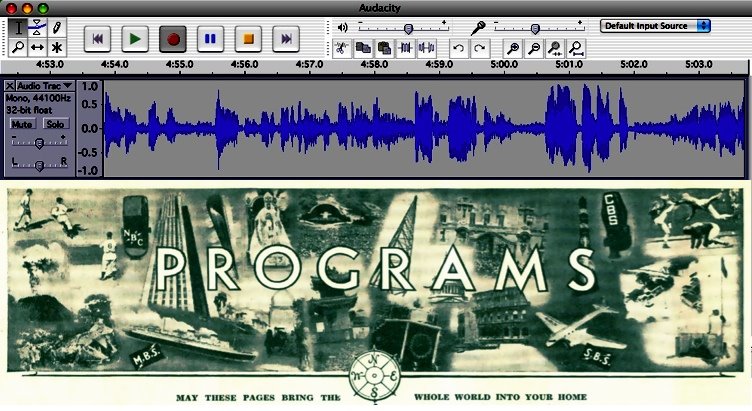
Along with music and poetry, the boxed-in cassettes encase the voices of old friends, the sounds of distant places and past lives. To get them out of their timbered limbo I recently downloaded Audacity, software that converts old tape to new files. For the past two weeks now I have done little else besides dubbing, editing, merging tracks, removing imperfections and changing the speed of recordingsโ€”all with a single-minded diligence that leaves little room for doubt: you just canโ€™t get Germany out of this old boy.

And why save all this space now that we are about to move into a house roughly three times as large as the old one? Perhaps, I am not such a free spirit after allโ€”just too lazy-boned to lug all that excess baggage. Could it be that what elbow greaseless me appreciates most about being at play in the theater of the mind is that it does not require the shifting of scenery? Be that as it may: I hope shall not long lack the time to make room for the stale air that is my element and the out-of-dating that is my mรฉtier.

For the Love of Brian; or, The Gospel According to Judith Iscariot

In a few weeks, all going according to plan, I shall be moving west, to the Welsh seaside town of Aberystwythโ€”a short move long in the making. Once in town and halfway settled, I shall set out to uncovering whatever pop-cultural past it hasโ€”you know, Liz Taylor slept here, Ben Gazzara filmed there; that sort of thing. When it comes to broadcasting, the prized hobbyhorse in my imaginary stables, no connection shall be too tangible to warrant my far-fetching it.

The other day, I missed out on a fine opportunity to introduce the place when BBC Radio Wales aired โ€œAberystwyth Mon Amour,โ€ an adaptation of the comedy-noir thriller by Malcolm Pryce, the first in a series that continued fancifully with Last Tango in Aberystwyth and Donโ€™t Cry for Me Aberystwyth. Dazzled by the likes of Carmen Miranda and Lucille Ball, I neglected to study the Radio Times for something of local interest.

Some travel notes and theater reviews aside, my life in Wales has not as yet been a significant aspect of my writings. All the same, it gave life to this journal. Not long after relocating here from New York City, when I did not seem to figure in the landscape, let alone signify in the culture, I decided in my isolation and estrangement to share what I knew or cared to rememberโ€”and it has been a comfort to me.

A few years ago, I posed here with my copy of The Unbearable Lightness of Being in Aberystwyth. Back then, what felt unbearable was the burden of my own lightness, the feather-weightiness of my existence in the relative obscurity of a rural community to which I could or would not relate. Being here did not exactly feel light; but the town made some effort to lighten up a bit today.

After thirty years, Aberystwyth lifted a ban on the screening of the supposedly blasphemous Monty Python satire Life of Brian, currently ranked among the top 250 films on the Internet Movie Database. According to the BBC, its decriminalizing will be celebrated with a charity event attended by three members of the cast: Terry Jones, Michael Palin, and Sue Jones-Davies. It was Jones-Daviesโ€”the love of Brian, Judith Iscariotโ€”who made it happen. After all, she is the mayor of the town now; and by lifting the ban on her screen image, she also improved the image of Aberystwyth as a place that isnโ€™t too heavy-handed in its dealings with the lighthearted and the irreverent. Thatโ€™s some relief to me . . .


Related writings
โ€œMining Culture: The Welsh in Hollywoodโ€
โ€œLittle Town Blues; or, Melting Awayโ€
How Screened Was My Valley: A Festival of Fflics (October 25-27)