
 Unlike my imperialist, Anschluss-eager ancestors, I am not anxious for Lebensraum, the supposed deficiency thereof justified many acts of ruthless expansion. If I lack living space, I tend to shrink-fit myself back into it; instead of elbowing my way out of a tight squeeze, I grab and ditch whatever the chosen niche cannot hold. The size of a pad has always been less important to me than its position or the pal who shares it. For much of my adult life I did not have as much as a closet to myself, let alone a room to call my own. Letting go of stuff has been both essential and elementary. True, I never possessed much that could not be replaced or that required ample room to place it in. A few photo albums, personal letters, and an old teddy bear—little else of mine has double-crossed the Atlantic as I, the disloyal Teuton, migrated from the Rhineland to the East River, from Manhattan to rural Wales.
Perhaps, it is this sense of freedom from dead weight, this longing be without belongings that attracted me to the theater of the mind. Back in New York, crammed into small quarters I knew I had to vacate before long, I began to collect the immaterial, the non-stuff that gathers no dust: plays written for the ear, tales unfolding on the air. Practically all of them are now stored on a single laptop . . . except for that impractical drawer full of plastic cases, the magnetic tape that can only hold so much and, of itself, so little attraction. Audiocassettes, I mean.
A mere decade ago, when I was writing my PhD dissertation (at a “desk” that doubled as a dining table), I had not yet caught on to the disencumbering economy known as mp3. Dozens of cassettes, purchased from various vendors of old-time radio recordings, were piling up in my digs, no matter how much I tried to preserve space by dubbing them from 60 to 120-minute tapes. To this day, many of those tapes still fill a large drawer, well out of earshot now that my Mac serves as my receiver, my library, and my annex.
Over the years, I have been able to replace many of them with digital recordings shared or sold online, albeit at a loss of fidelity. The ones that remain are of the rarer sort, the highbrow and experimental kind with which I set out to sell my study to academics reluctant to conceive of radio dramatics as literature. Most of these plays have been published on the paper that bestows upon them a watermark of distinction—a bias in favor of ink over air that bolstered my argument that the works of Archibald MacLeish, Alfred Kreymborg, Norman Corwin and Morton Wishengrad are indeed “oral literature,” an unfortunate oxymoron to which we resort when referring to the airborn(e) words whose life exceeds the margins of the printed page and the boundaries of the “wooden O.”
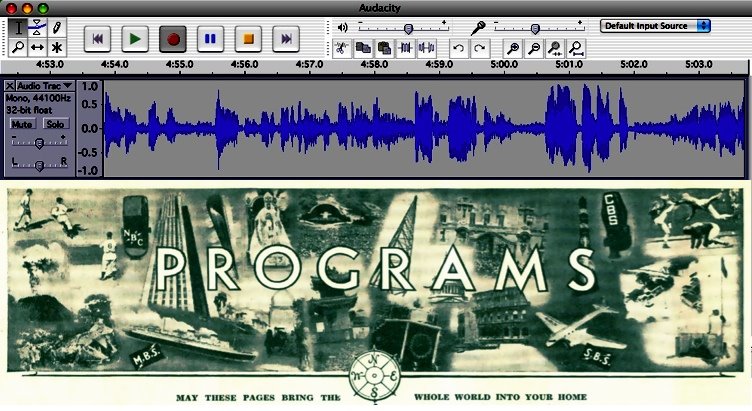
Along with music and poetry, the boxed-in cassettes encase the voices of old friends, the sounds of distant places and past lives. To get them out of their timbered limbo I recently downloaded Audacity, software that converts old tape to new files. For the past two weeks now I have done little else besides dubbing, editing, merging tracks, removing imperfections and changing the speed of recordings—all with a single-minded diligence that leaves little room for doubt: you just can’t get Germany out of this old boy.
And why save all this space now that we are about to move into a house roughly three times as large as the old one? Perhaps, I am not such a free spirit after all—just too lazy-boned to lug all that excess baggage. Could it be that what elbow greaseless me appreciates most about being at play in the theater of the mind is that it does not require the shifting of scenery? Be that as it may: I hope shall not long lack the time to make room for the stale air that is my element and the out-of-dating that is my métier.

 Staying out of touch has never been easier. We’ve all got our personal teleporters to spirit us away from the here and now. Technology is making it possible for us to remove ourselves from our communities, to stay at home not watching the world go by. Instead, we can revel in bygone worlds. Hundreds of satellite channels are serving up seconds. Before you know it, you quite forgot what time it is that you just passed. Isn’t it high time for Sally Jessy Raphaël to stop gabbing? Eight years ago she went off the air; but there she is, chatting away on British television, her owl glasses unscratched by the sand of time.
  This is a day for disguises, and a night of unmasking. A time to let yourself go, and a time to let go of something. A night to make an ass of yourself, and a morning to mark yourself with ash. Shrove Tuesday, Mardi Gras, Fastnacht. Back where I come from—Germany’s Rhineland—carnival is a major holiday, an interlude set aside for delusions, for letting powerless misrule themselves: laborers parading in the streets without demanding higher wages, farmers nominating mock kings and drag queens to preside over their revels; women storming the houses of local government to perform the ritual of emasculation by cutting off the ties that hang from the necks of the ruling sex. It is a riotous spectacle designed to preserve what is; a staged and sanctioned ersatz rebellion that exhausts itself in hangovers.

 Before settling down for a small-screening of Inherit the Wind, I twisted the dial in search of the man from whose contemporaries we inherited the debate it depicts: Charles Darwin, born, like Abraham Lincoln, on this day, 12 February 1809. Like Lincoln, Darwin was a liberator among folks who resisted free thinking, a man whose ideas not only broadened minds but roused the ire of the close-minded–stick in the muds who resented being traced to the mud primordial, dreaded having what they conceived of as being set in stone washed away in the flux of evolution, and resolved instead to keep humanity from evolving. On BBC radio, at least, Darwin is the man of the hour. His youthful
 Harry Heuser