Teaching by Numbers That Don’t Add Up; or, Not in the Mood to Celebrate an Anniversary

On the eve of the tenth anniversary of broadcastellan, I look back at what this blog once was and what it has been reduced to over the years.  The neglect is due in part to the fact that I struggled to engage an audience or generate interest in my study on radio, which, under the title Immaterial Culture, was eventually published as an academic book in 2013.  I think a copy of it still lies in some corner of the Theatre and Television department of Aberystwyth University, the institution that is my current employer.  It attests to the lack of imagination, ingenuity and respect of said institution that my offer to deliver a lecture on the subject has never come to fruition.  But that is only one of my grievances.

Why there is so little going on here at broadcastellan has mainly to do with my being too busy to devote time to what is essentially a hobbyhorse I can no longer ride at leisure.  My life has changed considerably since that first tentative entry in May 2005; in terms of my academic career, it has not changed for the better.

As a zero hour contract employee at Aberystwyth University, I work virtually daily for little or no pay.  No pay, you ask? How can that be? Well, I spent months creating two courses in art history that I delivered at a university in China in October 2014 and March 2015.  I received no compensation for this preparation; the work was simply not time-tabled, nor thought of as deserving of pay.  There is no shortage of examples; so I consider the most recent one.  Today, I was denied pay for work that was expected of me.

Showing my support for the university, I agreed to teach a course that apparently no full-time member of staff would touch.  For this dubious privilege I was to be remunerated on an hourly basis.  On that iffy foundation, I was to prepare a series of lectures and seminars.  No, let me revise that: I received no money for the preparation.  If the hourly lecture rate is meant to reflect preparation, the rate is below minimum wage.  

I am accustomed to this practice, having worked under such conditions for years.  In this case, there was quite a bit of research, the subject being The Language of German Politics.  I have not lived in Germany in about a quarter of a century and have not voted since before the wall came down (which is just about the time I left).  I was told that the instructor who had taught the course previously did not leave behind any notes on which to draw.  If it was a part-time instructor, I can sympathise.

Why leave behind your intellectual property, even though such rights are violated routinely at institutions of higher learning that take everything from you and take credit for anything you do (such as publishing a book or staging an exhibition that happens despite one’s work for the university, not as a result of it).  Anyway, I enjoy a challenge; a member of staff recently referred to my sense of enjoyment as masochism.

Agony it certainly turned out to be, at times.  I did not receive a contract for signing until three weeks into teaching, at which point it was impossible to withdraw.  There is no mention of pay for grading assignments in the contract, and there were to be 63 individual written papers and 21 final exams to grade.

On average, I spent over 40 minutes reading and marking each essay or translation submitted, sometimes considerably longer.  For each piece of writing up to 1000 words I was permitted to claim the staggering amount of £2.53.  This meant that I worked below the minimum wage, and in many cases quite significantly so.

This is so demonstrably unreasonable that I expressed my incredulity to the Human Resource department of Aberystwyth University.  After all, the task of evaluating the effectiveness of a translation is not simply a matter of right or wrong. As someone who has studied translation theories, I regard translation as an interpretative act that is – or should be – to some degree open to debate.  It is a debate I could hardly afford to have with my students, at least not at the rate of £2.53 per 1000-word manuscript.

I was familiar with these appalling pay rates from other teaching assignments at Aberystwyth University and have tolerated them heretofore without comment.  Though assessing a translation is not equivalent to reading a manuscript mainly for its content, the pay rate is the same.

This by-the-numbers approach to remuneration – and education – is detrimental to the quality of teaching that an institution like Aberystwyth University can deliver when it is relying on part-time staff.  I tried not to short-change students by providing fewer comments, as records will bear out.  I read each submission literally word for word in order to assess responsibly and provide detailed and constructive criticism on matters such as word choice and sentence structure.  This, I believe, is as it should be, and I expect neither praise nor gratitude for my conscientiousness.

As a zero contract hour employee at another department of the same university I routinely meet with students for tutorials.  It is an important aspect my teaching.  Anyone’s teaching.  Due to the decision of the European Languages department to pay me only for the hours I spent conducting lectures and seminars, I was unable hold individual meetings with my students there.  This contributed to student dissatisfaction, instances of which were brought to my attention just as I was about to depart for China.

Yes, I had another teaching commitment, on behalf of Aberystwyth University, while three of my courses were going on here in Wales.  I took off for Beijing with a sense of failure in the face of adversity; and, despite the module coordinator’s assurance that she had ‘heard a lot of praise for [my] teaching,’ the message left me disheartened.  Had I been permitted to conduct tutorials, I would have been able not only to address student concerns but also considerably to bridge the gap created by my China assignment.

It had been suggested to me to mark more leniently to ease tension.  However, I reject the notion that the lowering of standards should be considered as a measure to assure or boost student satisfaction.  Instead, I followed the departmental marking guidelines from which my standards were derived.

Being unable to meet with students resulted in spending more time assessing performances so as clearly to explain how each mark was derived.   This effectively lowered my pay for each assignment.  As I told the head of department, I do not think it fair to our students to provide fewer comments as a result of staff members’ time constraints.

Not being able to hold tutorials, I was also forced to spend more time responding to student inquires via email.  This time is not remunerated, either.  That I had to spend time in class detailing marking criteria, for instance, also limited the time allotted to delivering the material (almost all of which I created myself, as no lecture notes or presentations were available from previous years on which to model my own performance).

The department’s decision to cut corners further by denying me payment for a meeting with – and requested by – the module coordinator to finalise work that requires double marking is, apart from being unjust and insulting to me, a shortsighted decision that impacts negatively on the marking and compromises its fairness.  I had assumed it to be a matter of course that I should be paid for such time; I stated in an email to the module coordinator that I would bill the department at the ‘meeting’ rate, upon which the meeting was called off.  I have informed the department that I am unwilling to conduct a discussion about marks via email, thus without pay.

I told the department that I would not accept any further employment under the same conditions.  To do so would mean to accept Aberystwyth University’s exploitative practices.  The contract is phrased in a way that only underscores its inadequacies.  There is mention of time and a half pay and double pay, for instance.  Such a contract can never be honoured when the work in question is teaching.  I routinely work weekends and late into the night.  There is no mention anywhere of remuneration for any time spent designing or preparing for courses or responding to student email.

There is also no mention of marking.  As a long-time zero hour contract employee I might be expected to be familiar and perhaps even reconciled to such terms; but teaching languages is, as I said, vastly different from teaching other subject matter, as language comes – or should come – under closer scrutiny than in other disciplines.  Responsible teaching of languages will therefore almost inevitably result in a pay below the minimum wage for part-time staff.

All the while, my dedication to teaching has made it difficult for me to pursue my career as a writer, from which I derive as yet no income.  For a year’s worth of teaching, I get paid under £10,000.
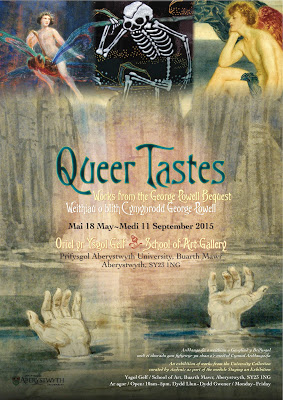
Queer Tastes: Works from the George Powell Bequest

George Powell
Poster design by Neil Holland

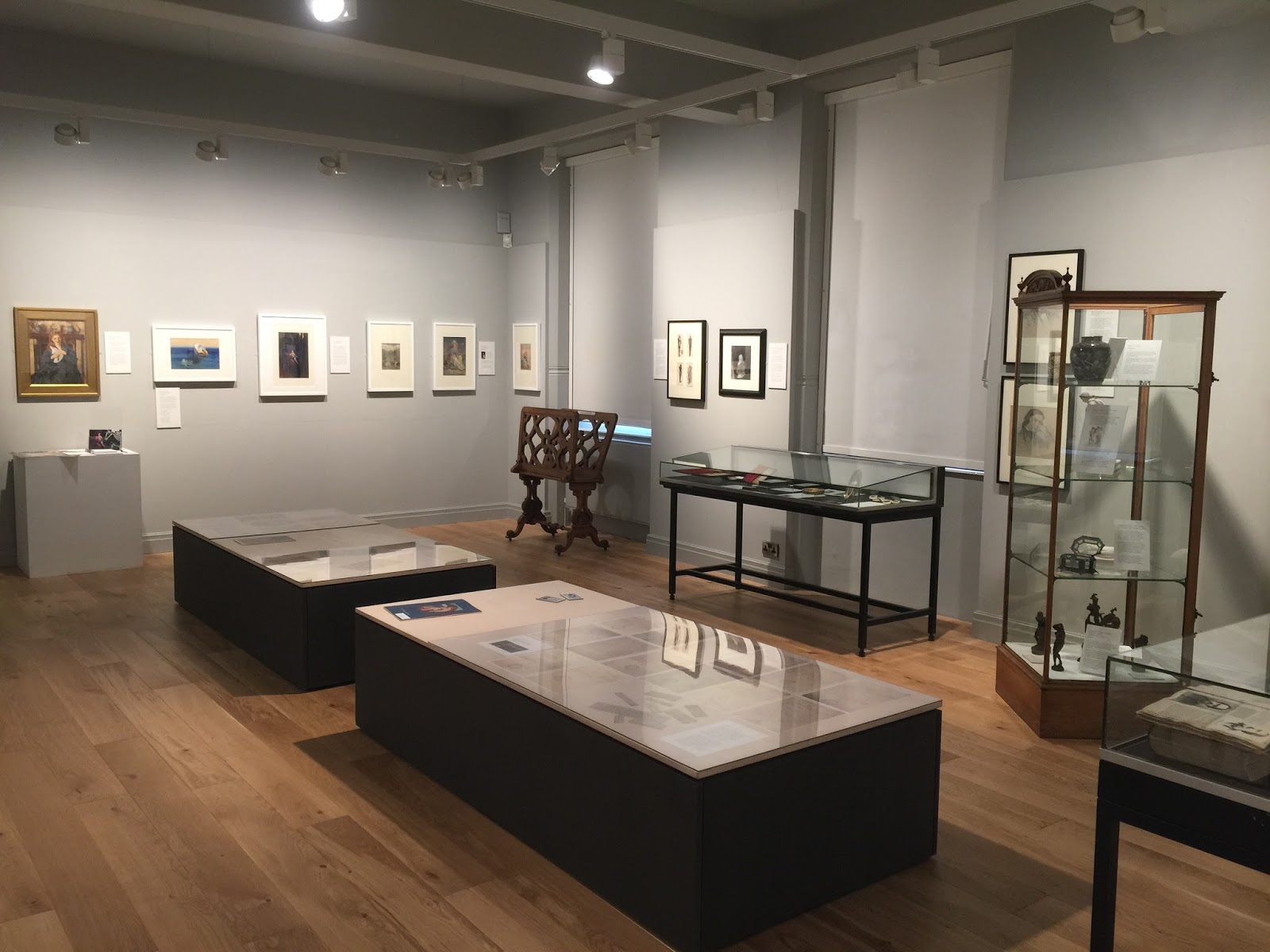
Queer Tastes is an exhibition I curated with students of my undergraduate module Staging an Exhibition at the School of Art, Aberystwyth University. Each year, the module culminates in a student-curated show on a given theme.


This year’s exhibition, which is open to the public from 18 May to 11 September, explores the identity of the Welsh-English dilettante George Ernest John Powell (1842 – 1882) through the collection that he bequeathed to Aberystwyth University. The objects were selected by students of the School of Art, which holds part of Powell’s bequest.  

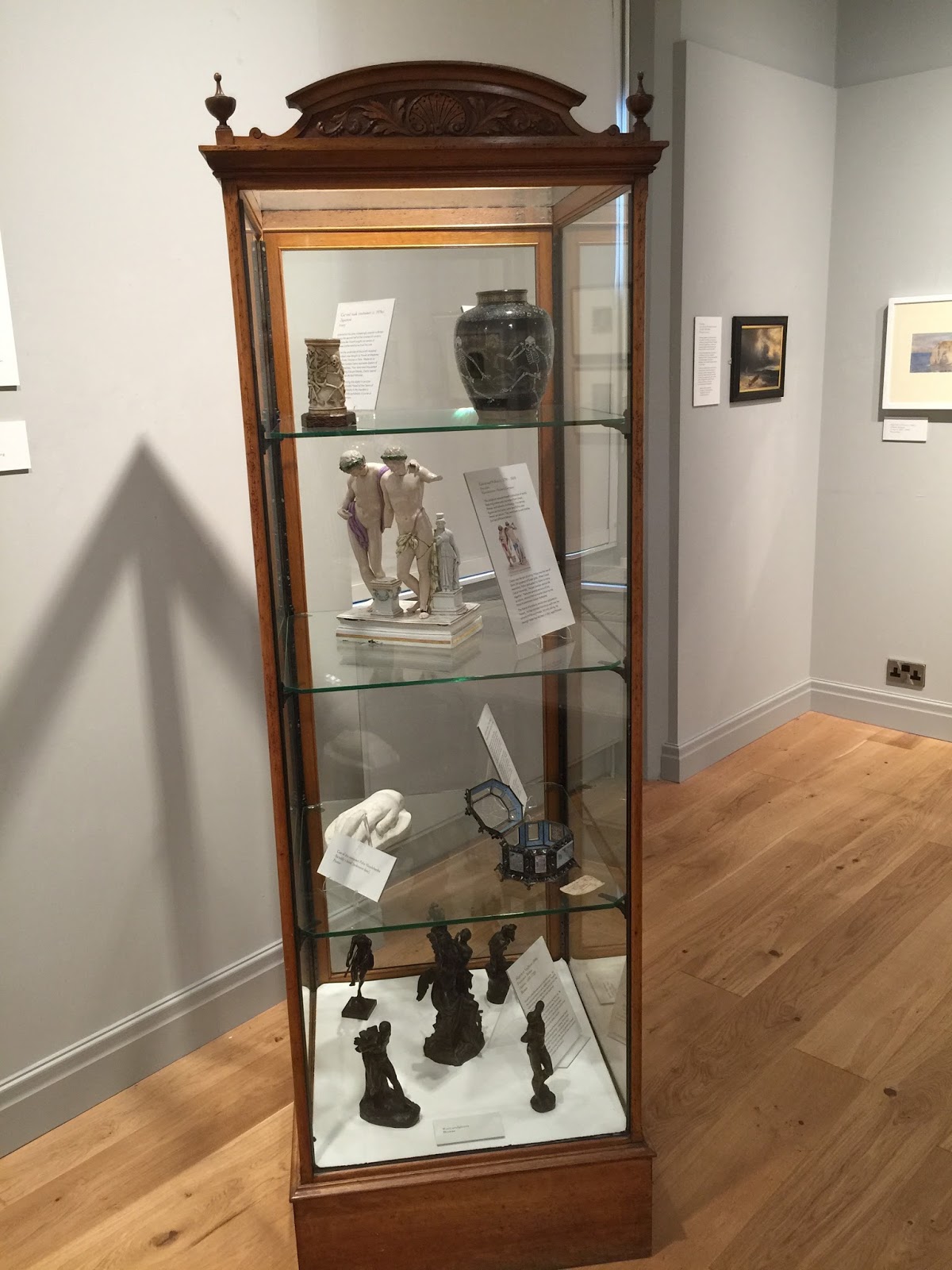
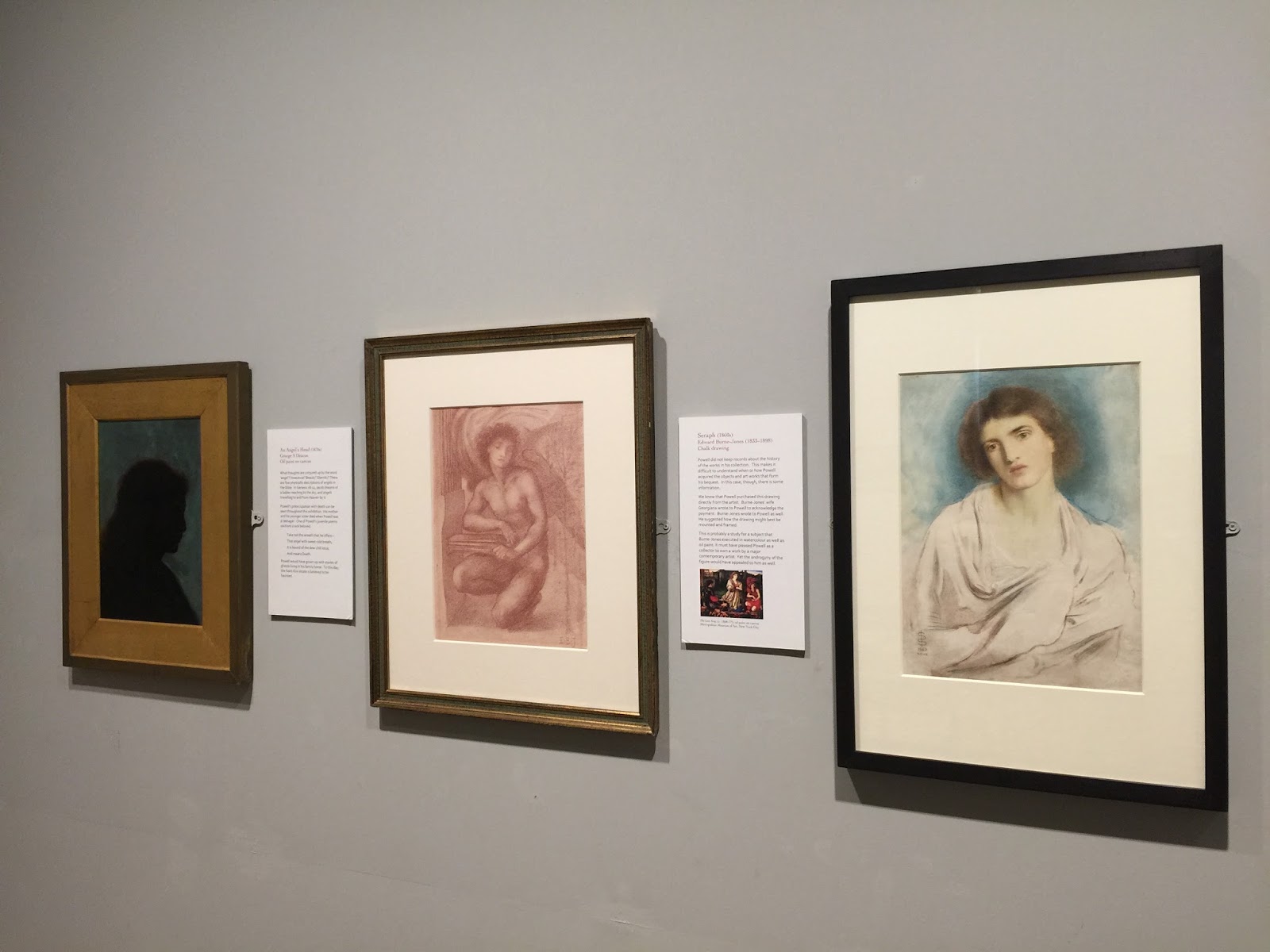
The exhibition includes works by Simeon Solomon, Rebecca Solomon, Edward Burne-Jones, Richard Westall and Hubert von Herkomer as well as artefacts and curios ranging from a plaster cast of Felix Mendelssohn-Bartholdy’s hand and a glass casket that allegedly once contained a splinter from Robert Schumann’s coffin.

The Powell family owned the Nant-Eos estate a few miles inland from Aberystwyth. Educated at Eton and Oxford, George Powell spent little time at Nant-Eos, which he would inherit in 1878. It was an unhappy place for him. His parents were estranged. His mother and younger sister died when Powell was a teenager.


Powell was a dreamer, much to his father’s disappointment. Instead of going hunting, the boy wrote poems about death, loss and betrayed love. Eager to get away, Powell travelled to Europe, Russia, North Africa and Iceland. In the company of the poet Algernon Charles Swinburne, Powell spent summers on the Normandy coast. There, he entertained writers and artists in a cottage he named after a bisexually promiscuous character in de Sade’s Philosophy in the Bedroom.

Powell has been called ‘eccentric’, ‘sinister’ and ‘sad’. He has also been labelled ‘homosexual’, a term not used in his day. ‘Queer’ suggests something – or someone – strange or at odds with our views. It asks that we trace our responses to otherness in ourselves.

A man of the world, Powell wanted to be remembered back in Wales as a patron and benefactor. He offered parts of his collection to Aberystwyth Town Council, on provision that a public gallery be created for their display. When the deal fell through, Powell gave the objects you see here to the University of his ‘dear but benighted town’.

Making our possessions public is in a way a ‘coming out’. It invites others to wonder about our past. It also means saying ‘I matter’. Collections like Powell’s encourage us to question how a person’s worth is determined.
Curators: Danielle Harrison, Kayla McInnes, Alice Morshead, Jenny Skemp, Valerija Zudro, with support from Harry Heuser (text and concept) and Neil Holland (staging and design).
Powell’s life and collection are the subject of my essay “‘Please don’t whip me this time’: The Passions of George Powell of Nant-Eos” in the forthcoming anthology Queer Wales (University of Wales Press).


Nuns Ablazing: Sister Act at Aberystwyth Arts Centre

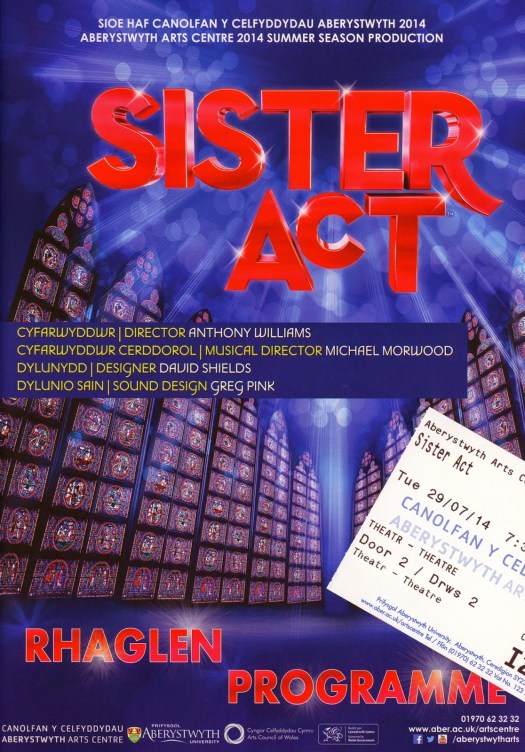
“Farrah Fawcett as thou art in heaven!” This is a good time to dust off your “F. M. boots” and shake your groove thing right on down to our local Arts Centre here in Aberystwyth. You know, F as in Funky and M as in, well, Mary, Mother of Grace.  Or, FM as in radio, tuned to the station that gives you Diana, Donna and … Deloris.  Deloris Van Cartier, honey, the diva that dreamed of a wearing white fur and ended up in a nun’s habit.  Yes, it’s Sister Act, the musical. The one about the convent where the mother’s Superior and the sisters Supreme.

In this production, Mother Superior is played by Lori Haley Fox, whom I previously saw perform here in Chess and Hairspray.  There is a bit of Velma Von Tussle in Mother Superior—but her Sister Act character has some depth, which comes across in Fox’s rendition of “Here Within These Walls.” You don’t just get to hiss and laugh at her, but get to understand her struggle to restore the order that wasn’t meant to be a reformed one. It’s a fight against the trivialization and exploitation of her beliefs.  To be sure, it’s a tall order to deliver such conviction in a play so invested in that very trivialization. But if there are false notes in this musical, they are not coming out of Fox’s mouth.  Nor out of Jenny Fitzpatrick’s, for that matter, who is great in the wear-your-Jackal-and-hide part of Deloris “Sister Mary Clarence” Van Cartier, a diamonds craving tramp with the proverbial heart of gold.  Or a golden larynx, anyway. And Fitzpatrick sure got that, and soul besides. Make that Philly soul.  After all, the scene is set in Philadelphia, the town to which the bastard of Disco can trace some of its heritage.

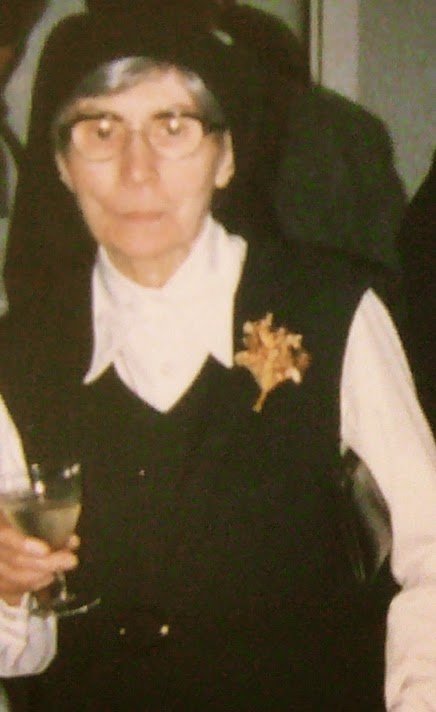
My great aunt was a nun, so I fancy myself an authority

[Image caption: My great aunt was a nun, so I fancy myself an authority.]

I’ve been attending the Aberystwyth Arts Centre productions ever since I arrived in this town after fifteen years of life in Manhattan.  I had a bad attitude in my suitcase and thought that nothing could match Broadway, that this was just the sticks.  Well, shows like Chicago and Hairspray proved me wrong.  Actually, the very first show I saw here, Oliver!, did that.  And it was great to see Mr. Bumble again, right there in that convent.  Gary Davis, I mean, who plays Monsignor O’Hara. Indeed, there were a number of familiar faces in the cast, among them David Barrett and Robert O’Malley.

Brother, it must be tough for any man to assert himself in a place where all those rapping and von Trapping sisters are doing it pretty much for themselves (and the Almighty); but Robert Grose as Curtis Jackson and Aaron Lee Lambert as Eddie Souther are giving it their best shot—and I’m using the metaphor advisedly.  Grose is at his smarmiest best singing “When I Find My Baby,” a creepy number worthy of Sweeney Todd and likely to give you the heebie-Bee Gees.

Meanwhile, in “I Could Be That Guy,” Lambert makes a transition that rivals the costume change endured by Deloris – albeit from plain to fabulous, so that the twain can meet somewhere in between—and he doesn’t get a phone booth or even a Hong Kong Phooey filing cabinet to do it in. So, props to him! Then again, why call props when Velcro and virtuosity will do? 

There are echoes of Kiss Me, Kate in the trio of thugs—The Three Degrees of separation from the baboon—who are making apes of themselves for our amusement in “Lady in the Long Black Dress.” Never mind Earth and Fire; these guys are pretty much all Wind. That said, Andrew Gallo as Joey has more moves in his eyebrows than most wannabe Travoltas have in their polyester-clad hips. George Ray as TJ does four-eyed cute as well as Rick “Suddenly Seymour” Moranis ever did. And Ricardo Castro is just bueno as Pablo in a Brüno kind of way. 

Meanwhile, for those who prefer their eye candy unwrapped, there are a couple of highly distracting boy dancers, competing though they were, temporarily, with an audience member in front of me who insisted on noisily unpacking her own treats. Sure, Toffifee is retro, but a flask is more discreet. 

Dancing boys and their legs apart, this is still a play in which the sisters have the upper hand; and glorious Jodie Jacobs as Sister Mary Robert and fierce Andrea Miller as Sister Mary Lazarus prove that “It’s Good to Be a Nun.” So what if Sister Act’s pastiche.  Why reinvent the Disco Ball? I, for one, am glad to be having the sisters “Here Within These Walls” of Aberystwyth Arts Centre to “Spread the Love.”  I’ll be back for another audience with them—and that adorable Pope—just as soon as I get the platforms redone on the F. M. boots I wore out tapping along. “Fabulous[,] Baby”!

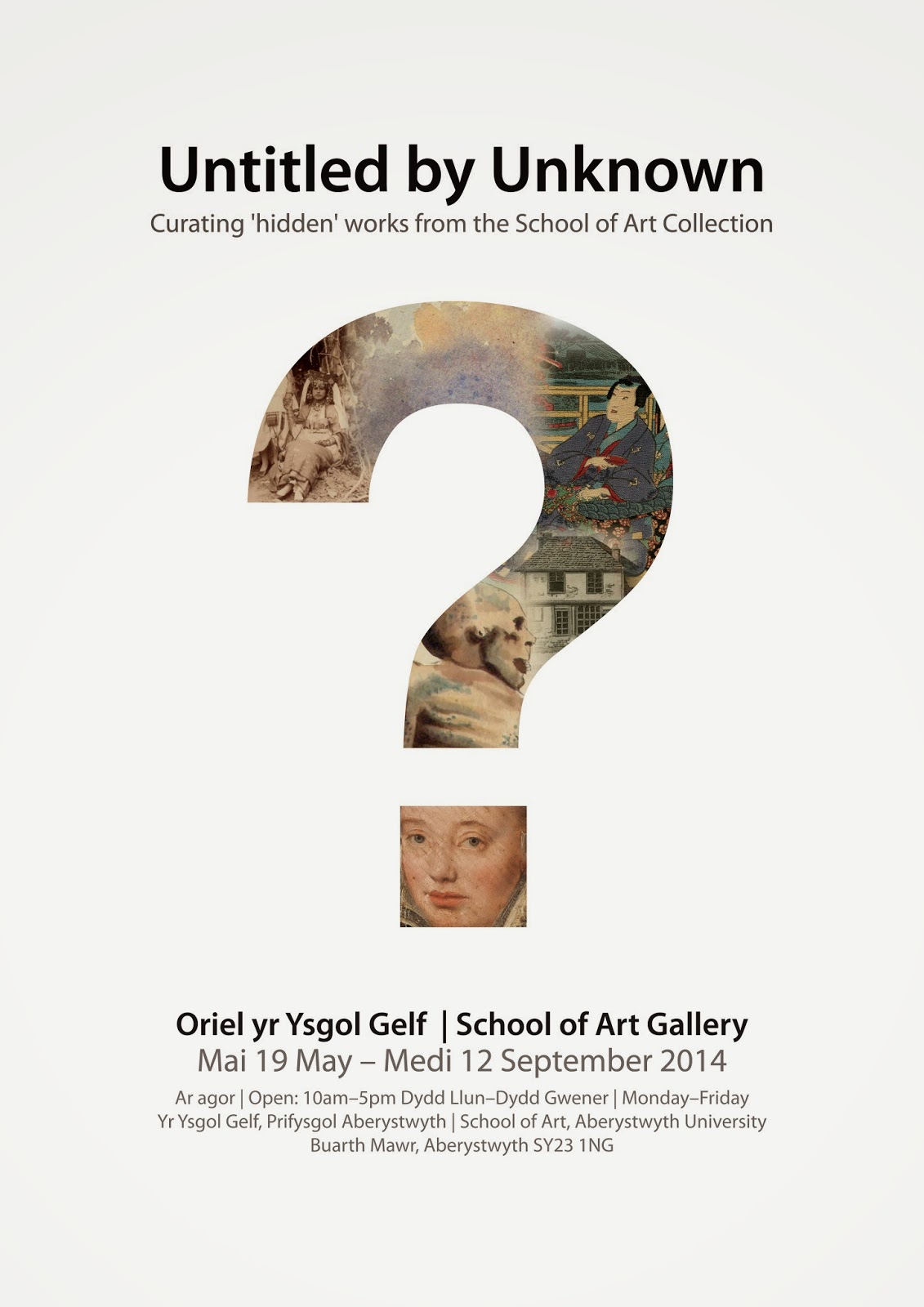
"Untitled by Unknown"

Every spring, the students of my “Staging an Exhibition” class are doing just what the title suggests: they curate a show at Aberystwyth University’s School of Art galleries. And every summer, I have to come up with another idea for another spring. This year’s exhibition, on show now until 12 September, poses a particular challenge. As stated on introductory panel, most of the works on displayed “have no official title. The identity of their creators remains unconfirmed.” This opens the debate as to their value and relevance: “Do their uncertain origins mean that these objects are unworthy of our time and attention?”

Untitled by Unknown: Curating ‘Hidden’ works from the School of Art Collection investigates the effects of doubt and mystery on our estimation of visual culture. The thirteen curators not only researched the objects but also needed to think of ways to interpret in the absence of verifiable facts.

Viewers are “encouraged to reflect on the ‘hidden’ lives” of the objects chosen by students: they include photographs, watercolours, prints and miniature paintings. Each work is identified only by the number by which it is filed and can be accessed in the School of Art collection’s online database.

The idea was to let visitors of our exhibition in on the curatorial task, to suggest that while a “lack of facts can be an obstacle,” it “can also be an opportunity for personal engagement.” Visitors may well question our interpretations and uncover alternative stories. Perhaps, they know more than we do about some of the mystery objects in our collection.

Untitled art works by unknown or anonymous artists often have no chance of being displayed—at least not until their mysteries are solved. Still, public museum and galleries have a responsibility of sharing the works in their collection.

Untitled by Unknown is not intended to show astounding works from exceptional artists. It is here to open a debate about what should be on display and how it may be shared.

My thanks to the students involved in making the show – and my class – possible: Jessie Davis, Karolina Hyży, Justyna Jurzyk, Kate Largan, Charlotte Raftery, Laura Roll, Elizabeth Salmon, Melissa Sarson, Belinda Smith, Julia Steiner, Stephanie Troye, Veera Vienola, and Eleri Wood.

Our thanks also to curator Neil Holland for all his help and expertise.

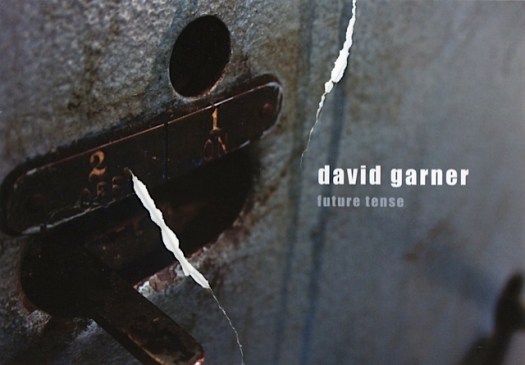
Future [S]ense? The Lost Found Objects of David Garner

Look! There are objects, people, and situations that compel me to do just that.  It takes some effort, though, to make me look longer than a moment, that blink of an eye Germans call “Augenblick.”  It is an effort and commitment that I have to bring myself to make, and whatever or whoever it is that commands me to look must warrant my sustained attention, must conquer my resistance, must provoke, charm, or seduce me to engage me in an exchange

“Look!” is a command that rarely fails; but, apart from performances that define the intended or desired duration of that look, few sites dictate, implore or recommend just how long I am to keep looking.  Do I circle once around this sculpture? Do I give that landscape the once-over, the twice-over or the over-and-over? How long do I need to look until I see something that rewards me for not looking away sooner?

Not every instance of looking turns into a spell of lingering, loitering and longing for more; and nothing is more effective in making me avert my gaze than being told what to look out for and how to see things.  This is the reaction I had looking at David Garner’s exhibition Future Tense, currently on display at the Aberystwyth Arts Centre.

Garner uses found objects to make more or less—and mostly less—compelling statements about a grab bag of social and political issues: production and consumption, education, unemployment, and postcolonialism.  His work hinges on a pairing of visual and verbal puns (such as “Wooly Learning/Dysgu Gwlanog,” a school blackboard with felted wool surface and wool text) or clichés (like “Beware when the gloves are off,” a row of ten Porcelain glove moulds mounted on an oak panel and suggesting a fascist salute); most of these pairings are too obvious in their single-minded double-meaning to startle, let alone enliven a discourse.  

Often, as in “Sheep in Sheep’s Clothing”—a taxidermied sheep wearing a coat knitted from its own fleece—the found object is stripped of its mysteries, its woolliness—its indeterminacies and ambiguities—spun instead into a readily solvable and as such instantly dissolvable puzzle.

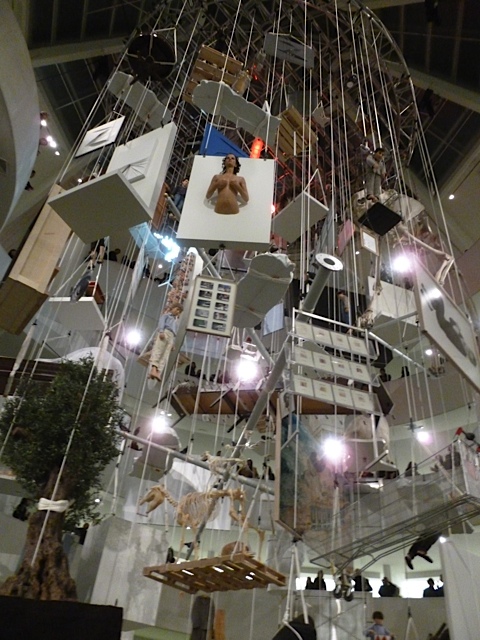
Unlike Duchamp’s perennially stimulating Fountain, Garner’s found objects are given a final resting place in a self-contained junkyard of a performance that rewards only those who are content to discover an artist’s meaning and who, unlike me, accept that meaning as final; such hermetic hermeneutics leave no room to respond other than “Got it.  Next!” There is none of the wonder, the awe—the sheer thrill of looking—that I experienced staring at Maurizio Cattelan’s All at the Guggenheim Museum earlier this year.

The only truly gripping sight in Garner’s Future Tense is not a sight at all but a sound: the sound of a large clock loudly ticking away.  I resisted looking at the caption and let that sound transport, envelop, and alarm me; listening, I was, for once, unaware of the time I had wasted looking here but reminded instead of the potentialities of art to move us to the point that we cannot but invest it with our life experience, our anxieties and desires—a potential that is largely unfulfilled by Future Tense, a configuration of readymades whose presence is so much circumscribed by the artist’s foregone conclusions that they have little chance of a future in our imaginings . . .

Once Upon a Time in Radioland: A Kind of Ruritanian Romance

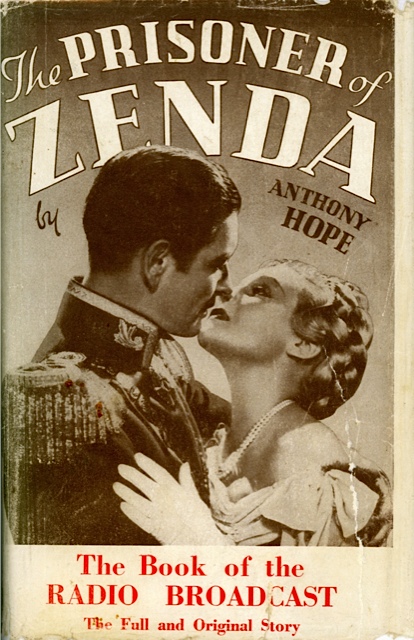
The other day, at my favorite bookstore here in Aberystwyth, I was caught in the eye by what struck me as a highly unusual cover for a 1938 edition of Anthony Hope’s fanciful pageturner The Prisoner of Zenda. Mind you, I’m not likely to turns those pages any time soon. I’m not one for Graustarkian excursions. That I found the old chestnut so arresting is due to the way in which it was sold anew to an audience of Britons to whom such a mode of escape from the crisis-ridden everyday must have been sufficiently attractive already. This was the 92nd impression of Zenda; and, with Europe at the brink of war, Ruritania must have sounded to those who prefer to face the future with their head in the hourglass contents of yesteryear like a travel deal too hard to resist.

My copy of the book

Now, the publishers, Arrowsmith, weren’t taking any chances.  Judging by the cover telling as much, they were looking for novel ways of repackaging a familiar volume that few British public and private libraries could have been wanting at the time.

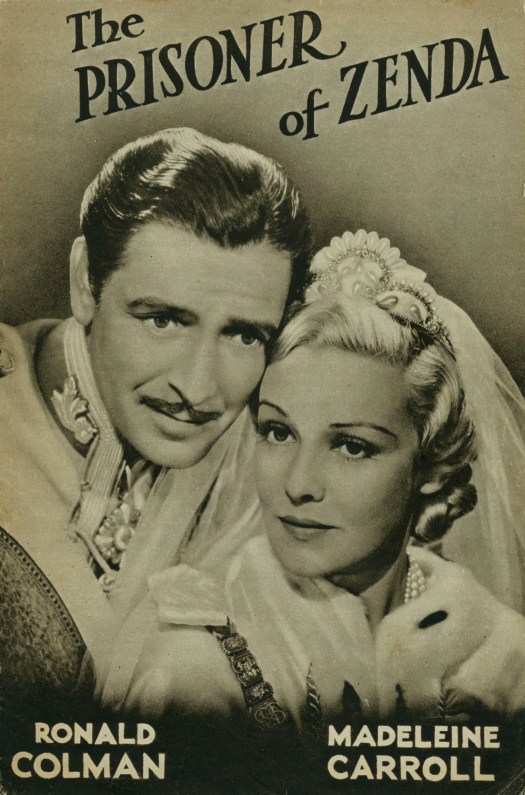
British moviegoers had just seen Ruritania appear before their very eyes in the 1937 screen version of the romance, which make dashing Ronald Colman an obvious salesperson and accounts for his presence on the dust jacket.  It is the line underneath, though, that made me look: “The Book of the Radio Broadcast,” the advertising slogan reads.  Desperate, anachronistic, and now altogether unthinkable, these words reminded me just how far removed we are from those olden days when radio ruled the waves.

The Prisoner of Zenda was recently the subject of a highly successful film,” the copy on the inside states somewhat pointlessly in the face of the faces on the cover.  What’s more, it continues, a “further mark of its popularity” was the story’s “selection by the BBC as a radio serial broadcast on the National Programme.”  To this day, the BBC produces and airs a great number of serial adaptations of classic, popular or just plain old literature; but, however reassuring this continuation of a once prominent storytelling tradition may be, a reminder of the fact that books are still turned into sound-only dramas would hardly sell copies these days.  Radio still sells merchandise—but a line along the lines of “as heard on radio” is pretty much unheard of in advertising these days.

From my collection of Cinegrams.

“This book is the original story on which the broadcast was based,” the dust jacket blurb concludes.  I, for one, would have been more thrilled to get my hands or ears on the adaptation, considering that all we have left of much of the BBC’s output of aural drama is such ocular proof of radio’s diminished status and pop-cultural clout.

Perhaps, my enthusiasm at this find was too much tempered with the frustration and regret such a nostalgic tease provokes.  At any rate, I very nearly left Ystwyth Books without the volume in my hands. That I walked off with it after all is owing to our friend, novelist Lynda Waterhouse, who saw me giving it the eye and made me a handsome present of it.  And there it sits now on my bookshelf, a tattered metaphor of my existence: I am stuck in a past that was never mine to outlive, grasping at second-hand-me-downs and gasping for recycled air . . . a prisoner of a Zenda of my own unmaking.

Stiff Competition: A Hairspray to Defy the West End Elements

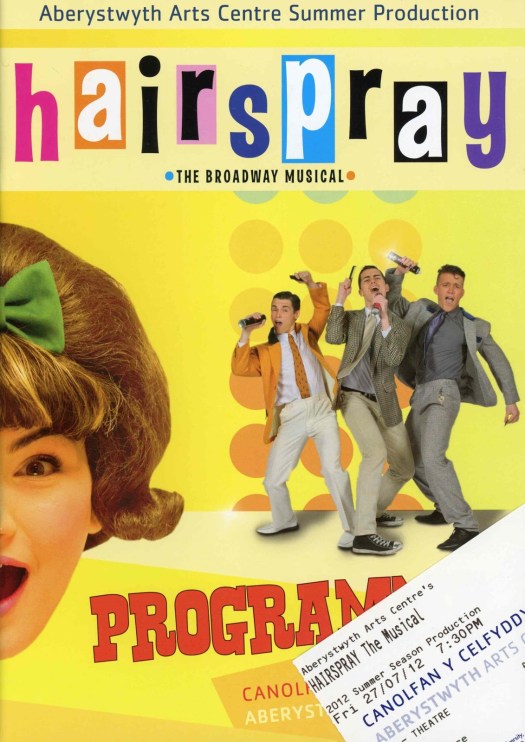
Funny thing about prejudice: if you let it take hold, it can deprive you and those around you of a real good time.  That, in a shiny Aqua Net shell, is the message of Hairspray, the musical.  And, boy, did I deprive myself . . . until now.  Sure, others around me still had that good time, but when Hairspray hit Broadway back in 2002, I was as set as an untamed cowlick.  I would have none of it. My Aqua Net days were long behind me by then, and I was not going to splash out on a rehash of a late-1980s cult comedy about early 1960s culture-clashing teenagers, told in songs that a Porter and Gershwin kind of guy like me is not inclined to hum while wearing a shower cap. Well, Kiss my Kate! Last Friday, I finally woke up and smelled the coiffing.  “Good morning, Baltimore!” And—oh, never mind “beautiful”—what a colorful morning it is.

Funny thing, too, that I only had to travel about half a mile to learn that musical lesson; no subway ride down to 42nd Street, no walk through London’s West End via Leicester Square (and TKTS).  Just up the hill, to Aberystwyth Arts Centre, where each summer a musical is staged that, as a tourist attraction, is far more reliable than our windswept seaside.  Over the years, I have seen eight of those summer seasons come and go, from Oliver! to Chess.  Boasting a cast whose list of combined Broadway and West End credits is way longer than I am in the tooth, this year’s production tops them all.

Its readily translatable story of teenage rebellion aside, Hairspray may not be the easiest piece of Americana to transplant to Wales.  Never mind references to Allen Funt, Jackie Gleason, and the Gabors, names not likely to ring for today’s young, British audiences the bells I and Tracy Turnblad can hear.  The Director’s Note in the program about Rosa Parks, whose image flashes on a big screen during one of the numbers, fills in some of the blanks.  This, after all, is American history, no matter how much John Waters it down.

Then again, it may not be the easiest thing, either, to translate the Civil Rights Movement into a musical riot without becoming as crude or politically incorrect as John Waters used to be.  But, whatever your own sense of otherness and experience of xenophobia might be—and “I Know Where I’ve Been”—Hairspray gives you enough of a whiff of those ill winds to make you investigate whence they blow.  “Run and Tell That”: if any production can communicate a shakeup without making anger the primary colour of the emotional rainbow, Unholy Waters! this can can.

You might expect—and forgive, too—any glitches or leftover curlers on opening night; but there were none here: upon pulling the lid, this Hairspraywas as solid as a freshly lacquered beehive.  Andrew Agnew is marvelous as Edna Turnblad, a part I identified so much with the fabulous Divine that I couldn’t face watching John Travolta in a latex mask.  Agnew makes you forget both—and he plays Edna in such an understated way that her big number “(You’re) Timeless to Me” makes you understand what, to someone of my certain age, is the warm heart of this show.  It’s a heart whose Beat you’d can’t stop without making Hairspray lose its maximum hold.

Edna might have missed every boat except the one she pours the gravy from; but she is not too old to kiss—and kick—the past goodbye and say “Welcome to the 60’s.”  This transition requires more than a new do or a swift costume change; and Agnew achieves it by centering Edna in the 1950s, a woman who loves Lucy though she might not like Ike—and who not only loves Tracy from the remove of a generational gap but gets her, too.

Tracy, of course, is her daughter—the embodiment of that new age—and Jenny O’Leary inhabits the role with the confidence and youthful energy for which it calls.  Tracy may not quite grasp just how seismic the event is in which she plays her part, an event—this much she knows—far bigger than “Negro Night” on the Corny Collins Show; but she approaches integration with the I-don’t-get-it naivety that has many of today’s youngsters baffled at their parent’s definition of marriage as a strictly segregated affair.

Hairspray leaves no doubt as to who “The Nicest Kids in Town” are; “nice” simply ain’t.  It is self-serving conventionality, a meanness of spirit that lingers under the neat surface like something you fight with lice shampoo.  How else to approach “Miss Baltimore Crabs,” Velma Von Tussle, a nasty piece of work done justice by Lori Haley Fox—and done in by the sheer force of Motormouth Maybelle, a woman who, like Edna, has seen better days, but whose better days were lived in times much worse.  

Marion Campbell, who plays Maybelle, comes on stage late to belt out her showstopper of a number—and her presence hits you like, say, Mahalia Jackson’s in Imitation of Life: a voice to be reckoned with, especially in a fight for equality.

Though the actress playing Tracy Turnblad receives top billing, it would be wrong to call the rest of the cast “supporting.”  Hairspray demands a great many good voices as it gives most of its characters the chance and challenge to shine, and everyone in this cast is living up to that challenge: Arun Blair Mangat as Seaweed, Samantha Giffard a Penny Pingleton, Morgan Crowley as Wilbur Turnblad, Hugo Harold-Harrison as Corny Collins . . .

The list is longer than that—but I’d be bald by the time I were done honor roll calling.  Besides, if I’m counting anything it’s the days until my next trip to the salon for another hit of Hairspray. Yes, funny thing about prejudice: once confronted, it can yield such eye-opening, ear-popping surprises.

So, toodle-oo to stiff upper lip! Stiff up yer quiff instead.

Blind Man’s Stuff: Alec Templeton in Time and Space

Last night, I had the good fortune to hear the music of Alec Templeton. Live and by proxy—and right here in town. Templeton’s compositions, among them barrier-obliterating and class-unconscious numbers like “Bach Goes to Town” and “Debussy in Dubuque,” were performed at the National Library of Wales, Aberystwyth. Pianist Simon Crawford-Phillips was ably assisted by Templeton himself, whose voice and ways on the keyboard were heard in a variety of radio recordings from the 1930s, ‘40s, and ‘50s.

Why here? Why now? Well, Templeton was a Welshman by birth, a fact that seems to have eluded most of the Welsh who pride themselves to be a nation of song. So, last night was as good and as high a time as any for his countrymen and women to acknowledge Templeton’s remarkable against-almost-all-odds career, even if the will to embark upon it took the composer-pianist as far West from the West of Britain as Hollywood. The countrywoman who did the acknowledging was Rhian Davies, teller of Templeton’s life in words and images. Davies, who generously acknowledged as well all the support and assistance her project received from broadcasting buffs and music lovers around the inter-networked world, has known about Templeton practically all her life. Eager to share her readily transmitted enthusiasm, she brought home to us, the assembled audience, that it is always Alec Templeton Time.

Templeton’s life is the stuff of legend. Born blind, he developed an ear so keen and a wit so sharp that he was destined to play tunes made for the cutting of rugs. That he was an expert at middlebrow musical culture has a lot to do with the fact that the eyes beneath his brows saw nothing and that his ears saw nothing but potential. Others, left in the dark yet accustomed to light, might have seen an insurmountable impediment.

The mind’s eye of Alec Templeton saw no such manifestations of doubt. He saw, say, Lower Basin Street … and took it. It may be that sightless people, who sense space by feeling their way around and listening intently, are not so much impressed by the walls facing them as their seeing contemporaries, not so much concerned with apparent boundaries, be they cultural or national.

“I understand,” a writer for Radio Guide remarked in 1936, “why his friends, when you start glooming about his sightless eyes, smile superciliously and say: ‘Save your sympathy for someone who needs it.’”

The stuff sighted folks concern themselves with is so much nonsense to a man like Templeton. Sensing a universe where others might imagine chaos, he crossed the waves and made a home for himself on the airwaves, authoring an etherized existence.

“Radio,” Templeton reportedly said, “is to me the greatest miracle of man’s ingenuity. My ears are my eyes, and I tune in at every opportunity, listening to everything from Vic and Sade to Toscanini.”

Hearing Templeton’s music performed live and seeing his career celebrated was a thrill. Yet as pleased as I was that all this happened in the little Welsh town where I now live, I wonder what claim Wales has to her native son. After all, the place of his birth, like his blindness, was not of his choosing. Indeed, he chose to unfurl his pinions, take to the air, and come to live for all willing to be all ears, in a medium whose art is not limited by space but that is instead the stuff—the no-matter—of time.   Make that Alec Templeton Time.

Face Value?

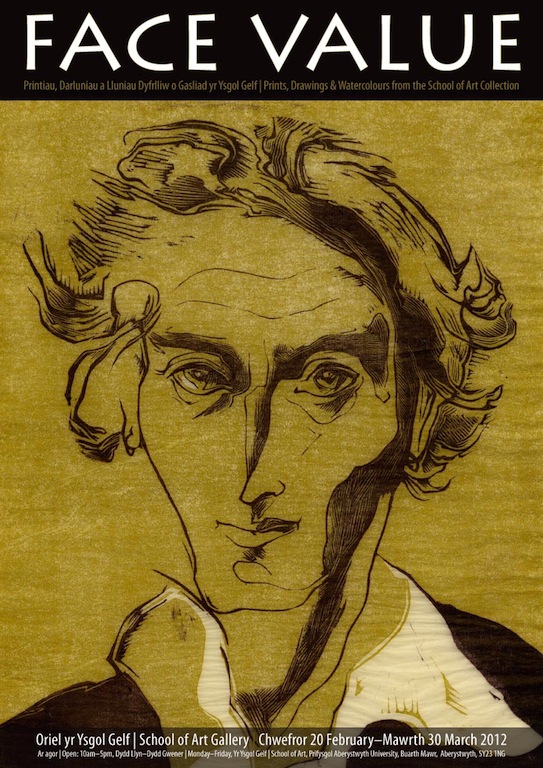
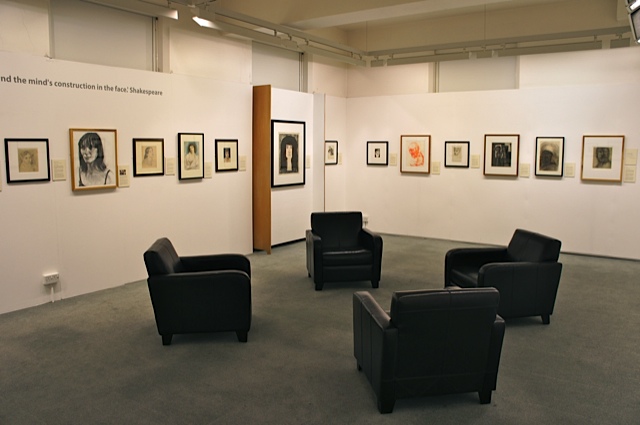
Time to mingle with the visitors, to watch them stand back, take in the artwork—and read those captions. During the past few months, I have been involved in putting together an art exhibition at the local university. It all started last October. I was given the opportunity to teach an undergraduate course in writing informative and interpretive texts for museums: labels, text panels, promotional material. The class was designed as a workshop. So, rather than just theorizing about such matters as readability and legibility or analyzing prose styles and target audiences, my students and I were faced with the challenge of curating a show.

That show, Face Value, is on display and open to the public until 30 March 2012 at the School of Art, Aberystwyth.   It features works on paper (watercolors, etchings, drawings) by artists as diverse as cover girl Gertrude Hermes, Edward Burne-Jones, Fernand Léger, Dante Gabriel Rossetti, Simeon Solomon, William Strang, Stuart Pearson Wright, and Keith Vaughan.  Here is the introductory panel greeting guests at the private view tonight:

‘It is only at the first encounter that a face makes its full impression on us,’ the philosopher Arthur Schopenhauer once remarked. Face Value encourages such chance encounters.  Many of these works on paper from the School of Art collection are presented here for the first time.  Most have never been shown side by side.

This themed exhibition explores various acts of reading: our interpretation of facial features, our attempts to work out the relationships between appearances and mental or emotional states, between character and physical characteristics, as well as between artist, sitter and ourselves.

In 1868, Charles Darwin conducted an experiment to demonstrate that humans have a universal set of facial expressions. An anatomist stimulated a subject’s facial muscles with electrodes to elicit expressions of anxiety, sadness, and joy. He then took a series of photographs with which Darwin presented guests at a dinner party, inviting them to guess the subject’s emotional state. Are our responses predictable? Are faces quite this easy to read?

Face Value is itself the product of an experiment. It was conceived in a classroom, in workshops designed to debate or refute the value of interpretive texts written for museums. Do we look at and judge a self-portrait of a named artist as we do an anonymous, faceless study of a head? Does knowledge about artist or sitter influence our appreciation? What is the curator’s role in aiding or informing our ‘encounter’ with works of art?

‘Who sees the human face correctly,’ Picasso asked, ‘the photographer, the mirror, or the painter?’ Our various guides to interpretation are meant to suggest that there is no ‘correct’ reading and that works of art cannot be taken at face value.

At face value, this is just another art exhibition; but many of the texts on the wall would not read or sound the way they do had I not learned from listening to and reading about radio how to keep sentences simple, short and clear.  It is a lesson I am still learning … and worth learning it is.  Especially for curators.

Letters of a [Class] Betrayed: Opera Without Soap

I am not inclined to manual labor. If I lift a finger, it is likely to come down on what isn’t grammatically up to scratch or else to add a few scrapes to my scalp as I take some rambling bull by the inkhorn. There has been a little more of that going on lately—teaching and editing—and, my furrowed pate notwithstanding, I am heartily glad of it. Yet as much as I relish being back in the game after suffering the indignity of being benched for the better—or, rather, worse—part of the past five seasons, the academy has never felt like a home court to me. It is as if, carved into the trunk of my family tree however rotten, puny and lacking in shelter it might be, are memos more emphatic than the certificates of achievement now gathering dust in the drawer I am so little inclined to tidy. Instead of considering myself invited as I enter places of culture and learning, I still feel at times as if I were crashing a party.

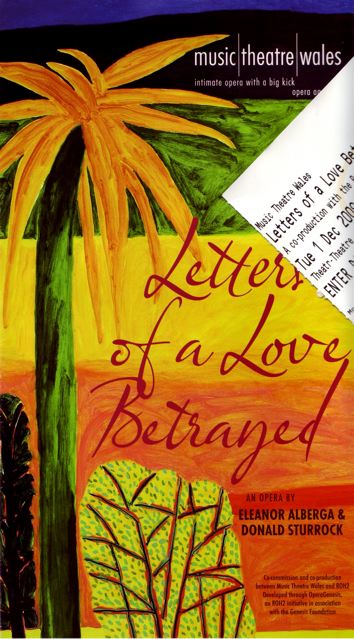
Program and ticket stub for Letters of a Love Betrayed

You see, I was born into that endangered social stratum known as the working class. It is an origin of which I am mindful, though neither proud nor ashamed. At least, I am not ashamed of it now. I used to be as thrilled about it as Ann Blyth’s character in Mildred Pierce, even though my parents bore a closer resemblance to Lana Turner in Imitation of Life—that is, too busy to notice that living up to their aspirations left their offspring in the dust they raised as they tried to shake the dirt clinging to their roots. At any rate, stuck in that cloud of dust was I, an asthmatic kid who couldn’t afford to hold his breath at the off chance of parental attention.

Not to suffocate under the rubble of post-Second World War Germany, my parents had to put their noses far closer to the proverbial grindstone than I ever did. Their generation, aided by American interests, pulled off the Wirtschaftswunder or “economic miracle,” a sleight-of-hands-on approach to the lasting trauma caused by total war and final solution, the coming to terms with which would have required equipment far more difficult to handle than shovel and broom.

I am not so disingenuous as to pass off my staying put as a form of sit-down strike, of giving the clean-and-cover-up efforts of my parents’ generation the spotless finger; but apart from the months I ill served my country working as a hospital orderly or the hours I spent cleaning apartments in New York City to help finance my college education, I remained sedentary for much of my life.

So far, it’s been a life spent lost in thoughts, ensconced in writing, and plunked down for performances that artists work on studiously for our delight and instruction—the kind of delight my father found it difficult to accept as serious work and the instruction he thought less of than the empirical knowledge that, along with calluses, is the badge and perquisite of the experience-hardened laborer.

I suppose it is easier for the worker—not to be equated here with the impecunious—to aspire to material possessions instead of culture and learning, since exposing yourself to something that poses a challenge rather than promising instant gratification requires still more work on the part of those who have little time and less energy to spare.

Now, my comparatively indolent existence permits me to spare that time; yet, as if my conscience and buttocks alike had been shaped by Protestant work ethics, I often feel rather uncomfortable. I’m not one to pooh-pooh the benefits of resting on one’s Popo (as dainty Germans call the posterior); but, there is nothing like wriggling in my seat in hopes of improving my mind to convince me that the calluses—and I—belong elsewhere.

I had that impression sitting through Letters of a Love Betrayed, a new opera by Eleanor Alberga (libretto by Donald Sturrock). Reading about it, I was intrigued by the promised fusion of Latin rhythms and a neo-Gothic romance based on a story by Isabel Allende, but felt let down by a score that to my untrained ear sounded forbidding, unmelodious, and, worse still, forgettable. Perhaps, the perceived cacophony was the result of a clanging together of too many stereotypes. Whatever melo- Letters possesses is all in the drama; derivative and contrived, it is creakier than a chair that has been squirmed out of too often.

I didn’t get it. I didn’t like it. I felt like a tired, vitamin deprived miner lured into a soup kitchen of the arts, the drama being a concession to what is assumed to be his tastes as he is being fed a presumably healthy diet with a none too musical spoon.

As I sat down again to express my thoughts on the matter of what’s the matter with me, I kept wondering whether what I was responding to so angrily was utter musical rubbish, dreck worse than the grime to which I chose not to expose myself, or whether my inability to open my mind was dictated to me by my past, a past unfolding in letters of a class betrayed.