One Tough Act One to Follow

Theater ought to make for good theater.  Noises OffA Chorus of Disapproval.  Stuff like that.  Sometimes, though, it doesnโ€™t.  And it doesnโ€™t because it doesnโ€™t quite become stuff.  And when it ainโ€™t stuff, it fails to matter.  The Lincoln Center production of Act One drives that home.  And what a slow drive it is.  You just sit there, or I did, thinking: when will it stop? Incredulous, I kept checking my watch to see whether time had stood still and I was stuck in the mind of a playwright who hadnโ€™t quite stopped revising, who hadnโ€™t quite figured out just where to go and how to end.  And the end, when it came at last, couldnโ€™t have been less of one.  You could have spelled it out in six letters.  THE END.  Itโ€™d be quicker that way. But that doesnโ€™t make an ending feel like any conclusion to draw from.
 
Granted, the question of how and where to finish is always a tough one when it comes to autobiography, a life unfolding and not wrapped up retrospectively. If only Moss Hart had done the adapting of his 1959 autobiography, the play might have had, if not necessarily a structure but at least an urgency, a currency that this nostalgic exercise in pointlessness woefully lacks.  Instead, we end up with an adaptation that, in its second act, is mostly about the act of adapting.
 

Thatโ€™s just the problem with the second half of James Lapineโ€™s reworking of Hartโ€™s book.  It tells โ€“ rather than compellingly dramatizes โ€“ the story of how Hart and Kaufman collaborated on Once in a Lifetime (1930).  Watching two guys sitting around drafting a play isnโ€™t nearly as riveting as experiencing that play or the evolution of it.  And, to me, at least, it didnโ€™t help matters that, several years ago, I saw a lifeless National Theatre production of Once in a Lifetime, starring David Suchet.  What should have been sheer madcap felt drowsily close to one nightcap too many.

 
โ€œThe theatre is not so much a profession as a disease, and my first look at Broadway was the beginning of a lifelong infection,โ€ Hart wrote.  Itโ€™s a line from Act One, the book, that makes it into Act One, the play, and it makes you aware how little blood there is in the latter.  It is altogether too glossy to make us believe in the curative potency of make-believe, felt by someone brought up in โ€œunrelieved poverty,โ€ as Hart put it.  Such urgency could turn theater-crazy Aunt Kate, charmingly though she is played by Andrea Martin, into someone akin to Blanche DuBois.


If the play, in this production, at least, isnโ€™t quite a cure for drama dependency, that may be because it isnโ€™t sufficiently catching to be an antidote to theater madness.  It has a cuteness about it that is merely subcutaneous.  It doesnโ€™t prick you, or hook you, or infuse you with the passion of which it can only speak in borrowed words.

Once Upon a Time in Radioland: A Kind of Ruritanian Romance

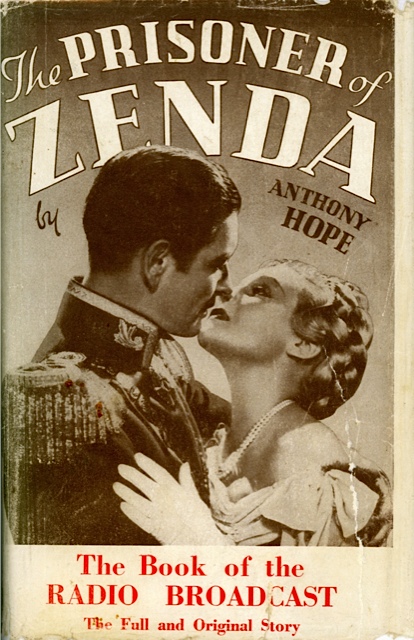
The other day, at my favorite bookstore here in Aberystwyth, I was caught in the eye by what struck me as a highly unusual cover for a 1938 edition of Anthony Hopeโ€™s fanciful pageturner The Prisoner of Zenda. Mind you, Iโ€™m not likely to turns those pages any time soon. Iโ€™m not one for Graustarkian excursions. That I found the old chestnut so arresting is due to the way in which it was sold anew to an audience of Britons to whom such a mode of escape from the crisis-ridden everyday must have beenย sufficiently attractive already. This was the 92nd impression of Zenda; and, with Europe at the brink of war, Ruritania must have sounded to those who prefer to face the future with their head in the hourglass contents of yesteryear like a travel deal too hard to resist.

My copy of the book

Now, the publishers, Arrowsmith, werenโ€™t taking any chances.ย  Judging by the cover telling as much, they were looking for novel ways of repackaging a familiar volume that few British public and private libraries could have been wanting at the time.

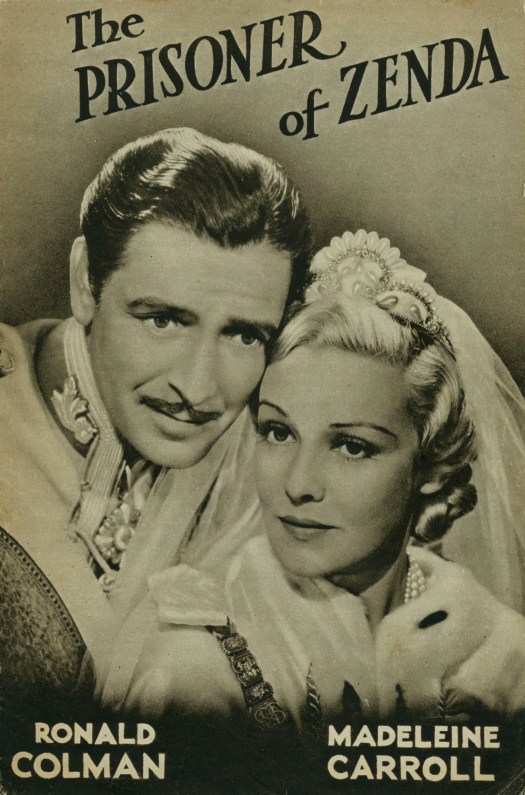
British moviegoers had just seen Ruritania appear before their very eyes in the 1937 screen version of the romance, which make dashing Ronald Colman an obvious salesperson and accounts for his presence on the dust jacket.ย  It is the line underneath, though, that made me look: โ€œThe Book of the Radio Broadcast,โ€ the advertising slogan reads.ย  Desperate, anachronistic, and now altogether unthinkable, these words reminded me just how far removed we are from those olden days when radio ruled the waves.

โ€œThe Prisoner of Zendaย was recently the subject of a highly successful film,โ€ the copy on the inside states somewhat pointlessly in the face of the faces on the cover.ย  Whatโ€™s more, it continues, a โ€œfurther mark of its popularityโ€ was the storyโ€™s โ€œselection by the BBC as a radio serial broadcast on the National Programme.โ€ ย To this day, the BBC produces and airs a great number of serial adaptations of classic, popular or just plain old literature; but, however reassuring this continuation of a once prominent storytelling tradition may be, a reminder of the fact that books are still turned into sound-only dramas would hardlyย sellย copies these days.ย  Radio still sells merchandiseโ€”but a line along the lines of โ€œas heard on radioโ€ is pretty much unheard of in advertising these days.

From my collection of Cinegrams.

โ€œThis book is the original story on which the broadcast was based,โ€ the dust jacket blurb concludes.  I, for one, would have been more thrilled to get my hands or ears on the adaptation, considering that all we have left of much of the BBCโ€™s output of aural drama is such ocular proof of radioโ€™s diminished status and pop-cultural clout.

Perhaps, my enthusiasm at this find was too much tempered with the frustration and regret such a nostalgic tease provokes.  At any rate, I very nearly left Ystwyth Books without the volume in my hands. That I walked off with it after all is owing to our friend, novelist Lynda Waterhouse, who saw me giving it the eye and made me a handsome present of it.  And there it sits now on my bookshelf, a tattered metaphor of my existence: I am stuck in a past that was never mine to outlive, grasping at second-hand-me-downs and gasping for recycled air . . . a prisoner of a Zenda of my own unmaking.

Double Hedda: Friel, Ibsen, and the Business of Giving It Oneโ€™s Best Shot

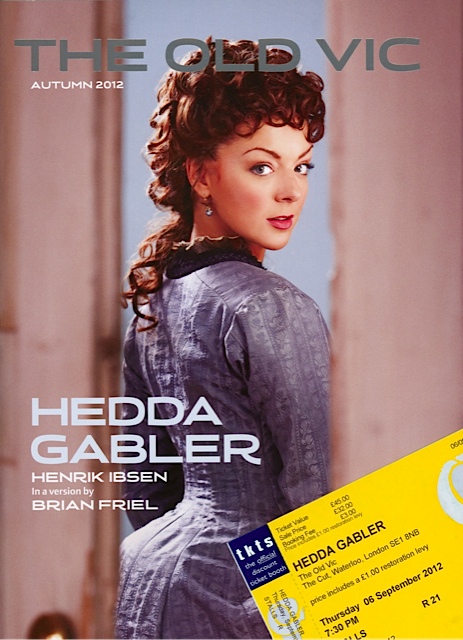
โ€œI donโ€™t think heโ€™s written a line thatโ€™s unnecessary,โ€ Adrian Scarborough remarked about Henrik Ibsen during rehearsals for the latest production of Hedda Gabler at Londonโ€™s Old Vic, in which Scarborough plays the part of Heddaโ€™s husband.  The endorsement is peculiarly out of place, considering that the Old Vicโ€™s Hedda hardly distinguishes itself byโ€”or even strives forโ€”a line-by-line fidelity to Ibsenโ€™s original.  Rather than a rewording of previous translations, Brian Frielโ€™s โ€œnew versionโ€ puts a few new words into the mouths of the old, familiar characters created by his fellow playwright, adding a line here and there that left me questioning their necessity.

Now, few theatergoers around the world are in a position to compare Ibsenโ€™s Norwegian to the translation in which they hear those lines performed; and whether a character (in this case Hedda) says โ€œBut of course one has to grow accustomed to anything newโ€ or โ€œNew surroundings take a little getting used toโ€ seems to make little difference.  Are such substitutions worth the bother? What’s more, are they worthy of a playwright like Friel?

โ€œBut of course one has to grow accustomed to anything new.โ€  That line can be found in the American-English translation by Rolf Fjelde, who, in an effort of doing โ€œthe very best [a translator] can do,โ€ kept โ€œa conscience-file of revisionโ€ in hopes of getting the opportunity โ€œFinally [to] Get It Right.โ€  Fjelde got that chanceโ€”and the result seems not particularly in need of further emendation.  Playwright Friel, though, is not about to offer his services as a mute transcriber whose job is to interpret without drawing attention to the interpreter and the challenges or impossibilities of arriving at any one definitive text in a given or taken language.  Friel does not claim his English version to be the last wordโ€”and, rather than having us take his word for it being faithful, wants to have a word with us about it.

To do so, Friel inserts hints of himself into the action, which, aside from Heddaโ€™s quest to destroy, quite literally, the text of patriarchy, involves the contest between two published writers, both western and male.  Most overtly, he does this by taking liberties with the lines spoken by the middle-aged Judge Brack who, in Frielโ€™s version, confounds his listeners with Americanisms like โ€œmaking whoopeeโ€ and provides a running commentary on the currency and lifespan of written and spoken language.  โ€œPhiladelphia, there you go!โ€ Friel seems to say to Fjelde, suggesting that Broadway and the West End may well require or at least warrant alternate versions of Ibsen and arguing that neither variant of English can or should be considered transcontinental, let alone universal.

Unlike Fjelde, Friel reminds us that we are in Norway, having characters drop names of places or remarking on the quality of โ€œNorwegian air.โ€  Yet, also unlike Fjelde, Friel reminds us, by foregrounding the novelty or datedness of words and debating their suitability, that we are not in any particular, definitive place at all but that we are instead in the contested, dangerous territory of language.  It is a territory that Hedda seems to control for a while with her probing questions and scathing remarks but that nonetheless delimits and ultimately overmasters her.

As scholar Anthony Roche puts it, Friel demonstrates himself to be โ€œconcerned with updating the constantly changing English language that will always require new adaptations of Ibsen, while making subtle additions that perhaps deepen our understanding of the rich emotional lives of the characters.โ€  Frielโ€™s Hedda is almost as much about Ibsenโ€™s characters as it is about the act of reading them โ€ฆ and of interpreting Ibsen.  It is a self-conscious take on the act of taking on a classic that, in its reflexivity borders on the by now rather tiresomely postmodern.  Give it your best shot, translator, I felt like responding, and let Hedda get her gun and do the rest.

That Hedda couldnโ€™t quite do her jobโ€”and that Friel hadn’t quite done hisโ€”became apparent from the laughter in the audience even as Hedda was about to do away with herself in the ingenious glass coffin the Old Vic production had prepared for that purpose.  โ€œThis is my first Ibsen,โ€ commented actress Fenella Woolgar (who took on the part of Thea Elvsted), โ€œand Iโ€™m discovering that he is a lot funnier than I anticipated.โ€  Perhaps, thatโ€™s because this ainโ€™t quite Ibsen and because Friel isnโ€™t quite the Ibsen-minded processor anyone expecting a traditional Hedda interpretation is likely to expect.

โ€œTranslation,โ€ as I said elsewhere (in an essay on the subject) is too mild a word to capture the violent process whereby a text written in one language and time is taken apart and rebuilt in another.  Hedda is a violent play; but given that I find myself preoccupied with the making of this Hedda rather than with the unmaking of its nominally central character, I wonder whether Friel has not inflicted some harm, necessary or otherwise, on Hedda and Hedda alike โ€ฆ

Ladykillers Instinct; or, Marcia Warrenโ€™s Profession

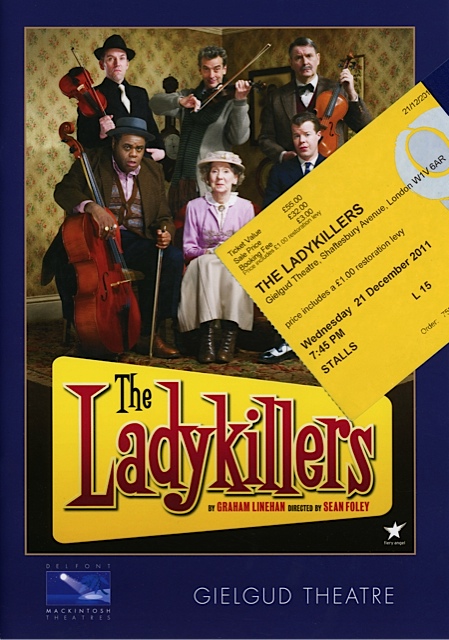
“Whatโ€™s your great online discovery,โ€ an interviewer asked Marcia Warren, star of the current West End production of Ladykillers.ย  To this, the veteran of stage, screen and radio replied, โ€œWhat does online mean?โ€ It is just the kind of answer most of us expectโ€”and want to hearโ€”from someone past middle age, which makes hers such a sly response.ย  Warren remains in character, as Mrs. Wilberforce, kindly old landlady to the killers, giving us what we find so reassuring and endearing about the senescence we otherwise dread.ย  She may or may not be jokingโ€”but she sure has earned the right neither to know nor to care.ย  Looked at it that way, being past it becomes a shelter, a retreat beyond trends, updates and upgrades whose seeming simplicity appeals to those who cannot afford to be quite so nonchalant about technology, who feel the pressure of performing in and conforming to the construct of the present as a digital age.ย 

Not to know or willfully to ignoreโ€”what luxury! Young and not-so-young alike find comfort in this deflecting mirror image of our future selves.ย  Itโ€™s a Betty White lie we use to kid ourselves .

We enjoy making light of old age; and those of us who have half a conscience enjoy it even more to be presented with elderly people or characters who are not simply the brunt of yet another ageist joke but are in on itโ€”and cashing in on it as well.  We laugh all the way as they take our laughter to the bank.

We want older folks to be feisty because it comforts us to know that, even in our declining years, there are weapons left with which to fight, however futile the fighting.  The middle aged, by comparison, are past the prime against which the standard their looks and performances are measured; it is their struggle to conceal or deny this obsolescence that makes them the stuff of deflationary humor.  We don’t laugh at Mrs. Wilberforce; we laugh at the bumbling crooks whose willfulness is no match for her force shield of insuperable antiquity.

It is this nod to nostalgia as a weapon against the onslaught of modernity that makes Ladykillers such a charmer of a story.ย  And what makes it work on the stage just as it works on the screen is that the 1955 original requires no update: the Ladykillers was born nostalgic.ย  It hit the screensโ€”in fabulous Technicolor, no lessโ€”at a time when, after years of postwar austerity, the British were ready to look back in amusement at their wants and desires and all those surreptitious attempts to meet them.ย  Sneers turned to smiles again as greed was finally being catered to once more.

Eluding those who try to will it by force, fortune winks at those who wait like Mrs. Wilberforce, a senior citizen yet hale, clearheaded and driven enough to enjoy a sudden windfall.  It is a conservative fantasy that appealed then as it appeals now, especially to middleclass, middle-aged theatergoers eager to distract themselves from banking woes and pension fears, from cybercrime and urban riots.

Familiar to me from radio dramatics, Warrenโ€™s name was the only one on the marquee I recognized as I decided whether or not take in what I assumed to be another one of those makeshift theatricals that too often take the place of real theater these daysโ€”stage adaptations of popular movies, books and cartoons like Shrek, Spider-Man, or Addams Family with which the theater world is trying rather desperately to augment its aging audience base.

Written by Graham Linehan and directed by Sean Foley, this new production of The Ladykillers fully justified its staging.ย  There is much for the eye to take in; indeed, it owing to an able castโ€”and the lovely, lively Ms. Warren above allโ€” to prevent the ingenious set and special effects from stealing this caper.

In the real, honest-to-goodness make-believe beyond the online trappings of which she claims to be ignorant, Warren gives us just what we want.  After all, acting for our pleasure and acting out our desires is her business.  Itโ€™s the oldest profession in the world.

Time and the Airwaves: Notes on a Priestley Season

Both BBC Radio 4 and 7 are in the thick of a J. B. Priestley festival, a spate of programs ranging from serial dramatizations of early novels (The Good Companions and Bright Day) and adaptations of key plays (Time and the Conways and An Inspector Calls), to readings from his travelogue English Journey and a documentary about the writerโ€™s troubled radio days. Now, I donโ€™t know just what might be the occasion for such a retrospective, since nothing on the calendar coincides with the dates of Priestleyโ€™s birth or death. Perhaps, it is the connection with the 70th anniversary of the evacuation of Dunkirk, an event on which Priestley embroidered in June 1941 for one of his Postscript broadcasts, that recalled him to the minds of those in charge of BBC radio programming.
Never mind the wherefores and whys. Any chance of catching up with Priestley is welcome, especially when the invitation is extended by way of the wireless, the means and medium by which his voice and words reached vast audiences during the 1930s and early 1940s, both in the United Kingdom and the United States.

For all his experience as a broadcaster, though, Priestley, who was not so highbrow as to high-hat the mass market of motion pictures, never explored radio as a playwrightโ€™s medium, as a potential everymanโ€™s theater on whose boards to try his combined radiogenic skills of novelist, dramatist, and essayist for the purpose of constructing the kind of aural plays that are radioโ€™s most significant contribution to twentieth-century literatureโ€”the plays of ideas.

Priestley prominently installed a wireless set in Dangerous Corner, a stage thriller whose characters gather to listen to a thriller broadcast. Later, he read his controversial wartime commentaries (titled Postscripts) to a vast radio audience. He even went on one of Rudy Valleeโ€™s variety programs to discuss the fourth dimension. Yet the medium that relied entirely on that dimension, to the contemplation of which he devoted many of his stage playsโ€”Time and the Conways and I Have Been Here Before among themโ€”did not intrigue Priestley to make time and create plays especially for the air.

To be sure, his falling out with the BBC in 1941 (as outlined in Martin Wainwrightโ€™s radio documentary about the Postscript broadcasts) did little to foster Priestleyโ€™s appreciation of the radiodramatic arts. Yet the indifference is apparent long before his relationship with Auntie soured. When interviewed for the 1 September 1939 issue of the Radio Times about his novel Let the People Sing, which was to be read serially on the BBC before it appeared in print, Priestley dismissed the idea that he had written it with broadcasting in mind:

“I realised, of course, that the theme must appeal to the big majority. But apart from that, I thought it better to let myself go and leave the BBC to make it into twelve radio episodes. It would otherwise have cramped my style.”

To Priestley, the โ€œexperimentโ€ of broadcasting his novel lay in the marketing โ€œgambleโ€ of making it publicly available prior to publication, a challenge of turning publishing conventions upside down by effectively turning the printed book into a sort of postscript. Clearly, he looked upon radio a means of distribution rather than a medium of artistic expression.

Reading I Have Been Here Before and listening to the radio adaptation of Time and the Conways, I realized now little either is suited to the time art of aural play. Whereas the Hรถrspiel or audio play invites the utter disregard for the dramatic unities of time and space, Priestley relied on the latter to make time visible or apparent for us on the stage.

The Conways, like the characters of Dangerous Corner before them, are brought before us in two temporal versions, a contrast designed to explore how destinies depend on single moments in timeโ€”moments in which an utterance or an action brings about changeโ€”and how such moments might be recaptured or rewritten to prevent time from being, in Hamletโ€™s words, โ€œout of joint.โ€

โ€œTimeโ€™s only a dream,โ€ Alan Conway insists. โ€œTime doesnโ€™t destroy anything. It merely moves us onโ€”in this lifeโ€”from one peep-hole to the next.โ€ Our past selves are โ€œreal and existing. Weโ€™re seeing another bit of the viewโ€”a bad bit, if you likeโ€”but the whole landscapeโ€™s still there.โ€

In Priestleyโ€™s plays, it is the scenery, the landscape of stagecraft, that remains there, โ€œwholeโ€ and virtually unchanged. The unity of space is adhered to so as to show up changes in attitudes and relationships and to maintain cohesion in the absence or disruption of continuity.

In radioโ€™s lyrical time plays, by comparison, neither time nor place need be of any moment. It is the moment alone that matters on the air, an urgency that Priestley, the essayist and wartime commentator, must surely have sensed.  Priestley, the novelist and playwright did or could not.  Too few ever did.  To this day, a whole aural landscape is biding its time . . .

Letters of a [Class] Betrayed: Opera Without Soap

I am not inclined to manual labor. If I lift a finger, it is likely to come down on what isnโ€™t grammatically up to scratch or else to add a few scrapes to my scalp as I take some rambling bull by the inkhorn. There has been a little more of that going on latelyโ€”teaching and editingโ€”and, my furrowed pate notwithstanding, I am heartily glad of it. Yet as much as I relish being back in the game after suffering the indignity of being benched for the betterโ€”or, rather, worseโ€”part of the past five seasons, the academy has never felt like a home court to me. It is as if, carved into the trunk of my family tree however rotten, puny and lacking in shelter it might be, are memos more emphatic than the certificates of achievement now gathering dust in the drawer I am so little inclined to tidy. Instead of considering myself invited as I enter places of culture and learning, I still feel at times as if I were crashing a party.

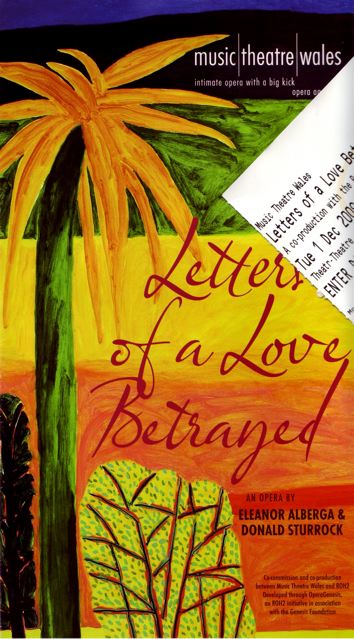
Program and ticket stub for Letters of a Love Betrayed

You see, I was born into that endangered social stratum known as the working class. It is an origin of which I am mindful, though neither proud nor ashamed. At least, I am not ashamed of it now. I used to be as thrilled about it as Ann Blythโ€™s character in Mildred Pierce, even though my parents bore a closer resemblance to Lana Turner in Imitation of Lifeโ€”that is, too busy to notice that living up to their aspirations left their offspring in the dust they raised as they tried to shake the dirt clinging to their roots. At any rate, stuck in that cloud of dust was I, an asthmatic kid who couldnโ€™t afford to hold his breath at the off chance of parental attention.

Not to suffocate under the rubble of post-Second World War Germany, my parents had to put their noses far closer to the proverbial grindstone than I ever did. Their generation, aided by American interests, pulled off the Wirtschaftswunder or โ€œeconomic miracle,โ€ a sleight-of-hands-on approach to the lasting trauma caused by total war and final solution, the coming to terms with which would have required equipment far more difficult to handle than shovel and broom.

I am not so disingenuous as to pass off my staying put as a form of sit-down strike, of giving the clean-and-cover-up efforts of my parentsโ€™ generation the spotless finger; but apart from the months I ill served my country working as a hospital orderly or the hours I spent cleaning apartments in New York City to help finance my college education, I remained sedentary for much of my life.

So far, itโ€™s been a life spent lost in thoughts, ensconced in writing, and plunked down for performances that artists work on studiously for our delight and instructionโ€”the kind of delight my father found it difficult to accept as serious work and the instruction he thought less of than the empirical knowledge that, along with calluses, is the badge and perquisite of the experience-hardened laborer.

I suppose it is easier for the workerโ€”not to be equated here with the impecuniousโ€”to aspire to material possessions instead of culture and learning, since exposing yourself to something that poses a challenge rather than promising instant gratification requires still more work on the part of those who have little time and less energy to spare.

Now, my comparatively indolent existence permits me to spare that time; yet, as if my conscience and buttocks alike had been shaped by Protestant work ethics, I often feel rather uncomfortable. Iโ€™m not one to pooh-pooh the benefits of resting on oneโ€™s Popo (as dainty Germans call the posterior); but, there is nothing like wriggling in my seat in hopes of improving my mind to convince me that the callusesโ€”and Iโ€”belong elsewhere.

I had that impression sitting through Letters of a Love Betrayed, a new opera by Eleanor Alberga (libretto by Donald Sturrock). Reading about it, I was intrigued by the promised fusion of Latin rhythms and a neo-Gothic romance based on a story by Isabel Allende, but felt let down by a score that to my untrained ear sounded forbidding, unmelodious, and, worse still, forgettable. Perhaps, the perceived cacophony was the result of a clanging together of too many stereotypes. Whatever melo- Letters possesses is all in the drama; derivative and contrived, it is creakier than a chair that has been squirmed out of too often.

I didnโ€™t get it. I didnโ€™t like it. I felt like a tired, vitamin deprived miner lured into a soup kitchen of the arts, the drama being a concession to what is assumed to be his tastes as he is being fed a presumably healthy diet with a none too musical spoon.

As I sat down again to express my thoughts on the matter of whatโ€™s the matter with me, I kept wondering whether what I was responding to so angrily was utter musical rubbish, dreck worse than the grime to which I chose not to expose myself, or whether my inability to open my mind was dictated to me by my past, a past unfolding in letters of a class betrayed.

โ€œ. . . reduced, blended, modernisedโ€: The Wireless Reconstitution of Printed Matter

Nearly two centuries ago, young Rebecca Sharp marked her entrance into the world by hurling a book out of a coach window. That book, reluctantly gifted to her by the proprietress of Miss Pinkertonโ€™s academy for young ladies, was Johnsonโ€™s dictionary, a volume for which Ms. Sharp had little use, given that she was rarely at a loss for words. By the time her story became known, in 1847, words in print had become a rather less precious commodity, especially after the British stamp tax was abolished in 1835, which, in turn, made the emergence of the penny press possible. Publications were becoming more frequentโ€”and decidedly more frivolous.

Gone were the days when a teenager like Mary Jones, whose story I encountered on a trip to the Welsh town of Bala last weekend, walked twenty-five miles, barefooted, for the privilege of owning a Bible. Sure, I enjoy the occasional daytrip to Hay-on-Wye, the renowned โ€œTown of Booksโ€ near the English border where, earlier this month, I snatched up a copy of the BBCโ€™s 1952 Year Book (pictured). Still, ever since the time of the great Victorian novelists, the reading public has been walking no further than the local lending library or wherever periodicals were sold to catch up on the latest fictions and follow the exploits of heroines like Becky Sharp in monthly installments.

In Victorian times, the demand for stories was so great that poorly paid writers were expected to churn them out with ever greater rapidity, which left those associated with the literary trade to ponder new ways of meeting the supply. In Gissingโ€™s New Grub Street (1891), a young woman assisting her scholarly papa is startled by an

advertisement in the newspaper, headed โ€œLiterary Machineโ€; had it then been invented at last, some automaton to [. . .] turn out books and articles? Alas! The machine was only one for holding volumes conveniently, that the work of literary manufacture might be physically lightened. But surely before long some Edison would make the true automaton; the problem must be comparatively such a simple one. Only to throw in a given number of old books, and have them reduced, blended, modernised into a single one for todayโ€™s consumption.

Barbara Cartland notwithstanding, such a โ€œtrue automatonโ€ has not yet hit the market; but the recycling of old stories for a modern audience had already become a veritable industry by the beginning of the second quarter of the 20th century, during which โ€œgolden ageโ€ the wireless served as both home theater and ersatz library for the entertainment and distraction craving multitudes.

A medium ofโ€”and only potentially forโ€”modernity, radio has always culled much of its material from the past, โ€œReturn with us nowโ€ being one of the phrases most associated with aural storytelling. It is a phenomenon that led me to write my doctoral study Etherized Victorians, in which I relate the demise of American radio dramatics to the failure to establish or encourage its own, autochthonous, that is, strictly aural life form.

Sure, the works of Victorian authors are in the public domain; as such, they are cheap, plentiful, and, which is convenient as well, fairly innocuous. And yet, for reasons other than economics, they strike us as radiogenic. Like the train whistle of the horse-drawn carriage, they seem to be the very stuff of radioโ€”a medium that was quaint and antiquated from the onset, when television was announced as being โ€œjust around the corner.โ€

Perhaps, the followers of Becky Sharp should not toss out their books yet; as American radio playwright Robert Lewis Shayon pointed out, the business of adaptation is fraught with โ€œartistic problems and dangers.โ€ He argued that he โ€œwould rather be briefed on a novelโ€™s outline, told something about its untransferable qualities, and have one scene accurately and fully done than be given a fast, ragged, frustrating whirl down plot-skeleton alley.โ€

It was precisely for this circumscribed path, though, that American handbooks like James Whippleโ€™s How to Write for Radio (1938) or Josephina Niggliโ€™s Pointers on Radio Writing (1946) prepared prospective adapters, reminding them that, for the sake of action, they needed to โ€œretain just sufficient characters and situations to present the skeleton plotโ€ and that they could not โ€œafford to waste even thirty seconds on beautiful descriptive passages.โ€

As I pointed out in Etherized, broadcast writers were advised to โ€œfree [themselves] first from the enchantment of the authorโ€™s styleโ€ and to โ€œoutline the action from memory.โ€ Illustrating the technique, Niggli reduced Jane Eyreโ€”one of the most frequently radio-readied narrativesโ€”to a number of plot points, โ€œbald statementsโ€ designed to โ€œeliminate the non-essential.โ€ Only the dialogue of the original text was to be restored whenever possible, although here, too, paraphrases were generally required to clarify action or to shorten scenes. Indeed, as Waldo Abbotโ€™s Handbook of Broadcasting (1941) recommended, dialogue had to be โ€œinvented to take care of essential description.โ€

To this day, radio dramatics in Britain, where non-visual broadcasting has remained a viable means of telling stories, the BBC relies on 19th-century classics to fill much of its schedule. The detective stories of Conan Doyle aside, BBC Radio 7 has just presented adaptations of Thackerayโ€™s Vanity Fair (1847-48), featuring the aforementioned Ms. Sharp, and currently reruns Trollope’s Barchester Chronicles (1855-67). The skeletons are rather more complete, though, as both novels were radio-dramatized in twenty installments, and, in the case of Trollopeโ€™s six-novel series, in hour-long parts.

BBC Radio 4, meanwhile, has recently aired serializations of Trollope’s Orley Farm (1862), Wilkie Collinsโ€™s Armadale (1866) and Mary Elizabeth Braddonโ€™s Lady Audleyโ€™s Secret (1862). Next week, it is presenting both Charlotte Brontรซโ€™s Villette and Elizabeth Gaskellโ€™s Ruth (both 1853), the former in ten fifteen minute chapters, the latter in three hour-long parts.

Radio playwright True Boardman once complained that adaptations for the aural medium bear as close a relation to the original as โ€œpowdered milk does to the stuff that comes out of cows.โ€ They are culture reconstituted. โ€œ[R]educed, blended, [and] modernisedโ€œ, they donโ€™t get a chance to curdle . . .

Note: Etherised Victorians was itself ‘reduced and blended,’ and published as Immaterial Culture in 2013.


Related writings (on Victorian literature, culture and their recycling)
โ€œHattie Tatty Coram Girl: A Casting Note on the BBCโ€™s Little Dorritโ€
โ€œValentine Vox Pop; or, Revisiting the Un-Classicsโ€
“Curtains Up and ‘Down the Wires'”
Eyrebrushing: The BBC’s Dull New Copy of Charlotte Brontรซ’s Bold Portrait”

” . . . the way of all flesh, material or imaginary”: Conan Doyle at 150

โ€œHad Holmes never existed I could not have done more, though he may perhaps have stood a little in the way of the recognition of my more serious literary work.โ€ That is how Arthur Conan Doyle, not long before his own death in 1930, announced to his readers that he would put an end to his most robust brainchild, the by now all but immortal Sherlock Holmes. Indeed, the figure continues to overshadow every aspect of Dr. Doyleโ€™s career, literary or otherwise. Perhaps, โ€œupstageโ€ is a more precise way of putting it, considering that the venerable sleuth was to enjoy such success in American and British radio drama from the early 1930s to the present day.

โ€œOne likes to think that there is some fantastic limbo for the children of imagination,โ€ Doyle assuaged those among his readers who found it difficult to accept that Holmesโ€™s departure was merely โ€œthe way of all flesh.โ€

To be sure, the earlier incident at the Reichenbach Falls suggested that Holmes was impervious to threats of character assassination, that he could reappear, time and again, in the reminiscences of Doctor Watson. Still, Doyleโ€™s intention to do away with Holmes so early in the detectiveโ€™s literary career had been no mere publicity stunt. Rather than feeling obliged to supply the public with the puzzles they craved, the author felt that his โ€œenergies should not be directed too much into one channel.โ€

One of the lesser-known alternative channels considered by Doyle has just been reopened for inspection. Today, 22 May, on the 150th anniversary of Doyleโ€™s birth in 1859, BBC Radio Scotland aired โ€œVote for Conan Doyle!โ€ a biographical sketch โ€œspecially commissionedโ€ to mark the occasion. In it, writer and Holmes expert Bert Coules relates how, in 1900, Doyle embarked on a career in politics. He decided to stand for parliament; but the devotees of Sherlock Holmes would not stand for it.

Coulesโ€™s play opens right where Doyle had first intended to wash his hands of Holmesโ€”at the Reichenbach Falls. No matter how sincere Doyle was in improving the Empireโ€™s image and the plight of the Britishโ€™s troops during the Second Boer War, the push hardly met with the approval of the reading public. โ€œHow could you!โ€ โ€œHow dare you!โ€ โ€œYou brute!โ€ the public protested.

Although it was not this perceived case of filicide that did him in, Doyle proved unsuccessful in his campaignโ€”and that despite support from Dr. Bell, who served as an inspiration for Holmes. After his defeat, Doyle โ€œbowed to the inevitableโ€”and back the man came.โ€

When the The Case-Book of Sherlock Holmes was published in 1927, Doyle dropped the man once more, albeit in a gentler fashion. To assuage loyal followers, he fancied Holmes and Watson in some โ€œhumble cornerโ€ of the โ€œValhallaโ€ of British literature. Little did he know that the โ€œfantastic limboโ€ in which the two were to linger would be that in-between realm of radio, a sphere removed from both stage and pageโ€”but nearer than either to the infinite โ€œOโ€ between our ears.

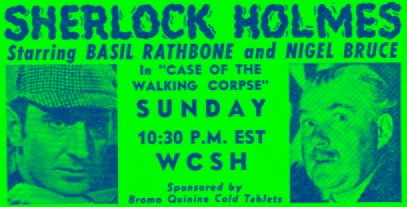
It hardly surprises that, Radio Scotlandโ€™s efforts to get out the โ€œVote forโ€ and let us walk โ€œIn the Footsteps of Conan Doyleโ€ aside, most of the programs presumably devoted to Doyle are concerned instead with โ€œThe Voice of Sherlock Holmesโ€ and the โ€œGameโ€ that is โ€œAfootโ€ when thespians like Cedric Hardwicke, John Gielgud, Carleton Hobbs and Clive Merrison approach the original. It is not Doyleโ€™s life that is celebrated in these broadcasts, but Holmesโ€™s afterlife.

True, to the aficionados of Doyle’s fiction, Sherlock Holmes has never been in need of resuscitation. Yet, as Jeffrey Richards remarked in “The Voice” (first aired in 1998),

[r]adio has always been a particularly effective medium for evoking the world of Holmes and Watson. The clatter of horses hoofs on cobbled streets, the howl of the wind on lonely moors, and the sinister creaks and groans of ancient manor houses steeped in history and crime.

The game may be afoot once more when Holmes returns to the screen this year; but, outside the pages that could never quite contain him, it is the โ€œfantastic limboโ€ of radio that kept the Reichenbach Falls survivor afloat. It is for the aural mediumโ€”the Scotland yardstick for fidelity in literary adaptationโ€”that all of his cases have been dramatized and that, in splendid pastiches like โ€œThe Abergavenny Murder,โ€ the figure of Sherlock Holmes has remained within earshot all these years.


Related writings
“โ€˜What monstrous place is this?โ€™: Hardy, Holmes, and the Secrets of Stonehengeโ€
โ€œRadio Rambles: Cornwall, Marconi, and the โ€˜Devil’s Footโ€™โ€
Old Sleuth Re-emerges in New Medium for American Ho(l)mes

Re: Boot (A Mental Effort Involving Distant Cousins)

Like many a woebegone youth of my generationโ€”once known as the No Future generationโ€”I entered the crumbling empire of Evelyn Waughโ€™s fictions by way of that lush, languid serial adaptation of Brideshead Revisited. It wasnโ€™t so much what I saw as what I had missed that made me pick up the book. Owing to my motherโ€™s loyalty to Dynasty, which aired opposite Brideshead on West German television back in the early 1980s, I was obliged to fill whatever holes our weekly appointment with the Carringtons had blasted into Waughโ€™s plot. Even more circuitous was my subsequent introduction to A Handful of Dust (1934).

In keeping with the titleโ€”and in poor housekeeping besidesโ€”a tatty paperback of it had been cast to steady a wonky table in the community room of a nurseโ€™s residence at the hospital where I carried out such duties as were imposed on me during the mandatory twenty-month stretch of civil service any boy not inclined to be trained for military action was expected to fulfill.

For twenty months, I, who ought to have been eating strawberries with Charles Ryder, served canteen slop and sanitized bedpans at a Cologne hospital. Was there ever a locality less deserving of the name it gave to the art of concealing our stenches, of which Romantic poet Samuel Taylor Coleridge once “counted two and seventy” in Cologne alone? My head was not held very high during those days, which probably led me to investigate just what propped up that misshapen piece of furniture. For once, though, I had reason to lament being downcast. A Handful of Dust turned out to be a rare find.

Counting the weeks to my release, I could sympathized with its anti-hero, the hapless Tony Last, trapped as he was in the wilds of the Amazon, forced to read the works of Charles Dickens to the one man who could have returned him to civilization but, enjoying his literary escapes, refused to release himโ€”a scenario familiar to regular listeners of thriller anthologies Suspense and Escape.) Like Mr. Last, I had gotten myself in an awful fixโ€”and up a creek that smelled the part.

So, when I think of Evelyn Waugh’s early fictions now, at a time in my life when I can more closely associate with his later Ordeal of Gilbert Pinfold, what comes to mind is the comparative misery of my youth and the pleasures derived from the incongruities at the heart of his late-1920s and 1930s novels, satires like Decline and Fall (1928), Vile Bodies (1930), and Black Mischief (1932). While not inclined to relive those days by revisiting such titles, I could not turn down the chance of another Scoop (1937), the first installment of a two-part adaptation of which is being presented this week by BBC Radio 4.

Ever topical, Scoop is a satire on journalism, war and the money to be made in the Hearstian enterprise of making the news that sells. Finding himself in the midst of it all is William Boot, whose sole contribution to the field of journalism is a โ€œbi-weekly half-column devoted to Nature.โ€ Decidedly not mightier than the sword, his pen produced lines like โ€œFeather-footed through the plashy fen passes the questing vole. . . .โ€ Not the rugged, muscular prose youโ€™d expect from a war correspondent.

It was all a deuced mistake, of course, this business of sending Boot to report on the crisis in Ishmaelia, a โ€œhitherto happy commonwealthโ€ whose Westernized natives no longer โ€œpublicly eat human flesh, uncooked, in Lent, without special and costly dispensation from their bishop.โ€ The chap who was meant and eager to go among them was Williamโ€™s namesake, one John Courteney Boot, a fashionable novelist who โ€œkept his name sweet in intellectual circles with unprofitable but modish works on history and travel,โ€ works like โ€œWaste of Time, a studiously modest description of some harrowing months among the Patagonian Indians.”

Absurd situations and wicked caricatures aside, it is Waughโ€™s proseโ€”the pith of impish phrases like โ€œstudiously modestโ€โ€”that makes a novel like Scoop such a font of literary Schadenfreude. โ€œAmusingly unkind,โ€ the London Times Literary Supplement called it. As it turns out, the jokeโ€™s on us once the narration is removed.

Condensing the wild plot in suitably madcap speed, Jeremy Front’s radio adaptation retains little of the narration, sacrificing not only wit but clarity to boot. What is left of the Waughโ€™s exposition may well lead the listener to believe that John, not William, is the central character. Indeed, like Waughโ€™s dimwitted Lord Copper, head of the Megalopolitan Newpaper Corporation, listeners are apt to (con)fuse the two.

Unlike Front, Waugh takes great pains to set up the farcical plot, dropping first one Boot, then another, and makes it clear just how the unequal pair are matched:

โ€œThe fashionable John Courtney Boot was a remote cousin [of William],โ€ Waughโ€™s narrator informs us, but they โ€œhad never met.โ€ Too eager to get on with the story, Front omits these line, relying solely on the juxtaposition of the two characters, who, during those first few minutes of the play, are little more than names to us.

However bootless the lament, I wish those stepping into the wooden O of radio today would put themselves in the shoes of their listener. Before experimenting with fancy footwork, they should consult a few classics to arrive at the proper balance between dialogue and narration. Otherwise, a potential Scoop can seem like such a Waste of Timeโ€”especially to those whose concentration is impaired by plot-obstructive reminiscences . . .


Related recordings
โ€œThe Man Who Liked Dickens,โ€ Suspense (9 Oct. 1947)
โ€œThe Man Who Liked Dickens,โ€ Escape (21 December 1952)

โ€œHere is your forfeitโ€: Itโ€™s Hopkinsโ€™s Night As Colbert Goes Private

โ€œOur guest stars might well have been tailored for the celebrated parts of Peter and Ellie,โ€ host Orson Welles remarked as he raised the curtain on the Campbell Playhouse production of “It Happened One Night,” heard on this day, 28 January, in 1940. Quite a bold bit of barking, that. After all, the pants once worn by bare-chested Clark Gable were handed down to William Powell, who was debonair rather than brawny. โ€œMr. William Powell surely needs no alteration at all,โ€ Welles insisted, even though the material required considerable trimming. Meanwhile, the part of Ellie, the โ€œspoiled and spirited heiressโ€ whom Peter cuts down to size until he suits her, was inherited by Miriam Hopkins. It had โ€œcertainly never been more faultlessly imagined than tonight,โ€ Welles declared. Indeed, as I was reminded by Andre Soaresโ€™s interview with biographer Allan Ellenberger on Alternative Film Guide, Hopkins numbered among the leading ladies who had turned down the role and, no doubt, came to regret it, given the critical and commercial success of It Happened, which earned Claudette Colbert an Academy Award.

Now, Welles was prone to hyperboles; but, in light of Colbertโ€™s memorable performance, his claim that the part had โ€œnever been more faultlessly imaginedโ€โ€”in a radio adaptation, no lessโ€”sounds rather spurious. As it turns out, raspy-voiced Hopkins (whom last I saw in a BFI screening of Becky Sharp) does not give the spirited performance one might expect from the seasoned comedienne. Her timing is off, her emoting out of character, all of which conspires, along with the imposed acceleration of the script, to render disingenuous what is meant to be her character’s transformation from brat to bride; and while Powell, a few fluffed lines notwithstanding, does quite well as the cocky Peter Grant (it was โ€œWarneโ€ when those pants were worn by Gable), the only โ€œspiritedโ€ performance is delivered by Bernard Herrmann, the composer of the lively score.

In short, there is little to justify Welles’s introductory boast. Was the Wunderkind getting back at Colbert for standing him up two months earlier, when Madeleine Carroll filled her place in โ€œThe Garden of Allahโ€? Whatโ€™s more, Colbert appeared to have passed on the chance to reprise her Oscar-winning role for Campbell Playhouse, something she had previously done, opposite Gable in one of his rare radio engagements, for a Lux Radio Theater reworking of the old โ€œNight Bus” story.

That same night, 28 January 1940, Colbert was heard instead on a Screen Guild broadcast in a production of โ€œPrivate Worlds,โ€ in a role for which she had received her second Academy Award nomination. During the curtain call, Colbert was obliged to “pay a forfeit” after incorrectly replying “The Jazz Singer” to the question “What was the first full-length all-talking picture to come out of Hollywood?” For this, she was ordered to recite a tongue twister; but it wasnโ€™t much of a forfeit, compared to the sense of loss both Colbert and Hopkins must have felt whenever they misjudged the business by rejecting important roles or by risking their careers making questionable choices.

In The Smiling Lieutenant, the two had played rivals who ended their fight over the same man by comparing the state of their undies; now, Hopkins seemed to be rummaging in Colbertโ€™s drawers for the parts she could have had but was not likely to be offered again. Well, however you want to spin it, radio sure was the place for makeshift redressing, for castoffs and knock-offs, for quick alterations and hasty refittings. It catered to the desire of actors and audiences alike to rewrite or at any rate tweak Hollywood history. Go ahead, try it on for size.