
The history of taboos sure is shocking. I mean, it is shocking to realize what, over the years, has been hidden from view and banned from our discourse. Interracial marriages. Same sex unions. Gender reassignments. While denial can be as harmful as our tendency to designate, you would have to have been living under that proverbial mineral formation or petrified by the religious fundamentalism that passes for faith these days to regard such realities as unmentionable. They may not be widely understood or tolerated, let alone embraced, but as the facts of life in all its complexities they are too much in the public eye to be ignored.
Often argued to be responsible for foisting a liberal education on the masses, Hollywood has, in fact, played an important role in keeping quiet about many aspects of our everyday lives. Beginning in the mid-1930s, and for several decades thereafter, the Production Code curtailed what could be shown or talked about in motion pictures.
It was on this day, 6 December, in 1933, that James Joyce’s Ulysses was ruled to be “not obscene,” lifting the ban on its sale in the US; but that, aside from its narrative structure, hardly made Ulysses ( 1922; previously serialised 1918-20) a hot property in Tinseltown. Writers who wanted a share of the profits to be made by selling stories or streamlining them for the silver screen had to deal with the strictures of the code and learn to rework their material accordingly.
One playwright who accepted this challenge was Lillian Hellman, whose 1934 stage success The Children’s Hour was brought to the ears of American radio listeners on this day in 1937.
The Children’s Hour tells the story of two women whose teaching careers and personal lives are wrecked when one of their pupils alleges that they are having an intimate relationship. Like Hellman’s 1936 screen version of The Children’s Hour, titled These Three, George Wells’s radio adaptation for the Lux Radio Theatre drowns out the unspeakable by suggesting instead a triangulated relationship with a virile heterosexual male at its center. Wedged between Stanwyck and Mary Astor that night was the presumably irresistible Errol Flynn.
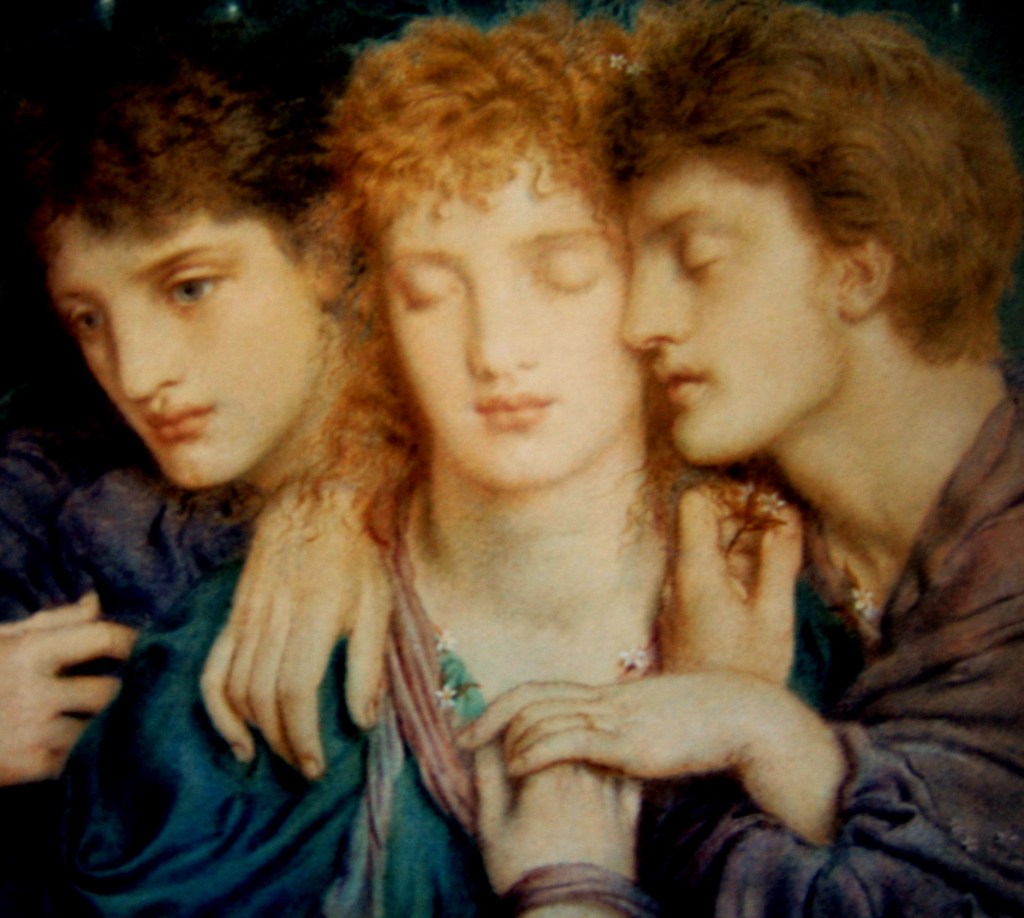
Hollywood had long thrived on love triangles, although they were rarely as ambiguous as in the above painting by the aforementioned queer artist Simeon Solomon. Indeed, the three-cornered plot is key to the first new genre of production-coded cinema—the screwball comedy, in which heterosexual marriage is challenged by old flames or new rivals until it is ultimately reaffirmed. Although—or perhaps because—These Three is more concerned with libel than with forbidden love, with allegations rather than physical acts, the revision eliminates the unmentionable to make room for a rumor that can be talked about.
As if determined to remove any doubts as to the straightness of the radio adaptation and all those associated with the production, Lux host Cecil B. DeMille opens the program by letting listeners in on a “secret,” a story that had “completely escaped the headlines.” The unheard-of item amounted to little more than the announcement of a recent marriage. According to DeMille’s anecdote, the unconventional Ms. Stanwyck had just attended the wedding of her stableboy, danced with the hired hands, and “made them all forget” that she was the “groom’s boss.” The Lux program presented itself as clean entertainment without wanting to appear stuffy.
What is more stuffy—and objectionable—than the codes governing radio and motion pictures is the subsequent silencing of the history of such hush-ups. A description of the Lux broadcast in a 1995 reference text, for instance, keeps mum about the pedigree of the adaptation by alluding vaguely to “[c]ertain aspects of the stage production’s plot” that “made a straight film version out of the question.” Phobic histories like these not only contribute to our ignorance of past inequalities. They keep us from moving beyond them.
 I’m happy to report that he is back. Not that I had time to report the incidence. This afternoon, Montague, our Jack Russell terrier, snuck through the seasonally thinned hedge and, driven by the promises of chicken and cows in the cool air, dashed off into the field—for which offense, any farmer has the right to shoot him. It seems that my responsibility toward the imp “has not created in [him] a sense of obligation.” I don’t mean to break his spirit; but I am trying hard to counter his instincts, especially those laws of nature that run counter to the ones we make for (or against) ourselves and others.
 Well, call me . . . whatever you like, but I am prickly when it comes to the protection of endangered species; those of the literary kind, I mean. Take Moby-Dick, for instance. Go ahead, so many have taken it before you, ripped out its guts and turned it into some cautionary tale warning against blind ambition and nature-defying obsession. Moral lessons are like sardines: readily tinned and easily stored until dispensed; but they become offensive when examined closely and exposed for much longer than it takes to swallow them.
 Well, August is coming across a lot like autumn. Fierce winds, cool temperatures, and short intervals of rain put an end to the July heat here in Ceredigion, Wales. Undoubtedly, I will return to hothouse climes next week, when I am back in New York City, where, on this day, 1 August, in 1819, a child was born that would eventually become one of the most celebrated authors of the 19th century: Herman Melville. Moby-Dick, his most famous work—a story everyone knows but a book hardly anyone reads—was filmed, starring Gregory Peck, not far away from here in the Welsh town of Fishguard, where, last summer, I had the misfortune to drown a cellular phone.
 Well, they come to the remotest of spots, spreading their words—or the word—undaunted by the indifference or hostility with which they are greeted. Jehovah’s Witnesses, I mean. This morning, I’ve been listening for about an hour to two of these travelling preachers, one of whom likened our lack of receptiveness and knowledge to sitting in front of a broken television set. Actually, the two reminded me of radio announcers: hawkers with a mission who come into your home (or as near as you let them) to sell you ideas and convince you to tune in tomorrow—a tomorrow so protracted it might have been conceived by a soap opera writer if it weren’t quite so blissful.
 Harry Heuser