Difference Reconciled: Ceri H. Pritchard’s Paradoxes

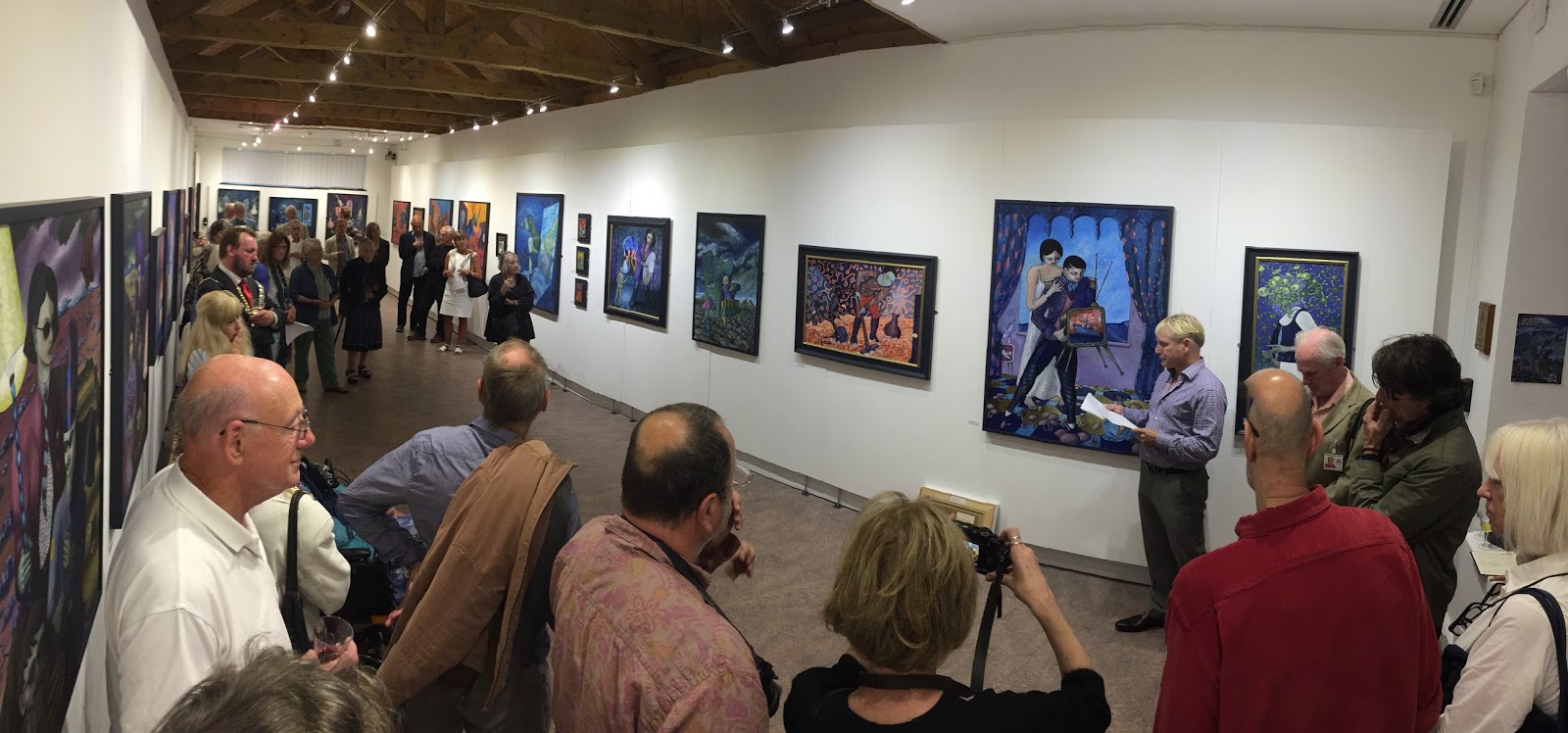
Ceri H. Pritchard at his solo exhibition Paradoxes, MOMA Machynlleth, 18 Sept. 2021

Some creative sparks managed to rekindle themselves during the pandemic; stoked up by a keenly felt sense of do-or-die urgency, they keep generating alternative realities – or alternatives to reality – out of the deepest blue of mind-numbing, soul-crumbling chaos.  While I do not quite succeed in numbering among those motivated mortals, visual artist Ceri H. Pritchard certainly does.  

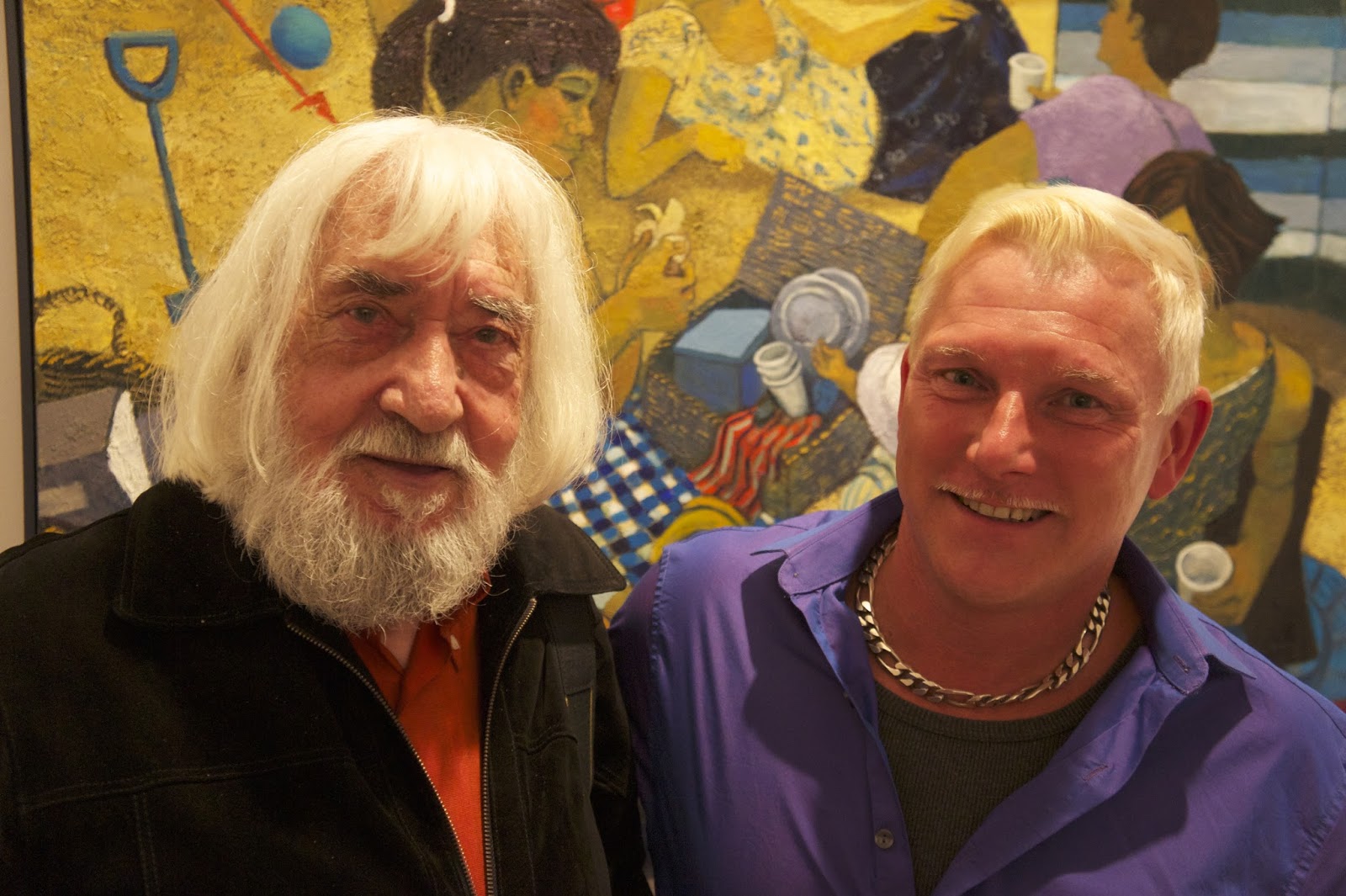
In front of Metamorphosis I at MOMA Machynlleth, with a temporarily unmasked Ceri H. Pritchard

His prodigious output, mordant wit and renewed openness to experimentation are on full display in his latest of a slew of solo shows.  Ceri H. Pritchard’s Paradoxes opened on 18 September 2021 at MOMA Machynlleth, one of Wales’s most distinguished contemporary art galleries, and is on view there until 13 November 2021.  I have been keeping up with Ceri’s work and am excited to see it transmogrify.  I said as much, or as little, in the introductory text panel I was glad to contribute to his exhibition:

Ceri first invited me into his studio in 2015.  A few years earlier, I had co-authored monographs on his parents, figurative painter Claudia Williams and the late landscape artist Gwilym Prichard.  At the time, I was as yet unfamiliar with Ceri’s decades-spanning international career.  It was an unexpected, disorientating encounter – in his parents’ house, no less – with what Ceri here terms ‘Paradoxes.’  

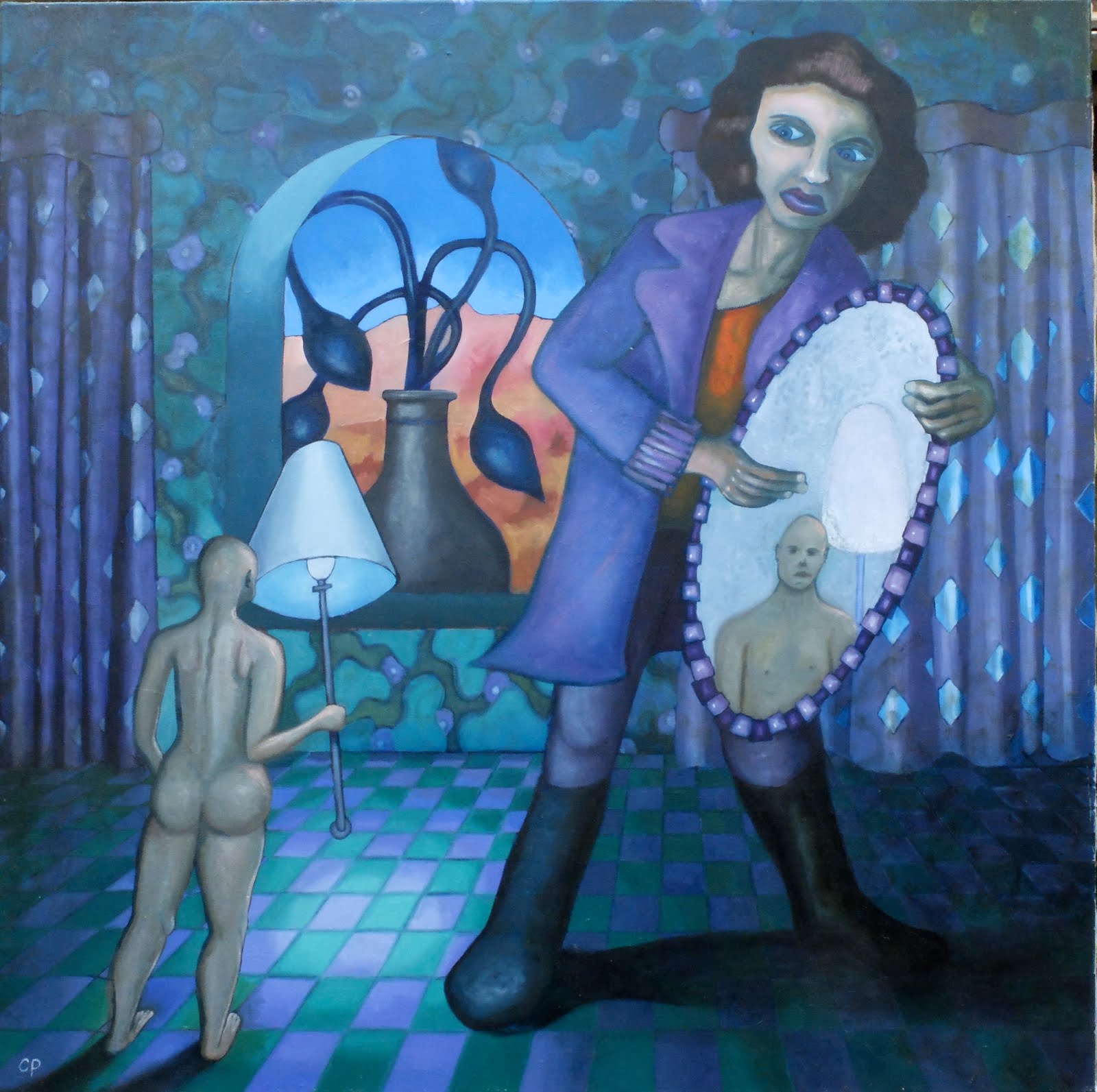
I was perhaps too quick to label his paintings ‘neo-surrealist’ in an effort to get an art historical handle on the uncanny with which I was confronted: an otherworldly territory strewn with the detritus of modernity, with outcast and less-than-easy chairs, outmoded models of disconnected television sets, and displaced floor lamps shedding no light on matters.

Resisting further temptations to make sense of it all by trying to place the work, I did not initially consider – but subsequently discussed with Ceri – how his conspicuous enthusiasm for colour and his partiality for patterns is prominent as well in his mother’s work, although in subject and mood Ceri’s paintings could not be further removed from Claudia’s figure compositions expressive of the bond between mother and child.  

And yet, the patterns in Ceri’s paintings, too, suggest blood bonds – biological ties, be it the universality of our molecular make-up or the common experience of life and death in the strange new age of COVID-19.  Those repeated shapes bespeak at once commonality and change, circulation and evolution – and they remind us that what we share can also keep us apart.

Gwilym Prichard, Landscape (1960), detail

The mostly unpopulated landscapes painted by Ceri’s father, Gwilym, meanwhile, showed a preoccupation with home and belonging, with the uncovering of roots in ancient soil rather than the representation of the iconic sites of his native Wales.  Ceri’s work, too, is concerned with home – but his approach to the question of belonging to particular cultures and traditions – is entirely different.  It is the paradox of being at home with dislocation and familiar with estrangement.

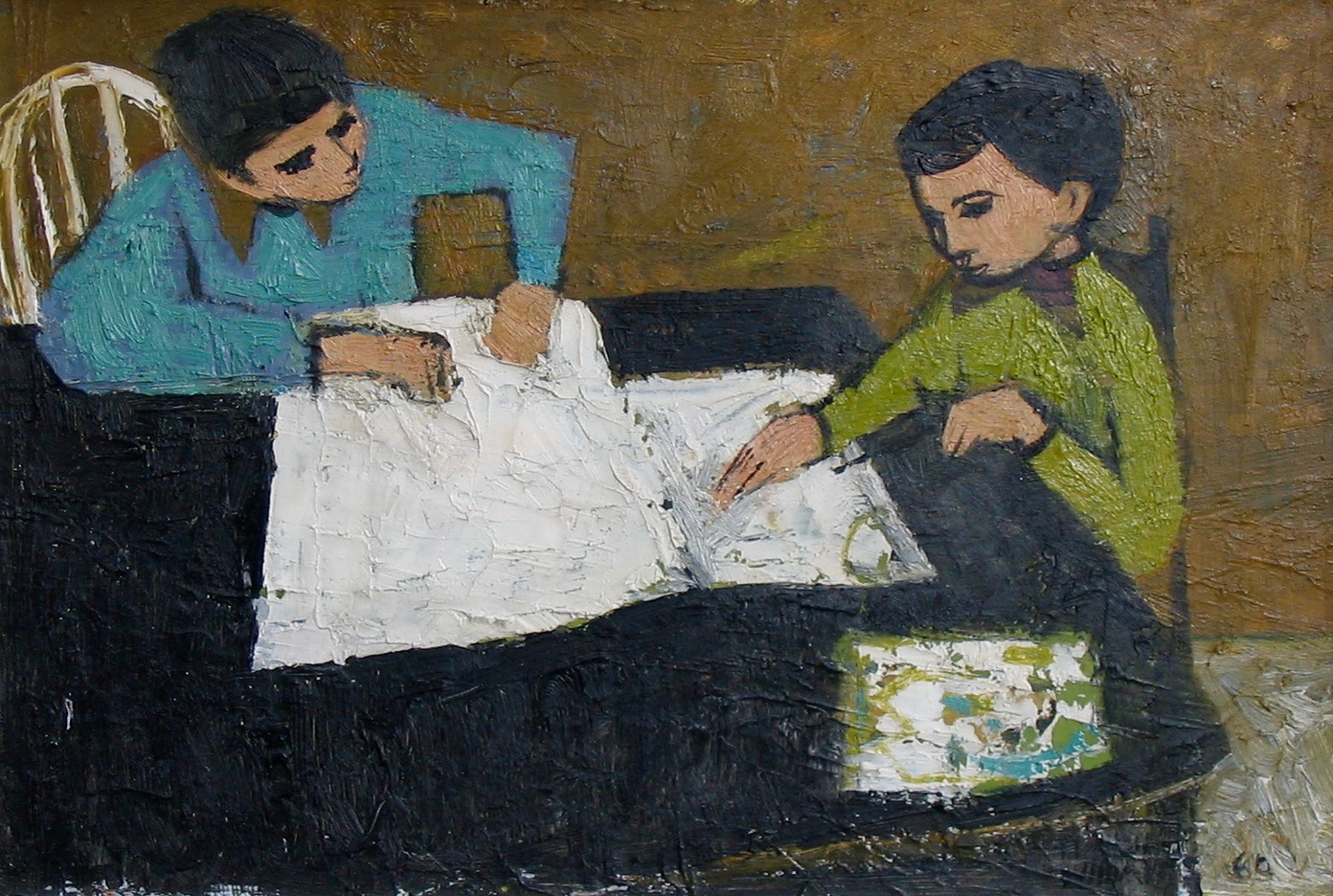
Claudia Williams, The Toy Basket (1989) detail

The paradoxes that Ceri’s work communicate are not the consolidation of a calculated career move, an effort to set himself apart as much as possible from the tradition represented by his artist parents.  They are felt, not fabricated.  Ceri’s practice is informed by an international outlook, a transnational engagement with diverse cultures, high and low, in France, Mexico and the United States.  The unresolved tension of paradox at play in his compositions reflects and responds to decades of being abroad and of returning as an artist whose paintings redefine the tradition of what it means to be living and working here and now – in twenty-first century Wales.  

Upon first seeing Ceri’s work, I felt as if I were about to be let in on a secret: canvases that were still underway, waiting – ready or reluctant – to come out into the open.  Catching up with his evolving work in his studio years later, in the middle of the pandemic, I sensed a renewed purpose, a conviction of having arrived at something worth the departure and of forging ahead, destination unknowable.  

This is a body of work distinguished by something other than its now familiar set of iconography and ready tropes packaged for public exhibition.  There is continued experimentation both in subject and technique – not just a recycling of a haunting image repertoire but a repurposing of found materials as well and an increasing openness to change and chance.

Ceri H. Pritchard, The State of Things (2021)

That air of mystery has not dissipated since I opened Ceri’s solo exhibition The Strange Edge of Reality at Tenby Museum and Art Gallery in 2016.  And although encounters with art may become less personal in a museum setting, an institutional space can also contribute to our sense of discovery by making us become more aware of alternative approaches and canonical outliers we may not have expected to find there. Surprise, mystification, and a darkly humorous take on what it means to be alive at a time it seems impossible for future generations to get nostalgic about – all that may be experienced here, but also the realisation of being prompted to become part of a compelling narrative in the making.

Rather than look at Ceri’s paradoxes as puzzles to be solved it might be useful to regard them as open invitations to question our assumptions about culture, heritage, and about art produced in Wales today. 

‘Mysteries,’ are ‘like the sun,’ the metaphysical poet John Donne wrote, ‘dazzling, yet plain to all eyes.’  And not unlike the metaphysical poets, Ceri’s compositions yoke together opposites to achieve a kind of reconciliation, a discordia concors (harmonious discord), even though, in Ceri’s case, the aim is not harmony: it is to become reconciled to remaining unsettled.
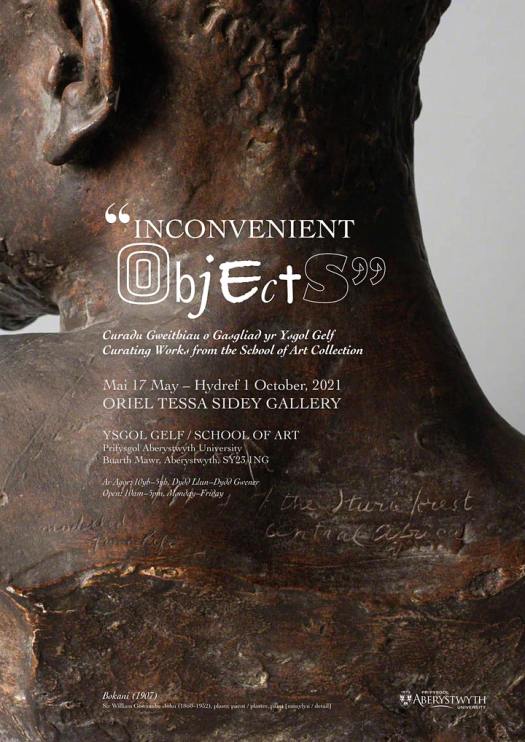
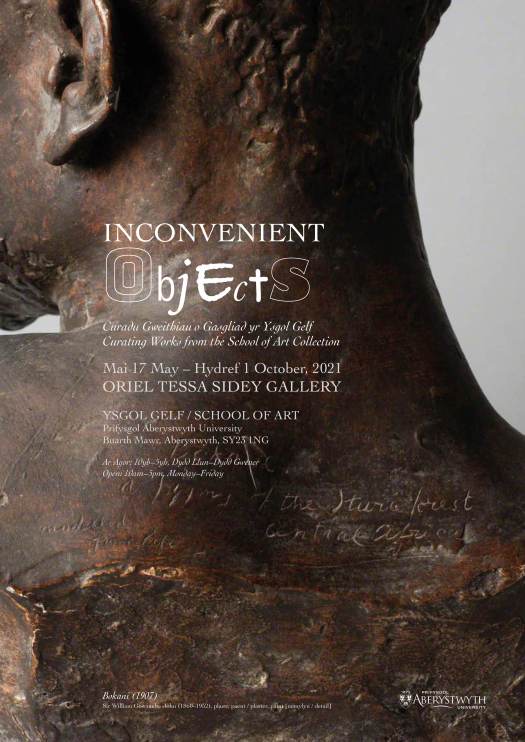
“Quote” of No Confidence: “Inconvenient Objects” at Aberystwyth University

After
Before

Like most professionals – secret agents excepting – I talk about my work at the slightest provocation.  Besides, academics are expected to drop their names freely in the hope that it may take root in a crowded field scattered with formidable grey matter and fragile egos.  There is a reason I have not yet mentioned one of my latest projects – the exhibition “Inconvenient Objects.”  For a while, it was my blood pressure monitor that had to do most of the talking, delivering clinical statements geared toward a strictly limited audience listening out for official pronouncements that can be made to serve as quantifiable substitutes for my, to my mind, tell-tale cries of anger and frustration. 

The power of words is at once affirmed and eroded in the act of our being rendered speechless, be it by way of silencing or sheer incredulity.  There is no irony in the fact that, in this case of speech free and curtailed, seemingly innocuous curls of quotation marks are at the heart of the matter. 

And just what was – or is – that matter you may well ask after reading this abstract and oblique preamble?

Since 2012, I have been involved in staging exhibitions in the galleries of the School of Art, Aberystwyth University, where I also teach art history and exhibition curating, as well as serving as Director of Research.  Most of those exhibitions – Queer TastesUgly, and Alternative Facts among them – are projects that I, with the assistance of the School’s senior curator, create for and realize with groups of undergraduate students each year.  All of those shows draw entirely from the School’s collections of some 25,000 objects of visual and material culture.

The School of Art at Aberystwyth has the distinction of being one of only two art schools in the United Kingdom that also operate as accredited museums.  I try to make use of that nearly unique status in all my teaching, and curating – in which many prospective students express an interest in their applications – provides me with an opportunity to link art history, theory and praxis in practical, public-oriented and creative ways.

I have long regarded the School of Art’s museum collections and public galleries as a mother lode for staff and students alike, as it enables them to generate and showcase their research.  The project for the current show, with which the galleries reopen to the public after over a year during which our collections lingered in the Pandora’s box that is the pandemic of which the previous project, Seeing Red, had been a casualty, was for students to investigate and interpret objects that might pose challenges to cultural institutions due to their subject matter or the politics and ideologies they bespeak.

The selected works range from Third Reich photography to a bust of a Congolese pygmy chief, but also feature groups of female nudes executed by male artists, graphic images of starvation in 1970s Ethiopia, unauthorised sketches of patients in a mental institution and scenes of bullfighting.  However rewarding the digging, the mother lode, in this instance, turned out to be a minefield.

The mining metaphor is borrowed from and alludes to one of the best-known examples of institutional critique, a practice of interrogating collections and museum spaces that artist-curators have employed since the 1970s.  Fred Wilson’s Mining the Museum was one such landmark project in which the legacies of colonialism were made transparent through the juxtapositional display of objects as outwardly disparate but intimately related as silverware and slave shackles to remind us how and on whose backs the wealth of the United States was built.

“Inconvenient Objects” was conceived to create awareness about the responsibility of contemporary museums such as ours and the role that exhibition curators play in making artifacts and their at times problematic histories accessible to the public.

The centerpiece of the exhibition, an early twentieth-century bust ostensibly created in the service of science and not intended as a portrait of the subject, Chief Bokani, was previously shown as an ethnographic “specimen” in the University’s geography department.  In the context of the exhibition, the plaster bust – created by one of Wales’ foremost sculptors – encourages debates about ethics and ethnicity in art and science. 

Wilson, unearthing a similar bust at the Hood Museum of Art, Dartmouth College, New Hampshire in 2005, had asked: ‘[Can we] extricate ourselves from the violence involved in acquiring these objects?’ The question remains whether “we” – as cultural institutions – can fulfil our civic mission by removing ourselves from the public discourse of reckoning? “We” have a lot to answer for if we don’t ask.

“Inconvenient Objects” so fully lived up to its title that it was ordered shut and hidden from view.  The word “inconvenient” was apparently central to the university management’s claim that the show posed a reputational risk.  I say “apparently” because what issues the university had with the show was never clearly – let alone directly – communicated to the curatorial team.*

Being that I also serve as the School’s “Equality Champion,” I had envisioned “Inconvenient Objects” as an opportunity to demonstrate that our University is committed to participating in the debate surrounding Black Lives Matter and the legacies of colonialism and empire in which sculptural objects such as our bust of Bokani are enmeshed.  Some three thousand words of gallery texts were in place to clarify those objectives.

After nearly two months behind closed doors – a hiding away that is now part of its story – the show was once again opened to the public, and it is scheduled to remain so until 1 October 2021.  With the addition of a single label, and a sign advising “viewer discretion” at the entrance, nothing has been altered.  And yet, everything has changed.

Our senior curator, who designed the poster, was obliged to place the title of the exhibition in quotation marks, indicating that we do not really mean what we say or else that that “we” does not refer to representatives of our institution.  In effect, the museum has been disabled from reflecting upon itself because such a critique – widely practiced elsewhere – might reflect poorly on the academic institution under which it is subsumed.

Minor adjustments though they may seem – a concession that allowed us to hold on to the title of the show – those quotation marks signal a disavowal, a lack of commitment and self-confidence.  They undermine the common endeavor to mine our public museums, instead of simply minding the store, an engagement with history and civics that should be all of our business.

*Curatorial team: Audrey Corbelli, Ciara Donnellan, Eve King, Orla Mai-Riley, Farrah Nicholson, Lucia Paone-Michael, Katie Rodge and Katarzyna Rynkowska, with contributions from Cara Cullen and Sarai David, and support from Harry Heuser (text and concept) and Neil Holland (staging and design)

Tickets for this free exhibition can be booked via Eventbrite.

Ceri Pritchard: “The Strange Edge of Reality”

I was asked to say a few words at the opening of Ceri Pritchard’s solo exhibition The Strange Edge of Reality at Tenby Museum and Art Gallery on 6 August 2016.   Here is what I said:

Opening Ceri Pritchard’s solo exhibition The Strange Edge of Reality, 6 August 2016at Tenby Museum and Art Gallery, Tenby, Wales

Last December, Ceri Pritchard invited me to see some of his latest work, which he puts before us today in this gallery.  Walking up the steps to his studio here in Tenby, I felt as if I were about to be let in on a secret: canvases that were still underway, waiting – ready or reluctant – to come out into the open.

That air of mystery hardly dissipated at the sight of those canvases.  It was an unexpected, exciting introduction.  And although introductions are rather more formalised in a gallery setting, anyone stepping into this room may experience what I felt then.  Surprise, mystification.  Yes, but also that sense of being prompted, compelled to take part in a narrative unfolding.

What we witness here are not interior monologues.  We are not prying into someone else’s secrets, at least not without consent.  Ceri’s compositions are carefully staged.  They are spectacular set pieces with props, masks, and harlequin costumes fit for the Commedia dell’arte – if pantomimes were created by Franz Kafka and produced by Sigmund Freud.  The dramatic lighting and overall theatricality of Ceri’s paintings set them apart from the illusionistic.  We are not just taking in a performance.  We wonder what’s happening behind the scenes.

These compositions are finished in execution only.  In all other respects, they are incomplete – open to the complex mind games we call, for lack of a better word, “interpretation.”

Now, Ceri Pritchard is standing right over there.  But it would be our loss to turn this into an opportunity for putting him on a psychiatrist’s couch, as it were, and ask him: just what were you thinking when you painted those figures? Where does all this come from?

As if artists had – or should have – all the answers, let alone the last word on whatever they bring into being.

Instead of pointing in Ceri’s direction, why not accept the invitation proffered by his paintings and ask: what might they tell us about ourselves? About our desires, our doubts and our demons?

What a work of art has to say depends to a large – and often underestimated – degree on our receptiveness, on our willingness to let it speak to us, and perhaps of us.

Ceri Pritchard, The Atomic Age (2016)

When look at a painting like The Atomic Age, for instance, I am reminded of the Cold War – the space race and the terror of nuclear proliferation – that became the stuff of childhood nightmares and, in my case, gave rise to compensatory fantasies.  There are plenty of mushrooms in Ceri’s paintings – not all of them suggestive of atomic clouds.  Some may be sprouting alternatives that the sensible – or insensitive – among us call “pipe dreams.”

The Strange Edge of Reality is an apt title for this exhibition. The works we see here are on the verge, teetering between worlds, not only in their set of imagery but also in their sense of place in art history and the art world of today.

Edginess is almost a prerequisite in contemporary art.  But few edges remain sharp for long.  And some become very blunt indeed – smooth and safe like a well-trodden threshold – a boundary with which to maintain our footing.  If it isn’t our voracious appetites that dull our senses to the cutting edge, it is our need to demarcate the terrain in which we might otherwise lose ourselves. 

In our appreciation of art, we tend to rely on classifications.  We might say, for instance, that Ceri’s work is surrealist, which would permit us to conclude that it is derived from or indebted to a certain, well-charted movement that originated in France in 1924.

Now, there is surrealist activity with a lower case “s.”  Henry Moore, for instance, argued that

[a]ll good art has contained both abstract and surrealist elements, just as it has contained both classical and romantic elements—order and surprise, intellect and imagination, conscious and unconscious.

This may be so vague as to take the edge off surrealism altogether, which is why such general applicationsof the term were frowned upon by Surrealists to whom the movement was an imperative.

“Movement” implies the coherence of a group through the adherence to a manifesto.  But Ceri, who adopted the term “neo-surrealist” to refer to his latest work, did not sign up to be part of a movement – there exists no Surrealist movement in Britain today.  What makes Ceri’s work edgy is that it reclaims a visual language that has long been neglected, at least in the medium of painting.

Among the artists and writers who influenced him, Ceri names the Surrealists André Breton, Francis Picabia, Salvador Dalí, and Max Ernst.  Not that Ceri’s work is an homage to them, much less a lament for a lost cause.  Rather, it makes a case for our renewed engagement with practices associated with the movement – a movement that first startled the British public at the International Surrealist Exhibition in London eighty years ago, in 1936, at a moment in history when suspicion dawned that Britain was no longer a post-war society but a pre-war one.  

The English poet David Gascoyne, who organised the London exhibition together with the artist Roland Penrose and the critic Herbert Read, declared surrealism to be a revolutionary “instrument” – a means of making us aware of the insufficiency – and the fallacy – of an order we accept as “reality.”

According to Gascoyne, the “fundamental ambition of surrealism is to dismantle all formal distinctions between dream and reality, and subjectivity and objectivity” – so that a new vision may emerge.  We can see such dismantling operating in Ceri’s paintings, in which opposites not simply clash but fuse.

The strange edge of reality isn’t simply an outer limit.  It is also a line along which meetings occur, as well as separations. The danger may lie not on the other side but in our tendency to take sides, to dismiss alternatives or to deny the other within our self.

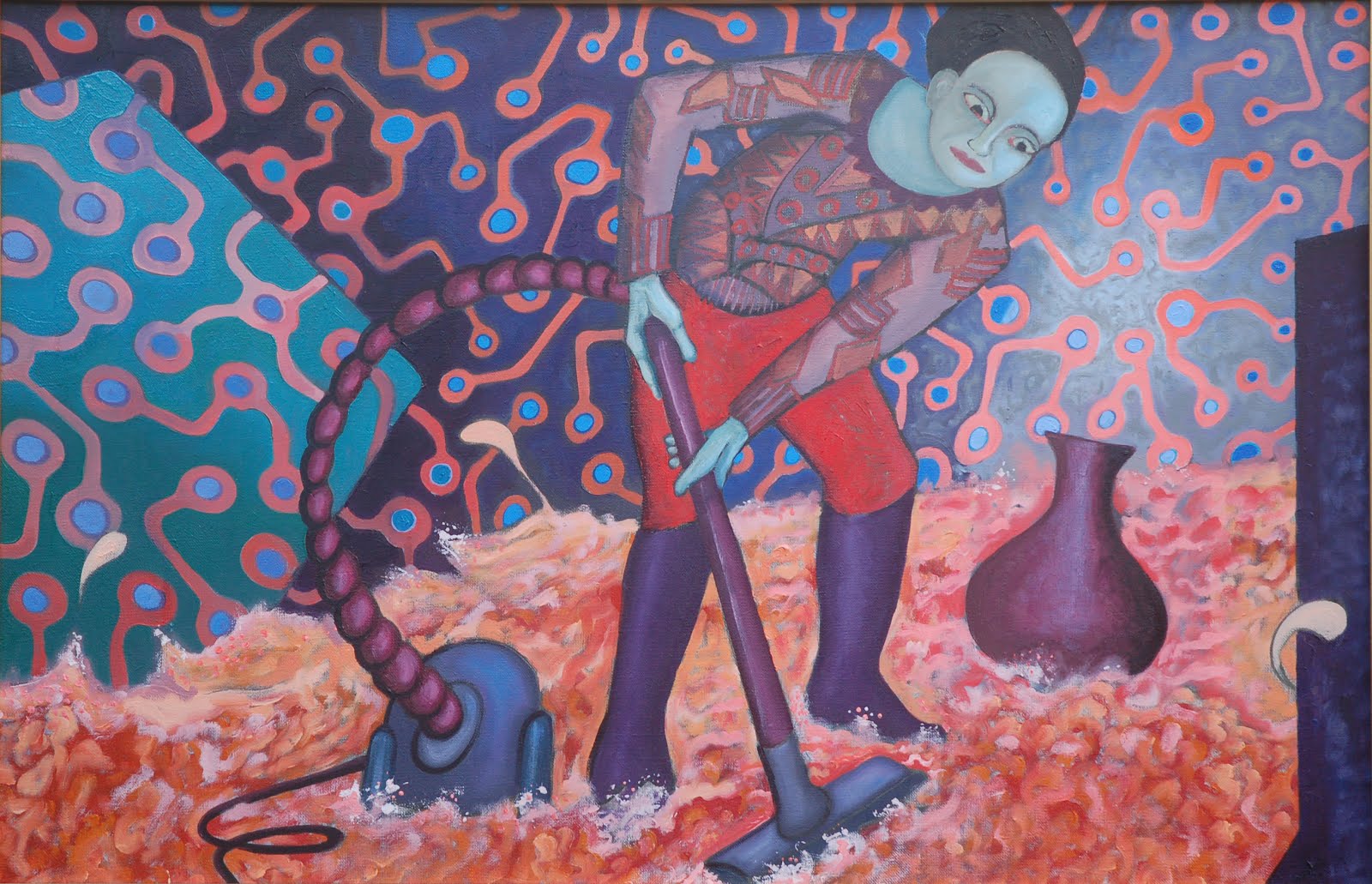
When it comes to making a clean break, to draw the line between chaos and order, there is nothing like a vacuum cleaner.  You will come across a number of those in Ceri’s paintings.  But, in Ceri’s invasion scenarios, hoovering proves futile.  Whatever we try to push away or keep apart from us creeps in from the margins to assume centre stage: fungi spreading over an interior floor space, insects crawling toward artificial light, and microbes taking over our grey cells.

Ceri Pritchard, La Limpiadora

And who is handling the equipment, anyway? The cleaner in La Limpiadora, for instance.  The creatures with which Ceri populates his scenes look like experiments conducted on the Island of Doctor Moreau, freaks of nature assembled in a game of Exquisite Corpse.  Anthropomorphic, androgynous – they defy the polarities of either/or we find so reassuring.

Ceri’s paintings call to mind the disorientation we experience not while dreaming but at the stage of waking, the state of being in and out of it at once.  It creates the unnerving sensation of estrangement that Freud termed the uncanny.

Such dislocations are also experienced when moving between cultures.  Ceri has long lived abroad, away from his native Wales.  Even the home that he has presumably come back to is not the Wales he knew as a child up in Anglesey.  Ceri, who studied art in England, has worked and exhibited in France, the United States and in Mexico – all countries, coincidentally, in which Surrealism thrived. 

Unlike ‘Modernism’ or ‘Art Deco,’ ‘Surrealism’ did not make it into the index of The Tradition: A New History of Welsh Art, 1400 – 1990, Peter Lord’s monumental new book on the visual culture of Wales.  That is not to say that those who look for it won’t find surrealist connections in Wales.  At that International Surrealist Exhibition in London, for instance, it was Dylan Thomas who handed out cups of plain water with a piece of string in it, which he offered to serve “weak or strong.”  But as tempting as it may be to identify national or regional influences in these paintings, Ceri’s neo-surrealism, like the work of the Surrealists before him, is cosmopolitan rather than parochial, and its expressions of our inner worlds are universal.

Ceri’s work resists being defined by – or confined to – any one place.  Trying to pin Ceri down by tracing his life story and his influences in his current paintings would mean to diminish the mystery and the trippy wondrousness of that work.  It is clear that he has been under the influence.  Ceri’s mind has altered many times.  That is to say, it has defied the pressure of being made up.

Ceri has experimented in many media, including sculpture, video and collage.  He has also been an abstract painter.  Figurative painting is where he is at the moment.  And that moment is also a time of introspection – a self-conscious exploration of the role of the artist and the function of art.

Many of the paintings in this exhibition are expressive of a tension between creative freedom and the demand placed on art to reflect the external world, that is, to be both mimetic and relevant, to resemble in order to matter.

Ceri Pritchard, Golau y Myfyrio

This restrictive view is countered by an ambition to shine a light on our infinite inner world instead of reflecting the system that tends to delimit the world outside and our place in it.  This dichotomy is summed up by the title Golau y Myfyrio – “Reflecting the Light” – and is rendered pictorial through the mirrors with which the figures in Ceri’s paintings are taunted and tormented, and the lamps that put them in another light.

That the title is Welsh suggests, in the absence of any stereotypically Welsh iconography, a continued processing of that ostensible homecoming.

Ceri’s current work has been described as “mature.”  It is meant to be a compliment, no doubt, but there is to me something too finite about the word.  What Ceri has managed through decades of artistic practice is to remain in his “formative years.”

Claudia Williams, Children Painting (1960)

Now, I have, on a wall in my house, a reminder of Ceri’s lifelong creativity in the form of this painting of him by his mother, Claudia Williams.  Here he is, aged six years old.  And there he is, never mind how many years later.  Ceri Pritchard has kept alive the urge to create by being alive to strangeness and by insisting on looking askance at “reality,” perched, as he is, on the edge.

“… a companionable thing”: Catching up with Stanley Anderson

A “companionable thing.”  That is how the English painter-printmaker Stanley Anderson (1884 – 1966) summed up what “art” should be.  His work reflects this sentiment, even though much of it was produced in solitude – slowly and studiously.  Staging the exhibition, Unmaking the Modern: The Work of Stanley Anderson, I was glad to have had another chance of giving my contemporaries an opportunity to get acquainted with Anderson, who died on this day fifty years ago, and to have a conversation with him as he, through his work, continues to communicate his beliefs.

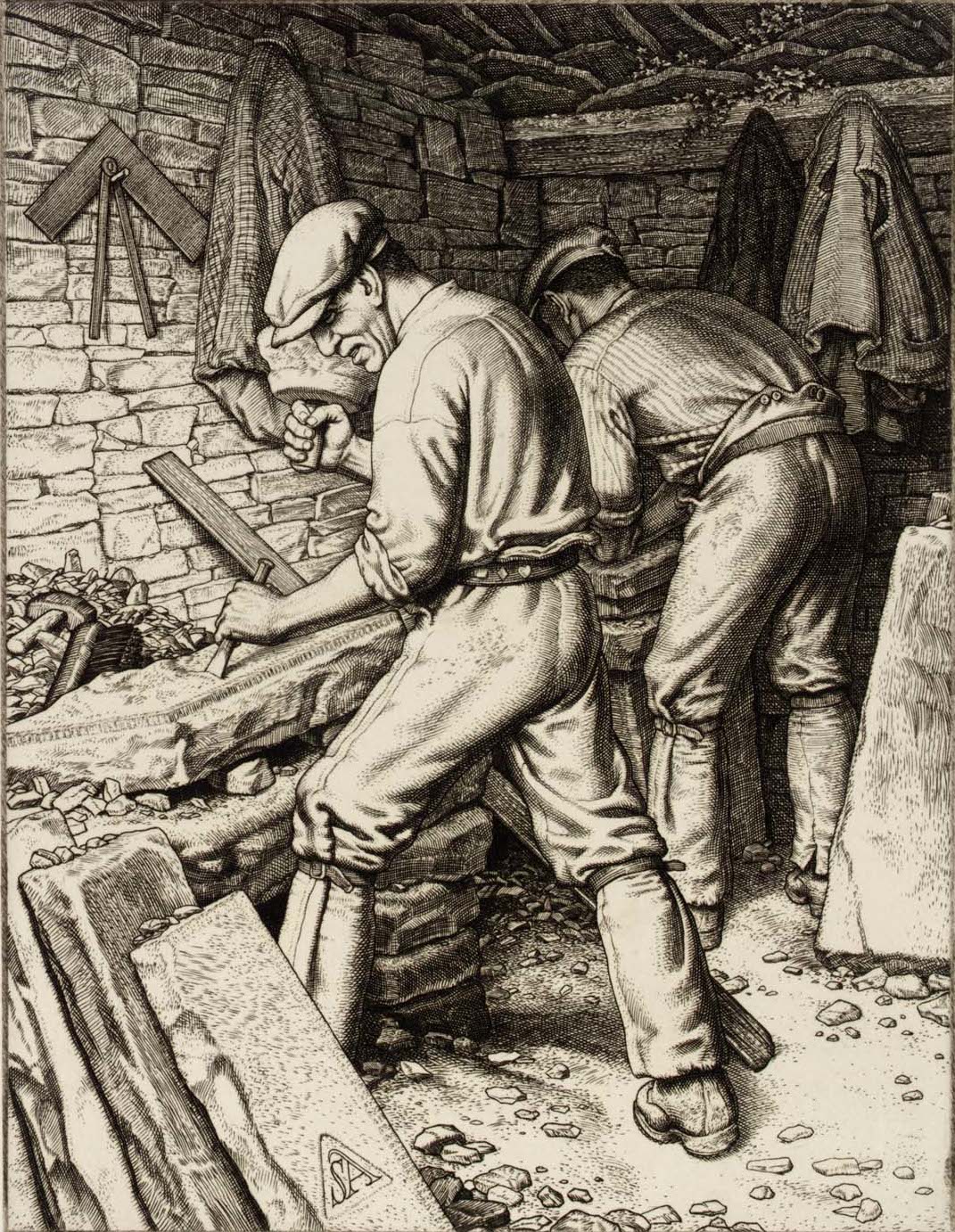
Stanley Anderson, Purbeck Quarrymen (1936), engraving

I say “another chance,” as I had previously co-curated an exhibition of Anderson’s prints at the Royal Academy in 2015 and, getting to know Anderson through his prints and correspondences, written about him with my better half, Robert Meyrick, a book that was released to coincide with that show.  Staging this second exhibition, Unmaking the Modern, a year later, I concentrated on Anderson’s efforts to bring about the conversation he hoped for – a conversation about the disregard for a generation of men like him who saw their lifetime commitment to traditions threatened by so-called progress.

Much of what Anderson chose to engage with and bring to our attention has disappeared: traditions gone and skills abandoned, rural communities destroyed and urban neighborhoods demolished, lives lost and often forgotten.  This may well evoke a sense of nostalgia.  But that nostalgia is ours, not Anderson’s.

Anderson did not refer to himself as an “artist” and rejected the idea that makers of cultural products should create such works for art’s sake or as a means of self-expression.  Making art, like doing any other meaningful work, was to him a social act – a “companionable thing.”

Anderson observed those changes as they took place: the demolition of buildings, the erection of shrines to profit and temples devoted to the exchange of money.  He responded concretely and in no uncertain terms to what he saw going on in his lifetime.  His works are not so much a lament as they are public outcries and displays of solidarity with those who, like him, where threatened by a demand for speed and expediency.

Objects of visual culture, especially prints, are a way of reaching out and fostering connections among individuals who share the values that are made manifest in arts and crafts.  Anderson’s works are the products and tokens of fellowship.  He took careful note of how others around him carried out their jobs of creating furniture, of working the land, and of serving the community.  He understood their labor and honored it with the work of his own hands.  Each print bespeaks a communion, a faithful, generous and sustained engagement with his subjects.

Anderson also looked at – and insisted on making us see – the forgotten men of his day: the homeless, the destitute and the aged.  He cast a light on individuals that society had turned into outcasts, misfits that could not or would not conform to the dramatic changes that progress demanded.

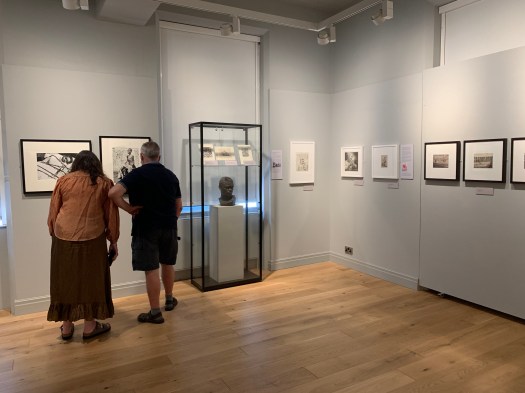
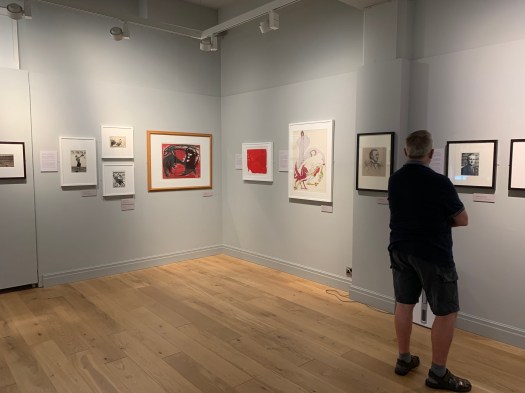
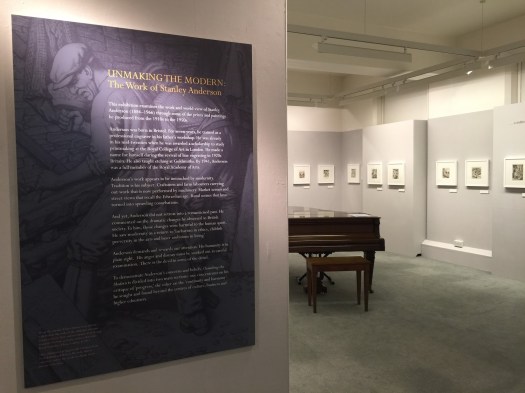
Installation view of the exhibition at the School of Art Museum & Galleries, Aberystwyth University

Anderson was not opposed to commerce; indeed, market scenes were among his favorite subjects.  Born in Bristol, he had trained for seven years as a professional engraver in his father’s workshop.  He was already in his mid-twenties when he was awarded a scholarship to study printmaking at the Royal College of Art in London.  Art – and the teaching of printmaking – were jobs to him.  Being a Royal Academician, meanwhile, was a privilege to him that came with the responsibility of making or promoting art that was not removed from the everyday but that brought people together and that got them looking at each other.

Long before Pop Art, Anderson bridged the divide between high and low culture that modernism had created.  He united what modernity insisted on separating: the heart and the hand.  This was a conscious decision, as his correspondence bears out, not a lack of awareness of Modernism.  After years of studying and using a variety of printmaking techniques, he returned to engraving, which he had long associated with trade. 

With those later engravings, he devoted himself to documenting the workaday activities of others – be they craftsmen or farmhands – who, like him, made a living from performing manual work for the benefit of others.  Making art, like performing any other meaningful work, was to Anderson a social act – a ‘companionable thing.’

Unmaking the Modern: The Work of Stanley Anderson was on show at the School of Art galleries, Aberystwyth University, Wales, from 1 February to 11 March 2016.  An online version is currently under construction.

The catalogue raisonné Stanley Anderson: Prints by Robert Meyrick and Harry Heuser was published in 2015.  Still online are a couple of short videos, produced for the Royal Academy exhibition An Abiding Standard, in which my husband and I talk about Anderson’s works and views.

For a comprehensive archive of Anderson’s prints, visit www.stanleyanderson.co.uk.

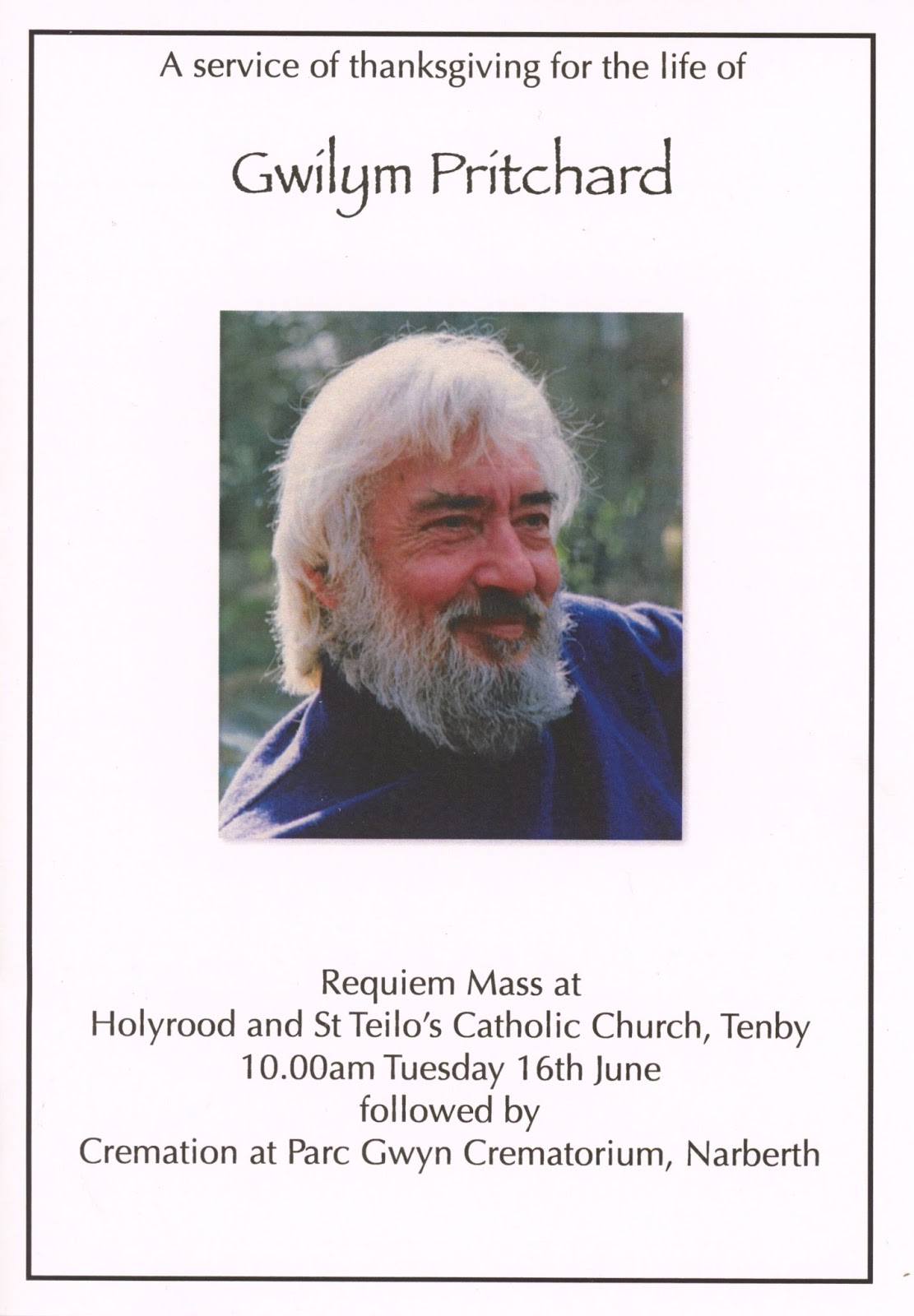
"Cofion, G": Remembering Gwilym Pri[t]chard

“I haven’t kept any diaries as such, apart from the odd word or two in my sketch books.  I have never felt the need to write anything and I really cannot see the point why anyone would be interested in what I would have to say.”  This is what the painter Gwilym Prichard wrote to me in reply to some questions I had while I was working on a monograph on his life and art.  Knowing Gwilym, I also knew that, though he was a man of his word, one word might have to suffice even when I, as a would-be biographer, was hoping for a thousand.


Gwilym talked – and continues to talk – to us through his art; he also talked to his art and had, he told me, private conversations with the works as they came into being on the canvas.  He didn’t think much of critics or the need for interpretation.  He believed that an artist’s work should speak for itself.  Terse as his words to me might sound, they were uttered in humility rather than indignation.  “I am grateful,” he added in parenthesis, “that I have had some success with my painting – I really have very little confidence but what I produce or show is stuff that I have painted with love and sincerity.  I hope that this comes through.”  That love – and the success it brought – was easily documented, mostly through Gwilym’s paintings.

 
Above Rhostryfan (1982), the painting I chose for my 
obituary of Gwilym in the Guardian

“Any more questions?” Gwilym continued his notes, which, much to my surprise, amounted to over thirty handwritten pages.  Clearly, he did not mean to cut me off, and wished me and my partner, Robert Meyrick, “all the best with the writing” with which he had entrusted us.  He answered every question, right down to the matter of the “t,” the letter he dropped from his surname in midlife whenever he signed his art.

 
That “writing,” A Lifetime’s Gazing, was a very special assignment for me.  Through Bob, I met Gwilym and his artist wife, Claudia Williams not long after I had moved to Wales in November 2004.  Back then, I felt distanced from Wales and the Welsh; I found it difficult to find myself or to find any purpose for myself here.  In fact, I still struggle with that.  I did not know then that I would end up working on Gwilym’s monograph.  Though it began years later, the project offered me an opportunity to write about the culture that I, a German with a New York education, could never presume to call my own.
 

I could relate to Gwilym in his difficulties of expressing himself fully – I mean truthfully and meaningfully – in English, Welsh being his first language, the language of his childhood.  Welsh spoke to him differently.  “I am a Welsh painter because I am Welsh,” he wrote, refusing to make an issue of what he felt to be at the core of his being … something understood.


Gwilym described himself as “emotional,” and English was perhaps too much the language of adulthood or reason, too abstract for an artist who treasured the concrete – the rock, the sea, and the soil.  The concrete had weight and depth for him, a weight and depth he did not have to measure because he felt it as an immeasurably rich presence, a constant in a life full of change and challenge.

How fortunate Gwilym was to have developed such a language; and how lucky we are to be hearing him with our own eyes whenever we look at the works that chart his journey …

Stanley Anderson: An Abiding Standard

This is a speech I prepared for the private view of “Stanley Anderson: An Abiding Standard” at the Royal Academy of Arts in London on 24 February 2015. Mindful of the assembled party ready to mingle and enjoy the evening, I decided to cut my talk short. Here it is in its entirety.

Stanley Anderson’s move from London to Oxfordshire coincides with – and made happen – a body of work for which he is now best known: a series of thirty or so prints on the subject of traditional farming methods and rural trades. They are on view in the Council Room.

Anderson’s move to the countryside was not a retreat. Despite their nostalgic appeal, his works are not escapist. Like his London scenes, they engage with the here and now. His here and now.

Anderson’s prints do not glorify England’s past or gloss over what he perceived to be its problems. It took me a while to appreciate that. As someone interested in the 1930s and 1940s and the impact the Second World War had on civilian life, I was disappointed not to find any overt references to the conflict, any depictions of the homefront, or images of disabled soldiers. After all, Anderson himself lost his London studio during the Blitz.

But they are there, those references. Or at least, Anderson’s commentaries on the human condition are there.

It is telling that so many of the men whose activities – or inactivities – he portrays are old. Anderson himself was in his 50s and 60s when he created these line engravings. The young had gone to war or else were working in the factories. It was war that turned men into machines and that, like other crises before it, had thrown the fragility – or the speciousness – of modern civilization into relief.

Anderson said that, when he moved to the country, his ‘mind and feelings became clearer, more definite in their reactions.’ In the countryside, alive to the seasons, he ‘seemed immersed in a sense of stability’ that was ‘not static. He called it ‘a sort of ordered growth’. Ordered growth in the face of chaos. And what he set out to do in his prints was to remind others of what they were in danger of losing or forgetting: the traditions that, he feared, would die with the men – the friends, neighbours and fellow craftsmen – whose work he commemorated in his prints.

Anderson did not want to be called an “artist.” He did not consider self-expression to be the highest achievement or chief aim of visual culture. He saw himself as a craftsman in the medieval tradition.

He aligned himself with anyone who derived his living – and his satisfaction – from the work produced with his or her own hands, just as Anderson did (with the support of his wife Lilian, a trained nurse).

Trade was not a dirty word for Anderson; nor did he mind getting his hands dirty. He not only related to his working men subjects – menial labourers and skilled craftsmen alike –he befriended these men, at a time when England turned its back on their traditions and forced the hand of many who were pushed into assembly line work or else were made to operate the machinery of war.

Moving to the countryside was not a getting away from mankind but a getting closer to his fellow man. Anderson called fellowship the ‘only currency’ that truly mattered. The ‘pleasure and interest’ of others in his work was what he deemed ‘ample repayment for all [his] labours.’

The hours he spent creating these prints were a time of contemplation; he abhorred speed and distrusted work produced quickly and, he believed, thoughtlessly. His works are spiritual, and the Zeitgeist they capture is that of an age in which spirituality was fast disappearing.

Anderson did not work or live fast. As [co-curator Robert [Meyrick] said, he spent seven years as an apprentice in his father’s engraving workshop, an experience on which he would draw and which he would not regret. His career is a continuum that anyone banking on instant fame might find hard to comprehend. His aim was to live by an abiding standard and his career was the reward of biding his time.

‘My life has been a quiet, studious one,’ the sixty-year-old Stanley Anderson told an American friend who wanted to write a biographical essay on him. There had been ‘no exciting experiences immorally, no amazing lights and shades, no boisterous contretemps; just a steady, sustained effort to express clearly and as well as my ability will allow, that note, in the main, I feel so deeply in life and nature – the plaintive note […].’

‘I often wonder, Anderson added, ‘if this is the reason I crave the friendship of sympathetic folk; why I feel that the arts are a social, or sociable act; why I abhor the bigotry, the insufficiency of self, and fear the exclusiveness of ‘success.’

Before we continue enjoying the ‘sociable act’ of this private view, I would like to express my gratitude to the man to whom everyone seeing this exhibition is indebted: to Stanley Anderson himself.

Anderson reminded me, again and again, how rewarding – how necessary – it is to keep at it, to keep looking, beyond the first glance in the search for novelty or the reassuring instance of recognition.

“In all matters of execution his work is highly disciplined,” a 1932 review in the London Times declared “and, if he seldom thrills you, he never lets you down.” If by thrill we mean the quickening pulse in response to the flashy and sensational, then the reviewer was certainly right. But there are thrills in Anderson’s work that are the rewards of anyone who keeps looking: discoveries of social commentaries – cultural references and sly observations – in which Anderson’s prints are rich.

We have not provided object labels for each of the 90 or so works on display here because we want to encourage you to look for yourselves without being told what to see. Anderson will tell you much about his attitudes toward modernity – and toward modernism – in these prints. These are not works that are open to a myriad of individual interpretations. His intentions become clear, his message, which often appears in fine print – in signs, fictional newspaper headlines and literary allusions – is consistent. His prints are essays on modern life and traditional labour, for the appreciation of which every line counts. So, stay a while …. and keep on looking.

“Stanley Anderson: An Abiding Standard” is on at the Royal Academy of Arts, London, from 25 February to 24 May 2015.

Future [S]ense? The Lost Found Objects of David Garner

Look! There are objects, people, and situations that compel me to do just that.  It takes some effort, though, to make me look longer than a moment, that blink of an eye Germans call “Augenblick.”  It is an effort and commitment that I have to bring myself to make, and whatever or whoever it is that commands me to look must warrant my sustained attention, must conquer my resistance, must provoke, charm, or seduce me to engage me in an exchange

“Look!” is a command that rarely fails; but, apart from performances that define the intended or desired duration of that look, few sites dictate, implore or recommend just how long I am to keep looking.  Do I circle once around this sculpture? Do I give that landscape the once-over, the twice-over or the over-and-over? How long do I need to look until I see something that rewards me for not looking away sooner?

Not every instance of looking turns into a spell of lingering, loitering and longing for more; and nothing is more effective in making me avert my gaze than being told what to look out for and how to see things.  This is the reaction I had looking at David Garner’s exhibition Future Tense, currently on display at the Aberystwyth Arts Centre.

Garner uses found objects to make more or less—and mostly less—compelling statements about a grab bag of social and political issues: production and consumption, education, unemployment, and postcolonialism.  His work hinges on a pairing of visual and verbal puns (such as “Wooly Learning/Dysgu Gwlanog,” a school blackboard with felted wool surface and wool text) or clichés (like “Beware when the gloves are off,” a row of ten Porcelain glove moulds mounted on an oak panel and suggesting a fascist salute); most of these pairings are too obvious in their single-minded double-meaning to startle, let alone enliven a discourse.  

Often, as in “Sheep in Sheep’s Clothing”—a taxidermied sheep wearing a coat knitted from its own fleece—the found object is stripped of its mysteries, its woolliness—its indeterminacies and ambiguities—spun instead into a readily solvable and as such instantly dissolvable puzzle.

Unlike Duchamp’s perennially stimulating Fountain, Garner’s found objects are given a final resting place in a self-contained junkyard of a performance that rewards only those who are content to discover an artist’s meaning and who, unlike me, accept that meaning as final; such hermetic hermeneutics leave no room to respond other than “Got it.  Next!” There is none of the wonder, the awe—the sheer thrill of looking—that I experienced staring at Maurizio Cattelan’s All at the Guggenheim Museum earlier this year.

The only truly gripping sight in Garner’s Future Tense is not a sight at all but a sound: the sound of a large clock loudly ticking away.  I resisted looking at the caption and let that sound transport, envelop, and alarm me; listening, I was, for once, unaware of the time I had wasted looking here but reminded instead of the potentialities of art to move us to the point that we cannot but invest it with our life experience, our anxieties and desires—a potential that is largely unfulfilled by Future Tense, a configuration of readymades whose presence is so much circumscribed by the artist’s foregone conclusions that they have little chance of a future in our imaginings . . .

Undone and Dusted: The Long Art of Christopher Williams

“Glory be to God for dappled things,” Gerard Manley Hopkins famously exclaimed—in a poem, no less, that was first published some three decades after his death. The delayed recognition he received makes us now think of Hopkins as a modern poet rather than a Victorian one. Brought to light in the darkest of days, his words spoke to an inglorious post-World War world so different from the perfectly imperfect one he knew that he could hardly have anticipated it. And yet, anticipate us he did—and “[a]ll things counter, original, spare, strange.” Secure in his belief in the One “whose beauty is past change,” Hopkins could revel in all that is “fickle, freckled (who knows how?),” in a life that is protean, fleeting and undone—the ever unfinished and often dirty business of living reconciled to our longing for perfection, permanence, and the eternal.


“Glory,” I wanted to shout, for dusty things, for art so long that no one in a single lifespan can ever be done with it—and for a chance to dust off works neglected and ignored to bring them to life anew. Not because they are perfect, not because they are classic or timeless—but because, in all their sketchiness, patchiness and almost-but-not-quiteness, they remind us—and glorify—the long and short of life: the clouds on the horizon, the waves hitting the rocks, the light of the ever setting sun on ancient mountains.

I was too busy tackling the dust (and keeping my mouth shut not to take it in) to wax philosophical and shout then—but I do think and feel it now when I look at some of the smaller canvases of Christopher Williams (1873-1934), a once well known artist, and native of Wales, whose forgotten and, in many cases, never before exhibited works I had a small part in putting back on public display here at the National Library of Wales in Aberystwyth.

Far more than Williams’s monumental paintings of momentous historical, mythological, and biblical themes, which belong to an age fast fading in his day, what is glorious to me are his studies of sea, sky, and rock—of the mutable majesty, the perennial transience of nature that he sought to encapsulate while working against time: the dying light of day, the waves against unwavering cliffs, the clash of the evanescent with the apparently everlasting. 

A few years ago, when I knew little of Wales and less of Williams, I visited one of the spots along the coast he had painted and compared what I saw to what he had depicted. The rocks were the same all right, but the sea and the sky looked nothing like the painting. Had he painted what he wanted to see, wanted us to see, or remembered seeing? Years later, when I returned to the same scene, the sea was turquoise, the sky cerulean—it was as Williams had pictured it. Only then did I appreciate the long hours he must have spent studying the light and the colors it creates. What was before him was fleeting—what is before us is unfinished—but what his quick brush transported one hundred years into his future is the product of a study far from cursory. Perhaps it takes a knowledge of the presence of something past change to see past the unchanging and glory in the changeable.

And there they are now, on view for a short while (until 22 September 2012), these past glimpses of change, these small studies alongside his finished—staid, staged and stately—compositions I helped to ready for the big show. Not that the project is done and dusted, as, together with my partner, Robert Meyrick, the curator of the present retrospective, I shall be co-authoring a book on the artist’s life and work . . .

Face Value?

Time to mingle with the visitors, to watch them stand back, take in the artwork—and read those captions. During the past few months, I have been involved in putting together an art exhibition at the local university. It all started last October. I was given the opportunity to teach an undergraduate course in writing informative and interpretive texts for museums: labels, text panels, promotional material. The class was designed as a workshop. So, rather than just theorizing about such matters as readability and legibility or analyzing prose styles and target audiences, my students and I were faced with the challenge of curating a show.

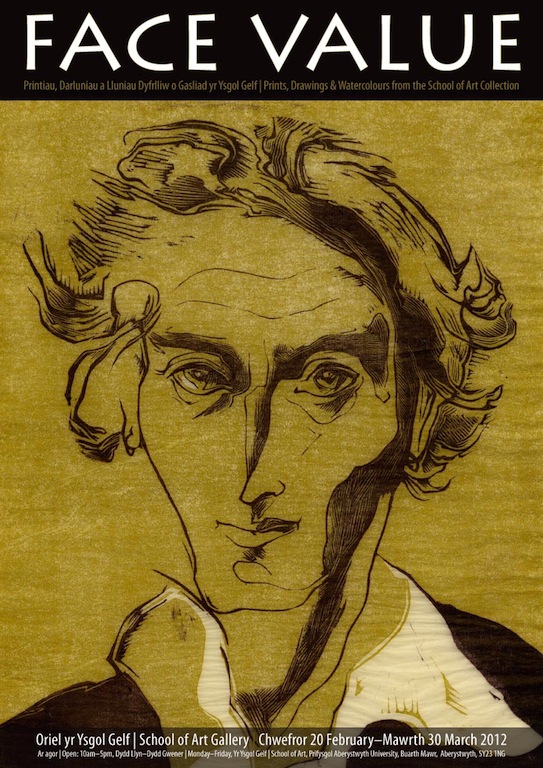
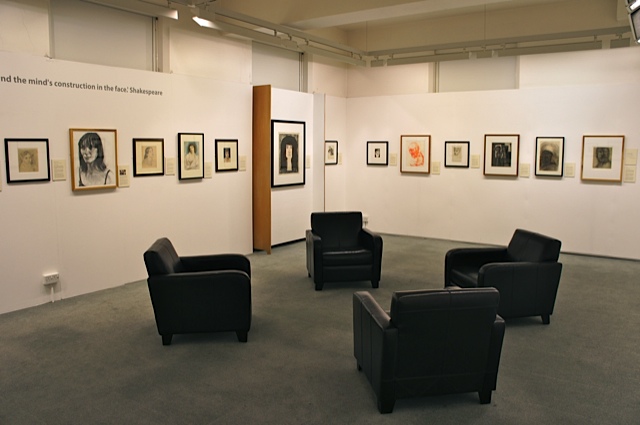
That show, Face Value, is on display and open to the public until 30 March 2012 at the School of Art, Aberystwyth.   It features works on paper (watercolors, etchings, drawings) by artists as diverse as cover girl Gertrude Hermes, Edward Burne-Jones, Fernand Léger, Dante Gabriel Rossetti, Simeon Solomon, William Strang, Stuart Pearson Wright, and Keith Vaughan.  Here is the introductory panel greeting guests at the private view tonight:

‘It is only at the first encounter that a face makes its full impression on us,’ the philosopher Arthur Schopenhauer once remarked. Face Value encourages such chance encounters.  Many of these works on paper from the School of Art collection are presented here for the first time.  Most have never been shown side by side.

This themed exhibition explores various acts of reading: our interpretation of facial features, our attempts to work out the relationships between appearances and mental or emotional states, between character and physical characteristics, as well as between artist, sitter and ourselves.

In 1868, Charles Darwin conducted an experiment to demonstrate that humans have a universal set of facial expressions. An anatomist stimulated a subject’s facial muscles with electrodes to elicit expressions of anxiety, sadness, and joy. He then took a series of photographs with which Darwin presented guests at a dinner party, inviting them to guess the subject’s emotional state. Are our responses predictable? Are faces quite this easy to read?

Face Value is itself the product of an experiment. It was conceived in a classroom, in workshops designed to debate or refute the value of interpretive texts written for museums. Do we look at and judge a self-portrait of a named artist as we do an anonymous, faceless study of a head? Does knowledge about artist or sitter influence our appreciation? What is the curator’s role in aiding or informing our ‘encounter’ with works of art?

‘Who sees the human face correctly,’ Picasso asked, ‘the photographer, the mirror, or the painter?’ Our various guides to interpretation are meant to suggest that there is no ‘correct’ reading and that works of art cannot be taken at face value.

At face value, this is just another art exhibition; but many of the texts on the wall would not read or sound the way they do had I not learned from listening to and reading about radio how to keep sentences simple, short and clear.  It is a lesson I am still learning … and worth learning it is.  Especially for curators.

History Stinks (and Your Granny Didn’t Smell So Good Either)

I’ve long tried—and, you might say, failed and pretty much given up on—filling a gap in the construction of our cultural histories, most of which are entirely too preoccupied with images and their interpretation. Western culture may privilege vision over any other sense—but if you think that the past will unfold before your eyes simply by looking at graphics, photos or printed records, you’ve been led by the ear you aren’t using. It’s no use being so eye-minded as to forget all about lowbrow radio programming, for instance. After all, sound-only broadcasting had a greater influence on most folks living in the middle of the 20th-century than the press or motion pictures—certainly a greater influence than most scholars are prepared to acknowledge. Radio comforted and counseled, intimated and importuned. It brought the world home and played on our minds like no competing medium could.

Crooning, cajoling, and commanding attention, whatever talent stood at the microphone became part of a soundtrack to the everyday of millions of dial-twisters who took in or were taken in by the big bands and banter, by sermons, sportscasts, and soap operas. Radio sold products as well as ideas and ideologies. It excelled in telling stories, be they fictive, factual or false; and, if you let it, it keeps on telling them or telling you about them . . .

While I have long suspected the picture to be incomplete if we insist on looking at the past as a sequence of images, I never seriously considered that, aside from sound, there is a story, too, in the way we smelled. And yet, in my old hometown of Cologne, Germany, alone—the burg that gave us the word for all our attempts at olfactory cover-up—the romantic poet Samuel Taylor Coleridge once ‘counted two and seventy stenches.’

There would have been no soap—and no soap operas—if we didn’t have trepidations about not being quite fresh, anxieties that were over-ripe for commercial exploitation. In the US, tuners-in of the 1930s, ‘40s and ‘50s were constantly being alerted to the dangers of B-O, reminded to ‘Lux’ their ‘dainties,’ and told to gargle before putting their kissers to the test. Lest they could endure facing guilt by omission, listeners lathered up with products like White King toilet soap, the box tops of which they collected and sent in to broadcasters as ocular proof of their hygienic diligence, for which cumulative evidence they were duly awarded various prizes (or premiums).

For all the restrictions faced by press and broadcasting, advertising some sixty, seventy years ago, was certainly more in your (presumably unwashed) face than it is now. It sounds as if listeners-in back then were in far greater need of Lysol and Listerine. Could it be that our forebears required more frequent scrubbing because they were more likely to labor manually without having access to as much running water, cold and hot, than our more sedentary selves take for granted today? If so, did they really need to be reminded of their particular emanations?

Advertisers did not rest until the natural acquired the whiff of the common. The airwaves, though they were not permitted to be polluted by sounds suggesting most of the bodily functions to which we give vent in private, certainly were awash with voices alerting us of the social consequences of reeking to high heaven.

However fleeting, sound has not been an instant bygone ever since we succeeded in preserving it some 135 years ago. Granted, such records do not tell us the whole story of how people talked and what they had to say; but whatever we bottle as fragrance is even more likely to throw us off the scent in our quest for the real, something that complicates our efforts whenever we feel inclined to stick our nose into the past.

The irony that I am using a print ad to illustrate my point has not eluded me. It is an ad, no less, from a magazine catering to the radio listeners, consumers who were often told, as they waited for the advent of long-promised television, that only sight could complete the picture. It is a myth in which even radio broadcasters were complicit.

Sure, the picture of the past is always incomplete; it is as much a composite as it is a construct. Still, I prefer to keep augmenting my impressions of those yesterdays by lending an ear to the ticking of our clocks. If we keep on looking, and look on only, we might well be missing what is right under our noses …