โ€œ. . . from a civilized land called Walesโ€: A Puzzlement Involving The King and I

I rose before the sun, and ran on deck to catch an early glimpse of the strange land we were nearing; and as I peered eagerly, not through mist and haze, but straight into the clear, bright, many-tinted ether, there came the first faint, tremulous blush of dawn, behind her rosy veil [ . . .]. A vision of comfort and gladness, that tropical March morning, genial as a July dawn in my own less ardent clime; but the memory of two round, tender arms, and two little dimpled hands, that so lately had made themselves loving fetters round my neck, in the vain hope of holding mamma fast, blinded my outlook; and as, with a nervous tremor and a rude jerk, we came to anchor there, so with a shock and a tremor I came to my hard realities.
With those words, capturing her first impression and anticipation of a โ€œstrange landโ€ as, on 15 March 1862, it came into partial viewโ€”the โ€œoutlookโ€ being โ€œblindedโ€โ€”aboard the steamer Chow Phya, Anna Harriette Leonowens commenced The English Governess at the Siamese Court (1870), the โ€œRecollections of Six Years in the Royal Palace at Bangkok.โ€ The account of her experience was to be followed up by a sensational sequel, Romance of the Harem (1872), both of which volumes became the source for a bestselling novel, Margaret Landonโ€™s Anna and the King of Siam (1944), several film and television adaptations, as well as the enduringly crowd-pleasing musical The King and I.

Conceived for musical comedy star Gertrude Lawrence, the titular โ€œIโ€ is currently impersonated by Shona Lindsay, who, until the end of August 2009, stars in the handsomely designed Aberystwyth Arts Centre Summer Musical Production of the Rodgers and Hammersteinโ€™s classic.

The title of the musical personalizes the story, at once suggesting authenticity and acknowledging bias. Just as it was meant to signal the true star of the original productionโ€”until Yul Brynner stole the showโ€”it seems to fix the perspective, assuming that we, the audience, see Siam and read its ruler through Annaโ€™s eyes. And yet, what makes The King and I something truly wonderfulโ€”and rather more complex than a one-sided missionaryโ€™s taleโ€”is that we get to know and understand not only the Western governess, but the proud โ€œLord and Masterโ€ and his daring slave Tuptim.

Instead of accepting Anna as model or guide, we can all become the โ€œIโ€ in this story of identity, otherness and oppression. Tuptimโ€™s experience, in particular, resonates with anyone who, like myself, has ever been compelled, metaphorically speaking, to โ€œkiss in a shadow,โ€ to love without enjoying equality or protection under the law. Tuptimโ€™s readily translatable story, which has been rejected as fictive and insensitive, is emotionally rather than culturally true.

โ€œTruth is often stranger than fiction,โ€ Leonowens remarked in her preface to Romance of the Harem, insisting on the veracity of her account. Truth is, truth is no stranger to fiction. All history is narrative and, as such, fictionโ€”that is, it is made up, however authentic the fabric, and woven into logical and intelligible patterns. Whoever determines or imposes such patternsโ€”the historian, the novelist, the reporterโ€”is responsible for selecting, evaluating, and shaping a story that, in turn, is capable of shaping us.

Tuptimโ€™s adaptation of Uncle Tomโ€™s Cabin, which strikes us at first strange and laughableโ€”then uncanny and eerily interchangeableโ€”in its inauthentic, allegorical retelling of a fiction that not only made but changed history, is an explanation of and validation for Rodgers and Hammersteinโ€™s sentimental formula. Through the estrangement from the historically and culturally familiar, strange characters become familiar to us, just Leonowens may have been aided rather than mislead by an โ€œoutlookโ€ that was โ€œblindedโ€ by the intimate knowledge of a childโ€™s love.

Strange it was, then, to have historicity or nationality thrust upon me as Anna exclaims, in her undelivered speech to the King, that she hails โ€œfrom a civilized land called Wales.โ€ It was a claim made by Leonowens herself and propagated in accounts like Mrs. Leonowens by John MacNaughton (1915); yet, according to Susan Brownโ€™s โ€œAlternatives to the Missionary Position: Anna Leonowens as Victorian Travel Writerโ€ (1995), โ€œno evidence supportsโ€ the assertion that Leonowens was raised or educated in Wales.

Still, there was an audible if politely subdued cheer in the Aberystwyth Arts Centre auditorium as Anna revealed her fictive origins to us. Granted, I may be more suspicious of nationalism than I am of globalization; but to define Leonowensโ€™s experience with and derive a sense of identity from a singleโ€”and rather ironic reference to homeโ€”seems strangely out of place, considering that the play encourages us to examine ourselves in the reflection or refraction of another culture, however counterfeit or vague. Beside, unlike last yearโ€™s miscast Eliza (in the Arts Centreโ€™s production of My Fair Lady), Anna, as interpreted by Ms. Lindsay, has no trace of a Welsh accent.

As readers and theatergoers, we have been โ€œgetting to know you,โ€ Anna Leonowens, for nearly one and a half centuries now; but the various (auto)biographical accounts are so inconclusive and diverging that it seems futile to insist on โ€œgetting to know all about you,โ€ no matter now much the quest for verifiable truths might be our โ€œcup of tea.โ€ What is a โ€œpuzzlementโ€ to the historians is also the key to the musical, mythical kingdom, an understood realm in which understanding lies beyond the finite boundaries of the factual.


Related writings
“By [David], she’s got it”; or, To Be Fair About the Lady
Delayed Exposure: A Man, a Monument, and a Musical

Related recordings
โ€œMeet Gertrude Lawrence,โ€ Biography in Sound (23 January 1955)
Hear It Now (25 May 1951), which includes recorded auditions for the role of Prince Chulalongkorn in The King and I

Another Manโ€™s Ptomaine: Was โ€œThe Undertakerโ€™s Taleโ€ Worth Exhuming?

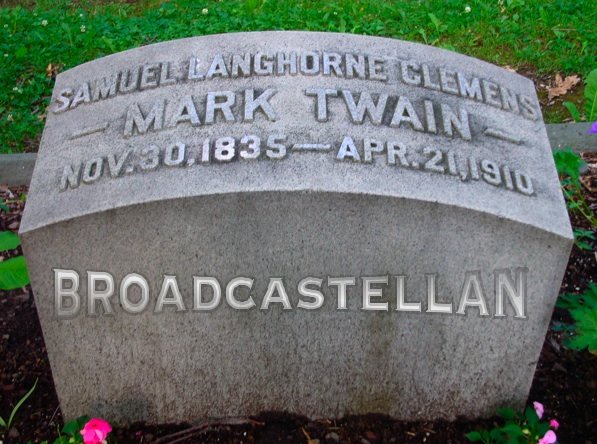
Bury this. Apparently, it was with words not much kinder that the aspiring but already middle-aged storyteller Samuel Clemens was told what to do with โ€œThe Undertakerโ€™s Tale.โ€ Written in 1877, it was not published until this year, nearly a century after the authorโ€™s death. The case of the premature burial has not only been brought to light but, thanks to BBC Radio 4, the disinterred matter has also been exposed to the air (and the breath of reader Hector Elizondo). So, you may ask after being duly impressed by the discovery, does it stink?

To be sure, even the most minor work of a major literary figure is deserving of our attention; and โ€œThe Undertakerโ€™s Taleโ€ is decidedly minor. It derives whatever mild titters it might induce from the premise that one manโ€™s meat is another manโ€™s poison or, to put it another way, one manโ€™s dead body is anotherโ€™s livelihood.

โ€œWe did not drop suddenly upon the subject,โ€ the narrator ushers us into the story told to him by his โ€œpleasant new acquaintance,โ€ the undertaker, โ€œbut wandered into it, in a natural way.โ€ We should expect slow decay, then, rather than a dramatic exitโ€”and, sure enough, there is little to startle or surprise us here.

There isnโ€™t much of a plot eitherโ€”but a lot of them. The eponymous characterโ€”one Mr. Cadaverโ€”is a kind-hearted chap who cheers at the prospect of an epidemic and who fears for his family business whenever the community is thriving. To him and his lovely, lively tribe there can be no joy greater than the timely demise of an unscrupulous vulture (some simulacrum of a Scrooge), whichโ€”death ex machina and Abracacaver!โ€”is just what happens in the end.

In its time, “The Undertaker’s Tale” may have been dismissed as being in poor taste; what is worse, though, is that it is insipid. To bury it was no doubt the right decision as it might have ended Clemens’s literary career before it got underway by poisoning the public’s mind against him. A death sentence of sorts.

It may sound morbid, but, listening to this unengaging trifle, I drifted off in thoughts of home. My future home, that is. No, I am not about to check out; but within a few days now I am going to move to a town known, albeit by very few, as Undertakerโ€™s Paradise.

Back in 2000, the Welsh seaside resort of Aberystwyth served as the setting for a dark comedy thriller with that title. Starring Ben Gazzara, it concerns an undertaker rather more enterprising than Mr. Cadaver in the procuring of bodies. Like Twainโ€™s story before it, the forgotten film is waiting to be dug up and appreciated anew. Unlike Twainโ€™s story, it has no literary pedigree to induce anyone to pick up a shovel. Shame, really. Itโ€™s the better yarn of the two.


Related writings
“Mark Twain, Six Feet Underโ€
“What Those Who Remembered Forgot: Don Knotts (1924-2006) on the Airโ€

” . . . the way of all flesh, material or imaginary”: Conan Doyle at 150

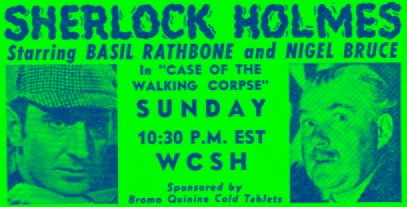
โ€œHad Holmes never existed I could not have done more, though he may perhaps have stood a little in the way of the recognition of my more serious literary work.โ€ That is how Arthur Conan Doyle, not long before his own death in 1930, announced to his readers that he would put an end to his most robust brainchild, the by now all but immortal Sherlock Holmes. Indeed, the figure continues to overshadow every aspect of Dr. Doyleโ€™s career, literary or otherwise. Perhaps, โ€œupstageโ€ is a more precise way of putting it, considering that the venerable sleuth was to enjoy such success in American and British radio drama from the early 1930s to the present day.

โ€œOne likes to think that there is some fantastic limbo for the children of imagination,โ€ Doyle assuaged those among his readers who found it difficult to accept that Holmesโ€™s departure was merely โ€œthe way of all flesh.โ€

To be sure, the earlier incident at the Reichenbach Falls suggested that Holmes was impervious to threats of character assassination, that he could reappear, time and again, in the reminiscences of Doctor Watson. Still, Doyleโ€™s intention to do away with Holmes so early in the detectiveโ€™s literary career had been no mere publicity stunt. Rather than feeling obliged to supply the public with the puzzles they craved, the author felt that his โ€œenergies should not be directed too much into one channel.โ€

One of the lesser-known alternative channels considered by Doyle has just been reopened for inspection. Today, 22 May, on the 150th anniversary of Doyleโ€™s birth in 1859, BBC Radio Scotland aired โ€œVote for Conan Doyle!โ€ a biographical sketch โ€œspecially commissionedโ€ to mark the occasion. In it, writer and Holmes expert Bert Coules relates how, in 1900, Doyle embarked on a career in politics. He decided to stand for parliament; but the devotees of Sherlock Holmes would not stand for it.

Coulesโ€™s play opens right where Doyle had first intended to wash his hands of Holmesโ€”at the Reichenbach Falls. No matter how sincere Doyle was in improving the Empireโ€™s image and the plight of the Britishโ€™s troops during the Second Boer War, the push hardly met with the approval of the reading public. โ€œHow could you!โ€ โ€œHow dare you!โ€ โ€œYou brute!โ€ the public protested.

Although it was not this perceived case of filicide that did him in, Doyle proved unsuccessful in his campaignโ€”and that despite support from Dr. Bell, who served as an inspiration for Holmes. After his defeat, Doyle โ€œbowed to the inevitableโ€”and back the man came.โ€

When the The Case-Book of Sherlock Holmes was published in 1927, Doyle dropped the man once more, albeit in a gentler fashion. To assuage loyal followers, he fancied Holmes and Watson in some โ€œhumble cornerโ€ of the โ€œValhallaโ€ of British literature. Little did he know that the โ€œfantastic limboโ€ in which the two were to linger would be that in-between realm of radio, a sphere removed from both stage and pageโ€”but nearer than either to the infinite โ€œOโ€ between our ears.

It hardly surprises that, Radio Scotlandโ€™s efforts to get out the โ€œVote forโ€ and let us walk โ€œIn the Footsteps of Conan Doyleโ€ aside, most of the programs presumably devoted to Doyle are concerned instead with โ€œThe Voice of Sherlock Holmesโ€ and the โ€œGameโ€ that is โ€œAfootโ€ when thespians like Cedric Hardwicke, John Gielgud, Carleton Hobbs and Clive Merrison approach the original. It is not Doyleโ€™s life that is celebrated in these broadcasts, but Holmesโ€™s afterlife.

True, to the aficionados of Doyle’s fiction, Sherlock Holmes has never been in need of resuscitation. Yet, as Jeffrey Richards remarked in “The Voice” (first aired in 1998),

[r]adio has always been a particularly effective medium for evoking the world of Holmes and Watson. The clatter of horses hoofs on cobbled streets, the howl of the wind on lonely moors, and the sinister creaks and groans of ancient manor houses steeped in history and crime.

The game may be afoot once more when Holmes returns to the screen this year; but, outside the pages that could never quite contain him, it is the โ€œfantastic limboโ€ of radio that kept the Reichenbach Falls survivor afloat. It is for the aural mediumโ€”the Scotland yardstick for fidelity in literary adaptationโ€”that all of his cases have been dramatized and that, in splendid pastiches like โ€œThe Abergavenny Murder,โ€ the figure of Sherlock Holmes has remained within earshot all these years.


Related writings
“โ€˜What monstrous place is this?โ€™: Hardy, Holmes, and the Secrets of Stonehengeโ€
โ€œRadio Rambles: Cornwall, Marconi, and the โ€˜Devil’s Footโ€™โ€
Old Sleuth Re-emerges in New Medium for American Ho(l)mes

Seems Mr. Corwin Is Here to Stay

Letโ€™s start by setting forth
That it is good to take a swig of fancy every now and then,
A nip or two of wonderment,
To jag the mind.

Itโ€™s good to send your thoughts excursioning
Beyond the paved and well-worn alleys of your life
If only as a form of exercise [. . .]

The man who prescribed this โ€œform of exerciseโ€ in โ€œSeems Radio Is Here to Stayโ€ some seventy years ago, back in April 1939, is producer-director-writer Norman Corwin. Today, he turns 99. Radioโ€™s foremost playwright was forced, however, to take the exercise outside the medium he loved. By the late-1940s, there was no room in US radio for โ€œexcursioning,โ€ and a frustrated Corwin advised anyone who wanted to โ€œmake a living from radioโ€ to be โ€œmediocre.โ€ The โ€œwriter who wants to do the best work in his power, in defiance of formula, I say: Forget radio.โ€

Corwin insisted that he was writing “neither with cynicism, anger, nor contempt.”

My only emotion is that of sadness for an old friend, now bedridden, who has been kind and generous to many writers, including me. The disease is probably incurable. Radio may well die, as a cultural force, of the after-effects of the childbirth of television. The complications are greed, venality and social irresponsibilities. Its spawn, the half-breed that is neither pictures nor radio but both, is already devouring everything around it, an omniphage chomping steadily into the economy of books, sports, movies and radio itself.

No, Corwin was not about to defect, like radioโ€™s talent, sponsors and audiences, to the rivaling medium of television. Unless its producers were ready to โ€œapply as much money and time to serious experimentation on the level of the old Columbia Workshop,โ€ he would โ€œcontinue to be more interested in radio, films, and print.โ€ To a dramatist concerned with the play of ideas, television had “neither the full scope and mobility of cinema, the immediacy of the legitimate theatre, nor the powerful suggestibility of radioโ€™s unillustrated spoken word.โ€

It is of this โ€œsuggestibilityโ€ that the body of Norman Corwinโ€™s work remains one of the most persuasive illustrations.


Related writings
“The Life of Radio: Norman Corwin Turns 97”
“A Mind for Biography: Norman Corwin, ‘Ann Rutledge,’ and Joan Fontaine”
“Magnetic Realism: Norman Corwin’s One World Flight

Dwelling on the Subject: The House in the Child

My future study, getting a make-over

How insignificant, at the moment, seem the influences of the sensible things which are tossed and fall and lie about us, so, or so, in the environment of early childhood. How indelibly, as we afterwards discover, they affect us; with what capricious attractions and associations they figure themselves on the white paper, the smooth wax, of our ingenuous souls, as โ€œwith lead in the rock for ever,โ€ giving form and feature, and as it were assigned house-room in our memory, to early experiences of feeling and thought, which abide with us ever afterwards, thus, and not otherwise.

It was Walter Paterโ€™s โ€œThe Child in the Houseโ€ (1878) that gave me the idea for a title; but it was my history of habitation that made me write The House in the Child, a fictionalized autobiography. I received some sort of graduate prize for submitting a fragment of it, a rather generous acknowledgement of the pain it took to attempt its constructionโ€”and fail. Now that I am quite preoccupied with the impending moveโ€”a subject that, to recycle a line from Charlotte Perkins Gilmanโ€™s โ€œYellow Wallpaperโ€ (1892),ย  โ€œdwells in my mind soโ€โ€”it occurred to me just how long the concept of dwelling has been on my mind, that maze of memories Pater calls the brain-building.

The House in the Child was never finished; and that is just as it should be, for the house was never finished with me. The foundation for the narrative was a sense of dislocation and the absence of private spaceโ€”living abroad, with a dinner table as a study, wondering what โ€œhomeโ€ meant. Thinking about the past, it came home to me that my family had been destroyed by the ambition of building that house. And yet, retreating into my own room (a luxury denied me during much of my adulthood) and the hidden realm of thought, I had done so little to keep the architecture of domesticity from falling apart.

Writing about myselfโ€”this most self-serving of literary endeavorsโ€”offered me a chance at revision, a chance to think of myself as someone who was not always thinking of himself first. I was not this child, but I might have been:

She points at the colorful map drawn neatly with crayonsโ€”red, blue, and green. Mostly red, though, because it makes everything look more significant and urgent somehow, like a warning label. On the map, the house looks like a castle, with chambers and vaults, corridors and hidden passageways. Everythingโ€™s angular and crooked, like in a real maze. A map can make any place important even if it really needs no map at all. The new house is much too small, reallyโ€”too plain, straight, and square. Nobody gets lost in a bungalow. But this drawing was not supposed to make it all clearer and plainer. It was meant to add the mystery and adventure the whole place lacked from the start.

There is still so much to unpack; but she needs to rest for a moment, anyway; and so she sits right here, glancing at this piece of paper.

โ€œEverythingโ€™s set up nicely, donโ€™t you think? You kids will love it. No more fighting about space and privacy, no more arguing about what goes where. Now, let me see.โ€

She plays the game well, slowly following the paths with her finger, studying the map as if it really were the floor plan to an enormous fortress.

Maybe she enjoys this moment because she is just as disenchanted with her new home as . . .

โ€œAh, here we are. This is your room. Your sisterโ€™s room is next to it . . . right here, see? And somewhere down here, in the basement, is the workroom. And you know whoโ€™s going to spend most of his free time in there. Then there is our bedroom, straight across this hallway, here. This is what we always wanted, isnโ€™t it? Weโ€™re all going to have our own rooms now.โ€

All except she. She does not have a place to herself, like we all do. What is her place? Where can she go to close the door? She has to sleep with him at night.

Maybe thatโ€™s why she keeps staring at the map, examining it as if she were looking for a vacant space to rest her eyes. Maybe she holds on to this plan because it promises a hiding place not to be found elsewhereโ€”not provided for in our house. Maybe thatโ€™s why her finger keeps running up and down the paths, back and forth, back and forth, like a mouse trapped in a labyrinth.

Finally, she lets go, gets up, and turns out the light.

โ€œYou can always come here, Mutti.โ€ But she has already closed the doorโ€”and she did not take the map . . .

โ€œI pulled and she shookโ€: A Dรฉcor to Try Oneโ€™s Decorum

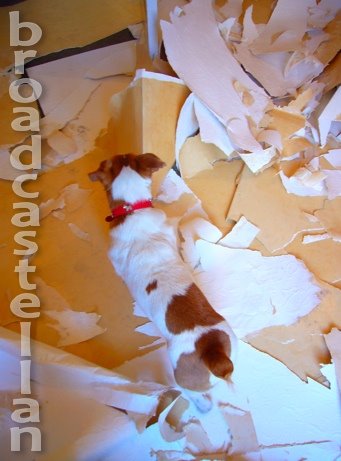
My dog, Montague, demonstrating his wallpaper training in response to my stripping

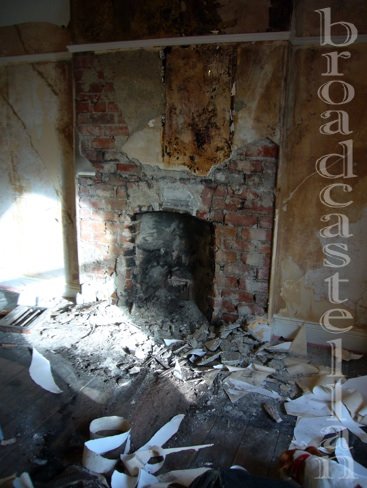
All right, so Iโ€™m sounding like an aging burlesque queen about to toss her tassels and turn in the G-string that is a turn-on no longerโ€”but, by Gypsy, I am tired of stripping. Wallpaper, I mean. This old Mazeppa has nothing but a scraper for a gimmick, and the only hand she ever got for all her grinding is a mighty sore one. I just could not live with it, though, that dreadful patternโ€”having it stare me down in defiance, berate me for letting myself be defeated by all the work that needs doing in the old house we plan on inhabiting before long. The idea (not mine, mind) was to paint over itโ€”but I scratched that faster than I could scrape. It might peep out from behind the paint, that ghastly design. It might start to creep up on me if I donโ€™t get at it firstโ€”just like in that most famous of all interior decorating nightmares, Charlotte Perkins Gilmanโ€™s โ€œYellow Wallpaperโ€ (1892). To date, Gilmanโ€™s feminist tale of terror is the most convincing argument for taking it all off.

To the tormented soul telling the story, the paper she finds in her roomโ€”the room in which she is meant to restโ€”becomes a โ€œconstant irritant.โ€ Within a few short weeks of studying it, for want of the intellectual activity denied to her, she is driven to the distraction once classified as hysteria:

The color is hideous enough, and unreliable enough, and infuriating enough, but the pattern is torturing.ย 

You think you have mastered it, but just as you get well underway in following, it turns a back-somersault and there you are. It slaps you in the face, knocks you down, and tramples upon you. It is like a bad dream.

Unlike the blank, โ€œdeadโ€ paper on which she writes in secret, the wallpaper is teeming with life, just below the surface. It is the surface of conventions that Gilman tears down with a vengeance:

This bed will not move!

I tried to lift and push it until I was lame, and then I got so angry I bit off a little piece at one cornerโ€”but it hurt my teeth.

Then I peeled off all the paper I could reach standing on the floor. It sticks horribly and the pattern just enjoys it! All those strangled heads and bulbous eyes and waddling fungus growths just shriek with derision!

When Gilman’s story was adapted for US radio, listeners to CBSโ€™s Suspense program may have felt rather differently about this schizophrenic battle when, in a broadcast that aired on 29 July 1948, it was enacted by Agnes Moorehead, who, in tackling the part, had to struggle as well with our memories of the neurotic and disagreeable Mrs. Elbert Stevenson, her most famous Suspense role. โ€œSorry, Wrong Paper,โ€ I kept thinking as I witnessed the disintegration. And yet, as the hard and cutting echoes of Mrs. Stevenson suggest, paper can beat both rock and scissorsโ€”a thought that filled me with renewed terror.

โ€œIt dwells in my mind so!โ€ Gilmanโ€™s character remarks, tellingly, about the dreaded wall covering. The dwelling has overmastered the dweller, like a wild animal resisting domestication, a beast beyond paper training. The prospect of being dominated or possessed in this way by a questionable dรฉcor is a scenario horrifying enough for me to put penknife to paper . . . and keep stripping.

โ€œ. . . a world between two soundsโ€; or, the Librarian Who Turned Up the Volume(s)

I could not have faulted anyone for brushing me off with a terse โ€œnone of your lip,โ€ considering that my kisser had taken on the appearance of an over-boiled frankfurter abandoned during a picnic invaded by flesh-eating ants. 

Luckily, sight at the time mattered less than sound, and the painkillers had not entirely divested me of whatever powers of articulating my ideas I yet possess. Yesterday morning, during a meeting with administrators at the local university, interest was once again expressed in a course I had proposed a few years earlier. I fancifully titled it โ€œWriting for the Ear,โ€ which was meant to distinguish the module from more traditional classes in radio writing as they are still being taught here in Britain.

I had previously turned down an offer to teach a course in writing for the medium, as I have no experience in developing scripts aimed at those in charge of productions at the BBC.

Besides, todayโ€™s technology makes it possible for anyone to have a voice in the forum, to podcast talks and engage in sonic experimentation. With these opportunities in mind, I outlined a course exploring the relationship between the spoken and the written that would make those who express themselves typographically alive of the value of sounds and the potentialities of silences.

Too much of the most eloquent prose and sonorous poetry is being silenced. Words written hundreds of years ago are still being pored over, but they are far less frequently voiced and heard. In classroom and study, printed words are scrutinized, paraphrased, underlined, crossed out, and annotated; they are dissected like so many toads in the imaginary garden, well before they get a chance to let out a single distinctive croak.

Lending your own voice to written lines is an act of resuscitationโ€”of breathing life into the thoughts of those who came before you, of triggering a startling echo in what was assumed to be a soundproof vault. Silences, too, speak volumes, especially when they enter into a dialogue with the spoken and the sounded.

Someone who had a lot to say on the subject of the word made sound was Archibald MacLeish, the Pulitzer Prize winning poet who, from 1939 to 1944 served as Librarian of Congress. Before being appointed Assistant Secretary of State for Public and Cultural Relations, MacLeish brought to radio a series of lectures titled The American Story. At a time of global conflict, the program was designed to emphasize

the experience in common of the American peoples, the story set down in the accounts of those who knew the American experience at first hand or were part of it. Whatever their race may have been, or their faith, or their language.

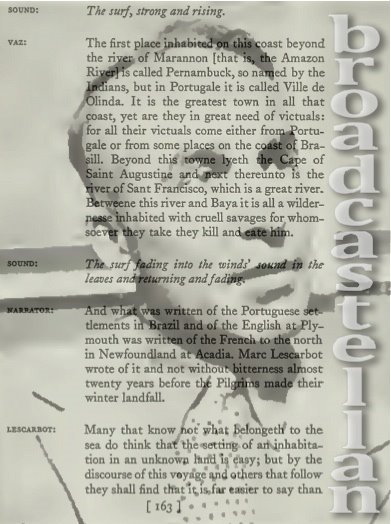
In other words, it took a scholarly approach to what Carmen Miranda accomplished in the conga line of duty. On this day, 18 March 1944, NBC presented โ€œBetween the Silence and the Surf,โ€ the eighth broadcast in the series. It related the settlement of the Americas, from Plymouth (as recorded by William Bradford in the 17th century) to Brazil (as documented by Lopez Vaz in the 1580s). I recently rediscovered the program while digitizing my collection of audio tapes; the published scripts, meanwhile, have been shared online. The printed words bespeak the poetโ€™s mission of giving voice to the lost and long unsounded, to lives shelved and shut away in our repositories of knowledge:

SOUND.ย  A slow surf, the hush of the waves withdrawing.

NARRATOR.ย  And the windโ€™s sound in the grass or in the brush or in the forests where they still must go.

SOUND.ย  The wind in the coarse grass and the solemn trees.

NARRATOR.ย  The world of the first settlements was the narrow world between the silence and the surf, between the water and the wildernessโ€”between the past cut off by water and the future closed by distance and by dangerโ€”but not closed.

According to the April 1944 issue of Radio Age, MacLeish โ€œpoured an immense amount of painstaking research,โ€ into this series; and in “addition to the laborious research and authentication,” he included the

most important fillipโ€”his own brilliant style of the prose poem, a style which has won for him the accolades of the literary world. Each line read on the broadcast is a part of this poetic narrative style, giving each program a dramatic sweep so necessary in producing the effect desired.

Yet while the poet claimed to have aimed at creating โ€œnew forms of radio expression,โ€ rather than adhering to the formats of โ€œconventional radio drama,โ€ critics were not uniformly enthusiastic, arguing the productions to be โ€œoverloaded with conversationโ€ and โ€œself-denyingly austere.โ€ Such gainsayings are representative of the bias toward dramatization and dialogue as opposed to lecture or oratory, no matter how many individual speakers were employed to deliver it.

In the foreword to the published scripts for the series, MacLeish defended his minimalist approach by reasoning that โ€œradioโ€™s unique function and unique opportunityโ€ was simply to convey speech instead of presenting words, โ€œartfully blendedโ€ by means of โ€œ[s]killful devices,โ€ to โ€œproduce dramatic effectsโ€:

Because radio is limited mechanically to sound, and particularly to the sound of speech, radio is capable of a concentration of speech itself, the text itself, which can give words a life and a significance they rarely achieve outside the printed pagesโ€”and which they achieve there only for the most gifted and fortunate readers.

The word, to MacLeish, was the beginning and the end. As a documentarian and poet, he inhabited that “world between two sounds,” listening, recording, and readying himself to speak with force and deliberation. His American Story is the story of humanity’s struggles for survival, for voice and representation.

Our daily existence, like that of the first settlers, is this โ€œnarrow world between the silence and the surf,โ€ between the calm and the roar, between tumult and tranquility.  Our lives are a string of moments waiting to be seized for having our say, periods of stillness, voluntary or imposed.  We may chronicle our times and leave behind piles of documents to be poured over or neglected by future generations; but it is the sound we make now and the space we leave for listening that define the present we must fill with meaning as we rage against the silence to which we are ultimately condemned . . .

Re: Boot (A Mental Effort Involving Distant Cousins)

Like many a woebegone youth of my generationโ€”once known as the No Future generationโ€”I entered the crumbling empire of Evelyn Waughโ€™s fictions by way of that lush, languid serial adaptation of Brideshead Revisited. It wasnโ€™t so much what I saw as what I had missed that made me pick up the book. Owing to my motherโ€™s loyalty to Dynasty, which aired opposite Brideshead on West German television back in the early 1980s, I was obliged to fill whatever holes our weekly appointment with the Carringtons had blasted into Waughโ€™s plot. Even more circuitous was my subsequent introduction to A Handful of Dust (1934).

In keeping with the titleโ€”and in poor housekeeping besidesโ€”a tatty paperback of it had been cast to steady a wonky table in the community room of a nurseโ€™s residence at the hospital where I carried out such duties as were imposed on me during the mandatory twenty-month stretch of civil service any boy not inclined to be trained for military action was expected to fulfill.

For twenty months, I, who ought to have been eating strawberries with Charles Ryder, served canteen slop and sanitized bedpans at a Cologne hospital. Was there ever a locality less deserving of the name it gave to the art of concealing our stenches, of which Romantic poet Samuel Taylor Coleridge once “counted two and seventy” in Cologne alone? My head was not held very high during those days, which probably led me to investigate just what propped up that misshapen piece of furniture. For once, though, I had reason to lament being downcast. A Handful of Dust turned out to be a rare find.

Counting the weeks to my release, I could sympathized with its anti-hero, the hapless Tony Last, trapped as he was in the wilds of the Amazon, forced to read the works of Charles Dickens to the one man who could have returned him to civilization but, enjoying his literary escapes, refused to release himโ€”a scenario familiar to regular listeners of thriller anthologies Suspense and Escape.) Like Mr. Last, I had gotten myself in an awful fixโ€”and up a creek that smelled the part.

So, when I think of Evelyn Waugh’s early fictions now, at a time in my life when I can more closely associate with his later Ordeal of Gilbert Pinfold, what comes to mind is the comparative misery of my youth and the pleasures derived from the incongruities at the heart of his late-1920s and 1930s novels, satires like Decline and Fall (1928), Vile Bodies (1930), and Black Mischief (1932). While not inclined to relive those days by revisiting such titles, I could not turn down the chance of another Scoop (1937), the first installment of a two-part adaptation of which is being presented this week by BBC Radio 4.

Ever topical, Scoop is a satire on journalism, war and the money to be made in the Hearstian enterprise of making the news that sells. Finding himself in the midst of it all is William Boot, whose sole contribution to the field of journalism is a โ€œbi-weekly half-column devoted to Nature.โ€ Decidedly not mightier than the sword, his pen produced lines like โ€œFeather-footed through the plashy fen passes the questing vole. . . .โ€ Not the rugged, muscular prose youโ€™d expect from a war correspondent.

It was all a deuced mistake, of course, this business of sending Boot to report on the crisis in Ishmaelia, a โ€œhitherto happy commonwealthโ€ whose Westernized natives no longer โ€œpublicly eat human flesh, uncooked, in Lent, without special and costly dispensation from their bishop.โ€ The chap who was meant and eager to go among them was Williamโ€™s namesake, one John Courteney Boot, a fashionable novelist who โ€œkept his name sweet in intellectual circles with unprofitable but modish works on history and travel,โ€ works like โ€œWaste of Time, a studiously modest description of some harrowing months among the Patagonian Indians.”

Absurd situations and wicked caricatures aside, it is Waughโ€™s proseโ€”the pith of impish phrases like โ€œstudiously modestโ€โ€”that makes a novel like Scoop such a font of literary Schadenfreude. โ€œAmusingly unkind,โ€ the London Times Literary Supplement called it. As it turns out, the jokeโ€™s on us once the narration is removed.

Condensing the wild plot in suitably madcap speed, Jeremy Front’s radio adaptation retains little of the narration, sacrificing not only wit but clarity to boot. What is left of the Waughโ€™s exposition may well lead the listener to believe that John, not William, is the central character. Indeed, like Waughโ€™s dimwitted Lord Copper, head of the Megalopolitan Newpaper Corporation, listeners are apt to (con)fuse the two.

Unlike Front, Waugh takes great pains to set up the farcical plot, dropping first one Boot, then another, and makes it clear just how the unequal pair are matched:

โ€œThe fashionable John Courtney Boot was a remote cousin [of William],โ€ Waughโ€™s narrator informs us, but they โ€œhad never met.โ€ Too eager to get on with the story, Front omits these line, relying solely on the juxtaposition of the two characters, who, during those first few minutes of the play, are little more than names to us.

However bootless the lament, I wish those stepping into the wooden O of radio today would put themselves in the shoes of their listener. Before experimenting with fancy footwork, they should consult a few classics to arrive at the proper balance between dialogue and narration. Otherwise, a potential Scoop can seem like such a Waste of Timeโ€”especially to those whose concentration is impaired by plot-obstructive reminiscences . . .


Related recordings
โ€œThe Man Who Liked Dickens,โ€ Suspense (9 Oct. 1947)
โ€œThe Man Who Liked Dickens,โ€ Escape (21 December 1952)

Get Out! Tintin Is Eighty?

When a good friend of mine told me earlier this week that comic strip reporter Tintin had been โ€œoutedโ€ by a fellow journalist, I was not the least bit surprised. The Tinky Winky controversy of the late-1990s came to mind, in which Jerry Falwellโ€”discard his soul!โ€”denounced the handbag-clutching purple creature of Teletubbies fame as being a “gay role model” for televisionโ€™s newest and youngest target audience, the toddler. As if, with parents plonking them down in front of the box at that age, those poor impressionables did not have enough worries about their future already.

Now, Matthew Parris, who purports to know the Belgian reporter more intimately than anyone except Snowy, had no such agenda; that is, he did not equate โ€œgayโ€ with โ€œdangerous.โ€ Still, I would not be so presumptuous as to drag the perennially adolescent Tintin, who turns 80 today, into what some assume to be a camp (well, it can be camp, as I demonstrated here). Instead, I did a little outing myself by dragging the above sculpture, my most recent addition to a small collection of Tintin memorabilia, onto our patio, whereupon I took in the animated Secret of the Unicorn, based on the strip rumored to be the source for Steven Spielbergโ€™s Tintin project now in pre-production.

I donโ€™t suppose that the gossip about Hergรฉโ€™s boy will in any way affect the box-office chances of the film and its intended sequels, about the success of which there has been so much doubt already that it was slow in receiving the green light. After all, if one source is to be believed, Tintin enthusiasm in the US and Britain amounts to โ€œlittle more than a cult.โ€ However unfortunate the phrase in this overstatement, nothing sinister or questionable other than doubt about the figureโ€™s bankability is implied. Still, the boy reporter, who has a somewhat shady past in propagandist cartoons and only gradually matured into the open-minded, worldly youth he became in his Tibetan adventure (the stage version of which I discussed here), has had his share of detractors.

Warning labels other than โ€œCaution: content may damage your kid’s chances to turn out straightโ€ have been attached to Tintinโ€™s exploits in the Congo (as mentioned here), and his tendencies have been denounced as right-wing. A globetrotting reporter who is racist, fascist, and gay? A rather incongruous picture; but then, the Tintin of 1929 is not the same young man who cleared the gypsies accused of having stolen the Castafiore emerald in 1963.

When first I encountered Tintin, no such thoughts occurred to me. Still, in part for reasons made plain by Mr. Parris, I was intrigued by the cub reporter and his freedom to travel around the world, unencumbered by homework, filial duties, or anxieties about puberty. He was as exciting and comforting in this respect as Pippi Longstocking, only neater and more mature.

As an adventure-starved, working-class latchkey kid unsure and downright scared about his own sexuality, I was only too eager to relate to an independent teenager whose parents are never seen or talked about, who does not appear to have girls on his mind, whose closest human pal is a hunk of a sea captain, and who is devoted to a fluffy pet dog named Snowy. I guess that makes me whatever Mr. Parris just labeled him.

When I now add another label in honor of Tintinโ€™s birthday, realizing just how often the lad has found his way into this journal, it simply reads . . . Tintin.

Best in Show: Dean Spanley as Out-of-Homebody Experience

My records show that I watched some 250 films in 2008. They range from silent one-reelers to noisy epics, from British wartime propaganda to Third Reich comedy, from the obscure Lottery Man (1916), which I enjoyed, to the biggest blockbuster of the year (The Dark Knight), which I did not. For all this variety, the majority of the titles on my list (continued to the right of this journal entry) are Hollywood films of the studio era, many of them from the 1930s and 1940s. Conventional as I am in this, I concur with those who hold 1939 to be Hollywoodโ€™s best vintage.

Later decades, the present one excepted, are poorly represented in my annual account. There are two films from the 1990s (one of them a television movie about the inclusion of which the pedant in me had a long debate with myself); a lone film from the 1980s (the tonally misjudged if beautifully languid A Handful of Dust, based on one of my favorite novels of the 1930s); and less than a handful of 1970s pictures, two of them by one of the greatest directors of Hollywoodโ€™s golden age, Alfred Hitchcock. There is to me no surprise in these statistics; they are an adequate reflection of my cinematic tastes and predilections. Prejudices, you might say.

What distorts the picture are my travels. They broaden to the extent that, against the pertinacity I cannot bring myself to pass off as better judgment, something like Hulk (sat through in New York), The Day the Earth Stood Still (endured in London), or Midnight Meat Train (suffered in Riga) slips in. Still, if it werenโ€™t for those bouts of wanderlust, I probably would not have had the pleasure of catching Guy Maddinโ€™s hypnotic My Winnipeg, featuring noir dame Ann Savage, who passed away on Christmas day last year; nor would I have seen Tarsem Singhโ€™s stunningly surreal The Fall or Toa Fraserโ€™s quietly quirky Dean Spanley, a film I caught at the Little Theatre in Bath, England (pictured above).

Dean Spanley is based on a 1936 novella by Lord Dunsany, which has been republished with Alan Sharpโ€™s screenplay and commentary. It is more accurate to say that the film is inspired by My Talks with Dean Spanley, a casual, witty discourse on reincarnation and the transmigration of souls. Inspired it certainly is.

As the title slyly suggests, the heart, soul and center of these talks is a clergyman who, in a former life, was what an intoxicated person afflicted with temporary dyslexia might call a โ€œSpanley.โ€ Without resorting to puns as crude as mine, the narrative plays with the idea that a man who wears a dog collar might have been barking at the moon before he learned to preach; that a clergyman may have had a past existence entirely at odds with his preachings about the afterlife; and that, in order to arrive at the secret of a dull, reserved, and abstemious man, one must drink him under the table to get him to reminisce about a time when he belonged there:

It was [the] remark about the woods and the night, and the eager way in which he spoke of the smells and the sounds, that first made me sure that the Dean was speaking from knowledge, and that he really had known another life in a strangely different body. Why these words made me sure I cannot say; I can only say that it is oddly often the case that some quite trivial remark in a manโ€™s conversation will suddenly make you sure that he knows what he is talking about. A man will be talking perhaps about pictures, and all at once he will make you feel that Raphael, for instance, is real to him, and that he is not merely making conversation. In the same way I felt, I can hardly say why, that the woods were real to the Dean, and the work of a dog no less to him than an avocation.

The film much expands on the original material without evaporating any of its charm. Distilling its essence, screenwriter Alan Sharp turns the talks with the Dean (wonderfully portrayed by Sam Neill) into a story of self-discovery and healing in which the clergymanโ€™s secret, arrived at by way of methodically yet unscrupulously administered Tokay, into the key to the troubled relationship of the narrator (Jeremy Northam) with his cantankerous father (played by Peter Oโ€™Toole). Rather than exploiting it strictly for laughs, Toa Fraserโ€™s sensitive treatment of Lord Dunsanyโ€™s novella is a rare and winningโ€”and so rarely winningโ€”combination of wit and sentiment.

Yes, travel broadens. Coming back home, you might even look differently at your own dog as he gives you that โ€œand-where-have-you-been look of mingled joy and reproach . . .