“… despite the distortion of the curving horn”: The Wireless, the “Radario,” and the First “Step on the Stairs” (1926)

“What is the basic force that makes the human mind function?” The question was posed not at a symposium attended by noted philosophers and physicians, but to the readers of the 27 February 1926 issue of Radio Digest, who were subsequently asked:

What is telepathy? Is it not fundamentally Radio activity, a form of Radio transmission[?] Can the energy that starts a mass of brain cells into motion, that formulates thought and speech[,] be propelled as the voice is propelled from the vibration of the fragile filament in a vacuum tube? Does this energy ever die? Can it be attuned, converted into controlled ether wave movement, refined to audible sensitiveness?

Whoa! One question at a time, if you please—and, thinking as a public speaker—if you expect a question to sink in and elicit a response.  Other than “Whoa!” that is.  A bit of context would be helpful.

The above is not a passage from Upton Sinclair’s Mental Radio, a treatise written in the late 1920s, published in 1931, and endorsed by Albert Einstein.  As the notion that telepathy was “fundamentally” a form of wireless transmission suggests—apart from the fact that it was published in Radio Digest—the context in which the question was posed was wireless transmission—and radio “drama” in particular.

Offering listeners “an opportunity to win fame, honor and bags of gold” for the solution of a mystery about to commence, the editors of Radio Digest got more specific, explaining:

These are questions to be considered in the strange case of Peleg Turner in the first two chapters of A Step on the Stairs, appearing in this issue of Radio Digest.  Was it the voice of the dead Peleg that manifested itself, as he had predicted, through the Radio horn for the benefit of his heirs?

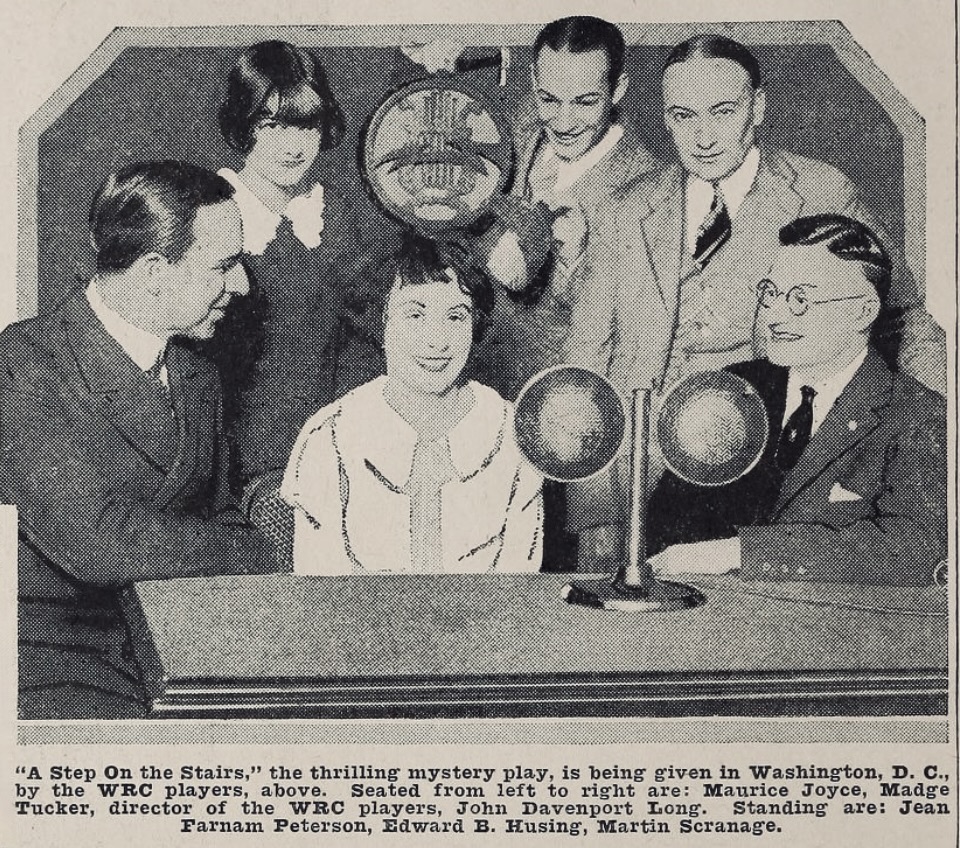
The WRC cast of A Step on the Stairs featuring Ted Husing (Radio Digest, 10 April 1926)

Call it ballyhoo or baloney, with those words, one of the earliest radio serials was launched in February 1926.

Continue reading ““… despite the distortion of the curving horn”: The Wireless, the “Radario,” and the First “Step on the Stairs” (1926)”

Live from the Lincoln Bedroom: Herbert Hoover Cautions Depression-Stricken Radio Listeners Against the “opiates of government charity”

“By the magic of the radio.”  Suitably charming if by then well-worn, the phrase served as the opening of a public address by the thirty-first president of the United States, Herbert Hoover.  Broadcast from the White House on this day, 12 February, in 1931, and occasioned by the birthday of Abraham Lincoln, the message conveyed in the speech that followed was decidedly less magical than the purported medium of enchantment by way of which it was delivered.

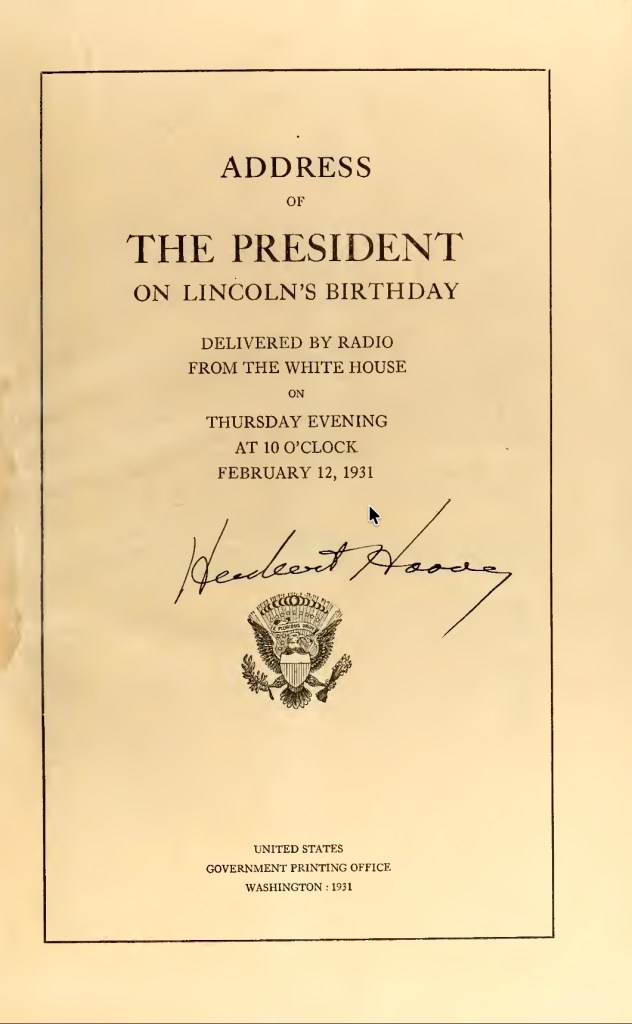
Address of the President on Lincoln’s Birthday (1931)

In lieu of a recording, the script published by US Government Printing Office serves as a reminder of Hoover’s inability to respond with understanding to the needs—and the mood—of the multitudes who tuned in to hear his words.  And while its initial reception is now difficult to gauge, the broadcast no doubt contributed to Hoover’s defeat the following year, on 8 November, when Franklin D. Roosevelt won the popular and electoral vote, carrying forty-two states.

FDR came to be known as “the radio president.”  His predecessor, however, had already made ample use of the medium, especially after the establishment of national chains—NBC in 1926 and CBS in 1927—significantly increased the possibility of reaching millions of US Americans instantly and simultaneously in their homes.

Just days after Hoover’s radio address on Lincoln’s Birthday in 1931, for instance, his administration launched a “drive against illiteracy in the United States” in cooperation with the Columbia Broadcasting System.  

There was little evidence of Hoover’s ability to read the room, however, as his voice passed through the four walls in which so-called members of the far from homogenous public sat alone or in intimate circles to learn about his response to the economic crisis that had left so many of them floundering.

Continue reading “Live from the Lincoln Bedroom: Herbert Hoover Cautions Depression-Stricken Radio Listeners Against the “opiates of government charity””

“It gets something off my chest, doesn’t it?”: Keeping Norman Corwin’s “Appointment” (1941) Because Liberty Won’t Keep in the Heat of Hatred

Cover of Thirteen by Corwin,
containing “Appointment,”
from my collection of radio-related literature

Speaking out against fascism—publicly and nationally, via the airwaves—used to be regarded in the United States of America as a moral imperative, or at least, in the terms of the Federal Communications Commission (FCC), as an act “in the public interest.”

These days, in the era of MAGA on steroids—and, to be clear, the first “A” in the acronym can be readily substituted to designate any number of imperiled democracies—fascism is no longer the anathema to democratic rule that it used to be understood as constituting.  

This is mainly because democracy itself—as a construct, an ideal and a reality—has become anathema to the members of a growing movement that is celebratory of autocracy and that, perversely and perfidiously, argues anti-fascism to be a threat to autocracy as a preferred system of streamlined government in which checks and balances are discarded and in which oppositional forces and alternative voices are denounced as deleterious and traitorous.

I had been meaning to write about the weaponization of the FCC in the wake of the cancellation and temporary or partial silencing of late night talk shows critical of the Trump administration; but for some reason, and via a route too tedious to trace, I happened, quite fortuitously, as it turns out, on a script for a radio play by poet-journalist Norman Corwin, the unofficial “poet laureate” of US radio during the early to mid-1940s.

I have already devoted a dozen or so posts to Corwin and his work, including plays as diverse as “A Man with a Platform,” “My Client Curley,” and “Seems Radio Is Here to Stay.”   

To this day, one of the most rewarding acknowledgments of my scholarly pursuits, such as they are, remains receiving word from Corwin expressive of his approval of my academic writings on him.

Although I have discussed many of Corwin’s writings for radio in Immaterial Culture, I had somehow failed to show up for his “Appointment”—a play first produced on 1 June 1941 as part of the cycle Twenty-six by Corwin.

Continue reading ““It gets something off my chest, doesn’t it?”: Keeping Norman Corwin’s “Appointment” (1941) Because Liberty Won’t Keep in the Heat of Hatred”

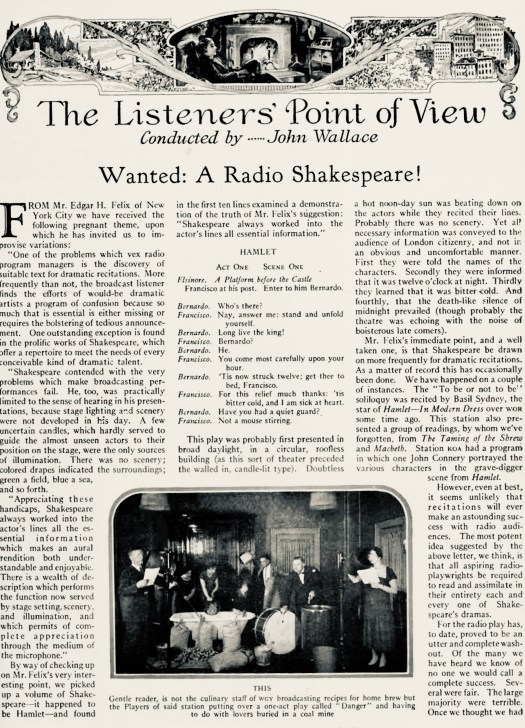
“The First Radio Play Printed in America”: “Sue ‘Em” (1925) and the Ensuing Question of Legitimacy

A photograph published in the April 1926 issue of Radio Broadcast
showing a young John Huston (left) and fellow members of the Provincetown Players

Here I go again.  Another broadcasting centenary, another radio “first.”  This “First,” mind, is wrapped in quotation marks, as the claim is not mine.  I am not going to dispute it, either, or challenge someone else to have the last word in the old “Who’s on First?” routine.  I have been there before.

Picture it: Early 2024.  I am commemorating the one-hundredth anniversary of radio “drama” at an event I staged with British playwright Lucy Gough at the National Library of Wales.  I set out by acknowledging the widely held assumption that Comedy of Danger by playwright-novelist Richard Hughes was the “first” original radio play to be broadcast … anywhere.

The claim served as a hook.  It was designed to underscore the international significance of the event.  At the same time, I tried to justify its happening in Wales by drawing attention to the play’s Welsh setting and the playwright’s affinity with the country.  More important to me than arriving at a definitive answer to the vexed question of whether Comedy of Danger should be regarded as the “first” of its kind are the shifting definitions of the term “radio play” on which, to my mind, hinges the answer to that question—or rather, its unanswerability and ultimate pointlessness.

After all, it is difficult to say what is “first” in any field if the field itself is not clearly delimited first, or if the field is so limitless that it defies delineation in the first place.  In the case of “radio play,” Hörspiel (play for listening) or radio drama—relatively arcane though this field of study may be—definitions not only vary greatly but are often not even attempted.

When is a play a radio play? That is a question I have been asking for a long time in my musings on the wireless, and it is a question I keep asking myself.  “When is a play a radio play” strikes me as a more useful way of framing the debate than the more obvious question “What is a radio play?” because the former encourages us to avoid the most perfunctory of answers: A radio play is a play written for and/or heard on the radio.  

Sure, on the surface it barely scratches, that statement sounds reasonable enough.  But are all plays written and produced for radio broadcasting radio plays by default? Is it the medium, then, that makes a play—any play—a radio play?

Not that “radio” as we understand or know it these days bears a close resemblance to “radio”—as a receiver set, a system, and a phenomenon—anno 1925, the year when Sue ‘Em, proclaimed by its publisher to be the “first radio play printed” in the USA, successfully made a play for first place in a radio playwrighting contest.

Continue reading ““The First Radio Play Printed in America”: “Sue ‘Em” (1925) and the Ensuing Question of Legitimacy”

Static and Spirits: Anarchic Airwaves, Prohibition, and the Return of Philo Gubb, Correspondence School “Deteckative”

Illustration for “The McNoodle Brothers’ Radio Mystery” in Radio News, Sept. 1923

Philo … Gubb? Never heard of him.  Nor, in all my years—make that decades—as a reader of detective fiction, had I come across, or become aware of, Ellis Parker Butler (1869–1937), the writer who brought Philo Gubb—“a tall, thin man, with the face and gait of a flamingo,” a paperhanger with a hankering for “deteckative” work—into a flurry of being.  Not until recently, that is.

Generally, I do not mind stumbling onto what might have been got at with greater ease and efficiency through methodical research.  I am aware that any perceived surprise on my part—that “Eureka!”-inducing moment of discovery—may be owing to an absence of assiduity.  That said, some of the most memorable encounters are made by chance, along circuitous routes.

In the case of Ellis Parker Butler and his brainchild Philo Gubb, though, I regret not having made the acquaintance of either of them sooner, given that this particular route led me back, unexpectedly, to the early days of broadcasting, about which Butler had much to say that might have been of interest and use to me in Immaterial Culture, my study of so-called old-time radio.

Now, Immaterial Culture does not pick up on the story of broadcasting until the network days of the late 1920s.  To gain an understanding how radio evolved, a look at prehistoric transmissions, albeit largely in the absence of sound recordings, is nonetheless instructive.  You cannot expect to “get” the cream of old-time broadcasting if you neglect an inspection of the cat’s whiskers for traces of same.

“There is a [loose] cannon”: Stephen Vincent Benét’s “Undefended Border” Revisited

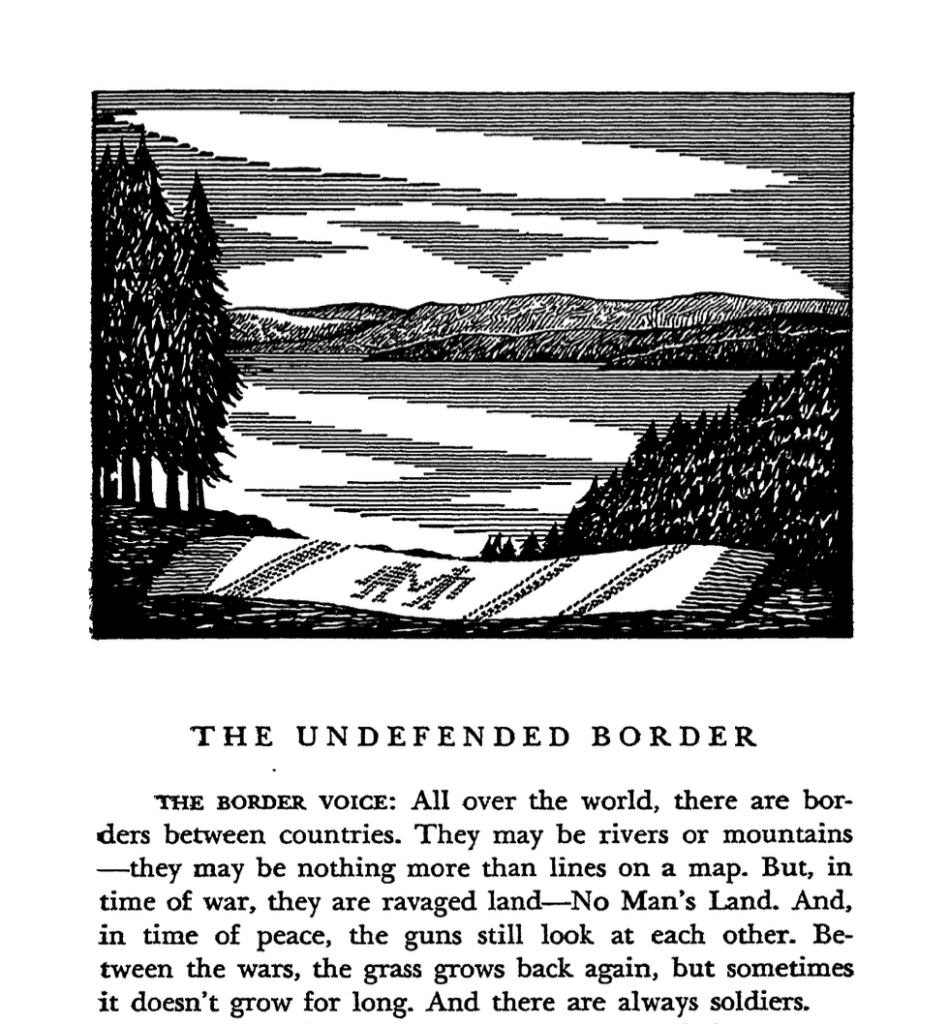
The published script as it appeared in We Stand United, an anthology of radio plays by Stephen Vincent Benét and “decorated” by Ernest Stock.

I commenced this journal back in 2005.   It was intended as a continuation of, and promotional vehicle for, my doctoral study “Etherized Victorians: Drama, Narrative, and the American Radio Play, 1929–1954.”  Its title, broadcastellan, was meant to declare me to be keeper of a vast Luftschloss—a neglected alcazar of the air, immaterially composed of numberless radio recordings I determined to play back.

As of this post, broadcastellan is nearing its twentieth anniversary.  While I do not take this as an opportunity, let alone an excuse, to reissue older posts, I nonetheless wonder: When history seems to be repeating itself, perhaps I may be justified to do the same, if only to demonstrate that not every “been there” necessarily translates into a feeling of “done that,” and that not all twice-told tales are a rehash—not, at least, when you approach them from a perspective that has profoundly, even fundamentally, changed along with the context, your life experience and your attitude toward the world.

I devoted one early entry to “The Undefended Border” (1940), a play by Pulitzer Prize-winning poet Stephen Vincent Benét (1898–1943).  Revisiting it now, in the age of the MAGA tariff wars and annexation threats, I cannot but think of the loose cannon that is recklessly flouting, or at any rate tarnishing, the legacy of the rusty “lone cannon” commemorated in Benét’s play.

Continue reading ““There is a [loose] cannon”: Stephen Vincent Benét’s “Undefended Border” Revisited”

“… an America that must never happen—that will never happen!”: Revisiting US American Anti-Third Reich Propaganda in the Second Age of MAGA

The script for “Chicago, Germany” as it appeared in the June 7-13 issue of Radio Life

Delving into the “Draft and Ideas” folder set aside for this blog, I came across a fragment titled “‘Chicago, Germany’: A 1940s Radio Play for Our Parallel Universe.”  It was intended for posting on 10 November 2016 as a response to a “Trump administration having become a reality.”  The draft was abandoned, but no other piece of writing was published in its place.  

In fact, the next entry in this journal did not appear until 15 May 2017, and it coincided with the opening of Alternative Facts, an exhibition I staged with students at the School of Art, Aberystwyth University, in Wales.

As the abandoned fragment and the ensuing hiatus suggest, the “reality” of the Trump presidency had so rattled me that I could not bring myself to continue a blog devoted to the popular culture of yesteryear, as much as I had always tried to de-trivialize bygone trifles not only by examining them in the context of their time but also by relating them to the realities of the present day.

The exhibition project that kept me busy in the interim, had similar aims.  Alternative Facts provided me, as a curator and educator, with an opportunity creatively to engage with the outrage of MAGA by appropriating a phrase that encapsulated the duplicity and travesty of those early days of spurious swamp-draining.

Fast forward to 20 January 2025, the day that Trump returned to office, by the popular demand that is a product of his populist brand, with the singular and single-minded vengeance of a MAGA-loomaniac.  Pardon the execrable pun, but I find no words other than that crass neologism adequately to describe a US President who pardons rioters storming the Capitol and defecating on democratic principles, much to the Nazi-salute inspiring enthusiasm of enabling, super-empowered and quite literally high-handed oligarchs who, I suspect, will, rather than Elon-gate this reign, eventually assume the gilded let’s-lay-democracy-to-rest-room that, in the interim, is the seat of Trump’s throne,

It struck me that the time was ripe for—and indeed rotten enough—to pick up pieces of that draft in light or dimness of the current and perhaps irrevocably changed political climate, which, far from incidentally, is the only human-made climate change we are likely to hear about from the US government for the duration, as dramatically shortened for our species and for most lifeforms on our planet as that time may have become in the process.

As a melodramatist who staged the end of the earth both on radio and for the movies (in the 1951 nuclear holocaust thriller Five), Arch Oboler would have much to say about all this—except that what Albert Wertheim has called his “penchant for altered reality” was being “married to his anti-fascist zeal” in propaganda plays sponsored by or at least aligned with the objectives of the US government during the FDR years.

Continue reading ““… an America that must never happen—that will never happen!”: Revisiting US American Anti-Third Reich Propaganda in the Second Age of MAGA”

The Medium Is the Murder: Technology, Human Nature, and “The Voice That Killed” (1923)

Illustration for “The Voice That Killed” (1923) by Leo Bates (1890-1957)

“There is a modern touch about this story that stamps it with the brand of originality.” That is how the editors of Detective Magazine introduced “The Voice That Killed,” a short work of fiction that first—and, as far as I can tell, last—appeared in print on 28 September 1923.  The man responsible for this slight but nonetheless noteworthy “touch” of the “modern” was Gwyn Evans (1898-1938), a writer best known for his fanciful contributions to the sprawling Sexton Blake Library.

While I am not prepared to pursue Evans’ trail into the far recesses of that vault of once popular culture, I have read enough of his stories to get the impression that “The Voice That Killed” is representative of Evans’ none-too original fascination with—or, perhaps, his adroit cashing in on the widespread ambiguity of his readers toward—modernity and the rapidity with which, in the years between the two World Wars, technology was transforming every aspect of human life, consuming some lives in the process.

Continue reading “The Medium Is the Murder: Technology, Human Nature, and “The Voice That Killed” (1923)”

The Wireless, Herr Doktor Flesch, and the Devil: Hearing, Reading and Translating “Zauberei auf dem Sender” (1924), the First Radio Play Broadcast in Germany

Publication of “Zauberei auf dem Sender” in issue 35 of Funk (December 1924)

What is this sound and fury? Just who is behind it all? And why? Rather than making assumptions about the receptiveness—or perceptiveness—of radio listeners back in October 1924, I asked myself those questions as I tuned in belatedly and indirectly, via the internet, to a 1962 recreation of the orchestrated chaos that is Hans Flesch’s Zauberei auf dem Sender.  

Subtitled “Versuch einer Rundfunkgroteske” (“an attempt at a radio grotesque”), Zauberei is widely considered to be the earliest exponent of the Hörspiel (literally, “ear-play”) to be broadcast in Germany, or, to be precise, that nation’s Weimar variant, Germany’s first, flawed and spectacularly failing experiment in democracy.

In December 1924, a few weeks after the play was performed live in a studio in Frankfurt am Main, the script appeared in an issue of Funk, a German periodical devoted to radio technology and broadcasting.  

Now, “Funk” in German refers to wireless transmission—but, when it comes to Zauberei auf dem Sender, the “funk” you may be left with could well be blue.

Continue reading “The Wireless, Herr Doktor Flesch, and the Devil: Hearing, Reading and Translating “Zauberei auf dem Sender” (1924), the First Radio Play Broadcast in Germany”

“… unequal emission”: “Interference,” “Modern Wireless,” and the “Wilds of Electronia”

Illustration by Ern Shaw (Modern Wireless, Nov. 1924)

“Many plays have been broadcast, but none of them seems to me to have the pep that is needed to get not merely across the footlights but across the ether.”  Complaints such as this one are all too familiar to me; in fact, they were launched so frequently against radio culture that, years ago, they prompted me to contest them. 

To misappropriate the famous question posed by the feminist critic Linda Nochlin, I asked “Why Are There No Great Radio Writers?” The objective was not to find examples to the contrary—those queer, quirky and quicksilver exceptions that can serve to prove the rule—but to query the question itself as (mis)leading and to expose the biases underlying it.

Continue reading ““… unequal emission”: “Interference,” “Modern Wireless,” and the “Wilds of Electronia””