Politics and Plumbing

Doesn’t Republican rhetoric sound tired these days? The material isn’t fit for Vaudeville. The same old folksy (make that fauxsy) references to the mythical Joe Sixpack or average Joe, plumbing and otherwise. Shouldn’t that at least be the average José by now? It all strikes me as so 1950s in its white picket-fenced-in parochialism. Tuners-in are treated to the same bromidic anecdotes that are meant to stand for what supposedly matters or to distract from what truly does.

To candidates like McCain and Palin, what matters surely isn’t the presumably average Joe or Jane, at least not as anything other than statistical figures adding up to a sufficient number of votes. What matters to Republicans is the maintaining of a status quo serving those at the top who, if they deem it fit, let a few crumbs fall from the table at which few sit and most serve. Republicans tend to appeal to our meanest instincts, greed and selfishness, for which reason they rely on the lowest common denominators in their campaign speeches and their less-than-reassuring assurances.

No new taxes? “Read my lips,” perchance? The line is familiar, even if the letdown seems to have been forgotten by most. Less government? Tell that to the average Janes whom you deny control of their own bodies and destinies. I, who might have been a US citizen by now had it not been for conservative politics, would rather have big government than a world controlled by large corporations whose profit-marginalization of humanity is not only harming national economies but, what should be more important to us than mammon, our shared, global ecology.

Joe the Plumber? Sure, he exists. That does not make the figure any less of a fiction, a campaign speech commodity. Listening to the final Presidential debate, I was reminded of a certain “expert plumber” who stood up against a ruthless politician clawing himself into office; a cat, no less. Back in 1940, when socialism was not quite the dirty word that it is today, playwright Arthur Miller (a revival of whose All My Sons opens on Broadway tonight) created such fierce opponents in his radio fantasy “The Pussycat and the Expert Plumber Who Was a Man” (previously discussed here).

Tom, the Pussycat in question, is a questionable campaigner who shrouds his feline identity in threats and promises; he gets elected mayor in a nasty contest relying on the exposure of past wrongs in the lives and careers of elected officials, however irrelevant such revelations might be to the act of governing.

Tom aspires to the Presidency . . . until he is confronted by a fearless plumber, a citizen who exposes him for the sly customer he really is. Beaten, Tom returns to his home. The “difference between a man and a cat,” he concludes,

is that a cat will do anything, the worst things, to fill his stomach, but a man . . . a man will actually prefer to stay poor because of an ideal. That’s why I could never be president; because some men are not like cats. Because some men, some useful men, like expert plumbers, are so proud of their usefulness that they don’t need the respect of their neighbors and so they aren’t afraid to speak the truth.

As long as there is cream there will be cats that keep their paws on it while they purr about prosperity for all. Send in some stout-hearted plumbers who refuse to be campaign fodder and, rather than having pulled the fur over their eyes, set out to realize the ideal of draining the arteries in which the cream is clotting. And don’t let cream-licking felines make you believe that an ideal such as this is nothing but the stuff of pipe dreams . . .

Banks (for the Memories)

“How do you want it?” the stern-looking woman inquired. “In tens,” I said, because I needed it that way. She was a bank clerk behind a counter; and I was referring to the denomination in which a portion of my savings was to be returned to me. I sounded like a masochist saying it; but, stepping into the money market in tense times such as ours, you must really be a glutton for punishment. As someone who still counts his savings in tens, I am not among the afflicted. Still, what with that whiff of October 1929 in the air and Iceland at the center of an international incident, you’ve got to be in hysterics to be laughing all the way to the vault.

Could an economic bust be a boon for the sit-at-home, dim-the-lights medium of radio? Of all commercial enterprises catering to our need for news and entertainment, it was the wireless that experienced a boom during the Great Depression. Radio profited from the closing of Broadway shows and the demise of Vaudeville. And while programs on the air advertised plenty of products, they came to your home free of charge; unlike today’s cable and satellite receiver, the old cat’s whiskers did not require a subscription. Even the equipment could be assembled cheaply.

Be it Wall Street laying an egg or enemy planes dropping bombs, the poor cousin of television truly comes into its own when the world is in turmoil. To be topical, for once, I am listening to a few classic programs featuring assorted banking woes.

Jack Benny pinching a penny, safecrackers at work in an episode of Gang Busters, or hapless yokels like Lum and Abner offering financial services, radio gave the public an earful of what, for the most part, it didn’t have: money, and the trouble that comes it with, especially when it goes.

Given the prudery of radio entertainment, it is probably safe to assert that misdeeds for dough outnumbered crimes of passion on the air, unless that passion exhausted itself in a peck on the cheek, however embellished it might get in your mind. Mr. Keen may not have been a Tracer of Lost Profits, but radio thrillers were nonetheless teeming with have-nots trying to get some without resorting to the legalized gambling known as the stock market.

“Please, would you come to the bank with me. Please,” a woman urges, with distress in her voice.

I, I’ve asked so many people, but they won’t listen to me. You, will you come to the bank with me? No, don’t turn your head. Please don’t go away. Listen, if I tell you very carefully why I want you to come to the bank with me, you will come, won’t you?

Another terrified investor? A demented clerk trying to get you to open an account? Well, wait and hear. It is the opening of a Lights Out! thriller cheekily titled “Come to the Bank” (17 November 1942). As playwright Arch Oboler explains, it is “the story of a woman who, for strange reasons soon apparent, is determined to get us to the bank.” These days, as empty bank vaults are about as spine-chilling a setting as a crowded morgue, the above plea makes for an intriguing premise indeed, especially if the concept of a presumably solid depository and a final resting place are being equated.

“Come to the Bank” is the account of a woman robbed of her savings as well as her sanity, insisting as she is that the missing man she cared for is “entombed” in the wall of the titular institution. “This is your last warning,” a psychiatrist tells her, “You are to stay away from the bank. You are to behave yourself as the good, intelligent citizen you normally are.” If he were alive today, shrewd Mr. O would milk his scenario for all it is worth.

Pitch-Hitting; or, When Dietrich’s Not Herself

My grandmother refused to listen. She would walk out of the room whenever Marlene Dietrich appeared on the small screen. “She betrayed our country,” Oma would say, referring to Dietrich’s departure for Hollywood about the time the fascists came into power. Actually, Dietrich left a few years earlier; but the Nazis sure failed to lure her back. What a loss it is to turn a deaf ear to what aforementioned radio actor Joe Julian called “an exotic accent” and a “strong voice-presence.” Working with her in Dietrich’s lost radio series Café Istanbul (1952), Julian got a “glimpse behind the public image” and discovered
a woman of strength, warmth, and intelligence, yet so spontaneous that when, during a rehearsal, she overheard one of the actors express doubt that the rest of her body [she was in her early fifties by then] was as youthful as her famous legs, she ripped open her blouse to prove him wrong.

On this day, 8 October, in 1939, Dietrich could provide no such proof of her health and vitality. Scheduled to appear on the Screen Guild program that night, she was forced to call in sick due to a severe cold that, according to Roger Prior, host of the show, had halted the shooting of Dietrich’s comeback feature Destry Rides Again. The star had tried to honor her commitment, but had lost her voice entirely during rehearsals. In what must be one of the most inept voice-overs in Hollywood history, the Screen Guild producers replaced her with . . . Zasu Pitts.

It was all for laughs, of course. After all, Pitts’s voice had about as much sex appeal as fingernails being painstakingly filed . . . with a blackboard. And by casting Pitts opposite the less-than-expressive Gary Cooper, the Guild made the most of this emergency situation. “Is that Marlene Dietrich?” Cooper inquired. The affirmative only produced a terse “Well, so long.” Trying to explain the situation, Prior informed Cooper that “Zasu has Marlene Dietrich’s lines.” “Not from where I’m standing,” Cooper retorted. Together with Bob Hope and the actress billed as “Marlene Zasu Dietrich Pitts”, he nonetheless condescended to co-star in the sketch “The Girl of the Woolly West; or, She Was Wearing Slacks, So She Died Like a Man.” It sure made audience’s anxious for Dietrich’s return.

Nine years later to the day, on 8 October 1948, Dietrich was once again sick—and scheduled to appear on the air. This time, though, she was able to perform her role, cast as she was as the ailing Madame Bovary in the Ford Theater presentation of the novel as adapted by NBC staff writers Emerson Crocker and Brainerd Duffield . Sure, you’ve got to take Madame Bovary with “a pinch of power”; but you won’t be sorry to hear Dietrich breathe her last on the occasion. Besides, who could expect fidelity in the case of Emma Bovary?

“If some of Flaubert’s delicate delineation of character was missing from ‘Bovary’-on-the-air,” critic Saul Carson remarked, “Marlene Dietrich more than made up for this loss in literary flavor by her superb acting in the lead role.” Hardly carrying the chief burden, Dietrich was supported that night by Van Heflin and Claude Rains. “Too often, film stars rely on their screen reputations to cover slipshod work in radio,” Carson conceded; “but these people performed as artists who respected the medium as well as the vehicle.”

If Dietrich’s in it, just about any vehicle will do for me. Unfortunately, the extant recording does about as much justice to her timbre as Zasu Pitts. As for you, grandma, who saw trains depart for the concentration camps without making a noise, I’m just sorry that fascist propaganda robbed you of your senses . . .

He Calls Them As He Hears Them: Joseph Julian Remembers

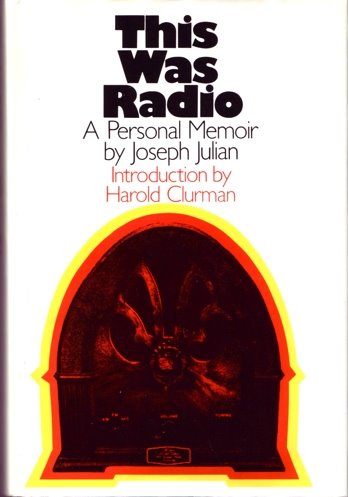
“The small but rich body of radio literature, which [Norman Corwin] brought so lovingly to life, lies languishing in a few libraries and second-hand book shops, under the titles Thirteen by Corwin and More by Corwin—a great shame and deprivation for the present generation!” My sentiments, entirely. Not my words, though, which is why I had to slap quotation marks on them. The man who said so was Joseph Julian, a once highly acclaimed and sought-after radio actor who starred in a number of plays written and directed by Corwin during the early-to-mid 1940s. Today, Julian’s memoir, a copy of which I recently added to my own library of out-of-print books on broadcasting, is one among those “languishing” volumes, a forgotten voice from a medium whose dramatic potentialities have remained largely unsounded since the late 1950s.

This Was Radio came out in the mid-1970s, a time widely deemed ripe for a reassessment of the aural medium and its derelict theater of the mind. Rather than waxing nostalgic—thereby squeezing the last few bucks out of a defunct business which, back then, most American adults still recalled experiencing first-ear, and fondly at that—Julian takes readers on a trip down memory lane that leads into neighbourhoods they would not get to hear about on an official tour.

His Corwinian class acts aside, Julian appeared on thriller programs like The Falcon, The Shadow, Inner Sanctum, Mr. Keen, Broadway Is My Beat, and The Mysterious Traveler. He was first heard on The March of Time, but as an also-ran-off-the-mouth, in re-enactments that called for crowd scenes. Briefly, he served as a sound man, during which stint he learned what noise a human body produces when it is turned inside out.

I can imagine just what kind of sounds emanated from Julian when he learned that the same thing was happening to his career. An established actor by the early 1940s, Julian remained highly successful throughout the decade, until, in 1950, his name appeared in Red Channels. His career as a radio actor declined rapidly; by 1953, his annual income had dwindled to a mere $1630.

Barred from work at CBS, Julian fired back by filing a lawsuit for libel. Character witnesses during Julian’s 1954 trial were Edward R. Morrow (last talked of here) and the aforementioned Morton Wishengrad. It was “an ugly period in American life and in mine,” Julian comments. His “urge” was “to skip over it”; but he felt a

responsibility as a victim to record some of what [he] went through. A whole new generation hardly knows that such a thing ever happened. But the fact is it could easily happen again if we relax our vigilance in defending our freedoms. Control of broadcasting is one of the first major objectives of those who would take them away.

His lawsuit was dismissed; thereafter, Julian virtually unemployed until William Fitelson, a theatrical lawyer and executive producer of the Theater Guild’s US Steel Hour television series staged one of the actor’s own plays in December 1954. Julian’s fortunes changed as quickly as they had declined; and he once again “getting calls for radio acting jobs.”

Without bitterness, Julian tells it as it is. About Myrna Loy, for instance, he remarks that, “if she had to win [her radio] role in a competitive audition with radio actresses, she wouldn’t have been there. Her voice, isolated from her other attributes, was dull and flat. She was selling her name, not her art.” More problematic still was it to perform a dramatic scene with Veronica Lake, who had such a weak, wispy voice” that the sound engineer could not get her and Julian “in proper balance.”

Lake was handed a “separate microphone across the stage” so that the engineer could “could mechanically raise her voice level to mine.” However effective for listeners at home, her faraway whispers had Julian straining to hear his cues. “Especially since they had her facing front so the audience could see her famous peek-a-boo hairdo. Hardly the way to play an intimate love scene with a lady!”

Of the notorious Hummerts, who “grimly dominated their empire” of soap operas, Julian remarks:

There was something darkly foreboding about [them].  Their stiff presence always evoked a sense of insecurity.  And with good reason.  They had a reputation for firing actors who incurred their slightest displeasure.  And authors.  When Mrs. Hummert once told a writer that she wanted “God” on every page of a script, and his answer was “Who will we get to play Him?” he was fired on the spot.  And whey you were fired from one of their shows it was a catastrophe.  It meant being banned from all their nine or ten others that might be on the air at any given time.

Call him fortunate or not, Julian continued to act on the air well into the medium’s decline. On this day, 4 October, in 1959, he was heard on Suspense, one of radio’s last remaining drama anthologies, in the routine thriller “Room 203.” It is a far cry from Julian’s greatest work; but these days, almost any cry uttered on radio seems distant.

Blind Medium: My Eyes Are in My Heart (1959) by Ted Husing

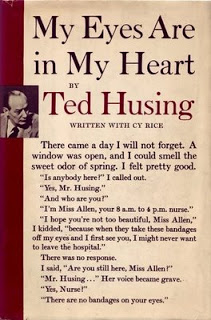
Sometimes, when my heart is not in in, my mind’s eye begins to stray. That was what happened a while back when I tried To Please a Lady. Tried to follow it, that is. The Lady in question is one of Barbara Stanwyck’s decidedly lesser vehicles, and the horsepower on display in it is not likely to get my heart a-racing. Still, as previously reported, it has what it takes to get me excited about even the dullest of features: a radio angle. When I spotted announcer Ted Husing in one of the racetrack scenes, I started to reread my notes on Ten Years Before the Mike, his autobiography. I do not own a copy of that one; and, looking for it online, I realized that the chances of my adding it to my library are fairly slim at the moment.
During my search, I did come across another book by Husing, one of which I had not been aware. Nor had I been aware, seeing Husing on the screen, that he was plagued by something he was hiding from the world, tormented all the more by keeping everyone around him in the dark. At the time To Please a Lady was shot, in 1950, Husing was suffering from dizzy spells and began dragging his right foot. Years of denial and secrecy led to several accidents, all of them the result of a tumor that grew, undiagnosed, on Husing’s brain. Six years on, having finally faced an operation, one of the biggest and highest-paid voices in radio lost his eyesight and the will to live.

All this and more is shared in Husing’s second autobiography, My Eyes Are in My Heart (1959). While much of his life in broadcasting had already been recounted in his first, the two decades that had elapsed between the publications—and the misfortune that befell its author—make the later reminiscences not only more retrospective but also more introspective. “My values then were superficial,” Husing reflects. “Since then, I have learned to separate the real from the false. But this took many years, much suffering and much re-evaluation.”

Like many people who enjoyed a life and career that is considered a success based on obvious measures of fortune and fame, Husing shows himself remorseful, believing his affliction to have been a punishment, and a just one at that. For having been ashamed that his parents spoke with a pronounced German accent, for instance. For not having been a good husband and father. For having been too enamored with celebrity.

Now, I’ve never bought this kind of argument. If such retribution existed, it would appear that any disabled person is a sinner at heart. Luckily, Husing keeps his humility well in check, telling many an amusing anecdote about his decades in broadcasting, dropping names like a traveller, eager to be the envy of his friends, drops picture postcards into a mailbox hundreds of miles from home. Has he really been responsible for the discovery or promotion of entertainers including Rudy Vallee, Guy Lombardo, Bing Crosby, and Desi Arnaz?

Ted Husing was chiefly known as a sports announcer. “Actually,” though, as he points out, he “logged far more broadcasting time on music and special events.” Today, his name does not ring a bell resonant enough to make the multitudes pay attention; but, back in the 1930s, ’40, and ‘50s, that bell could open the doors to the swankiest New York City nightclubs. Never mind those places. What makes My Eyes Are in My Heart such a fascinating book is the insight it provides into a by now lost world of broadcasting during what is often referred to as radio’s golden age. Reminiscing about the life of radio and his life in it, Husing not only knows but is what he talks of: a blind medium.

As for a certain tough to please Lady . . . she does not even get a mention.

Misinformation, Please: Earl Derr Biggers, Rex Stout, and Charlie Chan’s Sons

Earlier today, I added a few titles to our movie database, a list I try to keep up to date so as not to lose track of our collection. Yesterday, the fifth and final Charlie Chan box set arrived in the mail, containing the seven last entries into the 20th Century Fox series. Among them are some of my favorites: Charlie Chan at the Wax Museum, Castle in the Desert, and Dead Men Tell. Ever since I discovered these movies on German television—in German, mind you—I have been inordinately fond of the much-traveled sleuth, no matter how ramshackle to politically incorrect his vehicles.

As I shared here a few years ago, I never enjoyed a close relationship with my father, long since departed, and the Chan pictures somehow made me, an introvert teenager, long for the kind of bond grown-up sons number one and two maintained with their gentle and generous pop. Charmed by the series, I picked up Earl Derr Biggers’s Chan novels . . . and was greatly disappointed.

Biggers, whose Seven Keys to Baldpate was being presented on the Lux Radio Theatre on this day, 26 September, in 1938 (as already discussed here) may have been the father of Charlie Chan, but the brainchild, like Frankenstein before him, was passed around so often and given so many transformations that few recalled or bothered with his origins. After the author’s death, there followed such a long line of foster parents that hardly any of the family traits and characteristics can still be traced in the child. Shown above, for instance, is radio Chan Ed Begley (in a picture freely adapted from its source).

Some folks, though, remember. One of them was mystery writer Rex Stout. On this day in 1939, Stout appeared on the quiz program Information, Please! (discussed here) and, along with his fellow panelists, was called upon to answer a number of mystery related questions. In a task posed by a listener from Morristown, Pennsylvania, the panelists were to name heroes of crime fiction who were aided in their detective work by their fathers, their offspring, and their secretaries.

Clearly, this was a subject of which mystery writer Rex Stout could be expected to be familiar. Sure enough, the father of Nero Wolfe was quick to identify Ellery Queen’s paternal helpmate. “I’d hate to ask you to mention the actual titles of books by one of your rivals,” host Clifton Fadiman remarked, “but could you name, er, one or two of Mr. Queen’s books?” He should have said, Messrs. Queen, of course; but never mind.

At any rate, a straight answer from the competitor was not forthcoming, aside from the sly reply “The Adventures of Ellery Queen,” the title of the radio series based on the character but not penned by its creators.

When it came to naming a crime-solving father being assisted by his son, Stout shrouded himself in silence. It’s a “series of books,” Fadiman assisted, that had been successfully adapted for the screen. “Charlie Chan,” fellow panelist Carl Van Doren replied. “Quite right,” said Fadiman. To be sure, the word “assisted” is rather questionable; for, as Chan remarked in Murder over New York (also part of the abovementioned collection), “many cases would have been solved much sooner” had son Jimmy not insisted on getting involved.

Fadiman was ready to move on; but Stout voiced his disagreement. “Pardon me, Mr. Fadiman,” he interjected, “not in any of his books was he aided by his son, except that his son laced up his shoes or something for him.”

“That’s a help,” said the host, brushing aside the objection without giving it any consideration. “Korrektur bitte,” Chan’s German alter ego might well have protested, however mildly. Stout was right. The father-son relationship was created for the movies so as to give the rather austere Chan his Watsonian sidekick.

And very glad I am for this infidelity and the wayward child thus begot. “Does anyone help Nero Wolfe in your own series of stories, Mr. Stout,” Fadiman inquired. “I do, pretty often,” he quipped, missing out on a chance to give Archie Goodwin his due. Not long after the Information, Please broadcast, at a time when even Charlie Chan was enlisted into the Secret Service, Stout turned “lie detective” to expose the misinformation, spread through enemy propaganda, in a series titled Our Secret Weapon.

An Ear Against the Blue Wall

I tire easily of Henry James and can countenance only so much blue. If I got a kick out of being cryptic, I’d say that about explains why this journal contains only a single reference to Dragnet, the influential crime drama that, between 1949 and 1957, caught the ear of millions tuning in to NBC radio. As much as I enjoy detective stories, I don’t warm readily to cop shows. Or cops, for that matter, the sight of whom is rarely a comfort to me. Let me give you a “for instance.” One sunny afternoon in September, I was sitting on a bench in Carl Schurz Park on the Upper East Side of Manhattan. It being the beginning of a new semester, and the beginning of my career as a doctoral student, I had a backpack full of books to pore over so as not to fall behind right from the start. I was—and am—a slow reader; and, when it comes to American and British fiction, a non-native one at that.

So, I took out the library copy of James’s Princess Casamassima, a tome so long and somnolent that I struggled to keep my eyes open. The next thing I know is that an officer addresses me from a police car several yards behind me, insists that I had broken a law, and hands me a ticket. I was very nearly speechless; but, after cautioning a few old ladies on the verge of dozing off over their cross-stitching that they would do so at their own peril, I betook myself, past the crowds gathered in the area for the annual German-American Steuben Parade, to the nearest precinct, where I protested against the treatment I had received. At that point I ran into what is commonly known as the blue wall. There was no alternative but to appear in court, a prospect likely to make the non-immigrant even more uneasy than the citizen.

However trifling, this experience made me think of those who had been abused in the name of the law, in the name of all the laws the breaking of which does not mean the least bit of harm or inconvenience to anyone, but whose enforcement provides those in uniform with the opportunity to intimidate, demonstrate their might, and put a few coins into government coffers. My case was ultimately dismissed; but the whole affair caused me no slight irritation. Is it any wonder that I prefer my Friday on a desert island?

Still, the chance of placing an ear on that blue wall and listening in on the workings of the force has an undeniable appeal. The one radio program to cater to spies like me was Night Watch (1954-55), billed as “the actual on-the-scene report of your police force in action.”

“You’re gonna ride with us tonight,” the narrator promised those tuning in to CBS on this day, 25 September, in 1954. “And remember, the people you meet are not actors. What happens to us, happens to you; because this is it. This is real. This is Night Watch.

This early reality show was presented with the cooperation of the police department of Culver City, California, and took listeners straight to the scene of conflict. In the 25 September 1954 installment, the cases involve stolen motel towels and a disagreement between a mother and her fourteen-year-old daughter whose unrehearsed, unscripted words and untrained voices leave no doubt as to the authenticity of the recorded incident, careful editing notwithstanding.

While Night Watch did not feature the sensational crimes that listeners came to expect from fictional programs, the reporter accompanying the officers was attacked, shot and stabbed, on at least two occasions while serving as proxy witness to scenes of juvenile delinquency, prostitution, domestic abuse and suicide.

No matter how diligent, courteous, and compassionate the officers, the star attractions of the series are the average, anonymous folks of whose lives the audience gets an earful as if being handed a glass to press against the walls behind which dwelled the neighbors to whom our doors are closed. Having been kicked off that bench, I can meet them with something else besides idle curiosity.

The Lilt of the Lilliputian

The cover of Adventure in Radio, from my collection

A few years ago, walking home from graduate school one afternoon, I stopped by at a second-hand bookstore in my old neighborhood of Yorkville, Manhattan. Judging from the window display, the shop seemed to specialize in children’s books and memorabilia. While this did not deter me, I hardly expected to make any significant acquisition of a volume on the subject to which this journal is chiefly devoted. I mean, I was not looking for a decoder ring or some such souvenir from the bygone age of radio dramatics. I was, after all, researching my dissertation. There was on the shelves a beautiful copy of Adventure in Radio (1945). Subtitled “A Book of Scripts for Young People,” it may be expected to include juvenile playlets written for the medium, although not necessarily produced on network radio. On such compilations, of which there are many, I was not inclined to waste money or time.

Spiting my assumptions, Adventure in Radio not only contains a number of broadcast scripts from programs like Jack Armstrong and Let’s Pretend but also propaganda plays and wartime commentaries geared toward an adult audience. In addition, it offers insights on the production of radio plays, on sound effects, announcing, and “radio language.” It took a little salestalk from the owner of the by now long closed store, but I was soon convinced. Where (I did not know much about eBay back then) would I ever find such a book again? And how could I claim to be serious about old-time radio if I did not snatch up this copy? So, I handed over my $40 (it was the price tag that made me hesitate) and walked off, eager to continue my studies . . . and determined to find the recordings to match the published scripts now at my fingertips.

That often proved quite difficult; but I had made up my mind that I was not going to write about words divorced from performance. I wanted to hear what was being done with those scripts, how they were edited and interpreted. Take the NBC University Theater’s production of “Gulliver’s Travels,” for instance. It was broadcast on this day, 24 September, in 1948. My appreciation of the challenges of soundstaging the play grew after reading the comments with which Frank Papp, a director of radio drama for NBC, prefaces the script, originally written for the series World’s Great Novels. Papp points out the “unusual problems” Frank Wells’s adaptation posed in production:

In the matter of casting, the Lilliputian was the most difficult.  Here was needed a voice which gave the illusion of a tiny man.  A trick voice in itself would be only a caricature.  What was required was a voice that created a picture of a real human being of Lilliputian size.  After extensive auditioning, an actor was found whose talent and vocal capabilities fulfilled these requirements.

The actor portraying Gulliver was placed in an isolation booth, Papp explains, “so that the Lilliputian’s voice would not spill over into his microphone” and the two voices could be miked separately, with a volume reflecting the size of each character. The voice of the King of Brobdingnag, meanwhile, was “fed” both through an electronic filter to amplify its base quality and through NBC’s largest echo chamber to create the illusion of a giant.

The 24 September 1948 presentation of “Gulliver’s Travels,” starring Henry Hull in the title role, does not quite live up to the expectations raised by Papp’s introduction. Under the direction of Max Hutto, child actor (Anthony Boris) is cast in the role of the Lilliputian, a choice that infantilizes the character and renders pointless the effects achieved by the sound engineer.

While Wells’s script downsizes Swift’s story and diminishes its bitterness and bite, it is the production that contributes to a sense that Gulliver’s Travels is, at heart, a juvenile fantasy, despite its airing on the ambitious if misguided NBC University Theater, a program that linked listening to such bowdlerizations with courses in distant learning. I may have been able to match the script with a production, but it was not the one described in Adventure in Radio.

Squeezed as I am into the isolation booth of my preoccupations, it is my mind’s voice that supplies the lilt of the Lilliputian . . .

” … from hell to breakfast”: H. V. Kaltenborn Reporting

Listening selectively to US broadcast recordings of the 1930s, ‘40s, and ‘50s—the period often referred to as the radio’s golden age—I often neglect the kind of program that, during the late 1930s was fast gaining in significance as millions of Americans, many of whom were immigrants from Europe and Russia, were following reports from the Old World they had left. On this day, 22 September, in 1939, news commentator H. V. Kaltenborn kept CBS listeners abreast of the situation in Europe, paying special attention to the politically unstable kingdom of Romania.

As I learned yesterday, reading My Eyes Are in My Heart by aforementioned radio announcer Ted Husing, the King and Queen of Romania were savvy people not averse to selling out or forging lucrative alliances. On a tour of the United States back in 1926, Queen Maria of Romania, made a splash in the advertising world, agreeing to appear on radio, promote products, and be seen shopping in certain stores, all for the right sum of money.

Romania had one particularly valuable commodity, and the country, still neutral in the fall of 1939 was keen on keeping good relations with the nation that was about to swallow the continent. On 21 September, premier Armand Călinescu was assassinated by Romania’s fascist Iron Guard and Gheorghe Argeşanu, former Minister of War, was named as his successor. Here is how Kaltenborn (whose German title would have been Baron von Kaltenborn-Stachau, had he not been born and raised in Wisconsin) described the situation to American listeners:

That means that they are going to have a military government, as strong a government as King Carol [II] could possibly create, and it needs to be strong in view of the situation faced by imperiled Romania. Russian armies are menacing from the north.  German armies are menacing from the west.

While Russia was anxious to regain territory lost to Romania after Germany needed Romanian oil, Kaltenborn explained; and in trying not to offend either giant, Romania was on the brink of becoming another Poland.

Speaking rapidly and with animation, Kaltenborn occasionally stumbled in his commentary; he generally used notes rather than a prepared script, a technique that lent urgency to his reportage.

By 1939, he was a veteran, his beginnings in broadcasting dating back to 1922 (as you will learn listening to this Recollections tribute from 3 April 1957). As early as 1926, he had remarked upon “Radio’s Responsibility as a Molder of Public Opinion,” upon radio’s role as the Fifth Estate. “Public opinion is the king of America, and radio must assume a more conscious responsibility as democracy’s kingmaker,” he had cautioned.

World War II had only just begun; but news analysts like Kaltenborn were preparing the ignorant, the indifferent, and the isolationists for the inevitable, however tentative and cautious they were in their warnings:

I spent a good part of yesterday in Washington, I interviewed members of the Cabinet, outstanding leaders of the Senate, some of the most outspoken leaders of the opposition to lifting the embargo [against sending military aid to European countries facing threats from Germany and Russia, an embargo maintained as part the US Neutrality Act that FDR had urged Congress to repeal on 21 September], and got a picture of the atmosphere of Washington.  There is general apprehension in Washington that somehow, in some way, in spite of our not wanting it, that the country may be pushed towards war.

“Let those who seek to retain the present embargo position,” Kaltenborn insisted,

be wholly consistent and seek new legislation to cut off cloth and copper and meat and wheat and a thousand other articles from all the nations at war.  I seek a greater consistency through the repeal of the embargo provisions and a return to international law.

Kaltenborn then read a bulletin from the United Press, which stated that the isolationists in the Senate intended to fight the President on the embargo repeal “from hell to breakfast.”

Recordings of broadcast news and commentaries like this (which you may find in this invaluable Old Time Radio Researchers Group compilation), bring to life a time of fear and uncertainty without an awareness of which classic radio plays like “The War of the Worlds” cannot be fully understood.

Seeing Jungle Red; or, Arthur Godfrey’s Sneeze

The Latvian National Opera had not yet reopened for the fall season. Little more could be said in our defense. Having enjoyed another organ concert in the Dome, followed by a Russian meal at Arbat, we once again made our way through the old town to pay a visit to the city’s Forum Cinemas, a multiplex boasting the largest screen in Northern Europe. By the end of our stay, we had pretty much exhausted its late-night offerings (the overrated Dark Knight, the enjoyably featherweight Mamma Mia, the horrific Midnight Meat Train featuring Lipstick Jungle’s Brooke Shields, the enchanting art house fantasy The Fall, and the daft but tolerable Get Smart).

Not ready to head back to our hotel, situated none too conveniently in a remote spot of the run-down Russian quarter (seen above, beyond the cinema and the market, an area towered over by a block of bricks known as Stalin’s birthday cake), we decided to spend a few more Lats, the local currency, on . . . Disaster Movie.

Little did I know that what we were about to behold is now deemed the worst film ever made. Disaster Movie makes the average Saturday Night Live burlesque look like a penetrating commentary on the human condition. It is Airplane! operated by Alitalia. Bankrupt and ramshackle, it doesn’t just run on empty, it never gets off the ground into which it runs the genre. Without much hesitation, I added my lone star to the IMDb jury’s near unanimous verdict.

Having paid to watch, I can hardly lay claim to standards. And yet, I am determined not to throw money at The Women, the long-in-the-works remake of the Cukor classic, a so-called update starring (if you can call it that) a line of Hollywood A-list dropouts including Annette Bening and Meg Ryan. Who, I ask, is content to substitute the nail-polished treat of a lifetime for what looks like a Lifetime treatment of same?

On this day, 21 September, in 1939, radio personality Arthur Godfrey was called upon to promote the original on the Sun Dial, a morning program originating from the studios of WJSV in Washington, DC. The at that time not so “Old Redhead” alerted listeners to a midnight screening of The Women. And “how about the women treating the men to this show?” Godfrey dutifully added. Glancing at the advertising copy before him, the antemeridian plate spinner continued in a drone suggesting somnolence and stupefaction:

It says, talking about style: wait till you see that gorgeous $250 nightgown that is part of the Technicolor fashion show in that new picture The Women. Fancy that, paying $250 for a nightie [. . .]. Mine costs a dollar and a half, and I bet I sleep better than she does, I bet you. [Chuckle]. Well, anyway, MGM has screened Clare Boothe’s malicious, delicious play that’s a riot of revelations about our own sex. You know, men is what I’m talking, men. Norma Shearer, Joan Crawford, Rosalind Russell head a 100 percent female cast.

That historic lineup was hardly anything to sneeze at. Yet Godfrey did just that—letting out what is a rare enough sound in radio. Perhaps he was allergic to women’s pictures or rebelling at the thought of touting what did not match his persona; perhaps it was merely the effect of sleeping in that five-and-dime nightgown, a garment out of which many of those tuning in on that Thursday morning were jumping at what was the most surprising and lively sound in Godfrey’s lazy chatter. Coincidence or commentary, what a time for a sneeze!

After all, Godfrey told listeners that he had a “hunch” he was being recorded. Indeed, he was. The 21 September 1939 broadcast emanating from or transmitted by CBS affiliate WJSV has been preserved in its entirety, providing today’s listener with the opportunity to experience the pastime of a past generation, from serial dramas like the Angelus Lipstick-sponsored Romance of Helen Trent (aforementioned) to news presented by the recently departed George Putnam.

No matter how nonchalant, Godfrey was aware that his words were being captured for posterity. As pop-cultural waste like Disaster Movie drives home, such knowledge does not translate into an effort to deliver memorable performances. Fast cash is more practical than lasting fame. Meanwhile, if another take on The Women is your fancy, stay put for Jack Benny’s 5 November 1939 send-up or listen to Tallulah Bankhead’s 7 December 1950 portrayal of Sylvia Fowler on The Big Show. Instead of settling for a bromide, you might as well “put some gin in it.” It’s a little trick I learned from the Countess De Lave.