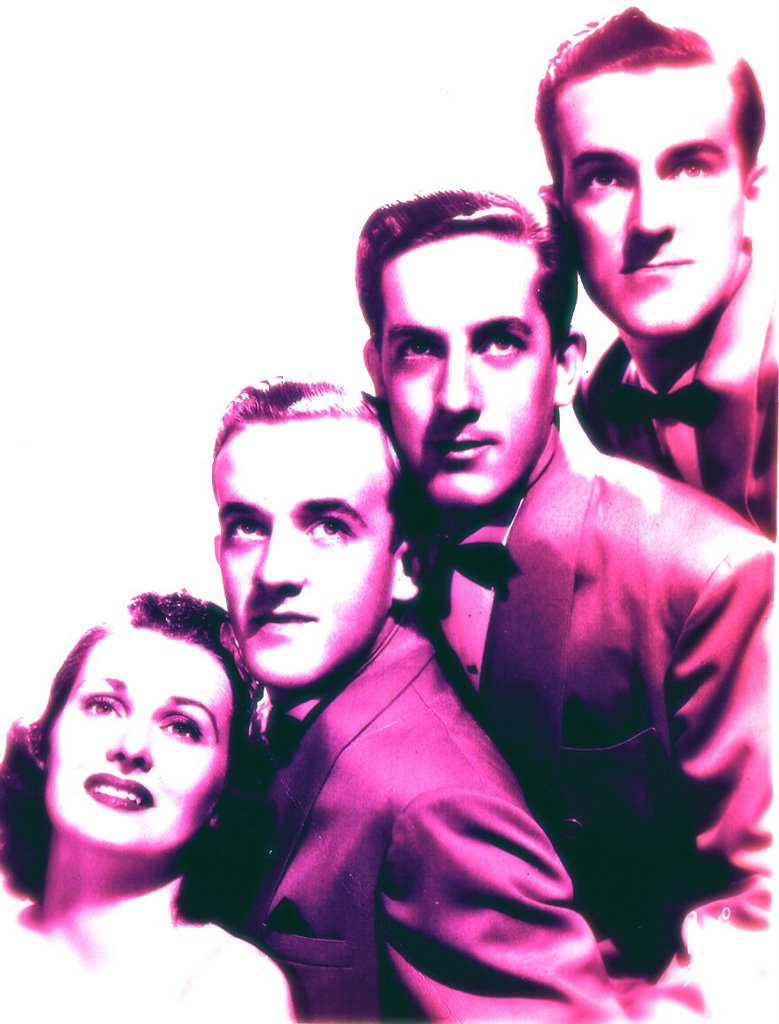
On This Day in 1949: At Quip’s End, Wireless Wit Calls It Quits

Well, I’ll probably laugh about it—eventually. Not a day in my life passes without mishaps, some major, some trivial, all vexing. Sure, I could blame it now on Montague, our new canine companion. After all, dogs are expected to be inept, to be indifferent to our technological comforts and headaches; but a few remaining bristles on that scouring brush called conscience go against the grain of my indolence and continue to tickle until I make a clean breast of it. The “it,” this time around, is a cordless phone plunged into the watery grave of a bathtub. The rest, as they say (in Hamlet) is silence.

I won’t be silent about the quietus of one of the great American radio comedians whose program left the air on this day, 26 June, in 1949. The comedian in question is Fred Allen, a mediocre juggler who discovered that playing with words attracted a larger audience. That is, until the quiz and giveaway craze of the late 1940s revealed the greed and idiocy of a public that was eager to leave radio behind for the promises of a few bucks, some gifts, and a little flickering picture in a box of tubes and wires.

Fred Allen was a satirist. Whereas Jack Benny relied on situational humor, Allen relished in timely wit. Benny got people to laugh by making a fool of himself on our behalf. His age, his musical shortcomings, his vanity and tightfistedness—they were as hilarious as they were endearing. Rival Allen, on the other hand, made fun of all and sundry. He was the court jester in the living room, sending up what got listeners down: New Deal bureaucracy, wartime rationing, postwar housing shortage—anything fit for banter in Allen’s Alley.

That Alley was Allen’s finest piece of airwaves architecture. It was just the airway to vent anger and open up debate. How unfortunate that, in his final months on the air, Allen stooped to driving around that lane—a broader and less angular Alley called Main Street—in a Ford vehicle, in keeping with the demands of his new sponsor and the greed rampant after years of sacrifice. It wasn’t television that ended Allen’s career, even though, as critics insisted, he had no face for it. That he had no voice for radio did not prevent him from excelling in that medium. It was commerce, plain and simple.

The sponsors kept giving him a tough time, demanding cuts or cutting him off. The giveaway programs cut him to the quick; he was smarting from the audience’s lack of loyalty. It was just a phase; but Allen, plagued by poor health, did not wait for it to end. On the final program, Portland Hoffa started things off “with a laugh” by telling a few intentionally corny jokes and supplying the laughter herself. “If I can keep up this pace, I’ll end up with my own program,” Hoffa declared. “The way radio is going, that is quite possible,” her husband retorted. It was Allen having the last laugh at the age of canned cheer. It was the gallows humor of a man at wit’s end.

There were jokes, too, about Milton Berle, the epitome of television humor, comedy that translated sharp lines into slips and gaffes, allusions into grimaces, and travesty into cross dressing. True, television could deliver verbal jokes—but it had to justify the image, however grainy or ghostly at first. An old vaudevillian who learned to tell jokes when his juggling hands failed to do the trick, Allen was not a lad of Berlesque. He made some attempts, as Alan Havig noted, but none succeeded, just as his film career had flopped while Benny and Hope stayed afloat.

On his last program, Allen confronted wit and humor by pairing fellow satirist Henry Morgan with humor triumphant—none other than Benny, the fall guy who would be back in the fall. Having overspent by buying into the installment plan scheme, Morgan, “flatter than something that has been stepped on,” is forced to go to a pawnshop. There, he is greeted by Benny, the broker, proudly showing off his cool, green vault and counting whatever money was coming his way. As it turns out, Benny was also the shyster whose loan got Morgan still deeper into his financial fix.

It paid to adjust, this final sketch suggested; and pinning your hopes on a medium that was being abandoned, as Allen put it in Treadmill to Oblivion, like the “bones at a barbecue” was no picnic. It’s no good to be good at something if it’s something the many no longer cares about. It’s the death sentence under the law of supply and demand. I know. I’ve been staring at that noose for years.

Old-time Radio Primer: H Stands for Hiatus

Well, how are you feeling today? According to one British study, 23 June is the happiest day of the year. Montague and I were perfectly content, playing and dozing in the garden and going for walks along the lane. Perhaps, the folks down in the nearby town of Aberystwyth were even happier last Tuesday, when they had several thousand pounds thrown at them on the street by a stranger who just wanted to “spread a little sunshine.”  Apparently, this local story had already travelled around the world (both my sister and my best friend in Germany had heard of it) before it came to my ears, which, no doubt, were too busy picking up the sounds of .

As grateful as I am for ready access and instant replay, recording technology can render our present-day listening quite unlike the experience of tuning in back then. It is difficult to get a sense of a weekly broadcasting schedule, of certain parts of the day being associated with particular programs, of the anticipation of their airing and the space such periodically scheduled events occupied in the minds of the audience in the interim.

To be sure, the middle of June would have been meant a rather prolonged wait for the next tune-in opportunity. It was during this month (rather than May, as on US television nowadays) that most of the crowd-pleasing drama series and comedy-variety shows went on their summer hiatus. Hiatus, from the Latin hiare, meaning “to yawn.”

As I suggested a while ago, the off-season in radio had initially been a response to technical difficulties of broadcasting during the long, bright days of the year. Now, a hiatus can be a precarious wait, which is why I’d never attempt one for broadcastellan. The question is: will the audience greet the news of your return with excitement, or a resounding yawn? That is, will your show go on even in its absence, circulating in the minds of the multitude? Not, perhaps, if your season finale is as disastrous as the second one of Desperate Housewives.

To be sure, broadcasters did not shut down the microphones and close the studios for the duration. Before resorting to reruns, which became customary in the 1950s, they scheduled replacement programs, some of which, like the Forecast series, were designed to test the potential of untried fare. It wasn’t all filler during those summer months. The Mercury Theater, for instance, was first heard in July 1938. Besides, a prestigious timeslot, one occupied by the Lux Radio Theatre demanded high-profile or at least adequate replacements. One of the most highly regarded programs to have its premiere during the summer was the thriller anthology Escape.

On this day, 23 June, in 1950, Escape offered the western melodrama “Sundown,” the “story of a boy who never owned anything . . . but a gun.” The cast was headed by Barton Yarborough, best remembered today for his portrayal of Texan daredevil Doc Long in Carlton E. Morse’s I Love a Mystery serial. Doc and his pals did not break for the summer; they kept audiences suspended, from one cliffhanger to the next. On the very day Yarborough was heard in “Sundown,” another Doc Long (played by Jim Boles) set out for a new adventure in “The Snake with the Diamond Eyes.”

There was time as well for summer schooling. On this day in 1957, Edward R. Murrow introduced the listeners of the CBS Radio Workshop to a word far more ominous than “hiatus,” precisely because it denotes a lingering presence:

A new word has been added to our ever increasing vocabulary.  It’s a small word, dressed in fear.  To pronounce, not very difficult.  To envision, staggering.  This scientific word may well become the most important in all languages and to all peoples. It is pronounced “fallout.” “Fallout.”  Rather a simple word to describe so much.  “Fallout.”  Radiation withheld by quantities of atmosphere that may eventually descend to pillage, burn, kill not only you and me, but the scores of generations unborn.  Quite a word, “fallout.”

Countering the politics of terror, Murrow suggested that this lexical novelty could also denote the harvest of knowledge, as “words, thoughts, ideas,” withheld in an “atmosphere of ignorance,” eventually descend on future generations. Perhaps, this intellectual fallout is rather too gradual and the radiation too slight. With atomic energy once again on the political agenda in Britain, and threats of nuclear warfare not quite a thing of the past, little seems to have been learned from past horrors.

I wish political leaders could be forced to go on hiatus to make room for summer replacements—especially since some of them seem as perverse as that ill-treated teenager in Escape, seeking retribution beyond reason in an atmosphere of fear and its inevitable fallout. To the restless mind, “hiatus” can mean “pause for thought.”

The Anarchy of Silence: Being Absent/Absent Being

Well, what does it suggest? My silence, I mean. Is it a sign of indifference or an exercise in difference? Does it bespeak failure or betoken activity elsewhere? Does it spell death, metaphoric or otherwise? Mind you, I have merely extended my customary weekend retreat from the blogosphere for a single day; and, such is the nature or curse of keeping a public journal—of being nobody to anyone—it may have gone virtually unnoticed. My absence, after all, is no more eloquent than your silence. It requires your presence to come into being.
The house is quiet once more. It resounds with absence. After a weekend of entertaining and sight-seeing, of silent film (with our house guest, Neil Brand, accompanying Buster Keaton’s Cops and The General at the local university’s Arts Center) and talks about radio drama in the still of a summer garden halfway up in the Welsh hills, I alone remained behind.

It is quiet, but never quite silent. There is the storm, rain lashing against the pane of the window, winds strong enough to make the walls of my room shiver. There were the shouts of “goal” on the television earlier today, as even I could not keep myself from having a peek at the World Cup goings-on. There were a few phone calls. There was a moment of reflection on the career of director Vincent The Damned Don’t Cry Sherman, who died last Sunday at the age of 99. And then there was my own voice, reading aloud the lines I have been writing. Yes, I have been writing.

As announced, I have begun anew to write a play. I decided upon a ghost story, a story of absence and presence—the very presence of absence. After looking at various scraps, jotted down ideas for radio plays, I kept in mind what I hinted at in my recent remarks about sound effects. I have used a problem in sound as the starting point for aural play. I won’t relate here and now just what the play is about, lest it should not come about after all if thus prematurely released. It will have to suffice that it features a disembodied voice, imagined sounds, and an improbable architecture. Echoes of that tower I mentioned previously.

In all this, the play is hardly experimental. It is a rather plain story; but one that insist on being told on the air, rather than any other medium. It aims at conveying a mood, at casting suspicion on the speakers, a shadow of doubt cast by the sounds and silence they make. Yes, they “make silence.” Too often we think of silence as being nothing, even though we insist on it being golden by virtue of its rarity. It is glorified as much as it is dreaded. It is a malevolent deity that renders us speechless by holding its tongue.

Now, in old-time radio, silence was anathema. It was not deemed golden enough to fill time on the air, time set aside to fill the coffers of the sponsors. It was dreaded, all right; but tunes and talk and sound effects trickery were let loose upon it to assure its sound defeat.

As Charles Addams suggests in the above visualization of the shrieks, shots, and thuds—the sound and the fury—of 1940s radio thrillers, silence was rarely called upon to make that difference, to speak of promises or signal impending doom. It was talked to death and yet survived in my favorite chapter of Carlton E. Morse’s “The Thing That Cries in the Night,” a noisy serial thriller that confronted a soldier of fortune with a silent and invisible adversary (which I discussed here at length)). If a speaker confronts an uncertain someone without getting a response, does the silence mean the certain absence of the addressee? Or is it a mark of the listener’s defiance? The anarchy of the unseen unheard!

I am hoping to create such uncertainties in my play—a mystery that depends to some degree on the listener’s picking up of a prominently dangled clew. If it goes unnoticed, the revelation might yield a moment of surprise; if it is perceived by the audience before the character in the play catches on, there may come into being a prolonged thrill of suspense. Radio is the very medium for such turns of the screw.

Old-time Radio Primer: G Stands for Gravel Box and Glass Crasher

Well, where to begin? Picture this, if you will. You decided to write a play that will never be seen; a play that will be imagined rather than staged; a play that will be taken in as sound alone. In short, something—some immaterial thing—that used to be called radio drama. Audio drama will suffice as a name for it, even though other, more grandiose terms have been suggested. Having studied the history of such performances for years, I might as well try my hands, my ears, and my mind at them. The question remains; where to begin?

This is what I am pondering as I sit here in the relative still of our garden, where life plays itself out in a display of colors, a cool breeze and the rays of the sun stroking my bare skin, and (to borrow from Tennyson) the air stirring to the “murmur of innumerable bees.” Now, audio plays can conjure any number of concrete images and intimate sensations; they may trigger memories of feelings—or desires for them—and thus bring them about. Audio drama. It is certainly not all sound.

Yet sound is the non-matter with which to do the conjuring. And to me, audio play has to be about sound and of sound, rather than a verbal exchange place, sequences of lines uttered and interrupted or augmented by non-verbal noise and moments of silence. I don’t hold with those critics who think of radio drama primarily as an oral medium. It is, more inclusively, aural.

Too often sounds have been relegated to the business of supporting a drama unfolding as dialogue or narration—of setting scenes, creating backdrops, or, at best, enhancing its atmosphere. The sounds of opening or closing doors, for instance, create the space in which characters are heard to move, as do those steps on rocks-strewn earth produced by sound(wo)man playing in the “gravel box.”

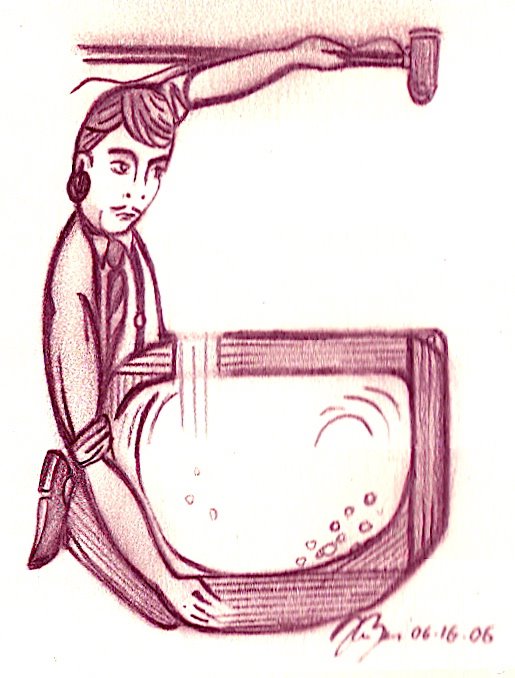
A gravel box, you see, is a container filled with pebbles, a box which used to simulate the ground on which the dramatis personae of the air were heard to tread. Are bodies immaterial without such sandbox sounds? Or does it suffice, after all, to rely on the voice box alone.

Then there are in radio dramatics those stirring noises of shots and sirens, crashing waves or smashed windows. There is the glass crasher, for example, which, as the name suggests, is a device used for creating the sound of breaking glass. G, in this entry in my old-time radio primer, does not stand for gadget or gimmick.

Sounds have a life beyond live support, beyond adding color or concrete markers of space, which merely enhance what is often already expressed in words: “Don’t you just love the ocean?” (biz: sound of waves); “Isn’t it romantic out here in under the stars?” (cue the crickets); “What are you pointing that gun at me for, you thug?” (insert shots here).

To appropriate another line of poetry (from Pope, this time), must sound seem an “echo to the sense”? Must it make sense? Must it be echoing something else? Does it always suggest a body, some certain corporeal entity responsible for such noise? Must sound be a relationship, a communicating passageway between one hearing and one sounding, traceable to an originating source which gives it meaning, as footsteps getting louder might mean “danger” if tracked down to the body of an approaching adversary or “the promise of pleasure” if traced to the form of a lover?

In other word, is sound an echo of the reverberating body producing it? The question, to be sure, is older than the wireless; it is as ancient as the atmosphere and the dark of night begetting such thoughts. Consider this exchange from Thomas Love Peacock’s Nightmare Abbey (1818), which investigates the relationship between (re)sonance and reception, between sounding and sounding out:

“Nonsense, sir,” interrupted Mr. Glowry. “That is not at all like the sound I heard.” 

“But, sir,” said Scythrop, “a key-hole may be so constructed as to act like an acoustic tube, and an acoustic tube, sir, will modify sound in a very remarkable manner. Consider the construction of the ear, and the nature and causes of sound. The external part of the ear is a cartilaginous funnel.” 

“It wo’n’t do, Scythrop. There is a girl concealed in this tower, and find her I will.”

Should I lead the ear to that concealed someone? Or will my play be all architecture, tower and bells, without a body in sight? We shall hear . . .

More Milestone Reflections; or, Quo Vadis, broadcastellan?

Well, I have been away taking pictures. Taking pictures away, to be precise. It was an entirely manual engagement with the arts, involving nothing more than hauling some large canvasses—paintings by the late British artist David Tinker—for an upcoming exhibition. The things we do for a meal and a daytrip to a place where sheep are outnumbered by people (in this case, Cardiff). It so happens that the artist’s widow is Tracy Spottiswoode, who writes for television and radio. She is currently working on a radio play for the BBC, based on a story related to her by her father. It is an incident in the life of Hollywood actor Robert Vaughn, who found himself caught up in the turmoil of the Prague Spring while filming on location in Czechoslovakia, anno 1968. Considering that another successful radio writer, silent film music composer Neil Brand (last seen on UK television in Paul Merton’s Silent Clowns series, which concludes today with a portrait of Harold Lloyd) is coming to visit this weekend, I decided to give writing for the medium another try and return to my own audiodramatic tinkerings (first and last hinted at here).

I have written much about radio, but never for it. And since this 200th entry into my journal marks another milestone (the last one having been contemplated here) it is a convenient moment to reflect on my writings, their uses and purposes. “Quo Vadis” is meant here as a way of mapping out a way, of asking myself what to do next with and within this forum, another opportunity of looking back, listening ahead, and saying thanks to all those who have been reading and commenting over the past five months. Writing in such a marginalized field—and writing in such a marginalizing style about it—can be a rather lonely pursuit.

Perhaps I am craving a larger audience than I am enjoying here; but writing an audio play (for the first time since high school) is merely another creative response to my ongoing engagement with radio. And, if the lacking response to Larry Gelbart’s recent radio satire “Abrogate” (as discussed here) is any indication, there may not be a large audience—or a large vocal one—for such writing either.

That said, there will be less of me, here, in the next few weeks, weeks that will involve gathering new impressions elsewhere, in London and New York City. As you may recall, when last I was in New York, I very nearly went out of my mind going in search of a wireless network to post my writings—not the kind of part in the theater of the mind I had in mine.

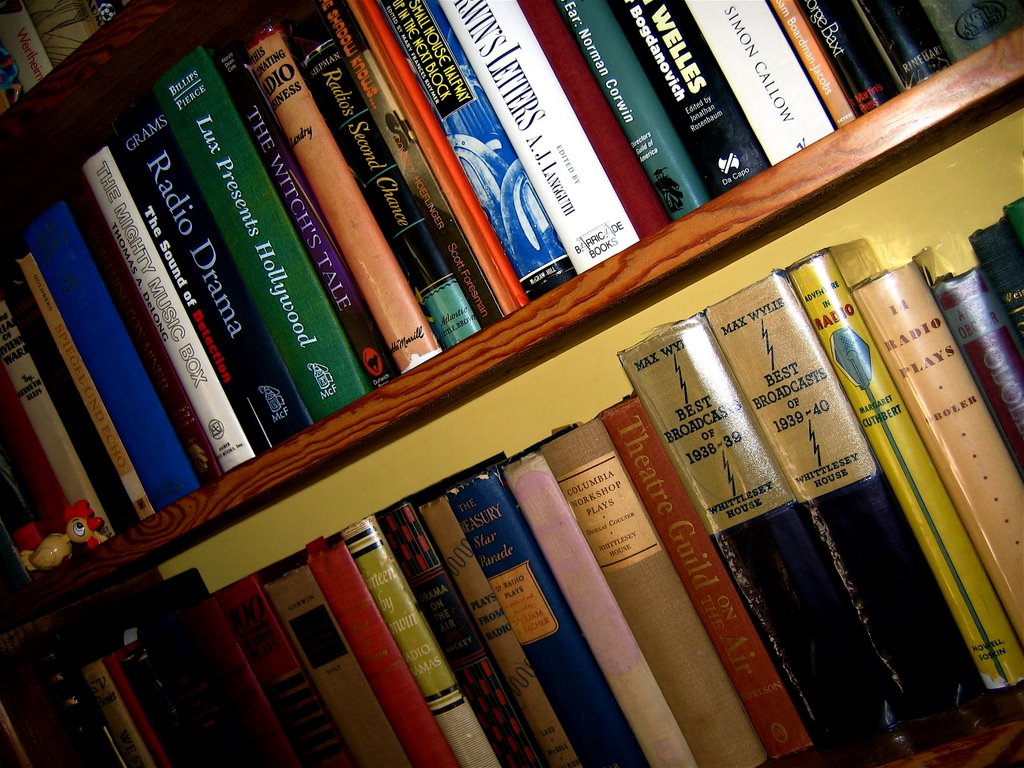
The recent acquisitions you will find on my bookshelf (including Arch Oboler’s Fourteen Radio Plays, Abbot’s Handbook of Broadcasting, and Wylie’s 1938/39 and 1939/40 Best Broadcasts, all pictured above) provide models and instructions for the wireless tyro. Today’s writers can learn a lot from the old practitioners, restraint as they were by commercial ties. Radio plays can be talky and tiresome, so intellectual as to become insipid. A healthy dose of melodrama and a helping of sound effects sure liven things up. At least, I hope they will in my efforts at soundstaging. I might exhibit some of my experiments in radio writing on my podcast site.

So, if you enjoy plays for the ear—or derive pleasure hearing about someone struggling to give prospective listeners an earful—you might find my forthcoming discussions about aural storytelling and sound effects of some interest. Please stay tuned . . .

Leaving His Ears Behind, E. M. Forster Steps Inside a Distant Echo Chamber of the Marabar Caves

Well, I wonder whether they will get here tonight. The troupe of the Johannesburg Market Theatre, I mean. Two weeks ago, they were supposed to take me to The Island; instead, they seemed to have gotten stranded somewhere else. I am all set to go, notwithstanding a lingering headache, brought on by alcohol and technology. As sobering as the experience might have been, I succeeded at last in putting my third podcast online. It conjures up the voices of a number of silent screen actresses; among them Mary Pickford, whose Little Annie Rooney was flickering on our screen this weekend, along with a 1924 production of Peter Pan, featuring the aforementioned Anna May Wong as Tiger Lily.

Both of these films are adaptations; but, whether you are familiar with the original or not, they are engrossingly cinematic so as to draw you in rather than draw your attention to their second-handedness. To me, an adaptation succeeds if it manages to make me forget its lineage, at least upon first inspection. I prefer to take in first and take on thereafter, to give a re-production a chance to stand on its own without forcing it to stand up against a text from which it more or less freely borrows.

Now, so-called old-time radio drama depended even more heavily on borrowed material than the movies. With schedules to be filled for weeks on end, there was great demand for stories, but a relatively short supply. Storytellers were, by and large, not paid enough to be original; given the governing principle of commercial sponsorship and the broadcasters’ insistence on groping for the largest audience possible, radio writers were discouraged from attempting anything new. In fact, they were even conservative in their approach to adaptation.

On this day, 12 June, in 1949, the NBC University Theater presented its version of E. M. Forster’s A Passage to India. Intent on proving its literary fidelity, a little passage was cut right through this play. And out walked none other than E. M. Forster himself. The dramatization, as one critic remarked, bore so little resemblance to the novel as to have “missed the boat completely”; as such, it was as much in need of an endorsement as it was unworthy of it. Yet, the listener might feel tempted to conclude, if Forster did not mind lending his ear and commenting on the play, it surely could not be quite as “cumulatively degrading to all concerned—author, producer, and audience” as the captious critic made it out to be.

In fact, however, Forster did not comment on the adaptation at all; he did not even mention it. Instead, he gave a brief lecture on his novel and its significance—a lecture that was taped and inserted into a performance he had not himself auditioned. Remarking on the partition and independence of India and Pakistan, Forster expressed himself “thankful” that his novel was “out of date.” Listeners to the University Theater might not have noticed at all, considering that there was so little left of the debate with which Forster’s novel is concerned.

Entirely squandered in this uninspired adaptation are the aural potentialities of the Marabar Caves. Unlike film, radio drama is not obliged to impose concrete images on a writer’s vision. Like the novel, it allows its audience to co-create those images or to resist them in order to realize the metaphorical potentialities of language.

The caves are such a metaphor; they are an echo chamber for a clash of cultures, the site of cultural blindness where the false shelter of ignorance caves in on itself. Without resorting to much sound effects trickery, the radio adaptation could have suggested the horrors of Marabar—the reverberation of one’s own voice drowning out all others in a choric recital of an ode to blindness.

Old-time Radio Primer: F Stands for Free

The dictionaries only manage to define it by telling us what it is not. It is such a troublesome little word, yet so attractive. “Free,” I mean. It has a lot to do with commercial broadcasting—the wireless with strings attached—which is why I am taking the liberty to include it in my old-time radio primer.  The state of being “free” is generally thought of as the absence of some restricting force or entity. However positive, it is a want we are wont to capture by negation. You are free to skip this line, by the way, unless, of course, you are somehow compelled to read on. Am I encroaching on your liberties by subjecting you to yet another sentence, by sentencing you to yet another subject? Go on, it is complimentary. And considering that wars are being fought over it, it is hardly a matter of no matter.

“Free” is so overused, misused and corrupted a lexical commodity that you have every reason to grow suspicious of anything offered on such terms—particularly that tautological fallacy of the “free gift” (with every purchase, no less). Eventually, you begin to wonder whether a word that only exists as an opposite, and exists only to be turned into that opposite, has any meaning at all.

If being free is the sensation of doing or being without, then freedom might very well be poverty, deprivation, and thraldom. Even if it is understood to mean doing or being without something on your own accord, you might want to take a moment of your spare time to consider how did you arrive at that accord, that agreement, without being under some forceful influence, and thus not free?

Here is the obligatory verse. It, too, is free this time:

“Free” is what looks good . . .
because you like the sound of it.
“Free” is what tastes good . . .
even if it smells funny.
“Free” is what feels good . . .
although it makes no sense at all.

In America, radio was being touted as a purveyor of gratis entertainment. And gratis deserves gratitude. You didn’t have to drop a nickel into the machine for every song or program you wanted to hear, even though the machine itself was no mean crystal set, but one of those expensive new console models that looked so nice in the advertisement and, the salesperson said, would fit so well into your living room. After all, you wouldn’t want to look cheap when handing out treats to your important dinner guests (the business kind, who could do something for you).

How comforting the thought that the entertainment at least was being paid for by someone who was also charitable enough to take care of all those who toiled and performed for your amusement over at the broadcasting studio, those big and expensive-looking facilities like the ones over at Radio City, which you’d love to visit some day, if only you had enough time or money for a trip to New York.

No need to get sarcastic. You are under no obligation to tune in tomorrow, as the announcer keeps insisting, although you sure would like to know whether Superman, “bombarded by livid bolts of atomic energy, and buried now for almost an hour,” will manage to save Metropolis or whether that “girl from a mining town in the West” can really “find happiness as the wife of a wealthy and titled Englishman”—especially now that she was being threatened by Lord Henry’s evil twin. Yes, you could turn it off. The freedom of it!

Sure, they’ve all got something to sell. That’s nothing, if hours of carefree listening can be had for just that—nothing. That’s why Jack Benny could make you laugh on the Lucky Strike Program last night and Nelson Eddy sang for you and the Chase and Sanborn people (the thought of which reminds you to get coffee at the market tomorrow—and to make it Sanka, just to show them)! It’s a free market.

So what if those who offered this free service really took it from you in the first place and used it for their own purposes! So what if they expected a little something—or rather a lot—in return for taking over the airwaves you quite forgot were free. You could always write a letter and complain, if it got out of hand. That was your right, as a taxpayer.

Perhaps we ought to remove the word from our vocabulary. It seems so much easier than striving for something so elusive. Feel free to differ.

On This Day in 1936: Silent Vamp Talks of Revamping

Well, it can be cruel. It can be tempting and frustrating. It may be doing something for you—but it can also be your undoing. And just when you think you’ve caught up with and mastered it, it dashes off and kicks the dust of your futile endeavours straight into your bloodshot eyes. Technology, I mean—the vamp that demands constant revamping. As a blogger and tyro podcaster, I am not sure whether I reproduce myself by means of technology or whether I am myself the product of technology. These perhaps overly binary reflections were brought on, at least, by an encounter with Elbot (whose wit, I learned today, is inspired in part by an episode of the old-time radio thriller anthology Quiet Please). Apparently, even a supposedly outmoded medium like radio can continue to be regenerative. A consummate tease, radio enjoys being turned on by receptive minds.

Rather counting on that garrulous generatrix was Theda Bara, cinema’s original vamp, who, on this day, 8 June, in 1936, was media savvy enough to grab a microphone and announced to the world (or some western region of it) that she was back in business. Oh, but how that business had changed since the queen of silent melodrama last tempted audiences, anno 1926.

In Hollywood, a ten-year hiatus is a one-way ticket to oblivion. And when your metier is quite dead, a comeback is just about out of the question. Bara was nonetheless asking for a return engagement. She could count on an audience of millions—the “public” she was in hopes of recapturing—when she stepped inside the Lux Radio Theatre for a chat with motion picture director W. S. Van Dyke. “Woody” Van Dyke admitted to having “admired” Bara “from afar when she was doing such magnificent spectacles as Cleopatra” and he was “just an extra.” Considering that Van Dyke had the voice of a gruff senior, that must have sounded a lifetime ago even then.

Reminiscing about that role, Bara talked of the challenges of silent moviemaking. Yes, Hollywood entertainment had “developed amazingly” since Cleopatra was released in 1917; but film is an actor’s medium, and dedicated performers like herself could do and did much to turn nickelodeon thrills into cinematic art. Preparing for that role, Bara claimed to have worked for months with a curator of Egyptology at the Metropolitan Museum in New York City. Now that silent movies were treated like the ancient history she once studied, it may have been too late to excavate her own career.

Her bold announcement that she was “going to do some motion picture work” was followed by a more tentative explanation: “I am considering an offer now, running through scripts and ideas. Oh, I just hope everyone will be as happy about another Theda Bara picture as I am. The public has been very good to me in the past.” The public—good, bad or indifferent—never heard her emote on the screen thereafter.

Ms. Bara, as you may hear in my next podcast, had a charming voice, quite capable of delivering lines of sophisticated comedy. She would have done well on the air, even as the lines in her face might have argued against her reappearance in sizeable movie roles. Perhaps, producers were not willing to see the vamp in any other way. When confronted by the narrow minds of big business, dazzling technology has the tendency to turn into a mute siren. She isn’t tamed, mind you. She is just not turned on by the calculating kind.

On This Day in 1955: After Twenty Years of Pushing Stars and Peddling Soap, a Hollywood Institution Closes Down

Well, I have no knack for it. Storytelling, that is. Not that I haven’t dabbled in fiction and drama—everything from attempting that great American novel (a Germanic variation, mind you) to co-authoring a college soap opera for public access television. I even wrote my memoirs, at age sixteen, and passed them around to my classmates so that they might have something sensational to read. Teenage angst notwithstanding, I was fairly certain that my story wasn’t finished; and I didn’t bother pretending it had a beginning I could recall, a middle I could make sense of, or an end I could foresee.

When it comes to connecting loose strands of thoughts to form something amounting to a composition, the essay is my yarn of choice. I guess I find it easier to write about or around something than getting around to writing something worth writing home about.

Making sense is as satisfying a creative activity as it is problematic. Just when you have put it all in a nutshell (granted, a cocoanut shell, given my prolixity), you should force yourself to go nuts and smash it all to pieces again. It is the only way to find out whether you have been rather too proud of the husk at the expense of ensuring the proper development of the kernel.

I doubt that I could take on the challenge of rendering the essence of someone else’s life, for instance. I would be too conscious of the act of imposing a structure, of connecting the dots and erasing others for the sake of providing a clear picture. After all, a dotted line with a beginning, middle, and end is an Aristotelian construction that, the blogging phenomenon notwithstanding, most of us still expect in a written composition. It is a dotted line on a contract between reader, writer, and subject I can’t bring myself to sign.

All this occurred to me again last night, when I watched the television premiere of Stan, a biographical drama about the friendship of comedy stars Stan Laurel and Oliver Hardy. In one hour, Stan creates a double portrait and sums up the relationship between its two sitters. Indeed, even the sitters are doubled—Stan and Ollie at the end of their lives looking back at the beginning and height of their career in film. I am looking forward to discussing the challenges of writing such a piece with its author, Neil Brand, who will be our houseguest next weekend. Perhaps, there’ll be an essay in that.

In the meantime, this is getting rather too long as an exposition to what I wanted to relate in the first place. Something about soap, and stars, and radio, the hook of which is the anniversary of the closing of a great Hollywood institution on this day, 7 June, in 1955. The institution in question was the Lux Radio Theatre, a highly popular program featuring adaptations from stage and screen as performed by practically all the great actors of the studio era.

Now, historical facts are not particularly interesting to me. You can always look those up, as I did this morning. To reproduce them is no great feat, unless you also question their veracity or ponder their significance. There is not enough storage space in my cranium to squander it on trivia. Besides, there’s a fine reference text on the subject by Connie Billips and Arthur Pierce, called Lux Presents Hollywood, which I frequently consult.

To me, the most fascinating aspect of the Lux program is its design, which is rather too intricate to be called a three-act drama interspersed with toilet soap commercials. The Lux Radio Theatre, which was my introduction to , is not so much a dramatic program as it is a theatrical one. Instead of attempting dramatic realism, it created the illusion of putting on a show. It celebrated its own composition, which brought together the diverging strands of promoting Hollywood and pushing soap, of packaging its familiar (if at times unrecognizable) stories with bits of backstage talk that gave listeners the impression of being theater insiders, of acting as creators and patrons of a show, rather than simply being its audience. After all, something more than sitting at home enjoying free entertainment was expected of them.

The masters of ceremony (most notably among them Cecil B. DeMille) reminded listeners that their loyalty to the sponsor’s product kept it going. The stars, who promoted themselves as well as the studios that employed them, came across as working citizens rather than distant idols. They, too, used that soap, or at least claimed as much when they delivered the sales talk. Sometime, as the host did not hesitate to point out to the home audience, they were even spotted in the crowd of the Music Box Theater, from where the broadcasts originated.

It all sounds like a friendly family business; in fact, DeMille was practically born into the job of hawking the wares of Lord and Lady Leverhulme (the show’s sponsors, pictured above), considering that, as he pointed out to the listener, the motto on his family crest was “Lux Tua Vita Mea.”

Now there’s a story of British industry and American showmanship, a success story not unlike the fortuitous if complicated Hollywood teaming of Englishman Stan Laurel with that big guy from Georgia. I won’t be telling it, though. I am too busy weaving the voices heard on the Lux into another podcast, this one featuring Marilyn Monroe’s 1947 broadcasting debut as an “intermission guest” on Lux—before the young starlet had even been cast in a single motion picture. Three-and-a-half decades later, such a commercial association did wonders for the career of Michelle Pfeiffer, who made a name for herself peddling the aforementioned soap in the early 1980s by creating the illusion that she already was a big name in Hollywood.

Our lives are compositions co-authored by a great many people, which is why some of us are so eager to assume control over this muddle of influences by turning it into our very own story. It’s the victory of the elaborate shell over the elusive kernel.

On This Day in 1938: New York Planetarium Sends Astrologer on an Interplanetary Mission of Peace

Selena Royle

Well, they should all be out tonight. The stars, I mean. One of the great joys of living in the country is seeing millions of them lighting up the sky. On a clear night, you can read by the light of the moon. I grew up in an industrial and smog-shrouded region of western Germany; and when I moved to brightly lit New York City, I got to see no more than a dozen of those distant suns, even on a cloudless night. As if to make up for that firmamental deficiency of our modern world, the Hayden Planetarium in Manhattan once offered Americans an opportunity to commune with the universe by taking a microphone to the heavenly bodies.

On this day, 6 June, in 1938, the planetarium was the site of a dramatic radio broadcast of The Planets, a verse play inspired by the Gustav Holst’s popular orchestral suite and written especially for the medium by New York City poet Alfred Kreymborg. Soundstaged in the planetarium’s Solar Room and broadcast over WEAF and affiliated NBC stations, The Planets was performed by seasoned New York stage actors with experience in radio theatricals, including Charles Webster, Burford Hampden, and Selena Royle (pictured above, all dressed up for an earlier radio play, The Finger of Darkness).

Unfortunately, no recordings of this impressive event seem to have survived; and, as much as I argued against such readings only yesterday, I am left with nothing but the publish script, some cues and an on-the-air-conditioned imagination, to gather how it might have sounded.

Kreymborg took to the airwaves because, as he put it, the “world we live in now is so closely knit that a sudden event touches all people, no matter how far removed from one another. Our local or personal spheres have become universal.” The impending war in Europe was such an “event” touching all—and radio was the medium to bring faraway crises into the living rooms of America. The allegory of The Planets, according to its author,

concerns the earth from the World War up to now [that is, 1938] and then tomorrow. An old astrologer, pointing his glass toward the heavens searching for peace somewhere, is the central figure. In the course of his starry adventure he encounters the planetary gods, roaming the earth as in Grecian times: Mars, Venus, Mercury, Jupiter, Saturn, Uranus, Neptune.

The gods represent the stages of world political events from 1931 to 1938, with Uranus, the father of magic, standing for the global crises of the years just prior to the Second World War. As the earth spins from one age of war to another, the astrologer attempts to dissuade soldiers from going into combat, but dies prophesying “[a]nother hell”

Far greater than the hells of yesteryear,
And greater than the hells of ancient time
When gods laid heaven low and men fought men.

The play, which one contemporary reviewer dismissed as a “diatribe against war,” proved prophetic in this regard; but its author was less of a visionary in his hopes that the theater of the mind might some day attract noted poets and mature into an art akin to the drama of ancient Greece.

“We have all been too impatient with radio in the past,” Kreymborg remarked, “and have based our judgment on the very worst things we could listen to.” Today, we base our judgment of old-time radio on the average thriller and sitcom, rather than on the occasional experiments that, however flawed, suggest what the aural arts might have been or may yet become.

Unless we are content to dig in the muck of culture or delve into the mire of war, it might be worth our while to keep reaching for the stars . . .