On This Day in 1942: The Wannsee Konferenz Maps Out the Final Solution

An engagement with old-time radio need not be an escape from the world; it can be a return to the very realities we may have been desirous to avoid or void altogether. Listening to recordings of historical broadcasts can become a confrontation with the past, its representation, and, in the act of relating, with the present itself. Today, for instance, marks the anniversary of the Wannsee Conference at which, on 20 January 1942, the fate of eleven million European Jews was being debated and decided upon with the matter-of-factness and statistical precision known as the “final solution” (the minutes of which genocidal get-together can be found here). Few radio playwrights were as committed to representing the Jewish experience as Morton Wishengrad, whose 1942 play “The Battle of the Warsaw Ghetto” is as chilling and relentless as the calculated cruelty of the master(race)minding behind the massacre on which it comments.

Wishengrad, a prolific and politically engaged playwright whom noted radio actor Joseph Julian once called the only writer beside Corwin to have created a “body of radio literature that deserves a perennial life,” lets the record speak for itself in his chilling echo of fascist calculating and cataloguing—of a nation’s counting, counting down, and accounting of murder millionfold. In “The Battle of the Warsaw Ghetto,” first heard on NBC on the eve of Yom Kippur in 1943, the personal story of a holocaust victim, related from the grave, is reinforced by the sound of “black trucks” rolling out of the Ghetto to the concentration camps, by the three voices of fate (the three fates?) calling up the facts with a statistical precision that echoes the calculated ruthlessness of the acts planned and committed:

VOICE I. July 22, 1942.
VOICE II. Six thousand two hundred and eighty-nine.
VOICE III. Destination . . . Tremblinka.
VOICE I. July 23rd.
VOICE II. Seven thousand eight hundred and twenty.
VOICE III. Destination . . . Oswiantzem.
VOICE I. July 24th.
VOICE II. Seven thousand four hundred and forty-four.
VOICE III. Destination . . . Belzec. 

(Biz: Voices and truck sounds hold under narrator.) 

NARRATOR. Done with method, precise, efficient, recorded.  To Tremblinka, Oswiantzem, Belzec, Sobibor, Majdany—a lethal gas chamber, an electric furnace, a poison pit, an execution field, a cemetery.  And add also ten thousand brave, hopeless, tragic men who seized sticks and stones and knives and bare fists and charged the tanks and tried to halt the trucks.  Add their bodies to the list for the ten days of June, 1942. Make your total and then add two precise, methodical, documented months in August and September, 1942.  Reckon it.  Do it carefully.  You cannot do it on your fingers.  No! Let me give you the sum.  Listen, 275,954 fewer bread cards in the Ghetto! Swift, accurate, final.  Quicker than typhus, surer than hunger.

The records of the Wannsee Konferenz became instrumental in the gathering of evidence for the Nuremberg Nazi trials, another somber occasion dramatized on 16 October 1946 by playwright Arnold Perl, whose docudrama “The Empty Noose” suggested that, while the masterminds of the Third Reich had been hanged, the thoughts behind their actions were still very much alive, both in America and abroad. The regularly scheduled whodunit The Adventures of Ellery Queen was not heard that night.

“The medium needs writers who have something to say about the culture,” Wishengrad remarked in his foreword to The Eternal Light, an anthology of scripts from the series. Old-time radio drama also deserves listeners who take in and respond with their ears and minds open.

On This Day in 1942: Bette Davis Gives Birth to Arch Oboler’s “American”

The retrograde activity of keeping up with the out-of-date seems generally ill-suited to blogging. I doubt whether to keep looking back—and looking forward to doing so as I do—is such a forward-looking thing to do. A blog signifies little to most readers if it cannot bring them up-to-date on its declared subject matter, be it popular culture, politics, or fly-fishing. I have often felt compelled—and more often been compelled by others—to defend my engagement with the outmoded; indeed, the first comment left for me in the Blog Explosion directory was a terse “why?”

The answer, if I felt obliged to dignify such a monosyllabic and misologic remark with a reply, is this: I enjoy the challenge of discovering the relevance of a cultural artefact or an obscure piece of writing not created with me or my present in mind, and debating to what degree my thinking and being might be indebted to the attitudes reflected in such products. Besides, not being able to relate or connect to the supposed bygone is a personal loss, and, given the potential of history repeating itself, often a dangerous one at that.

Now, it would require some degree of mental obduracy or lack of imagination not to be able to relate to “An American Is Born,” a play that aired on US radio on this day, 19 January, in 1942. After all, “An American Is Born” deals with persecution and immigration in wartime, which makes it eminently topical. It is also a deliberate and unabashed work of propaganda, composed at a time when the word did not yet carry quite as negative a connotation as is attached to it these days.

Just how accepting would today’s audiences be of a play like “An American Is Born”? How likely would they find it produced and disseminated by the mass media?

“An American Is Born” was adapted by radio playwright Arch Oboler from a novella by Peter Jefferson Packer and Fanya Lawrence Foss. Written when the US had not yet entered World War II, and first sound-staged in late 1940 with Elisabeth Bergner in the lead, it was again produced a little over a year later for the Cavalcade of America program, with Bette Davis heading the cast. Clearly, this “American” was reborn to be recruited for home front duty.

In the 1942 production, Davis, who was one of Oboler’s favorite leading ladies, played opposite the versatile radio actor Raymond Edward Johnson. Johnson and Davis took on the roles of Czech immigrants Karl Kroft and his pregnant wife Marta. Their US visa having expired, the young couple cross the border to Mexico, where they wait for their quota numbers to come up. “With the left foot first,” Marta insists as they touch Mexican soil. “That means we’ll be back soon.”

Marta, whose father fought for democracy in her native Prague, desires nothing more than for her child to “be an American from his first cry.” In a “world gone mad with the ravings of little men, he should be born in a country that remains sane and firm. A country that believes that man, as an individual, has certain inalienable rights.”

Initially as idealistic and hopeful as the speech Oboler puts in her mouth, Marta is confident that their stay will only last a few days; but she is soon undeceived about the process of immigration. For those waiting, the weeks and months across the border are filled with uncertainties, threatened by corruption, extortion, and political persecution.

When a fellow European offers to assist the young couple, Marta little suspects that he is a member of the Gestapo. She is unaware as well that her openness about her father’s political convictions endangers the lives of her parent and her unborn child.

Another immigrant who is thus intimidated commits suicide, but not before doing away with the enemy in their midst. At the risk of her own life and that of her unborn child, Marta manages to convince Karl to make a run for it. As the title suggests, the two find their way across the border to the US, where their child takes the first breath of freedom as an American citizen.

When was it that such an overtly propagandistic melodrama last reached a large American audience? The 1991 movie adaptation of the Reagan-era bestseller Not Without My Daughter comes to mind, a film in which even a Coca-Cola sign in a Turkish bordertown was greeted as a herald of US American freedom. Seeing it as an international student living in New York City, I thought the film distressingly simplistic, shamelessly manipulative and, in the context of the Gulf War, rather nauseating at the time.

Are narratives like “An American Is Born” rarer now because Americans have less to be proud of as a nation or because today’s purveyors of popular culture, with an international market in mind, doubt that the brand of one-message-suits-all patriotism can still reach a sizeable enough audience to make it pay off.

US network radio did much to hold a nation together, both during the Depression and the Second World War. I suspect, especially on the subject of immigration, this is no longer a role the media are ready, willing, or even able to play.

On This Day in 1942: Death Upsets the Pudding Trade

Only a few days ago I commemorated my 100th entry into the broadcastellan journal by going in search of fellow old-time radio bloggers. Not a week later, the subject has become considerably more prominent among bloggers with an entire classroom of neophytes posting their thoughts on radio’s “imagined community” and reviewing individual programs selected by their instructor. It remains to be seen whether the thought-sharing extends beyond the virtual college annex, or just how long the on-air engagement with “yesterday’s internet” (as Gerald Nachman called the radio) will last. “Tired of the everyday routine? Ever dream of a life of romantic adventure? Want to get away from it all?” Just hop over to technorati and type in “Three Skeleton Key,” the title of the first radio play on the group’s listening list.

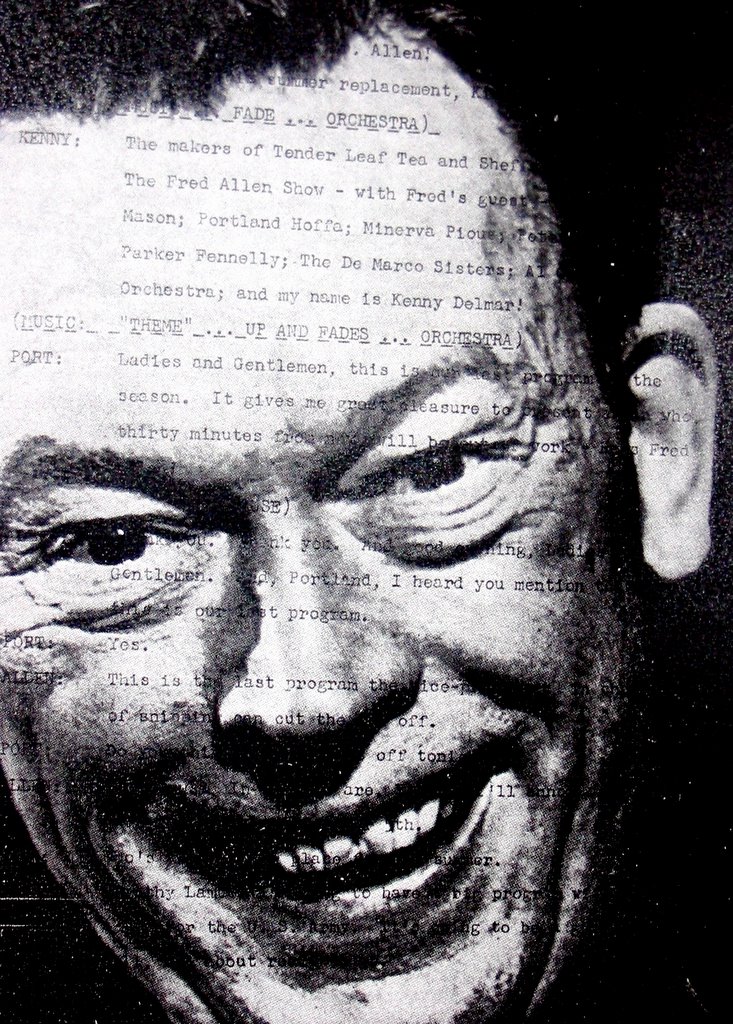
Speaking of “everyday routine,” it was hardly business as usual on Jack Benny’s Jell-O program on this day, 18 January, in 1942. “Jack Benny will not be with us tonight,” announcer Don Wilson informed those tuning in for some fun and laughter. Instead, the half-hour was filled with song and band music, with the reassurance that Jack would be back on the following Sunday to entertain America. Was the beloved comedian out sick, as he would be for five weeks in 1943, when George Burns and Orson Welles guest-hosted the show?

No, it was the violent death of glamorous, 33-year old motion picture actress Carole Lombard, Benny’s co-star in the Lubitsch comedy To Be or Not to Be, then in post-production. Lombard’s death on 16 January—and Benny’s cancellation of his scheduled performance two days later—were solemn reminders how the war, into which the US had just entered in December, would alter the everyday lives of all Americans, service(wo)men, celebrities, and civilians alike. The Academy Award-nominated actress had been returning from a War Bond Drive in Indianapolis when her plane crashed and killed all passengers on board. For her contribution to the war effort, Lombard was later awarded the Presidential Medal of Freedom.

To be sure, there were no references to Lombard’s death during the 18 January broadcast, news unlikely to have a favorable impact on the sale of gelatine puddings, the manufacturers of which sponsored the popular program. On the following Sunday, Benny’s writers even found humor in dealing with the comedian’s fictive car crash.

For one night, though, Benny’s conspicuous absence spoke volumes louder than this speech in Hamlet, the play from which Lombard’s last movie borrowed its title and which presented the miser from Waukegan in a preposterous impersonation of the miserable prince (pictured above). Asked to explain just what “seems” to be the matter with him, Hamlet replies:

‘Tis not alone my inky cloak, [. . .],
Nor customary suits of solemn black,
Nor windy suspiration of forced breath,
No, not the fruitful river in the eye,
Nor the dejected haviour of the visage,
Together with all forms, moods, shows of grief
That can denote me truly. These indeed “seem,”
For they are actions that a man might play;
But I have that within which passeth show—
These but the trappings and the suits of woe.

Comedy can do only so much to combat grief, solemn speeches so little to capture it. Beyond the domain of the airwaves, the rest is silence.

On This Day in 1948: James M. Cain Authenticates a “Lovely Counterfeit”

Well, I’ve done my darndest here to spread the word about old-time radio. Before it became “old-time,” radio did this rather more effectively, of course; spreading the word, about itself that is. It had professional announcers who could make you buy, or at least desire, most anything, from a can of soup to a slice of soap opera. Sure, not everyone fell for the hyperboles of the air, especially when they fell on the deaf ears of journalists who made a living trashing the American pastime of listening to romantic serials, aural funnies, and gory thrillers; if they did not ignore radio drama altogether, as they do nowadays, the peddlers of the printed word tended to denounce and deride as gleefully and excessively as radio announced and applauded itself.

Unlike the feud between radio comedians Fred Allen and Jack Benny, this was an all too real confrontation. If listening to the radio continued to be a pleasure, it was increasingly thought of as a guilty one, much to the displeasure of the sponsors.

One way of countering the attacks of the press, of assuring listeners that radio drama was perfectly respectable, middle-class fare, was to drag noted authors before the microphone, especially when their works were being adapted for the broadcast medium. When Howard Koch’s dramatization of Rebecca opened the Campbell Playhouse on 9 December 1938—thus predating the premiere of Hitchcock’s film adaptation by well over a year—the legitimacy of the production was underscored by producer-host Orson Welles’s transatlantic telephone conversation with Daphne du Maurier.

Five months later (5 May 1939), when the Campbell Playhouse presented Wickford Point, author J. P. Marquand was also on hand to add prestige to the production. And when Edna Ferber was heard in the 31 March 1939 broadcast of Show Boat, she not only appeared for a curtain call, but joined the stock company of the Campbell Playhouse to play the role of Parthy in a non-musical adaptation of her 1926 bestseller.

Of course, such cross-promotions, which were likely to benefit authors and publishers even more than broadcasters, were no guarantors of excellence or authenticity. Agatha Christie’s previously discussed sanctioning of The Adventures of Hercule Poirot (22 February 1945) could hardly have deceived anyone about the spurious parentage of this anonymously penned and not surprisingly short-lived series. Christie spoke with dignity and authority, but could lend none to the production.

Quite the reverse can be said about the Suspense production of Love’s Lovely Counterfeit and its endorsement by author James M. Cain, heard over the US network CBS on this day, 17 January, in 1948. The play, headed by James Cagney and introduced by Robert Montgomery (who also read an excerpt from the novel, was the real thing: not mere dramatic snipped, but an hourlong presentation that could do justice to Cain’s short novel.

Its author, however, was little of help when asked to address the public: “briefly, I thought it was excellent.” In a rather unusual move, bespeaking the prestige of the Suspense program, Cain also congratulated the two men responsible for the adaptation. Missing his cue twice during his short scripted small talk with Cagney and Montgomery, he rendered his authentication disingenuous in the process.

Perhaps, a bit of fakery, such as Cagney’s enthusiasm about the “particular element that makes Cain the most powerful writer of true suspense fiction in America”—the “inevitable climax, an explosion of the energy” generated by “two people in love”—might have been more convincing. Most listeners would not have noticed if their favorite author had been impersonated by a professional actor, reading lines prepared for the occasion by the author; but so eager were producers to demonstrate that radio was no cheap substitute, that they felt compelled to sell the authentic at the cost of sounding phony.

Martin Luther Kingfish? Langston Hughes, Booker T. Washington, and the Problem of Representation

It was time to close the fourth broadcastellan poll, for which I had put together a list of radio plays by notable American poets, playwrights, and novelists including Archibald MacLeish, Arthur Miller, and Pearl S. Buck, as well as works by writers more closely associated with the medium (namely Arch Oboler, Morton Wishengrad, and Norman Corwin). I was not surprised that the play receiving the most votes was Lucille Fletcher’s “Sorry, Wrong Number.”

Less surprising still was that just as many voters turned out to declare that they had not heard or read a single one of the works mentioned. My intention was to highlight this anticipated lack of awareness, to suggest, particularly to those already interested in old-time radio, that to tune in to aural drama of the 1930s and ’40s does not mean to sever all connections with thoroughly respectable literature or so-called legitimate drama. Sure, Life Can Be Beautiful—but old-time radio drama can also be thought-provoking, historically relevant, and artistically engaging.

I needed to make this claim when I set out to turn my love for the traditional American Hörspiel (German for audio play) into the subject of a doctoral study in English literature. Long neglected and too infrequently discussed, aural dramatics are far easier to sell, package, and deliver as an historical subject than as an aesthetic one. Anything that may tell us about a people, its past and its paths, is generally deemed worthwhile a prolonged investigation of what is otherwise thought of as artistically negligible or intellectually dubious.

While eager to move discussions about radio drama into the academic circles in which I assumed myself to be spinning for years to come, I was anxious not to distort the subject by paying too much attention to a few isolated literary productions at the expense of the episodic thrillers, comedy-variety shows and dramatic anthologies that made up the bulk of the US networks’ night-time schedules throughout the 1940s. In other words, I did not want to represent the exclusive by excluding the representative.

As it turns out, recovering what was largely absent told me much about the everyday of American broadcasting as commercial construct and historical reality, as well as the democracy of memory.

None of those voting in my poll knew the radio play “Booker T. Washington in Atlanta” by noted African-American poet Langston Hughes; no wonder, since recordings of it have apparently not been preserved and its script has not been published in decades. It aired over the Columbia Broadcasting System to commemorate the Booker T. Washington stamp that was issued on 7 April 1940. Hughes called his play “a special occasion script, as are most scripts dealing with Negro life—since we are not normally a part of radio drama, except as comedy relief.”

Few radio plays captured the black experience, whereas the “stereotype of the dialect-speaking, amiably moronic Negro servant” was the “chief representative of [his] racial group on the air.” Erik Barnouw, who included the play in his anthology Radio Drama in Action (1945), added that “[t]his kind of script” was acceptable in American broadcasting since it “can emphasize Negro accomplishments instead of our society’s failure toward him.”

US radio entertainment was not all Amos ‘n’ Andy—an Anglo-Saxon distortion of the diversity of an ever-evolving culture; nor should it be mistaken for an accurate representation of 1940s America. The average radio audience was largely a construct created by an industry that provided the funding for programming designed to increase its profits and improve its image. Yet however warped, it was nonetheless a composite picture in which millions of individual listeners tried to find themselves.

It is this problem of representation that Hughes addresses in his play: “You’ve spoke in front of northern white folks, and southern colored folks, and us farmers around here too,” a farmer tells Booker T. Washington:

But in Atlanta tomorrow you gonna have city folks and country folks, Yankees and Southerners—and colored folks added to that.  Now, how you gonna please all them different kind o’ folks, Washington? I figger you got yourself in a kinder tight place.

What Those Who Remembered Forgot: Shelley Winters (1920-2006) on the Air

From Mary Pickford to Marilyn Monroe, every actress who made a name for herself in Hollywood made use of the promotional facility of radio to keep that name on the minds and lips of American moviegoers. Winters’s radio credits include appearances on notable dramatic programs such as Screen Director’s Playhouse (5 June 1949), Stars Over Hollywood (22 November 1952), and the Lux Radio Theatre (5 January 1953). In comedic turns, she was heard as a guest on the Martin and Lewis program (16 November 1951) and played an unlikely Valentine for Archie on Duffy’s Tavern (16 February 1950).

The recent passing of Academy Award winning actress Shelley Winters compelled me to inaugurate a new column, a recurring feature I shall call “What Those Who Remembered Forgot.” The title is meant to suggest that the obituaries of people active in Hollywood during the 1930s, ‘40s, or early to mid ‘50s, often omit references to their work on radio—the single most important source of home entertainment in the United States prior to the ascendancy of television.

The BBC’s obituary of Shelley Winters is no exception. It informs readers that Winters’s “television appearances spanned several decades,” but has not a word to spare on the actress’s radio performances, a dozen of which are listed in David Goldin’s invaluable database of old-time radio recordings.

In what appears to be her first dramatic role in a piece written especially for radio—Family Theater‘s “Throw Your Heart in the Ring” (27 April 1949)—Winters plays Maggie, a city nurse who proudly claims never to have broken a rule, but at last breaks her own record when she finds herself torn between acting by the book and following her heart.

Told about a man in need of her assistance, she comes to the aid of an aloof, gun-carrying stranger apparently hiding from the law. He might be a killer; but Maggie decides to violate regulations by not reporting the case while she treats the initially ungrateful patient secretly in his hotel room. As the two get to know each other, and as she learns the truth about him, she manages to convince the disheartened man to face his own responsibilities.

A forgettable play? Perhaps. Yet it is the medium we are apt to forget along with such performances, thereby denying ourselves not only access to a marginal aspect of an actor’s career, but the appreciation of her craft as it unfolds beyond her physical presence. Here, Winters is all voice; and so strong is the hold images have over most of us that we find it difficult to engage in this disembodiment, as if a voice without a body were somehow not the real thing, artistically insubstantial—in a word, immaterial.

Milestone Reflections; or, Who (Besides Me) Is Blogging about Old-Time Radio?

Well, this is my 100th entry into broadcastellan, a journal commenced, slowly and tentatively, one afternoon in May 2005, at which point in my life I decided to reintroduce myself to the world in the guise of “The Magnificent Montague.” Posting such a collection of essays over a period of eight months on matter I ventured to term (or perhaps mislabel) “unpopular culture” is not a particularly impressive achievement, to be sure, but one that might nonetheless serve as an occasion to sum up or, however uncharacteristic of me, look ahead.

Instead of going on about myself, however, I will lean against my soon to be toppled milestone to survey the so-called blogosphere in order to find out who else is blogging about these days. According to technorati, there has been at least one mention per day of the term “old-time radio” for the past thirty days. During three of those twenty-four hour periods, more than ten posts have been devoted to some aspect of this comprehensive subject. While not the most impressive display of interest, there sure are enough listeners out there to get a conversation going. Listening, to me, has always been an intimate experience. I much prefer headphones over loudspeakers, for instance, to take in the voices of comedy and the sounds of mystery.

Writing too, has long been a private matter, a momentary or prolonged exclusion of the world for the purpose of gathering thoughts and expressing ideas. While working on my dissertation, it took me years to compose something approaching a draft I felt confident enough to share. But now that writing and publishing happen almost simultaneously on the internet, I have become more eager to discuss and debate than to churn out a series of more or less engaging essays for the benefit of myself and the amusement of strangers.

Recent posts about old-time radio include the suggestion of listening to old mystery programs in the dark, reminiscences about a childhood enriched by the theater of the imagination, and an account of a first-time encounter with the Mercury Theatre‘s “The War of the Worlds.”

While other web journalists marvel at the dubious scientific advancement of breeding glow-in-the-dark pigs, this one describes the joy of taking The Great Gildersleeve, Jack Benny, Fred Allen, and The Shadow for an airing on his mobile phone, and this one provides a link to an internet tv channel featuring radio shows like The Saint. Someone else relates how pleased he was to have made a small investment in order to download recordings of programs like Inner Sanctum from the internet; and yet another confesses her love for the voice of Gale Gordon.

For the most part, these listening experiences are merely shared in passim rather than at any great length; but perhaps this is going to change as radio plays are becoming more readily accessible and more a part of everyday culture again. I sure hope so. In anticipation of such developments, I shall retreat to get some melodrama, comedy or variety streaming into my ears.

So, what’s on your iPod (or on whatever gadget you choose to catch up with old-time radio)?

On This Day in 1945: Katharine Hepburn Acts Like It Is Nineteen Thirty-Three

Well, the past three weeks or so have been rather trying. My New York City souvenir proves to be one of the most adhesive colds I’ve ever had the misfortune to catch. I’ve slipped up on several occasions composing my blog entries—and am indebted to those who pointed it out to me. For weeks now I have not been able to enjoy my daily dose of classic Hollywood. You know there’s something amiss when you, an ardent movie buff, find yourself dozing off while watching some of the finest motion pictures of Hollywood’s golden age. Over the past few weeks I’ve been falling asleep during or failing to follow film classics including (in order of their disappearance before my eyes) the exotic Greta Garbo vehicle Mata Hari; Jacques Tourneur’s Cat People; Garson Kanin’s Bachelor Mother; the Rogers and Hammerstein musical Carousel; and The Milky Way starring my favorite comedian, Harold Lloyd. What will this cold deprive me of next!

Now, tonight I was determined to take in another holiday themed radio play—and, having selected an hourlong recording, I was anxious to put my attention to the test. Instead of nodding off, I found myself laughing and shedding tears as I listened to Erik Barnouw’s adaptation of Little Women, first heard on this day, 23 December, in 1945 on the Theatre Guild program.

Barnouw, who later became one of the first historians of American broadcasting (and who recalled one of his experiences adapting plays for the Theatre Guild program in Media Marathon, pictured above), chopped up Louisa May Alcott’s beloved story so expertly that it comes across as whole and rich and unhurried. The success of this production is in large part due to the passionate performance of Katharine Hepburn as Jo, a role she first took on back in 1933, when she appeared in George Cukor’s cinematic rendering of the 1868 original.

Now, Ms. Hepburn’s voice aged rather more rapidly than her exterior; or at least it proved more difficult to cover up the brittleness of her vocal chords than it is to apply fresh paint to pallid or freckled cheeks. Generally, radio served aging actors quite well; but Ms. Hepburn, then merely 38 years old, sounded considerably older, especially when heard among the youthful voices of the three women who played her sisters. Since she also told the story in retrospect, however, this did not create much of a problem; besides, Hepburn’s enthusiasm and vigor readily assist the listener in imagining her as the quick-tempered and sharp-tongued Jo March, whose “ambition was to do something very splendid.”

Hepburn did something splendid that night, as did Oskar Homolka in the role of the Professor who wins Jo’s heart. The wounds of war were still fresh that Christmas—so Professor Bhaer was turned into an Austrian, instead of being Alcott’s idea of a “regular German—rather stout, with brown hair tumbled all over his head, a bushy beard, good nose, the kindest eyes [Jo] ever saw, and a splendid big voice that does one’s ears good, after our sharp or slipshod American gabble.” With the exception of a line from Goethe, this adaptation cuts most references to and expressions in German, which feature so prominently in Alcott’s novel.

Still, after those two previously discussed holiday plays on Suspense—the second of which I apparently forgot as soon as I had heard it—this intelligible and charming aural production of Little Women was a joy not behold. “‘I wish it was Christmas or New Year’s all the time. Wouldn’t it be fun?’ answered Jo, yawning dismally.” I am yawning, too, now; but I am glad to have stayed awake long enough to see Jo and the Professor happily united.

Now it is time to pack my suitcase once again. I’m off to the south of Wales and to London thereafter. So (as not to be forced into perpetuating the unfortunate “Happy Holidays”/”Merry Christmas” debate), I’ll say in my native German, “Frohe Weihnachten,” one and all!

On This Day in 1937: Santa Claus Vows to Go on Strike

Well, it is high yuletide by now, but some of us are still not ready for the annual gift exchange. Finding the right presents for those we love or feel obligated to honor with more or less well-chosen stocking stuffers sure can be a challenge and a chore. It can also be a great joy—but that just doesn’t make for compelling drama or brisk comedy. On this day, 22 December, in 1937, US radio’s foremost satirist, Fred Allen, told listeners of Santa Claus’s own difficulties administering holiday cheer, experiences so disheartening that the man in the red suit threatened to go on strike.

Maybe sit-down Santa was a member of New York City’s Transit Workers’ Union. But that is just so 2005! The ever-topical Allen hardly requires any assistance from me, even though a few footnotes for his jokes might be in order after all these years. That December evening in 1937, Allen turned the gift-swapping season into an occasion for political commentary as he poked fun at the big government of the Roosevelt Administration. The play produced by the Mighty Allen Art Players, the comedian’s imaginary theatre company, was a “Christmas fable” titled “Santa Claus Sits Down; or, Jingle Bells Shall Not Ring Tonight.”

It dramatizes Santa’s misadventures in generosity, his life as a misunderstood and unappreciated, sack-carrying purveyor of joy. Some two thousand years ago, he presented Nero with a new lighter; you know what happened next. Even less fortunate was his encounter with young Bobby Burns, the aspiring Scottish poet, for whom Santa had a “rhyming dictionary” on his sleigh. While the young versifier was delighted to receive this highly useful tome, he simply could not accept it as a present. Instead, Santa was thrown in the “booby hatch” for the lunacy of giving away free stuff. Worse still was Santa’s meeting with Paul Revere, who fired shots at the jolly one for being a “Redcoat.”

All this lies in the past, however. Under the Roosevelt Administration, Santa’s woes are strictly of the bureaucratic kind. With charity and good will so thoroughly organized, he has become quite obsolete. Apparently working overtime, the head of the “Hummingbird Conservation Project” has just given away two million dollars for a “hummingbird community bird bath in Florida” when Santa drops in. The official doesn’t quite know what to make of the kind stranger with the bag: “Santa Claus? One of the Wagner Act Clauses?” No, Santa corrects him, “I’m a mystical creature.” The Hummingbird conservationist assumes him to be a “friend of Jim Farley,” one of Roosevelt’s closest political advisors, but insists that the old man’s services are no longer required.

So, why is there no use for good old Santa under Roosevelt? According to the one whose office is for the birds, “the government is Santa Claus today.” This slight sketch (which might have inspired Norman Corwin to pen “The Plot to Overthrow Christmas”) was Allen’s expression of public dismay at seemingly frivolous government spending during a time when most Americans were still recovering from the Great Depression. Big spending was suspicious to most—and hardly an option for the masses.

“Being Santa Claus is just one pain in the ermine after another,” the old man sighs. In the end, however, he decides to “giv[e] the world one more chance,” just as American voters would find it in their hearts to keep the forger of the New Deal in office until his death in 1945. Perhaps because many of them realized that, bureaucracy notwithstanding, they were at the receiving end after all.

On This Day in 1950 and 1953: Suspense Pops Some Corn for the Holidays

After yesterday’s intriguing ghost story on Suspense, I went in search for a few more seasonal treats from the same series. Unfortunately, listening to the sentimental offerings that aired on this day, 21 December, in 1950 and 1953, respectively, is about as thrilling as finding yet another pair of socks under the tree.

In 1953, when most stars had already abandoned US radio, along with a television and Cinemascope crazy public, Greer Garson stepped up to the microphone for “‘Twas the Night Before Christmas.” No doubt, she had been pushed behind it by the producers of her upcoming picture, which was duly plugged. Never mind that the Academy Award-winning actress never appeared in the announced film, Knights of the Round Table.

Considering that “‘Twas the Night Before Christmas” was written by Morton Fine and David Friedkin, experts in radio thrillers, and that it featured a stellar cast including radio stalwarts Howard McNear, Herb Butterfield, Irene Tedrow, Joseph Kearns, and Harry Bartell, the episode bears less resemblance to old-fashioned blood-and-thunder worthy of Suspense than to the melodramatic stardust sprinkled onto the airwaves by light-drama anthologies like The First Nighter or Grand Central Station.

“‘Twas the Night Before Christmas” tells the story of a little girl (Anne Whitfield) who is faced with the possibility that her mother and father might not come home for the holidays—that they might never come home again. Her nanny (Garson) receives news that the child’s parents might have died in a plane crash. Only the most naïve listener—or those with faith enough to believe that a Christmas thriller might end unhappily—would assume for one moment that the parents are truly dead. And, sure enough, after much crying and praying, the two return home.

The only highlight of this murky mess of failed heartstrings manipulation is Ms. Garson’s passionate reading of “A Visit from St. Nicholas,” the poem by Clement Clarke Moore from whose famous first line the play borrows its title. The reading, designed to console the child, is cut short by the arrival of her parents, just when Santa’s slay is ready to “dash away.” After a perfunctory reunion, the nanny is urged to continue her reading. What a pity Garson ever got interrupted, only to carry on with this dreadful piece of sentimental pulp.

Only slightly better is “A Christmas for Carol,” starring crooner-comedian Dennis Day. Day plays the husband of the eponymous Carol, who is about to give birth—but not without complications. Being a lowly bank clerk and unable to pay for a nurse, the desperate man decides to resort to crime.

After stealing the life savings of an elderly man, he becomes remorseful and quite incapable of escaping with the loot. His struggles are closely followed by one Mr. . . . wait for it . . . Wiseman, a police officer who, having stood by and observed the young man being put to the test of his own conscience, finds his faith in the anxious father-to-be entirely justfied. Virtue is duly rewarded; a twist of fate relieves the impecunious family from hardship and harm, as mother and child are well enough not to require any expensive care after all.

Now, I don’t think any of this is worse than the appalling “Wizard of Oz” pantomime I just glimpsed at (for as long as I could stand it) on ITV 1’s Paul O’Grady Show. Still, the allegedly “outstanding theater of thrills” (as Suspense was announced each week) certainly tossed audiences some awfully stale fruitcakes for the 1950 and 1953 holidays. Say, what is your favorite Yuletide yarn?