
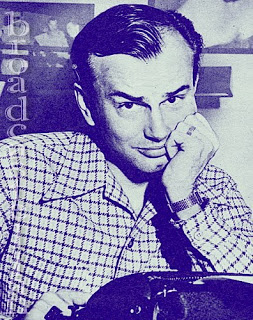
“Frankly, I’m a little worried,” comedian Jack Paar confided in announcer Hy Averback on this day, 17 August, in 1947. He was, after all, merely a “summer replacement,” a “fellow who broadcasts during the hot weather to give the other actors time to count the money they’ve made all winter.” For the past twelve weeks, Paar had been sitting in for his first-namesake, skinflint Jack Benny, and had held warm that cozy place on the summer sun dial quite nicely at that. Still, while the reception had been far from icy, his “brief summer career” was fast coming to an end as radio was “getting ready for the winter again.”
Unintelligible as they might seem to most of today’s readers, there were tell-tale signs: Edgar Bergen “repainting Charlie McCarthy,” Fibber McGee “waxing Harlow Wilcox,” and Phil Harris switching to “antifreeze, with an olive.”
Resigned as he was to his autumnal fate, the soon-to-be displaced replacement did not go gentle into the night; instead, he took it upon himself to find his “winter replacement” by staging a talent contest.
The first applicants auditioning for Paar are a midget sister act. The sisters do not impress Paar much, even though his assessment suggests that he was not quite at home in the non-visual medium. I mean, having bags under his eyes didn’t send Fred Allen packing; nor did being a trifle wooden hurt Charlie McCarthy’s career.
PAAR. Maybe I was listening wrong. Did you say you do card tricks with mice?
ACT 2. Yes. Here. Pick a mouse.
PAAR. [ . . .] Don’t you do any of the conventional magician’s tricks, like, maybe, sawing a woman in half?
ACT 2. Oh, but monsieur, I shall never saw a woman in half again. I was never so humiliated. I was on the stage of the Orpheum Theater, you see . . .
PAAR. You mean, something went wrong with the trick?
ACT 2. Oh, yes. I don’t know how it happened, but I was sawing this woman in half when, all of a sudden, I heard . . . blup, blup, blup, blip . . .
PAAR. Poor Simone Simon.
The third act is somewhat more promising or, at any rate, more familiar. It is, don’t you know, Jack. Benny, that is, “comedian and violin virtuoso.”
“I was the original Jack Armstrong, the All-American Boy,” Benny insists as he lists his spurious radio credentials. “When you were a boy, we didn’t have all of America,” Paar retorts. To prove that, until his season ended some twelve weeks ago, he was “one of the funniest men in radio,” the self-important Benny reads some lines from one of his scripts. So convinced was he of his own genius, that he did not bother to fill in the blanks left by his absentee sidekicks:
Thank you, Don. Well, hello Mary. Phil, you gotta do something about that band. Sing, Dennis. Rochester, answer the door. Yikes. Well, what do you know, it’s Ronnie and Benita. But I think. But I. But. But. But. Bu . . . we’re a little late. So, good night, folks.
Whether boasting Benny looked in on his replacement to give the latter a boost or to let listeners know that the spot was still his, I don’t know; but rarely has a reminder of being replaceable made a comedian on hiatus sound so incomparable.
Meanwhile, just to remind myself that summer ain’t over yet, even though it sure feels like autumn here on the Welsh coast, I booked a trip to visit the old place. Yes, hold your wax, Harlow, beginning next week, I am back in New York. It’s a neat trick, considering that the new place we’ve been doing up still demandss so much of our attention and time. Displacement activity, you say? I should be scratching paint rather than scrape pennies and scram? Aw, go pick (on) a mouse!
Related recording
Jack Paar (17 August 1947)
 Nearly two centuries ago, young Rebecca Sharp marked her entrance into the world by hurling a book out of a coach window. That book, reluctantly gifted to her by the proprietress of Miss Pinkerton’s academy for young ladies, was Johnson’s dictionary, a volume for which Ms. Sharp had little use, given that she was rarely at a loss for words. By the time her story became known, in 1847, words in print had become a rather less precious commodity, especially after the British stamp tax was abolished in 1835, which, in turn, made the emergence of the penny press possible. Publications were becoming more frequent—and decidedly more frivolous.




 I rarely hear from my sister; sometimes, months go by without a word between us. I have not seen her in almost a decade. Like all of my relatives, my sister lives in Germany. I was born there. I am a German citizen; yet I have not been “home” for nearly twenty years. It was back in 1989, a momentous year for what I cannot bring myself to call “my country,” that I decided, without any intention of making a political statement about the promises of a united Deutschland, I would leave and not return in anything other than a coffin. I don’t care where my ashes are scattered; it might as well be on German soil—a posthumous mingling of little matter. This afternoon, my sister sent me one of her infrequent e-missives. I was sitting in the living room and had just been catching up with the conclusion of an old thriller I had fallen asleep over the night before. The message concerned US President Obama’s visit to Buchenwald, the news of which had escaped me.

 Harry Heuser